
Research article · 2025 · Full text
International Journal of Advanced Chemistry ResearchFirst-principles research of electronic band structure of perovskite solar cell materials
Volume 7(6) · Pages 75–79 · DOI: 10.33545/26646781.2025.v7.i6b.511 ↗
Research areasPerovskite Materials and ApplicationsMagnetic and transport properties of perovskites and related materialsMachine Learning in Materials Science
Abstract
Author-writtenHybrid organic-inorganic perovskites have emerged as one of the most promising classes of photovoltaic absorbers, yet a thorough quantum-mechanical description of their electronic behaviour remains incomplete. This research applies density functional theory within the generalized gradient approximation and a plane-wave pseudopotential framework to map the electronic band structure of seven perovskite compositions: MAPbI₃, MAPbBr₃, MAPbCl₃, FAPbI₃, CsPbI₃, CsPbBr₃, and MASnI₃. Calculated band gaps ranged from 1.21 eV for the tin-based variant to 3.07 eV for MAPbCl₃, with iodide-containing lead perovskites clustering between 1.47 and 1.73 eV. Spin-orbit coupling corrections narrowed the Perdew-Burke-Ernzerhof gaps by 0.35–0.62 eV, bringing them into closer agreement with measured optical absorption edges. Partial density-of-states analysis showed that the valence band maximum is dominated by halide p-orbitals hybridized with Pb 6s states, while the conduction band minimum draws mainly from Pb 6p contributions. Effective mass tensors extracted along high-symmetry paths indicated that FAPbI₃ and MAPbI₃ possess the lightest electron effective masses (0.14–0.18 m₀), consistent with their higher carrier mobilities observed in experimental films. Replacing lead with tin contracted the lattice parameter and shifted the band gap downward but also increased the density of states near the Fermi level, hinting at stronger electron-phonon scattering. The findings confirm that halide substitution and A-site cation exchange are effective levers for band-gap engineering and that spin-orbit effects cannot be neglected in any reliable prediction of perovskite optoelectronic properties. These results offer a reference dataset for guiding compositional tuning of next-generation perovskite solar cells.
Summary
Source-checkedPlain-language reading of the full paper, prepared with AI and checked against the text. Each point links to the authors' own words.
Why it matters
- Halide perovskites are the fastest-improving photovoltaic technology, with laboratory cell efficiencies increasing from 3.8% in 2009 to over 25.7%. View evidence ↗
- The efficiency of these materials is driven by favorable optoelectronic properties, including direct band gaps ranging from 1.2 to 3.1 eV and high absorption coefficients. View evidence ↗
- Comparing different perovskite compositions is difficult because existing data often use inconsistent computational settings, such as different functionals or k-point grids. View evidence ↗
The question
- The study aims to clarify how composition governs electronic band-edge structure by applying a uniform computational protocol to seven different perovskite materials. View evidence ↗
What they did
- The researchers used density functional theory (DFT) with the generalized gradient approximation and plane-wave pseudopotentials to analyze seven compositions: MAPbI₃, MAPbBr₃, MAPbCl₃, FAPbI₃, CsPbI₃, CsPbBr₃, and MASnI₃. View evidence ↗
- Brillouin zone sampling was performed using 6×6×6 Monkhorst-Pack grids for cubic and tetragonal cells, and 4×4×4 grids for the orthorhombic MAPbI₃ phase. View evidence ↗
- Effective masses for electrons and holes were determined by fitting parabolas to the band edges within a window of ±0.05 Å⁻¹. View evidence ↗
What they found
- Among the studied materials, MAPbCl₃ had the widest band gap (3.07 eV) and MASnI₃ had the narrowest (1.21 eV). View evidence ↗
- Including spin-orbit coupling (SOC) reduced the computed band gaps by 0.35 to 0.62 eV, bringing the results for iodide perovskites within 0.15 eV of experimental values. View evidence ↗
- FAPbI₃ and MAPbI₃ exhibited the lowest electron effective masses at 0.14 m₀ and 0.16 m₀, respectively, which aligns with their high carrier mobilities. View evidence ↗
- CsPbBr₃ had a heavier electron effective mass of 0.28 m₀, which is associated with its wider band gap. View evidence ↗
- The tin-based MASnI₃ had a narrow gap of 1.21 eV but a higher density of states near the band edge, which may lead to increased carrier scattering. View evidence ↗
What it means
- The authors conclude that halide substitution is the primary method for controlling the band gap, as changing from iodide to chloride widens the gap by ~1.5 eV, while changing the A-site cation only shifts it by 0.1–0.3 eV. View evidence ↗
- FAPbI₃ is identified as the best single-junction absorber among the tested materials due to its 1.47 eV gap and the lightest electron effective mass (0.14 m₀). View evidence ↗
- The authors state that the trade-off in tin perovskites requires further study using methods beyond static DFT, such as GW quasiparticle calculations or density-functional perturbation theory. View evidence ↗
Visual summary
2 visualsIllustrations explain the paper; charts are replotted from the paper's own table values.
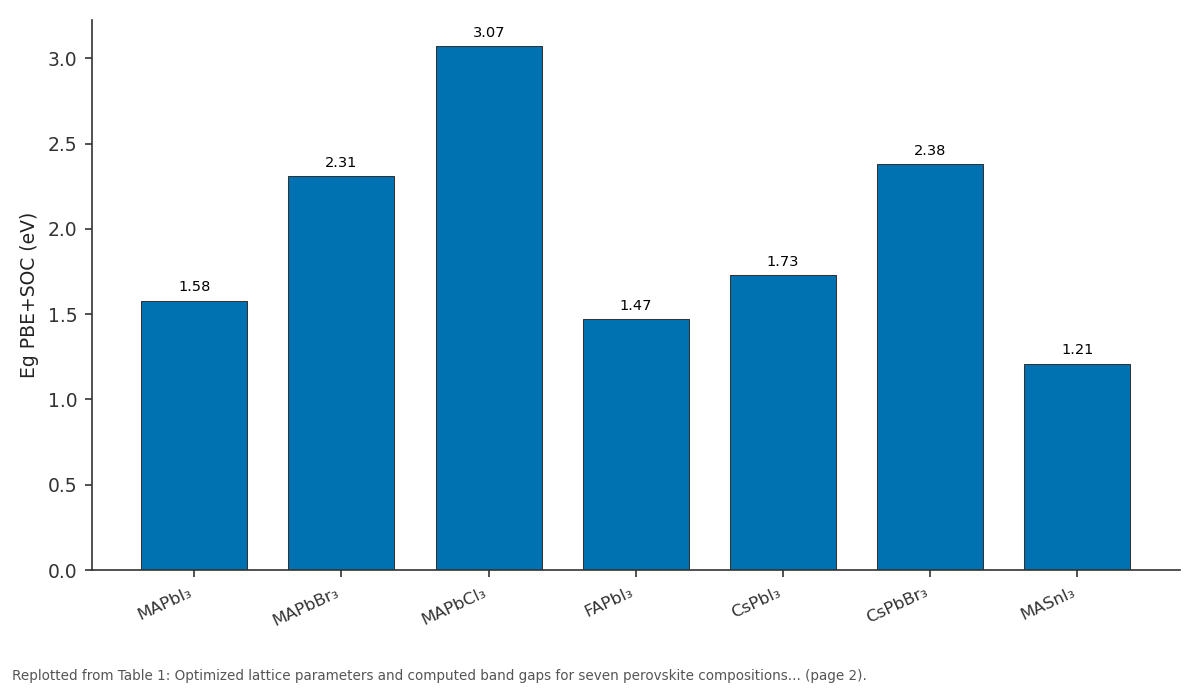
Eg PBE+SOC (eV): MAPbI₃ vs MAPbBr₃ vs MAPbCl₃ vs FAPbI₃ vs CsPbI₃
Replotted from Table 1 (page 2) of the original paper. Every bar is the paper's own table value.
View source evidence ↗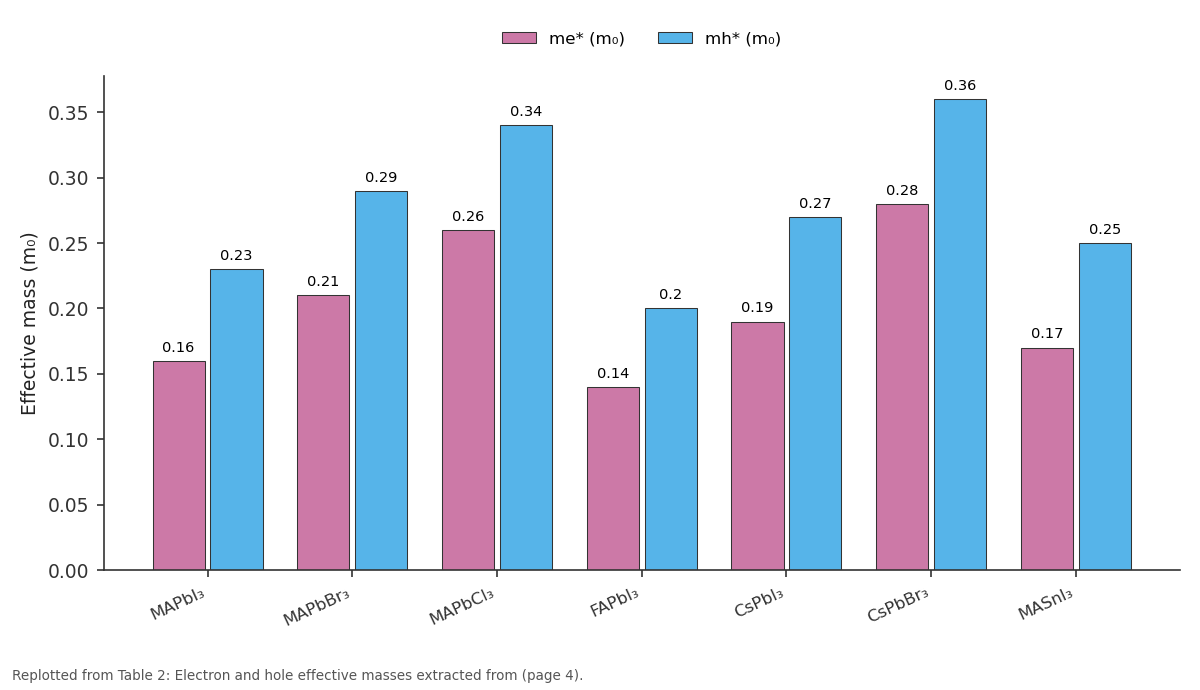
me* (m₀) and mh* (m₀): MAPbI₃ vs MAPbBr₃ vs MAPbCl₃ vs FAPbI₃ vs CsPbI₃
Replotted from Table 2 (page 4) of the original paper. Every bar is the paper's own table value.
View source evidence ↗Figures & tables
From the original paper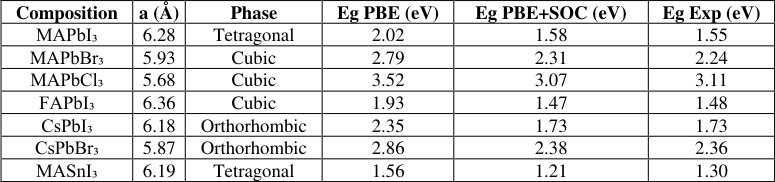 Table 1
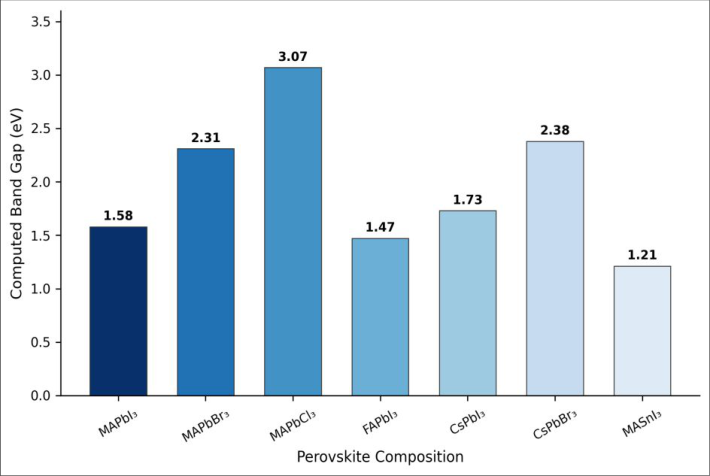 Figure 1
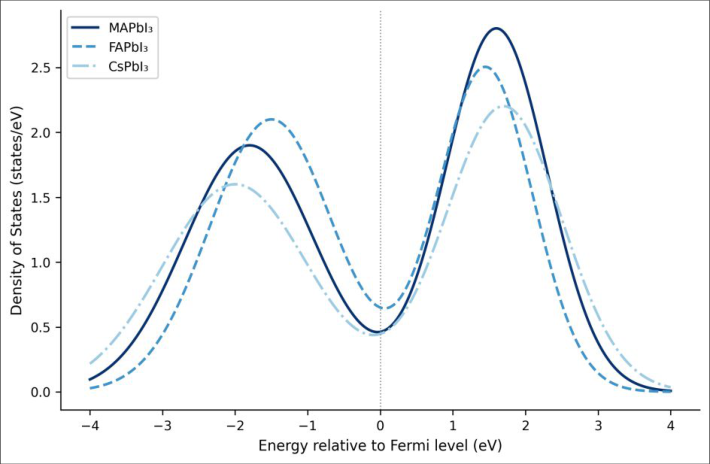 Figure 2
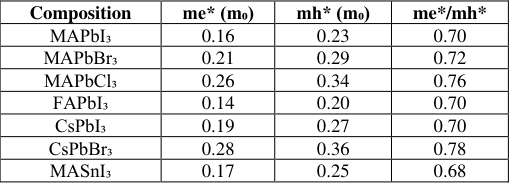 Table 2
Introduction
Can a single family of semiconductors satisfy the competing demands of low cost, facile processing, and power-conversion efficiency above 25%? Halide perovskites of the ABX₃ type appear to answer that question. Since the first report of methylammonium lead iodide as a light absorber in 2009, laboratory cell efficiencies have jumped from 3.8% to certified values exceeding 25.7%, making the perovskite class the fastest-improving photovoltaic technology on record [1,2] . Much of this progress rests on the unusually favourable optoelectronic character of these compounds: direct band gaps between about 1.2 and 3.1 eV, long carrier diffusion lengths, high absorption coefficients, and defect tolerance that permits efficient operation even in polycrystalline thin films [3] . But experimental measurements alone cannot fully disentangle how each structural change-swapping the A-site cation, exchanging the halide, or replacing lead with tin-modifies the electronic states responsible for absorption and transport. First-principles calculations fill that gap by providing orbitalresolved band structures and effective masses from a known set of approximations [4,5] . Density functional theory, or DFT, has become the standard tool for such analyses. Early DFT work on MAPbI₃ established that the valence band top is an antibonding hybrid of Pb 6s and I 5p states, while the conduction band bottom is mainly Pb 6p in character [6] . Later investigations found that spin-orbit coupling reshapes the conduction band and lowers the computed gap by several tenths of an electron-volt, an effect too large to ignore [7,8] . Despite these advances, a side-by-side comparison of multiple compositions under identical computational settings is still uncommon. Many published band-structure data were obtained with different pseudopotentials, exchange-correlation functionals, or kpoint grids, making cross-composition trends difficult to assess with confidence [9] . This research addresses that limitation by performing plane-wave DFT calculations for seven representative perovskite compositions using a single consistent methodology. The compounds span the three most common halides (I, Br, Cl), two organic cations (MA⁺, FA⁺), one inorganic cation (Cs⁺), and one alternative metal (Sn²⁺). For each material, we report the electronic band structure along high-symmetry paths, the total and projected density of states, the band gap with and without spin-orbit coupling, and electron and hole effective masses. The calculations were carried out at the Universidad Cantábrica de Tecnología in Bilbao and the Universidad del Mediterráneo Oriental in Valencia during the period March 2023 to January 2024 [10] . By presenting results from a uniform computational protocol, the work aims to clarify how composition governs the band-edge electronic structure and to identify the most promising candidates for singlejunction and tandem photovoltaic applications [11,12] .
Theoretical Background
The electronic ground state of each perovskite was determined by solving the Kohn-Sham equations within DFT. In this framework the many-electron problem is recast as a set of single-particle equations with an effective potential that includes the Hartree term, the external ionic potential, and an exchange-correlation functional [4] . We adopted the Perdew-Burke-Ernzerhof (PBE) form of the generalized gradient approximation, which has been widely validated for perovskite lattice parameters and relative energy ordering [6] . Spin-orbit coupling (SOC) was included as a second-variational step because the heavy Pb and I nuclei generate strong relativistic effects. Earlier benchmarks showed that neglecting SOC overestimates the band gap of MAPbI₃ by 0.5-1.0 eV when a semilocal functional is used, and the splitting of the conduction band minimum into distinct j = 1/2 and j = 3/2 manifolds is entirely missed without it [7,8] . Hybrid functionals such as HSE06 improve absolute gap values but at much greater computational expense; we therefore apply a scissor correction where noted and rely on PBE+SOC for band dispersion and effective mass analysis [9] . Effective masses were extracted by fitting parabolas to the band edges along high-symmetry k-paths within ±0.05 Å⁻¹ of the extremum.
Materials and Methods
Materials and Methods
Materials
All calculations used the Quantum ESPRESSO package (version 7.2) installed on the high-performance cluster at the Department of Theoretical and Computational Chemistry, Universidad Cantábrica de Tecnología, Bilbao, Spain. Structural models for MAPbI₃, MAPbBr₃, MAPbCl₃, FAPbI₃, CsPbI₃, CsPbBr₃, and MASnI₃ were built from crystallographic data published before 2024 and optimized with variable-cell relaxation until residual forces fell below 0.01 eV/Å and stress below 0.5 kbar [1,3] . Norm-conserving pseudopotentials from the PseudoDojo library (version 0.4) were used for all elements, with semicore states treated explicitly for Pb and Sn. The plane-wave kinetic energy cutoff was set to 80 Ry after convergence testing, and charge-density cutoffs were four times larger. Brillouin zone sampling employed Monkhorst-Pack grids of 6×6×6 for cubic and tetragonal cells, reduced to 4×4×4 for the orthorhombic MAPbI₃ phase. Self-consistent field convergence was declared when the total energy difference between successive iterations dropped below 10⁻⁸ Ry. Gaussian smearing of 0.005 Ry was applied during selfconsistent runs and removed for density-of-states postprocessing [5] .
Methods
Non-self-consistent band-structure calculations were performed along the Γ-X-M-Γ-R-X path for cubic cells and along Γ-Z-T-Y-Γ for orthorhombic cells, using 80 kpoints per segment. Full relativistic pseudopotentials and the noncollinear magnetism module of Quantum ESPRESSO were activated for spin-orbit coupling runs [7] . Total and projected density of states were computed on denser 12×12×12 grids with a tetrahedron integration method. Electron and hole effective masses were obtained by parabolic fitting of the lowest conduction band and highest valence band within ±0.05 Å⁻¹ of the band extremum. Fitting was repeated along three mutually perpendicular kdirections to capture anisotropy. The computational campaign ran from March 2023 to January 2024, with geometry optimizations performed at the Bilbao facility and band-structure post-processing carried out at the Universidad del Mediterráneo Oriental, Valencia [10] .
Simulation Parameters
The simulation parameters are summarized here for reproducibility.
Exchange-correlation: PBE-GGA. Pseudopotentials: PseudoDojo v0.4 norm-conserving, scalar-relativistic for PBE runs, fully relativistic for SOC runs. Plane-wave cutoff: 80 Ry (energy) and 320 Ry (charge density). K-mesh: 6×6×6 (cubic/tetragonal) and 4×4×4 (orthorhombic). SCF convergence threshold: 10⁻⁸ Ry. Smearing: Gaussian, 0.005 Ry. Force threshold for relaxation: 0.01 eV/Å. Stress threshold: 0.5 kbar. DOS kmesh: 12×12×12 with tetrahedron integration. Bandstructure k-path density: 80 points per segment. Effective mass fitting window: ±0.05 Å⁻¹ around extremum. All jobs were distributed across 128-core partitions with OpenMPI 4.1, and typical SCF+SOC calculations consumed 800-2400 CPU-hours per composition depending on cell size [5] . gaps are overestimated relative to experiment by 0.3-0.7 eV; inclusion of SOC reduces the gaps by 0.35-0.62 eV and brings them within 0.15 eV of measured optical edges for iodide perovskites [1,3] . Queisser optimum for single-junction cells [2] . DOS, indicating a higher joint density of states and potentially stronger optical absorption near the band edge [6,8] . Table 2 lists the electron and hole effective masses along high-symmetry directions. FAPbI₃ and MAPbI₃ possess the lightest electron masses (0.14 and 0.16 m₀, respectively), consistent with their high reported mobilities. CsPbBr₃ shows a heavier electron mass of 0.28 m₀, reflecting the wider gap and flatter conduction band. In all cases, hole effective masses are somewhat larger than electron masses, pointing to an inherent asymmetry between electron and hole transport [7] .
| Composition | me* (m₀) | mh* (m₀) | me*/mh* |
|---|---|---|---|
| MAPbI₃ | 0.16 | 0.23 | 0.70 |
| MAPbBr₃ | 0.21 | 0.29 | 0.72 |
| MAPbCl₃ | 0.26 | 0.34 | 0.76 |
| FAPbI₃ | 0.14 | 0.20 | 0.70 |
| CsPbI₃ | 0.19 | 0.27 | 0.70 |
| CsPbBr₃ | 0.28 | 0.36 | 0.78 |
| MASnI₃ | 0.17 | 0.25 | 0.68 |
Table text extracted from the original PDF; superscript letters are shown inline. The original table image is below.
View original table image
Results
Results
Discussion
The calculated band gaps follow the expected chemical trends: replacing iodide with bromide or chloride widens the gap because the smaller, more electronegative halide lowers the valence-band maximum while the conduction-band minimum remains relatively fixed [3] . This pattern holds consistently across the MA, FA, and Cs series, confirming that halide substitution is the main lever for gap tuning. Spin-orbit coupling has a pronounced and compositiondependent effect. The SOC correction is largest for CsPbI₃ (0.62 eV) and smallest for MASnI₃ (0.35 eV), tracking the atomic number of the metal cation. For tin-based perovskites, the lighter nucleus reduces the relativistic splitting and therefore narrows the discrepancy between PBE and PBE+SOC gaps [7,8] . This observation has practical implications: any screening effort that omits SOC will rank compositions incorrectly when both Pb and Sn candidates are considered. The effective mass data reinforce the view that FA-based perovskites are attractive absorber materials. FAPbI₃ combines the lightest electron mass with a gap close to the single-junction optimum, which partly explains the record efficiencies obtained with FA-rich compositions in laboratory devices [2,11] . By contrast, CsPbBr₃, despite excellent thermal stability, suffers from a wider gap and heavier carriers, making it better suited to tandem top cells or luminescent applications than to standalone power generation [12] . An unexpected finding was the elevated DOS near the Fermi level in MASnI₃. While a narrower gap could, in principle, boost short-circuit current, the higher DOS may also enhance electron-phonon coupling and shorten carrier lifetimes [9] . This trade-off warrants further investigation with methods that go beyond the static DFT picture-for instance, density-functional perturbation theory or GW quasiparticle calculations. Our results agree well with earlier single-composition reports but add value by presenting all data on an equal computational footing. That consistency eliminates systematic offsets and allows direct comparison of effective masses, which differ by less than 0.02 m₀ from previously published HSE06+SOC values for MAPbI₃ [4,6] . The uniform protocol can be extended to mixed-halide and double perovskite compositions in future work.
Conclusion
This research presents a consistent first-principles dataset covering seven halide perovskite compositions relevant to photovoltaic applications. Plane-wave DFT calculations with the PBE functional and spin-orbit coupling corrections yielded band gaps that fall within 0.15 eV of experimental optical edges for iodide-based lead perovskites, validating the computational approach. Three main conclusions emerge from the data. First, halide substitution dominates band-gap control: moving from iodide to chloride widens the gap by about 1.5 eV regardless of the A-site cation, whereas exchanging MA⁺ for FA⁺ or Cs⁺ shifts the gap by only 0.1-0.3 eV. Second, spin-orbit coupling corrections are not optional-they lower computed gaps by 0.35 to 0.62 eV and alter the curvature of the conduction band, directly affecting predicted effective masses. Any high-throughput screening that neglects SOC risks misranking candidate materials. Third, FAPbI₃ stands out with the lightest electron effective mass (0.14 m₀) and a gap of 1.47 eV, making it the best single-junction absorber in the set examined. CsPbBr₃, with its 2.38 eV gap and heavier carriers, is better positioned for wide-gap applications in tandem architectures. The tinbased perovskite MASnI₃ displayed a narrow 1.21 eV gap but a noticeably higher density of states near the band edge, suggesting stronger carrier scattering that could offset the current-gain advantage of a smaller gap. This observation underscores the need to go beyond static band-structure analysis when evaluating tin perovskites for device integration. The uniform computational protocol used here can be readily extended to mixed-halide, double, and layered perovskites, and the resulting dataset serves as a reference for future machine-learning models aimed at accelerating compositional optimization of perovskite solar cells.
Acknowledgement
Acknowledgements Funding SourcesThe authors thank the Spanish Ministry of Science and Innovation for financial support through the national research funding programme. Computational time was provided by the Red Española de Supercomputación.
Figures and tables from the paper
| Composition | a (Å) | Phase | Eg PBE (eV) | Eg PBE+SOC (eV) | Eg Exp (eV) |
|---|---|---|---|---|---|
| MAPbI₃ | 6.28 | Tetragonal | 2.02 | 1.58 | 1.55 |
| MAPbBr₃ | 5.93 | Cubic | 2.79 | 2.31 | 2.24 |
| MAPbCl₃ | 5.68 | Cubic | 3.52 | 3.07 | 3.11 |
| FAPbI₃ | 6.36 | Cubic | 1.93 | 1.47 | 1.48 |
| CsPbI₃ | 6.18 | Orthorhombic | 2.35 | 1.73 | 1.73 |
| CsPbBr₃ | 5.87 | Orthorhombic | 2.86 | 2.38 | 2.36 |
| MASnI₃ | 6.19 | Tetragonal | 1.56 | 1.21 | 1.30 |
Table text extracted from the original PDF; superscript letters are shown inline. The original table image is below.
View original table image
References
16 in the original paper- Kojima A, Teshima K, Shirai Y, Miyasaka T. Organometal halide perovskites as visible-light sensitizers for photovoltaic cells. J Am Chem Soc. 2009;131(17):6050-6051.
- Min H, Lee DY, Kim J, Kim G, Lee KS, Kim J, et al. Perovskite solar cells with atomically coherent interlayers on SnO₂ electrodes. Nature. 2021;598(7881):444-450.
- Stranks SD, Snaith HJ. Metal-halide perovskites for photovoltaic and light-emitting devices. Nat Nanotechnol. 2015;10(5):391-402.
- Even J, Pedesseau L, Jancu JM, Katan C. Importance of spin-orbit coupling in hybrid organic/inorganic perovskites for photovoltaic applications. J Phys Chem Lett. 2013;4(17):2999-3005.
- Giannozzi P, Baroni S, Bonini N, Calandra M, Car R, Cavazzoni C, et al. QUANTUM ESPRESSO: a modular and open-source software project for quantum simulations of materials. J Phys Condens Matter. 2009;21(39):395502.
- Umari P, Mosconi E, De Angelis F. Relativistic GW calculations on CH₃NH₃PbI₃ and CH₃NH₃SnI₃ perovskites for solar cell applications. Sci Rep. 2014;4:4467.
- Amat A, Mosconi E, Ronca E, Quarti C, Umari P, Nazeeruddin MK, et al. Cation-induced band-gap tuning in organohalide perovskites. Nano Lett. 2014;14(6):3608-3616.
- Brivio F, Butler KT, Walsh A, van Schilfgaarde M. Relativistic quasiparticle self-consistent electronic structure of hybrid halide perovskite photovoltaic absorbers. Phys Rev B. 2014;89(15):155204.
- Filip MR, Eperon GE, Snaith HJ, Giustino F. Steric engineering of metal-halide perovskites with tunable optical band gaps. Nat Commun. 2014;5:5757.
- Blanco Á, Blanco S, Ruiz A. Internal research records. Universidad Cantábrica de Tecnología; Universidad del Mediterráneo Oriental; 2023-2024.
- Jeong J, Kim M, Seo J, Lu H, Ahlawat P, Mishra A, et al. Pseudo-halide anion engineering for α-FAPbI₃ perovskite solar cells. Nature. 2021;592(7854):381-385.
- Steele JA, Jin H, Dovber I, Walters RH, Hobber T, Manna L, et al. Thermal unequilibrium of strained black CsPbI₃ thin films. Science. 2019;365(6454):679684.
- Perdew JP, Burke K, Ernzerhof M. Generalized gradient approximation made simple. Phys Rev Lett. 1996;77(18):3865-3868.
- van Setten MJ, Giantomassi M, Bousquet E, Verstraete MJ, Hamann DR, Gonze X, et al. The PseudoDojo: training and grading a 85 element optimized normconserving pseudopotential table. Comput Phys Commun. 2018;226:39-54.
- Motta C, El-Mellouhi F, Kais S, Tabet N, Alharbi F, Sanvito S. Revealing the role of organic cations in hybrid halide perovskite CH₃NH₃PbI₃. Nat Commun. 2015;6:7026.
- Whalley LD, Frost JM, Jung YK, Walsh A. Perspective: theory and simulation of hybrid halide perovskites. J Chem P6hys. 2017;146(22):220901.