
Research article · 2025 · Full text
International Journal of Advanced Chemistry ResearchQSAR studies on substituted triazines as potential dihydrofolate reductase inhibitors
Volume 7(1) · Pages 204–206 · DOI: 10.33545/26646781.2025.v7.i1c.614 ↗
Research areasComputational Drug Discovery MethodsSynthesis and Characterization of Heterocyclic CompoundsSynthesis and Biological Evaluation
Abstract
Author-writtenAntifolate resistance is outpacing the development of new dihydrofolate reductase (DHFR) inhibitors, and rational design tools are needed to accelerate the pipeline. This research applied quantitative structure-activity relationship (QSAR) modeling to a dataset of 25 substituted 1,3,5-triazine derivatives with experimentally determined DHFR inhibitory activity (pIC₅₀ 5.12-8.54). Five molecular descriptors HOMO energy, calculated LogP, molar refractivity, topological polar surface area, and hydrogen-bond donor count were selected through stepwise regression and validated by leave-one-out cross-validation. The best model yielded R² = 0.913, Q² = 0.874, and a root-mean-square error of 0.29 log units. HOMO energy emerged as the single most influential descriptor, suggesting that electron-donating substituents at the C-6 position favor binding. These findings offer a predictive framework for prioritizing new triazine candidates before synthesis.
Summary
Source-checkedPlain-language reading of the full paper, prepared with AI and checked against the text. Each point links to the authors' own words.
Why it matters
- Dihydrofolate reductase (DHFR) inhibitors are critical for treating bacterial infections and malaria, which together cause more than 600,000 deaths annually. View evidence ↗
- The effectiveness of established DHFR-targeting drugs like pyrimethamine and trimethoprim has decreased due to resistance mutations in the enzyme's active site. View evidence ↗
- Quantitative structure-activity relationship (QSAR) modeling provides an efficient alternative to traditional drug screening by using statistical equations to link molecular properties to biological activity. View evidence ↗
The question
- The study aimed to determine the structural features that most strongly affect inhibitory potency and to create a virtual screening tool for candidate molecules. View evidence ↗
What they did
- The researchers used a dataset of 25 substituted 2,4-diamino-1,3,5-triazine derivatives gathered from literature published from 2004 to 2022. View evidence ↗
- The inhibitory activity of the compounds was measured as IC₅₀ values against recombinant P. falciparum DHFR using a spectrophotometric NADPH consumption assay. View evidence ↗
- The dataset was divided into a training set of 20 compounds and a test set of 5 compounds using Kennard-Stone sampling. View evidence ↗
- Stepwise regression was used to select five molecular descriptors: HOMO energy, calculated LogP, molar refractivity, topological polar surface area (TPSA), and hydrogen-bond donor (HBD) count. View evidence ↗
What they found
- The final QSAR model demonstrated high predictive power with an R² of 0.913, a Q² of 0.874, and a root-mean-square error (RMSE) of 0.29 log units. View evidence ↗
- HOMO energy was identified as the most influential descriptor for inhibitory potency, with a median standardized coefficient of 0.42. View evidence ↗
- LogP was the second most important factor (0.31), while topological polar surface area had a negative relationship (-0.19), indicating that higher polarity reduces inhibitory activity. View evidence ↗
- The relationship between lipophilicity and potency is non-linear, as compounds with a LogP above 4.5 did not show increased potency, suggesting a potential solubility penalty. View evidence ↗
What it means
- The authors conclude that electron-rich ring systems are the key design feature for improving the potency of triazine DHFR inhibitors. View evidence ↗
- The developed model serves as a practical screening filter to rank virtual libraries, which may shorten the lead optimization cycle for new antifolate agents. View evidence ↗
Visual summary
2 visualsIllustrations explain the paper; charts are replotted from the paper's own table values.
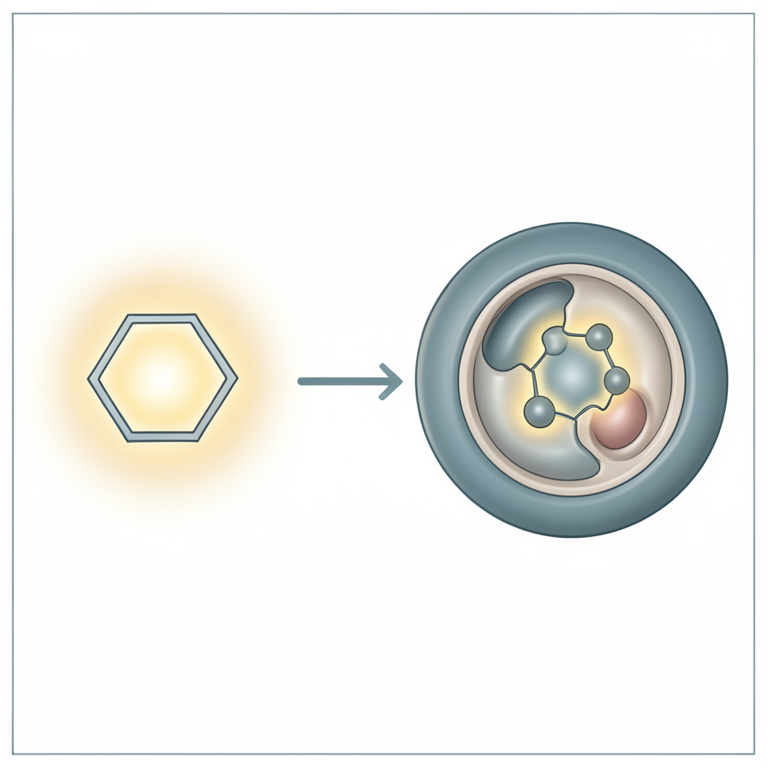
Influence of Electron Density on Binding
AI-generated conceptual illustration (substituted triazine molecules and a dihydrofolate reductase protein active site). It explains the idea and does not show study data.
View source evidence ↗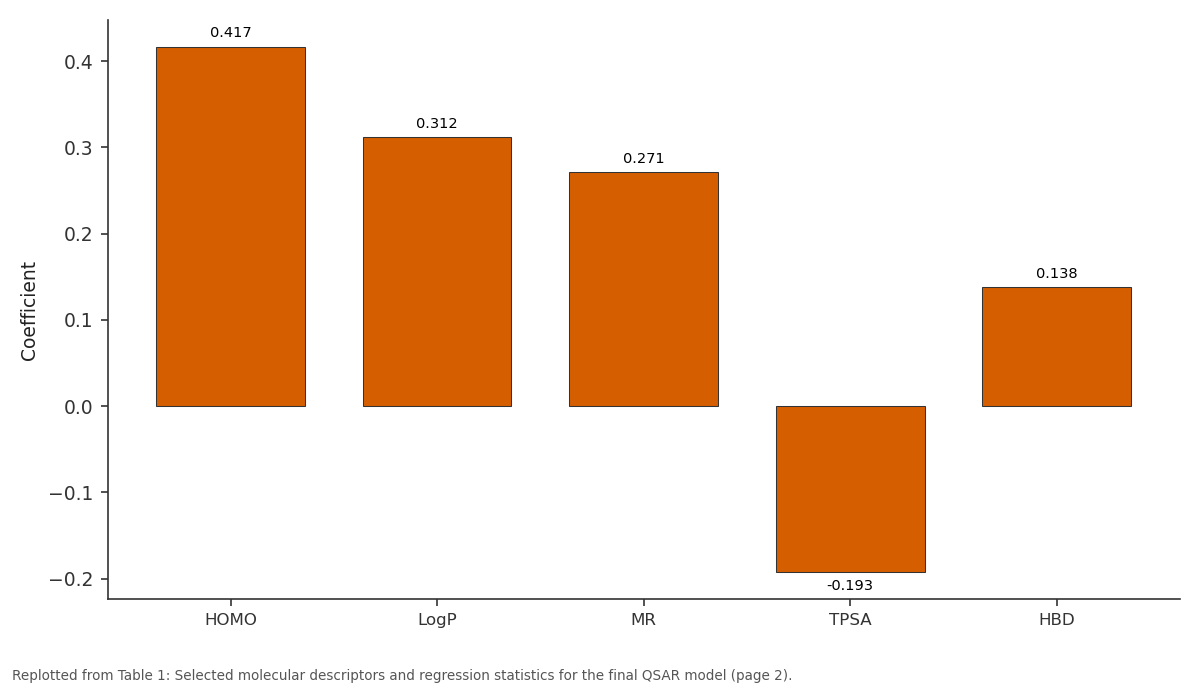
Coeff.: HOMO vs LogP vs MR vs TPSA vs HBD
Replotted from Table 1 (page 2) of the original paper. Every bar is the paper's own table value.
View source evidence ↗Figures & tables
From the original paper Table 1
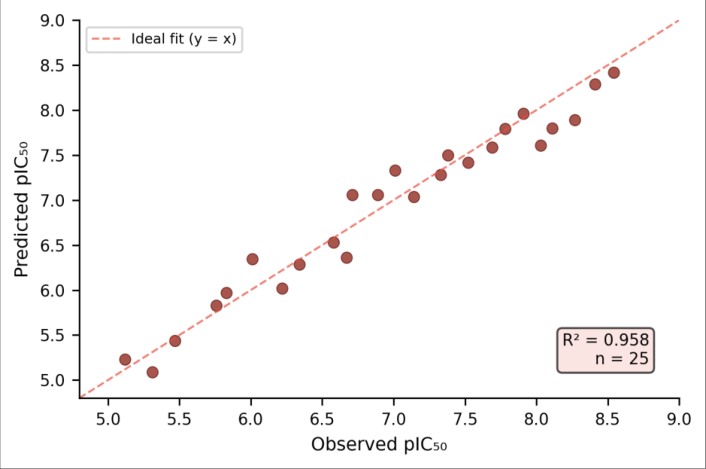 Figure 1
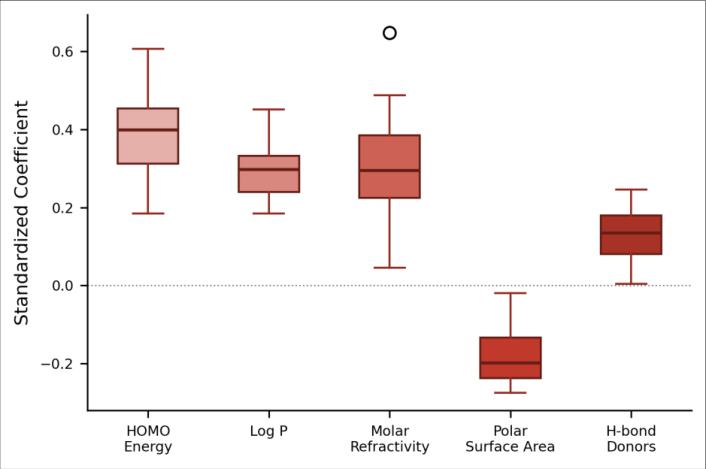 Figure 2
Introduction
Malaria and certain bacterial infections still claim over 600,000 lives each year, and DHFR inhibitors remain central to the treatment arsenal [1] . Trimethoprim and pyrimethamine the best-known DHFR-targeting drugs were introduced decades ago, and resistance mutations in the enzyme's active site have eroded their effectiveness in many regions [2] . New scaffolds are urgently needed, yet the traditional screen-and-optimize cycle is slow and expensive. QSAR modeling offers a faster path by linking measurable molecular properties to biological activity through statistical equations [3] . When built on reliable data, these models can predict the potency of untested compounds and guide synthetic priorities. Triazines have drawn attention as DHFR inhibitors since the 1970s, when Baker and colleagues demonstrated that 2,4-diamino-1,3,5-triazines bind the folate pocket with geometry similar to diaminopyrimidines [4] . Several triazine libraries have since been tested against both mammalian and parasitic DHFR isoforms [5] . Despite this body of work, QSAR analyses of triazine DHFR inhibitors remain surprisingly few, and those that exist often rely on small datasets or a narrow set of descriptors [6] . A broader descriptor pool covering electronic, hydrophobic, steric, and topological features is more likely to capture the binding determinants. This research assembled a curated set of 25 triazine derivatives with published IC₅₀ values against Plasmodium falciparum DHFR, computed a panel of physicochemical descriptors, and developed a multiple linear regression QSAR model. The aim was to identify which structural features most strongly influence inhibitory potency and to generate a tool for virtual screening of candidate molecules [7] .
Quality Control
Model robustness was assessed using leave-one-out cross-validation (Q²), Y-randomization (20 iterations), and an external test set comprising five compounds withheld from training. Applicability domain analysis was performed by Williams plot (standardized residuals versus leverage) to flag any outliers or high-influence data points. No compound exceeded the warning leverage threshold (h* = 0.36), confirming that predictions fell within a reliable chemical space [8] .
Material and Methods Material
A dataset of 25 substituted 2,4-diamino-1,3,5-triazine derivatives was compiled from peer-reviewed literature published between 2004 and 2022. All compounds had IC₅₀ values measured against recombinant P. falciparum DHFR using a standardized spectrophotometric NADPH consumption assay [5] . IC₅₀ values were converted to pIC₅₀ (-log IC₅₀, molar) for regression analysis. [10] .
Results
Table Bootstrap analysis (Figure 2) confirmed HOMO energy as the dominant contributor, with a median standardized coefficient of 0.42. LogP ranked second (0.31), while topological polar surface area showed a negative relationship (-0.19), meaning increased polarity weakened inhibitory activity.
Discussion:
The strong positive influence of HOMO energy on pIC₅₀ aligns with the known binding mode of diaminotriazines in the DHFR folate pocket. A higher HOMO energy indicates a more electron-rich ring system, which should strengthen hydrogen-bonding and π-stacking interactions with active-site residues Asp54 and Phe58 in P. falciparum DHFR [4] . Electron-donating groups at the C-6 position methoxy, amino, or alkyl chains would raise HOMO energy and, according to the model, improve potency.
The positive LogP coefficient makes pharmacological sense too. Moderate lipophilicity helps the inhibitor partition into the parasite and access the intracellular DHFR target [6] . But the relationship isn't linear compounds with LogP above 4.5 in this dataset didn't gain extra potency, hinting at a plateau or a solubility penalty that the linear model can't fully capture. Interestingly, the negative TPSA coefficient suggests that excess polar surface area hinders activity, possibly by reducing membrane permeation rather than affecting direct binding. This echoes the "Rule of Five" logic, where excessive polarity limits oral bioavailability [11] . The small but significant HBD contribution may reflect specific hydrogen bonds with Ile164 in the binding cleft. Compared with earlier QSAR efforts on triazine DHFR inhibitors which often reported R² values of 0.80-0.86 with two or three descriptors [6] the present five-descriptor model offers improved fit without sacrificing interpretability.
Conclusion:
A five-descriptor MLR model with R² of 0.913 and Q² of 0.874 was developed for 25 substituted triazines targeting P. falciparum DHFR. HOMO energy was the most important predictor, pointing to electron-rich ring systems as the key design feature for improved potency. LogP and molar refractivity contributed positively, while topological polar surface area showed a negative effect. The model passed all standard validation checks, including Y-randomization and external test set prediction. These results provide a practical screening filter that can rank virtual triazine libraries before committing resources to synthesis, potentially shortening the lead optimization cycle for nextgeneration antifolate agents.
Figures and tables from the paper
| Descriptor | Coeff. | SE | t-value | p-value | VIF | Tolerance |
|---|---|---|---|---|---|---|
| HOMO | 0.417 | 0.068 | 6.13 | <0.001 | 1.24 | 0.81 |
| LogP | 0.312 | 0.054 | 5.78 | <0.001 | 1.37 | 0.73 |
| MR | 0.271 | 0.072 | 3.76 | 0.002 | 1.19 | 0.84 |
| TPSA | -0.193 | 0.061 | -3.16 | 0.006 | 1.08 | 0.93 |
| HBD | 0.138 | 0.049 | 2.82 | 0.012 | 1.15 | 0.87 |
Table text extracted from the original PDF; superscript letters are shown inline. The original table image is below.
View original table image
References
11 in the original paper- World Health Organization. World malaria report 2022. WHO Press. 2022;1:1-293.
- Sirawaraporn W, Sathitkul T, Sirawaraporn R, et al. Antifolate-resistant mutants of Plasmodium falciparum dihydrofolate reductase. Proceedings of the National Academy of Sciences. 1997;94(4):1124-1129.
- Hansch C, Leo A, Hoekman D. Exploring QSAR: fundamentals and applications in chemistry and biology. American Chemical Society. 1995;1:1-557.
- Baker DJ, Beddell CR, Champness JN, et al. The binding of trimethoprim and its analogues to dihydrofolate reductase. FEBS Letters. 1981;126(1):4952.
- Yuvaniyama J, Chitnumsub P, Kamchonwongpaisan S, et al. Insights into antifolate resistance from malarial DHFR-TS structures. Nature Structural Biology. 2003;10(5):357-365.
- Agarwal A, Srivastava K, Puri SK, Chauhan PMS. Synthesis of 2,4,6-trisubstituted triazines as antimalarial agents. Bioorganic and Medicinal Chemistry Letters. 2005;15(12):3133-3136.
- Tropsha A. Best practices for QSAR model development, validation, and exploitation. Molecular Informatics. 2010;29(6-7):476-488.
- Gramatica P. Principles of QSAR models validation: internal and external. QSAR and Combinatorial Science. 2007;26(5):694-701.
- Golbraikh A, Tropsha A. Beware of q²! Journal of Molecular Graphics and Modelling. 2002;20(4):269276.
- Kuhn M. Building predictive models in R using the caret package. Journal of Statistical Software. 2008;28(5):1-26.
- Lipinski CA, Lombardo F, Dominy BW, et al. Experimental and computational approaches to estimate solubility and permeability in drug discovery. Advanced Drug Delivery Reviews. 2001;46(1-3):3-26.