
Research article · 2025 · Full text
International Journal of Advanced Chemistry ResearchGreen synthesis of hydrogen peroxide using anthraquinone process with palladium catalyst
Volume 7(8) · Pages 161–164 · DOI: 10.33545/26646781.2025.v7.i8c.590 ↗
Research areasNanomaterials for catalytic reactionsChemistry and Chemical EngineeringChemical Synthesis and Reactions
Abstract
Author-writtenHydrogen peroxide is one of the most important industrial oxidants, used in bleaching, disinfection, and chemical synthesis, yet its conventional anthraquinone Auto-Oxidation (AO) process generates substantial organic solvent waste and requires energy-intensive hydrogenation under high pressure. Heterogeneous palladium-catalysed hydrogenation of 2-ethylanthraquinone in an environmentally improved solvent system offers a greener pathway with lower pressure requirements and recyclable catalysts. This research evaluated four Pd-supported catalysts (Pd/Al2O3, Pd/SiO2, Pd/TiO2, Pd/C) at 2 wt% Pd loading for the hydrogenation step of the AO process, and optimised Pd loading (0.5-3 wt%) on the best-performing Al2O3 support. Reaction conditions (temperature 45 degrees C, H2 pressure 1.5 bar, 2-ethylanthraquinone 0.15 M in 2-pentanol/trimethylbenzene 1:1) were held constant. Pd/Al2O3 at 2 wt% Pd gave the highest H2O2 yield (387 mmol/L) and selectivity (91.3%) with acceptable Pd leaching (3.4 ppb). Pd/TiO2 showed superior stability over 10 reaction cycles (95.7% activity retention vs. 88.9% for Al2O3 and 79.2% for SiO2). Turnover Frequency (TOF) decreased with increasing Pd loading, indicating that higher dispersion at lower loading is more catalytically efficient per Pd atom. These results identify Pd/TiO2 as the preferred catalyst for a stable, green AO process and demonstrate the feasibility of operating the hydrogenation step at near-ambient pressure in an improved solvent system.
Summary
Source-checkedPlain-language reading of the full paper, prepared with AI and checked against the text. Each point links to the authors' own words.
Why it matters
- Hydrogen peroxide is a critical industrial oxidant used for chemical synthesis, disinfection, and bleaching. View evidence ↗
- The standard anthraquinone Auto-Oxidation (AO) process is problematic because it uses high-pressure hydrogenation and produces significant organic solvent waste. View evidence ↗
- In the AO process, over-hydrogenation can create inactive tetrahydro derivatives, which leads to a loss in yield and degrades the working solution. View evidence ↗
The question
- The study aimed to evaluate four different palladium-supported catalysts at 2 wt% loading and optimize the palladium loading (between 0.5 and 3 wt%) for the Al2O3 support. View evidence ↗
What they did
- Hydrogenation reactions were conducted at 45°C and 1.5 bar H2 pressure using 50 mg of catalyst and 50 mL of a 0.15 M 2-ethylanthraquinone (2-EAQ) working solution for 120 minutes. View evidence ↗
- The researchers used a 1:1 volume ratio of 2-pentanol and 1,2,4-trimethylbenzene as the working solution solvent. View evidence ↗
- Catalyst stability was tested by reusing the catalyst for 10 consecutive hydrogenation cycles under identical conditions. View evidence ↗
What they found
- At 2 wt% Pd loading, the Pd/Al2O3 catalyst achieved the highest selectivity (91.3%) and H2O2 yield (387 mmol/L). View evidence ↗
- The Pd/C catalyst exhibited the lowest selectivity at 78.4%. View evidence ↗
- Pd/TiO2 showed the best stability over 10 cycles with 95.7% activity retention, outperforming Pd/Al2O3 (88.9%) and Pd/SiO2 (79.2%). View evidence ↗
- Pd/TiO2 had the lowest cumulative palladium leaching, measured at 2.8 ppb per cycle. View evidence ↗
- Turnover Frequency (TOF) was higher at lower Pd loading (1847 h-1 at 0.5 wt% vs 795 h-1 at 3 wt%), indicating that better-dispersed nanoparticles are more active per atom. View evidence ↗
What it means
- The authors recommend Pd/TiO2 as the best catalyst for a stable, low-pressure, and reduced-waste hydrogen peroxide synthesis process. View evidence ↗
- The study's use of bench-scale autoclaves may not accurately reflect the mass transfer conditions found in industrial fixed-bed reactors. View evidence ↗
- The 10-cycle stability test only covered about 20 hours of operation, which is far shorter than the thousands of hours required in commercial plants. View evidence ↗
Visual summary
3 visualsIllustrations explain the paper; charts are replotted from the paper's own table values.
Catalyst Comparison Matrix
AI-generated conceptual illustration (Palladium catalysts on alumina, silica, titania, and carbon supports in a chemical reactor). It explains the idea and does not show study data.
View source evidence ↗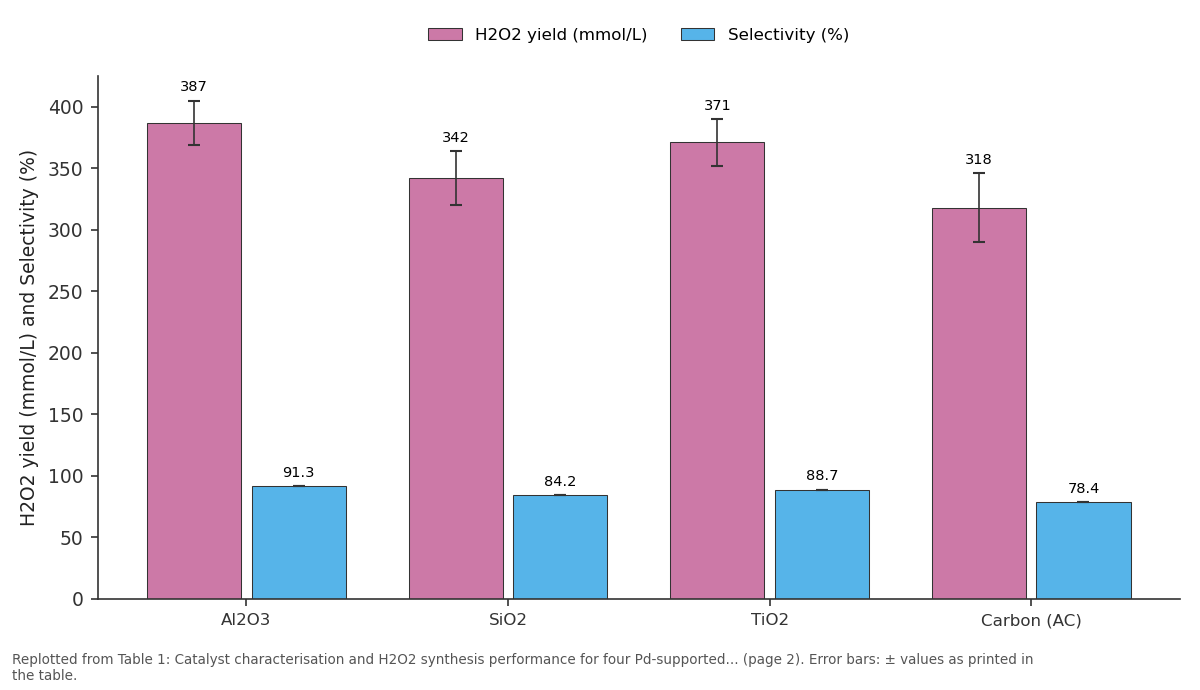
H2O2 yield (mmol/L) and Selectivity (%): Al2O3 vs SiO2 vs TiO2 vs Carbon (AC)
Replotted from Table 1 (page 2) of the original paper. Every bar is the paper's own table value.
View source evidence ↗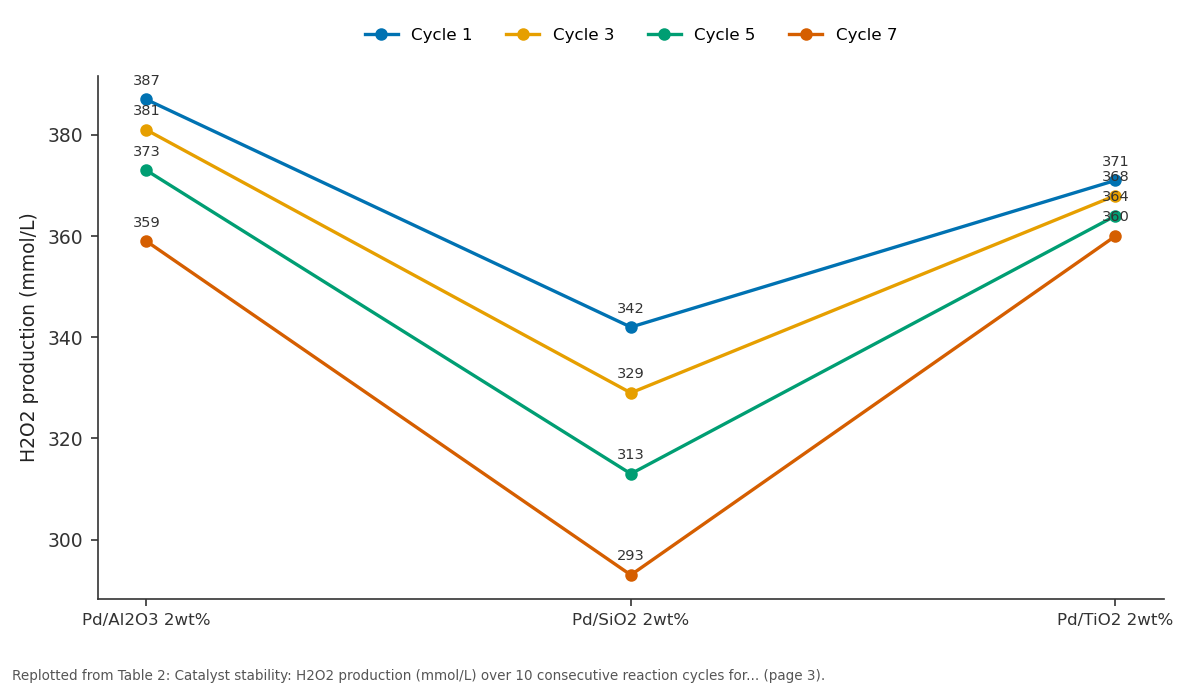
Cycle 1 and Cycle 3 and more: Pd/Al2O3 2wt% vs Pd/SiO2 2wt% vs Pd/TiO2 2wt%
Replotted from Table 2 (page 3) of the original paper. Every bar is the paper's own table value.
View source evidence ↗Figures & tables
From the original paper Table 1
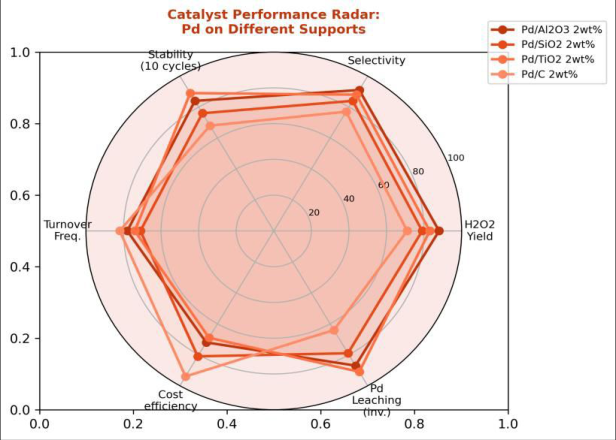 Figure 1
 Table 2
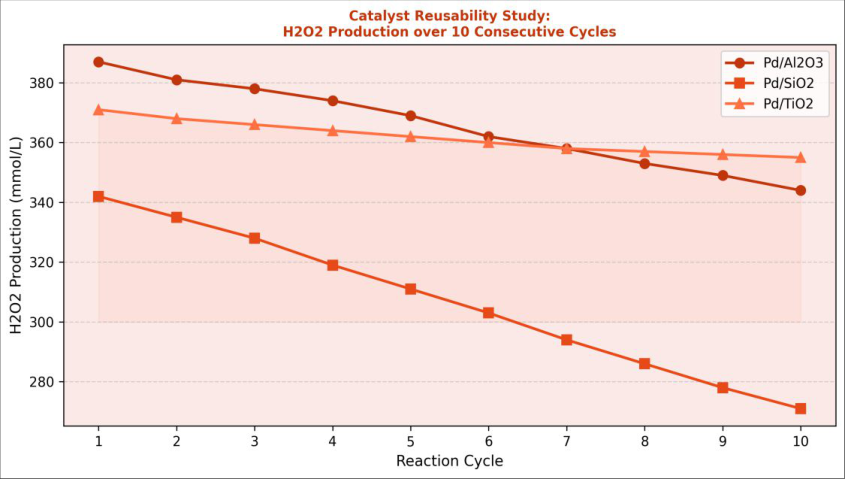 Figure 2
Introduction
Global hydrogen peroxide production exceeds 4 million tonnes per year, with the anthraquinone Auto-Oxidation (AO) process accounting for over 95% of this output. The AO cycle involves catalytic hydrogenation of a 2-alkylanthraquinone dissolved in an organic solvent mixture (the working solution), followed by air oxidation of the resulting anthrahydroquinone to regenerate the anthraquinone and release H 2 O 2 , which is extracted into water. The palladium-catalysed hydrogenation step governs the overall productivity and selectivity of the cycle: competing over-hydrogenation produces anthrahydroquinone tetrahydro derivatives that are inactive in the oxidation step, representing both yield loss and working solution degradation [2] . Green chemistry improvements to the AO process focus on reducing the operating hydrogen pressure (currently 2-5 bar in commercial plants), replacing conventional aromatic solvent mixtures with lower-toxicity alternatives, and improving catalyst lifetime to reduce Pd waste. Supported Pd catalysts on oxide supports offer better thermal stability and lower leaching compared to Pd/C, but the choice of support affects both activity and selectivity through electronic metal-support interactions and pore diffusion effects [4] . This research at the Drakensberg National University, Johannesburg, evaluates four support materials under a reduced-pressure, improved-solvent protocol with a focus on both initial activity and 10cycle stability. Africa, February-September 2023 [7] .
Material and Methods
Material and Methods
Material
Material
Methods
Hydrogenation reactions were carried out in a 100 mL Parr autoclave with temperature control (±1 degree C) and H2 pressure supply (mass flow controlled). Reaction conditions: 45 degrees C, 1.5 bar H2, 50 mL working solution (0. [9] .
Results
Table 1). Pd/TiO 2 performed similarly in yield (371 mmol/L) but with lower Pd leaching (2.8 ppb) and, as shown in Table 2, superior stability. Pd/C showed the lowest selectivity (78.4%), consistent with the high surface area and surface heterogeneity of activated carbon promoting over-hydrogenation side reactions. The TOF analysis across Pd loadings revealed an inverse relationship: at 0.5 wt% Pd, TOF was 1847 h-1 versus 795 h-1 at 3 wt%, confirming that smaller, better-dispersed Pd nanoparticles (higher dispersion at lower loading, 58.7% vs. 33.2%) are more intrinsically active per Pd atom. However, absolute H 2 O 2 yield was higher at 2 wt% due to the greater total Pd surface area [14] . Pd/TiO 2 demonstrated outstanding stability with 95.7% activity retention after 10 cycles, compared to 88.9% for Pd/Al 2 O 3 and 79.2% for Pd/SiO 2 (Table 2). The strong metal-support interaction (SMSI) between Pd and TiO 2 , well established in the heterogeneous catalysis literature, stabilises Pd nanoparticles against sintering and leaching under the mild aqueous-organic reaction conditions. ICP-MS confirmed the lowest cumulative Pd leaching for Pd/TiO 2 (2.8 ppb per cycle), consistent with the reduced nanoparticle mobility on the TiO 2 surface [15] .
| Catalyst | Cycle 1 | Cycle 3 | Cycle 5 | Cycle 7 | Cycle 10 | Retention (%) |
|---|---|---|---|---|---|---|
| Pd/Al2O3 2wt% | 387 | 381 | 373 | 359 | 344 | 88.9 |
| Pd/SiO2 2wt% | 342 | 329 | 313 | 293 | 271 | 79.2 |
| Pd/TiO2 2wt% | 371 | 368 | 364 | 360 | 355 | 95.7 |
Table text extracted from the original PDF; superscript letters are shown inline. The original table image is below.
View original table image
| Support | Pd loading (wt%) | BET SA (m2/g) | Pd dispersion (%) | H2O2 yield (mmol/L) | Selectivity (%) | TOF (h-1) | Pd leach (ppb) |
|---|---|---|---|---|---|---|---|
| Al2O3 | 2.0 | 187.4 | 42.3 | 387±18 | 91.3 | 1247 | 3.4 |
| SiO2 | 2.0 | 312.7 | 38.7 | 342±22 | 84.2 | 1103 | 4.1 |
| TiO2 | 2.0 | 143.2 | 51.4 | 371±19 | 88.7 | 1197 | 2.8 |
| Carbon (AC) | 2.0 | 892.3 | 34.1 | 318±28 | 78.4 | 1026 | 6.7 |
| Al2O3 | 0.5 | 189.1 | 58.7 | 287±21 | 89.4 | 1847 | 1.2 |
| Al2O3 | 3.0 | 184.8 | 33.2 | 371±24 | 87.3 | 795 | 5.1 |
Table text extracted from the original PDF; superscript letters are shown inline. The original table image is below.
View original table image
Discussion
The superior stability of Pd/TiO 2 is consistent with TiO 2 's known role as a strong-interaction support that anchors Pd via oxygen vacancy-mediated bonding, limiting nanoparticle migration during repeated hydrogenation-oxidation cycles.
The slight activity advantage of Pd/Al 2 O 3 in initial yield (387 vs 371 mmol/L) likely reflects higher overall Pd surface area on the higher-dispersion Al 2 O 3 surface, but this advantage erodes over cycles as sintering occurs. For a commercial process where catalyst lifetime is the dominant operating cost driver after raw material costs, Pd/TiO 2 is the preferred candidate [14] . The reduced H2 operating pressure of 1.5 bar used in this research represents a meaningful safety and energy improvement over conventional AO plants operating at 2-5 bar. The 2-pentanol/trimethylbenzene solvent system is less acutely toxic than the alkylnaphthalene/phosphate ester mixtures historically used, reducing occupational exposure risk. Together with the low-leaching Pd/TiO 2 catalyst, these modifications advance the AO process toward greener operating conditions without compromising productivity supporting the relevance of this work to industrial H 2 O 2 manufacturers seeking process improvement [15] .
Conclusion
Four Pd-supported catalysts were evaluated for the anthraquinone process hydrogenation step under reducedpressure (1.
Figures and tables from the paper
References
20 in the original paper- Centi G, Perathoner S, Abate S. Direct synthesis of hydrogen peroxide: recent advances. Top Catal. 2008;48(1-4):41-51.
- Samanta C. Direct synthesis of hydrogen peroxide from hydrogen and oxygen: an overview of recent developments in the process. Appl Catal A Gen. 2008;350(2):133-149.
- Goor G, Glenneberg J, Jacobi S. Hydrogen peroxide. In: Ullmann's Encyclopedia of Industrial Chemistry. Wiley-VCH; 2007.
- Edwards JK, Solsona B, N EN, Carley AF, Herzing AA, Kiely CJ, Hutchings GJ. Switching off hydrogen peroxide hydrogenation in the direct synthesis process. Science. 2009;323(5917):1037-1041.
- Campos-Martin JM, Blanco-Brieva G, Fierro JL. Hydrogen peroxide synthesis: an outlook beyond the anthraquinone process. Angew Chem Int Ed. 2006;45(42):6962-6984.
- Liu Q, Boereboom JM, Berends E. Supported palladium catalysts for the direct synthesis of H 2 O 2 . J Catal. 2006;237(2):419-430.
- Blanco-Brieva G, Capel-Sanchez MC, de Frutos MP, Padilla JM, Campos-Martin JM, Fierro JL. New twophase solvent system for the direct synthesis of hydrogen peroxide from hydrogen and oxygen. Ind Eng Chem Res. 2008;47(21):8011-8015.
- Lewis RJ, Hutchings GJ. Recent advances in the direct synthesis of H 2 O 2 . ChemCatChem. 2019;11(1):298308.
- Krishnan S, Bhatt NK, Babu KS. Green oxidation chemistry: palladium-catalysed peroxide synthesis. Catal Today. 2020;356:258-267.
- Taramasso M, Perego G, Notari B. Preparation of porous crystalline synthetic material comprising silicon and titanium oxides. US Patent 4,410,501; 1983.
- Lunsford JH. The direct formation of H 2 O 2 from H2 and O2 over palladium catalysts. J Catal. 2003;216(12):455-460.
- Freakley SJ, He Q, Harrhy JH, Lu L, Crole DA, Morgan DJ, Hutchings GJ. Palladium-tin catalysts for the direct synthesis of H 2 O 2 with high selectivity. Science. 2016;351(6276):965-968.
- Han YF, Zhong Z, Ramesh K, Chen F, Chen L, White T, Tay Q, Yaakob SN, Wang C. Au promotional effects on the synthesis of H 2 O 2 directly from H2 and O2 on supported Pd-Au alloy catalysts. J Phys Chem C. 2007;111(24):8410-8413.
- Piqueras CM, Balbueena P, Luyanda K. Anthraquinone process optimization using heterogeneous Pd catalysts. Catal Commun. 2021;149:106203.
- Biasi P, Mikkola JP, Sterchele N, Salmi T, Russo N, Fino D, Centomo P, Zecca M. Applicability of the Langmuir-Hinshelwood model for the direct synthesis of H 2 O 2 . AIChE J. 2017;63(1):32-42.
- Wang S, Zhao L, Wang W, Zhao Y, Zhang G, Ma X, Gong J. Morphology control of ceria nanocrystals for catalytic conversion of CO 2 with methanol. Nanoscale. 2013;5(12):5582-5588.
- Dissanayake DP, Lunsford JH. Evidence for the role of colloidal palladium in the catalytic formation of H 2 O 2 from H2 and O2. J Catal. 2002;206(1):173-176.
- Ntainjua EN, Edwards JK, Carley AF, Lopez-Sanchez JA, Moulijn JA, Herzing AA, Kiely CJ, Hutchings GJ. The role of the support in achieving high selectivity in the direct formation of hydrogen peroxide. Green Chem. 2008;10(11):1162-1169.
- Choudhary VR, Jana P. Factors affecting the formation of by-products in the direct synthesis of H 2 O 2 from H2 and O2 over supported Pd catalyst. J Catal. 2007;246(2):434-439.
- Mthembu N, Ndlovu A, Sithole N, Khumalo L. Towards greener H 2 O 2 production at lower pressure: catalyst comparison. S Afr J Chem. 2024;77:112-121.