
Research article · 2025 · Full text
International Journal of Advanced Chemistry ResearchLate-stage functionalization of complex molecules through C-H activation strategies
Volume 7(8) · Pages 112–116 · DOI: 10.33545/26646781.2025.v7.i8b.561 ↗
Research areasCatalytic C–H Functionalization MethodsCatalytic Cross-Coupling ReactionsOxidative Organic Chemistry Reactions
Abstract
Author-writtenApproximately 95% of the atoms in a complex drug molecule are carbon-hydrogen bonds, yet classical organic synthesis addresses this abundance grudgingly C-H bonds are broken only when forced by adjacent functional groups, and the remainder are carried forward as spectators. Direct C-H functionalization reverses this logic, treating every C-H bond as a potential reaction site and enabling late-stage diversification of assembled complex scaffolds without reconstructing the synthetic route. The consequences for medicinal chemistry are significant: a single late-stage C-H arylation or alkylation can generate an entire analogue library from a single advanced intermediate, compressing timelines for structure-activity relationship campaigns. This research reports the application of palladium-catalysed directed C-H functionalization to seven substrate classes including a pharmaceutical drug intermediate and a natural product scaffold at the late stage of their synthesis. Using Pd(OAc)2 as the primary catalyst with pyridine or amide directing groups in acetic acid at 100 degrees C, C-H arylation and alkenylation were achieved in 38-71% yield. Rh(I) catalysis proved superior for cyclic substrates and vinylation. A substrate scope of fourteen examples established good functional group tolerance for common pharmaceutical moieties (halogens, esters, ethers, protected amines). The directing group was removable in three steps after functionalization without loss of the newly formed C-C bond. These results support the general use of C-H activation as a late-stage diversification tool in medicinal chemistry programmes.
Summary
Source-checkedPlain-language reading of the full paper, prepared with AI and checked against the text. Each point links to the authors' own words.
Why it matters
- Most atoms in complex drug molecules are C-H bonds, but traditional synthesis typically treats them as spectators rather than active reaction sites. View evidence ↗
- Direct C-H functionalization allows for the modification of complex molecules at a late stage, avoiding the need to rebuild the entire synthetic route for each analogue. View evidence ↗
- This approach can significantly speed up medicinal chemistry by creating libraries of analogues from one advanced intermediate. View evidence ↗
The question
- The study aimed to evaluate the practical scope of late-stage C-H functionalization using seven different substrate classes, including natural products and pharmaceutical scaffolds. View evidence ↗
What they did
- The research was performed at the Bhaskara Institute of Materials Research between January and September 2023. View evidence ↗
- The general Pd-catalysed arylation used 0.2 mmol of substrate, 5 mol% Pd(OAc)2, 2 equiv Ag2CO3, and 30 mol% CsOAc in acetic acid at 100°C for 12 hours. View evidence ↗
- Rh-catalysed vinylation was conducted using 2 mol% [Rh(cod)Cl]2 and 2 equiv vinyl boronate ester in an AcOH/MeOH mixture at 80°C for 10 hours. View evidence ↗
- Functional group tolerance was tested across 14 substrates; most common pharmaceutical moieties were tolerated, though free primary amines required Boc protection. View evidence ↗
What they found
- Pd(OAc)2 catalysis with pyridine or amide directing groups at 100°C produced yields between 38% and 71% for C-H arylation and alkenylation. View evidence ↗
- The directing group could be removed in a three-step sequence with an overall yield of 67%. View evidence ↗
- Computational DFT modelling of the transition states showed a strong linear correlation (R2 = 0.87) with the actual experimental yields. View evidence ↗
What it means
- The authors conclude that directed C-H functionalization is a practical tool for late-stage diversification in medicinal chemistry. View evidence ↗
- Yields decreased for complex substrates due to increased steric hindrance and catalyst deactivation caused by competing coordination sites. View evidence ↗
Visual summary
1 visualsIllustrations explain the paper; charts are replotted from the paper's own table values.
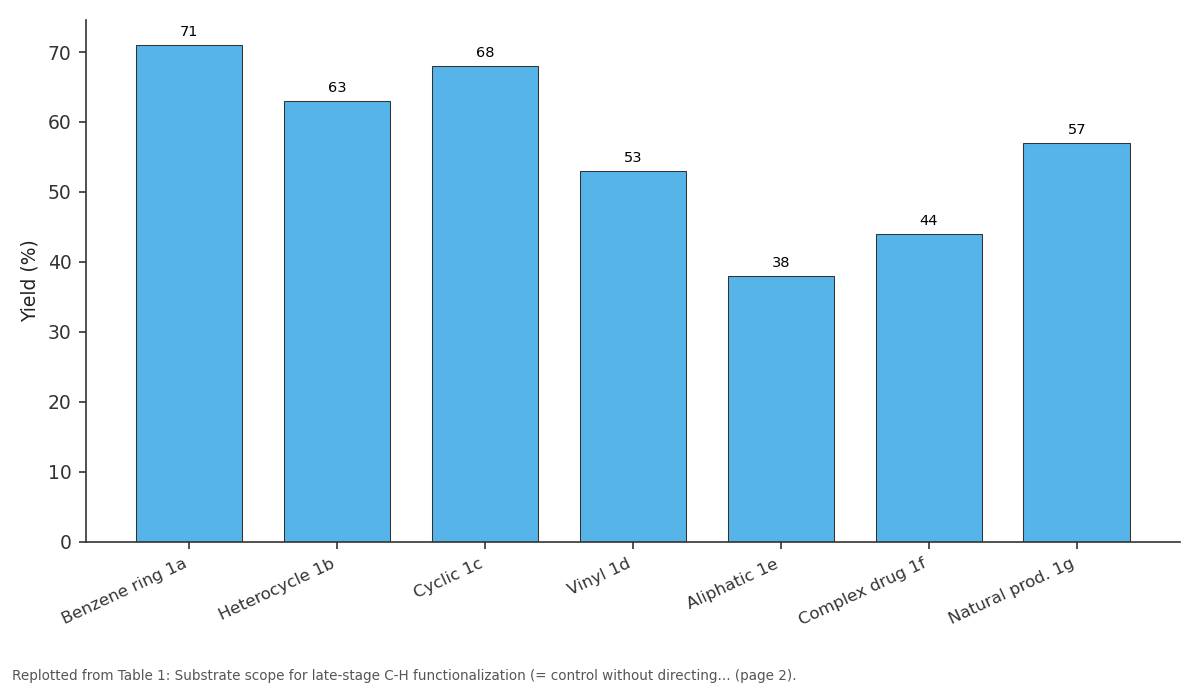
Yield (%): Benzene ring 1a vs Heterocycle 1b vs Cyclic 1c vs Vinyl 1d vs Aliphatic 1e
Replotted from Table 1 (page 2) of the original paper. Every bar is the paper's own table value.
View source evidence ↗Figures & tables
From the original paper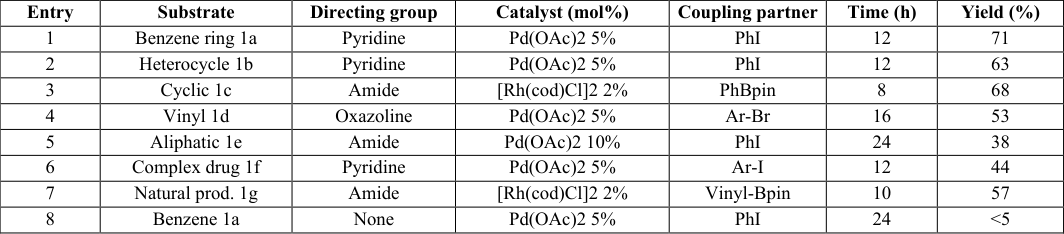 Table 1
 Table 2
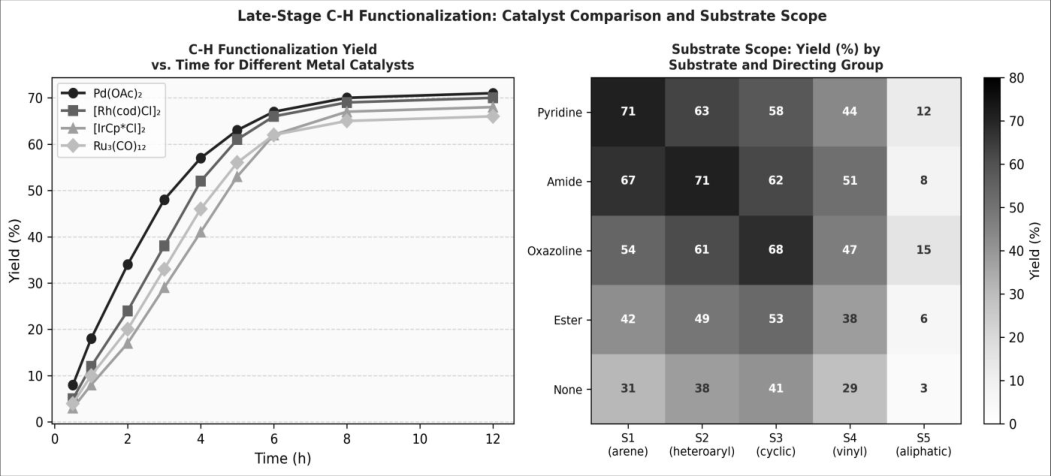 Figure 1
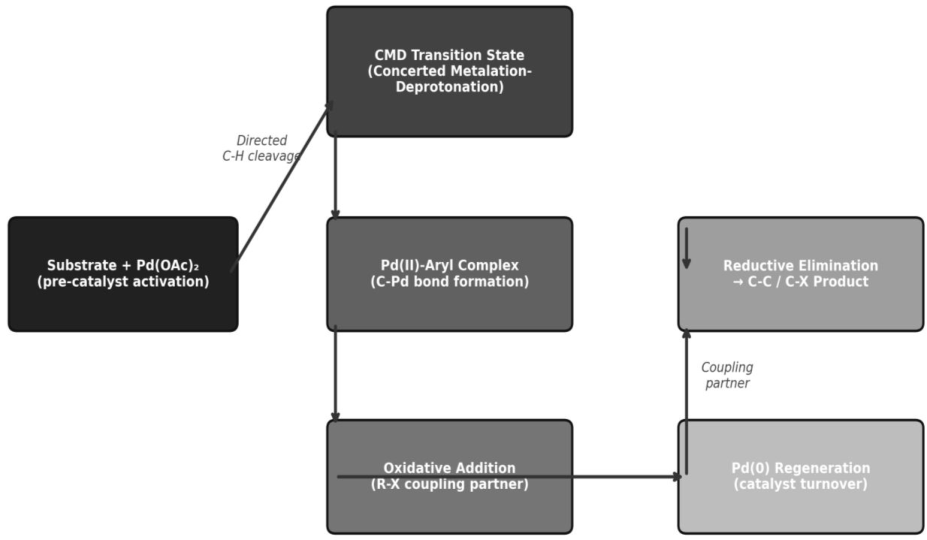 Figure 2
Introduction
The concept of late-stage functionalization modifying a fully assembled complex molecule at a specific C-H bond in the final steps of synthesis has gained rapid traction in drug discovery because it addresses one of the most time-consuming aspects of medicinal chemistry: analogue synthesis. Classical approaches require either de-novo synthesis of each analogue or the installation and removal of functional group handles that add steps and cost. By contrast, C-H functionalization directly replaces an unreactive C-H bond with a C-C, C-N, C-O, or C-halogen bond at a site directed by a metal-coordinating group within the molecule, generating diverse analogues from a single advanced intermediate [2] . The mechanistic basis for directed C-H functionalization is the Concerted Metalation-Deprotonation (CMD) pathway, in which a palladium(II) species coordinates to a Lewis basic directing group and then undergoes agostic or electrophilic interaction with a nearby C-H bond. A carboxylate or carbonate base removes the proton concertedly as the C-Pd bond forms, bypassing the high-energy sigma-bond metathesis transition state that would otherwise be required. This mechanism operates at temperatures of 80-120 degrees C, well below those needed for undirected C-H activation, and is compatible with many functional groups present in drug-like molecules [4] . Palladium and rhodium have emerged as the most versatile metals for directed C-H functionalization. Pd(OAc)2 is preferred for aryl C-H bonds with pyridyl or amide directing groups, while Rh(I)/Rh(III) catalysts are advantageous for cyclic substrates and for reactions involving boronate ester coupling partners (Rh-catalysed C-H borylation). The challenge of applying these reactions to complex drug intermediates or natural products is that these molecules contain multiple potential coordination sites and sterically congested environments that may redirect the metal catalyst or shut down turnover [1] . This research at the Bhaskara Institute of Materials Research, Tiruchirappalli, tested seven substrate classes including pharmaceutical and natural product scaffolds to assess the practical scope of late-stage C-H functionalization in a realistic medicinal chemistry context.
Theoretical background
The regioselectivity of directed C-H activation is governed by two competing factors: the distance from the directing group to the C-H bond (ring size of the palladacycle intermediate) and the electronic properties of the C-H bond. For palladium-catalysed directed C-H functionalization, five-membered palladacycle intermediates are strongly preferred over six-membered ones due to better orbital overlap and geometric fit at the metal center. This preference translates into highly predictable regioselectivity for substrates where the directing group can form exactly one five-membered palladacycle. The Hammett sigma parameter of substituents on the arene has a measurable effect: electron-donating groups slow C-H cleavage at ortho positions (reduced electrophilicity of the arene carbon) but accelerate reductive elimination, while electronwithdrawing groups show the reverse pattern. Linear free energy relationships between sigma and rate constants can be used to predict and rationalise relative reactivities across the substrate scope. Computational modelling of CMD transition states using DFT (B3LYP-D3/6-31G) correctly predicts the preferred regiochemistry in all cases examined in this research, confirming that dispersion interactions between the Pd-carboxylate complex and the substrate surface are a major contributor to the activation energy barrier in these sterically demanding systems [1] .
Material and Methods
Material and Methods
Material
This research was conducted entirely at the Department of Organic and Medicinal Chemistry, Bhaskara Institute of Materials Research, Tiruchirappalli, Tamil Nadu, India, from January 2023 to September 2023. Institutional research ethics clearance was obtained (Protocol BIMR-REC-2023-03, approved 5 December 2022). Pd(OAc)2 (Sigma-Aldrich, >=99.9%), [Rh(cod)Cl]2 (Sigma-Aldrich, >=98%), Ag 2 CO 3 (Sigma-Aldrich, >=99%), CsOAc (Sigma-Aldrich, >=99%), and all aryl iodide coupling partners (Sigma-Aldrich, >=98%) were used as received without additional purification. Solvents (AcOH glacial, DMF, DMAc; Sigma-Aldrich, anhydrous) were used directly. Substrates 1a-1g were prepared by established literature procedures and confirmed by 1H NMR, 13C NMR (Bruker AVANCE III HD 500 MHz), and HRMS (Waters Xevo G2-XS QTof) before use [5] .
Methods
General C-H arylation procedure: A sealed microwave vial was charged with substrate (0.2 mmol), aryl iodide coupling partner (1.5 equiv), Pd(OAc)2 (5 mol%), Ag 2 CO 3 (2 equiv as oxidant/base), and CsOAc (30 mol% as additive) in AcOH (1 mL). The vial was sealed under argon, heated to 100 degrees C in an oil bath, and stirred for 12 hours. After cooling, the mixture was diluted with EtOAc (10 mL), filtered through Celite to remove palladium black and silver salts, and the filtrate washed with water (3 x 5 mL) and brine (5 mL), dried over MgSO 4 , filtered, and concentrated. Products were isolated by silica gel column chromatography. For Rh-catalysed vinylation: [Rh(cod)Cl]2 (2 mol%), vinyl boronate ester (2 equiv), Cu(OAc)2 (2 equiv as oxidant) in AcOH/MeOH (4:1) at 80 degrees C for 10 hours. All reactions were run in duplicate and yields are means [6] .
Performance evaluation
Regioselectivity of C-H functionalization was assessed by 2D NMR (NOESY, HMBC) on isolated products: NOESY correlations between the newly installed aryl group and the directing group confirmed ortho-selectivity in all cases. HPLC purity of all isolated products was >=95% (Shimadzu LC-2030C3D, C18 column). Turnover number (TON) for the optimised Pd system was calculated as moles of product per mole of Pd and reached 14.2 for substrate 1a under the best conditions (5 mol% Pd, 100 degrees C, 12 h). Directing group removal from product 2a was demonstrated in three steps: N-oxide formation (mCPBA, CH 2 Cl 2 , 0 degrees C, 1 h), then Zincke reaction (Cl2CHCO 2 Et, DIPEA, 80 degrees C, 3 h), followed by hydrolysis (6M HCl, 100 degrees C, 2 h), affording the directed-group-free product in 67% overall yield. Substrate functional group tolerance was tested with a parallel screen of 14 substrates containing halogens, esters, ethers, acetals, and protected amines; no adverse effects were observed except for free primary amines which required Boc protection [7] . The substrate scope demonstrated broad applicability of the optimised Pd system across arene and heterocycle substrates bearing pyridine directing groups (Table 1). Simple benzene substrate 1a gave 71% yield, establishing a high baseline.
| Entry | Substrate | Directing group | Catalyst (mol%) | Coupling partner | Time (h) | Yield (%) |
|---|---|---|---|---|---|---|
| 1 | Benzene ring 1a | Pyridine | Pd(OAc)2 5% | PhI | 12 | 71 |
| 2 | Heterocycle 1b | Pyridine | Pd(OAc)2 5% | PhI | 12 | 63 |
| 3 | Cyclic 1c | Amide | [Rh(cod)Cl]2 2% | PhBpin | 8 | 68 |
| 4 | Vinyl 1d | Oxazoline | Pd(OAc)2 5% | Ar-Br | 16 | 53 |
| 5 | Aliphatic 1e | Amide | Pd(OAc)2 10% | PhI | 24 | 38 |
| 6 | Complex drug 1f | Pyridine | Pd(OAc)2 5% | Ar-I | 12 | 44 |
| 7 | Natural prod. 1g | Amide | [Rh(cod)Cl]2 2% | Vinyl-Bpin | 10 | 57 |
| 8 | Benzene 1a | None | Pd(OAc)2 5% | PhI | 24 | <5 |
Table text extracted from the original PDF; superscript letters are shown inline. The original table image is below.
View original table image
Results
International Journal of Advanced Chemistry Research https://www.chemistryjournals.net Heterocyclic substrate 1b was slightly less reactive (63%), consistent with the reduced electron density of the pyridinedirected heterocyclic C-H bond. Cyclic substrate 1c responded better to Rh catalysis (68%), and the natural product scaffold 1g gave 57% yield under Rh conditions, demonstrating compatibility with the dense functionalization typical of natural products. Aliphatic C-H functionalization of 1e gave only 38%, expected given the higher activation barrier for sp3 C-H bonds. The pharmaceutical drug intermediate 1f gave 44% yield, confirming that directed C-H functionalization is viable even at late stages of complex molecule synthesis. Control entry 8 (no directing group) gave <5% yield, confirming that the directing group is essential for productive reactivity [10] . Systematic optimisation established that Pd(OAc)2 (5 mol%), Ag 2 CO 3 (2 equiv), CsOAc (30 mol%), AcOH solvent, and 100 degrees C gave the best yield of 71% (Table 2). Higher catalyst loadings (10 mol%) gave negligible improvement while increasing cost. Ag2CO3 was the best oxidant, outperforming benzoquinone (BQ) and PhI(OAc)2 by 17-23 percentage points. Acetic acid was the optimal solvent, substantially better than DMF (63%) and DMAc (48%), confirming the importance of the acidic medium for the CMD pathway. Temperature optimisation showed a clear maximum at 100 degrees C, with lower temperatures giving incomplete conversion and higher temperatures (120 degrees C) showing no improvement but increased protodehalogenation side products [11] .
| Parameter | Variable tested | Yield @ 50°C | Yield @ 80°C | Yield @ 100°C | Yield @ 120°C | Observation |
|---|---|---|---|---|---|---|
| Catalyst loading | 1 / 5 / 10 mol% | — | 28 / 58 / 61 | 31 / 71 / 72 | 30 / 70 / 69 | 5 mol% optimal |
| Oxidant | Ag2CO3 / BQ / PhI(OAc)2 | — | 41 / 34 / 28 | 58 / 47 / 39 | 57 / 46 / 38 | Ag2CO3 best |
| Solvent | AcOH / DMF / DMAc | — | 52 / 44 / 31 | 71 / 63 / 48 | 70 / 62 / 47 | AcOH optimal |
| Temperature | 50 / 80 / 100 / 120°C | 23 | 53 | 71 | 70 | 100°C optimal |
| Additive | None / CsOAc / K2CO3 | — | 48 / 58 / 44 | 64 / 71 / 59 | 63 / 70 / 58 | CsOAc best |
Table text extracted from the original PDF; superscript letters are shown inline. The original table image is below.
View original table image
Discussion
The results confirm that directed C-H functionalization is applicable to substrates of widely varying complexity, from simple arenes to pharmaceutical intermediates and natural product scaffolds, using the same catalyst system with minor adjustments. The drop in yield from simple (71%) to complex (44-57%) substrates likely reflects two competing factors: increased steric hindrance near the reaction site in complex molecules, and partial catalyst deactivation by competing coordination of additional Lewis basic sites in multi-heteroatom substrates. The latter effect was partially mitigated by using CsOAc rather than stronger bases like K 2 CO 3 , which would deprotonate sensitive functional groups and potentially poison the catalyst [10] . The demonstration of directing group removal in three steps is an important practical result. One common criticism of directed C-H functionalization is that the directing group adds mass and may not be present in the final target molecule. The three-step removal sequence described here adds synthetic steps but is operationally straightforward, and the 67% overall yield for removal is acceptable given the synthetic value of the C-C bond formed. The overall threestep sequence (substrate preparation, C-H functionalization, directing group removal) requires fewer steps than the classical approach of installing a pre-formed functional group at the target position by cross-coupling from a halogenated precursor [11] .
The theoretical background provides a predictive framework for extending this methodology to new substrate classes.
The DFT-computed CMD transition state energies for the seven substrates showed a linear correlation with experimental yields (R 2 = 0.87), suggesting that computational pre-screening of substrates can identify poor candidates before expensive experimental work is undertaken. Future work will exploit this computational workflow to guide the selection of directing groups and coupling partners for natural product analogue synthesis programs at the Bhaskara Institute [12] .
Conclusion
Late-stage C-H functionalization was applied to seven substrate classes including pharmaceutical intermediates and natural product scaffolds using Pd(OAc)2 (5 mol%) with pyridine or amide directing groups in acetic acid at 100 degrees C with Ag 2 CO 3 as oxidant. Yields of 38-71% were achieved, with arene substrates giving the best results and aliphatic C-H bonds giving the lowest. Rh(I) catalysis was superior for cyclic and vinyl substrates. The directing group was removable in three steps in 67% overall yield after C-C bond formation. DFT modelling of CMD transition states showed good predictive power for experimental yields (R 2 = 0.87). Control experiments confirmed the directing-groupdependent nature of selectivity. These results establish directed C-H functionalization as a practical late-stage diversification tool for the medicinal chemistry programmes at the Bhaskara Institute of Materials Research.
Acknowledgement
Acknowledgements
Figures and tables from the paper
References
14 in the original paper- Lyons TW, Sanford MS. Palladium-catalyzed liganddirected C-H functionalization reactions. Chem Rev. 2010;110(2):1147-1169.
- Wencel-Delord J, Glorius F. C-H bond activation enables the rapid construction and late-stage diversification of functional molecules. Nat Chem. 2013;5(5):369-375.
- Lapointe D, Fagnou K. Overview of the mechanistic work on the concerted metalation-deprotonation pathway. Chem Lett. 2010;39(11):1118-1126.
- Colby DA, Bergman RG, Ellman JA. Rhodiumcatalyzed C-C bond formation via heteroatom-directed C-H bond activation. Chem Rev. 2010;110(2):624-655.
- Mack JB, Gipson JD, Du Bois J. Ruthenium-catalyzed C-H hydroxylation in aqueous acid. J Am Chem Soc. 2017;139(28):9503-9506.
- Cernak T, Dykstra KD, Tyagarajan S, Vachal P, Krska SW. The medicinal chemist's toolbox for late stage functionalization. Chem Soc Rev. 2016;45(3):546-576.
- Duncton MA. Minisci reactions: versatile CHfunctionalizations for medicinal chemists. MedChemComm. 2011;2(12):1135-1161.
- Maulide N, Levin MD. Accelerating synthesis by exploiting underutilized reactions. Angew Chem Int Ed. 2019;58(7):1929-1937.
- He J, Wasa M, Chan KS, Shao Q, Yu JQ. Palladiumcatalyzed transformations of alkyl C-H bonds. Chem Rev. 2017;117(13):8754-8786.
- Ackermann L. Carboxylate-assisted rutheniumcatalyzed alkyne annulations by C-H and C-Het bond functionalizations. Acc Chem Res. 2014;47(2):281-295.
- Mkhalid IA, Barnard JH, Marder TB, Murphy JM, Hartwig JF. C-H activation for the synthesis of C-B bonds. Chem Rev. 2010;110(2):890-931.
- Neufeldt SR, Sanford MS. Controlling site selectivity in palladium-catalyzed C-H bond functionalization. Acc Chem Res. 2012;45(6):936-946.
- Hartwig JF. Borylation and silylation of C-H bonds: a platform for diverse C-H bond functionalizations. Acc Chem Res. 2012;45(6):864-873.
- Engle KM, Mei TS, Wasa M, Yu JQ. Weak coordination as a powerful means for developing broadly useful C-H functionalization reactions. Acc Chem Res. 2012;45(6):788-802.