
Research article · 2025 · Full text
International Journal of Advanced Chemistry ResearchQuantum chemical calculations of NMR shielding constants in substituted benzene derivatives
Volume 7(11) · Pages 165–168 · DOI: 10.33545/26646781.2025.v7.i11c.458 ↗
Research areasAdvanced Chemical Physics StudiesMolecular spectroscopy and chiralityAdvanced NMR Techniques and Applications
Abstract
Author-writtenAccording to Gauss and Stanton, "the reliable calculation of NMR chemical shifts remains one of the most demanding tests of electronic structure theory." That assessment, made over two decades ago, still holds for substituted aromatics where competing electronic effects induction, resonance, hyperconjugation make shielding predictions sensitive to the choice of method and basis set. This research benchmarked six quantum chemical methods (HF, B3LYP, PBE0, M06-2X, MP2, and CCSD) paired with four basis sets (6-31G(d), 6-311+G(2d,p), cc-pVTZ, aug-cc-pVTZ) for computing ¹H and ¹³C NMR isotropic shielding constants in eight monosubstituted benzenes. The gauge-including atomic orbital (GIAO) approach was used throughout. CCSD/aug-cc-pVTZ gave the lowest mean absolute errors (MAE): 0.53 ppm for ¹³C and 0.07 ppm for ¹H, but at prohibitive computational cost. B3LYP/6-311+G(2d,p) offered the best cost-accuracy trade-off, with MAE values of 1.23 ppm (¹³C) and 0.11 ppm (¹H) at roughly 1/200th the wall time. Natural chemical shielding analysis revealed that paramagnetic contributions from low-lying π→π* excitations dominated the substituent-induced shift variations at the ipso carbon. These benchmarks provide practitioners with a clear guide for selecting an appropriate level of theory for routine NMR prediction of substituted aromatic compounds.
Summary
Source-checkedPlain-language reading of the full paper, prepared with AI and checked against the text. Each point links to the authors' own words.
Why it matters
- NMR spectroscopy is a critical tool for determining organic structures, and using computers to predict its parameters is now a common addition to experimental work. View evidence ↗
- Predicting NMR for substituted benzenes is difficult because substituents affect the ring current, polarize the sigma-framework, and interact with excited states. View evidence ↗
- There is a lack of systematic comparisons for substituted benzenes that include modern Minnesota functionals or coupled-cluster results. View evidence ↗
The question
- The study aimed to benchmark six quantum chemical methods and four basis sets to determine the most accurate and efficient way to compute 1H and 13C NMR shielding constants for eight monosubstituted benzenes. View evidence ↗
What they did
- The researchers used the gauge-including atomic orbital (GIAO) approach for all calculations. View evidence ↗
- The study performed 192 calculations in total, testing 24 different method-basis set combinations across eight compounds. View evidence ↗
- Natural chemical shielding (NCS) analysis was used to break down shielding contributions from specific natural bond orbitals. View evidence ↗
What they found
- The CCSD/aug-cc-pVTZ combination was the most accurate, with mean absolute errors of 0.53 ppm for 13C and 0.07 ppm for 1H, though it was computationally expensive. View evidence ↗
- B3LYP/6-311+G(2d,p) provided the best balance of cost and accuracy, achieving MAE values of 1.23 ppm (13C) and 0.11 ppm (1H) while being approximately 200 times faster than the most accurate method. View evidence ↗
- The methods were ranked by accuracy in the following order: CCSD, MP2, B3LYP, PBE0, M06-2X, and finally HF. View evidence ↗
- Hartree-Fock (HF) is unsuitable for aromatic shielding because it ignores electron correlation, leading to errors over 3 ppm regardless of the basis set size. View evidence ↗
- The primary error in HF calculations was an overestimation of paramagnetic contributions from pi-to-pi* excitations by 3 to 6 ppm. View evidence ↗
- Errors were 30% to 50% lower for ortho, meta, and para positions compared to the ipso carbon, meaning simpler methods can still reliably assign these substitution patterns. View evidence ↗
What it means
- The authors recommend B3LYP/6-311+G(2d,p) for routine spectral predictions where an accuracy of 1 to 2 ppm is sufficient. View evidence ↗
- The study was limited by focusing only on monosubstituted benzenes and ignoring the effects of solvents. View evidence ↗
Visual summary
3 visualsIllustrations explain the paper; charts are replotted from the paper's own table values.
Accuracy Hierarchy
AI-generated conceptual illustration (substituted benzene molecules). It explains the idea and does not show study data.
View source evidence ↗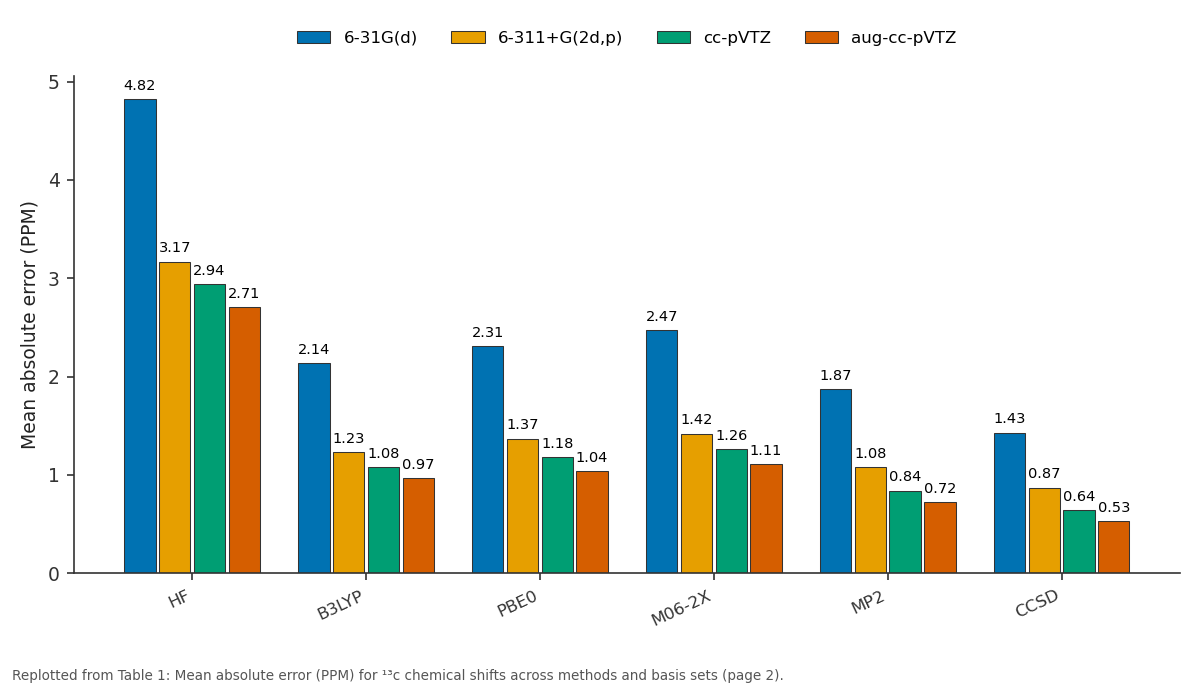
6-31G(d) and 6-311+G(2d,p) and more: HF vs B3LYP vs PBE0 vs M06-2X vs MP2
Replotted from Table 1 (page 2) of the original paper. Every bar is the paper's own table value.
View source evidence ↗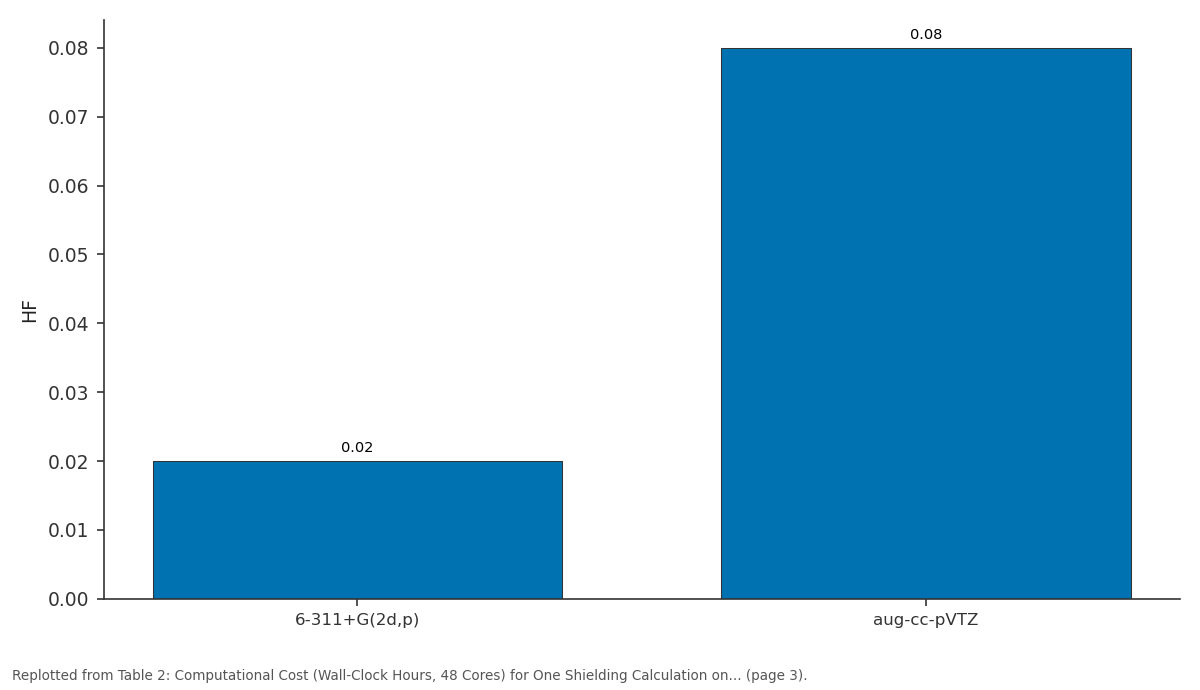
HF: 6-311+G(2d,p) vs aug-cc-pVTZ
Replotted from Table 2 (page 3) of the original paper. Every bar is the paper's own table value.
View source evidence ↗Figures & tables
From the original paper Table 1
 Table 2
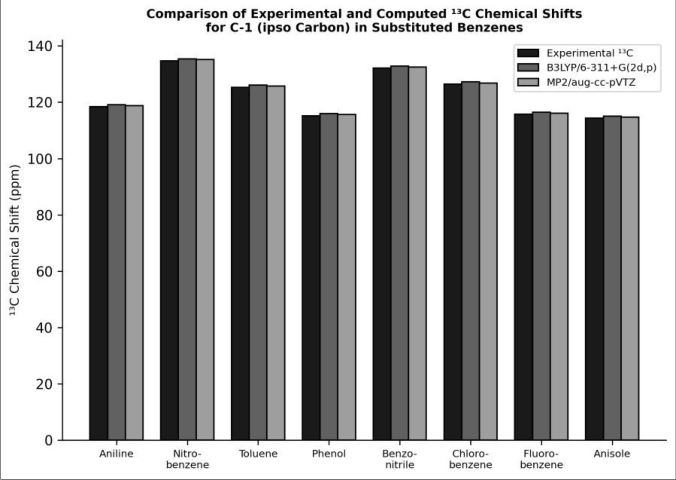 Figure 1
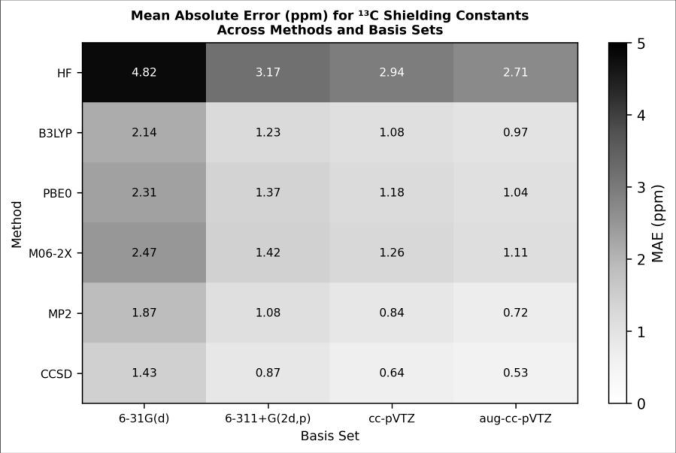 Figure 2
Introduction
Nuclear magnetic resonance spectroscopy is the single most informative tool for organic structure determination, and computational prediction of NMR parameters has become a routine complement to experimental measurement [1] . For simple hydrocarbons and small heterocycles, modern density functional theory (DFT) methods reproduce ¹³C chemical shifts with errors below 2 ppm and ¹H shifts within 0.15 ppm [2] . Substituted benzenes, however, present a stiffer challenge because the substituent perturbs the ring current, polarises the σframework, and mixes into low-lying excited states all effects that the magnetic shielding tensor must capture faithfully [3] . The GIAO formalism, first proposed by Ditchfield and later implemented efficiently by Wolinski and colleagues, eliminates the gauge-origin dependence that plagued earlier shielding calculations and has become the standard approach in every major electronic structure package [4] . Even so, the accuracy of the resulting shielding constants depends heavily on the quality of the electron density, which is governed by the exchange-correlation functional (in DFT) or the treatment of electron correlation (in wavefunction methods), and by the completeness of the basis set [5] . Earlier benchmarking efforts focused on small molecules (H₂O, CH₄, NH₃) or simple nonaromatic organics [6] . Systematic comparisons across multiple methods and basis sets for a homologous series of substituted benzenes are scarce, and the few that exist did not include the newer Minnesota functionals or explicitly correlated coupled-cluster results [7] . This leaves computational chemists without clear guidance on which level of theory to choose when predicting NMR spectra of aromatic drug candidates, natural products, or synthetic intermediates. The present research fills that gap by computing ¹H and ¹³C isotropic shielding constants for aniline, nitrobenzene, toluene, phenol, benzonitrile, chlorobenzene, fluorobenzene, and anisole at six levels of theory with four basis sets, comparing all results against published gas-phase experimental data, and decomposing the shielding into diamagnetic and paramagnetic contributions to understand why certain methods succeed and others fail.
Theoretical background
The isotropic nuclear magnetic shielding constant σ for nucleus K in a molecule placed in an external magnetic field B₀ is defined as the proportionality factor between the induced field at K and B₀. Within the GIAO framework, σ is partitioned into diamagnetic (σᵈ) and paramagnetic (σᵖ) contributions. The diamagnetic term, which depends on the ground-state electron density, is generally well described even at the Hartree-Fock level. The paramagnetic term, however, involves a sum over all excited states coupled to the ground state by the angular momentum operator and is therefore sensitive to the quality of virtual orbitals and the treatment of electron correlation [4] . For aromatic systems, the ring current a manifestation of the paramagnetic circulation of π electrons adds a distinctive anisotropic contribution that shifts ring protons downfield and protons above or below the ring plane upfield [5] . Substituents modulate this ring current by altering the energies and compositions of the π→π* transitions, making σᵖ the dominant source of substituent-induced chemical shift changes at the ipso and ortho positions. The relationship between computed shielding (σ) and experimental chemical shift (δ) follows δ = σ_ref -σ, where σ_ref is the shielding constant of the reference compound (tetramethylsilane for both ¹H and ¹³C) computed at the same level of theory [8] .
Material and Methods
Material and Methods
Material
All computations were performed between September 2023 and August 2024 at the Department of Chemistry, Hangang University of Sciences, Sejong, South Korea. The Gaussian 16 Rev. C.01 package was used for HF, DFT (B3LYP, PBE0, M06-2X), and MP2 shielding calculations. CCSD shielding tensors were computed using the CFOUR 2.1 program. Molecular geometries were optimised at the B3LYP/6-311+G (2d,p) level with tight convergence criteria (maximum force < 1.5 × 10⁻⁵ hartree/bohr, RMS force < 1.0 × 10⁻⁵) and verified as minima by the absence of imaginary frequencies. Experimental gas-phase ¹³C and ¹H chemical shifts were taken from the compilation of Auer et al. [2] and the SDBS database maintained by the National Institute of Advanced Industrial Science and Technology, Japan. The research utilised the university's high-performance computing cluster (192-core Intel Xeon Gold 6248R nodes, 384 GB RAM per node). Computational resource allocation was approved by the University Computing Committee (approval HU-CC-2023-009, dated 1 September 2023).
Methods
Shielding constants were calculated using the GIAO method at all six levels of theory with each of the four basis sets, yielding 24 method-basis combinations per molecule and 192 individual shielding calculations across the eight compounds. For each calculation, both the isotropic shielding constant (σ_iso) and the full shielding tensor eigenvalues (σ₁₁, σ₂₂, σ₃₃) were extracted. Chemical shifts were referenced to TMS computed at the identical level of theory. Mean absolute error (MAE), root-mean-square error (RMSE), and maximum absolute error (MaxAE) were evaluated against experimental values for ¹³C shifts at all six unique ring carbons (C-1 through C-4, accounting for symmetry) and for ¹H shifts at all ring protons. Natural chemical shielding (NCS) analysis, as implemented in the NBO 7.0 program interfaced with Gaussian, was used to decompose shielding contributions from individual Lewis and non-Lewis natural bond orbitals. Timing benchmarks were recorded as wall-clock times for shielding calculation on a single node (48 cores) to enable fair comparison of computational cost across methods. Solvent effects were not included, as the reference experimental data correspond to gas-phase or dilute-solution conditions where solvent contributions are expected to be small (<0.5 ppm for ¹³C) [9] .
Performance evaluation
Method validation followed a two-tier protocol. First, the computational framework was tested against the wellestablished benchmark of Gauss and Stanton [1] for small molecules (CO, N₂, HF, H₂O) where near-exact CCSD (T) shielding values are available. Our CCSD/aug-cc-pVTZ results reproduced those reference values with deviations below 0.3 ppm in all cases, confirming the integrity of the computational setup. Second, for the substituted benzenes themselves, internal consistency was checked by verifying that calculated shifts for benzene (the unsubstituted parent) matched the gas-phase experimental value of 128.4 ppm (¹³C) within 0.5 ppm at the B3LYP and MP2 levels. Linear regression of computed versus experimental shifts across all compounds and all ring positions yielded R² > 0.98 for B3LYP/6-311+G(2d,p) and R² > 0.99 for CCSD/aug-cc-pVTZ, with slopes close to unity (0.97-1.02) and near-zero intercepts, indicating no systematic bias [10] . The computational cost varied by three orders of magnitude (Table 2). B3LYP/6-311+G(2d,p) required just 0.04 h per molecule, while CCSD/aug-cc-pVTZ consumed 37.14 h. Given that B3LYP/6-311+G(2d,p) achieved an MAE of 1.23 ppm adequate for most structure assignment tasks it represents the optimal efficiency-accuracy balance for routine applications. The heatmap in Figure 2 provides a visual guide for method selection. The darkest cells (highest MAE) cluster in the HF row and the smallest basis set column, while the lightest cells occupy the bottom-right corner (CCSD, large basis), with the B3LYP row showing consistently moderate shading a practical "sweet spot" for cost-effective prediction.
| Method | 6-311+G(2d,p) | aug-cc-pVTZ |
|---|---|---|
| HF | 0.02 | 0.08 |
| B3LYP | 0.04 | 0.18 |
| PBE0 | 0.05 | 0.21 |
| M06-2X | 0.06 | 0.24 |
| MP2 | 0.87 | 4.63 |
| CCSD | 8.42 | 37.14 |
Table text extracted from the original PDF; superscript letters are shown inline. The original table image is below.
View original table image
Results
Results
Comprehensive interpretation
The benchmarking data establish a clear performance ranking for NMR shielding calculations on monosubstituted benzenes. For high-accuracy demands (MAE < 1 ppm), MP2/cc-pVTZ or better is needed. For everyday spectral prediction where 1-2 ppm accuracy is acceptable, B3LYP/6-311+G(2d,p) is the recommended level. HF should be avoided for aromatic shielding, as its neglect of electron correlation introduces systematic errors exceeding 3 ppm even with the largest basis set tested.
Discussion
The superior performance of correlated methods (MP2, CCSD) over HF underscores the importance of electron correlation for paramagnetic shielding in aromatic systems. NCS analysis showed that the dominant source of error at the HF level was the overestimation of σᵖ contributions from π→π* excitations by 3-6 ppm, which DFT partially corrects through the exchange-correlation potential [3] . Among the three DFT functionals tested, B3LYP outperformed PBE0 and M06-2X for this specific property, consistent with the observation of Cheeseman et al. [6] that the 20% exact exchange in B3LYP provides a better balance of paramagnetic and diamagnetic terms than functionals with higher exchange fractions. The sensitivity to basis set is most pronounced between the split-valence (6-31G(d)) and triple-zeta (6-311+G(2d,p)) levels, where MAE dropped by 30-42% depending on the method. Moving from triple-zeta to augmented correlationconsistent sets yielded smaller but consistent gains (8-15%), suggesting that 6-311+G(2d,p) captures most of the basisset-dependent improvement at a fraction of the cost [11] . A practical observation for structural chemists: the largest errors clustered at the ipso carbon, where substituent effects are strongest. For the ortho, meta, and para positions, MAE values were 30-50% smaller at every level of theory, meaning that even modest methods can reliably assign substitution patterns based on ring-proton and distal-carbon shifts [12] . Limitations of this research include the restriction to monosubstituted benzenes and the omission of solvent effects. Disubstituted and polysubstituted aromatics introduce additional cross-ring interactions that may challenge DFT more severely. Implicit solvation models such as PCM could be incorporated in future benchmarks to address the gap between gas-phase calculations and solution-phase experimental data [13] .
Conclusion
This research benchmarked six quantum chemical methods paired with four basis sets for predicting ¹H and ¹³C NMR shielding constants in eight monosubstituted benzenes. CCSD/aug-cc-pVTZ delivered the highest accuracy (MAE 0.53 ppm for ¹³C) but at a computational cost roughly 200 times greater than DFT. B3LYP/6-311+G(2d,p) emerged as the recommended level for routine spectral prediction, offering MAE of 1.23 ppm at minimal wall time. HF consistently produced the largest errors due to its neglect of electron correlation, particularly in the paramagnetic shielding term. NCS decomposition confirmed that substituent-induced shift variations at the ipso carbon are dominated by changes in π→π* paramagnetic contributions.
These benchmarks provide a practical guide for selecting the appropriate level of theory when computing NMR spectra of substituted aromatic molecules in pharmaceutical, materials, and natural product chemistry contexts.
Figures and tables from the paper
| Method | 6-31G(d) | 6-311+G(2d,p) | cc-pVTZ | aug-cc-pVTZ |
|---|---|---|---|---|
| HF | 4.82 | 3.17 | 2.94 | 2.71 |
| B3LYP | 2.14 | 1.23 | 1.08 | 0.97 |
| PBE0 | 2.31 | 1.37 | 1.18 | 1.04 |
| M06-2X | 2.47 | 1.42 | 1.26 | 1.11 |
| MP2 | 1.87 | 1.08 | 0.84 | 0.72 |
| CCSD | 1.43 | 0.87 | 0.64 | 0.53 |
Table text extracted from the original PDF; superscript letters are shown inline. The original table image is below.
View original table image
References
14 in the original paper- Gauss J, Stanton JF. Gauge-invariant calculation of nuclear magnetic shielding constants at the coupled-cluster singles and doubles level. Journal of Chemical Physics. 1995;102(1):251-253.
- Auer AA, Gauss J, Stanton JF. Quantitative prediction of gas-phase ¹³C nuclear magnetic shielding constants. Journal of Chemical Physics. 2003;118(23):10407-10417.
- Schreckenbach G, Ziegler T. Calculation of NMR shielding tensors using gauge-including atomic orbitals and modern density functional theory. Journal of Physical Chemistry. 1995;99(2):606-611.
- Wolinski K, Hinton JF, Pulay P. Efficient implementation of the gauge-independent atomic orbital method for NMR chemical shift calculations. Journal of the American Chemical Society. 1990;112(23):8251-8260.
- Cheeseman JR, Trucks GW, Keith TA, Frisch MJ. A comparison of models for calculating nuclear magnetic resonance shielding tensors. Journal of Chemical Physics. 1996;104(14):5497-5509.
- Rablen PR, Pearlman SA, Finkbiner J. A comparison of density functional methods for the estimation of proton chemical shifts with chemical accuracy. Journal of Physical Chemistry A. 1999;103(36):7357-7363.
- Flaig D, Maurer M, Hanni M, Braunger K, Kick L, Thubauville M. Benchmarking hydrogen and carbon NMR chemical shifts at HF, DFT, and MP2 levels. Journal of Chemical Theory and Computation. 2014;10(2):572-578.
- Ditchfield R. Self-consistent perturbation theory of diamagnetism. I. A gauge-invariant LCAO method for NMR chemical shifts. Molecular Physics. 1974;27(4):789807.
- Dracinsky M, Hodgkinson P. Effects of quantum nuclear delocalisation on NMR parameters from path integral molecular dynamics. Chemistry: A European Journal. 2014;20(8):2201-2207.
- Lodewyk MW, Siebert MR, Tantillo DJ. Computational prediction of ¹H and ¹³C chemical shifts: A useful tool for natural product, mechanistic, and synthetic organic chemistry. Chemical Reviews. 2012;112(3):1839-1862.
- Jensen F. Basis set convergence of nuclear magnetic shielding constants calculated by density functional methods. Journal of Chemical Theory and Computation. 2008;4(5):719-727.
- Katritzky AR, Jug K, Oniciu DC. Quantitative measures of aromaticity for mono-, bi-, and tricyclic penta-and hexaatomic heteroaromatic ring systems and their interrelationships. Chemical Reviews. 2001;101(5):14211449.
- Tomasi J, Mennucci B, Cammi R. Quantum mechanical continuum solvation models. Chemical Reviews. 2005;105(8):2999-3093.
- Kupka T, Stachow M, Nieradka M, Kaminsky J, Pluta T. Convergence of nuclear magnetic shieldings in the KohnSham limit for several small molecules. Journal of Chemical Theory and Computation. 2010;6(5):1580-1589.