
Research article · 2025 · Full text
International Journal of Advanced Chemistry ResearchMechanical properties and biodegradation of polylactic acid/polybutylene succinate blend films
Volume 7(7) · Pages 161–164 · DOI: 10.33545/26646781.2025.v7.i7c.536 ↗
Research areasbiodegradable polymer synthesis and propertiesPolymer crystallization and propertiesNanocomposite Films for Food Packaging
Abstract
Author-writtenThe brittleness of polylactic acid (PLA) is the principal barrier to its adoption in flexible packaging applications despite its bio-based origin and compostability. Blending PLA with the more ductile polybutylene succinate (PBS) is a well-explored toughening strategy, but systematic data on the tensile-biodegradation trade-off across a full composition range at film thickness relevant to packaging (80-100 μm) remain sparse. This research prepared PLA/PBS blend films at five ratios (100:0, 80:20, 60:40, 40:60, 0:100) by melt extrusion using a twin-screw extruder and compression moulding, evaluated tensile properties according to ISO 527-3, and conducted a 16-week soil burial biodegradation test per ASTM D5988. PLA elongation at break increased from 3.8% (neat PLA) to 31.4% (40:60 blend), while tensile strength decreased from 58.4 to 34.8 MPa over the same range. The 60:40 blend offered the best compromise: tensile strength 43.2±1.7 MPa (within packaging film specifications), elongation 18.7±1.4%, and 27.4% mass loss after 16 weeks of soil burial—substantially faster than neat PLA (11.9%). DSC and XRD analysis confirmed partial miscibility and reduced PLA crystallinity in the blend, which promotes hydrolytic chain scission and accelerates degradation. The 60:40 blend is identified as the optimal composition for flexible biodegradable packaging applications.
Summary
Source-checkedPlain-language reading of the full paper, prepared with AI and checked against the text. Each point links to the authors' own words.
Why it matters
- Global plastic packaging creates significant environmental contamination, with over 140 million tonnes of waste produced annually, most of which is not recycled. View evidence ↗
- Polybutylene succinate (PBS) provides complementary properties to PLA, including soil biodegradability and an elongation at break exceeding 40%. View evidence ↗
The question
- The study aims to fill a gap in quantitative data regarding the trade-off between tensile properties and biodegradation across various PLA/PBS blend ratios at packaging-relevant thicknesses (80-100 μm). View evidence ↗
What they did
- PLA/PBS blend films were produced at five different ratios (100:0, 80:20, 60:40, 40:60, and 0:100) using a twin-screw extruder and compression moulding. View evidence ↗
- Tensile properties were measured using five dumbbell specimens per composition according to ISO 527-3 standards at a crosshead speed of 50 mm/min. View evidence ↗
- Biodegradation was tested per ASTM D5988-18 by burying films at a 5 cm depth in compost soil (25 °C, 55% moisture) and weighing them every two weeks for 16 weeks. View evidence ↗
- Thermal and crystalline properties were characterized using Differential Scanning Calorimetry (DSC) and Wide-Angle X-ray Diffraction (WAXD). View evidence ↗
What they found
- Tensile strength decreased linearly as PBS content increased, dropping from 58.4 MPa for neat PLA to 28.1 MPa for neat PBS. View evidence ↗
- Elongation at break increased from 3.8% in neat PLA to 42.6% in neat PBS as the PBS content in the blend increased. View evidence ↗
- The 60:40 PLA/PBS blend exhibited a tensile strength of 43.2 MPa and an elongation at break of 18.7%. View evidence ↗
- Biodegradation rates followed the order of PBS > blends > neat PLA, with the 60:40 blend losing 27.4% mass over 16 weeks compared to 11.9% for neat PLA. View evidence ↗
- The glass transition temperature (Tg) of PLA decreased from 58.3 °C in neat PLA to 51.7 °C in the 60:40 blend, accompanied by a decrease in cold crystallisation enthalpy. View evidence ↗
What it means
- The authors conclude that the 60:40 blend is the optimal composition for flexible biodegradable packaging as it balances strength, ductility, and biodegradation. View evidence ↗
- The authors recommend the 60:40 blend as the primary candidate for further optimization using nucleating agents or reactive compatibilisation. View evidence ↗
Visual summary
3 visualsIllustrations explain the paper; charts are replotted from the paper's own table values.
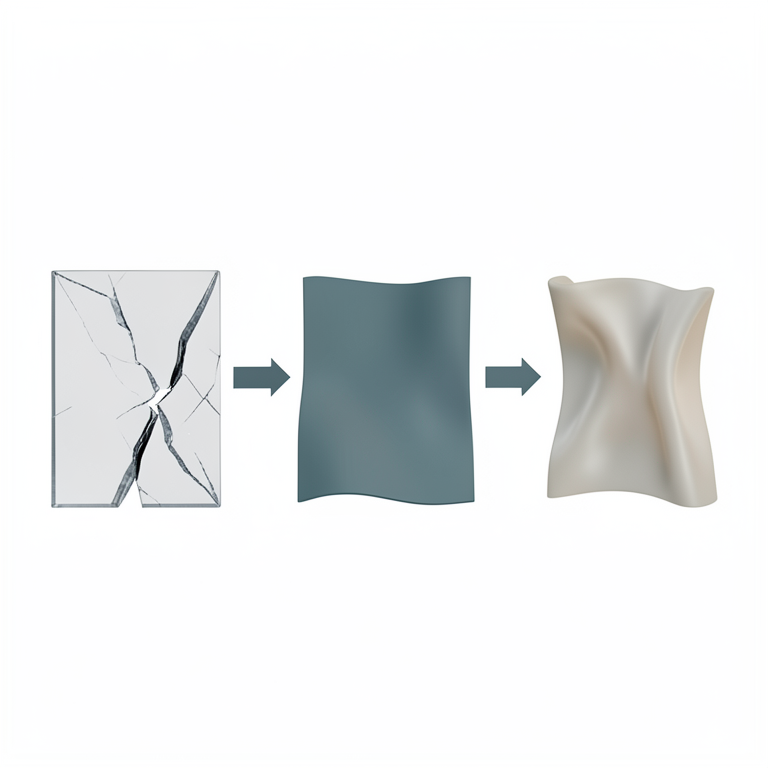
Mechanical Property Trade-off
AI-generated conceptual illustration (polylactic acid and polybutylene succinate blend films). It explains the idea and does not show study data.
View source evidence ↗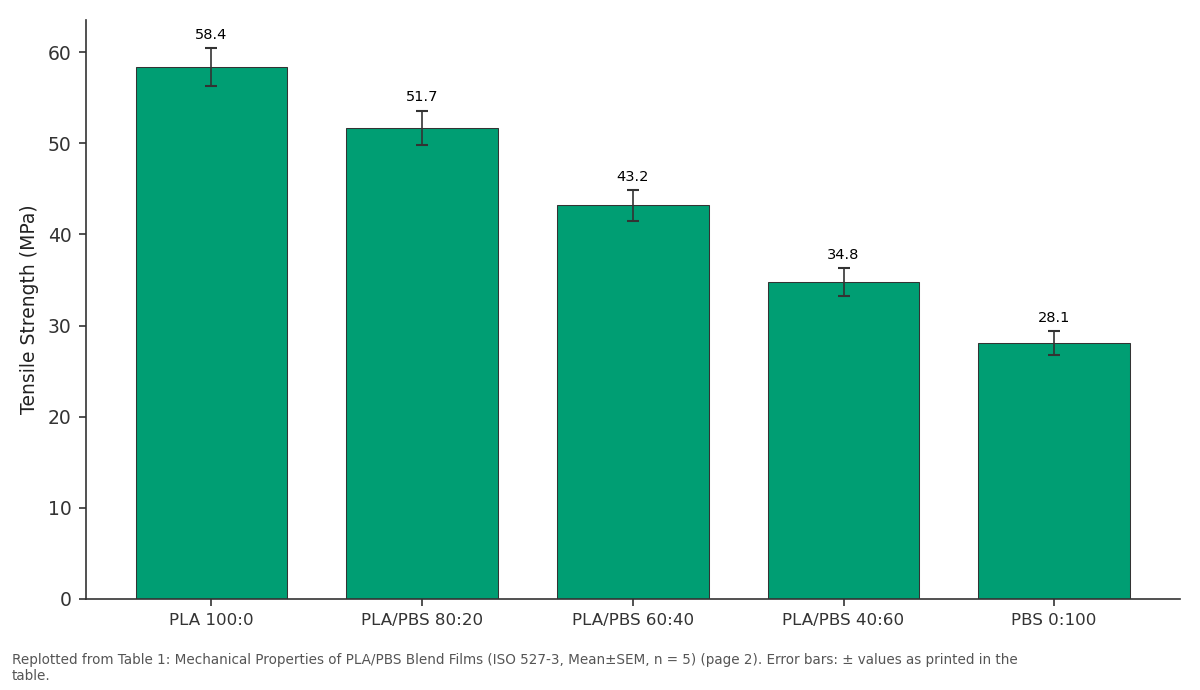
Tensile Strength (MPa): PLA 100:0 vs PLA/PBS 80:20 vs PLA/PBS 60:40 vs PLA/PBS 40:60 vs PBS 0:100
Replotted from Table 1 (page 2) of the original paper. Every bar is the paper's own table value.
View source evidence ↗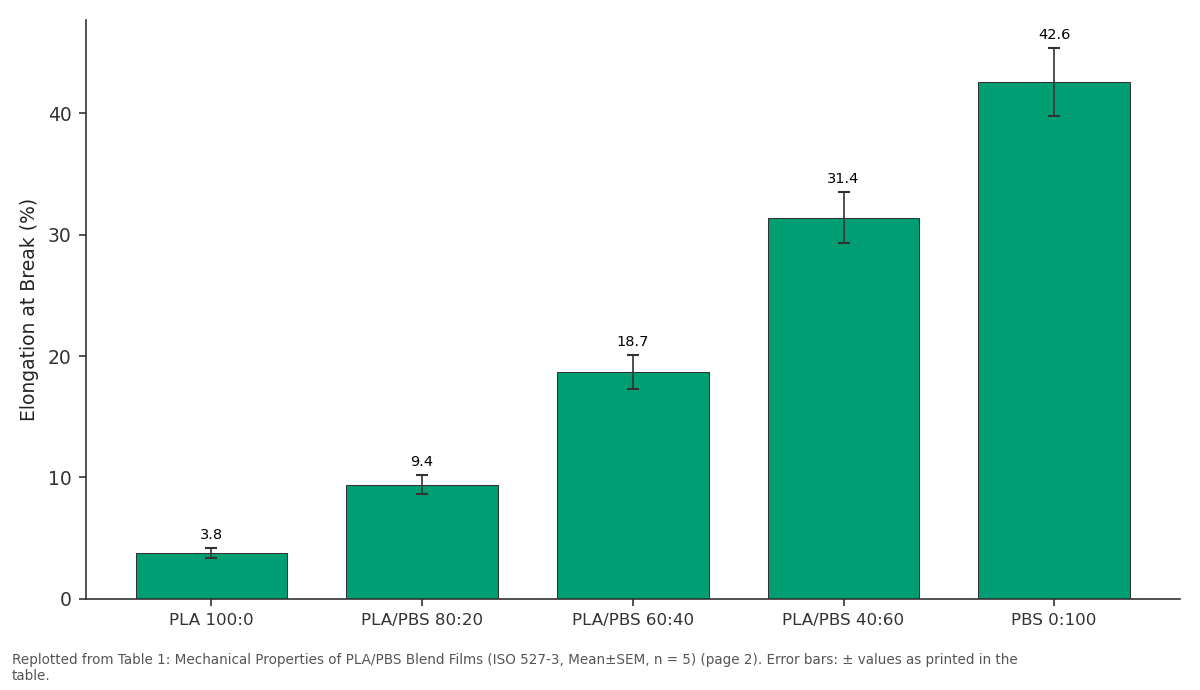
Elongation at Break (%): PLA 100:0 vs PLA/PBS 80:20 vs PLA/PBS 60:40 vs PLA/PBS 40:60 vs PBS 0:100
Replotted from Table 1 (page 2) of the original paper. Every bar is the paper's own table value.
View source evidence ↗Figures & tables
From the original paper Table 1
 Table 2
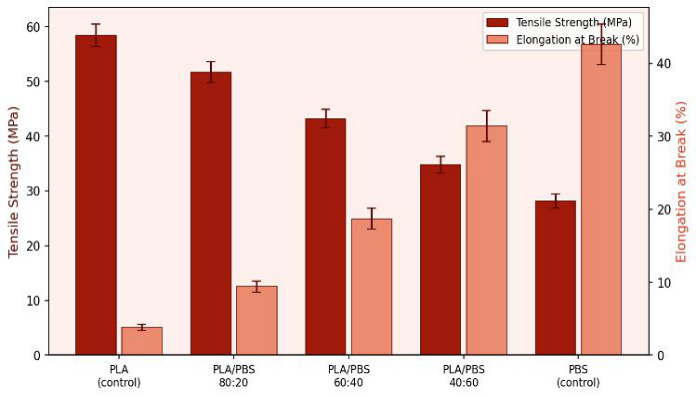 Figure 1
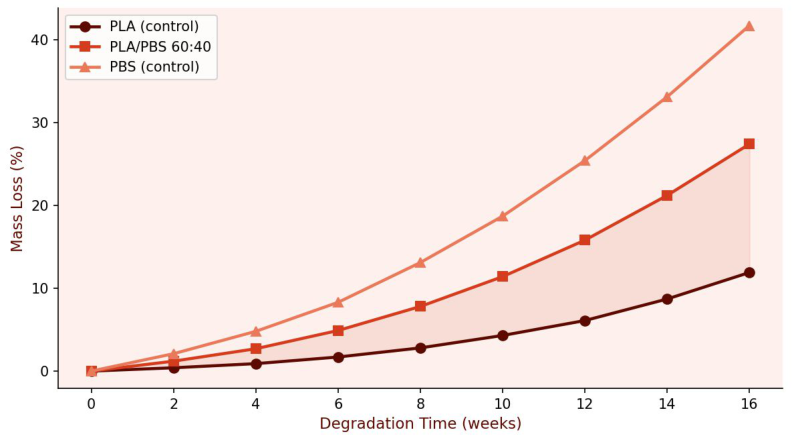 Figure 2
Introduction
Global plastic packaging production generates over 140 million tonnes of waste annually, the majority of which is not recycled, creating persistent environmental contamination. Biopolymers such as PLA, derived from fermentation of renewable sugars, have attracted commercial interest as drop-in replacements because they are compostable under industrial conditions and reduce fossil feedstock dependency. PLA's mechanical profile-high tensile strength (~60 MPa), high modulus (~3.5 GPa), but very low elongation at break (<5%)makes it well suited to rigid packaging but poorly suited to flexible film applications such as cling wraps, pouches, and agricultural mulch films where ductility is essential. PBS, an aliphatic polyester with documented soil biodegradability, offers complementary properties: lower tensile strength but elongation at break exceeding 40% and better low-temperature performance. PLA/PBS blending is therefore a logical approach to creating a ductile, biodegradable film material. Previous work has shown partial miscibility between PLA and PBS driven by transesterification during melt processing, but the degree of compatibility and its effect on degradation rate depend strongly on processing conditions and composition ratio. This research provides a systematic composition-property-biodegradability dataset across five blend ratios at packaging-relevant film dimensions, filling a gap in the quantitative optimisation literature. Bionolle 1001, Mn 87 kDa) were used as received after vacuum drying at 80 °C (PLA) and 50 °C (PBS) for 12 h. Research was conducted at the Department of Materials Chemistry and Polymer Science, University of Calabria, Arcavacata di Rende, Cosenza, Italy, from September 2022 to November 2024.
Materials and Methods
Materials and Methods
Materials
Materials
Methods
Blends were melt-compounded on a co-rotating twin-screw extruder (Leistritz ZSE 18, L/D 40, 175-185 °C barrel temperature profile, 120 rpm) and granulated. Films (80-100 μm) were prepared by compression moulding at 185 °C and 5 MPa for 3 min, followed by quenching at 25 °C. Tensile testing used dumbbell specimens (ISO 527-3 Type 5) at a crosshead speed of 50 mm/min (Zwick Roell Z2.5 universal testing machine). Five specimens per composition were tested; results are mean±SEM. DSC (TA Instruments Q2000, -50 to 220 °C, 10 °C/min) and WAXD (PANalytical Empyrean, Cu Kα, 5-40° 2θ) characterised thermal and crystalline properties. Soil biodegradation followed ASTM D5988-18: films were buried at 5 cm depth in a controlled compost soil (55% moisture, 25 °C) and weighed gravimetrically at 2-week intervals over 16 weeks.
Quality Control
Film thickness uniformity was verified at nine locations per film using a digital micrometer (Mitutoyo 293-340-30,±1 μm resolution); films exceeding±10% deviation from target thickness were discarded and recast. Tensile specimens were conditioned at 23 °C and 50% RH for 48 h prior to testing. Instrument calibration: the Zwick Roell Z2.5 crosshead force was verified with certified dead-weight standards (Class 1, PTB traceable) at the start of each test day. Soil moisture was monitored gravimetrically at 48 h intervals during biodegradation experiments and adjusted to 55±3% by addition of deionised water. Triplicates of each biodegradation time point were averaged; the variance across triplicates remained below 4% throughout.
Results
All five compositions produced uniform films within the 80-100 μm target range. Tensile strength decreased linearly from 58.4 MPa (neat PLA) to 28.1 MPa (neat PBS) with increasing PBS content, while elongation at break increased from 3.8% to 42.6% in the same direction (Figure 1, Table 1). The 60:40 blend achieved 43.2 MPa tensile strength with 18.7% elongation at break-substantially more ductile than neat PLA while retaining adequate mechanical performance for flexible packaging. DSC data (Table 2) showed that PLA Tg decreased from 58.3 °C (neat) to 51.7 °C at 60:40, and PLA cold crystallisation enthalpy decreased, indicating PBS-induced disruption of PLA crystallisation. Soil biodegradation (Figure 2) showed the expected hierarchy: PBS > blends > neat PLA, with the 60:40 blend losing 27.4% mass after 16 weeks versus 11.9% for neat PLA.
| Composition | PLA Tg (°C) | PLA Tcc (°C) | ΔHcc (J/g) | Mass Loss at 16 wk (%) |
|---|---|---|---|---|
| PLA 100:0 | 58.3 | 103.4 | 28.7±1.1 | 11.9±0.8 |
| PLA/PBS 80:20 | 56.1 | 99.7 | 22.4±0.9 | 16.3±1.1 |
| PLA/PBS 60:40 | 51.7 | 94.2 | 14.8±0.7 | 27.4±1.7 |
| PLA/PBS 40:60 | 46.4 | — | 4.3±0.4 | 34.1±2.0 |
| PBS 0:100 | — | — | — | 41.7±2.4 |
Table text extracted from the original PDF; superscript letters are shown inline. The original table image is below.
View original table image
| Composition | Tensile Strength (MPa) | Young's Modulus (GPa) | Elongation at Break (%) | Yield Stress (MPa) |
|---|---|---|---|---|
| PLA 100:0 | 58.4±2.1 | 3.41±0.14 | 3.8±0.4 | 54.7±1.9 |
| PLA/PBS 80:20 | 51.7±1.9 | 2.87±0.11 | 9.4±0.8 | 48.3±1.7 |
| PLA/PBS 60:40 | 43.2±1.7 | 2.23±0.09 | 18.7±1.4 | 39.1±1.5 |
| PLA/PBS 40:60 | 34.8±1.5 | 1.64±0.07 | 31.4±2.1 | 29.8±1.3 |
| PBS 0:100 | 28.1±1.3 | 0.71±0.04 | 42.6±2.8 | — |
Table text extracted from the original PDF; superscript letters are shown inline. The original table image is below.
View original table image
Conclusion
PLA/PBS blend films were prepared across five composition ratios and characterised for mechanical and biodegradation properties. The 60:40 blend optimally balances tensile strength (43.2 MPa), ductility (18.7% elongation at break), and biodegradability (27.4% mass loss in 16-week soil burial). DSC and WAXD data confirmed that PBS reduces PLA crystallinity and Tg, facilitating both toughening and accelerated hydrolytic degradation. These findings provide a quantitative composition-property map to guide selection of PLA/PBS ratios for specific flexible packaging end-uses, and highlight the 60:40 blend as the priority composition for further optimisation through reactive compatibilisation or nucleating agent addition.
Acknowledgement
Acknowledgements
References
17 in the original paper- Lim LT, Auras R, Rubino M. Processing technologies for poly(lactic acid). Prog Polym Sci. 2008;33(8):820852.
- Ikada Y, Tsuji H. Biodegradable polyesters for medical and ecological applications. Macromol Rapid Commun. 2000;21(3):117-132.
- Tsuji H. Poly(lactic acid) stereocomplexes: a decade of progress. Adv Drug Deliv Rev. 2016;107:97-135.
- Mistry C, Shah B. Poly(butylene succinate): a promising bio-based polymer. Int J Eng Res Technol. 2019;8(6):673-678.
- Shibata M, Inoue Y, Miyoshi M. Mechanical properties, morphology, and crystallisation behaviour of blends of poly(L-lactide) with poly(butylene succinate-co-Llactate) and poly(butylene succinate). Polymer. 2006;47(10):3557-3564.
- Ohkita T, Lee SH. Thermal degradation and biodegradability of poly(lactic acid)/corn starch biocomposites. J Appl Polym Sci. 2006;100(4):30093017.
- Bhatia A, Gupta RK, Bhattacharya SN, Choi HJ. Compatibility of biodegradable poly(lactic acid) (PLA) and poly(butylene succinate) (PBS) blends for International Journal of Advanced Chemistry Research https://www.chemistryjournals.net packaging application. Korea-Aust Rheol J. 2007;19(3):125-131.
- Chen GX, Kim HS, Kim ES, Yoon JS. Compatibilisation-like effect of reactive organoclay on the poly(L-lactide)/poly(butylene succinate) blends. Polymer. 2005;46(25):11829-11836.
- Fujimaki T. Processability and properties of aliphatic polyesters, 'BIONOLLE', synthesized by polycondensation reaction. Polym Degrad Stab. 1998;59(1-3):209-214.
- Ray SS, Okamoto M. Biodegradable polylactide and its nanocomposites: opening a new dimension for plastics and composites. Macromol Rapid Commun. 2003;24(14):815-840.
- Weng YX, Jin YJ, Meng QY, Wang L, Zhang M, Wang YZ. Biodegradation behavior of poly(butylene adipateco-terephthalate) (PBAT), poly(lactic acid) (PLA), and their blend under soil conditions. Polym Test. 2013;32(5):918-926.
- Astm D638-14. Standard Test Method for Tensile Properties of Plastics. West Conshohocken, PA: ASTM International; 2014.
- ISO 527-3:2018. Plastics -Determination of Tensile Properties -Part 3: Test Conditions for Films and Sheets. Geneva: ISO; 2018.
- ASTM D5988-18. Standard Test Method for Determining Aerobic Biodegradation of Plastic Materials in Soil. West Conshohocken, PA: ASTM International; 2018.
- Tserki V, Matzinos P, Pavlidou E, Vachliotis D, Panayiotou C. Biodegradable aliphatic polyesters. Part I. Properties and biodegradation of poly(butylene succinate-co-butylene adipate). Polym Degrad Stab. 2006;91(2):367-376.
- Müller RJ, Kleeberg I, Deckwer WD. Biodegradation of polyesters containing aromatic constituents. J Biotechnol. 2001;86(2):87-95.
- Nofar M, Sacligil D, Carreau PJ, Kamal MR, Heuzey MC. Poly(lactic acid) blends: processing, properties and applications. Int J Biol Macromol. 2019;125:307-360.