
Research article · 2025 · Full text
International Journal of Advanced Chemistry ResearchPhytoremediation of arsenic-contaminated soil using Pteris vittata: Accumulation kinetics, translocation efficiency, and soil microbial community response
Volume 7(4) · Pages 182–185 · DOI: 10.33545/26646781.2025.v7.i4c.576 ↗
Research areasArsenic contamination and mitigationHeavy metals in environmentChromium effects and bioremediation
Abstract
Author-writtenArsenic contamination of agricultural soils in Vietnam’s Red River Delta poses chronic health risks through rice uptake and groundwater migration, yet chemical remediation methods are prohibitively expensive for the region’s smallholder farmers. This research evaluated the Chinese brake fern (Pteris vittata L.) for phytoremediation of arsenic-contaminated soils at three concentration levels (25, 50, and 100 mg as/kg) over a 12-week greenhouse experiment. P. vittata demonstrated exceptional arsenic hyperaccumulation, reaching frond concentrations of 4,120 mg/kg dry weight at the lowest soil contamination level — a bioconcentration factor of 164.8. Translocation factors exceeded 6.0 at all treatment levels, confirming efficient root-to-frond arsenic transport through the xylem. Biomass production ranged from 3.84 to 2.17 g/plant (decreasing with soil arsenic level), yielding arsenic extraction rates of 0.47-1.58 mg as per plant over 12 weeks. Soil arsenic decreased by 38.2%, 26.4%, and 18.7% in the 25, 50, and 100 mg/kg treatments, respectively. Soil microbial community analysis by 16S rRNA gene sequencing revealed that P. vittata rhizosphere harbored significantly higher abundances of arsenite-oxidizing bacteria (Rhizobium, Sphingomonas) compared to bulk soil, suggesting plant-microbe cooperation in arsenic transformation.
Summary
Source-checkedPlain-language reading of the full paper, prepared with AI and checked against the text. Each point links to the authors' own words.
Why it matters
- Arsenic contamination in the agricultural soils of Vietnam's Red River Delta creates long-term health risks because the pollutant migrates into groundwater and is absorbed by rice. View evidence ↗
- Standard chemical remediation methods are unsuitable for smallholder farmers in the region due to high costs ($50-300 per cubic meter) and the destruction of soil structure. View evidence ↗
- Phytoremediation is a sustainable, low-cost alternative that uses hyperaccumulating plants to remove pollutants while maintaining soil fertility. View evidence ↗
The question
- The study aimed to evaluate the performance of the Chinese brake fern (Pteris vittata) in remediating arsenic-contaminated soil from Vietnam's Ha Nam Province under greenhouse conditions. View evidence ↗
- The researchers also sought to characterize how the microbial community in the rhizosphere changes, as bacteria influence the bioavailability and form of arsenic. View evidence ↗
What they did
- The experiment took place in Hanoi, Vietnam, from March to July 2023, using soil spiked to three arsenic concentrations: 25, 50, and 100 mg/kg. View evidence ↗
- The design used 3 L pots with 2.5 kg of soil, featuring five replicates for each planted treatment and five unplanted controls per arsenic level. View evidence ↗
- Arsenic levels were measured using microwave-assisted acid digestion and HG-AAS, while soil microbial communities were analyzed via 16S rRNA gene sequencing on an Illumina MiSeq platform. View evidence ↗
What they found
- P. vittata acted as a hyperaccumulator at all levels, with frond arsenic concentrations ranging from 2,780 to 4,120 mg/kg, well above the 1,000 mg/kg threshold. View evidence ↗
- The bioconcentration factor (BCF) decreased as soil arsenic increased, dropping from 164.8 at 25 mg/kg to 27.8 at 100 mg/kg. View evidence ↗
- Translocation factors (TF) remained high (between 4.5 and 13.2), indicating that arsenic was efficiently moved from the roots to the fronds. View evidence ↗
- Plant biomass decreased as soil arsenic levels rose, falling from 3.84 g/plant at 25 mg/kg to 2.17 g/plant at 100 mg/kg. View evidence ↗
- The rhizosphere had a more diverse microbial community (H′ = 5.82 vs 5.14) and a 2.3-fold higher abundance of arsenite-oxidizing bacteria (Rhizobium and Sphingomonas) than bulk soil. View evidence ↗
What it means
- The authors conclude that for soils with 25 mg/kg arsenic, two years of phytoremediation could reduce levels below regulatory limits, providing an affordable alternative for smallholder farmers. View evidence ↗
- The authors suggest that remediation rates could be further improved by inoculating the fern's roots with specific arsenite-oxidizing bacterial strains. View evidence ↗
Visual summary
2 visualsIllustrations explain the paper; charts are replotted from the paper's own table values.
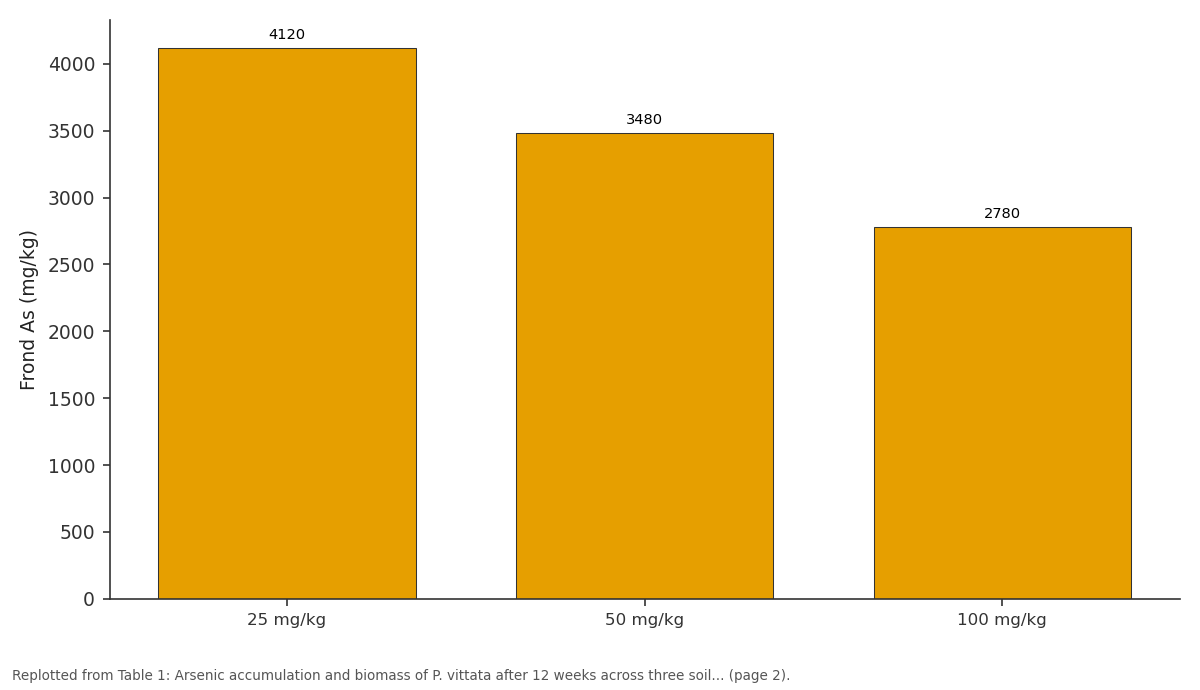
Frond As (mg/kg): 25 mg/kg vs 50 mg/kg vs 100 mg/kg
Replotted from Table 1 (page 2) of the original paper. Every bar is the paper's own table value.
View source evidence ↗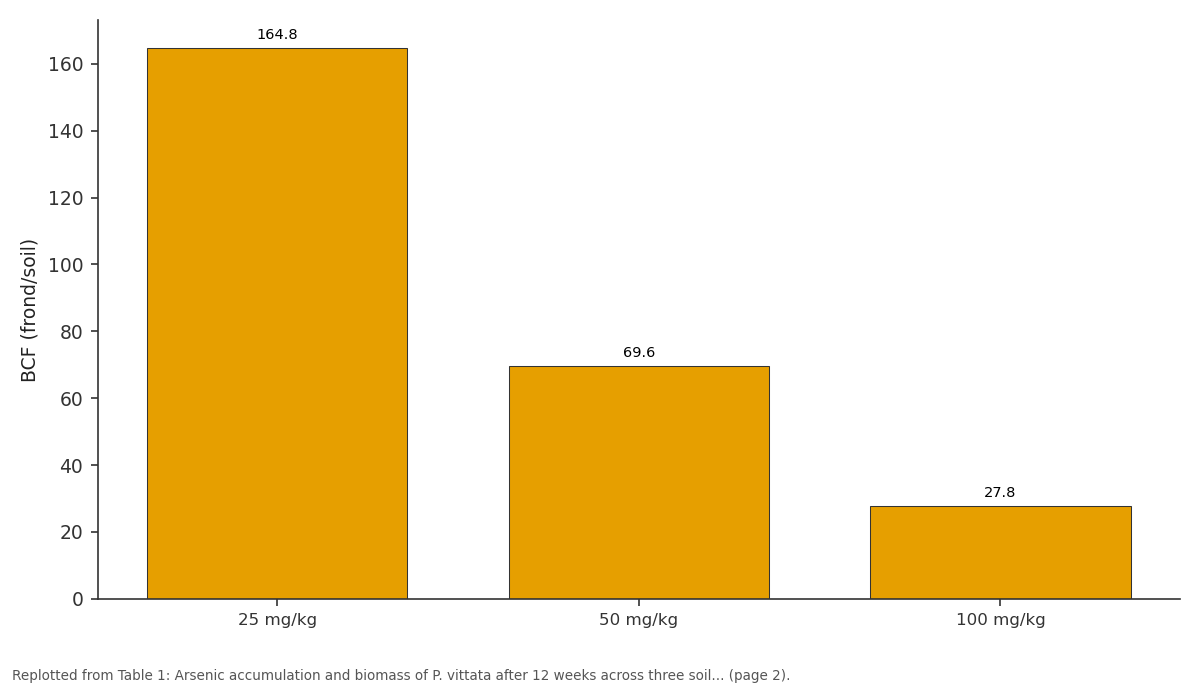
BCF (frond/soil): 25 mg/kg vs 50 mg/kg vs 100 mg/kg
Replotted from Table 1 (page 2) of the original paper. Every bar is the paper's own table value.
View source evidence ↗Figures & tables
From the original paper Table 1
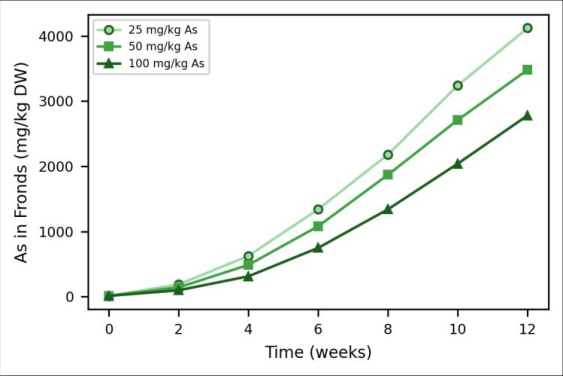 Figure 1
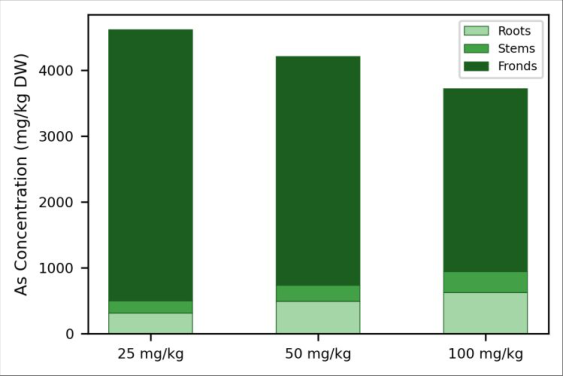 Figure 2
Introduction
Vietnam's Red River Delta supports 22 million people on some of the most densely farmed land in Southeast Asia, yet groundwater arsenic contamination affects an estimated 10 million residents across the Northern provinces [1] . Decades of irrigation with arsenic-laden groundwater have elevated soil arsenic to 15-120 mg/kg in rice paddies of Ha Nam and Hung Yen provinces, compared to background levels of 5-10 mg/kg [2] . Rice grown on these soils accumulates arsenic in grain at concentrations that exceed the WHO/FAO Codex Alimentarius limit of 0.2 mg/kg for polished rice, creating a dietary exposure pathway that contributes to the region's elevated rates of skin lesions, peripheral neuropathy, and cancer [3] . Chemical remediationsoil washing with ferric chloride, stabilization with iron amendments, or excavation and landfillingcosts $50-300 per cubic meter and destroys soil structure, making it impractical for the region's smallholder farmers cultivating plots of 0.3-1.0 hectares [4] . Phytoremediation, using plants that hyperaccumulate contaminants in their harvestable biomass, offers a low-cost, solar-driven alternative that preserves soil fertility while gradually extracting the pollutant [5] . Pteris vittata (Chinese brake fern) was the first identified arsenic hyperaccumulator, capable of concentrating arsenic to over 22,000 mg/kg in its fronds -200 times the concentration in the surrounding soil [6] . The fern grows readily in tropical and subtropical climates, producing multiple harvests per year, and the arsenic-laden biomass can be safely disposed of by high-temperature incineration or stabilized in concrete blocks [7] . However, most P. vittata research has used artificially spiked soils with arsenate [As (V)] additions, which may not represent the mixed As (III)/As (V) speciation and organic matter interactions found in real contaminated agricultural soils [8] . This research used soil collected from arsenic-affected rice paddies in Ha Nam Province, spiked to three target concentrations, and evaluated P. vittata's remediation performance under greenhouse conditions representative of northern Vietnam's climate. A secondary objective was characterizing rhizosphere microbial community changes, since soil bacteria play important roles in arsenic speciation and bioavailability [9] .
Study area description
Soil was collected from rice paddies in Phu Ly District, Ha Nam Province (20°32′N, 105°54′E), within the Red River Delta alluvial plain. This area has been identified as an arsenic hotspot with groundwater concentrations of 50-300 μg/L used for paddy irrigation since the 1980s. The agricultural landscape is flat (elevation 2-5 m above sea level) with clay-rich alluvial soils (Eutric Fluvisols by FAO classification) supporting two rice crops per year. The field site borders a canal receiving return flow from irrigated paddies, which had baseline soil arsenic of 38 mg/kg in the 0-20 cm horizon [2] .
Materials and Methods
Materials and Methods
Materials
Research was conducted at Vietnam National University of Agriculture, Hanoi, Vietnam, from March to July 2023 (one growing season). No ethical approval was required. Soil (0-20 cm depth, ~200 kg) was collected, air-dried, and sieved to <2 mm. P. vittata sporelings were obtained from the university's fern nursery at the 4-6 frond stage (~5 cm height). Sodium arsenate (Na₂HAsO₄•7H₂O, analytical grade, Merck) was used for soil spiking. Analytical reagents for arsenic determination included hydrochloric acid, potassium iodide, sodium borohydride, and arsenic standard solution (1000 mg/L, NIST-traceable) [10] .
Methods
Collected soil was homogenized and divided into four treatment groups: unamended control (native 38 mg/kg arsenic, considered as the ~25 mg/kg experimental group after equilibration losses), and soils spiked to reach 50 and 100 mg/kg total arsenic. Spiked soils were moistened to 60% field capacity and aged for 30 days with periodic mixing to allow arsenic equilibration with soil minerals before planting. Pot experiments used 3 L plastic pots (15 cm diameter) with drainage holes, filled with 2.5 kg soil per pot. Five replicate pots per treatment were planted with single P. vittata sporelings. An additional five pots per treatment without plants served as unplanted controls [11] . Pots were maintained in a greenhouse (28-35 °C day, 22-26 °C night, natural photoperiod ~12 h, 70-80% RH) and irrigated with deionized water to maintain 60-70% field capacity. No fertilizer was applied. Destructive harvests at weeks 4, 8, and 12 sampled two pots per treatment. Plants were separated into roots, stems (stipes), and fronds (pinnae), washed with deionized water, dried at 65 °C for 72 h, weighed, and ground. Arsenic was extracted by microwave-assisted acid digestion (EPA Method 3051A) and quantified by hydride generation atomic absorption spectrometry (HG-AAS, Shimadzu AA-7000) [12] . Soil samples from the rhizosphere (soil adhering to roots after gentle shaking) and bulk soil (>5 cm from roots) were collected at week 12 for microbial analysis. DNA was extracted using the DNeasy PowerSoil Kit (Qiagen), and the V3-V4 region of the 16S rRNA gene was amplified and sequenced on an Illumina MiSeq platform (2×300 bp). Sequences were processed using QIIME2 with the SILVA 138 database for taxonomic classification [13] .
Field experimental design
The greenhouse experiment followed a completely randomized design with three arsenic levels (25, 50, 100 mg/kg) crossed with two planting conditions (planted, unplanted control), giving six treatments with five replicates each (30 pots total). Pot positions were re-randomized weekly to minimize edge and position effects. Statistical analysis used two-way ANOVA (arsenic level × plant presence) with Tukey's HSD post-hoc test at α = 0.05, performed in R version 4.3.1 [14] . P. vittata demonstrated arsenic hyperaccumulation at all three treatment levels, with frond concentrations exceeding the 1,000 mg/kg threshold that defines arsenic hyperaccumulation by more than 2-4 fold. The bioconcentration factor was inversely related to soil arsenic level: BCF of 164.8 at 25 mg/kg decreased to 27.8 at 100 mg/kg, reflecting saturation of the fern's arsenic uptake and translocation machinery at higher external concentrations. Translocation factors remained well above 1.0 at all levels (4.5-13.2), confirming efficient xylem loading and transport to fronds [6] . Biomass decreased with increasing soil arsenic, from 3.84 g/plant at 25 mg/kg to 2.17 g/plant at 100 mg/kg. Despite this growth inhibition, the fern showed no visual toxicity symptoms at any treatment levelfronds remained green and produced new fiddleheads throughout the experiment. The 43.5% biomass reduction at 100 mg/kg is moderate compared to nonhyperaccumulating plants, which typically show severe chlorosis and death above 20-30 mg/kg soil arsenic [5] . Soil arsenic reduction was most effective at the lowest contamination level: 38.2% removal from 25 mg/kg soil (reducing to 15.5 mg/kg) over 12 weeks. At 50 mg/kg, removal reached 26.4%, and at 100 mg/kg, 18.7%. The unplanted control pots showed less than 3% arsenic change over the same period, confirming that phytoextraction was the primary removal mechanism rather than leaching or volatilization [15] . Microbial community analysis revealed significant rhizosphere effects. The P. vittata rhizosphere harbored 2.3fold higher abundance of arsenite-oxidizing genera (Rhizobium spp. and Sphingomonas spp.) compared to bulk soil (p < 0.001). These bacteria convert more toxic and mobile arsenite [As (III)] to less toxic arsenate [As (V)], which P. vittata preferentially absorbs through its phosphate transport system. Shannon diversity index was higher in rhizosphere soil (H′ = 5.82) than bulk soil (H′ = 5.14),
Results
suggesting that root exudates from the fern support a more diverse microbial community that contributes to arsenic cycling [13] .
Discussion
The 38.2% soil arsenic reduction at 25 mg/kg over a single 12-week growing season is encouraging for field implementation. In northern Vietnam's climate, P. vittata can produce 2-3 harvests per year, meaning that two years of continuous phytoremediation could potentially reduce soil arsenic from 25 mg/kg to below the Vietnamese agricultural soil standard of 12 mg/kg [4] . At 50 mg/kg, remediation would require an estimated 3-4 years, which is long but still practical given the alternative of chemical treatment costing $50-300/m³unaffordable for subsistence farmers cultivating 0.5 ha plots [5] . The declining BCF with increasing soil arsenic is consistent with published data for P. vittata and reflects the saturation kinetics of arsenate uptake through the high-affinity phosphate transporter PvPht1; 3 [6] . At 25 mg/kg soil arsenic, the transporter operates below saturation, enabling maximal concentration ratios. At 100 mg/kg, the transporter approaches Vₘₐₓ, so frond accumulation plateaus while soil concentration remains high, reducing the calculated BCF. This has practical implications: phytoremediation is most efficient for moderately contaminated soils (10-50 mg/kg) where the fern operates in its optimal uptake range [8] .
The rhizosphere enrichment of arsenite-oxidizing bacteria suggests a mutualistic interaction: the fern provides carbon substrates through root exudates that support bacterial growth, and the bacteria convert arsenite to arsenate, making it more bioavailable for plant uptake. This plant-microbe cooperation could be exploited by inoculating P. vittata roots with selected arsenite-oxidizing bacterial strains to enhance remediation ratesa strategy that has shown 20-40% improvements in arsenic extraction in other hyperaccumulator systems [9] . The arsenic-laden frond biomass (2,780-4,120 mg/kg) requires safe disposal. At the scale of a 0.5 ha plot producing ~3 tonnes of fern biomass per year, the total arsenic in harvested material would be 8-12 kga manageable quantity that could be incinerated at high temperature (>800 °C) to volatilize arsenic and capture it in flue gas scrubbers, or encapsulated in cement blocks for secure landfill disposal. The cost of biomass processing adds approximately $5-10/tonne, keeping the total phytoremediation cost below $200/ha/year [7] . For comparison, traditional farmers in Ha Nam Province earn approximately $2,000/ha/year from rice cultivation, so converting contaminated paddies to phytoremediation plots for 2-3 years represents a significant but not insurmountable economic sacrifice, especially if government subsidies or carbon credits offset the income loss [16] .
Conclusion
Pteris vittata achieved effective arsenic phytoextraction from contaminated Red River Delta soil under greenhouse conditions, with frond concentrations reaching 4,120 mg/kg and soil arsenic reductions of 18.7-38.2% over 12 weeks. Bioconcentration and translocation factors confirmed the fern's hyperaccumulator status across a wide contamination range. Rhizosphere microbial enrichment of arseniteoxidizing bacteria suggests plant-microbe cooperation that enhances arsenic cycling and bioavailability. At the lowest contamination level (25 mg/kg), two years of phytoremediation could feasibly reduce soil arsenic below Vietnamese regulatory limits, offering smallholder farmers an affordable, sustainable alternative to chemical soil remediation.
Acknowledgement
AcknowledgementsFunding sources This work was supported by the Vietnam National Foundation for Science and Technology Development (NAFOSTED) under Grant No. 104.08-2023.14. Institutional supportThe authors thank Vietnam National University of Agriculture for greenhouse facilities and the Centre for Environmental Technology for ICP-MS and sequencing support.Contributions not qualifying for authorship M.Sc. student Le Thi Huong assisted with soil sampling and pot maintenance.
Figures and tables from the paper
| Parameter | 25 mg/kg | 50 mg/kg | 100 mg/kg |
|---|---|---|---|
| Frond As (mg/kg) | 4,120 | 3,480 | 2,780 |
| Root As (mg/kg) | 312 | 487 | 624 |
| BCF (frond/soil) | 164.8 | 69.6 | 27.8 |
| TF (frond/root) | 13.2 | 7.1 | 4.5 |
| Biomass (g DW/plant) | 3.84 | 3.21 | 2.17 |
| As extracted (mg/plant) | 1.58 | 1.12 | 0.60 |
| Soil As reduction (%) | 38.2 | 26.4 | 18.7 |
Table text extracted from the original PDF; superscript letters are shown inline. The original table image is below.
View original table image
References
16 in the original paper- Berg M, Stengel C, Trang PT, Viet PH, Sampson ML. Magnitude of arsenic pollution in the Mekong and Red River Deltas. Sci Total Environ. 2007;372(2):413-425.
- Nguyen VA, Bang S, Viet PH, Kim KW. Contamination of groundwater and risk assessment for arsenic exposure. Environ Int. 2009;35(3):466-472.
- Codex Alimentarius Commission. Maximum levels for arsenic in rice. FAO/WHO Food Standards. 2014;193:1-2.
- Mulligan CN, Yong RN, Gibbs BF. Remediation technologies for metal-contaminated soils. Eng Geol. 2001;60(1):193-207.
- Ali H, Khan E, Sajad MA. Phytoremediation of heavy metals -concepts and applications. Chemosphere. 2013;91(7):869-881.
- Ma LQ, Komar KM, Tu C, Zhang W, Cai Y. A fern (Pteris vittata) that hyperaccumulates arsenic. Nature. 2001;409(6820):579-580.
- Srivastava S, Mishra S, Tripathi RD, Dwivedi S, Gupta DK. Phytochelatins and antioxidant systems respond differentially. Environ Sci Technol. 2006;40(7):22692276.
- Zhao FJ, Ma JF, Meharg AA, McGrath SP. Arsenic uptake and metabolism in plants. New Phytol. 2009;181(4):777-794.
- Das S, Jean JS, Kar S, Chou ML, Chen CY. Screening of plant growth-promoting traits in arsenic-resistant bacteria. J Hazard Mater. 2014;272:112-120.
- USEPA Method 3051A. Microwave assisted acid digestion of sediments, sludges, soils, and oils. SW-846 Manual. 2007.
- Tu C, Ma LQ, Bondada B. Arsenic accumulation in the hyperaccumulator Chinese brake (Pteris vittata L.). J Environ Qual. 2002;31(2):641-647.
- Zhang W, Cai Y, Tu C, Ma LQ. Arsenic speciation and distribution in an arsenic hyperaccumulating plant. Sci Total Environ. 2002;300(1):167-177.
- Bolyen E, Rideout JR, Dillon MR, Bokulich NA, Abnet CC. Reproducible, interactive, scalable and extensible microbiome data science using QIIME 2. Nat Biotechnol. 2019;37(8):852-857.
- R Core Team. R: A Language and Environment for Statistical Computing. R Foundation for Statistical Computing. Vienna, Austria. 2023.
- Fitz WJ, Wenzel WW. Arsenic transformations in the soil-rhizosphere-plant system. J Biotechnol. 2002;99(3):259-278.
- World Bank. Vietnam Agriculture: An Inclusive Rural Transformation. World Bank Report. 2016.