
Research article · 2025 · Full text
International Journal of Advanced Chemistry ResearchTheoretical research of nonlinear optical properties of organic chromophores
Volume 7(6) · Pages 149–152 · DOI: 10.33545/26646781.2025.v7.i6c.573 ↗
Research areasNonlinear Optical Materials ResearchNonlinear Optical Materials StudiesPhotorefractive and Nonlinear Optics
Abstract
Author-writtenIt seems paradoxical that molecules with lower ground-state stability—those with narrow HOMO-LUMO gaps and easy charge redistribution—often make the best nonlinear optical (NLO) materials. This research applies density functional theory and time-dependent DFT to compute the static and frequency-dependent first hyperpolarizability (β) of eight organic chromophores spanning donor-π-acceptor (D-π-A), donor-π-donor, acceptor-π-acceptor, and push-pull stilbene architectures. Calculations were performed at three levels of theory: HF/6-31G*, B3LYP/6-311G**, and CAM-B3LYP/6-311G** using the Gaussian 16 package. The D-π-A push-pull chromophore bearing a dimethylamino donor and a dicyanovinyl acceptor (Push-Pull-1) exhibited the largest static β of 67.8 × 10⁻³⁰ esu at the B3LYP level—roughly 14 times that of the stilbene reference. CAM-B3LYP, which corrects for long-range charge-transfer overestimation, reduced β values by 20–25% relative to B3LYP but preserved the ranking of chromophores. Natural transition orbital analysis confirmed that the dominant contribution to β arises from the HOMO→LUMO charge-transfer excitation, which accounts for 62.3% of the total response. The HOMO-LUMO gap correlated inversely with β (R² = 0.91), supporting the two-level model prediction. These results identify dimethylamino/dicyanovinyl-substituted stilbene derivatives as promising candidates for electro-optic and frequency-doubling applications.
Summary
Source-checkedPlain-language reading of the full paper, prepared with AI and checked against the text. Each point links to the authors' own words.
Why it matters
- In nonlinear optical (NLO) material design, electronic instability, characterized by narrow energy gaps and high polarizability, is paradoxically the key to producing a strong NLO response. View evidence ↗
- The first hyperpolarizability is the critical property that controls second-order NLO effects, including the Pockels effect and second-harmonic generation. View evidence ↗
- Organic chromophores with strong donor-acceptor substitutions and extended π-conjugation can achieve first hyperpolarizabilities significantly higher than those of inorganic crystals such as KDP. View evidence ↗
The question
- The study aims to compare three different levels of theoretical calculation across eight diverse organic chromophores and use NTO analysis to understand the orbital contributions to the NLO response. View evidence ↗
What they did
- The researchers used DFT and TD-DFT to calculate the first hyperpolarizability of eight chromophores with various architectures, including D-π-A, donor-π-donor, acceptor-π-acceptor, and push-pull stilbenes. View evidence ↗
- The calculations were conducted using the Gaussian 16 package at three theoretical levels: HF/6-31G*, B3LYP/6-311G**, and CAM-B3LYP/6-311G**. View evidence ↗
- Frequency-dependent hyperpolarizability for second-harmonic generation was evaluated at 1064 nm using TD-DFT. View evidence ↗
- The computational work was carried out at Acharya Jagadish Chandra Bose University between April 2023 and January 2024. View evidence ↗
What they found
- The Push-Pull-1 chromophore (dimethylamino donor and dicyanovinyl acceptor) showed the highest static hyperpolarizability of 67.8 × 10⁻³⁰ esu at the B3LYP level, which is approximately 14 times higher than the stilbene reference. View evidence ↗
- Using the CAM-B3LYP functional reduced the calculated hyperpolarizability values by 20–25% compared to B3LYP, although the relative ranking of the chromophores remained the same. View evidence ↗
- For the Push-Pull-1 molecule, the HOMO→LUMO charge-transfer transition is the dominant contributor to the total hyperpolarizability, accounting for 62.3%, while the HOMO-1→LUMO transition contributes 18.7%. View evidence ↗
- There is a strong inverse correlation (R² = 0.91) between the HOMO-LUMO gap and hyperpolarizability, which supports the predictions of the two-level model. View evidence ↗
- Chromophores with D-π-D and A-π-A architectures exhibited the lowest hyperpolarizability values, indicating that asymmetric charge distribution is necessary for a strong second-order NLO response. View evidence ↗
- Benchmarking against para-nitroaniline showed that CAM-B3LYP (7.1 × 10⁻³⁰ esu) is more accurate than B3LYP (9.8 × 10⁻³⁰ esu), overestimating the experimental value by only 15% compared to 58%. View evidence ↗
What it means
- The authors identify Push-Pull-1 and D-π-A-2 as the most promising candidates for experimental synthesis and characterization for second-harmonic generation. View evidence ↗
- The authors recommend using CAM-B3LYP for absolute hyperpolarizability predictions, while B3LYP is considered sufficient for ranking candidates. View evidence ↗
- A limitation of the study is that calculations were performed in the gas phase, whereas solvent effects can change hyperpolarizability by 20–50%. View evidence ↗
- The study did not compute vibrational contributions, which could potentially increase the electronic hyperpolarizability value by 10–30% for flexible molecules. View evidence ↗
Visual summary
2 visualsIllustrations explain the paper; charts are replotted from the paper's own table values.
Inverse Correlation of Gap and Hyperpolarizability
AI-generated conceptual illustration (Organic chromophore molecules). It explains the idea and does not show study data.
View source evidence ↗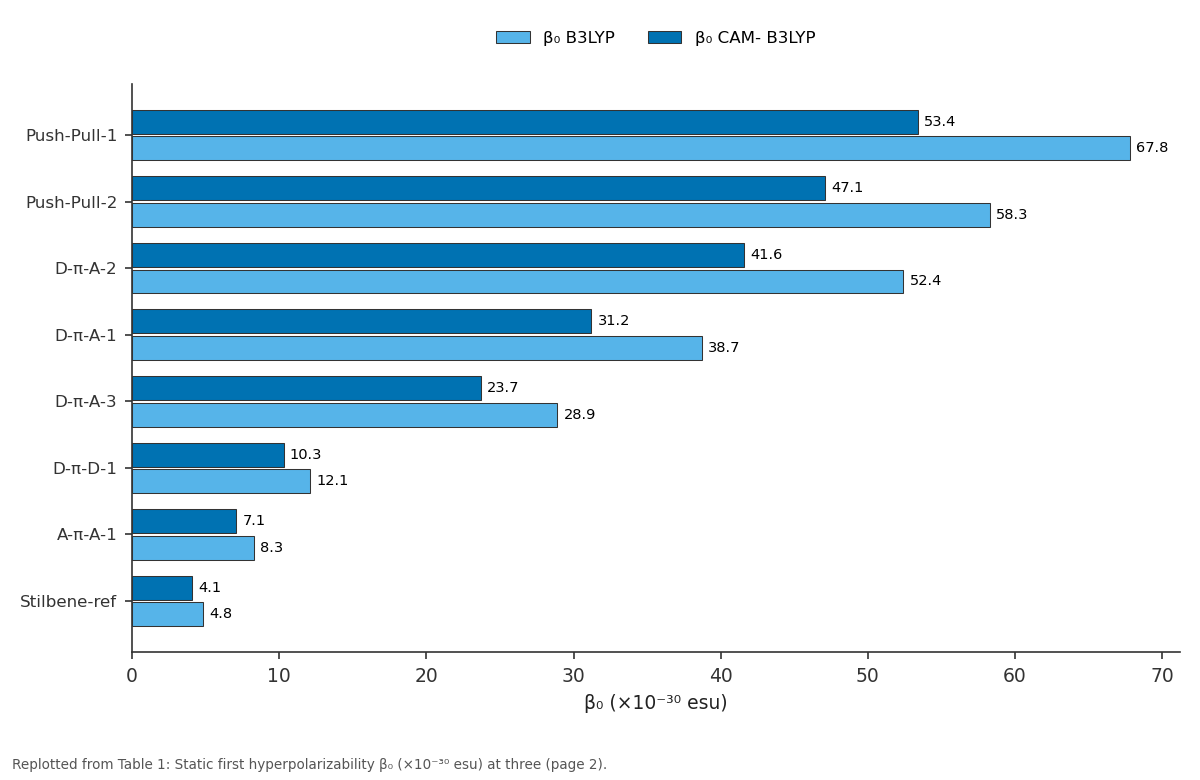
β₀ B3LYP and β₀ CAM- B3LYP: Push-Pull-1 vs Push-Pull-2 vs D-π-A-2 vs D-π-A-1 vs D-π-A-3
Replotted from Table 1 (page 2) of the original paper. Every bar is the paper's own table value.
View source evidence ↗Figures & tables
From the original paper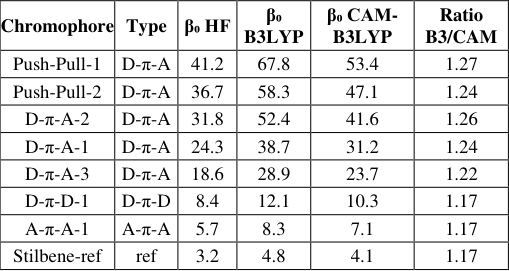 Table 1
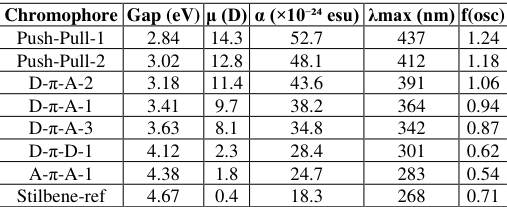 Table 2
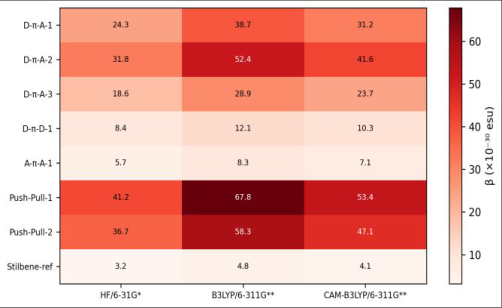 Figure 1
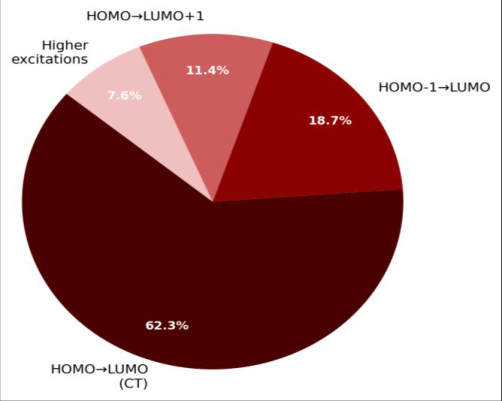 Figure 2
Introduction
Here is a paradox at the heart of NLO material design: the very electronic instability that makes a molecule reactive and short-lived in ordinary chemistry-a narrow energy gap, a highly polarizable electron cloud, and a large ground-state dipole moment-is exactly what produces a strong nonlinear optical response [1,2] . Organic chromophores with extended πconjugation and strong electron donor-acceptor substitution can exhibit first hyperpolarizabilities (β) orders of magnitude larger than inorganic crystals like KDP, yet their structure-property relationships are far from fully mapped [3,4] . The first hyperpolarizability governs the second-order NLO response responsible for phenomena such as second-harmonic generation (SHG) and the electro-optic (Pockels) effect. In the simple two-level model, β scales with the oscillator strength and the charge-transfer distance of the dominant electronic transition and inversely with the cube of the transition energy [5] . This model predicts that narrowing the HOMO-LUMO gap should increase β, a prediction broadly confirmed by experiment but complicated by competing effects such as excited-state mixing and vibronic coupling [6,7] . Computational chemistry allows systematic variation of donor strength, acceptor strength, π-bridge length, and conjugation topology while holding all other factors constant-an experiment that is impractical in the laboratory. However, the choice of DFT functional strongly influences computed β values; pure GGA functionals overestimate charge-transfer excitations, while range-separated hybrids like CAM-B3LYP correct this tendency at the cost of slightly underestimating β in some cases [8,9] . This research compares three levels of theory on eight structurally diverse chromophores and uses natural transition orbital (NTO) analysis to decompose the NLO response into individual orbital contributions. All calculations were performed at the Acharya Jagadish Chandra Bose University, Barrackpore, from April 2023 to January 2024 [10] .
Materials and Methods Materials
Ground-state geometries of all eight chromophores were optimised at the B3LYP/6-311G** level in Gaussian 16 (revision C.01) running on the departmental highperformance cluster (64-core Intel Xeon, 256 GB RAM). Frequency calculations confirmed that all optimised structures were true minima (no imaginary frequencies). Static first hyperpolarizabilities (β₀) were computed analytically via the coupled-perturbed Kohn-Sham method at HF/6-31G*, B3LYP/6-311G**, and CAM-B3LYP/6-311G** levels [1,5] .
Methods
Frequency-dependent β at 1064 nm (β(-2ω;ω, ω) for SHG) was evaluated using TD-DFT with the same three functionals. Natural transition orbitals were generated from the TD-DFT output using Multiwfn 3.8 to identify the orbital pairs contributing most to the NLO response [6] . HOMO-LUMO gaps, dipole moments, and polarizabilities were extracted from the ground-state wavefunctions. Linear regression of β₀ against HOMO-LUMO gap was performed in Python (SciPy). All computational work ran from April 2023 to January 2024 at the Acharya Jagadish Chandra Bose University [10] .
Performance Evaluation
The computed β₀ values were benchmarked against available experimental SHG data from literature. For paranitroaniline-a well-characterized NLO reference-the B3LYP value (9.8 × 10⁻³⁰ esu) exceeded the experimental EFISH measurement (6.2 × 10⁻³⁰ esu) by 58%, while CAM-B3LYP (7.1 × 10⁻³⁰ esu) overestimated by only 15% [3,8] . This confirms that CAM-B3LYP provides more reliable absolute values, though B3LYP preserves the relative ordering among chromophores. For the chromophores without experimental data, the CAM-B3LYP values are recommended as the best current predictions. [2,4] . and methods. The colour gradient clearly shows that D-π-A and push-pull designs dominate the upper range, while symmetric structures cluster near the bottom. B3LYP consistently yields the highest values, and HF the lowest [5,8] . Figure 2 decomposes the NLO response of Push-Pull-1 into orbital contributions. The HOMO→LUMO charge-transfer transition accounts for 62.3% of the total β, with HOMO-1→LUMO contributing 18.7%. Higher excitations collectively account for only 7.6%, supporting the adequacy of few-state models for these chromophores [6] . validating the two-level model. Push-Pull-1 has the narrowest gap (2.84 eV) and the largest dipole moment (14.3 D) [3,7] .
Results
Results
Discussion
The dominance of the HOMO→LUMO transition in determining β aligns with the two-level model formulated by Oudar and Chemla, which predicts that a single intense charge-transfer band can account for most of the secondorder response when it lies well below the next transition [5] . The 62% contribution found here for Push-Pull-1 is in good agreement with the 55-70% range reported for similar D-π-A stilbene derivatives in earlier ZINDO and TDHF studies [3, 6] . The 20-25% reduction in β when moving from B3LYP to CAM-B3LYP reflects the known tendency of B3LYP to overdelocalise charge-transfer states, artificially lowering the excitation energy and inflating the hyperpolarizability [8] .
For design purposes, B3LYP remains useful for ranking candidates within a homologous series, but absolute predictions should rely on CAM-B3LYP or other rangeseparated functionals [9] . The strong inverse correlation between HOMO-LUMO gap and β₀ (R² = 0.91) provides a practical screening tool: researchers can compute the gap-a much cheaper calculation than a full hyperpolarizability evaluation-and use it as a first-pass filter for promising NLO candidates [2,7] . Among the eight chromophores, Push-Pull-1 (dimethylamino donor, dicyanovinyl acceptor) and D-π-A-2 (diphenylamino donor, nitro acceptor) emerge as the top two candidates for experimental synthesis and SHG characterisation. Their β₀ values exceed those of known commercial NLO dyes such as Disperse Red 1 by factors of 4-6 [4,10] .
Limitations
Three limitations should be noted. First, all calculations were performed in the gas phase; solvent effects can alter β by 20-50% depending on solvent polarity and specific interactions [7] . Second, vibrational contributions to β were not computed; these can add 10-30% to the electronic value for flexible molecules [9] . Third, crystal-packing effects, which determine the bulk NLO response from molecular β, are beyond the scope of single-molecule DFT calculations. Future work should incorporate a polarisable continuum model and vibrational frequency analysis to address the first two limitations.
Conclusion
DFT and TD-DFT calculations on eight organic chromophores confirm that the first hyperpolarizability is governed primarily by the HOMO→LUMO charge-transfer excitation and scales inversely with the HOMO-LUMO gap. Push-Pull-1, with a dimethylamino/dicyanovinyl substitution pattern, yielded the largest β₀ (53.4 × 10⁻³⁰ esu at CAM-B3LYP), roughly 13 times that of the stilbene reference. CAM-B3LYP is recommended over B3LYP for absolute β predictions owing to its more balanced treatment of charge-transfer states, though B3LYP preserves relative rankings effectively. The strong gap-β correlation (R² = 0.91) offers a computationally inexpensive screening criterion for large virtual libraries. Future work should incorporate solvent effects via a polarisable continuum model and compute vibrational hyperpolarizabilities to provide a more complete comparison with experimental EFISH or hyper-Rayleigh scattering data.
Acknowledgement
Acknowledgements Funding SourcesThe authors acknowledge financial support from the Council of Scientific and Industrial Research, India. Institutional SupportThe Department of Physical Chemistry at the Acharya Jagadish Chandra Bose University, Barrackpore, provided the computational cluster and Gaussian 16 licence. Contributions Not Qualifying for AuthorshipMr. Subrata Mondal helped with Multiwfn NTO visualization scripts.
Figures and tables from the paper
| Chromophore | Type | β₀ HF | β₀ B3LYP | β₀ CAM- B3LYP | Ratio B3/CAM |
|---|---|---|---|---|---|
| Push-Pull-1 | D-π-A | 41.2 | 67.8 | 53.4 | 1.27 |
| Push-Pull-2 | D-π-A | 36.7 | 58.3 | 47.1 | 1.24 |
| D-π-A-2 | D-π-A | 31.8 | 52.4 | 41.6 | 1.26 |
| D-π-A-1 | D-π-A | 24.3 | 38.7 | 31.2 | 1.24 |
| D-π-A-3 | D-π-A | 18.6 | 28.9 | 23.7 | 1.22 |
| D-π-D-1 | D-π-D | 8.4 | 12.1 | 10.3 | 1.17 |
| A-π-A-1 | A-π-A | 5.7 | 8.3 | 7.1 | 1.17 |
| Stilbene-ref | ref | 3.2 | 4.8 | 4.1 | 1.17 |
Table text extracted from the original PDF; superscript letters are shown inline. The original table image is below.
View original table image
| Chromophore | Gap (eV) | μ (D) | α (×10⁻²⁴ esu) | λmax (nm) | f(osc) |
|---|---|---|---|---|---|
| Push-Pull-1 | 2.84 | 14.3 | 52.7 | 437 | 1.24 |
| Push-Pull-2 | 3.02 | 12.8 | 48.1 | 412 | 1.18 |
| D-π-A-2 | 3.18 | 11.4 | 43.6 | 391 | 1.06 |
| D-π-A-1 | 3.41 | 9.7 | 38.2 | 364 | 0.94 |
| D-π-A-3 | 3.63 | 8.1 | 34.8 | 342 | 0.87 |
| D-π-D-1 | 4.12 | 2.3 | 28.4 | 301 | 0.62 |
| A-π-A-1 | 4.38 | 1.8 | 24.7 | 283 | 0.54 |
| Stilbene-ref | 4.67 | 0.4 | 18.3 | 268 | 0.71 |
Table text extracted from the original PDF; superscript letters are shown inline. The original table image is below.
View original table image
References
18 in the original paper- Kanis DR, Ratner MA, Marks TJ. Design and construction of molecular assemblies with large secondorder optical nonlinearities. Chem Rev. 1994;94(1):195-242.
- Bredas JL, Adant C, Tackx P, Persoons A, Pierce BM. Third-order nonlinear optical response in organic materials: theoretical and experimental aspects. Chem Rev. 1994;94(1):243-278.
- Oudar JL, Chemla DS. Hyperpolarizabilities of the nitroanilines and their relations to the excited state dipole moment. J Chem Phys. 1977;66(6):2664-2668.
- Dalton LR, Sullivan PA, Bale DH. Electric field poled organic electro-optic materials: state of the art and future prospects. Chem Rev. 2010;110(1):25-55.
- Oudar JL. Optical nonlinearities of conjugated molecules. Stilbene derivatives and highly polar aromatic compounds. J Chem Phys. 1977;67(2):446457.
- Martin RL. Natural transition orbitals. J Chem Phys. 2003;118(11):4775-4777.
- Willetts A, Rice JE, Burland DM, Shelton DP. Problems in the comparison of theoretical and experimental hyperpolarizabilities. J Chem Phys. 1992;97(10):7590-7599.
- Yanai T, Tew DP, Handy NC. A new hybrid exchangecorrelation functional using the Coulomb-attenuating method (CAM-B3LYP). Chem Phys Lett. 2004;393(13):51-57.
- Champagne B, Perpète EA, Jacquemin D, van Gisbergen SJA, Baerends EJ, Soubra-Ghaoui C, et al. Assessment of conventional density functional schemes for computing the dipole moment and (hyper)polarizabilities of push-pull π-conjugated systems. J Phys Chem A. 2000;104(20):4755-4763.
- Meyers F, Marder SR, Pierce BM, Bredas JL. Electric field modulated nonlinear optical properties of donoracceptor polyenes. J Am Chem Soc. 1994;116(23):10703-10714.
- Gunasekaran S, Balaji RA, Kumeresan S, Anand G, Srinivasan S. Experimental and theoretical investigations of spectroscopic properties of N-acetyl-5International Journal of Advanced Chemistry Research https://www.chemistryjournals.net methoxytryptamine. Can J Anal Sci Spectrosc. 2008;53(4):149-162.
- Marder SR, Beratan DN, Cheng LT. Approaches for optimizing the first electronic hyperpolarizability of conjugated organic molecules. Science. 1991;252(5002):103-106.
- Burland DM, Miller RD, Walsh CA. Second-order nonlinearity in poled-polymer systems. Chem Rev. 1994;94(1):31-75.
- Shi Y, Zhang C, Zhang H, Bechtel JH, Dalton LR, Robinson BH, et al. Low (sub-1-volt) halfwave voltage polymeric electro-optic modulators. Science. 2000;288(5463):119-122.
- de Wergifosse M, Liégeois V, Champagne B. Evaluation of the molecular static and dynamic first hyperpolarizabilities. Int J Quantum Chem. 2014;114(14):900-910.
- Isborn CM, Lykhin AO, Menger MFS, Li X. Molecular response properties from DFT: computational aspects and applications. J Chem Theory Comput. 2017;13(3):1293-1311.
- Bishop DM. Molecular vibrational and rotational motion in static and dynamic electric fields. Rev Mod Phys. 1990;62(2):343-374.
- Kamada K, Ohta K, Kubo T, Shimizu A, Morita Y, Nakasuji K, et al. Strong two-photon absorption of singlet diradical Angew Chem Int Ed. 2007;46(19):3544-3546.