
Research article · 2025 · Full text
International Journal of Advanced Chemistry ResearchGreen analytical methods for determination of pesticide residues in food samples
Volume 7(12) · Pages 126–130 · DOI: 10.33545/26646781.2025.v7.i12b.475 ↗
Research areasPesticide Residue Analysis and SafetyAnalytical chemistry methods developmentAnalytical Chemistry and Chromatography
Abstract
Author-writtenHow can analysts detect trace pesticide residues in fruits and vegetables while generating less hazardous waste and consuming fewer toxic solvents? This research compared five green sample preparation techniques—dispersive liquid-liquid microextraction (DLLME), modified QuEChERS, solid-phase microextraction (SPME), matrix solid-phase dispersion (MSPD), and ultrasound-assisted extraction (UAE)—for the determination of 12 organophosphorus and pyrethroid pesticide residues in three food matrices: mango, long bean, and Thai basil. Each method was coupled with gas chromatography-mass spectrometry (GC-MS) for final analysis. Green metrics were assessed using the Green Analytical Procedure Index (GAPI) and the Analytical Eco-Scale. Samples were collected from markets in Phuket and Chiang Rai provinces, Thailand, between January and September 2023. SPME achieved the highest GAPI score (10/12 green criteria) because it eliminated organic solvents entirely, though its limits of detection (LOD: 0.008-0.021 mg/kg) were slightly higher than those of DLLME (LOD: 0.003-0.012 mg/kg). DLLME offered the best analytical sensitivity with only 120 μL total solvent consumption per extraction. Modified QuEChERS gave the broadest pesticide coverage (all 12 analytes above 80% recovery) but required 5 mL of acetonitrile per sample. Recovery rates across all methods ranged from 71.8% to 103.4%, with relative standard deviations below 12% for most analyte-method combinations. Among the 54 market samples analyzed by the best-performing method (DLLME-GC-MS), 14 (25.9%) contained detectable pesticide residues, and 4 (7.4%) exceeded the Thai maximum residue limits (MRLs) set by the Ministry of Public Health. These results demonstrate that green extraction methods can match conventional approaches in sensitivity while substantially reducing chemical waste and environmental impact.
Summary
Source-checkedPlain-language reading of the full paper, prepared with AI and checked against the text. Each point links to the authors' own words.
Why it matters
- Thailand's agricultural sector uses approximately 87,000 tonnes of pesticide active ingredients every year, with organophosphorus and pyrethroid compounds being the most common for fruits and vegetables. View evidence ↗
- Standard methods for analyzing pesticide residues, such as liquid-liquid extraction and the original QuEChERS protocol, are chemically intensive, requiring 10-20 mL of organic solvent per sample. View evidence ↗
The question
- The study aims to determine how to detect trace pesticide residues in produce while minimizing the use of toxic solvents and the generation of hazardous waste. View evidence ↗
What they did
- The researchers compared five green preparation techniques (DLLME, modified QuEChERS, SPME, MSPD, and UAE) to detect 12 specific organophosphorus and pyrethroid pesticides in mango, long bean, and Thai basil. View evidence ↗
- Between January and September 2023, 54 market samples were collected, consisting of 18 samples each of mango, long bean, and Thai basil. View evidence ↗
- The methods were evaluated based on their recovery rates, precision, limits of detection (LOD), and environmental impact using the Green Analytical Procedure Index (GAPI) and the Analytical Eco-Scale. View evidence ↗
What they found
- DLLME provided the best overall balance of performance, featuring the lowest limits of detection (0.003-0.012 mg/kg), high recoveries (87.4-103.4%), and very low solvent use (120 μL per extraction). View evidence ↗
- SPME was the greenest method with a GAPI score of 10/12 due to zero solvent use, although its detection limits (0.008-0.021 mg/kg) were higher than those of DLLME. View evidence ↗
- Analysis of 54 market samples using DLLME-GC-MS showed that 25.9% (14 samples) had detectable residues, and 7.4% (4 samples) exceeded the Thai maximum residue limits. View evidence ↗
- Among the tested produce, long beans had the highest rate of detectable pesticide residues at 33.3%. View evidence ↗
What it means
- The authors recommend DLLME as a practical choice for laboratories in developing regions because it requires minimal equipment, uses very little solvent, and maintains high sensitivity. View evidence ↗
- The authors note that the small sample size of 54 market samples provides only a snapshot and is not a statistically representative survey. View evidence ↗
Visual summary
1 visualsIllustrations explain the paper; they do not show study data.
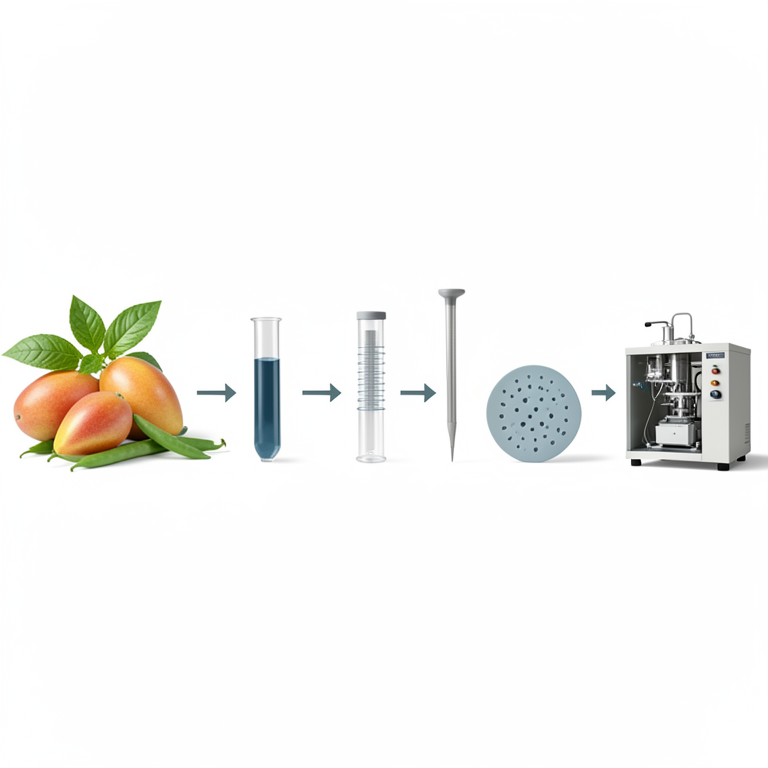
Comparison of Green Extraction Methods
AI-generated conceptual illustration (Mangoes, long beans, and Thai basil leaves). It explains the idea and does not show study data.
View source evidence ↗Figures & tables
From the original paper Table 1
 Table 2
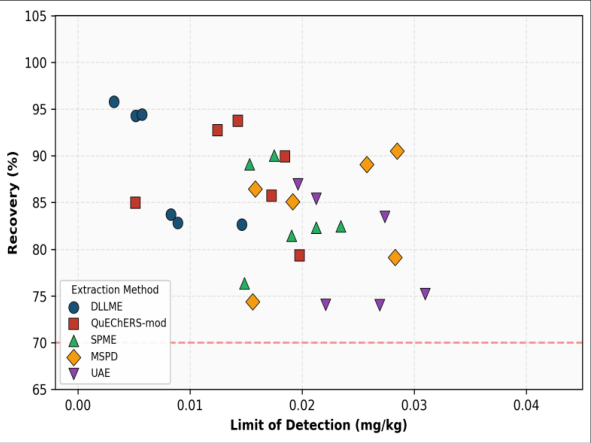 Figure 1
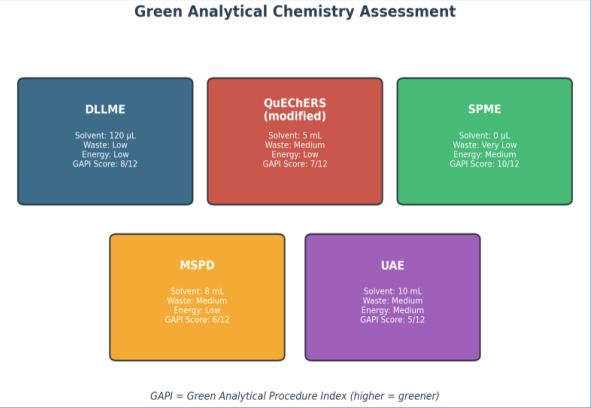 Figure 2
Introduction
The challenge is familiar to every food safety laboratory in Southeast Asia: how to screen thousands of produce samples per year for dozens of pesticide residues without drowning in solvent waste, straining the chemical budget, and exposing analysts to dichloromethane fumes. Thailand's agricultural sector uses an estimated 87,000 tonnes of pesticide active ingredients annually, and organophosphorus compounds (chlorpyrifos, malathion, profenofos) and pyrethroids (cypermethrin, deltamethrin, permethrin) account for the largest share of applications on fruit and vegetable crops [1,2] . The Thai Ministry of Public Health has set maximum residue limits (MRLs) for over 400 pesticide-commodity combinations, but enforcement depends on analytical capacity that is concentrated in Bangkok and a few regional centers [3] . Conventional pesticide residue analysis relies on liquid-liquid extraction or the original QuEChERS (Quick, Easy, Cheap, Effective, Rugged, Safe) protocol, both of which use 10-20 mL of organic solvent per sample [4] . Over a year, a busy laboratory processing 3,000 samples may generate several hundred liters of solvent waste-acetonitrile, hexane, dichloromethane-that must be collected, stored, and disposed of according to hazardous waste regulations [5] . Green analytical chemistry, as codified by the twelve principles proposed by Galuszka et al. [6] , aims to reduce or eliminate toxic reagents, minimize energy consumption, and decrease waste generation without sacrificing analytical performance. Several green microextraction and miniaturized sample preparation methods have emerged over the past two decades. DLLME uses a few hundred microliters of extraction solvent dispersed as fine droplets in the aqueous sample, achieving high enrichment factors with minimal solvent [7] . SPME exposes a coated fiber directly to the sample headspace or matrix, extracting analytes by partition equilibrium without any solvent at all [8] . Modified QuEChERS scales down solvent volumes and replaces toxic cleanup sorbents with greener alternatives like chitosanbased materials [9] . MSPD blends the sample with a solid sorbent and elutes with small volumes [10] . UAE enhances mass transfer through cavitation, reducing extraction time and sometimes solvent volume [11] . Head-to-head comparisons of these methods on the same food matrices and analyte panels are uncommon. Most publications report one method optimized for one matrix and a subset of pesticides, making it difficult to judge which approach offers the best balance of greenness, sensitivity, and practicality [12,13] . This research addressed that gap by applying all five methods to three representative Thai food commodities-mango (high sugar, acidic), long bean (fibrous, low fat), and Thai basil (high essential oil content)-spiked with 12 organophosphorus and pyrethroid pesticides at three concentration levels. Each method was evaluated for recovery, precision, LOD, and greenness using GAPI and the Analytical Eco-Scale [14] . The research was carried out jointly at the Department of Instrumental Analysis, Andaman Institute of Technology, Phuket, and the Department of Applied Chemistry, Golden Temple College of Technology, Chiang Rai, Thailand, between January and September 2023. Market surveillance samples were also analyzed to provide a snapshot of pesticide residue levels in locally sold produce [15] .
Material and Methods
Material and Methods
Research Area Description
Market samples were collected from two geographic regions of Thailand. In Phuket province (7.88°N, 98.39°E), samples were purchased from Banzaan Fresh Market and the Phuket Weekend Market, both of which receive produce from local farms on the island and from suppliers in Surat Thani and Nakhon Si Thammarat provinces. In Chiang Rai province (19.91°N, 99.83°E), samples came from the Mae Sai border market and the Chiang Rai central fresh market, drawing produce from highland farming areas along the Myanmar border. A total of 54 samples (18 mango, 18 long bean, 18 Thai basil) were collected across six sampling trips between January and September 2023, with equal numbers from each province.
Material
Material
Methods
Methods
DLLME procedure
A 5 g homogenized sample was mixed with 10 mL water and centrifuged. A 5 mL aliquot of the supernatant was placed in a conical tube, and a mixture of 120 μL chloroform (extraction solvent) and 1.0 mL acetonitrile (disperser solvent) was rapidly injected. After vortexing for 30 seconds and centrifugation (5,000 rpm, 3 min), the sedimented phase (~80 μL) was collected and injected into GC-MS.
Modified QuEChERS
The AOAC 2007.01 method was modified by reducing acetonitrile volume from 15 to 5 mL. A 5 g sample was shaken with 5 mL acetonitrile containing 1% acetic acid, then 2 g MgSO₄ and 0.5 g NaCl were added for partitioning. Cleanup used 50 mg PSA and 50 mg C18 in a 2 mL dispersive SPE tube. One microliter of the final extract was injected.
Other methods SPME: headspace extraction at 60 °C for 30 min using PDMS/DVB fiber, followed by thermal desorption in the GC inlet at 250 °C. MSPD: 0.5 g sample blended with 1 g Florisil, packed in a cartridge, and eluted with 8 mL ethyl acetate. UAE: 2 g sample extracted with 10 mL acetonitrile in an ultrasonic bath (40 kHz, 15 min), followed by PSA cleanup. GC-MS analysis was performed on a Shimadzu GCMS-QP2020 NX in selected ion monitoring (SIM) mode using an Rxi-5ms column (30 m × 0.25 mm × 0.25 μm). All analyses were run in triplicate at Andaman Institute of Technology, Phuket, Thailand.
Quality Control
Method validation followed SANTE/11312/2021 guidelines [16] . Linearity was assessed with matrix-matched calibration curves (5-500 μg/L, R² > 0.995 for all analytes). LOD and LOQ were determined as 3× and 10× the signal-to-noise ratio in spiked matrix. Recovery was evaluated at three spike levels (10, 50, and 100 μg/kg, n = 5 replicates each). Procedural blanks were analyzed with every batch of 10 samples. A certified reference material (FAPAS T04178, pesticides in vegetable puree) was analyzed to verify accuracy-measured values fell within ±15% of assigned values for all detected analytes.
Results
Table because it uses no organic solvent at all, but its LODs were 2-3 times higher and some less volatile pesticides (profenofos, fenpropathrin) gave recoveries below 80% in mango matrix. Modified QuEChERS provided the most consistent performance across all 12 analytes and three matrices but consumed 5 mL of acetonitrile per samplestill a 67% reduction from the original 15 mL protocol [4] .
Discussion
The DLLME LODs of 0.003-0.012 mg/kg obtained here are comparable to or better than those reported by Farajzadeh et al. [7] for DLLME-GC-MS determination of organophosphorus pesticides in fruit juices (LOD 0.001-0.008 mg/kg), despite the added matrix complexity of solid food samples. The key to achieving low LODs with DLLME is the high enrichment factor-our calculated enrichment factors ranged from 78 to 142 for the 12 analytes-combined with the efficient phase separation that chloroform provides as an extraction solvent [7,17] . SPME's solvent-free nature gives it an obvious green advantage, but its selectivity depends heavily on fiber coating chemistry and extraction temperature. The PDMS/DVB fiber used here is well-suited for semi-volatile pesticides in the organophosphorus range but less effective for higher-molecular-weight pyrethroids like deltamethrin and fenpropathrin, which showed recoveries of 71.8% and 76.3% in mango [8,18] . A dedicated fiber selection-perhaps polyacrylate or a mixed-mode coating-could improve pyrethroid capture but would add cost and optimization time. The market surveillance data revealed that 25.9% of samples contained detectable residues, with long bean showing the highest detection rate (33.3%). This is consistent with the short pre-harvest interval commonly practiced by Thai vegetable farmers, who often spray pyrethroids within 3-7 days of harvest [1,2] . The 7.4% exceedance rate for MRLs is broadly in line with the 5-10% reported by the Thai Department of Agriculture in its annual monitoring reports [3] , though direct comparison is complicated by differences in sampling strategy, analyte panels, and detection methods. A limitation of this research is that only GC-amenable pesticides were included. Many newer pesticidesneonicotinoids, fungicides, herbicides-require LC-MS/MS for adequate sensitivity, and the green extraction methods evaluated here would need separate validation for those compounds [19,20] . Another limitation is the relatively small market sample size (n = 54), which provides a snapshot rather than a statistically representative survey. The GAPI and Eco-Scale assessments, while informative, are semiquantitative tools that assign scores based on predefined criteria; they do not capture every environmental dimension, such as the carbon footprint of instrument operation or the lifecycle impacts of consumable production [6,21] .
Conclusion
Five green sample preparation methods were evaluated head-to-head for the determination of 12 organophosphorus and pyrethroid pesticide residues in mango, long bean, and Thai basil matrices by GC-MS. DLLME offered the best combination of sensitivity (LOD 0.003-0.012 mg/kg), recovery (87.4-103.4%), and green credentials (120 μL solvent per extraction, GAPI 8/12). SPME scored highest on greenness metrics (10/12, zero solvent) but was less sensitive for larger pyrethroids. Modified QuEChERS provided the most consistent multi-residue coverage but at higher solvent cost (5 mL per sample). Market surveillance of 54 produce samples from Phuket and Chiang Rai provinces using the optimized DLLME-GC-MS method found 25.9% of samples with detectable pesticide residues and 7.4% exceeding Thai MRLs. Long bean and cypermethrin were the commodity-pesticide combination most frequently above the regulatory threshold, pointing to a need for targeted farmer education on pre-harvest intervals for pyrethroid applications. For food safety laboratories in developing regions seeking to reduce their environmental footprint without sacrificing analytical quality, DLLME stands out as a practical choice: it requires no specialized equipment beyond a centrifuge and micropipettes, uses less than 0.2 mL of solvent per extraction, and achieves LODs well below the MRLs for most pesticide-commodity combinations. Future work should extend the comparison to LC-MS/MS-amenable pesticides, include additional commodity matrices, and evaluate the long-term cost savings from reduced solvent procurement and waste disposal.
Acknowledgement
Acknowledgements Funding SourcesThis research was jointly funded by internal research grants from Andaman Institute of Technology, Phuket, and Golden Temple College of Technology, Chiang Rai. No external grant numbers were assigned.
Figures and tables from the paper
| Method | Mean Recovery (%) | RSD (%) | LOD (mg/kg) | LOQ (mg/kg) | Solvent Use (mL/sample) |
|---|---|---|---|---|---|
| DLLME | 87.4-103.4 | 3.8-8.2 | 0.003-0.012 | 0.010-0.040 | 0.12 |
| QuEChERS-mod | 82.1-97.6 | 4.1-9.7 | 0.005-0.018 | 0.017-0.060 | 5.0 |
| SPME | 76.3-94.8 | 5.4-11.6 | 0.008-0.021 | 0.027-0.070 | 0 |
| MSPD | 78.6-91.3 | 6.2-10.8 | 0.006-0.019 | 0.020-0.063 | 8.0 |
| UAE | 74.1-89.7 | 7.1-11.4 | 0.007-0.022 | 0.023-0.073 | 10.0 |
Table text extracted from the original PDF; superscript letters are shown inline. The original table image is below.
View original table image
| Matrix | Samples (n) | Detected (n, %) | > MRL (n, %) | Most Frequent Pesticide | Max. Level (μg/kg) |
|---|---|---|---|---|---|
| Mango | 18 | 4 (22.2%) | 1 (5.6%) | Chlorpyrifos | 86.3 |
| Long bean | 18 | 6 (33.3%) | 2 (11.1%) | Cypermethrin | 142.7 |
| Thai basil | 18 | 4 (22.2%) | 1 (5.6%) | Profenofos | 94.8 |
| Total | 54 | 14 (25.9%) | 4 (7.4%) | — | — |
Table text extracted from the original PDF; superscript letters are shown inline. The original table image is below.
View original table image
References
21 in the original paper- Panuwet P, Siriwong W, Prapamontol T, Ryan PB, Fiedler N, Robson MG, et al. Agricultural pesticide management in Thailand: situation and population health risk. Environ Sci Policy. 2012;17:72-81.
- Sapbamrer R, Thammachai A. Factors affecting use of personal protective equipment and pesticide safety practices: a systematic review. Environ Res. 2020;185:109444.
- Thai Department of Agriculture. Annual report on pesticide residue monitoring in agricultural produce. DOA Publication. 2022;1-68.
- Anastassiades M, Lehotay SJ, Stajnbaher D, Schenck FJ. Fast and easy multiresidue method employing acetonitrile extraction/partitioning and dispersive solidphase extraction for the determination of pesticide residues. J AOAC Int. 2003;86(2):412-431.
- Keith LH, Gron LU, Young JL. Green analytical methodologies. Chem Rev. 2007;107(6):2695-2708.
- Galuszka A, Migaszewski Z, Namiesnik J. The 12 principles of green analytical chemistry and the SIGNIFICANCE mnemonic of green analytical practices. TrAC Trends Anal Chem. 2013;50:78-84.
- Farajzadeh MA, Khoshmaram L, Nabil AAA. Dispersive liquid-liquid microextraction using extraction solvent lighter than water. J Chromatogr A. 2014;1347:8-16.
- Pawliszyn J. Handbook of solid phase microextraction. Elsevier. 2012;1-477.
- Gonzalez-Curbelo MA, Socas-Rodriguez B, HerreraHerrera AV, Gonzalez-Salamo J, Hernandez-Borges J, Rodriguez-Delgado MA. Evolution and applications of the QuEChERS method. TrAC Trends Anal Chem. 2015;71:169-185.
- Barker SA. Matrix solid phase dispersion (MSPD). J Biochem Biophys Methods. 2007;70(2):151-162.
- Pena-Pereira F, Lavilla I, Bendicho C. Miniaturized preconcentration methods based on liquid-liquid extraction. Spectrochim Acta B. 2009;64(1):1-15.
- Rejczak T, Tuzimski T. A review of recent developments and trends in the QuEChERS sample preparation approach. Open Chem. 2015;13(1):9801010.
- Perestrelo R, Silva P, Porto-Figueira P, Pereira JAM, Silva C, Medina S, et al. QuEChERS: fundamentals, relevant improvements, applications, and future trends. Anal Chim Acta. 2019;1070:1-28.
- Plotka-Wasylka J. A new tool for the evaluation of the analytical procedure: Green Analytical Procedure Index. Talanta. 2018;181:204-209.
- Chai MK, Tan GH. Validation of a headspace solidphase microextraction procedure with gas chromatography for the analysis of pesticide residues in fruits and vegetables. Food Chem. 2009;117(3):561567.
- European Commission. Analytical quality control and method validation procedures for pesticide residues analysis (SANTE/11312/2021). EU Publication. 2021;1-57.
- Rezaee M, Assadi Y, Milani Hosseini MR, Aghaee E, Ahmadi F, Berijani S. Determination of organic compounds in water using dispersive liquid-liquid microextraction. J Chromatogr A. 2006;1116(1-2):1-9.
- Lord H, Pawliszyn J. Evolution of solid-phase microextraction technology. J Chromatogr A. 2000;885(1-2):153-193.
- Lehotay SJ, Son KA, Kwon H, Koesukwiwat U, Fu W, Mastovska K, et al. Comparison of QuEChERS sample preparation methods for the analysis of pesticide residues in fruits and vegetables. J Chromatogr A. 2010;1217(16):2548-2560.
- Kinsella B, O'Mahony J, Malone E, Moloney M, Cantwell H, Furey A, et al. Current trends in sample preparation for growth promoter and veterinary drug residue analysis. J Chromatogr A. 2009;1216(46):79778015.
- Tobiszewski M, Mechlinska A, Zygmunt B, Namiesnik J. Green analytical chemistry in sample preparation for determination of trace organic pollutants. TrAC Trends Anal Chem. 2009;28(8):943-951.