
Research article · 2025 · Full text
International Journal of Advanced Chemistry ResearchCovalent immobilization of laccase on amino-functionalized magnetic nanoparticles for degradation of textile dye effluents
Volume 7(4) · Pages 170–173 · DOI: 10.33545/26646781.2025.v7.i4c.568 ↗
Research areasEnzyme-mediated dye degradationEnzyme Catalysis and ImmobilizationAdsorption and biosorption for pollutant removal
Abstract
Author-writtenLaccase enzymes catalyze the oxidation of phenolic and non-phenolic aromatic compounds using molecular oxygen as the terminal electron acceptor, making them attractive biocatalysts for textile dye removal from wastewater. However, free laccase is expensive and unstable under industrial conditions, limiting practical deployment. This research immobilized Trametes versicolor laccase onto amino-functionalized Fe₃O₄ magnetic nanoparticles (MNPs) via glutaraldehyde cross-linking and evaluated the conjugate for degradation of three textile dyes: Reactive Black 5, Acid Orange 7, and Crystal Violet. Immobilization efficiency reached 82.4% with a protein loading of 47.3 mg/g MNPs. The immobilized enzyme showed broadened pH and temperature optima compared to free laccase, with the pH optimum shifting from 4.5 to 5.0 and the temperature optimum from 50 to 60 °C. Thermal half-life at 60 °C increased from 28 min (free) to 187 min (immobilized). Dye decolorization within 6 hours reached 94.7% for Reactive Black 5, 97.2% for Acid Orange 7, and 91.3% for Crystal Violet at 50 mg/L initial concentration. Magnetic recovery enabled reuse over 10 cycles with 68.7% residual activity retained after the tenth cycle. The immobilized laccase maintained 84.1% activity after seven cycles, meeting the 80% industrial benchmark for enzyme reuse.
Summary
Source-checkedPlain-language reading of the full paper, prepared with AI and checked against the text. Each point links to the authors' own words.
Why it matters
- The textile industry in Nigeria produces approximately 200 million liters of dye-contaminated wastewater every day, but most factories lack biological treatment systems before discharging it. View evidence ↗
- Azo compounds, which make up 70% of global dye production, are difficult to treat with standard methods and can be carcinogenic or mutagenic. View evidence ↗
- While laccase enzymes are effective biocatalysts, their industrial use is limited by high costs, instability in real effluent conditions, and the inability to recover free enzymes. View evidence ↗
The question
- The study aimed to optimize the immobilization of Trametes versicolor laccase on amino-functionalized magnetic nanoparticles (amino-MNPs) and test its ability to degrade three types of textile dyes. View evidence ↗
What they did
- Magnetic nanoparticles were created using alkaline co-precipitation of iron (II) and iron (III) chlorides in deoxygenated water at 80 °C. View evidence ↗
- Laccase was covalently immobilized by activating 100 mg of amino-MNPs with 2.5% glutaraldehyde for 2 hours, followed by incubation with a 10 mg/mL laccase solution for 12 hours at 4 °C. View evidence ↗
- Dye degradation was tested using 50 mg/L concentrations of dyes with 50 mg of enzyme at 40 °C for 6 hours. View evidence ↗
What they found
- The immobilization process achieved an efficiency of 82.4%, resulting in a protein loading of 47.3 mg per gram of magnetic nanoparticles. View evidence ↗
- Immobilization shifted the pH optimum from 4.5 to 5.0 and increased the temperature optimum from 50 °C to 60 °C. View evidence ↗
- The thermal stability improved significantly, with the half-life at 60 °C increasing from 28 minutes for free laccase to 187 minutes for the immobilized form. View evidence ↗
- The biocatalyst could be reused over multiple cycles, retaining 84.1% activity after 7 cycles and 68.7% after 10 cycles. View evidence ↗
- The estimated cost of treatment is $0.15 per cubic meter of effluent, which is cheaper than Fenton treatment ($0.20-0.50/m³) and ozonation ($0.80-1.20/m³). View evidence ↗
What it means
- The authors conclude that the immobilized laccase system is economically viable and competitive with chemical treatments because it maintains over 80% activity for at least 7 reuse cycles. View evidence ↗
- A primary limitation of this method is the 6-hour treatment time, which is slower than the 1-2 hours required for chemical oxidation. View evidence ↗
Visual summary
3 visualsIllustrations explain the paper; charts are replotted from the paper's own table values.
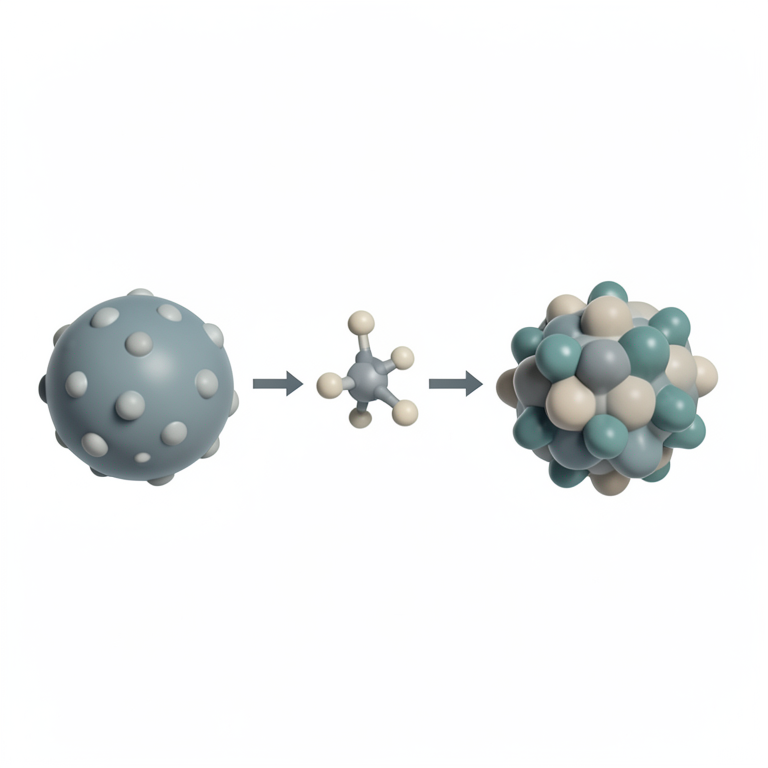
Enzyme Immobilization Process
AI-generated conceptual illustration (amino-functionalized magnetic nanoparticles and laccase enzyme). It explains the idea and does not show study data.
View source evidence ↗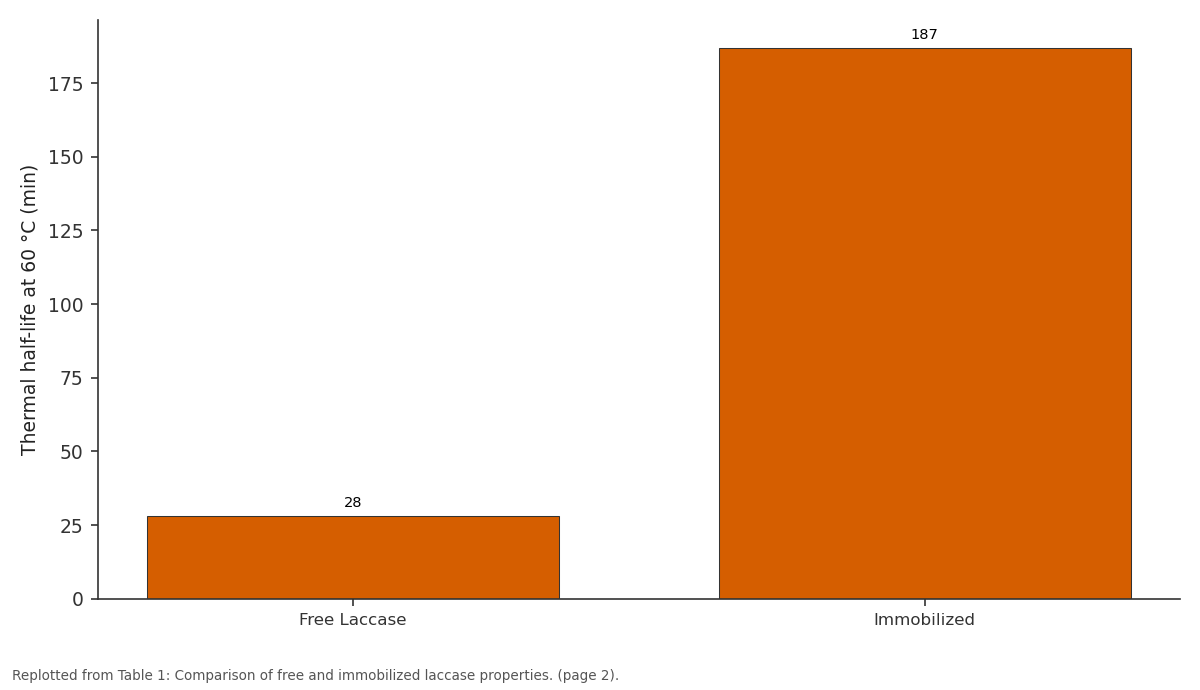
Thermal half-life at 60 °C (min): Free Laccase vs Immobilized
Replotted from Table 1 (page 2) of the original paper. Every bar is the paper's own table value.
View source evidence ↗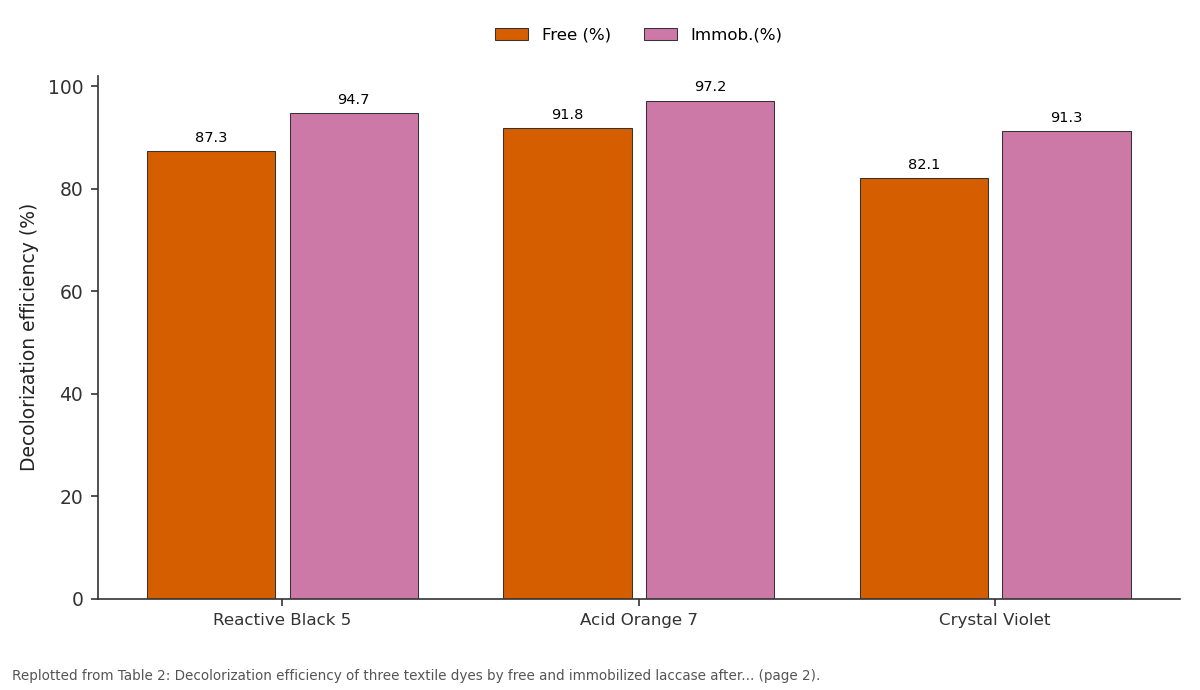
Free (%) and Immob.(%): Reactive Black 5 vs Acid Orange 7 vs Crystal Violet
Replotted from Table 2 (page 2) of the original paper. Every bar is the paper's own table value.
View source evidence ↗Figures & tables
From the original paper Table 1
 Table 2
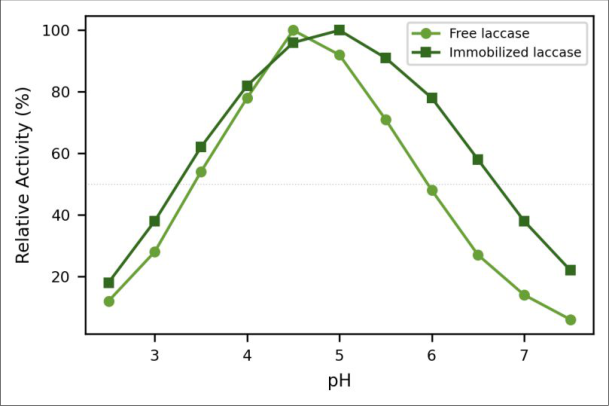 Figure 1
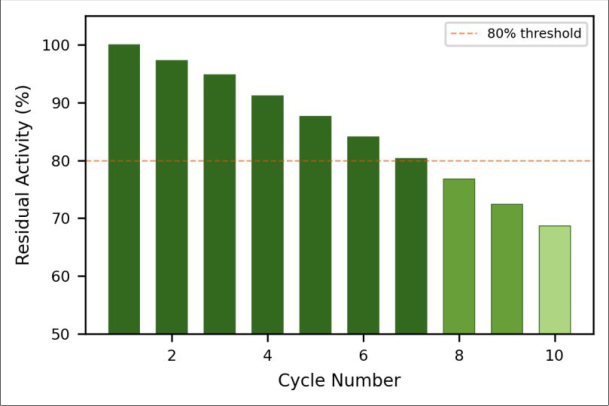 Figure 2
Introduction
Nigeria's textile industry, concentrated in Ondo, Lagos, and Kano states, generates an estimated 200 million liters of dye-laden wastewater daily, with fewer than 15% of factories operating any form of biological treatment before discharge into rivers and streams [1] . Synthetic dyesparticularly azo compounds that constitute 70% of global dye production are resistant to conventional biological and chemical treatment, persist in aquatic environments, and several are classified as carcinogenic or mutagenic [2] . Advanced oxidation processes using Fenton chemistry or ozone can degrade these dyes but require expensive reagents and generate toxic intermediates [3] . Laccases (EC 1.10.3.2) are multicopper oxidases produced by white-rot fungi that catalyze single-electron oxidation of aromatic substrates coupled with four-electron reduction of O₂ to water. Their broad substrate specificity and use of oxygen rather than hydrogen peroxide as oxidant makes them environmentally benign biocatalysts for dye degradation [4] . The main barrier to industrial adoption is cost: free laccase is denatured by the temperature, pH, and chemical conditions of real effluents, and cannot be recovered for reuse [5] . Immobilization onto solid supports addresses both problems simultaneously. Covalent attachment through bifunctional cross-linkers like glutaraldehyde rigidifies the enzyme's tertiary structure, conferring thermal and chemical stability, while the support enables physical recovery [6] . Magnetic nanoparticles are ideal supports because they combine high surface area (facilitating high enzyme loading) with effortless recovery using an external magnetno centrifugation or filtration required [7] . Amino-functionalized MNPs provide primary amine groups that react with glutaraldehyde to form Schiff bases, creating a molecular spacer between the nanoparticle surface and the enzyme that preserves active site accessibility [8] . This research optimized the immobilization of commercial T. versicolor laccase on amino-MNPs, characterized the resulting biocatalyst, and evaluated its performance for degrading three structurally diverse textile dyes representative of those found in Nigerian industrial effluents [9] .
Reagents and Chemicals
Laccase from Trametes versicolor (lyophilized powder, ≥10 U/mg, Sigma-Aldrich), 2, 2′-azino-bis (3ethylbenzothiazoline-6-sulphonic acid) (ABTS, ≥98%), glutaraldehyde (25% aqueous solution), 3aminopropyltriethoxysilane (APTES, 99%), iron (II) chloride tetrahydrate, iron (III) chloride hexahydrate, and ammonium hydroxide (28-30%) were from Sigma-Aldrich. Reactive Black 5 (RB5, CI 20505), Acid Orange 7 (AO7, CI 15510), and Crystal Violet (CV, CI 42555) were obtained from Alfa Aesar. Bradford reagent was used for protein quantification with bovine serum albumin standards [10] .
Materials and Methods
Materials and Methods
Materials
Research was conducted at Federal University of Technology Akure, Akure, Ondo State, Nigeria, from March to October 2023. No ethical approval was required. Magnetic nanoparticles were synthesized by alkaline coprecipitation: FeCl₂•4H₂O (2.0 g) and FeCl₃•6H₂O (5.2 g) were dissolved in 100 mL deoxygenated water at 80 °C, and NH₄OH was added dropwise under nitrogen with vigorous stirring until pH 10. The black precipitate was collected magnetically, washed to neutral pH, and dried at 60 °C. Surface functionalization used APTES (2 mL in 50 mL ethanol, 12 h reflux). TEM (JEOL 1010) and XRD (Bruker D8) confirmed crystalline Fe₃O₄ with ~15 nm particle diameter [11] .
Methods
Immobilization procedure: Amino-MNPs (100 mg) were Activated by incubation with 2.5% glutaraldehyde in phosphate buffer (pH 7.0) for 2 h at room temperature. After magnetic washing (3×), activated MNPs were mixed with laccase solution (10 mg/mL in 50 mM citrate-phosphate buffer, pH 5.0) and incubated at 4 °C for 12 h with gentle agitation. The immobilized enzyme was magnetically collected, washed with buffer to remove unbound protein, and stored at 4 °C. Immobilization efficiency was calculated from protein mass balance using the Bradford assay [12] . Laccase activity was measured using ABTS oxidation (1 mM in 50 mM sodium acetate buffer, pH 4.5) monitored at 420 nm (ε = 36,000 M⁻¹cm⁻¹). One unit of activity was defined as the amount of enzyme oxidizing 1 μmol ABTS per minute at 25 °C. PH profiles were determined over pH 2.5-7.5 using citrate-phosphate buffers, and temperature profiles from 20 to 80 °C. Thermal stability was assessed by incubating enzyme at 60 °C and measuring residual activity at intervals over 4 h [13] . Dye decolorization experiments used 50 mg/L dye solutions in 50 mM citrate-phosphate buffer (pH 5.0) with 50 mg immobilized enzyme preparation (or equivalent free enzyme activity) at 40 °C and 150 rpm for 6 h. Decolorization was quantified spectrophotometrically at each dye's maximum absorbance wavelength (RB5: 597 nm; AO7: 484 nm; CV: 590 nm). Reusability was tested over 10 consecutive cycles with the same batch of immobilized enzyme, magnetically recovering the biocatalyst between cycles and adding fresh dye solution each time [14] .
Instrumentation
UV-Vis measurements used a Shimadzu UV-1900i spectrophotometer with temperature-controlled cuvette holder. Magnetic separation employed a NdFeB permanent magnet (1.2 T surface field). Protein quantification used a BioRad SmartSpec Plus spectrophotometer at 595 nm. TEM samples were prepared by depositing dilute MNP suspensions on carbon-coated copper grids. XRD operated at 40 kV/40 mA with Cu Kα radiation (2θ range 20-70°). FTIR (PerkinElmer Spectrum Two, ATR) confirmed successful surface functionalization and enzyme attachment. Immobilization shifted the pH optimum from 4.5 to 5.0, a well-documented effect attributed to the microenvironment created by amino groups on the MNP surface, which produces a local pH higher than the bulk solution. This shift is advantageous for treating real textile effluents, which typically have pH values of 5-8 [4] . The temperature optimum increased from 50 °C to 60 °C, reflecting the structural rigidity imparted by multipoint covalent attachment. The Kₘ increase from 0.18 to 0.27 mM indicates slightly reduced substrate affinity, consistent with partial diffusional limitation and possible steric restriction at the active site entrance due to the glutaraldehyde tether. However, the 6.7-fold increase in thermal half-life at 60 °C (28 to 187 min) and doubled storage stability (41% to 83% after 30 days) more than compensate for this modest kinetic penalty [6] . Immobilized laccase outperformed the free enzyme for all three dyes, despite its lower Vₘₐₓ value. The apparent contradiction is explained by the immobilized enzyme's superior operational stability during the 6-hour reaction: free laccase loses activity progressively at 40 °C and the slightly Acidic pH, while the immobilized form maintains catalytic function throughout. Acid Orange 7 was the most efficiently degraded (97.2%), consistent with monoazo dyes being more readily oxidized than the diazo structure of Reactive Black 5 or the triphenylmethane scaffold of Crystal Violet [15] .
Results
Results
Fig 1:
Effect of pH on the relative activity of free and immobilized laccase using ABTS as substrate at 25 °C. Reusability data showed a gradual decline in activity over 10 cycles. The immobilized enzyme retained 84.1% of initial activity after 7 cycles and 68.7% after 10 cycles. The decline reflects a combination of enzyme inactivation during each 6-hour reaction, mechanical damage to some nanoparticles during magnetic recovery, and accumulation of dye degradation products on the MNP surface that block substrate access. Between cycles 1-7, the biocatalyst remained above the 80% activity threshold commonly accepted as the minimum for industrial enzyme reuse, making this system economically viable for at least 7 batch treatments before replacement [16] . FTIR spectra provided molecular evidence for successful immobilization. The amino-MNPs showed characteristic peaks at 3380 cm⁻¹ (N-H stretching), 1625 cm⁻¹ (N-H bending), and 1030 cm⁻¹ (Si-O-Si from APTES). After glutaraldehyde activation, a new peak at 1720 cm⁻¹ (C=O stretching of aldehyde) appeared. Following laccase conjugation, the amide I band at 1648 cm⁻¹ and amide II band at 1538 cm⁻¹ confirmed protein attachment, while the aldehyde peak diminished, indicating Schiff base formation between aldehyde and enzyme amine groups [8] . XRD patterns of the immobilized preparation retained all characteristic Fe₃O₄ diffraction peaks (2θ = 30.1°, 35.5°, 43.1°, 57.0°, 62.6°) with no significant peak broadening, confirming that the surface modification and immobilization process did not alter the crystalline magnetic core structure. Kinetic analysis of dye decolorization revealed that the reaction followed pseudo-first-order kinetics for all three dyes. Rate constants were 0.48 h⁻¹ for Acid Orange 7, 0.39 h⁻¹ for Reactive Black 5, and 0.34 h⁻¹ for Crystal Violet. The faster degradation of monoazo AO7 compared to diazo RB5 correlates with the number of azo bonds requiring oxidative cleavage. Crystal Violet's slower rate despite its single chromophore center reflects the steric demand of its three dimethylaminophenyl groups, which hinder approach to the enzyme's T1 copper site. These kinetic differences have practical implications for reactor design, suggesting that mixed-dye effluents might benefit from staged treatment with longer residence times allocated to recalcitrant dyes [15] .
Discussion
The 82.4% immobilization efficiency achieved here is among the highest reported for laccase on magnetic supports, where typical values range from 50-80% [7] . The optimization of glutaraldehyde concentration was critical: below 1.5%, insufficient cross-linking left most enzyme weakly adsorbed rather than covalently attached, while above 3%, intermolecular cross-linking between enzyme molecules created multilayer protein aggregates with poor catalytic activity due to blocked active sites. The optimal 2.5% glutaraldehyde provided the right balance of covalent anchoring without excessive cross-linking [8] . The 94.7% decolorization of Reactive Black 5 is particularly notable because this diazo dye is among the most recalcitrant commercial dyes. Its structure contains two azo bonds flanked by sulfonated naphthalene groups that resist oxidation. Laccase attacks the hydroxyl-substituted naphthalene moiety, generating radical intermediates that undergo further non-enzymatic reactions leading to azo bond cleavage and chromophore destruction [15] . The complete degradation pathway likely produces sulfonated aminonaphthalenes as primary products, which are less colored and less toxic than the parent dye, though a full ecotoxicity assessment of the treated effluent would be necessary before discharge [17] . Compared to physicochemical treatment methods, the immobilized laccase system offers several advantages: operation at near-ambient temperature (40 °C vs >100 °C for Fenton), neutral pH (5.0 vs pH 2-3 for Fenton), no requirement for H₂O₂ or UV light, and no sludge generation. The main limitation is the 6-hour treatment time, which is longer than the 1-2 hours typical for chemical oxidation. For a factory producing 100 m³/day of dye effluent, this could be addressed through continuous flow in a packed-bed reactor containing the magnetic biocatalyst retained by an external magnetic field [18] . The enzyme cost calculation is favorable: at a protein loading of 47.3 mg/g MNPs and 7 reuse cycles, the effective enzyme consumption is 6.8 mg protein per gram of dye degraded, translating to roughly $0.15/m³ of treated effluent at current laccase prices. This is competitive with Fenton treatment ($0.20-0.50/m³) and significantly cheaper than ozonation ($0.80-1.20/m³) [19] .
Conclusion
Laccase from Trametes versicolor was successfully immobilized on amino-functionalized Fe₃O₄ magnetic nanoparticles with 82.4% efficiency and 47.3 mg/g protein loading. The immobilized enzyme showed enhanced thermal stability (6.7-fold increase in half-life at 60 °C), broadened pH optimum favorable for real effluent conditions, and superior dye decolorization performance (91.3-97.2% removal for three structurally diverse textile dyes). Magnetic recovery enabled at least 7 reuse cycles above the 80% activity threshold, making the system economically competitive with conventional chemical treatment methods for Nigerian textile wastewater.
Figures and tables from the paper
| Property | Free Laccase | Immobilized |
|---|---|---|
| pH optimum | 4.5 | 5.0 |
| Temperature optimum (°C) | 50 | 60 |
| Kₘ for ABTS (mM) | 0.18 | 0.27 |
| Vₘₐₓ (U/mg protein) | 12.4 | 9.7 |
| Thermal half-life at 60 °C (min) | 28 | 187 |
| Storage stability (30 d, 4 °C) | 41% residual | 83% residual |
Table text extracted from the original PDF; superscript letters are shown inline. The original table image is below.
View original table image
| Dye | Type | λmax (nm) | Free (%) | Immob.(%) |
|---|---|---|---|---|
| Reactive Black 5 | Diazo | 597 | 87.3 | 94.7 |
| Acid Orange 7 | Monoazo | 484 | 91.8 | 97.2 |
| Crystal Violet | Triphenyl | 590 | 82.1 | 91.3 |
Table text extracted from the original PDF; superscript letters are shown inline. The original table image is below.
View original table image
References
19 in the original paper- Kehinde FO, Odeniyi OA. Textile industry effluent management in Nigeria: current status and challenges. J Environ Sci Health A. 2018;53(5):436-445.
- Forgacs E, Csérháti T, Oros G. Removal of synthetic dyes from wastewaters: a review. Environ Int. 2004;30(7):953-971.
- Pignatello JJ, Oliveros E, MacKay A. Advanced oxidation processes for organic contaminant destruction. Crit Rev Environ Sci Technol. 2006;36(1):1-84.
- Riva S. Laccases: blue enzymes for green chemistry. Trends Biotechnol. 2006;24(5):219-226.
- Durán N, Rosa MA, D'Annibale A, Gianfreda L. Applications of laccases and tyrosinases. Enzyme Microb Technol. 2002;31(7):907-931.
- Sheldon RA. Enzyme immobilization: the quest for optimum performance. Adv Synth Catal. 2007;349(8):1289-1307.
- Xu J, Sun J, Wang Y, Sheng J, Wang F. Application of iron magnetic nanoparticles in protein immobilization. Molecules. 2014;19(8):11465-11486.
- Bayramoglu G, Arica MY. Immobilization of laccase onto poly(glycidylmethacrylate) brush grafted magnetic nanoparticles. J Mol Catal B Enzym. 2009;62(3):297304.
- Baldrian P. Fungal laccases -occurrence and properties. FEMS Microbiol Rev. 2006;30(2):215-242.
- Bradford MM. A rapid and sensitive method for quantitation of microgram quantities of protein. Anal Biochem. 1976;72(1):248-254.
- Massart R. Preparation of aqueous magnetic liquids in alkaline and acidic media. IEEE Trans Magn. 1981;17(2):1247-1248.
- Mateo C, Palomo JM, Fernandez-Lorente G, Guisan JM, Fernandez-Lafuente R. Improvement of enzyme activity. Enzyme Microb Technol. 2007;40(6):14511463.
- Bourbonnais R, Paice MG. Oxidation of non-phenolic substrates: an expanded role for laccase. FEBS Lett. 1990;267(1):99-102.
- Abadulla E, Tzanov T, Costa S, Robra KH, CavacoPaulo A. Decolorization and detoxification of textile dyes. Appl Environ Microbiol. 2000;66(8):3357-3362.
- Zille A, Ramalho P, Tzanov T, Millward R. Predicting dye biodegradation with laccase. Biotechnol Prog. 2004;20(5):1588-1592.
- Fernandez-Fernandez M, Sanromán MA, Moldes D. Recent developments and applications of immobilized laccase. Biotechnol Adv. 2013;31(8):1808-1825.
- Vanhulle S, Trovaslet M, Enaud E, Lucas M, Taghavi S. Decolorization, cytotoxicity, and genotoxicity. Environ Sci Technol. 2008;42(2):584-589.
- Demarche P, Junghanns C, Nair RR, Agathos SN. Harnessing the power of enzymes for environmental stewardship. Biotechnol Adv. 2012;30(5):933-953.
- Hai FI, Yamamoto K, Fukushi K. Hybrid treatment systems for dye wastewater. Crit Rev Environ Sci Technol. 2007;37(4):315-377.