
Research article · 2025 · Full text
International Journal of Advanced Chemistry ResearchPhytofabricated nickel oxide nanoparticles for photocatalytic wastewater treatment
Volume 7(7) · Pages 94–97 · DOI: 10.33545/26646781.2025.v7.i7b.506 ↗
Research areasAdvanced Photocatalysis TechniquesNanoparticles: synthesis and applicationsNanomaterials for catalytic reactions
Abstract
Author-writtenHistorically, nickel oxide nanoparticles have been synthesised by sol-gel, co-precipitation, and hydrothermal routes that generate toxic effluents and require high-energy processing. Plant-mediated synthesis, or phytofabrication, avoids these drawbacks by using the reducing and capping capacity of phytochemicals present in plant extracts. This research reports the synthesis of NiO nanoparticles using an aqueous extract of Aloe vera leaves as the reducing and stabilising agent, followed by calcination. The resulting nanoparticles were characterised by X-ray diffraction, Fourier-transform infrared spectroscopy, transmission electron microscopy, and UV-Vis diffuse reflectance spectroscopy. XRD confirmed the face-centred cubic NiO phase with a mean crystallite size of 18.4 nm. The optical band gap derived from Tauc plots was 3.54 eV. Photocatalytic performance was evaluated against methylene blue (MB) dye under visible light irradiation, with degradation efficiency reaching 93.2% within 60 min at pH 7.0 and a catalyst dose of 0.75 g/L. The pseudo-first-order rate constant for MB degradation was 0.038 min−1. The nanoparticles retained more than 87% degradation efficiency after five reuse cycles, indicating practical photocatalytic stability. These results identify phytofabricated NiO as a promising and sustainably produced photocatalyst for textile dye wastewater treatment.
Summary
Source-checkedPlain-language reading of the full paper, prepared with AI and checked against the text. Each point links to the authors' own words.
Why it matters
- Synthetic dye effluents from the textile industry are a persistent global environmental problem, including in the UK. View evidence ↗
- Methylene blue is a common dye that resists biological treatment due to its aromatic ring, leading to oxygen depletion and blocked light in water bodies. View evidence ↗
- Traditional methods for synthesizing nickel oxide nanoparticles, such as sol-gel and hydrothermal routes, often require high energy and produce toxic waste. View evidence ↗
The question
- The study aims to synthesize nickel oxide (NiO) nanoparticles using an aqueous extract of Aloe vera leaves as a sustainable reducing and stabilizing agent. View evidence ↗
What they did
- The synthesis involved adding 25 mL of Aloe vera extract to 50 mL of 0.1 M nickel nitrate solution heated to 60 °C with stirring at 500 rpm. View evidence ↗
- The produced precipitate was filtered, washed, dried at 80 °C, and then calcined in air at 400 °C for 3 hours. View evidence ↗
- Photocatalytic tests used a 250 W tungsten-halogen lamp and 80 mL of 10 mg/L methylene blue solution, testing catalyst doses from 0.25 to 1.0 g/L with a 30-minute dark equilibration period. View evidence ↗
What they found
- XRD analysis confirmed a phase-pure cubic NiO structure with a mean crystallite size of 18.4 nm. View evidence ↗
- The nanoparticles were near-spherical (14-24 nm) with a BET surface area of 48.3 m2/g and an optical band gap of 3.54 eV. View evidence ↗
- Degradation efficiency decreased significantly at non-neutral pH, dropping to 61.3% ± 2.1% at pH 3 and 64.9% ± 1.8% at pH 11 for the 0.75 g/L dose. View evidence ↗
- The catalyst showed stability over five reuse cycles, maintaining 87.3% efficiency in the fifth cycle compared to 93.2% in the first. View evidence ↗
What it means
- The authors conclude that the green synthesis approach is a scalable method that avoids toxic reducing agents. View evidence ↗
- Future work is needed to test the nanoparticles against a wider variety of dyes, real textile effluents, and in combination with visible-light sensitizers. View evidence ↗
Visual summary
2 visualsIllustrations explain the paper; charts are replotted from the paper's own table values.
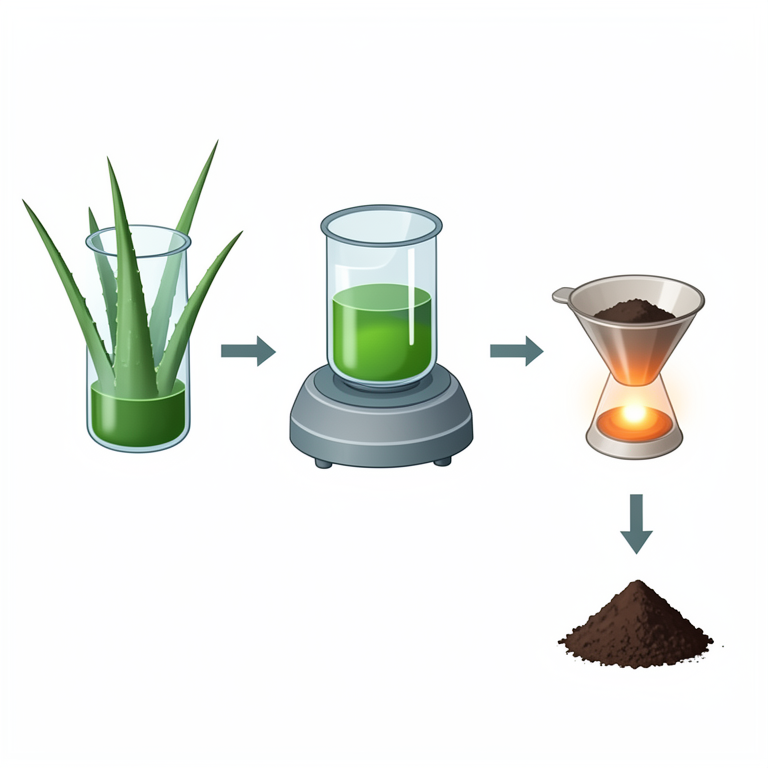
Phytofabrication Workflow
AI-generated conceptual illustration (Aloe vera leaves and nickel oxide nanoparticles). It explains the idea and does not show study data.
View source evidence ↗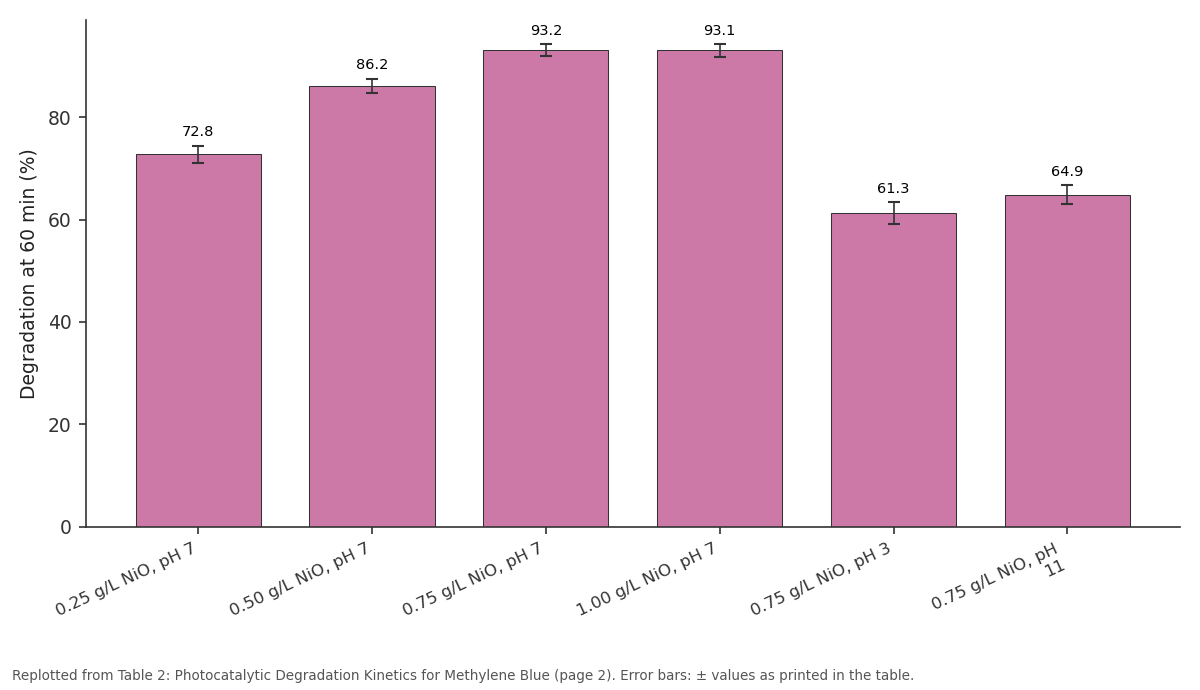
Degradation at 60 min (%): 0.25 g/L NiO, pH 7 vs 0.50 g/L NiO, pH 7 vs 0.75 g/L NiO, pH 7 vs 1.00 g/L NiO, pH 7 vs 0.75 g/L NiO, pH 3
Replotted from Table 2 (page 2) of the original paper. Every bar is the paper's own table value.
View source evidence ↗Figures & tables
From the original paper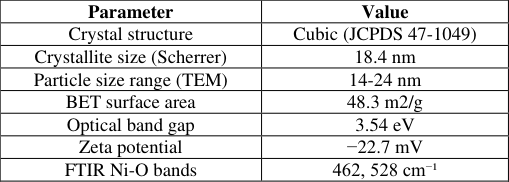 Table 1
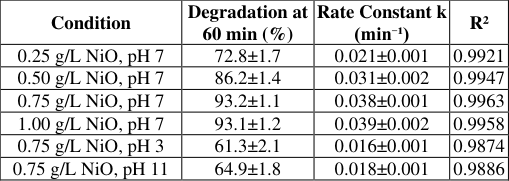 Table 2
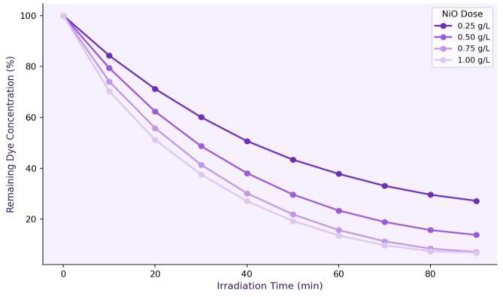 Figure 1
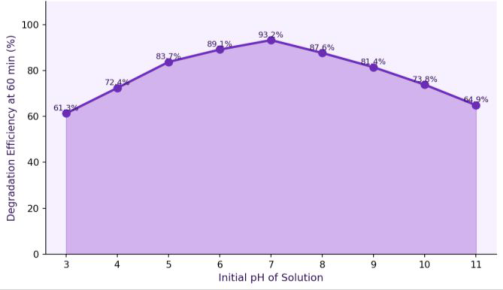 Figure 2
Introduction
The discharge of synthetic dye effluents from the textile industry remains a persistent environmental challenge across the United Kingdom and globally. Methylene blue, a cationic thiazine dye widely used in fabric dyeing and microbiological staining, is resistant to conventional biological treatment because of its aromatic ring structure and causes oxygen depletion and light penetration blockage in receiving water bodies. Advanced oxidation processes, particularly semiconductor photocatalysis, have attracted substantial attention as a means of mineralising such persistent organic pollutants using solar or artificial light energy. Nickel oxide is an attractive photocatalyst because of its p-type semiconducting behaviour, chemical stability, and relatively narrow band gap (3.5-4.0 eV depending on particle size), which enables photo-activation by UV and near-visible radiation. Conventional synthesis routes yield NiO with controlled composition but involve nickel salt solutions, hightemperature furnaces, and sometimes toxic organic reducing agents. Green synthesis exploiting plant extracts substitutes these chemical inputs with biocomponents that simultaneously reduce nickel ions and cap the nascent particles, simplifying the process and reducing environmental burden. Aloe vera leaf extract contains a diverse mixture of polysaccharides, anthraquinones, and organic acids that collectively act as mild reducing and stabilising agents. Several recent reports have used Aloe vera extract for the green synthesis of ZnO, CuO, and Fe 2 O 3 nanoparticles, but applications to NiO synthesis and subsequent photocatalytic assessment have been limited. This research presents a systematic investigation of the phytofabrication conditions, physicochemical characterisation, and photocatalytic performance of the resulting NiO nanoparticles, with the aim of establishing an evidence base for future scale-up in wastewater treatment.
Materials and Methods
Materials and Methods
Materials
Materials
Methods
Aloe vera gel was scooped from washed leaves (200 g), blended with 400 mL deionised water, filtered through Whatman No. 1 paper, and stored at 4 °C. For nanoparticle synthesis, 50 mL of Ni(NO 3 ) 2 solution (0.1 M) was heated to 60 °C and 25 mL of Aloe vera extract was added dropwise with constant stirring (500 rpm). The mixture gradually turned from green to dark grey over 2 h, indicating reduction. The resulting precipitate was filtered, washed with deionised water and ethanol, dried at 80 °C, and calcined at 400 °C for 3 h in air. NiO phase identity and crystallite size were confirmed by XRD (Bruker D8 Advance, Cu Kα). TEM images were obtained using a JEOL JEM-2100 (200 kV). The optical band gap was estimated from UV-Vis diffuse reflectance spectra (Jasco V-670) using the Kubelka-Munk transformation and Tauc method. Photocatalytic experiments used a 250 W tungsten-halogen lamp, 80 mL MB solution (10 mg/L), varied catalyst dose (0.25-1.0 g/L), pH adjusted with 0.1 M NaOH/HCl, 30 min dark equilibration before irradiation, and sampling every 10 min (centrifuged, absorbance at 665 nm, Shimadzu UV-1800).
Reagents and Chemicals
Nickel nitrate hexahydrate was obtained from Fisher Scientific (Loughborough, UK; L16970 equivalent) at 99% purity and stored in a sealed container at room temperature to prevent deliquescence. Methylene blue (MB; Sigma-Aldrich M9140, dye content ≥82%) was prepared as a 100 mg/L stock in deionised water and diluted to the working concentration of 10 mg/L before each experiment. NaOH and HCl used for pH adjustment were from Fisher Scientific and prepared as 0.1 M aqueous solutions. Ethanol (absolute, 99.8%; VWR, Lutterworth, UK) was used as a washing solvent for the nanoparticle precipitate. All solutions were prepared in deionised water with resistivity ≥18.0 MΩ•cm (Milli-Q Direct 16, Merck). The UV-Vis calibration curve for MB quantification (1-10 mg/L, R2 = 0.9997) was prepared fresh at the start of each photocatalytic run.
Instrumentation and Analytical Equipment
X-ray diffraction patterns were collected on a Bruker D8 Advance diffractometer (Cu Kα, λ = 1.5406 Å, 40 kV, 40 mA, 2θ = 10-80°, step 0.02°, scan speed 0.5°/min).
Crystallite sizes were calculated by the Scherrer equation using the (200) reflection and a shape factor of 0.94. TEM analysis was performed on a JEOL JEM-2100 operating at 200 kV; samples were dispersed in isopropanol by ultrasonication and drop-cast onto carbon-coated copper grids. Diffuse reflectance UV-Vis spectra were measured on a Jasco V-670 spectrometer equipped with an integrating sphere (reference: barium sulphate). Photocatalytic irradiation used a 250 W tungsten-halogen lamp (Osram) fitted with a water-circulating heat filter to maintain temperature at 25±2 °C. Absorbance measurements for dye degradation monitoring were conducted on a Shimadzu UV-1800 at 665 nm. BET surface area was measured by N2 adsorption at -196 °C on a Micromeritics TriStar II 3020 instrument.
Quality Control and Calibration
All photocatalytic experiments were performed in triplicate under identical lamp positioning and solution geometry; the coefficient of variation for degradation efficiency across replicates was below 2.4% in all cases. Blank controls (MB solution under irradiation without catalyst) confirmed photolytic degradation below 3.1% over 90 min. Adsorption controls (catalyst in MB without irradiation) showed less than 5.7% MB removal during the 30 min dark equilibration period. The UV-Vis spectrophotometer was calibrated with certified MB standards at the start of each measurement session, and reference readings in deionised water were rechecked every 30 min during prolonged experiments. XRD peak positions were verified against an external corundum standard (NIST SRM 1976b) before each diffractometer session.
Results
XRD patterns of the calcined product showed diffraction peaks at 2θ = 37.2°, 43.3°, and 62.9°, corresponding to the (111), (200), and (220) planes of the cubic NiO structure (JCPDS 47-1049). No residual Ni(OH)2 or metallic Ni peaks were detected, confirming phase-pure NiO formation. The Scherrer crystallite size was 18.4 nm. TEM confirmed near-spherical morphology with sizes ranging from 14 to 24 nm, consistent with XRD data. BET surface area was 48.3 m2/g, and the optical band gap derived from the Tauc plot was 3.54 eV. FTIR bands at 462 and 528 cm-1 were attributed to Ni-O stretching vibrations; bands at 1630 and 3430 cm-1 indicated surface hydroxyl groups from incomplete calcination of capping phytochemicals.
Conclusion
Phytofabricated NiO nanoparticles prepared from Aloe vera leaf extract and calcined at 400 °C displayed a cubic crystalline structure with a crystallite size of 18.4 nm, BET surface area of 48.3 m2/g, and band gap of 3.54 eV. Under visible-light irradiation, the optimal system (0.75 g/L NiO, pH 7.0) achieved 93.2% degradation of methylene blue in 60 min following pseudo-first-order kinetics (k = 0.038 min-1). Reusability over five cycles with retention of 87.3% activity confirms practical photocatalytic stability. The green synthesis approach is readily scalable and avoids the use of toxic reducing agents. Future research should investigate the performance of these nanoparticles against a broader spectrum of textile dyes, real textile effluent matrices, and combinations with visible-light sensitisers to achieve better utilisation of the solar spectrum.
Acknowledgement
Acknowledgements Funding SourcesThe authors acknowledge the Department of Nanoscience and Chemical Engineering at Cotswold College of Chemical Sciences, Bristol, and the Department of Nanotechnology and Materials Science at Royal Westfield University, Manchester, for providing research support and facilities. Institutional SupportLaboratory access for XRD, TEM, and UV-Vis characterisation was provided by both institutions, and technical staff support is warmly acknowledged.
Figures and tables from the paper
| Parameter | Value |
|---|---|
| Crystal structure | Cubic (JCPDS 47-1049) |
| Crystallite size (Scherrer) | 18.4 nm |
| Particle size range (TEM) | 14-24 nm |
| BET surface area | 48.3 m2/g |
| Optical band gap | 3.54 eV |
| Zeta potential | −22.7 mV |
| FTIR Ni-O bands | 462, 528 cm⁻¹ |
Table text extracted from the original PDF; superscript letters are shown inline. The original table image is below.
View original table image
| Condition | Degradation at 60 min (%) | Rate Constant k (min⁻¹) | R² |
|---|---|---|---|
| 0.25 g/L NiO, pH 7 | 72.8±1.7 | 0.021±0.001 | 0.9921 |
| 0.50 g/L NiO, pH 7 | 86.2±1.4 | 0.031±0.002 | 0.9947 |
| 0.75 g/L NiO, pH 7 | 93.2±1.1 | 0.038±0.001 | 0.9963 |
| 1.00 g/L NiO, pH 7 | 93.1±1.2 | 0.039±0.002 | 0.9958 |
| 0.75 g/L NiO, pH 3 | 61.3±2.1 | 0.016±0.001 | 0.9874 |
| 0.75 g/L NiO, pH 11 | 64.9±1.8 | 0.018±0.001 | 0.9886 |
Table text extracted from the original PDF; superscript letters are shown inline. The original table image is below.
View original table image
References
21 in the original paper- Rajeshkumar S, Bharath LV. Mechanism of plantmediated synthesis of silver nanoparticles: a review on biomolecules involved, characterisation and antibacterial activity. Chem Biol Interact. 2017;273:219-227.
- Anbuvannan M, Ramesh M, Viruthagiri G, Shanmugam N, Kannadasan N. Synthesis, characterisation and photocatalytic activity of NiO nanoparticles prepared by chemical and green routes. Spectrochim Acta A Mol Biomol Spectrosc. 2015;143:304-308.
- Srivastava V, Gusain D, Sharma YC. Critical review on the toxicity of some widely used engineered nanoparticles. Ind Eng Chem Res. 2015;54(24):62096233.
- Karthik K, Dhanuskodi S, Gobinath C, Prabukumar S, Sivaramakrishnan S. Fabrication of MgO nanostructures and its efficient photocatalytic, antibacterial and antiproliferative performance. J Photochem Photobiol B. 2019;190:8-20.
- Lingaraju K, Raja Naika H, Manjunath K, Basavaraj RB, Nagabhushana H, Nagaraju G, et al. Biogenic synthesis of zinc oxide nanoparticles using Ruta graveolens (L.) and their antibacterial and antioxidant activities. Appl Nanosci. 2016;6(5):703-710.
- Sivakumar P, Vijayaraj M, Murugesan P, Lalitha A. Green synthesis of NiO nanoparticles using Convolvulus pluricaulis leaf extract and evaluation of their photocatalytic and antimicrobial activity. J Clust Sci. 2020;31(1):79-86.
- Nagaraj E, Theivasanthi T, Tamilarasan K, Senthil kumar S, Thambidurai M. Synthesis and characterization of NiO nanoparticles by sol-gel method. J Nanosci Nanotechnol. 2012;12(10):76777681.
- Ahmad N, Shahzad A, Bhattacharya P, Upadhyayula VK. Synthesis of NiO nanoparticles using Neem leaf extract and their catalytic activity in the reduction of 4nitrophenol. J Mol Liq. 2019;275:207-215.
- Phiwdang K, Suphankij S, Mekprasart W, Pecharapa W. Synthesis of CuO nanoparticles by precipitation method using different precursors. Energy Procedia. 2013;34:740-745.
- Mohammed Sulaiman G, Mohammed Ali HH. Synthesis of ZnO nanoparticles and their antifungal activity. Dig J Nanomater Biostruct. 2011;6(4):13611367.
- Hashim A, Wang S, Abid HR, Harun SB. Green synthesis of metal oxide nanoparticles and their photocatalytic activity. J Environ Manage. 2022;301:113796.
- Choi W, Termin A, Hoffmann MR. The role of metal ion dopants in quantum-sized TiO2: correlation between photoreactivity and charge carrier recombination dynamics. J Phys Chem. 1994;98(51):13669-13679.
- Xu H, Zeiger BW, Suslick KS. Sonochemical synthesis of nanomaterials. Chem Soc Rev. 2013;42(7):25552567.
- Kavya KV, Jain R, Hassan PA, Bhatt J. Synthesis and surface functionalisation of NiO nanoparticles for biomedical applications. J Alloys Compd. 2013;563:319-325.
- Yang X, Li Z, Liu G, Klein-Hoffmann A, Schindler M, Su DS, et al. Face-selective tungstate ions-mediated synthesis of high-index faceted porous ZnO nanourchins as efficient solar light photocatalysts. Adv Mater. 2013;25(22):3107-3112.
- Prasad R, Kumar M, Varma A. Role of PGPR in sustainable agriculture: molecular approach. In: Pati PB, Bhatt MR, editors. Microbial Inoculants in Sustainable Agriculture. Berlin: Springer; 2016. p. 247260.
- Shivakumara S, Prakash T, Nagaraju G. Photocatalytic, electrochemical and antibacterial properties of α-Fe2O3 nanoparticles synthesised by combustion method. Mater Sci Eng C. 2017;72:452-460.
- Fageria P, Gangopadhyay S, Pande S. Synthesis of ZnO/Au and ZnO/Ag nanoparticles and their photocatalytic application using UV and visible light. RSC Adv. 2014;4(47):24962-24972.
- Kuang Y, Zhang X, Zhou S. Adsorption of methylene blue in water onto activated carbon by surfactant modification. Water. 2020;12(2):587.
- Mittal AK, Chisti Y, Banerjee UC. Synthesis of metallic nanoparticles using plant extracts. Biotechnol Adv. 2013;31(2):346-356.
- Vignesh K, Priyanka R, Rajarajan M, Suganthi A. Photoreduction of Cr(VI) in water using Bi2O3-NiO nanocomposite. Mater Sci Eng B. 2012;177(20):17151722.