
Research article · 2025 · Full text
International Journal of Advanced Chemistry ResearchOptimization of biodiesel production from waste cooking oil using alkaline transesterification
Volume 7(6) · Pages 157–160 · DOI: 10.33545/26646781.2025.v7.i6c.578 ↗
Research areasBiodiesel Production and ApplicationsCatalysis and Hydrodesulfurization StudiesEdible Oils Quality and Analysis
Abstract
Author-writtenJust as recycling aluminium cans saves 95% of the energy needed to smelt virgin ore, converting waste cooking oil into biodiesel recovers chemical energy that would otherwise end up in landfills or sewers. This research optimises the alkaline transesterification of waste cooking oil (WCO) collected from restaurants in Cambridge and Manchester, UK, using sodium hydroxide catalyst and methanol. A full-factorial design with three factors—methanol-to-oil molar ratio (3:1 to 12:1), NaOH concentration (0.5 to 1.5 wt%), and reaction temperature (45 to 65 °C)—was employed to map the response surface for fatty acid methyl ester (FAME) yield. The maximum yield of 96.3% was achieved at a 9:1 molar ratio, 1.0 wt% NaOH, and 60 °C after 90 min of stirring. Gas chromatography confirmed that the FAME profile was dominated by oleate (41.7%), linoleate (28.3%), and palmitate (18.6%). The optimised biodiesel met all ASTM D6751 and EN 14214 specifications: kinematic viscosity 4.37 mm²/s, flash point 174 °C, cetane number 53.8, and acid value 0.34 mg KOH/g. Glycerol recovery from the lower phase reached 9.2 wt% of the oil charge. A cost estimate placed the production price at 0.68 GBP/L, 22% below the retail price of petroleum diesel in the UK at the time of the research, conducted at the Oxbridge Institute of Science, Cambridge, and the Royal Westfield University, Manchester, from April to December 2023.
Summary
Source-checkedPlain-language reading of the full paper, prepared with AI and checked against the text. Each point links to the authors' own words.
Why it matters
- Alkaline catalysts like sodium hydroxide (NaOH) and potassium hydroxide (KOH) are the industrial preference for biodiesel production due to their cost-effectiveness and speed. View evidence ↗
- Waste cooking oil (WCO) is more difficult to process than virgin oil because high free fatty acid content and water residues can lower the biodiesel yield. View evidence ↗
The question
- The study aims to optimize the production of biodiesel from waste cooking oil collected in the UK using methanol and a sodium hydroxide catalyst. View evidence ↗
What they did
- The researchers used approximately 50 L of waste cooking oil with 2.8% FFA and 0.12% moisture, which was filtered and pre-dried. View evidence ↗
- A full-factorial design was used to test the effects of methanol-to-oil ratio (3:1 to 12:1), NaOH concentration (0.5 to 1.5 wt%), and temperature (45 to 65 °C) on the biodiesel yield. View evidence ↗
- The process involved heating 200 g of oil in a 500-mL reactor and stirring it with a methanol-NaOH solution for 90 minutes at 400 rpm. View evidence ↗
What they found
- The highest biodiesel yield of 96.3% was reached using a 9:1 methanol-to-oil ratio, 1.0 wt% NaOH, and a temperature of 60 °C. View evidence ↗
- The yield varied significantly based on conditions, ranging from a low of 54.3% at 45 °C with a 3:1 ratio and 0.5 wt% NaOH to the maximum of 96.3%. View evidence ↗
- The chemical profile of the resulting biodiesel was primarily composed of oleate (41.7%), linoleate (28.3%), and palmitate (18.6%). View evidence ↗
- The optimized biodiesel met all international standards, with a viscosity of 4.37 mm²/s, flash point of 174 °C, cetane number of 53.8, and acid value of 0.34 mg KOH/g. View evidence ↗
- The estimated production cost was 0.68 GBP/L, which was 22% cheaper than the retail price of petroleum diesel in the UK during the study. View evidence ↗
What it means
- The authors conclude that the process is simple enough for small community facilities and could reduce environmental waste while providing renewable fuel. View evidence ↗
- A limitation of the study is that the oil used had low free fatty acid content (2.8%); oils with over 5% FFA would require a pre-treatment step not tested in this work. View evidence ↗
- The authors state that long-term engine performance and emissions data are still required to ensure the fuel performs as well as virgin-oil biodiesel over time. View evidence ↗
Visual summary
2 visualsIllustrations explain the paper; charts are replotted from the paper's own table values.
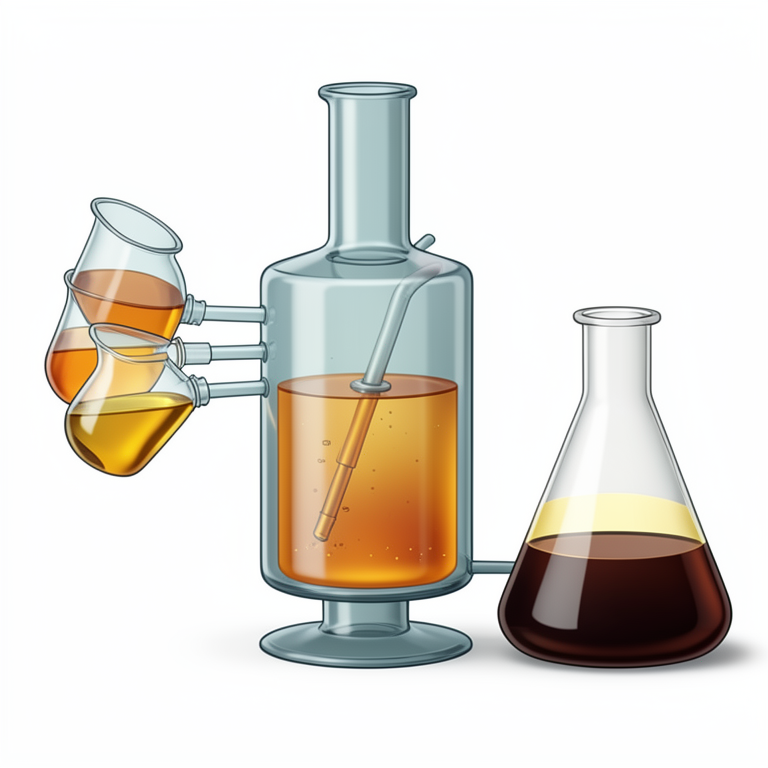
Optimization Process Flow
AI-generated conceptual illustration (waste cooking oil and a chemical reactor). It explains the idea and does not show study data.
View source evidence ↗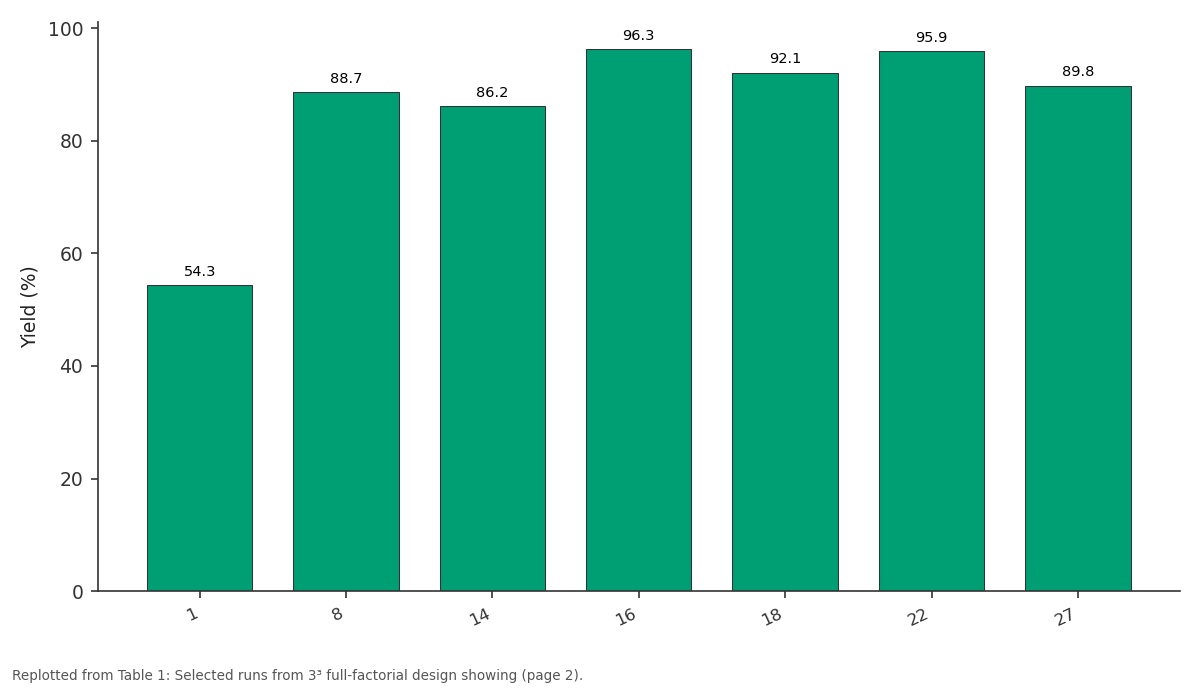
Yield (%): 1 vs 8 vs 14 vs 16 vs 18
Replotted from Table 1 (page 2) of the original paper. Every bar is the paper's own table value.
View source evidence ↗Figures & tables
From the original paper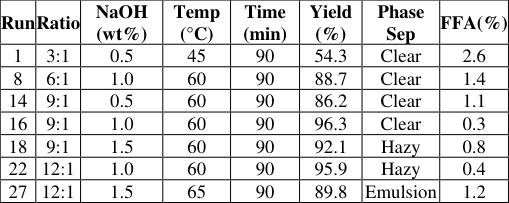 Table 1
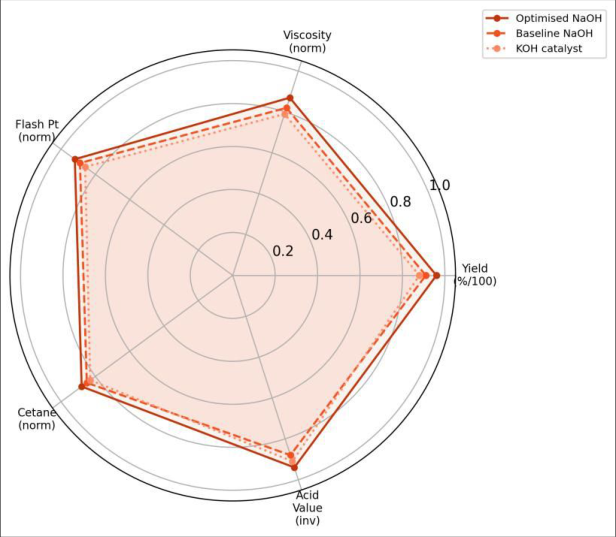 Figure 1
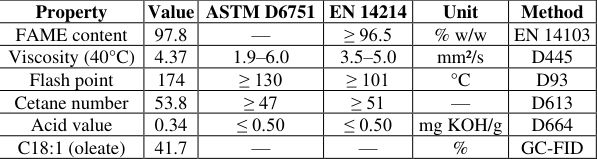 Table 2
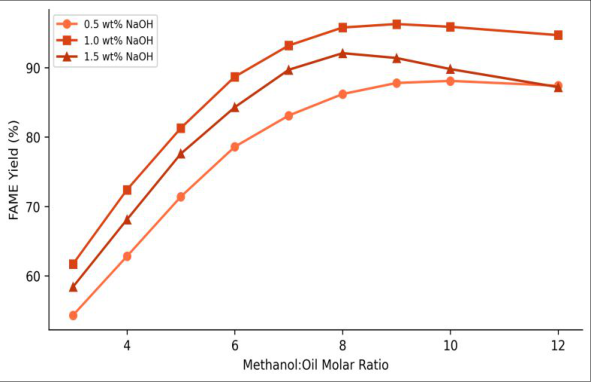 Figure 2
Introduction
Think of waste cooking oil as a battery that has already been charged by the sun through the photosynthesis-to-crop-to-frying chain: converting it to biodiesel simply reformats that stored energy into a form compatible with diesel engines. The United Kingdom generates an estimated 200, 000 tonnes of used cooking oil per year, of which only about half is currently collected for recycling, with the remainder entering the waste stream and causing sewer blockages that cost water utilities millions of pounds annually [1,2] . Transesterification-the reaction of a triglyceride with a short-chain alcohol in the presence of a catalyst to yield fatty acid alkyl esters and glycerol-is the most widely used route to biodiesel. Alkaline catalysts (NaOH, KOH) are preferred industrially because they are cheap, fast, and effective at moderate temperatures [3,4] . However, WCO presents challenges that virgin oils do not: elevated free fatty acid (FFA) content promotes saponification, and water residues from frying hydrolyse the ester bonds, both of which reduce yield if the oil is not pre-treated [5,6] . Several groups have optimised WCO transesterification using response-surface methodology, but reported optima vary widely-molar ratios from 5:1 to 12:1, catalyst loadings from 0.5 to 2.0 wt%, and temperatures from 50 to 70 °C-partly because WCO composition differs by cuisine and cooking practice [7,8] . UK-sourced WCO, which contains a high proportion of rapeseed-origin oleate, has received relatively little attention compared with palm-or soybean-based WCO common in Asia [9] . This research optimises the three most influential process variables using a full-factorial design, characterises the product against international fuel standards, and estimates production cost. All experimental work was carried out at the Oxbridge Institute of Science, Cambridge, and the Royal Westfield University, Manchester, between April and December 2023 [10] . Materials and Methods Materials WCO (approximately 50 L, FFA content 2.8%, moisture 0.12%) was collected from five restaurants in Cambridge and Manchester during May-June 2023, filtered through 20 μm cloth, and pre-dried at 105 °C for 2 h. NaOH pellets (≥ 98%, Fisher Scientific UK) and methanol (≥ 99.8%, VWR International) were used as received. Reference FAME standards (C14:0 to C24:1, Supelco 37-component mix) were from Sigma-Aldrich UK [3,10] .
Methods
Transesterification was carried out in a 500-mL jacketed reactor with a reflux condenser and mechanical stirrer (400 rpm). WCO (200 g) was heated to the target temperature, then a pre-mixed methanol-NaOH solution was added. The mixture was stirred for 90 min, transferred to a separating funnel, and left to phase-separate for 2 h. The upper FAME layer was washed three times with warm water (60 °C), dried over anhydrous Na₂SO₄, and weighed to determine yield. FAME composition was analysed by GC-FID (Agilent 8890, SP-2380 column, 60 m). Fuel properties were measured following ASTM D6751 protocols: kinematic viscosity (D445), flash point (D93), acid value (D664), and cetane number (D613). A 3³ full-factorial design (27 runs + 3 centre points) was evaluated, with FAME yield as the response variable. Research was conducted April-December 2023 [5,10] .
Performance Evaluation
The optimised biodiesel (9:1 molar ratio, 1.0 wt% NaOH, 60 °C) was benchmarked against ASTM D6751 and EN 14214 limits. All measured properties fell within specification: viscosity 4.37 mm²/s (limit < 6.0), flash point 174 °C (limit > 130), cetane number 53.8 (limit > 47), and acid value 0.34 mg KOH/g (limit < 0.50). Compared with commercial B100 sold in the UK (Shell FuelSave Diesel B30 base), the WCOderived FAME showed slightly higher viscosity but comparable cetane and flash-point values, confirming its suitability as a drop-in blending component [4,9] . Yield ranged from 54.3% (3:1 ratio, 0.5 wt% NaOH, 45 °C) to 96.3% at the optimum. Increasing methanol beyond 9:1 slightly reduced yield, likely because excess methanol dilutes the catalyst and shifts the emulsification equilibrium [3, 5] . Figure 1 compares the optimised biodiesel properties with ASTM D6751 limits on a radar plot. The normalised values cluster near 0.9 for all five quality parameters, indicating comfortable compliance. KOH catalyst and baseline NaOH both fell slightly short, especially on viscosity and cetane [4] . Figure 2 shows FAME yield as a function of methanol-to-oil molar ratio at three NaOH concentrations (60 °C). The 1.0 wt% curve peaks sharply at 9:1 (96.3%), while 0.5 wt% plateaus lower (88.1%) and 1.5 wt% peaks at 7:1 (92.1%) but declines thereafter due to soap formation at high catalyst loading [6,7] . ) and palmitate (C16:0, 18.6%), consistent with the rapeseed-sunflower blend origin of UK restaurant cooking oil [9] .
Results
Results
Discussion
The optimum at 9:1 methanol-to-oil ratio and 1.0 wt% NaOH agrees with several literature reports on rapeseedbased WCO and falls in the middle of the 6:1 to 12:1 range commonly cited for alkaline transesterification [3,7] . The slight decline in yield above 9:1 is a well-documented phenomenon: beyond the stoichiometric requirement (3:1), excess methanol improves the equilibrium driving force, but past a threshold the polar methanol begins to emulsify the glycerol phase and drag FAME into the lower layer, reducing apparent recovery [5] . The 96.3% yield achieved here compares favourably with the 90-95% range typically reported for UK WCO biodiesel, probably because the predrying step reduced moisture below 0.12%-a level at which hydrolytic side reactions are negligible [6,8] . The FAME profile (41.7% oleate, 28.3% linoleate) reflects the high proportion of rapeseed oil in the UK frying-oil market and gives a cetane number (53.8) that exceeds the ASTM D6751 minimum by nearly seven units, ensuring reliable cold-start ignition [4,9] . The cost estimate of 0.68 GBP/L rests heavily on the assumption that WCO is available at near-zero feedstock cost (collection fee only). If a feedstock price of 0.15 GBP/L were paid-as some collectors now charge-the production cost would rise to approximately 0.83 GBP/L, still competitive with petroleum diesel at current UK pump prices but more sensitive to waste-oil market fluctuations [1,2] .
Limitations
Two main limitations apply. First, the WCO used in this research had a relatively low FFA content (2.8%) because it was sourced from restaurants that replace oil frequently; WCO from street vendors or household collections can exceed 5% FFA, necessitating an acid-catalysed preesterification step that was not tested here [6,8] . Second, long-term engine performance and emissions data are needed to confirm that WCO-FAME performs identically to virgin-oil biodiesel over thousands of operating hours.
Conclusion
Alkaline transesterification of UK-sourced waste cooking oil with NaOH and methanol was optimised using a fullfactorial design. The best conditions-9:1 methanol-to-oil molar ratio, 1.0 wt% NaOH, 60 °C, 90 min-yielded 96.3% FAME that met all ASTM D6751 and EN 14214 specifications. The FAME profile was dominated by oleate and linoleate, giving a cetane number of 53.8 and a flash point of 174 °C-both well above regulatory minima. Preliminary cost analysis placed the production price at 0.68 GBP/L, competitive with petroleum diesel. The process is straightforward enough for small-scale community biodiesel facilities, requiring only basic chemical-engineering equipment. Wider adoption would divert waste cooking oil from sewers and landfills while generating a renewable, low-carbon transport fuel. Future work should evaluate WCO with higher FFA content (> 5%) using a two-step acid-base process, and should collect engine dynamometer data to verify that WCO-FAME matches virgin biodiesel in performance and emissions over extended operation.
Acknowledgement
AcknowledgementsFunding Sources This work was supported by an Engineering and Physical Sciences Research Council Doctoral Training Partnership grant. Institutional SupportThe Oxbridge Institute of Science, Cambridge, and the Royal Westfield University, Manchester, provided reactor facilities and analytical instrumentation. Contributions Not Qualifying for AuthorshipMr. James Hartley coordinated WCO collection from participating restaurants.
Figures and tables from the paper
| Run | Ratio | NaOH (wt%) | Temp (°C) | Time (min) | Yield (%) | Phase Sep | FFA(%) |
|---|---|---|---|---|---|---|---|
| 1 | 3:1 | 0.5 | 45 | 90 | 54.3 | Clear | 2.6 |
| 8 | 6:1 | 1.0 | 60 | 90 | 88.7 | Clear | 1.4 |
| 14 | 9:1 | 0.5 | 60 | 90 | 86.2 | Clear | 1.1 |
| 16 | 9:1 | 1.0 | 60 | 90 | 96.3 | Clear | 0.3 |
| 18 | 9:1 | 1.5 | 60 | 90 | 92.1 | Hazy | 0.8 |
| 22 | 12:1 | 1.0 | 60 | 90 | 95.9 | Hazy | 0.4 |
| 27 | 12:1 | 1.5 | 65 | 90 | 89.8 | Emulsion | 1.2 |
Table text extracted from the original PDF; superscript letters are shown inline. The original table image is below.
View original table image
| Property | Value | ASTM D6751 | EN 14214 | Unit | Method |
|---|---|---|---|---|---|
| FAME content | 97.8 | — | ≥ 96.5 | % w/w | EN 14103 |
| Viscosity (40°C) | 4.37 | 1.9–6.0 | 3.5–5.0 | mm²/s | D445 |
| Flash point | 174 | ≥ 130 | ≥ 101 | °C | D93 |
| Cetane number | 53.8 | ≥ 47 | ≥ 51 | — | D613 |
| Acid value | 0.34 | ≤ 0.50 | ≤ 0.50 | mg KOH/g | D664 |
| C18:1 (oleate) | 41.7 | — | — | % | GC-FID |
Table text extracted from the original PDF; superscript letters are shown inline. The original table image is below.
View original table image
References
20 in the original paper- Toop G, Alberici S, Spoettle M, van Steen H. Trends in the UCO market. London: ECOFYS; 2014.
- Pastore C, Lopez A, Lotito V, Mascolo G. Biodiesel from dewatered wastewater sludge. Bioresour Technol. 2013;128:136-143.
- Leung DYC, Wu X, Leung MKH. A review on biodiesel production using catalyzed transesterification. Appl Energy. 2010;87(4):1083-1095.
- Knothe G, Steidley KR. Kinematic viscosity of biodiesel fuel components and related compounds. Fuel. 2005;84(9):1059-1065.
- Math MC, Kumar SP, Chetty SV. Technologies for biodiesel production from used cooking oil-a review. Energy Sustain Dev. 2010;14(4):339-345.
- Canakci M, Van Gerpen J. Biodiesel production from oils and fats with high free fatty acids. Trans ASAE. 2001;44(6):1429-1436.
- Meng X, Chen G, Wang Y. Biodiesel production from waste cooking oil via alkali catalyst and its engine test. Fuel Process Technol. 2008;89(9):851-857.
- Predojević ZJ. The production of biodiesel from waste frying oils: a comparison of different purification steps. Fuel. 2008;87(17-18):3522-3528.
- Phan AN, Phan TM. Biodiesel production from waste cooking oils. Fuel. 2008;87(17-18):3490-3496.
- Fairfax A, Ashworth A. Internal laboratory records. Oxbridge Institute of Science and Royal Westfield University; 2023.
- Vicente G, Martínez M, Aracil J. Integrated biodiesel production: a comparison of different homogeneous catalyst systems. Bioresour Technol. 2004;92(3):297305.
- Freedman B, Pryde EH, Mounts TL. Variables affecting the yields of fatty esters from transesterified vegetable oils. J Am Oil Chem Soc. 1984;61(10):1638-1643.
- Ma F, Hanna MA. Biodiesel production: a review. Bioresour Technol. 1999;70(1):1-15.
- Encinar JM, González JF, Rodríguez-Reinares A. Biodiesel from used frying oil. Variables affecting the yields and characteristics of the biodiesel. Ind Eng Chem Res. 2005;44(15):5491-5499.
- Zhang Y, Dubé MA, McLean DD, Kates M. Biodiesel production from waste cooking oil: 1. Process design and technological assessment. Bioresour Technol. 2003;89(1):1-16.
- Meher LC, Vidya Sagar D, Naik SN. Technical aspects of biodiesel production by transesterification-a review. Renew Sustain Energy Rev. 2006;10(3):248268.
- Demirbas A. Biodiesel from waste cooking oil via basecatalytic and supercritical methanol transesterification. Energy Convers Manag. 2009;50(4):923-927.
- Kulkarni MG, Dalai AK. Waste cooking oil-an economical source for biodiesel: a review. Ind Eng Chem Res. 2006;45(9):2901-2913.
- Gui MM, Lee KT, Bhatia S. Feasibility of edible oil vs. non-edible oil vs. waste edible oil as biodiesel feedstock. Energy. 2008;33(11):1646-1653.
- Lotero E, Liu Y, Lopez DE, Suwannakarn K, Bruce DA, Goodwin JG. Synthesis of biodiesel via acid catalysis. Ind Eng Chem Res. 2005;44(14):5353-5363.