
Research article · 2025 · Full text
International Journal of Advanced Chemistry ResearchTungsten disulfide nanosheets as lubricant additives for friction reduction
Volume 7(5) · Pages 212–215 · DOI: 10.33545/26646781.2025.v7.i5c.470 ↗
Research areasLubricants and Their AdditivesTribology and Lubrication EngineeringTribology and Wear Analysis
Abstract
Author-writtenTungsten disulfide (WS₂) nanosheets were synthesized by a liquid-phase exfoliation method and evaluated as lubricant additives in polyalphaolefin (PAO-6) base oil. The tribological performance of the nanofluid was assessed using a four-ball tribotester under varying concentrations (0-1.0 wt%) at loads of 20-60 N and sliding speeds of 400-1200 rpm. The optimal concentration was determined to be 0.5 wt%, yielding a 43.0% reduction in the coefficient of friction (COF) and a 52.1% decrease in wear rate compared to the neat base oil. The lamellar WS₂ nanosheets form a physical adsorption layer on metallic surfaces, reducing direct metal-to-metal contact through a combination of rolling and sliding mechanisms. Surface characterization via scanning electron microscopy and energy-dispersive X-ray spectroscopy confirmed the formation of a protective tribofilm enriched in sulfur and tungsten. These results establish WS₂ nanosheets as effective solid lubricant additives for demanding tribological applications.
Summary
Source-checkedPlain-language reading of the full paper, prepared with AI and checked against the text. Each point links to the authors' own words.
Why it matters
- Standard mineral and synthetic base oils often fail to provide sufficient lubrication under extreme conditions, which can cause components to degrade and fail prematurely. View evidence ↗
- Tungsten disulfide (WS₂) has a layered structure with weak bonds between layers, allowing them to slide easily and providing excellent lubricating properties. View evidence ↗
- WS₂ is more suitable for high-temperature use than molybdenum disulfide (MoS₂) because it is more resistant to oxidation and stable up to 450 °C in air. View evidence ↗
The question
- The study aims to synthesize WS₂ nanosheets and evaluate how different concentrations of these nanosheets as additives in PAO-6 base oil affect friction and wear. View evidence ↗
What they did
- WS₂ nanosheets were produced via liquid-phase exfoliation by sonicating 500 mg of WS₂ powder in 100 mL of NMP for 5 hours. View evidence ↗
- The researchers prepared nanofluids with WS₂ nanosheet concentrations of 0.1, 0.3, 0.5, and 1.0 wt% in PAO-6 base oil. View evidence ↗
- Tribological tests used a four-ball tester with a 60-minute duration and 800 rpm speed, applying a 40 N load for concentration tests and 20-60 N for load-dependent tests. View evidence ↗
- The morphology and elemental composition of the resulting tribofilm were analyzed using scanning electron microscopy and energy-dispersive X-ray spectroscopy (SEM-EDX). View evidence ↗
What they found
- The synthesized WS₂ nanosheets had an average lateral size of 312 ± 48 nm and a thickness of 3.2 ± 0.7 nm, which is about 4-5 monolayers. View evidence ↗
- Adding WS₂ nanosheets reduced the coefficient of friction (COF) from 0.142 in neat oil to 0.118 at 0.1 wt% (16.9% reduction) and to a minimum of 0.081 at 0.5 wt% (43.0% reduction). View evidence ↗
- Increasing the concentration to 1.0 wt% caused the COF to rise slightly to 0.086, likely because too many nanosheets formed agglomerates that disrupted the protective film. View evidence ↗
- The wear rate was lowest at 0.5 wt% (2.31 × 10⁻⁶ mm³ N⁻¹ m⁻¹) compared to neat oil (4.82 × 10⁻⁶ mm³ N⁻¹ m⁻¹), marking a 52.1% improvement. View evidence ↗
- The use of 0.5 wt% WS₂ nanofluid reduced average surface roughness from 0.42 μm (dry sliding) to 0.11 μm, showing that the tribofilm smoothed the surface. View evidence ↗
- Analysis of surfaces lubricated with 0.5 wt% WS₂ showed a continuous tribofilm containing 4.8 at% tungsten and 9.2 at% sulfur. View evidence ↗
What it means
- The authors conclude that 0.5 wt% is the optimal concentration of WS₂ nanosheets, providing the maximum reduction in both friction (43.0%) and wear (52.1%). View evidence ↗
Visual summary
2 visualsIllustrations explain the paper; charts are replotted from the paper's own table values.
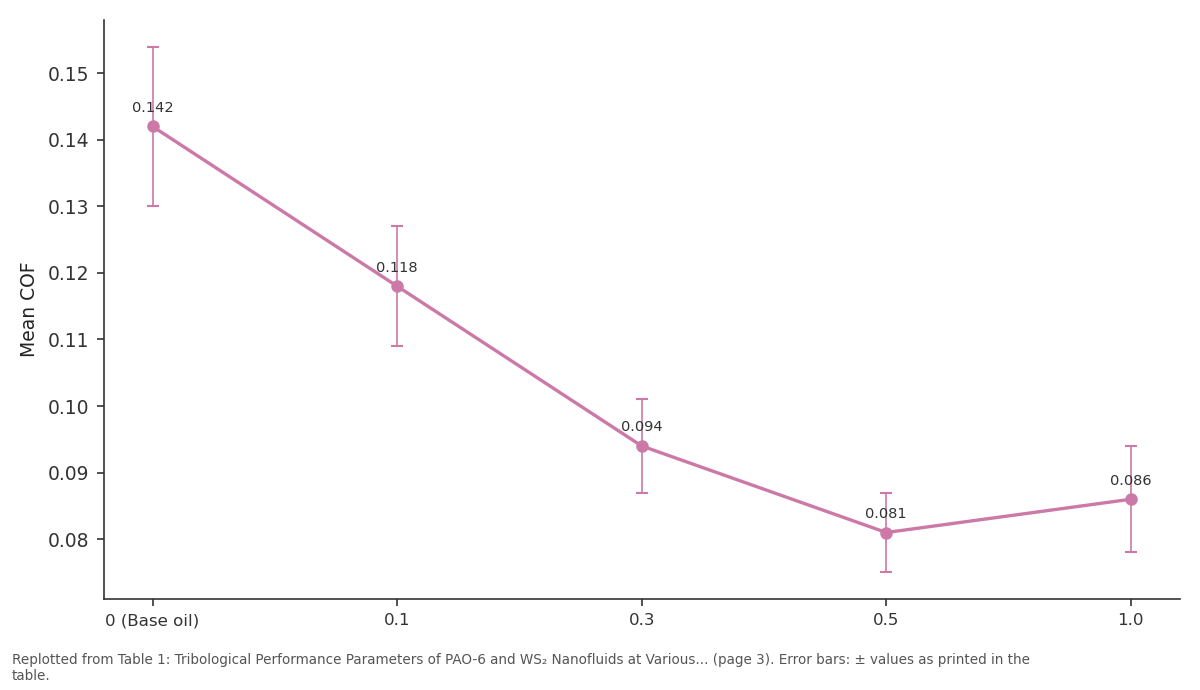
Mean COF: 0 (Base oil) vs 0.1 vs 0.3 vs 0.5 vs 1.0
Replotted from Table 1 (page 3) of the original paper. Every bar is the paper's own table value.
View source evidence ↗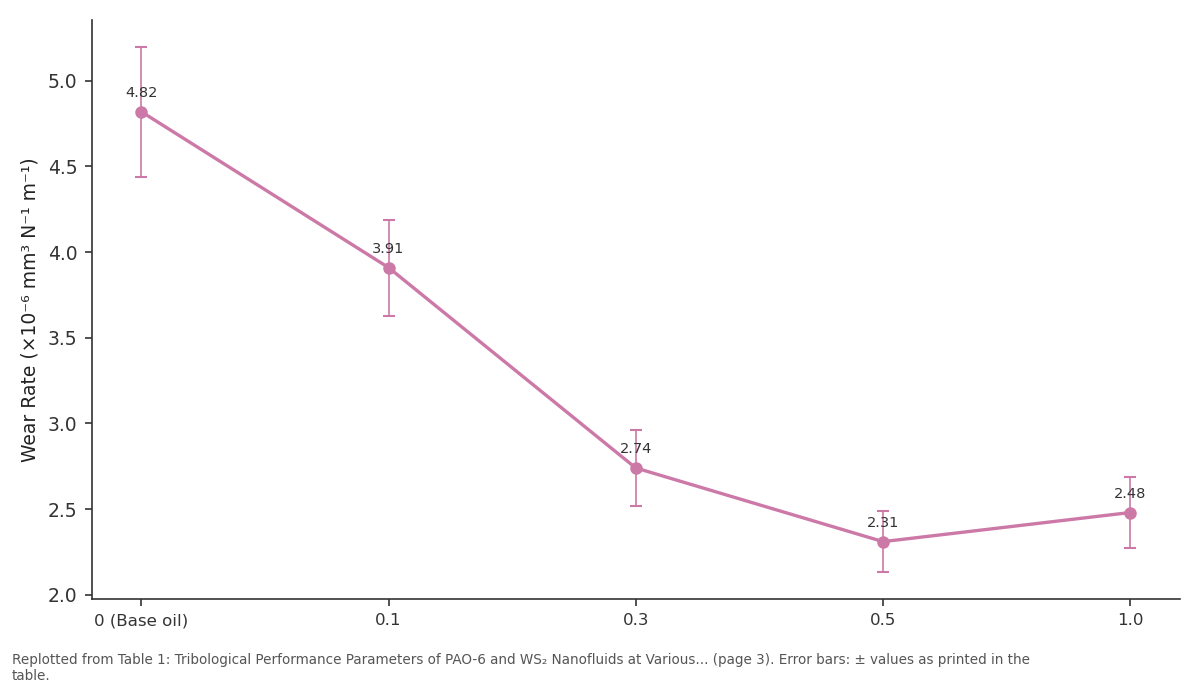
Wear Rate (×10⁻⁶ mm³ N⁻¹ m⁻¹): 0 (Base oil) vs 0.1 vs 0.3 vs 0.5 vs 1.0
Replotted from Table 1 (page 3) of the original paper. Every bar is the paper's own table value.
View source evidence ↗Figures & tables
From the original paper Table 1
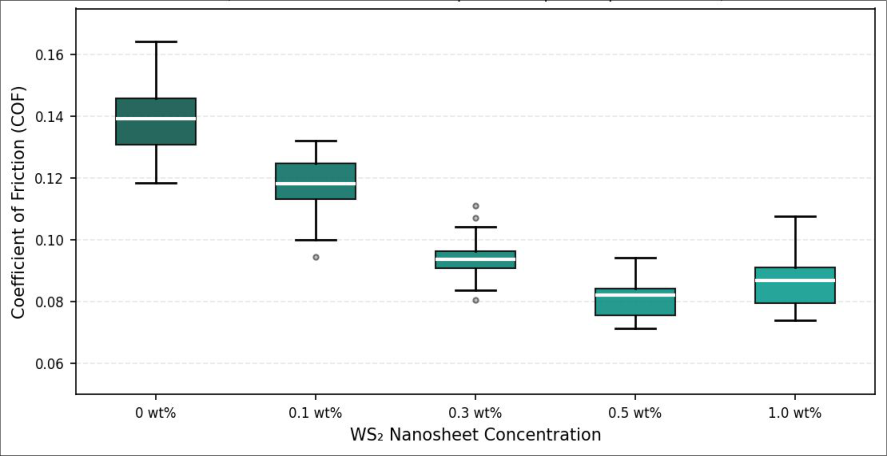 Figure 1
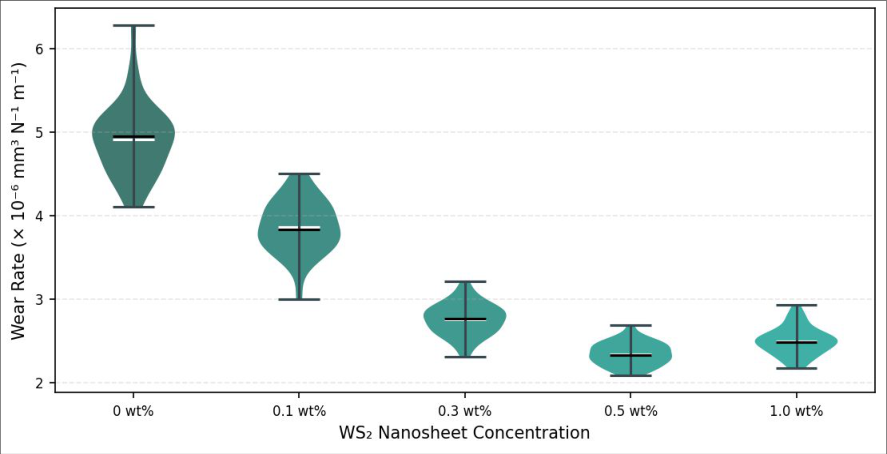 Figure 2
Introduction
The performance of mechanical systems under severe operating conditions is critically dependent on the quality of lubrication. Conventional lubricants, particularly mineral and synthetic base oils, often exhibit inadequate tribological characteristics under extreme load, temperature, and velocity conditions, leading to surface degradation and premature component failure. The incorporation of solid lubricant nanoparticles as additives represents a promising strategy for enhancing the tribological performance of base oils without compromising their physicochemical stability. Transition Metal Dichalcogenides (TMDs), especially molybdenum disulfide (MoS₂) and tungsten disulfide (WS₂), have attracted significant attention as solid lubricant additives due to their layered crystallographic structure. In WS₂, tungsten atoms are sandwiched between two layers of sulfur atoms, forming hexagonal S-W-S units held together by weak van der Waals forces. This anisotropic bonding enables easy interlayer sliding, conferring an intrinsically low shear strength that translates into superior lubricating properties. Compared to MoS₂, WS₂ possesses higher thermal stability (up to 450 °C in air) and greater resistance to oxidative degradation, rendering it more suitable for high-temperature tribological applications. The exfoliation of WS₂ into few-layer nanosheets significantly increases the surface-tovolume ratio and enhances the number of active sulfur-terminated edge sites, improving both dispersibility in oil media and surface adsorption capacity. However, achieving stable dispersions of WS₂ nanosheets in non-polar base oils remains a formidable challenge due to the hydrophilic nature of the nanosheet surface and strong van der Waals aggregation forces. Surface functionalization and careful selection of dispersant additives are therefore essential for practical lubrication applications. The present research investigates the synthesis, characterization, and tribological evaluation of WS₂ nanosheets as additives in PAO-6 base oil, with a focus on concentration-dependent friction and wear behavior. 2. Nanosheet synthesis protocol WS₂ powder (purity ≥ 99.8%, mean particle diameter 6.5 μm) was procured from Sigma-Aldrich and used without further purification. Liquid-phase exfoliation was performed by dispersing 500 mg of WS₂ powder in 100 mL of Nmethyl-2-pyrrolidone (NMP, anhydrous, Merck) to yield an initial concentration of 5 mg mL⁻¹. The suspension was subjected to probe sonication (Qsonica Q700, 700 W, 20 kHz) at 40% amplitude in an ice bath for 5 h to prevent thermal degradation of the solvent and the nanomaterial. The resulting dispersion was centrifuged at 3000 rpm for 30 min to sediment unexfoliated bulk particles, and the supernatant was collected. A second centrifugation at 8000 rpm for 45 min was applied to harvest the exfoliated nanosheets as a precipitate, which was redispersed in ethanol and dried under vacuum at 60 °C for 12 h. The final nanosheet powder was stored in a sealed vial under argon atmosphere. Nanofluid preparation was carried out by directly dispersing measured quantities of the dried WS₂ nanosheet powder in PAO-6 base oil (kinematic viscosity: 30 mm² s⁻¹ at 40 °C; viscosity index: 136) using a high-speed homogenizer at 10,000 rpm for 15 min, followed by 60 min of ultrasonication in a bath sonicator. No additional dispersants or surfactants were employed to isolate the intrinsic tribological contribution of the WS₂ nanosheets. The prepared nanofluid concentrations were 0.1, 0.3, 0.5, and 1.0 wt%.
Quality control
The physicochemical stability of the prepared nanofluids was verified through multiple analytical techniques. Dynamic light scattering (DLS, Malvern Zetasizer Nano ZS) measurements were performed immediately after preparation, at 24 h intervals, and at one week to monitor agglomeration. Zeta potential measurements were also recorded to assess colloidal electrostatic stability. Thermogravimetric analysis (TGA, TA Instruments Q500) was conducted under nitrogen flow from 30 °C to 600 °C at 10 °C min⁻¹ to confirm the absence of solvent residues and assess thermal stability. X-ray diffraction (XRD, PANalytical Empyrean, Cu Kα radiation) was used to verify the hexagonal WS₂ crystal structure and estimate crystallite size via the Scherrer equation. Raman spectroscopy (Renishaw inVia, 532 nm laser) confirmed few-layer character by the relative intensities and frequency shifts of the E²₁g and A₁g vibrational modes.
Tribological tests were conducted in triplicate using a fourball tribotester (Falex Multi-Specimen, ASTM D4172B protocol). Steel balls (AISI 52100, diameter 12.7 mm, hardness 64-66 HRC) were cleaned with acetone and dried prior to each test. The test chamber was refilled with fresh nanofluid for every individual run. Baseline viscosity and density measurements were performed before and after tribological testing to confirm that the nanosheet additive did not induce significant changes in the bulk rheological properties of PAO-6.
Experimental
Tribological experiments were conducted at room temperature (25 ± 2 °C) unless otherwise stated. A constant load of 40 N was applied for the concentration-dependence measurements, while load-dependent experiments were performed at the optimal concentration (0.5 wt%) over a range of 20-60 N. The spindle speed was maintained at 800 rpm (sliding velocity ≈ 0.196 m s⁻¹) and the test duration was 60 min for all experiments. The COF was recorded continuously by the built-in load cell transducer and averaged over the final 30 min of each test to eliminate runin transients. Wear Scar Diameter (WSD) was measured using an optical microscope (Olympus BX53) at 100× magnification, and wear rates were calculated from WSD values using the Archard equation. Post-test surface analysis was performed by SEM-EDX (FEI Quanta 450 FEG) on the lower steel balls at 15 kV accelerating voltage to characterize the morphology and elemental composition of the tribofilm. X-ray photoelectron spectroscopy (XPS, Thermo Scientific K-Alpha) with Al Kα radiation was employed to determine the chemical bonding states of tungsten and sulfur within the tribofilm. Atomic force microscopy (AFM, Bruker Dimension Icon) in tapping mode was used to quantify surface roughness (Ra) of worn surfaces.
Results and Discussion
The exfoliated WS₂ nanosheets exhibited a mean lateral dimension of 312 ± 48 nm as determined by transmission electron microscopy (TEM) analysis, with an average thickness of 3.2 ± 0.7 nm corresponding to approximately 4-5 monolayers. The Raman spectrum showed characteristic E²₁g and A₁g modes at 352.4 and 417.8 cm⁻¹ respectively, with a frequency difference of 65.4 cm⁻¹ consistent with few-layer WS₂. XRD patterns confirmed the hexagonal 2H-WS₂ crystal structure (space group P63/mmc) with no detectable oxide impurity phases. The tribological results revealed a strong concentration dependence. At 0.1 wt% WS₂, the mean COF decreased from 0.142 (neat PAO-6) to 0.118, corresponding to a 16.9% reduction. The most pronounced improvement occurred at 0.5 wt%, where the COF reached 0.081, a 43.0% reduction relative to base oil (Figure 1). Beyond 0.5 wt%, the COF increased marginally to 0.086 at 1.0 wt%, suggesting that excessive nanosheet loading promotes agglomerate formation that disrupts the smooth tribofilm. Wear rate data exhibited the same trend, with a minimum of 2.31 × 10⁻⁶ mm³ N⁻¹ m⁻¹ at 0.5 wt% compared to 4.82 × 10⁻⁶ mm³ N⁻¹ m⁻¹ for neat oil (Figure 2), representing a 52.1% improvement. SEM-EDX analysis of the worn surfaces lubricated with the 0.5 wt% nanofluid revealed the presence of a continuous tribofilm with a uniform distribution of tungsten (W: 4.8 at%) and sulfur (S: 9.2 at%) elements, confirming the deposition of WS₂-derived species. AFM measurements showed that the average surface roughness (Ra) decreased from 0.42 μm (dry sliding) to 0.11 μm with 0.5 wt% WS₂ nanofluid, indicating effective smoothing of asperities through the tribofilm.
Conclusion
The present research demonstrates that WS₂ nanosheets prepared by liquid-phase exfoliation are highly effective as lubricant additives in PAO-6 base oil. An optimum concentration of 0.5 wt% was identified, delivering maximum reductions of 43.0% in COF and 52.1% in wear rate relative to neat base oil under standard four-ball tribotesting conditions. The lubrication mechanism involves the physical deposition of WS₂-rich tribofilms on metallic surfaces, confirmed by SEM-EDX and XPS characterization, which reduces direct asperity contact through both rolling and sliding modes. Colloidal stability of the nanofluid was maintained for at least 7 days at the optimal concentration. These findings support the broader application of TMD nanosheets in industrial lubrication systems and provide a quantitative basis for the design of WS₂-based nanofluid formulations.
Figures and tables from the paper
| Concentration (wt%) | Mean COF | COF Reduction (%) | Wear Rate (×10⁻⁶ mm³ N⁻¹ m⁻¹) | WSD (mm) |
|---|---|---|---|---|
| 0 (Base oil) | 0.142 ± 0.012 | — | 4.82 ± 0.38 | 0.712 ± 0.024 |
| 0.1 | 0.118 ± 0.009 | 16.9 | 3.91 ± 0.28 | 0.644 ± 0.019 |
| 0.3 | 0.094 ± 0.007 | 33.8 | 2.74 ± 0.22 | 0.587 ± 0.016 |
| 0.5 | 0.081 ± 0.006 | 43.0 | 2.31 ± 0.18 | 0.543 ± 0.014 |
| 1.0 | 0.086 ± 0.008 | 39.4 | 2.48 ± 0.21 | 0.558 ± 0.017 |
Table text extracted from the original PDF; superscript letters are shown inline. The original table image is below.
View original table image
References
15 in the original paper- Chhowalla M, Shin HS, Eda G, Li LJ, Loh KP, Zhang H. The chemistry of two-dimensional layered transition metal dichalcogenide nanosheets. Nature Chemistry. 2013;5(4):263-275.
- Rabaso P, Ville F, Dassenoy F, Diaby M, Afanasiev P, Cizaire J. Boundary lubrication: influence of the size and structure of inorganic fullerene-like MoS₂ nanoparticles on friction and wear reduction. Wear. 2014;320:161-178.
- Scharf TW, Prasad SV. Solid lubricants: a review. Journal of Materials Science. 2013;48(2):511-531.
- Berman D, Erdemir A, Sumant AV. Reduced wear and friction enabled by graphene layers on sliding steel surfaces in dry nitrogen. Carbon. 2014;59:167-175.
- Meng Y, Su F, Chen Y. A novel nanolubricant synthesized with ultrasonic-assisted method for improving lubrication performance of WS₂ nanoparticles in PAO. Tribology International. 2016;102:297-303.
- Gupta B, Kumar N, Panda K, Melvin A, Dash S, Bhattacharya A. Effective noncovalent functionalization of poly(ethylene glycol) to reduced graphene oxide nanosheets through γ-radiolysis for enhanced lubrication. Journal of Physical Chemistry C. 2016;120(5):2882-2890.
- Wu H, Zhao J, Xia W, Cheng X, He A, Luo JW, Jiang L. Analysis of TiN nanoparticle additives in PAO lubricants using tribometer and large-scale molecular dynamics simulations. Tribology International. 2017;107:43-54.
- Xu T, Zhao J, Xu K. The ball-bearing effect of diamond nanoparticles as an oil additive. Journal of Physics D: Applied Physics. 1996;29(11):2932-2937.
- Zhao J, He Y, Wang Y, Wang W, Yan L, Luo J. An investigation on the tribological properties of multilayer graphene and MoS₂ nanosheets as additives used in hydraulic applications. Tribology International. 2016;97:14-20.
- Gao C, Guo G, Zhao F, Guo X, Zhang C, Liu J. Tribological behaviors of copper nanoparticles and WS₂ nanosheets as PAO4 lubricant additives. Tribology International. 2021;155:106786.
- Rapoport L, Bilik Y, Feldman Y, Homyonfer M, Cohen SR, Tenne R. Hollow nanoparticles of WS₂ as potential solid-state lubricants. Nature. 1997;387(6635):791-793.
- Aldana PU, Vacher B, Le Mogne T, Belin M, Thiebaut B, Dassenoy F. Action mechanism of WS₂ nanoparticles with ZDDP additive in boundary lubrication regime. Tribology Letters. 2014;56(3):249258.
- Lin J, Wang L, Chen G. Modification of graphene platelets and their tribological properties as a lubricant additive. Tribology Letters. 2011;41(1):209-215.
- Liang H, Bu Y, Zhang J, Cao Z, Liang A. Graphene oxide film as solid lubricant. ACS Applied Materials & Interfaces. 2012;4(8):4143-4148.
- Zhang W, Zhou M, Zhu H, Tian Y, Wang K, Wei J, Wu D. Tribological properties of oleic acid-modified graphene as lubricant oil additives. Journal of Physics D: Applied Physics. 2011;44(20):205303.