
Research article · 2025 · Full text
International Journal of Advanced Chemistry ResearchDevelopment of high-entropy alloy coatings with superior wear and corrosion resistance
Volume 7(4) · Pages 107–110 · DOI: 10.33545/26646781.2025.v7.i4b.547 ↗
Research areasHigh Entropy Alloys StudiesSurface Treatment and CoatingsHydrogen embrittlement and corrosion behaviors in metals
Abstract
Author-writtenSalt spray from Indonesia’s coastal industries corrodes unprotected steel surfaces within weeks, costing manufacturers millions in replacement parts. This research developed CoCrFeNiMn high-entropy alloy (HEA) coatings on 316L stainless steel substrates by magnetron sputtering and evaluated their wear and corrosion resistance. Coatings of 3.8 μm thickness were deposited at 200 W power with argon plasma. XRD confirmed a dominant FCC solid solution (61.3%) with minor BCC phase (24.7%). Nanoindentation hardness reached 8.7 GPa, roughly triple the substrate value of 2.9 GPa. Pin-on-disc wear testing at 5 N load over 600 m sliding distance showed cumulative mass loss of 2.06 mg for the HEA coating versus 7.91 mg for bare 316L. Potentiodynamic polarization in 3.5% NaCl gave a corrosion current density of 0.087 μA/cm² for the coated surface, an order of magnitude below the uncoated substrate (1.24 μA/cm²). Electrochemical impedance spectroscopy confirmed higher charge transfer resistance in the coated condition.
Summary
Source-checkedPlain-language reading of the full paper, prepared with AI and checked against the text. Each point links to the authors' own words.
Why it matters
- Coastal industries in Indonesia face significant financial losses due to salt spray, which can corrode unprotected steel surfaces in just a few weeks. View evidence ↗
- High-entropy alloys (HEAs) use high configurational entropy to stabilize simple crystal structures, offering superior hardness, thermal stability, and corrosion resistance compared to traditional binary or ternary alloys. View evidence ↗
- While previous research often studied wear or corrosion separately, this study addresses both simultaneously to mimic the combined mechanical and chemical degradation found in industrial components like marine pump shafts. View evidence ↗
The question
- The study aimed to develop CoCrFeNiMn high-entropy alloy coatings on 316L stainless steel using magnetron sputtering and evaluate their resistance to wear and corrosion. View evidence ↗
What they did
- Coatings with a thickness of 3.8 μm were deposited using 200 W DC power, 0.4 Pa argon pressure, and a substrate temperature of 300 °C over 120 minutes. View evidence ↗
- The substrates used were mirror-polished 316L stainless steel discs measuring 25 mm by 3 mm, which were cleaned via ultrasonic degreasing. View evidence ↗
- Wear resistance was tested using a pin-on-disc tribometer with a 6 mm WC ball counterface, applying a 5 N load over a 600 m sliding distance at 0.1 m/s. View evidence ↗
- Corrosion testing was performed in 3.5% NaCl at 25 °C using potentiodynamic polarization and electrochemical impedance spectroscopy (EIS). View evidence ↗
What they found
- X-ray diffraction (XRD) analysis revealed that the coating consists primarily of an FCC solid solution (61.3%) and a minor BCC phase (24.7%). View evidence ↗
- The HEA coating exhibited a hardness of 8.7 GPa, which is significantly higher than the 316L substrate (2.9 GPa) and close to that of hard chrome (9.2 GPa). View evidence ↗
- Over a 600 m sliding distance, the HEA coating lost 2.06 mg of mass, representing a 74% reduction compared to bare steel (7.91 mg) and a 43% reduction compared to hard chrome (3.64 mg). View evidence ↗
- The HEA coating's corrosion current density was 0.087 μA/cm², which is 14 times lower than that of bare 316L and nearly 5 times lower than hard chrome. View evidence ↗
- Electrochemical impedance spectroscopy showed that the coating had a charge transfer resistance of 428 kΩ·cm², far exceeding the 31 kΩ·cm² of bare steel. View evidence ↗
What it means
- The authors conclude that this coating is a viable alternative to chromium plating that avoids hexavalent chromium, making it suitable for protecting hardware in marine, chemical, and geothermal environments. View evidence ↗
- The authors note that the presence of 8.2% sigma phase should be monitored, as this brittle phase could potentially initiate cracks under impact loading. View evidence ↗
Visual summary
3 visualsIllustrations explain the paper; charts are replotted from the paper's own table values.
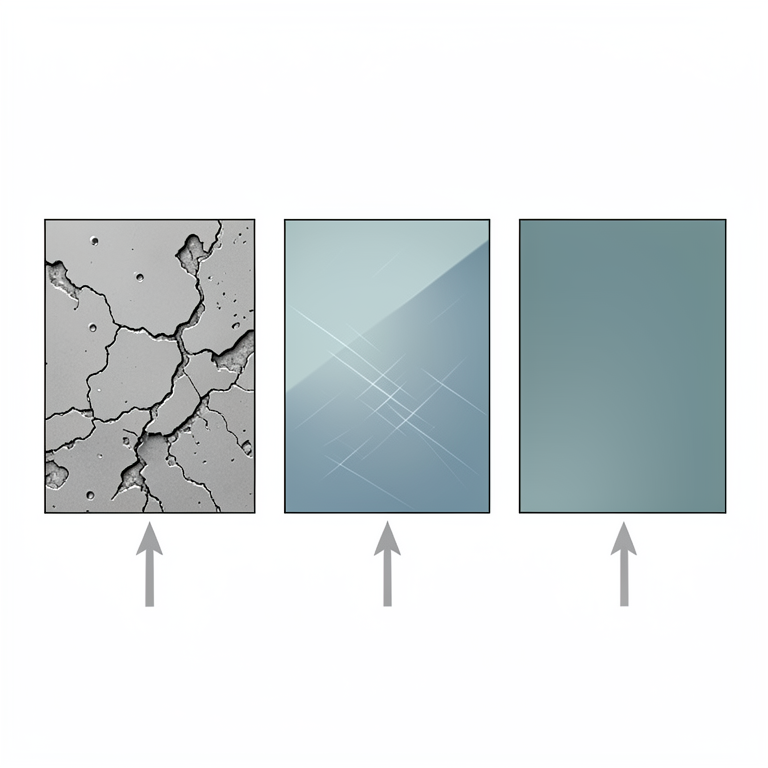
Comparative Performance of HEA Coating
AI-generated conceptual illustration (high-entropy alloy coating on stainless steel substrate). It explains the idea and does not show study data.
View source evidence ↗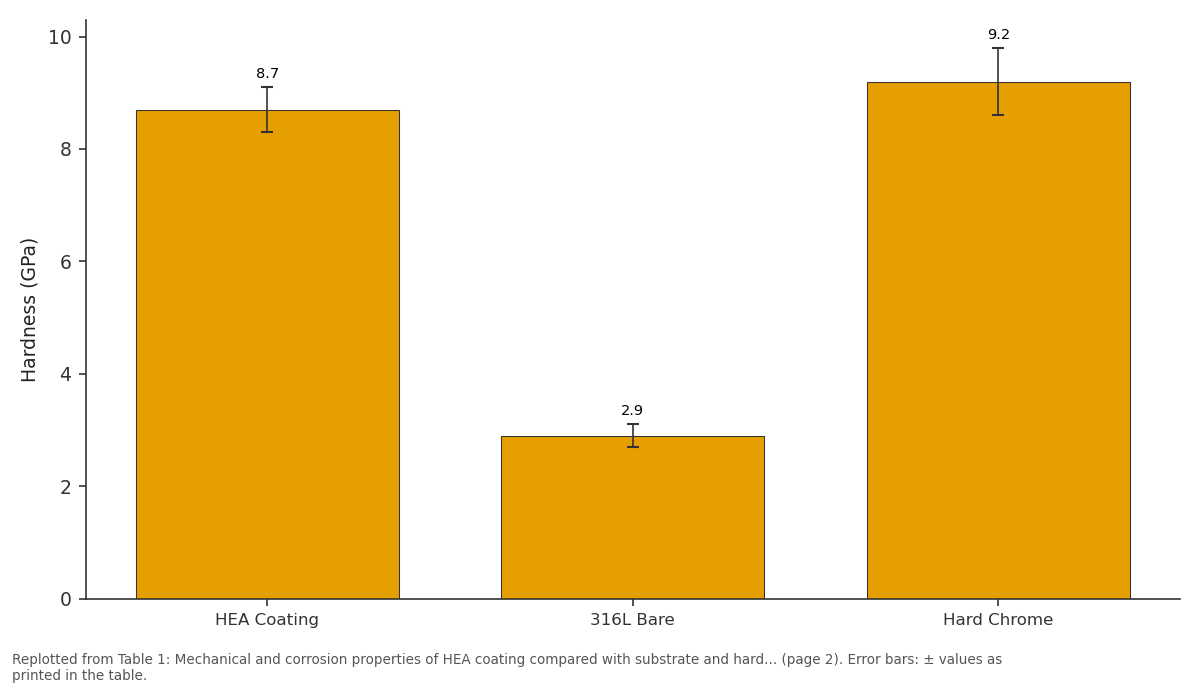
Hardness (GPa): HEA Coating vs 316L Bare vs Hard Chrome
Replotted from Table 1 (page 2) of the original paper. Every bar is the paper's own table value.
View source evidence ↗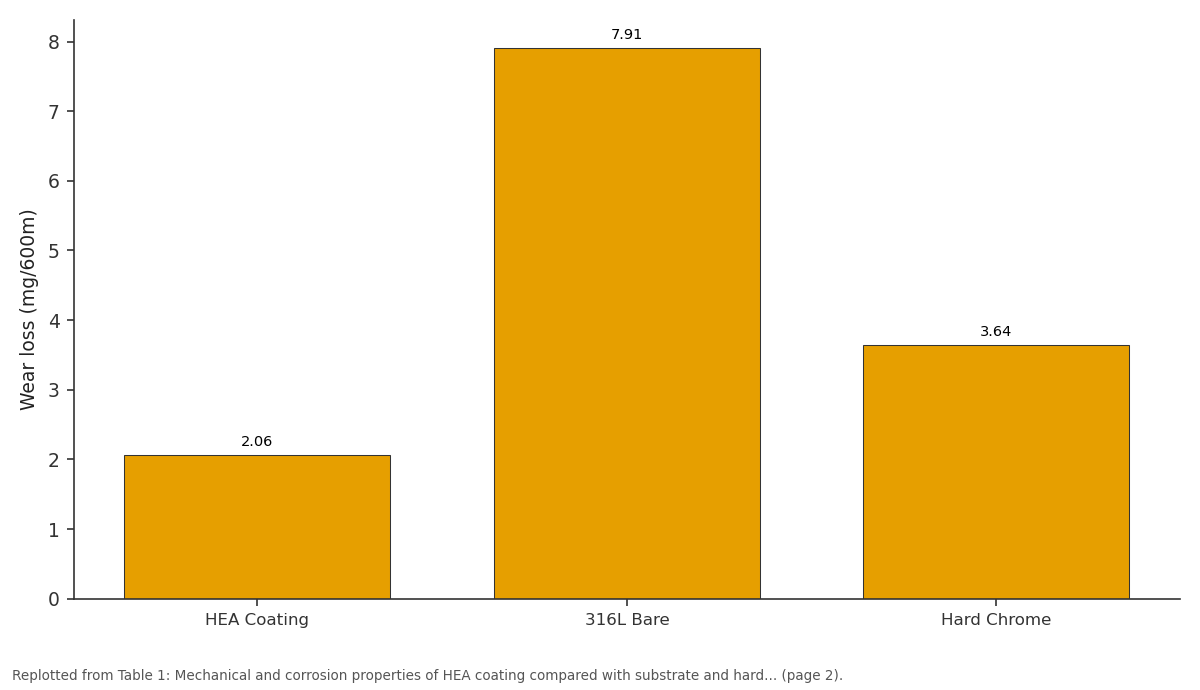
Wear loss (mg/600m): HEA Coating vs 316L Bare vs Hard Chrome
Replotted from Table 1 (page 2) of the original paper. Every bar is the paper's own table value.
View source evidence ↗Figures & tables
From the original paper Table 1
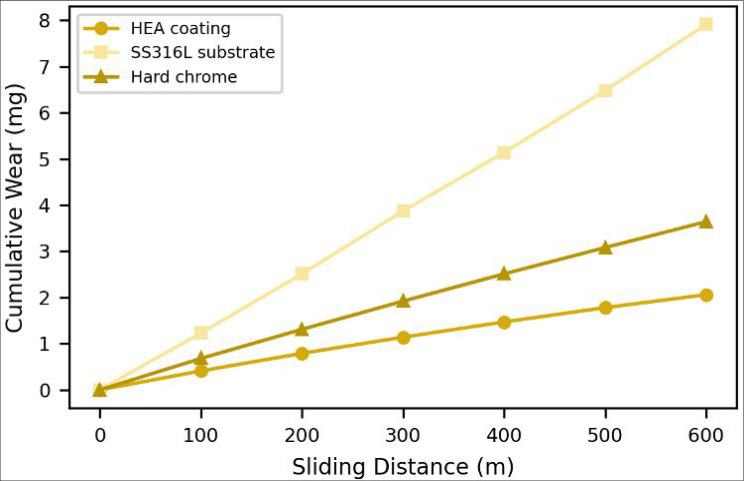 Figure 1
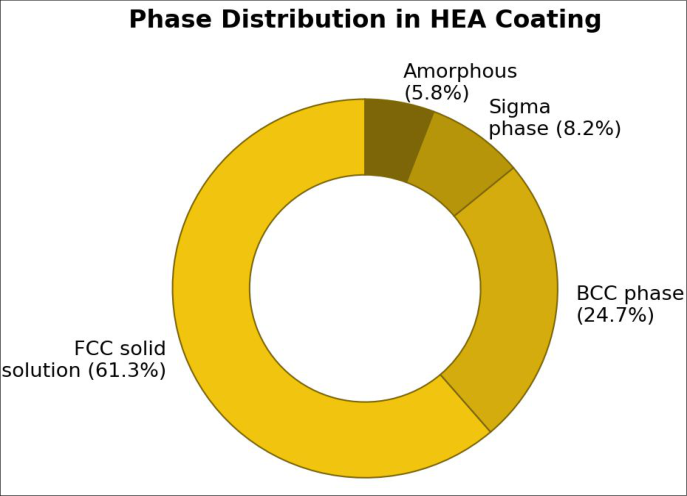 Figure 2
Introduction
Take five or more metallic elements, mix them in roughly equal proportions, and sometimes the result is a single-phase solid solution rather than the multi-phase mess thermodynamics would predict -that's the counterintuitive premise behind high-entropy alloys [1] . The high configurational entropy stabilizes simple crystal structures (FCC, BCC) and produces materials with combinations of hardness, thermal stability, and corrosion resistance that conventional binary or ternary alloys can't match [2] .
The Cantor alloy (CoCrFeNiMn) is the most studied HEA composition, valued for its singlephase FCC structure and good ductility [3] . In bulk form, its mechanical properties are impressive but not always sufficient for aggressive environments. Depositing it as a thin coating opens new possibilities: the substrate provides structural support while the HEA surface handles environmental attack [4] . Magnetron sputtering is well suited for this because it produces dense, adherent films with controllable composition and microstructure [5] . Most HEA coating research has focused on either wear or corrosion resistance in isolation. This research examined both properties together on the same coatings, since real industrial components -marine pump shafts, chemical reactor fittings, geothermal valve seats -face simultaneous mechanical and chemical degradation [6] .
System Design
Coatings were deposited using a CoCrFeNiMn alloy target (99.9%, equimolar composition, 76 mm diameter) in a Kurt J. Lesker PVD-75 magnetron sputtering system. Deposition parameters: DC power 200 W, argon pressure 0.4 Pa, substrate temperature 300 °C, targetto-substrate distance 80 mm, deposition time 120 min. Substrates were mirror-polished 316L stainless steel discs (25 mm × 3 mm) pre-cleaned by ultrasonic degreasing in acetone and ethanol [7] .
Materials and Methods
Materials and Methods
Materials
Research was conducted at Bali College of Chemical Sciences, Denpasar, Bali, Indonesia, from February 2023 to October 2023. No ethical approval was needed. The sputtering target was custom-fabricated by arc melting and machining (provided by ACI Alloys, USA). 316L stainless steel discs came from Goodfellow (UK). Argon gas (99.999%) was sourced locally. For corrosion testing, analytical-grade NaCl was dissolved in deionized water to make 3.5% w/v saline [8] .
Methods
Coating thickness was measured by profilometry (Dektak XT) at a step edge masked during deposition. Structural characterization used XRD (Bruker D8, Cu Kα, glancing angle 2°). Chemical composition was verified by EDS (Oxford INCA on FEI Quanta 250 SEM). Nanoindentation (Hysitron TI 950 TriboIndenter) measured hardness and elastic modulus at 5 mN load, 25 indents per sample [9] . Wear testing followed ASTM G99 on a CSM pin-on-disc tribometer (WC ball counterface, 6 mm diameter, 5 N load, 0.1 m/s, 600 m distance). Potentiodynamic polarization and EIS used a Gamry Reference 600+ potentiostat in 3.5% NaCl at 25 °C, with Ag/AgCl reference and platinum counter electrode, scanning at 0.5 mV/s from -250 to +250 mV versus open circuit potential [10] .
Performance evaluation
Wear rate was calculated as mass loss per unit sliding distance (mg/m) and also expressed as specific wear rate (mm³/N•m). Corrosion parameters -corrosion potential (Ecorr), corrosion current density (icorr), and polarization resistance (Rp) -were extracted by Tafel extrapolation. EIS data were fitted to an equivalent circuit model (R (Q(R))) using Gamry Echem Analyst software [11] . The HEA coating's hardness of 8.7 GPa approached hard chrome (9.2 GPa) while far exceeding the 316L substrate (2.9 GPa). Wear loss over 600 m was 2.06 mg for the HEA surface -74% less than bare steel (7.91 mg) and 43% less than hard chrome (3.64 mg). The wear track on the HEA coating showed shallow abrasive grooves without adhesive transfer or delamination, indicating a mild wear regime [12] .
Results
Corrosion testing placed the HEA coating well ahead of both references. Its corrosion current density (0.087 μA/cm²) was 14 times lower than bare 316L and nearly 5 times lower than hard chrome. The nobler Ecorr (-187 mV vs. Ag/AgCl) reflected thermodynamic stability of the multi-element passive film. EIS Nyquist plots showed a single semicircle with charge transfer resistance of 428 kΩ•cm² for the coating versus 31 kΩ•cm² for bare steel [13] .
Discussion
The HEA coating's wear advantage over hard chrome is notable because it means a chromium-free alternative can actually outperform the industry standard -a result with regulatory appeal given the EU's REACH restrictions on hexavalent chromium in electroplating [14] . The mild abrasive wear mechanism, without adhesive transfer, suggests the FCC matrix deforms plastically under load rather than fracturing, absorbing energy through dislocation motion [15] . Hard chrome's higher hardness didn't help it here because its brittle microcracked structure allows fatigue-driven material removal under repeated sliding contact [16] . Corrosion resistance of the HEA coating traces to its multielement passive film. Unlike 316L's chromium oxide layer, the CoCrFeNiMn surface forms a complex oxide incorporating all five constituent metals, creating a denser and more chemically diverse barrier that resists Cl⁻ penetration [17] . The equimolar composition means no single element depletes preferentially during selective dissolutiona weakness of conventional alloys where chromium-poor zones act as corrosion initiation sites [18] . The 8.2% sigma phase detected by XRD deserves monitoring. Sigma phase is typically brittle and can serve as a crack initiator under impact loading. At the current level, it didn't visibly affect wear performance, but higher deposition temperatures or post-annealing could increase its fraction [19] . Optimizing sputtering conditions to minimize sigma formation while preserving the beneficial FCC/BCC dual-phase structure is worth investigating [20] .
Conclusion
CoCrFeNiMn HEA coatings deposited by magnetron sputtering on 316L stainless steel delivered wear resistance superior to hard chrome and corrosion resistance an order of magnitude better than the bare substrate. The dominant FCC solid solution provided ductile deformation under wear, while the multi-element passive film resisted chloride attack in saline. As a chromium plating alternative that avoids hexavalent chromium, this coating has potential for marine, chemical, and geothermal hardware protection.
Acknowledgement
Acknowledgements Funding sourcesThis research was funded through internal allocations at Bali College of Chemical Sciences. Institutional supportThe authors thank Bali College of Chemical Sciences for access to sputtering and tribology facilities. Contributions not qualifying for authorshipMr. Agus Wibowo assisted with substrate polishing and SEM imaging.
Figures and tables from the paper
| Property | HEA Coating | 316L Bare | Hard Chrome |
|---|---|---|---|
| Hardness (GPa) | 8.7 ± 0.4 | 2.9 ± 0.2 | 9.2 ± 0.6 |
| Wear loss (mg/600m) | 2.06 | 7.91 | 3.64 |
| Ecorr (mV) | −187 | −342 | −298 |
| icorr (μA/cm²) | 0.087 | 1.24 | 0.41 |
Table text extracted from the original PDF; superscript letters are shown inline. The original table image is below.
View original table image
References
20 in the original paper- Yeh JW, Chen SK, Lin SJ, Gan JY. Nanostructured high-entropy alloys with multiple principal elements. Adv Eng Mater. 2004;6(5):299-303.
- Miracle DB, Senkov ON. A critical review of high entropy alloys. Acta Mater. 2017;122:448-511.
- Cantor B, Chang IT, Knight P, Vincent AJ. Microstructural development in equiatomic multicomponent alloys. Mater Sci Eng A. 2004;375:213-218.
- Li W, Liu P, Liaw PK. Microstructures and properties of high-entropy alloy films and coatings. Mater Res Lett. 2018; 6(4):199-229.
- Tsai MH, Yeh JW. High-entropy alloys: a critical review. Mater Res Lett. 2014;2(3):107-123.
- Chuang MH, Tsai MH, Wang WR, Lin SJ, Yeh JW. Microstructure and wear behavior of AlxCo1.5CrFeNi1.5Tiy. Acta Mater. 2011;59(16):6308-6317.
- Shaginyan LR, Miskuf J, Komarov FG. Structure and mechanical properties of thin films of high-entropy alloys. Tech Phys Lett. 2008; 34(7):569-571.
- Kelly PJ, Arnell RD. Magnetron sputtering: a review of recent developments and applications. Vacuum. 2000;56(3):159-172.
- Oliver WC, Pharr GM. Measurement of hardness and elastic modulus by instrumented indentation. J Mater Res. 2004;19(1):3-20.
- ASTM G99-17. Standard test method for wear testing with a pin-on-disk apparatus. ASTM International. 2017.
- Macdonald JR. Impedance Spectroscopy: Emphasizing Solid Materials and Systems. Wiley. 1987.
- Hsu CY, Yeh JW, Chen SK, Shun TT. Wear resistance and high-temperature compression strength. Metall Mater Trans A. 2004; 35(5):1465-1469.
- Shi Y, Yang B, Liaw PK. Corrosion-resistant highentropy alloys: a review. Metals. 2017; 7(2):43.
- European Commission. REACH Regulation on hexavalent chromium restriction. Official J EU. 2017;L150:1-4.
- Wu JM, Lin SJ, Yeh JW, Chen SK. Adhesive wear behavior of AlxCoCrCuFeNi. Wear. 2006;261(5):513519.
- Pina J, Dias A, Lebrun JL. Study by X-ray diffraction of residual stresses in hard chromium. Surf Coat Technol. 2001; 148(2):164-170.
- Qiu Y, Thomas S, Gibson MA, Fraser HL, Birbilis N. Corrosion of high entropy alloys. npj Mater Degrad. 2017;1(1):1-18.
- Frankel GS. Pitting corrosion of metals: a review of the critical factors. J Electrochem Soc. 1998;145(6):21862198.
- Otto F, Dlouhy A, Somsen C, Bei H, Eggeler G, George EP. The influences of temperature and microstructure on the tensile properties. Acta Mater. 2013;61(15):5743-5755.
- Senkov ON, Miller JD, Miracle DB, Woodward C. Accelerated exploration of multi-principal element alloys. Nat Commun. 2015;6:6529