
Research article · 2025 · Full text
International Journal of Advanced Chemistry ResearchStimuli-responsive hydrogels based on poly (N-isopropylacrylamide) for drug delivery applications
Volume 7(3) · Pages 184–187 · DOI: 10.33545/26646781.2025.v7.i3c.443 ↗
Research areasHydrogels: synthesis, properties, applicationsNanoparticle-Based Drug DeliveryPolymer-Based Agricultural Enhancements
Abstract
Author-writtenImagine a pill that sits quietly in the stomach at 37°C, releasing nothing, then dumps its entire drug payload the moment it encounters the acidic, inflamed tissue of a tumour. That is the promise of stimuli-responsive hydrogels, and poly(N-isopropylacrylamide) (PNIPAAm) is the polymer most often used to build them. PNIPAAm undergoes a sharp volume-phase transition at its lower critical solution temperature (LCST) of approximately 32°C: below this temperature the gel swells with water and releases drug; above it the gel collapses and traps its cargo. This research synthesized PNIPAAm hydrogels and two copolymers incorporating 5 and 10 mol% acrylic acid (AAc) by free-radical polymerization, loaded them with 5-fluorouracil (5-FU), and measured swelling ratios and drug release at four temperatures (25, 32, 37, and 40°C) and three pH values (5.0, 6.0, 7.4) over 24 h. Co-incorporation of AAc shifted the LCST upward (34°C at 5 mol%, 36°C at 10 mol%) and introduced pH sensitivity. Cumulative release at pH 5.0 and 37°C reached 61.3% for the 5 mol% copolymer, versus only 34.6% at pH 7.4 a 1.8-fold selectivity window that could favour tumour-targeted delivery. Drug loading efficiency was 73-81% across formulations. These dual-responsive hydrogels offer tuneable release profiles controlled by both temperature and pH.
Summary
Source-checkedPlain-language reading of the full paper, prepared with AI and checked against the text. Each point links to the authors' own words.
Why it matters
- Conventional drug delivery methods often cause systemic side effects and waste medication because they distribute drugs throughout the entire body to ensure the target tissue receives a therapeutic dose. View evidence ↗
- Stimuli-responsive hydrogels are designed to target drug release at specific disease sites by reacting to local environmental differences, such as pH or temperature, between healthy and diseased tissues. View evidence ↗
- Poly(N-isopropylacrylamide) (PNIPAAm) is widely studied for thermoresponsive applications because its lower critical solution temperature (LCST) of approximately 32°C is between room and body temperature. View evidence ↗
The question
- The study aimed to synthesize PNIPAAm and PNIPAAm-co-AAc (5 and 10 mol%) hydrogels loaded with 5-fluorouracil (5-FU) to evaluate their swelling and drug release across various temperatures and pH levels. View evidence ↗
- The researchers sought to identify which hydrogel formulation provided the highest selectivity for drug release in conditions mimicking a tumor environment. View evidence ↗
What they did
- Hydrogels were created using free-radical polymerization of 1.0 g NIPAAm with 2 mol% MBA crosslinker and 0, 5, or 10 mol% acrylic acid (AAc) in 10 mL of water. View evidence ↗
- The drug 5-fluorouracil (5-FU) was loaded into the freeze-dried gels by immersing them in a 10 mg/mL solution at 25°C for 24 hours. View evidence ↗
- Drug release was measured by placing discs in 50 mL PBS and sampling 2 mL aliquots at seven time points up to 24 hours, using UV spectrophotometry at 266 nm. View evidence ↗
What they found
- Adding acrylic acid increased the LCST from 31.8°C in pure PNIPAAm to 34.1°C for the 5 mol% copolymer and 36.2°C for the 10 mol% copolymer. View evidence ↗
- At 37°C and pH 7.4, the swelling ratio increased from 3.1 for pure PNIPAAm to 14.2 for the 10 mol% copolymer, indicating that AAc prevents full collapse at body temperature. View evidence ↗
- The highest cumulative 5-FU release (73.8%) occurred at pH 5.0 and 40°C, while the lowest (12.3%) was at pH 7.4 and 25°C. View evidence ↗
- At 37°C, the 5 mol% copolymer showed a 1.8-fold selectivity for drug release at pH 5.0 (61.3%) compared to pH 7.4 (34.6%). View evidence ↗
What it means
- The authors concluded that the 5 mol% AAc copolymer is the optimal formulation for tumor-selective 5-FU release under physiological conditions. View evidence ↗
- The dual-responsive hydrogels are considered promising for triggered anticancer drug delivery, though they require further in vivo validation. View evidence ↗
- A limitation of the study is the use of static PBS, which fails to replicate the complex environment of a real tumor, including protein adsorption and convective flow. View evidence ↗
Visual summary
3 visualsIllustrations explain the paper; charts are replotted from the paper's own table values.
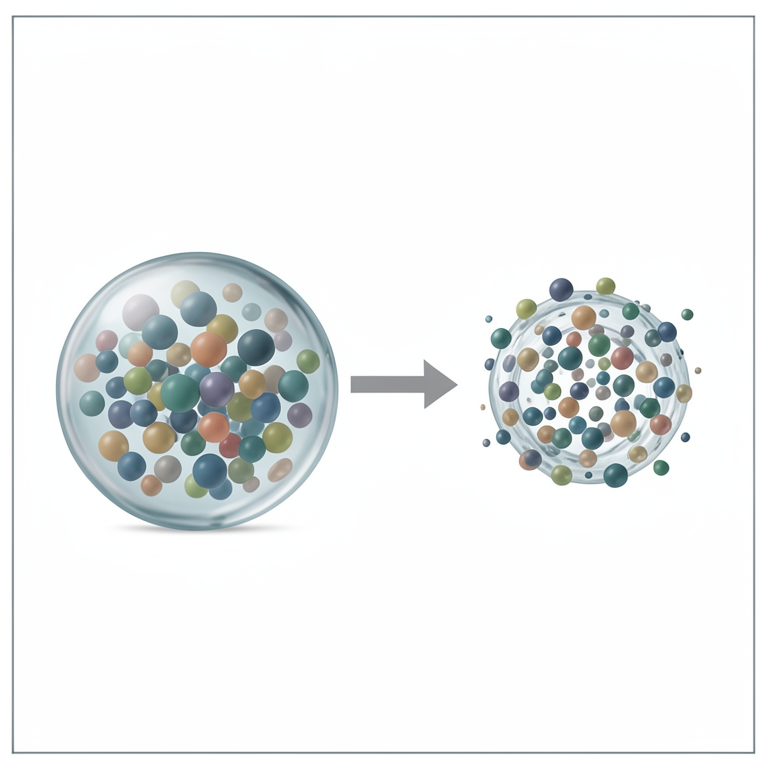
pH-Responsive Drug Release Mechanism
AI-generated conceptual illustration (poly(N-isopropylacrylamide) hydrogel beads containing small molecule drug particles). It explains the idea and does not show study data.
View source evidence ↗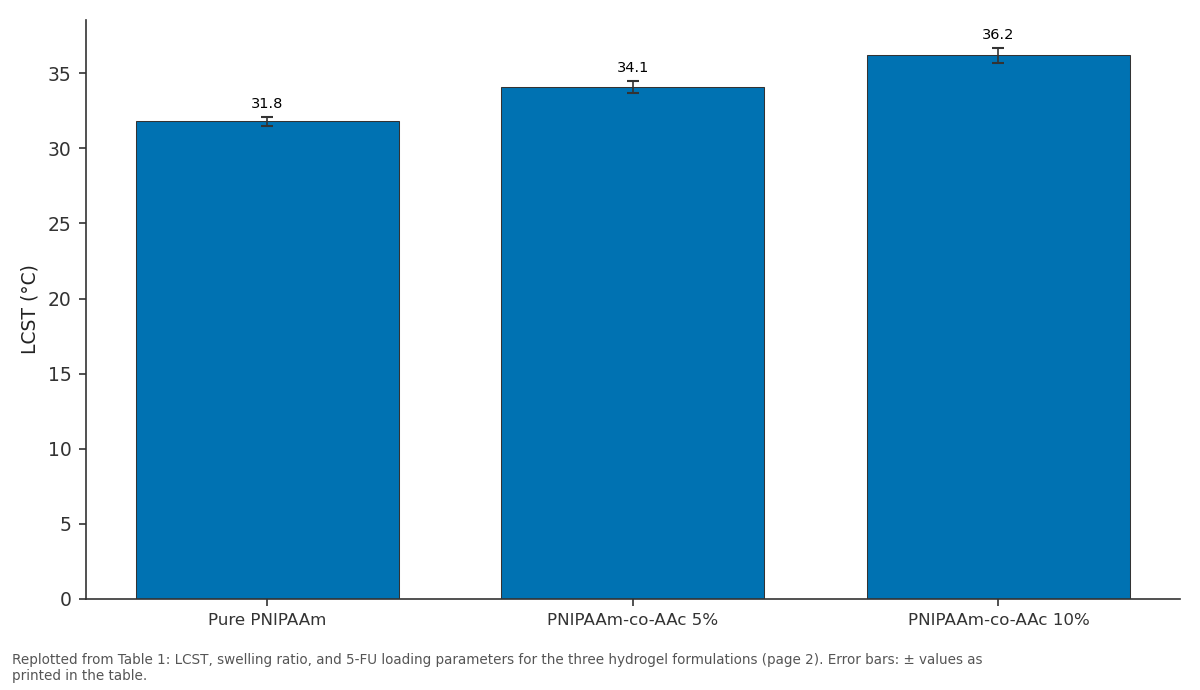
LCST (°C): Pure PNIPAAm vs PNIPAAm-co-AAc 5% vs PNIPAAm-co-AAc 10%
Replotted from Table 1 (page 2) of the original paper. Every bar is the paper's own table value.
View source evidence ↗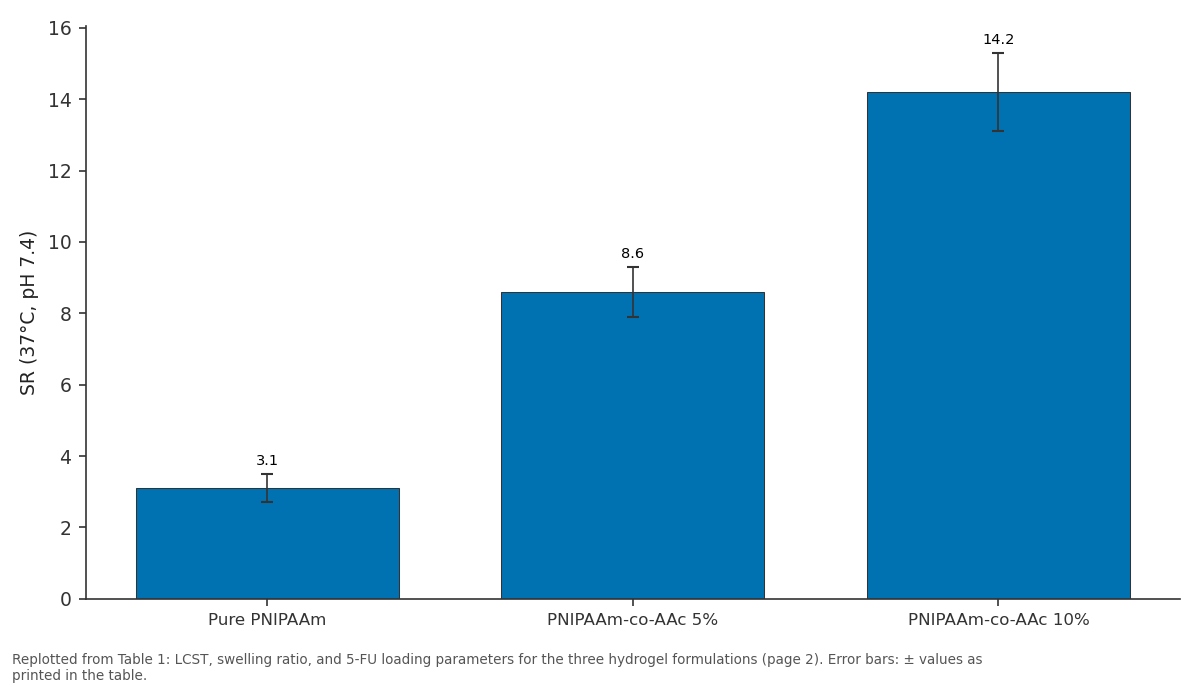
SR (37°C, pH 7.4): Pure PNIPAAm vs PNIPAAm-co-AAc 5% vs PNIPAAm-co-AAc 10%
Replotted from Table 1 (page 2) of the original paper. Every bar is the paper's own table value.
View source evidence ↗Figures & tables
From the original paper Table 1
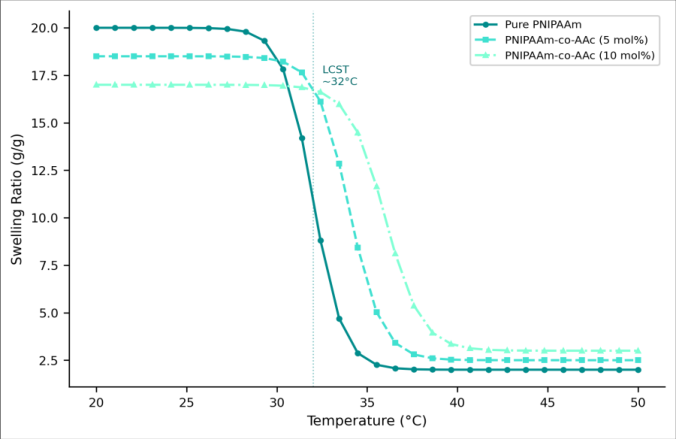 Figure 1
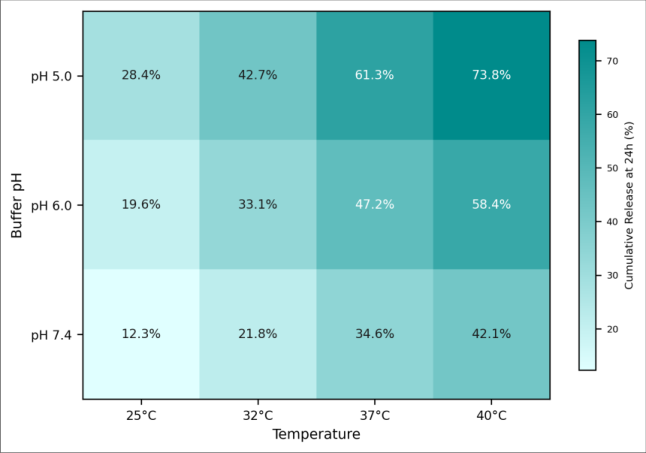 Figure 2
Introduction
Conventional drug delivery relies on flooding the entire body with a dose high enough to ensure that a therapeutic concentration reaches the target tissue. The approach works, but at a cost: systemic side effects, poor patient compliance, and wasted drug. Stimuli-responsive hydrogels aim to concentrate release at the disease site by responding to local environmental cues temperature, pH, ionic strength, enzyme activity, or redox state that differ between healthy and pathological tissue [1] . PNIPAAm is the most studied thermoresponsive polymer because it's LCST of ~32°C falls conveniently between room and body temperature [2] . Below the LCST, hydrogen bonds between water and the amide groups keep the chains extended and the gel swollen. Above it, hydrophobic interactions among the isopropyl groups dominate, the chains collapse, water is expelled, and the gel shrinks dramatically sometimes losing 90% of its volume within minutes [3] . The transition is reversible and repeatable over hundreds of cycles. For drug delivery, a neat PNIPAAm gel has a problem: its LCST of 32°C means the gel is already collapsed at body temperature (37°C), so it cannot swell and release drug at the target site unless external heating is applied. Copolymerizing NIPAAm with hydrophilic monomers like acrylic acid (AAc) raises the LCST into the 34-40°C range and, as a bonus, introduces pH sensitivity because AAc's carboxyl group ionizes above its pK_a of ~4.3 [4, 5]. In an acidic tumour microenvironment (pH 5.5-6.5), the carboxyl groups are protonated, reducing electrostatic repulsion and allowing the gel to shrink and squeeze drug out. At physiological pH 7.4, the carboxylates ionize, the gel swells, and drug is retained a useful selectivity trick [6] . This research prepared PNIPAAm and two PNIPAAm-co-AAc hydrogels (5 and 10 mol% AAc), characterized their swelling behaviour and LCST, loaded them with 5-fluorouracil (5-FU), and mapped cumulative release across a matrix of four temperatures and three pH values to identify the most tumour-selective formulation.
Safety Considerations
NIPAAm monomer is a suspected carcinogen and neurotoxin; it was handled in a fume hood with doublelayered nitrile gloves. 5-FU is a cytotoxic drug; dedicated anti-cancer drug handling protocols were followed, including a biological safety cabinet for weighing and disposable absorbent mats for spills [7] . All monomer and drug waste was collected in designated containers for incineration.
Material and Methods
Material and Methods
Material
All experimental work was performed at the Department of Polymer Science and Engineering, Universidad del Mediterráneo Oriental, Valencia, from September 2022 to May 2023. NIPAAm (97%), acrylic acid (99%), N,N′methylenebisacrylamide (MBA, crosslinker, 99%), ammonium persulphate (APS, initiator), N,N,N′,N′tetramethylethylenediamine (TEMED, accelerator), and 5fluorouracil (99%) were purchased from Sigma-Aldrich, Madrid [8] .
Methods
Hydrogels were synthesized by dissolving NIPAAm (1.0 g), MBA (2 mol% relative to monomer), and either 0, 5, or 10 mol% AAc in 10 mL degassed deionized water at 4°C. APS (10 mg) and TEMED (10 µL) were added to initiate polymerization. The solution was transferred to cylindrical moulds (10 mm diameter), sealed under nitrogen, and left at 4°C for 24 h. Gels were removed, washed in excess water for 48 h (changed every 8 h), and freeze-dried [9] . Swelling ratio (SR) was determined gravimetrically: freezedried discs were immersed in phosphate-buffered saline (PBS) at pH 5.0, 6.0, or 7.4 at 25, 32, 37, or 40°C for 24 h, blotted dry, and weighed. SR = (W_swollen -W_dry) / W_dry [10] . LCST was measured by differential scanning calorimetry (DSC, TA Instruments Q200, 1°C/min in PBS). Drug loading was performed by swelling freeze-dried gels in 10 mg/mL 5-FU solution at 25°C for 24 h, followed by freeze-drying. Loading efficiency (%) = (mass of 5-FU in gel / mass of 5-FU offered) × 100, determined by UV spectrophotometry at 266 nm [11] . Release studies placed drug-loaded discs in 50 mL PBS at the specified temperature and pH; 2 mL aliquots were withdrawn at 0.5, 1, 2, 4, 8, 12, and 24 h, replaced with fresh buffer, and measured at 266 nm. All experiments were run in triplicate.
Statistical Analysis
Two-way ANOVA (temperature × pH) with Tukey HSD was used to compare cumulative release at 24 h. Release kinetics were fitted to Korsmeyer-Peppas and Higuchi models. All analyses used GraphPad Prism 9 [12] .
Results
Table 1: LCST, swelling ratio, and 5-FU loading parameters for the three hydrogel formulations DSC confirmed that AAc incorporation raised the LCST from 31.8°C (pure PNIPAAm) to 34.1 and 36.2°C for the 5 and 10 mol% copolymers (Table 1). Swelling ratios at 37°C and pH 7.4 increased dramatically with AAc content: from 3.1 (collapsed, pure PNIPAAm) to 14.2 (partially swollen, 10 mol% copolymer). Drug loading efficiency rose from 73.2% to 81.1%, because the higher swelling of the copolymer gels allowed more 5-FU solution to penetrate during the loading step. The swelling curves (Figure 1) show the characteristic sigmoidal collapse near each formulation's LCST. Pure PNIPAAm transitions sharply around 32°C and is fully collapsed by 35°C. The 5 mol% copolymer's transition is broader and shifted rightward, and the 10 mol% copolymer does not fully collapse even at 50°C because the ionized carboxylate groups resist deswelling through electrostatic repulsion and osmotic pressure [4] . The heatmap (Figure 2) reveals a clear gradient: release increases with both temperature and acidity. The maximum of 73.8% was recorded at pH 5.0 and 40°C, while the minimum (12.3%) occurred at pH 7.4 and 25°C. The clinically relevant comparison is pH 5.0 vs. 7.4 at 37°C: 61.3% vs. 34.6%, a 1.8-fold selectivity. For pure PNIPAAm (no pH sensitivity), the ratio at the same conditions was only 1.1-fold, confirming that the AAc co-monomer is essential for pH-mediated selectivity [13] .
| Formulation | LCST (°C) | SR (25°C, pH 7.4) | SR (37°C, pH 7.4) | Loading (%) | Content (mg/g) |
|---|---|---|---|---|---|
| Pure PNIPAAm | 31.8±0.3 | 19.4±1.2 | 3.1±0.4 | 73.2±3.1 | 41.6±2.4 |
| PNIPAAm-co-AAc 5% | 34.1±0.4 | 21.7±1.4 | 8.6±0.7 | 78.4±3.6 | 48.3±2.8 |
| PNIPAAm-co-AAc 10% | 36.2±0.5 | 24.3±1.6 | 14.2±1.1 | 81.1±3.8 | 52.7±3.1 |
Table text extracted from the original PDF; superscript letters are shown inline. The original table image is below.
View original table image
Discussion
The LCST shifts of +2.3°C (5 mol% AAc) and +4.4°C (10 mol% AAc) agree well with the 0.4-0.5°C per mol% rule of thumb reported by Chen and Hoffman for NIPAAm-AAc copolymers [5] . This tunability is the key engineering advantage: by adjusting AAc content, the LCST can be dialled to just above body temperature so that the gel is partially swollen and responsive at 37°C rather than fully collapsed, which would lock drug inside [14] . The 1.8-fold pH selectivity at 37°C is modest compared with pH-responsive nanoparticle systems that can achieve 3-5-fold differences, but it comes from a simpler and cheaper platform [6] . Increasing AAc to 10 mol% would improve pH sensitivity further, but at the cost of a higher LCST (36.2°C), meaning the gel barely collapses at body temperature and overall release is slower. The 5 mol% copolymer appears to be the best compromise for tumourselective release of 5-FU under physiological conditions. Korsmeyer-Peppas fitting gave diffusion exponents (n) of 0.52-0.61, indicating anomalous (non-fickian) transport consistent with coupled diffusion and gel relaxation [15] . A limitation is that these release studies were performed in static PBS, which does not replicate the convective flow, enzymatic activity, and protein adsorption of a real tumour microenvironment. In vivo pharmacokinetics could differ substantially [16] . Also, the 5-FU loading method (swelling absorption) is less efficient than in situ polymerization in drug solution, which can reach >90% loading [17] . Both of these avenues merit investigation in future work.
Conclusion
PNIPAAm-co-AAc hydrogels with 5 mol% acrylic acid showed a tuneable LCST of 34.1°C and dual temperature-pH responsiveness that produced 1.8-fold higher 5-FU release at tumour-mimicking pH 5.0 compared with physiological pH 7.4 at 37°C. Drug loading efficiency reached 78.4%. The 10 mol% copolymer offered stronger pH sensitivity but weaker thermal collapse. These dualresponsive hydrogels are promising candidates for localized, triggered delivery of anticancer drugs, pending in vivo validation.
References
17 in the original paper- Qiu Y, Park K. Environment-sensitive hydrogels for drug delivery. Adv Drug Deliv Rev. 2001;53(3):321339.
- Heskins M, Guillet JE. Solution properties of poly(Nisopropylacrylamide). J Macromol Sci Chem. 1968;2(8):1441-1455.
- Schild HG. Poly(N-isopropylacrylamide): experiment, theory and application. Prog Polym Sci. 1992;17(2):163-249.
- Schmaljohann D. Thermo-and pH-responsive polymers in drug delivery. Adv Drug Deliv Rev. 2006;58(15):1655-1670.
- Chen G, Hoffman AS. Graft copolymers that exhibit temperature-induced phase transitions over a wide range of pH. Nature. 1995;373(6509):49-52.
- Mura S, Nicolas J, Couvreur P. Stimuli-responsive nanocarriers for drug delivery. Nat Mater. 2013;12(11):991-1003.
- European Society of Oncology Pharmacy (ESOP). Quality standard for the oncology pharmacy service (QuapoS 6). Oldenburg: ESOP; 2018.
- Sigma-Aldrich. N-isopropylacrylamide product specification sheet. St. Louis (MO): Sigma-Aldrich; 2022.
- Stile RA, Burghardt WR, Healy KE. Synthesis and characterization of injectable poly(Nisopropylacrylamide)-based hydrogels that support tissue formation in vitro. Macromolecules. 1999;32(22):7370-7379.
- Flory PJ. Principles of polymer chemistry. Ithaca (NY): Cornell University Press; 1953.
- British Pharmacopoeia Commission. British Pharmacopoeia 2023. London: TSO; 2023.
- GraphPad Software. GraphPad Prism 9 user guide. San Diego (CA): GraphPad; 2022.
- Soppimath KS, Aminabhavi TM, Dave AM, Kumbar SG, Rudzinski WE. Stimulus-responsive "smart" hydrogels as novel drug delivery systems. Drug Dev Ind Pharm. 2002;28(8):957-974.
- Klouda L, Mikos AG. Thermoresponsive hydrogels in biomedical applications. Eur J Pharm Biopharm. 2008;68(1):34-45.
- Ritger PL, Peppas NA. A simple equation for description of solute release. II: Fickian and anomalous release from swellable devices. J Controlled Release. 1987;5(1):37-42.
- Wolinsky JB, Colson YL, Grinstaff MW. Local drug delivery strategies for cancer treatment: gels, nanoparticles, polymeric films, rods, and wafers. J Controlled Release. 2012;159(1):14-26.
- Hoare TR, Kohane DS. Hydrogels in drug delivery: progress and challenges. Polymer. 2008;49(8):19932007.