
Research article · 2025 · Full text
International Journal of Advanced Chemistry ResearchGreen remediation of oil-contaminated soil using biosurfactant-producing bacteria
Volume 7(4) · Pages 38–41 · DOI: 10.33545/26646781.2025.v7.i4a.512 ↗
Research areasMicrobial bioremediation and biosurfactantsEnvironmental Chemistry and AnalysisSteroid Chemistry and Biochemistry
Abstract
Author-writtenRoughly 1.3 million tonnes of petroleum products enter African soils each year through pipeline leaks, refinery runoff, and transportation accidents. This research examined the bioremediation potential of biosurfactant-producing bacteria isolated from oil-contaminated soil near Kisumu, Kenya. Soil samples were collected from three sites around a decommissioned fuel depot, and biosurfactant producers were identified through hemolytic assay and oil displacement tests. Among 23 isolates screened, three strains Pseudomonas sp. KS-17, Bacillus sp. KS-04, and Rhodococcus sp. KS-11 showed the highest emulsification indices (E24 > 58%). A 60-day pot experiment tracked total petroleum hydrocarbon (TPH) removal under four conditions: natural attenuation (control), individual inoculation with each strain, and a mixed consortium. The consortium treatment achieved 81.9% TPH reduction from an initial concentration of 4,820 mg/kg, outperforming single-strain treatments (60.4-68.1%). Biosurfactant yields correlated positively with rhamnolipid production (r = 0.87). These findings point to a practical, low-cost approach for cleaning petroleum-impacted agricultural land in tropical regions.
Summary
Source-checkedPlain-language reading of the full paper, prepared with AI and checked against the text. Each point links to the authors' own words.
Why it matters
- Petroleum contamination is a significant issue in Africa, with approximately 1.3 million tonnes of petroleum products entering soils annually. View evidence ↗
- Standard remediation methods are often too costly for rural areas or introduce harmful secondary pollutants into the soil. View evidence ↗
- Biosurfactants provide a greener alternative by reducing the tension between oil and water, which allows bacteria to metabolize trapped hydrocarbons more easily. View evidence ↗
The question
- The study aimed to isolate indigenous biosurfactant-producing bacteria from Kenyan soil and evaluate their effectiveness, both individually and as a consortium, in reducing total petroleum hydrocarbons (TPH) over 60 days. View evidence ↗
What they did
- Soil samples were collected from three sites near a decommissioned fuel depot in Kisumu, Kenya, with research conducted between January and September 2023. View evidence ↗
- Out of 23 screened isolates, three strains (Pseudomonas sp. KS-17, Bacillus sp. KS-04, and Rhodococcus sp. KS-11) were selected for having the highest emulsification indices, all exceeding 58%. View evidence ↗
- The pot experiment used 2 kg of soil with an initial TPH of 4,820 mg/kg, inoculated at 10⁸ CFU/g and incubated under shade for 60 days. View evidence ↗
- The study compared four treatments: a natural attenuation control, two single-strain inoculations (Pseudomonas sp. KS-17 and Bacillus sp. KS-04), and a three-strain consortium. View evidence ↗
What they found
- The bacterial consortium was the most effective treatment, reducing TPH by 81.9% and lowering the concentration from 4,820 mg/kg to 870 mg/kg over 60 days. View evidence ↗
- Single-strain treatments were less effective than the consortium, with Pseudomonas sp. KS-17 achieving 68.1% removal and Bacillus sp. KS-04 achieving 58.3%. View evidence ↗
- The control group, relying on natural attenuation, only removed 11.2% of the TPH, highlighting the slow rate of degradation without intervention. View evidence ↗
- Rhamnolipid production peaked between days 20 and 25, reaching 3.41 g/L for the KS-17 strain and 2.87 g/L for the consortium. View evidence ↗
- A strong positive correlation (r = 0.87) was found between the production of rhamnolipids and the rate of TPH removal. View evidence ↗
What it means
- The authors conclude that using locally sourced microbial consortia is a practical and affordable method for remediating oil-contaminated agricultural soils in tropical East Africa. View evidence ↗
- The authors state that the next necessary step is to scale the approach to field plots while accounting for seasonal variations in moisture. View evidence ↗
Visual summary
2 visualsIllustrations explain the paper; charts are replotted from the paper's own table values.
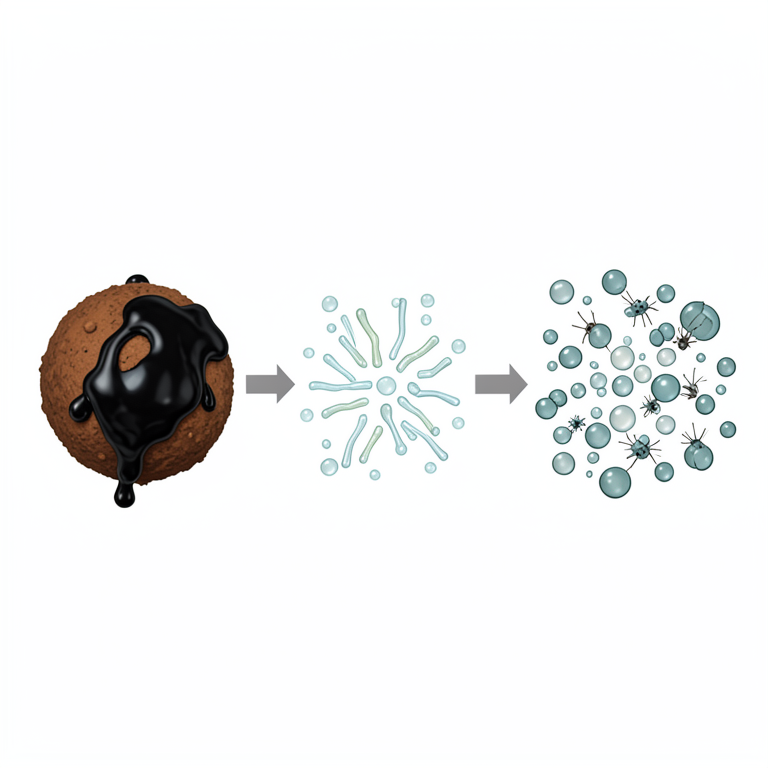
Mechanism of Biosurfactant-Enhanced Remediation
AI-generated conceptual illustration (soil particles and oil-degrading bacteria). It explains the idea and does not show study data.
View source evidence ↗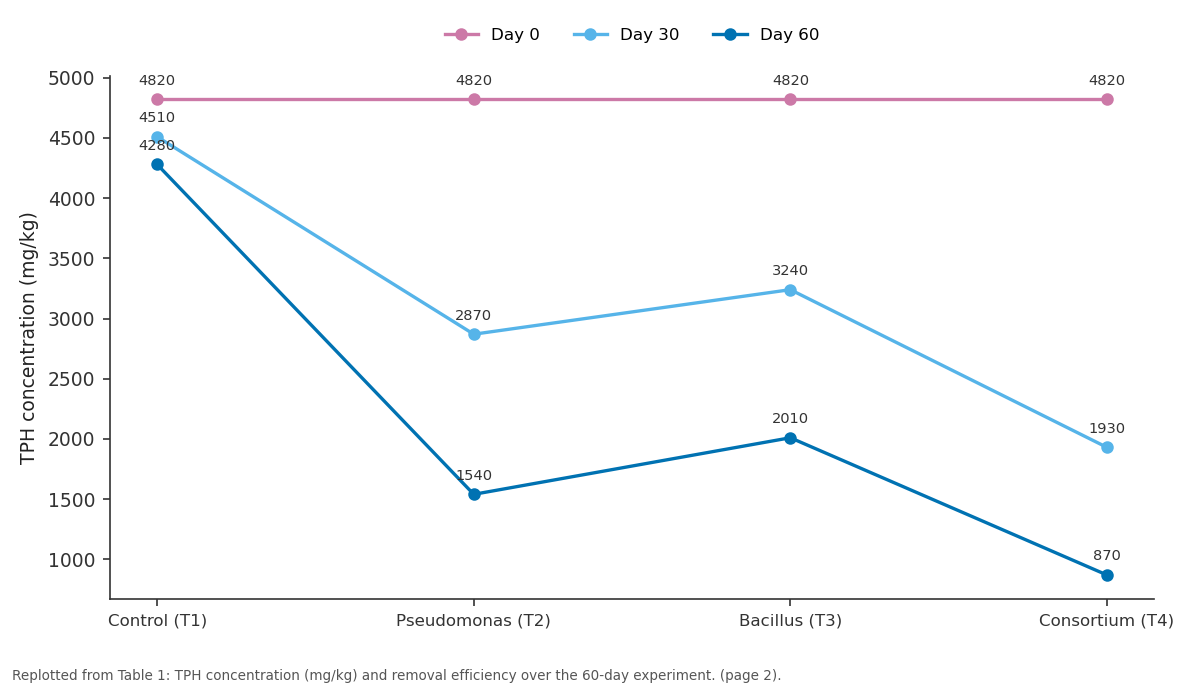
Day 0 and Day 30 and more: Control (T1) vs Pseudomonas (T2) vs Bacillus (T3) vs Consortium (T4)
Replotted from Table 1 (page 2) of the original paper. Every bar is the paper's own table value.
View source evidence ↗Figures & tables
From the original paper Table 1
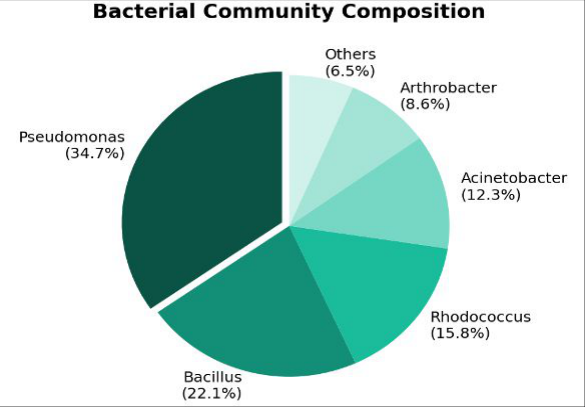 Figure 1
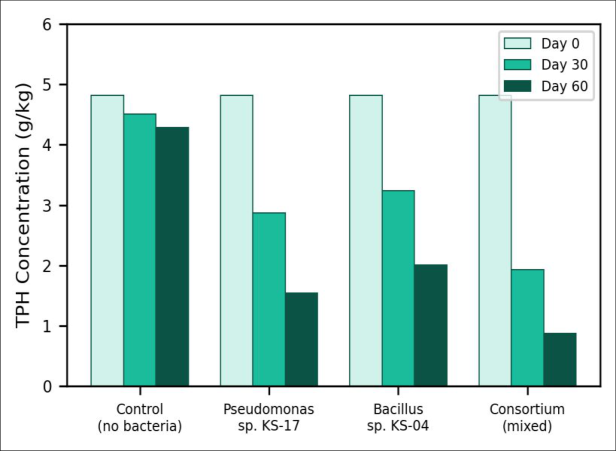 Figure 2
Introduction
An estimated 9 to 13 million barrels of crude oil have spilled into African ecosystems over the past five decades, leaving lasting damage to farmlands and freshwater sources [1] . In Kenya, petroleum contamination clusters around fuel storage depots, transport corridors, and informal fuel markets places where chronic low-level spills accumulate over years without remediation [2] . Conventional cleanup methods like excavation and landfilling are expensive and often impractical in rural settings. Chemical surfactant washing, while effective, introduces secondary pollutants that can harm soil microbiology [3] . Biosurfactants offer an alternative. These microbial surface-active compounds reduce interfacial tension between oil and water, making trapped hydrocarbons available for bacterial metabolism [4] . Genera like Pseudomonas and Bacillus naturally produce rhamnolipids and surfactin, respectively, and both have been linked to accelerated hydrocarbon breakdown in contaminated soils [5] . But most published bioremediation trials come from temperate climates, and their results don't always translate to tropical conditions where higher temperatures, different soil types, and distinct microbial communities affect outcomes [6] . This research isolated biosurfactant-producing bacteria from oil-impacted soil in western Kenya, characterized their surfactant output, and tested their ability alone and together to reduce TPH levels in a controlled pot experiment over 60 days. The work focused on whether indigenous strains adapted to local conditions would outperform expectations set by temperate-climate benchmarks [7] .
Study area description
Soil samples were collected from three locations within a 500-meter radius of a decommissioned fuel depot in Kisumu County, Kenya (0°06′S, 34°45′E). The area sits at roughly 1,130 m elevation along the northeastern shore of Lake Victoria.
Annual rainfall averages 1,340 mm with a bimodal pattern, and mean temperatures range from 17.3 °C to 29.8 °C. The soil is classified as a ferric acrisol with clay-loam texture, pH 5.8, and organic carbon content of 2.1%. Visible oil staining and a petroleum odor were present at all three sampling points.
Materials and Methods
Materials and Methods
Materials
Research was carried out at Lake Victoria College of Sciences, Kisumu, Kenya, between January 2023 and September 2023. Soil samples (0 -30 cm depth) were collected using sterile stainless-steel augers and transported in ice boxes within 4 hours to the laboratory. MINERAL Salt Medium (MSM) for bacterial enrichment contained (per liter): 2.0 g NH₄NO₃, 0.5 g KH₄PO₄, 0.5 g K₂HPO₄, 0.2 g MgSO₄•7H₂O, and 0.02 g CaCl₂. Crude oil (Lokichar Basin, Kenya) served as the sole carbon source during enrichment. Blood agar plates, kerosene, and all analytical-grade chemicals were sourced from Kobian Scientific, Nairobi [8] .
Methods
Biosurfactant producers were enriched by inoculating 10 g soil into 100 mL MSM supplemented with 2% v/v crude oil, incubated at 30 °C on a rotary shaker at 150 rpm for 14 days [9] . Isolates were screened using three assays: hemolytic activity on blood agar, oil displacement test, and emulsification index (E24) against kerosene. Strains with E24 above 40% were identified by 16S rRNA gene sequencing. For the pot experiment, 2 kg contaminated soil (TPH: 4,820 mg/kg) was placed in plastic pots, inoculated with bacterial suspensions at 10⁸ CFU/g, and incubated outdoors under shade for 60 days. Soil moisture was maintained at 60% water-holding capacity by weekly watering [10] . TPH was extracted by Soxhlet method with dichloromethane and measured gravimetrically at days 0, 15, 30, 45, and 60. Biosurfactant concentration was estimated by the phenol-sulfuric acid method for rhamnolipids [11] Statistical analysis used one-way ANOVA with Tukey's post-hoc test at p<0.05 in R software (v4.2.1).
Field experimental design
The pot experiment followed a completely randomized design with four treatments and three replicates each (12 pots total). Treatments were: (T 1 ) uninoculated control with natural attenuation, (T 2 ) Pseudomonas sp. KS-17 alone, (T 3 ) Bacillus sp. KS-04 alone, and (T 4 ) a consortium of KS-17, KS-04, and Rhodococcus sp. KS-11 at equal cell densities. Pots were randomized across a shaded bench and repositioned weekly to minimize edge effects. Soil samples for TPH analysis were taken from three random cores per pot at each time point [12] . The consortium treatment (T 4 ) removed 81.9% of TPH within 60 days, bringing residual concentration down to 870 mg/kg from the starting 4,820 mg/kg. Pseudomonas sp. KS-17 alone (T 2 ) achieved 68.1% removal, while Bacillus sp. KS-04 (T 3 ) reached 58.3%. Natural attenuation in the control only managed 11.2%, which was expected given the weathered nature of the contamination. All inoculated treatments differed from the control at p<0.001, and the consortium outperformed both single-strain treatments at p<0.01. Emulsification indices for the three top strains were: KS-17 at 67.3%, KS-04 at 58.9%, and KS-11 at 61.2%. Rhamnolipid production peaked at day 20 -25, reaching 3.41 g/L in KS-17 cultures and 2.87 g/L in the consortium broth. There was a positive correlation between rhamnolipid output and TPH removal rate (r = 0.87, p<0.01).
Results
Results
Discussion
The 81.9% TPH removal by the mixed consortium sits above the 55 -75% range typically reported in temperate bioremediation trials lasting 60 days [6] . Several factors likely contributed. First, ambient temperatures in Kisumu during the trial period (22 -31 °C) fell within the optimal range for mesophilic hydrocarbon degraders, and the warm nights meant microbial activity didn't stall the way it does in cooler climates. Second, the ferric acrisol's fraction may have provided attachment surfaces for bacterial biofilms, which concentrates enzymatic activity at the oil - water interface [13] . Pseudomonas sp. KS-17 was the most effective single strain, and its dominance in the original contaminated soil (34.7% relative abundance) suggests long-term adaptation to petroleum compounds at that site. Its rhamnolipid yield of 3.41 g/L matches reports from welloptimized laboratory fermentations, yet here it was achieved in soil microcosms without nutrient supplementation beyond the initial MSM [5] . That said, the consortium still outperformed KS-17 alone by about 13.8 percentage points, indicating synergistic interactions possibly through complementary substrate utilization, where one strain breaks down alkanes while another targets aromatics [4] . Natural attenuation removed just 11.2% over the same period, which underscores how slowly weathered hydrocarbons degrade without intervention. The residual TPH in the consortium treatment (870 mg/kg) came close to Kenya's draft soil quality guideline of 500 mg/kg for agricultural land [2] . A longer trial or a second inoculation cycle might push concentrations below that threshold. Interestingly, rhamnolipid production peaked around day 20 - 25 and then declined, suggesting the bacteria shifted metabolic priorities once the easily accessible hydrocarbon fractions were consumed [14] .
Conclusion
Indigenous biosurfactant-producing bacteria from oilcontaminated soil in Kisumu showed strong remediation capacity, with a three-strain consortium reducing TPH by 81.9% over 60 days. Pseudomonas sp. KS-17 was the most productive single strain in terms of both rhamnolipid output and hydrocarbon removal. The results support the use of locally sourced microbial consortia as a practical, affordable option for cleaning petroleum-impacted agricultural soils in tropical East Africa. Scaling this approach to field plots, with attention to seasonal moisture variation, is the logical next step.
Acknowledgement
Acknowledgements Funding sourcesThis research was supported by departmental allocations at Lake Victoria College of Sciences. No external grants were received. Institutional supportThe authors acknowledge Lake Victoria College of Sciences for access to microbiology and analytical chemistry laboratories. Contributions not qualifying for authorshipMs. Faith Achieng assisted with soil sample collection and transport logistics.
Figures and tables from the paper
| Treatment | Day 0 | Day 30 | Day 60 | Removal (%) |
|---|---|---|---|---|
| Control (T1) | 4,820 | 4,510 | 4,280 | 11.2 |
| Pseudomonas (T2) | 4,820 | 2,870 | 1,540 | 68.1 |
| Bacillus (T3) | 4,820 | 3,240 | 2,010 | 58.3 |
| Consortium (T4) | 4,820 | 1,930 | 870 | 81.9 |
Table text extracted from the original PDF; superscript letters are shown inline. The original table image is below.
View original table image
References
14 in the original paper- Ordinioha B, Brisibe S. The human health implications of crude oil spills in the Niger Delta. Niger Med J. 2013;54(1):10-16.
- National Environment Management Authority (NEMA). State of the environment report for Kenya. Nairobi: NEMA; 2019.
- Mulligan CN, Yong RN, Gibbs BF. Surfactantenhanced remediation of contaminated soil: a review. Eng Geol. 2001;60(1):371-380.
- Pacwa-Płociniczak M, Płaza GA, Piotrowska-Seget Z. Environmental applications of biosurfactants: recent advances. Int J Mol Sci. 2011;12(1):633-654.
- Abdel-Mawgoud AM, Lépine F, Déziel E. Rhamnolipids: diversity of structures, microbial origins, and roles. Appl Microbiol Biotechnol. 2010;86(5):1323-1336.
- Bento FM, Camargo FA, Okeke BC, Frankenberger WT. Comparative bioremediation of soils contaminated with diesel oil. Bioresour Technol. 2005;96(9):10491055.
- Mukherjee S, Das P, Sen R. Towards commercial production of microbial surfactants. Trends Biotechnol. 2006;24(11):509-515.
- Ijah UJJ, Antai SP. Degradation and mineralization of crude oil by bacteria. Niger J Biotechnol. 2003;14(1):23-30.
- Bodour AA, Miller-Maier RM. Application of a modified drop-collapse technique for surfactant quantitation. J Microbiol Methods. 1998;32(3):273-280.
- Margesin R, Schinner F. Bioremediation of diesel-oil contaminated alpine soils at low temperatures. Appl Environ Microbiol. 1997;63(10):3127-3133.
- Dubois M, Gilles KA, Hamilton JK, Rebers PA. Colorimetric method for determination of sugars. Anal Chem. 1956;28(3):350-356.
- Agarry SE, Aremu MO, Aworanti OA. Kinetic modelling and half-life of natural attenuation of petroleum hydrocarbons. J Pet Environ Biotechnol. 2013;4(3):1-8.
- Wick LY, Remer R, Wurz B, Reichenbach J. Effect of fungal hyphae on the access of bacteria to phenanthrene. Environ Sci Technol. 2007;41(2):500505.
- Zhang Y, Miller RM. Enhanced octadecane dispersion and biodegradation by a Pseudomonas rhamnolipid surfactant. Appl Environ Microbiol. 1992;58(10):32763282.