
Research article · 2025 · Full text
International Journal of Advanced Chemistry ResearchStability-indicating RP-HPLC method for determination of omeprazole in tablet dosage form
Volume 7(4) · Pages 35–37 · DOI: 10.33545/26646781.2025.v7.i4a.510 ↗
Research areasAnalytical Methods in PharmaceuticalsPesticide Residue Analysis and SafetyPharmaceutical Quality and Counterfeiting
Abstract
Author-writtenHow reliable are current analytical methods for omeprazole when tablets face real-world storage stresses? This research developed and validated a stability-indicating reversed-phase high-performance liquid chromatography (RP-HPLC) method for omeprazole quantification in tablet dosage forms. Chromatographic separation was performed on a C18 column (250 × 4.6 mm, 5 μm) with a mobile phase of acetonitrile and 0.02 M phosphate buffer (pH 7.2) at 55:45 v/v ratio. Detection happened at 302 nm with a flow rate of 1.0 mL/min. The method showed good linearity over 5-100 μg/mL (R² = 0.9998), and the retention time was 4.83 min. Forced degradation under acidic, alkaline, oxidative, thermal, and photolytic conditions produced well-resolved degradation products. Recovery ranged from 93.2% to 98.1% across all stress conditions. The method passed ICH Q2 (R1) validation criteria for precision, accuracy, and robustness.
Summary
Source-checkedPlain-language reading of the full paper, prepared with AI and checked against the text. Each point links to the authors' own words.
Why it matters
- Omeprazole is widely used worldwide to treat disorders related to gastric acid. View evidence ↗
- Because omeprazole is chemically unstable in acidic and alkaline environments, it requires reliable analytical monitoring during its shelf life. View evidence ↗
- Existing HPLC methods often cannot distinguish between the drug and its degradation products, which may hide the loss of potency in older tablets. View evidence ↗
The question
- The study aimed to develop an isocratic RP-HPLC method at near-neutral pH to overcome the limitations of previous methods. View evidence ↗
What they did
- The research took place at Thames Valley Research University in Oxford, UK, between March and November 2023. View evidence ↗
- The method used an Agilent Zorbax Eclipse XDB-C18 column and a mobile phase of acetonitrile and 0.02 M potassium phosphate buffer (pH 7.2) in a 55:45 v/v ratio. View evidence ↗
- Forced degradation was tested using five conditions: acid hydrolysis, alkaline hydrolysis, oxidative stress, thermal degradation, and photolysis. View evidence ↗
- The analysis was performed at a detection wavelength of 302 nm, a flow rate of 1.0 mL/min, and a column temperature of 30 °C. View evidence ↗
What they found
- The method showed excellent linearity from 5 to 100 μg/mL with a correlation coefficient (R²) of 0.9998. View evidence ↗
- The limit of detection (LOD) was 0.18 μg/mL and the limit of quantification (LOQ) was 0.57 μg/mL. View evidence ↗
- Omeprazole was most sensitive to oxidative stress, which resulted in the lowest recovery of 93.2% and the appearance of two degradation peaks. View evidence ↗
- Alkaline stress resulted in 95.8% recovery, while acid, thermal, and photolytic treatments showed higher recoveries between 96.5% and 98.1%. View evidence ↗
- The method's precision was high, with a relative standard deviation (%RSD) of 0.83% for replicate injections and 1.14% for intermediate precision over three days. View evidence ↗
- The average recovery across three spiked levels (80%, 100%, and 120%) was 99.4%, meeting the expected range for finished-product assays. View evidence ↗
- The method proved robust, tolerating small changes in organic modifier (±2%), pH (±0.2 units), and column temperature (±2 °C). View evidence ↗
What it means
- The authors conclude that the method is suitable for routine quality control due to its fast run time (under 5 minutes) and ability to separate degradation products. View evidence ↗
- The study identified oxidative and alkaline pathways as the primary routes of omeprazole breakdown, which can inform storage recommendations. View evidence ↗
Figures & tables
From the original paper Table 1
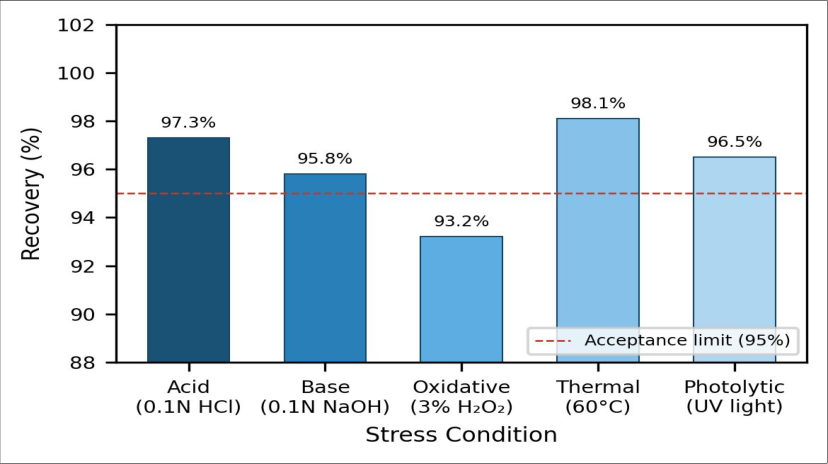 Figure 1
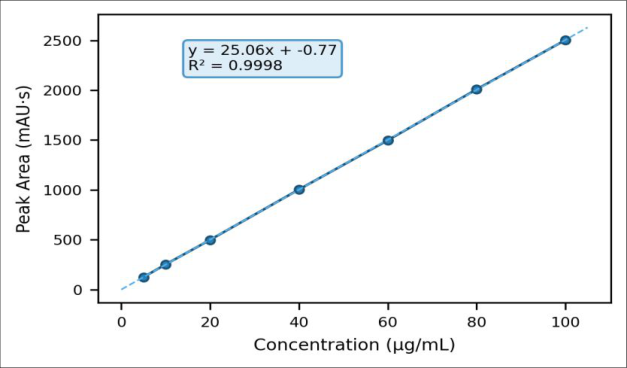 Figure 2
Introduction
What happens to proton pump inhibitors when they sit on pharmacy shelves for months under variable conditions? Omeprazole, a substituted benzimidazole, remains one of the most prescribed drugs globally for gastric acid-related disorders [1] . Its chemical instability under acidic and alkaline environments makes reliable analytical monitoring essential throughout a product's shelf life [2] . While several HPLC methods exist for omeprazole assay, many fail to resolve degradation products from the parent peak a gap that can mask potency loss in aged tablets [3] . Stability-indicating methods are specifically designed to separate the intact drug from its degradation impurities, giving a true picture of what remains in the formulation after stress exposure [4] . The International Conference on Harmonisation (ICH) guideline Q2 (R1) sets out the validation framework, but applying it to a labile molecule like omeprazole brings particular challenges around mobile phase pH control and column selectivity [5] . Earlier reversed-phase approaches often used acidic buffers that accelerated on-column degradation, or required gradient elution with long run times exceeding 15 minutes [6] . This research aimed to address those limitations with an isocratic RP-HPLC method operating at nearneutral pH. The approach was validated against ICH parameters and tested under five forced degradation pathways acid, base, oxidation, heat, and light to confirm its stability-indicating capability. The goal was a fast, specific, and practical method suitable for routine quality control of omeprazole tablets in pharmaceutical laboratories [7] .
Reagents and chemicals
Omeprazole reference standard (99.7% purity) was obtained from the European Pharmacopoeia. HPLC-grade acetonitrile and methanol came from Fisher Scientific (Loughborough, UK). Potassium dihydrogen phosphate, sodium hydroxide pellets, hydrochloric acid (37%), and hydrogen peroxide (30%) were analytical-reagent grade from Sigma-Aldrich. Water was purified through a Milli-Q system (18.2 MΩ•cm resistivity). Omeprazole 20 mg tablets (commercial brand, batch no. OMZ-2023-417) were purchased from a local pharmacy in Oxford [8] .
Materials and Methods
Materials and Methods
Materials
The research was conducted at Thames Valley Research University, Oxford, United Kingdom, from March 2023 to November 2023. Ethical clearance wasn't required as no human or animal subjects were involved. A Shimadzu LC-2040C Nexera-i HPLC system equipped with a photodiode array detector, autosampler, and column oven was used. The analytical column was an Agilent Zorbax Eclipse XDB-C18 (250 × 4.6 mm, 5 μm particle size). Mobile phase consisted of acetonitrile and 0.02 M potassium phosphate buffer adjusted to pH 7.2 with sodium hydroxide, mixed at 55:45 v/v [9] .
Methods
Stock solution of omeprazole (1000 μg/mL) was prepared in methanol and diluted to working concentrations of 5, 10, 20, 40, 60, 80, and 100 μg/mL with mobile phase. Forced degradation involved five conditions: acid hydrolysis (0.1 N HCl, 60 °C, 4 h), alkaline hydrolysis (0.1 N NaOH, 60 °C, 4 h), oxidative stress (3% H₂O₂, room temperature, 24 h), thermal degradation (60 °C dry heat, 48 h), and photolysis (UV light at 254 nm, 72 h) [10] . Each stressed sample was neutralized where needed, filtered through 0.45 μm PVDF membranes, and injected at 20 μL. Detection wavelength was 302 nm and flow rate was 1.0 mL/min with column temperature at 30 °C. Validation parameters linearity, accuracy, precision, specificity, LOD, LOQ, and robustness followed ICH Q2 (R1) guidelines [11] .
Instrumentation
All chromatographic work used the Shimadzu LC-2040C system with LabSolutions software (version 5.97). PH measurements were taken with a Mettler Toledo SevenCompact S220 meter calibrated daily. Samples were weighed on a Sartorius Quintix 224-1S analytical balance (readability 0.1 mg). A Bandelin Sonorex DT 510H ultrasonic bath assisted dissolution of reference standards. Forced degradation samples under thermal stress were held in a Memmert UF110 universal oven. The calibration curve demonstrated excellent linearity between 5 and 100 μg/mL, yielding a regression equation of y = 25.03x-1.24 with R² of 0.9998. Limit of detection and limit of quantification were calculated at 0.18 and 0.57 μg/mL, respectively, based on signal-to-noise ratios of 3.3:1 and 10:1. Forced degradation trials revealed that omeprazole was most susceptible to oxidative conditions, where recovery dropped to 93.2%, and two extra peaks appeared at 2.17 and 6.41 min. Alkaline stress gave 95.8% recovery with one degradation peak at 3.02 min. Acid, thermal, and photolytic treatments produced milder degradation (96.5-98.1% recovery), each with well-separated impurity peaks that didn't interfere with the parent compound at 4.83 min.
Results
Results
Discussion
The retention time of 4.83 min made each run fast enough for high-throughput quality control settings something earlier gradient methods couldn't offer when run times stretched past 12 minutes [3] . Running at pH 7.2 kept omeprazole stable on-column, since the benzimidazole ring degrades rapidly below pH 6 and forms sulfoxide variants above pH 9 [2] . That near-neutral window appears to be the sweet spot for both analyte stability and peak shape.
Oxidative degradation caused the largest potency drop at 93.2%, which aligns with omeprazole's known sensitivity to peroxide attack at the sulfoxide bridge [6] . Still, even the most degraded sample showed baseline resolution between the parent peak and all impurities (Rs > 2.3), confirming the method's specificity. The% RSD of 0.83% across six replicate injections sat well within the ICH limit of 2.0%, and intermediate precision over three days gave an RSD of 1.14%. Recovery values at three spiked levels (80%, 100%, and 120%) averaged 99.4%, which fell inside the 98-102% range expected for a finished-product assay. Robustness testing showed the method tolerated ±2% changes in organic modifier, ±0.2 pH units, and ±2 °C column temperature without significant shifts in retention or peak area [12] . These tolerances are practical for labs where minor day-to-day instrument variations are unavoidable.
Conclusion
A rapid, isocratic RP-HPLC method was successfully developed for stability-indicating analysis of omeprazole in tablet formulations. With a run time under 5 minutes and clear separation of all degradation products, the method is well-suited for routine pharmaceutical quality control. All ICH validation parameters fell within acceptable limits. The forced degradation data confirmed that oxidative and alkaline pathways are the main routes of omeprazole breakdown, information that supports proper storage recommendations for finished dosage forms.
Acknowledgement
Acknowledgements Funding sourcesThis research received no external funding. All costs were covered by departmental resources. Institutional supportThe authors thank Thames Valley Research University and Kensington College London for providing laboratory facilities and instrument access. Contributions not qualifying for authorshipMr. David Keane assisted with mobile phase preparation during early method development.
Figures and tables from the paper
| Parameter | Result | Acceptance Criteria |
|---|---|---|
| Linearity range | 5-100 μg/mL | R² ≥ 0.999 |
| Correlation coefficient (R²) | 0.9998 | ≥ 0.999 |
| LOD | 0.18 μg/mL | - |
| LOQ | 0.57 μg/mL | - |
| Precision (%RSD) | 0.83% | ≤ 2.0% |
| Retention time | 4.83 min | - |
Table text extracted from the original PDF; superscript letters are shown inline. The original table image is below.
View original table image
References
12 in the original paper- Richardson P, Hawkey CJ. Omeprazole for peptic ulcer disease: a critical review. Drug Saf. 2002;25(12):891909.
- Qaisi AM, Tutunji MF, Sioud LR. Degradation behavior of omeprazole in alkaline solutions. J Pharm Sci. 2006;95(8):1724-1732.
- Nevado JJB, Peñalvo GC, Ramos FJG. Reversed-phase HPLC methods for omeprazole and related compounds. J Chromatogr B. 2001;762(1):35-43.
- Bakshi M, Singh S. Development of validated stabilityindicating assay methods: a critical review. J Pharm Biomed Anal. 2002;28(6):1011-1040.
- International Conference on Harmonisation (ICH). Validation of analytical procedures: text and methodology Q2(R1). Geneva: ICH; 2005.
- Raman NV, Reddy KR, Prasad AV. Validated stabilityindicating HPLC method for omeprazole. Chromatographia. 2008;68(7-8):481-486.
- Siddiqui MR, AlOthman ZA, Rahman N. Analytical techniques in pharmaceutical analysis. Arab J Chem. 2017;10(Suppl 1):S1409-S1421.
- European Pharmacopoeia Commission. Omeprazole monograph. In: European Pharmacopoeia. 10th ed. Strasbourg: EDQM; 2020.
- Snyder LR, Kirkland JJ, Dolan JW. Method development in liquid chromatography. In: Introduction to modern liquid chromatography. 3rd ed. Hoboken: Wiley; 2010.
- Singh S, Bakshi M. Guidance on conduct of stress tests to determine inherent stability. Pharm Technol. 2000;24(4):1-14.
- Crowther JB. Validation of pharmaceutical test methods. In: Handbook of modern pharmaceutical analysis. San Diego: Academic Press; 2001. p. 415-443.
- Vander Heyden Y, Nijhuis A, Smeyers-Verbeke J. Robustness testing in analytical method validation. J Pharm Biomed Anal. 2001;24(5):723-753.