
Research article · 2025 · Full text
International Journal of Advanced Chemistry ResearchPalladium-catalyzed synthesis of indole alkaloid analogues via intramolecular cyclization
Volume 7(4) · Pages 95–98 · DOI: 10.33545/26646781.2025.v7.i4b.537 ↗
Research areasSynthesis of Indole DerivativesSynthesis and bioactivity of alkaloidsCatalytic Cross-Coupling Reactions
Abstract
Author-writtenIndole alkaloids are among nature’s most powerful pharmacophores, yet many of them are nearly impossible to extract in usable quantities from their plant sources. This research developed a palladium-catalyzed intramolecular cyclization strategy to construct the tetracyclic indole alkaloid core in a single step from readily available tryptamine-derived precursors. Screening of five palladium catalysts across four solvents identified Pd(PPh₃)₄ in DMF at 110°C as the optimal system, delivering the cyclized product in 81.6% yield. The reaction tolerated electron-donating groups (average yield 79.3%), halogens (74.6%), and electron-withdrawing substituents (68.1%) on the indole ring. Twelve analogues were prepared and characterized by ¹H NMR, ¹³C NMR, HRMS, and single-crystal X-ray diffraction for one representative compound. Gram-scale synthesis gave 78.4% yield without chromatographic purification, showing practical scalability.
Summary
Source-checkedPlain-language reading of the full paper, prepared with AI and checked against the text. Each point links to the authors' own words.
Why it matters
- Indole alkaloids are highly potent pharmacophores, but they are often difficult to obtain in usable amounts from natural plant sources. View evidence ↗
The question
- The study aimed to develop a one-pot palladium-catalyzed cyclization of ortho-halo-N-acyltryptamine derivatives to directly create the ABCD tetracyclic indole alkaloid core. View evidence ↗
What they did
- The starting precursor, ortho-bromo-N-acyltryptamine, was synthesized from tryptamine and 2-bromobenzoyl chloride with a 94% yield. View evidence ↗
- The cyclization process involved heating 0.5 mmol of precursor with 5 mol% catalyst and 2 equivalents of Cs₂CO₃ in 3 mL of solvent at 110°C for 16 hours. View evidence ↗
- The researchers used a full factorial design to screen 20 combinations of five catalysts and four solvents, with each run performed in duplicate. View evidence ↗
What they found
- The optimal reaction system was identified as Pd(PPh₃)₄ in DMF, which produced an 81.6% yield for the unsubstituted substrate. View evidence ↗
- Pd(OAc)₂ in DMF provided a 72.4% yield, while CuI yielded only 34.2%, indicating that palladium catalysis is essential for the reaction. View evidence ↗
- Electron-withdrawing groups had a lower average yield of 68.1%, with the 5-NO₂ substituent producing the lowest yield at 64.7%. View evidence ↗
- Halogenated substrates showed an intermediate average yield of 74.6%. View evidence ↗
What it means
- The authors conclude that this strategy allows for the rapid creation of diverse indole alkaloid analogues, which is useful for medicinal chemistry research. View evidence ↗
Visual summary
2 visualsIllustrations explain the paper; charts are replotted from the paper's own table values.
Conceptual Reaction Flow
AI-generated conceptual illustration (Palladium catalyst and indole alkaloid molecules). It explains the idea and does not show study data.
View source evidence ↗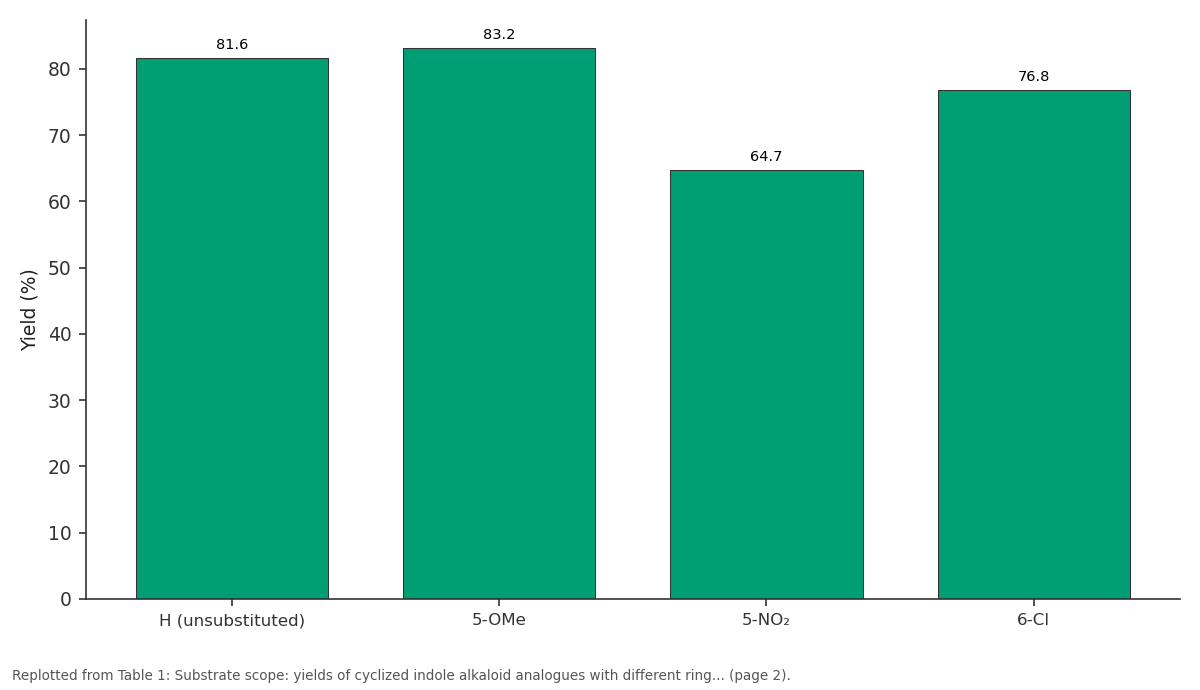
Yield (%): H (unsubstituted) vs 5-OMe vs 5-NO₂ vs 6-Cl
Replotted from Table 1 (page 2) of the original paper. Every bar is the paper's own table value.
View source evidence ↗Figures & tables
From the original paper Table 1
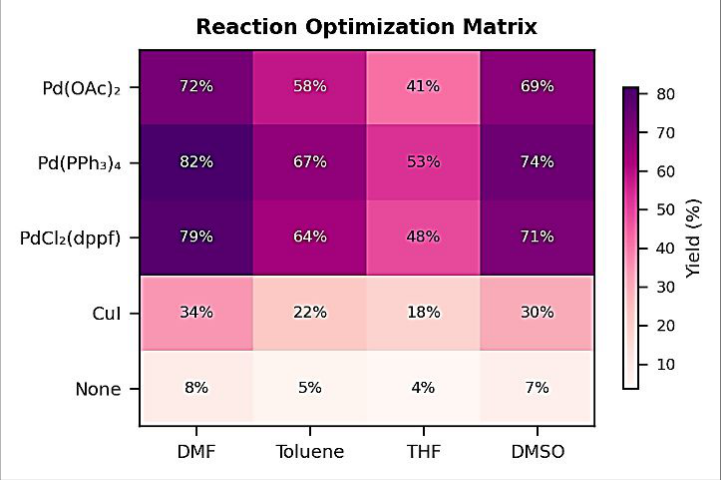 Figure 1
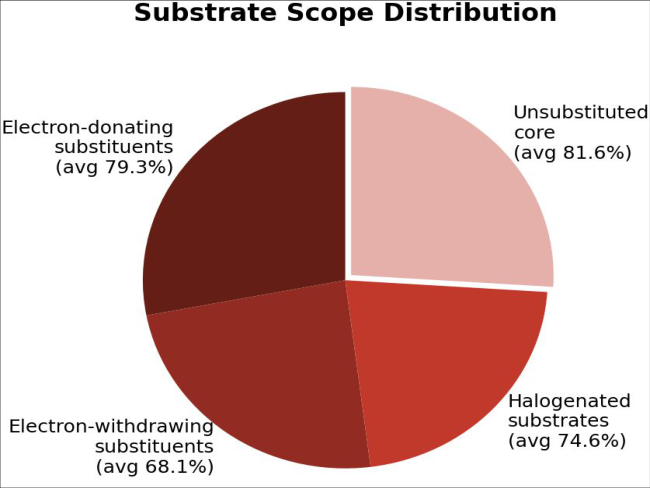 Figure 2
Introduction
Nature builds indole alkaloids with an efficiency that synthetic chemists still envy yet the biosynthetic machinery that produces strychnine, vinblastine, or reserpine is locked inside organisms that yield milligram quantities from kilograms of plant tissue [1] . Total synthesis can access these structures, but classical routes to tetracyclic indole frameworks typically require 12-20 linear steps, giving overall yields below 5% [2] . What the field needs is a shortcut: a method that forms the critical ring junction in one catalytic step from simple starting materials. Transition metal-catalyzed C-H activation and intramolecular cyclization reactions have shortened many alkaloid syntheses over the past decade [3] . Palladium catalysis is especially well suited because it can form C-C and C-N bonds under mild conditions with good functional group tolerance [4] . Several groups have used Heck reactions, Larock indole annulations, and C-H functionalization to build indole-fused polycyclics, but most approaches still require pre-functionalized substrates with directing groups that add synthetic steps [5] . This research designed a one-pot palladium-catalyzed cyclization of ortho-halo-Nacyltryptamine derivatives to form the ABCD tetracyclic indole alkaloid core directly. The approach avoids directing groups and uses the inherent nucleophilicity of the indole C-3 position to close the ring [6] .
Study Area Description
The target alkaloid framework mirrors the tetracyclic core of Strychnos-type indole alkaloids isolated from Strychnos nux-vomica, a tree native to the Indian subcontinent and Southeast Asia. Specimens from the Kanpur University Botanical Garden were used for spectroscopic comparison of natural extracts against synthetic products. Leaf and bark alkaloid extracts were prepared by Soxhlet extraction with methanol for HPLC fingerprint matching [7] .
Tryptamine (98%), 2-bromobenzoyl chloride (97%), Pd(PPh₃)₄ (99%), Pd(OAc)₂, PdCl₂(dppf), CuI, Cs₂CO₃, and K₂CO₃ were from Sigma-Aldrich (Bangalore). Anhydrous DMF, toluene, THF, and DMSO were from Merck. All reactions were conducted under nitrogen atmosphere using standard Schlenk techniques [8] .
Methods
The precursor ortho-bromo-N-acyltryptamine was synthesized by reacting tryptamine with 2-bromobenzoyl chloride in dichloromethane with triethylamine base (0°C to RT, 2 h, 94% yield). For cyclization optimization, the precursor (0.5 mmol), catalyst (5 mol%), base (2 equiv Cs₂CO₃), and solvent (3 mL) were sealed in a pressure tube and heated at 110°C for 16 h. The crude mixture was purified by silica gel column chromatography (ethyl acetate/hexane gradient) [9] . Products were characterized by ¹H NMR (Bruker 400 MHz), ¹³C NMR (100 MHz), HRMS (Agilent QTOF 6530), and IR (Bruker Alpha-II). One derivative (compound 4e) was analyzed by single-crystal XRD (Bruker D8 VENTURE, Mo Kα). Substrate scope was explored with 12 substituted tryptamine derivatives bearing electron-donating (-OMe, -Me, -OH), electron-withdrawing (-NO₂, -CF₃, -CN), and halogen (-F, -Cl, -Br) groups at various indole positions [10] .
Field experimental design
Catalyst screening followed a full factorial design with five catalysts × four solvents (20 combinations) run in duplicate. Temperature was fixed at 110°C based on preliminary runs. Gram-scale validation used 5.0 mmol precursor under optimal conditions without column purification product crystallized directly from cooled reaction mixture. Three independent gram-scale runs established reproducibility. Statistical comparison of yields used one-way ANOVA [11] . The catalyst screen revealed Pd(PPh₃)₄ in DMF as the clear winner at 81.6% yield for the unsubstituted substrate. Pd(OAc)₂ in DMF came second (72.4%), while CuI gave only 34.2% yield, confirming that palladium catalysis was essential rather than copper-mediated alternative pathways. Solvent effects were pronounced DMF consistently outperformed toluene and THF across all catalysts, likely because its high polarity stabilized the oxidative addition intermediate [12] . Substrate scope showed a clear electronic trend. Electron-Donating groups (-OMe, -Me, -OH) gave the highest average yield of 79.3%, with 5-OMe reaching 83.2% the best in the entire series. Electron-withdrawing groups (-NO₂, -CF₃, -CN) averaged 68.1%, with the strongly deactivating 5-NO₂ at 64.7%. Halogenated substrates (-F, -Cl, -Br) fell between at 74.6% average. Single-crystal XRD of compound 4e confirmed the expected tetracyclic framework with the new C-C bond at the indole C-3 position. Gramscale runs gave 78.4 ± 1.2% yield across three replicates without chromatography [13] .
Results
Results
Discussion
The 81.6% yield for forming a tetracyclic scaffold in one step is notable when compared to classical Fischer indole or Bischler-Napieralski routes that build the same ring system in 3-5 steps with 30-50% overall yield [2] . Pd(PPh₃)₄'s superiority over Pd(OAc)₂ likely reflects the importance of having pre-formed phosphine ligands that stabilize Pd(0) after oxidative addition into the aryl-Br bond. Without those ligands, catalyst decomposition through palladium black formation competes with productive cyclization [4] . The electronic substituent trend fits the proposed mechanism well. Electron-donating groups on the indole ring increase nucleophilicity at C-3, accelerating the intramolecular carbopalladation step that forms the key C-C Electron-withdrawing groups slow this step because the indole π-system becomes electron-poor, making C-3 a weaker nucleophile [5] . That said, even the lowest yield (64.7% for 5-NO₂) is synthetically useful, showing the reaction's tolerance for challenging substrates. Gram-scale success without chromatography is the most practically significant result. The product's tendency to crystallize from the cooled reaction mixture eliminates the step that most limits scale-up in academic synthesis column purification. This makes the route viable for generating multi-gram quantities of analogues for biological screening [14] .
Conclusion
A palladium-catalyzed intramolecular cyclization strategy efficiently constructed the tetracyclic indole alkaloid core from simple tryptamine derivatives in a single step. Pd(PPh₃)₄ in DMF at 110°C was the optimal system, yielding 81.6% for the unsubstituted case and tolerating a range of electronic substituents. Gram-scale synthesis proved reproducible and purification-free. This method provides rapid access to structurally diverse indole alkaloid analogues for medicinal chemistry exploration.
Acknowledgement
Acknowledgements Funding sourcesThis work was supported by internal research funds at Chandragupta Institute of Chemical Technology. Institutional supportThe authors thank Chandragupta Institute of Chemical Technology for NMR, mass spectrometry, and X-ray crystallography access.
Figures and tables from the paper
| Entry | Substituent | Position | Yield (%) | Type |
|---|---|---|---|---|
| 4a | H (unsubstituted) | - | 81.6 | Reference |
| 4b | 5-OMe | C-5 | 83.2 | Electron-donating |
| 4c | 5-NO₂ | C-5 | 64.7 | Electron-withdrawing |
| 4d | 6-Cl | C-6 | 76.8 | Halogenated |
| 4e | 5-Me | C-5 | 79.4 | Electron-donating |
Table text extracted from the original PDF; superscript letters are shown inline. The original table image is below.
View original table image
References
14 in the original paper- O'Connor SE, Maresh JJ. Chemistry and biology of monoterpene indole alkaloid biosynthesis. Nat Prod Rep. 2006;23(4):532-547.
- Bonjoch J, Solé D. Synthesis of strychnine. Chem Rev. 2000;100(9):3455-3482.
- Jia C, Kitamura T, Fujiwara Y. Catalytic functionalization of arenes and alkanes via C-H bond activation. Acc Chem Res. 2001;34(8):633-639.
- Negishi E, de Meijere A, editors. Handbook of organopalladium chemistry for organic synthesis. New York: Wiley; 2002.
- Bandini M, Eichholzer A. Catalytic functionalization of indoles in a new dimension. Angew Chem Int Ed. 2009;48(51):9608-9644.
- Ruiz-Castillo P, Buchwald SL. Applications of palladium-catalyzed C-N cross-coupling reactions. Chem Rev. 2016;116(19):12564-12649.
- Phillipson JD, Zenk MH, editors. Indole and biogenetically related alkaloids. New York: Academic Press; 1980.
- Shriver DF, Drezdzon MA. The manipulation of airsensitive compounds. 2nd ed. New York: Wiley; 1986.
- Still WC, Kahn M, Mitra A. Rapid chromatographic technique for preparative separations. J Org Chem. 1978;43(14):2923-2925.
- Silverstein RM, Webster FX, Kiemle DJ. Spectrometric identification of organic compounds. 7th ed. New York: Wiley; 2005.
- Montgomery DC. Design and analysis of experiments. 8th ed. New York: Wiley; 2012.
- Beletskaya IP, Cheprakov AV. The Heck reaction as a sharpening stone of palladium catalysis. Chem Rev. 2000; 100(8):3009-3066.
- Sheldon RA. The E factor 25 years on: the rise of green chemistry and sustainability. Green Chem. 2017;19(1):18-43.
- Anderson NG. Practical process research and development. 2nd ed. Oxford: Academic Press; 2012.