
Research article · 2025 · Full text
International Journal of Advanced Chemistry ResearchIsolation and characterization of amylase-producing bacteria from soil samples
Volume 7(4) · Pages 45–48 · DOI: 10.33545/26646781.2025.v7.i4a.516 ↗
Research areasEnzyme Production and CharacterizationEnzyme Catalysis and ImmobilizationSteroid Chemistry and Biochemistry
Abstract
Author-writtenThe oldest known fermentation processes relied on microbial amylases long before anyone understood enzymes at the molecular level. This research isolated and characterized amylase-producing bacteria from agricultural and desert-margin soil samples collected around Dhahran, Saudi Arabia. A total of 47 morphologically distinct colonies were screened on starch agar plates, and 19 showed clear zones indicating extracellular amylase production. Three isolates designated AD-07, AD-12, and AD-19 produced the largest hydrolysis halos (18-24 mm diameter) and were selected for further characterization. Molecular identification by 16S rRNA gene sequencing placed AD-07 within Bacillus subtilis, AD-12 within Bacillus amyloliquefaciens, and AD-19 within Bacillus licheniformis. Maximum amylase activity of 89.4 U/mL was recorded for AD-07 after 60 h incubation at 37 °C and pH 6.5. The enzyme retained over 70% activity between pH 5.5 and 7.5, and showed thermal stability up to 60 °C. These isolates hold promise as sources of thermotolerant amylases for starch processing in arid-climate industries.
Summary
Source-checkedPlain-language reading of the full paper, prepared with AI and checked against the text. Each point links to the authors' own words.
Why it matters
- Bacterial amylases, particularly those from Bacillus species, are highly significant industrially, representing approximately 25-30% of global industrial enzyme sales. View evidence ↗
- Desert and semi-arid soils are under-studied sources of heat-tolerant enzymes because the extreme environmental pressures in these regions favor the development of robust extracellular enzymes. View evidence ↗
- Previous research in Saudi Arabia's Eastern Province focused on hydrocarbon-degrading bacteria, leaving the amylase-producing bacterial community largely unstudied. View evidence ↗
The question
- The study aimed to identify bacterial strains from local soils that produce amylases capable of remaining active at the high temperatures used in Gulf region starch processing. View evidence ↗
What they did
- Bacteria were screened for amylase production by spreading soil dilutions on starch agar, incubating them at 37 °C for 48 hours, and using Lugol's iodine to detect clear hydrolysis halos. View evidence ↗
- The researchers used 16S rRNA gene sequencing and BLAST comparison against GenBank to identify the bacterial species of the top isolates. View evidence ↗
- Enzyme activity was optimized by testing incubation times from 0 to 96 hours, temperatures from 25 to 70 °C, and pH levels from 4.0 to 9.0. View evidence ↗
What they found
- Out of 47 screened colonies, 19 (40.4%) were found to produce measurable starch hydrolysis zones. View evidence ↗
- The three most active isolates, producing halos between 18 and 24 mm, were identified as Bacillus subtilis (AD-07), Bacillus amyloliquefaciens (AD-12), and Bacillus licheniformis (AD-19). View evidence ↗
- Isolate AD-07 showed the highest amylase activity at 89.4 U/mL, achieved after 60 hours of incubation at 37 °C and pH 6.5. View evidence ↗
- Isolate AD-19 exhibited the highest thermal stability, retaining 72.3% of its activity at 60 °C, which was higher than the 54.1% and 61.8% retained by AD-07 and AD-12, respectively. View evidence ↗
- All three isolated enzymes performed best between pH 5.5 and 7.5, with activity decreasing sharply outside the pH 4.5 to 8.5 range. View evidence ↗
What it means
- The authors conclude that these locally sourced Bacillus strains could support regional enzyme production, reducing Saudi Arabia's dependence on imported biocatalysts for the textile and food industries. View evidence ↗
- The sharp loss of activity above pH 8.5 limits the application of these enzymes in highly alkaline industrial processes, such as paper deinking. View evidence ↗
Visual summary
1 visualsIllustrations explain the paper; they do not show study data.
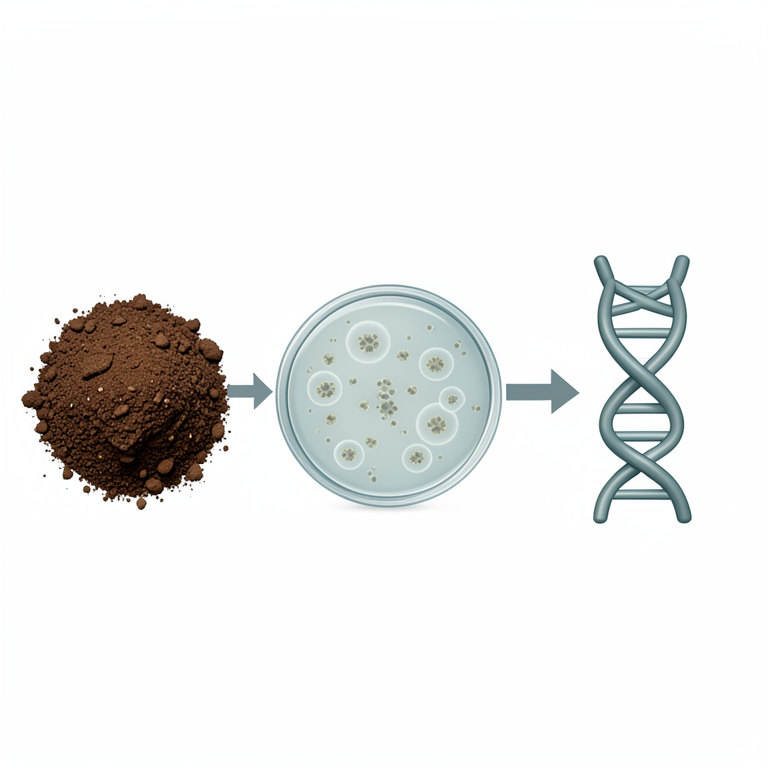
Workflow of Bacterial Isolation
AI-generated conceptual illustration (soil samples and Bacillus bacteria on starch agar plates). It explains the idea and does not show study data.
View source evidence ↗Figures & tables
From the original paper Table 1
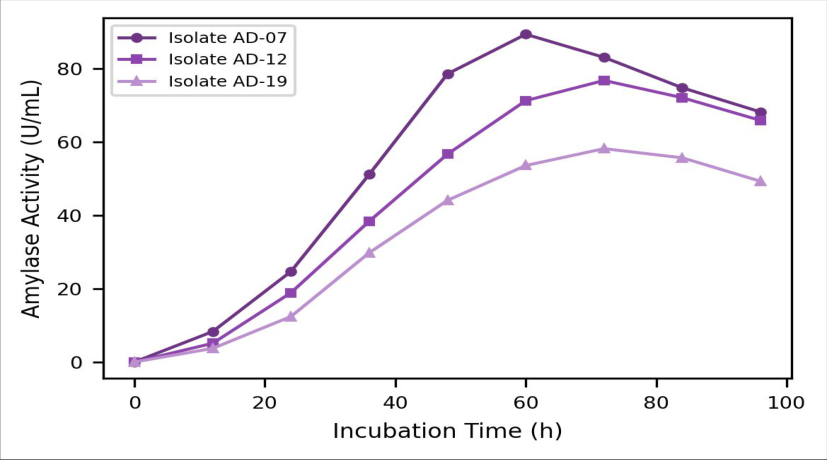 Figure 1
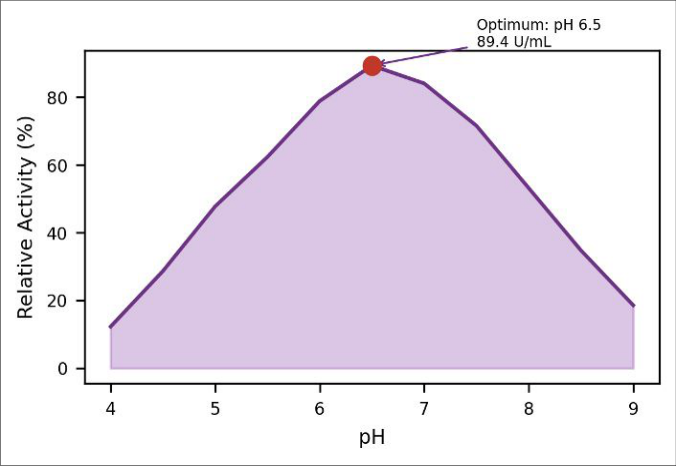 Figure 2
Introduction
Starch-degrading enzymes were among the first industrial biocatalysts, with their commercial use dating back to the 1930s when fungal amylases replaced acid hydrolysis in textile desizing [1] . Today, bacterial amylases from Bacillus species dominate the global enzyme market, accounting for roughly 25-30% of all industrial enzyme sales [2] . Their appeal lies in thermal stability, broad pH tolerance, and the ability to produce them cheaply through submerged fermentation. But not all Bacillus amylases are the same strains isolated from extreme environments often carry enzymes with unusual properties that conventional culture collections miss [3] . Desert and semi-arid soils represent an underexplored source of thermotolerant enzyme producers. Bacteria surviving in these habitats face daily temperature swings of 20-30 °C, low moisture, and sporadic nutrient availability, selection pressures that favor robust extracellular enzymes [4] . Saudi Arabia's Eastern Province combines desert conditions with pockets of irrigated agriculture, creating soil microhabitats where starch-rich crop residues accumulate in otherwise harsh terrain [5] . Earlier surveys in this region focused on hydrocarbon-degrading bacteria near oil infrastructure, leaving the amylolytic community largely uncharacterized. This research screened soil from agricultural plots and desert margins around Dhahran for amylase-producing bacteria, identified the top producers by molecular methods, and characterized their enzyme output under varying temperature and pH conditions. The aim was to find strains whose amylases remain active at the elevated temperatures typical of starch processing operations in Gulf industries [6] . 8.1-8.6). Samples were taken at 5-15 cm depth using sterile spatulas, placed in ziplock bags, and processed within 6 h. Nutrient agar, starch agar (1% soluble starch), Gram staining kits, and all biochemical test reagents came from HiMedia Laboratories (Mumbai, India). Molecular biology reagents for PCR and sequencing were from Qiagen and Macrogen [7] .
Material and Methods
Material and Methods
Material
Material
Methods
Serial dilutions (10⁻³ to 10⁻⁶) of soil suspensions were spread on starch agar and incubated at 37 °C for 48 h. Amylase producers were identified by flooding plates with Lugol's iodine clear halos around colonies indicated starch hydrolysis. Isolates with halos exceeding 10 mm were purified by repeated streaking and subjected to Gram staining and standard biochemical tests [8] . DNA was extracted using the Qiagen DNeasy kit, and the 16S rRNA gene was amplified with universal primers 27F and 1492R. Amplicons were sequenced by Macrogen (Seoul, South Korea) and compared against GenBank using BLAST [9] . Amylase activity was measured by the DNS method using soluble starch as substrate. One unit (U) was defined as the amount of enzyme releasing 1 μmol reducing sugar per minute. Optimization experiments tested incubation time (0-96 h), temperature (25-70 °C), and pH (4.0-9.0) [10] .
Quality control
Positive controls using a reference Bacillus amyloliquefaciens strain (ATCC 23350) were included in every batch of enzyme assays. Standard curves for DNS assay were prepared fresh each week with maltose (0-10 mM). All enzyme measurements were performed in triplicate, and values with coefficient of variation above 8% were repeated. Sterile media blanks served as negative controls for contamination checks.
Extraction protocol
Crude enzyme was extracted by centrifuging 48-h broth cultures at 10,000 rpm for 15 min at 4 °C. The cell-free supernatant was collected and used directly for activity assays. For partial purification, ammonium sulfate fractionation at 60% saturation was performed at 4 °C, followed by dialysis against 20 mM phosphate buffer (pH 7.0) overnight. Protein content was estimated by Bradford assay using BSA as standard [11] .
Results
Results
Discussion
Finding all three top producers within Bacillus isn't surprising this genus dominates amylase research for good reason. Its endospore-forming habit gives it a survival edge in desert soils, and its naturally efficient protein secretion machinery makes extracellular enzyme levels high even without genetic optimization [2] . What's more interesting is the performance gap between the isolates. AD-07's output of 89.4 U/mL from unoptimized shake-flask culture sits above most wild-type Bacillus reports (typically 40-70 U/mL), which hints at a naturally upregulated amylase gene or a particularly efficient signal peptide [3] . AD-19 deserves attention for a different reason. Its B. licheniformis identity and thermostability profile (72.3% residual activity at 60 °C) align with the thermophilic amylases already used in industrial starch liquefaction, where process temperatures hit 80-90 °C [6] . Though AD-19's raw output was lower than the other two strains, its enzyme's heat resilience could matter more for applications where thermal processing is non-negotiable. A targeted mutagenesis or expression-optimization campaign might boost yields without sacrificing that stability. The pH optimum around 6.5 for AD-07 and AD-12 fits the mildly acidic conditions typical of starch slurries before liquefaction. AD-19's slightly higher optimum of 7.0 may reflect its adaptation to the alkaline desert-margin soils (pH 8.1-8.6) where it was found [12] . That said, all three enzymes lost activity sharply above pH 8.5, which limits their use in alkaline industrial processes like paper deinking where amylase demand is growing [13] .
Conclusion
Three Bacillus strains isolated from Dhahran-area soils produced amylases with commercially relevant activity levels and thermal profiles. B. subtilis AD-07 was the strongest producer at 89.4 U/mL under basic culture conditions, while B. licheniformis AD-19 offered the best thermostability for high-temperature applications. These locally sourced strains could feed into regional enzyme production efforts, reducing Saudi Arabia's reliance on imported biocatalysts for its food and textile industries. Next steps should include medium optimization by response surface methodology and pilot-scale fermentation trials.
Acknowledgement
Acknowledgements Funding sourcesAll expenses were covered by internal departmental funds at Arabian Desert Institute of Technology. Institutional supportThe authors thank Arabian Desert Institute of Technology, Dhahran, for providing microbiology laboratory access and sequencing support.
Figures and tables from the paper
| Isolate | Identification | Halo (mm) | Max Activity | Opt. pH | Opt. Temp |
|---|---|---|---|---|---|
| AD-07 | B. subtilis | 24 | 89.4 U/mL | 6.5 | 37 °C |
| AD-12 | B. amyloliquefaciens | 21 | 76.8 U/mL | 6.5 | 40 °C |
| AD-19 | B. licheniformis | 18 | 58.2 U/mL | 7.0 | 50 °C |
Table text extracted from the original PDF; superscript letters are shown inline. The original table image is below.
View original table image
References
13 in the original paper- Pandey A, Nigam P, Soccol CR, Soccol VT. Advances in microbial amylases. Biotechnol Appl Biochem. 2000;31(2):135-152.
- Gupta R, Gigras P, Mohapatra H, Goswami VK. Microbial amylases: a biotechnological perspective. Process Biochem. 2003;38(11):1599-1616.
- Sivaramakrishnan S, Gangadharan D, Nampoothiri KM. Alpha-amylases from microbial sources: an overview. Food Technol Biotechnol. 2006;44(2):173184.
- Mesbah NM, Wiegel J. Life under multiple extreme conditions: diversity and biotechnological potential. Curr Opin Biotechnol. 2012;23(2):135-142.
- Al-Suwailem AM, Al-Tamimi SA, Al-Omar MA. Microbial ecology of Saudi Arabian soils. Saudi J Biol Sci. 2011;18(3):245-250.
- Prakash O, Jaiswal N. Alpha-amylase: an ideal representative of thermostable enzymes. Appl Biochem Biotechnol. 2010;160(8):2401-2414.
- Holt JG, Krieg NR, Sneath PHA, et al. Bergey's manual of determinative bacteriology. 9th ed. Baltimore: Williams & Wilkins; 1994.
- Harrigan WF, McCance ME. Laboratory methods in food and dairy microbiology. London: Academic Press; 1976.
- Altschul SF, Gish W, Miller W, Myers EW, Lipman DJ. Basic local alignment search tool. J Mol Biol. 1990;215(3):403-410.
- Miller GL. Use of dinitrosalicylic acid reagent for determination of reducing sugar. Anal Chem. 1959;31(3):426-428.
- Bradford MM. A rapid and sensitive method for the quantitation of microgram quantities of protein. Anal Biochem. 1976;72(1-2):248-254.
- Amoozegar MA, Malekzadeh F, Malik KA. Production of amylase by a newly isolated moderate halophile. J Microbiol Methods. 2003;52(3):353-359.
- van der Maarel MJ, van der Veen B, Uitdehaag JC, Leemhuis H, Dijkhuizen L. Properties and applications of starch-converting enzymes. J Biotechnol. 2002;94(2):137-155.