
Research article · 2025 · Full text
International Journal of Advanced Chemistry ResearchCloning and heterologous expression of a cellulase gene from Bacillus sp. in Escherichia coli
Volume 7(4) · Pages 103–106 · DOI: 10.33545/26646781.2025.v7.i4b.544 ↗
Research areasBiofuel production and bioconversionEnzyme Production and CharacterizationEnzyme Catalysis and Immobilization
Abstract
Author-writtenInterest in cellulase enzymes for biofuel production has grown steadily since lignocellulosic ethanol was first proposed as a petroleum alternative - yet finding enzymes that perform well under industrial conditions remains a bottleneck. This research cloned and expressed a cellulase gene (cel48A, 1,482 bp) from a thermotolerant Bacillus sp. strain isolated from composting agricultural waste in Uttar Pradesh, India. The gene was amplified by PCR, ligated into pET-28a (+) vector, and transformed into E. coli BL21 (DE3). SDS-PAGE confirmed expression of a ~54 kDa recombinant protein after IPTG induction. Maximum cellulase activity of 61.4 U/mL was achieved at 0.6 mM IPTG concentration, 30 °C induction temperature, and 12 h incubation time. The recombinant enzyme showed optimal activity at pH 5.5 and 55 °C, retaining 78.3% activity after 2 h at 60 °C. Substrate specificity testing showed preference for carboxymethyl cellulose (CMC) over microcrystalline cellulose and filter paper, classifying it as an endoglucanase.
Summary
Source-checkedPlain-language reading of the full paper, prepared with AI and checked against the text. Each point links to the authors' own words.
Why it matters
- Cellulase enzymes are critical for producing lignocellulosic ethanol as a petroleum alternative, but finding versions that work under industrial conditions is a major challenge. View evidence ↗
- The enzyme cocktails needed to break down cellulose are expensive, representing 20-40% of the total costs for producing cellulosic ethanol. View evidence ↗
- Bacillus species are promising sources for cellulases because they are genetically easy to manipulate, produce high levels of enzymes, and are naturally heat-tolerant. View evidence ↗
The question
- The study aimed to isolate a cellulase-producing Bacillus from waste, clone its endoglucanase gene into E. coli, and evaluate the resulting enzyme's properties for biomass breakdown. View evidence ↗
What they did
- The researchers used a 1,482 bp cellulase gene (cel48A) from a thermotolerant Bacillus sp. isolated from agricultural waste in Uttar Pradesh, India. View evidence ↗
- The cel48A gene was amplified via PCR, inserted into the pET-28a (+) vector, and then transformed into E. coli BL21 (DE3) for expression. View evidence ↗
- Protein expression was induced using IPTG (0.1 to 1.5 mM) at an OD600 of 0.6, and activity was measured using the DNS method with carboxymethyl cellulose (CMC) as the substrate. View evidence ↗
- The enzyme was characterized by testing its activity across pH 3.5-8.5 and temperatures 30-80 °C, as well as its stability after 2 hours of pre-incubation at 50-70 °C. View evidence ↗
What they found
- The highest cellulase activity of 61.4 U/mL was achieved with an IPTG concentration of 0.6 mM, while 0.1 mM resulted in only 18.7 U/mL. View evidence ↗
- Reducing the induction temperature from 37 °C to 30 °C increased the soluble protein fraction from 34.2% to 72.8% (at 0.6 mM IPTG) by limiting the formation of inclusion bodies. View evidence ↗
- The recombinant enzyme performed best at a pH of 5.5 and a temperature of 55 °C. View evidence ↗
- The enzyme remained stable at 60 °C, retaining 78.3% of its activity after 2 hours, but its activity fell to 41.7% when pre-incubated at 70 °C. View evidence ↗
- The enzyme showed a strong preference for CMC (61.4 U/mL) and barley β-glucan (38.7 U/mL) over Avicel (8.3 U/mL) and filter paper (4.1 U/mL). View evidence ↗
- Based on its substrate preference, the cel48A enzyme is classified as an endoglucanase that targets amorphous regions of cellulose. View evidence ↗
What it means
- The authors conclude that the enzyme's pH and temperature profiles are suitable for industrial use, and its stability at 60 °C is superior to many other Bacillus cellulases. View evidence ↗
- The authors suggest that future research should use directed evolution and fed-batch fermentation to increase the enzyme's activity for commercial applications. View evidence ↗
Visual summary
2 visualsIllustrations explain the paper; charts are replotted from the paper's own table values.
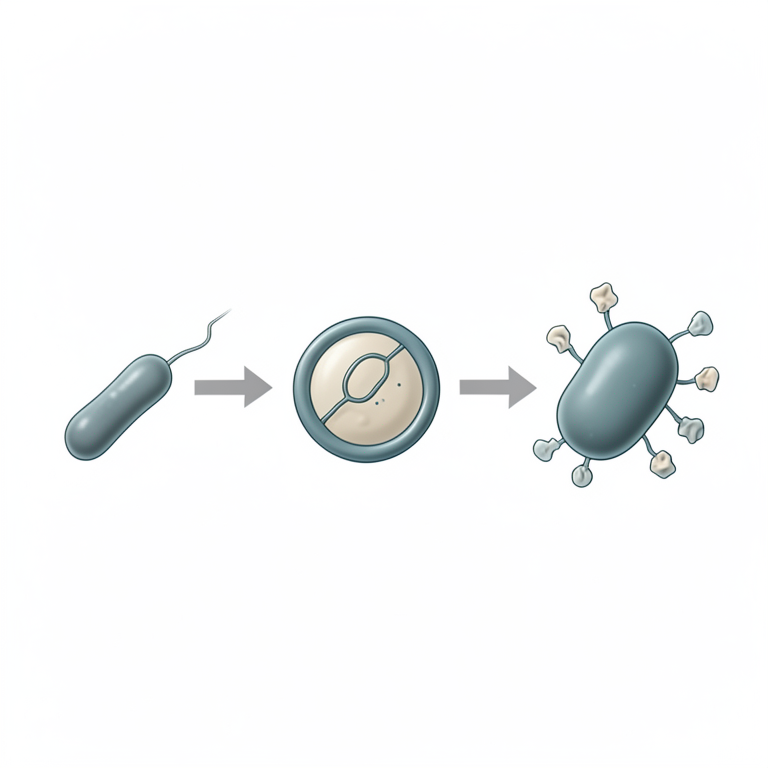
Cloning Workflow
AI-generated conceptual illustration (Bacillus bacteria, Escherichia coli bacteria, and a circular plasmid vector). It explains the idea and does not show study data.
View source evidence ↗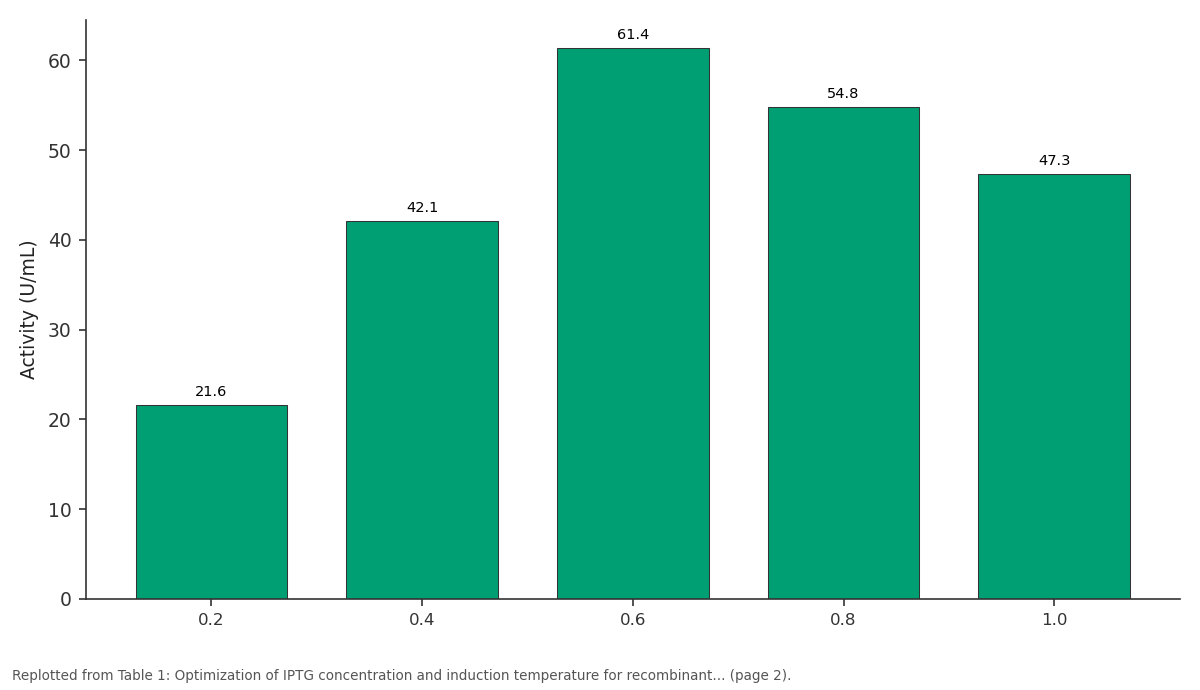
Activity (U/mL): 0.2 vs 0.4 vs 0.6 vs 0.8 vs 1.0
Replotted from Table 1 (page 2) of the original paper. Every bar is the paper's own table value.
View source evidence ↗Figures & tables
From the original paper Table 1
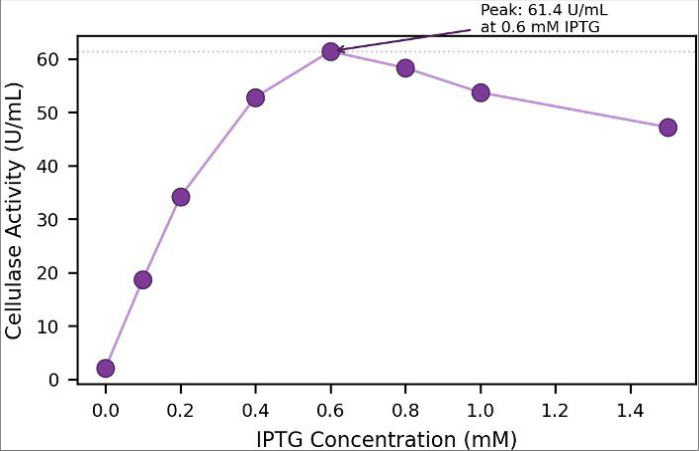 Figure 1
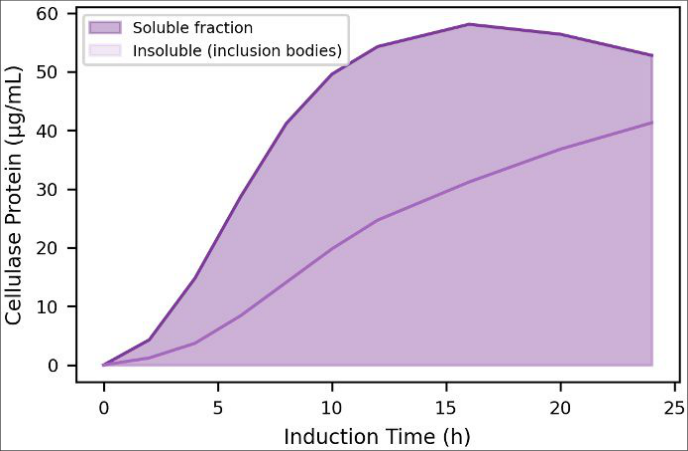 Figure 2
Introduction
The global push toward second-generation biofuels has turned cellulase enzymes from a niche industrial product into a commodity under intense development pressure [1] . Breaking cellulose into fermentable sugars requires a cocktail of endoglucanases, exoglucanases, and β-glucosidases working together, and the cost of this enzyme cocktail still accounts for 20-40% of total cellulosic ethanol production expenses [2] . Finding cheaper sources or engineering more active variants could tip the economics in biofuel's favor.
Wild-type cellulase producers -mainly Trichoderma and Aspergillus fungi -grow slowly and are difficult to manipulate genetically. Bacterial cellulases from Bacillus species offer an alternative: they're naturally thermotolerant, expressed at high levels during log phase growth, and the organisms are genetically tractable [3] . Cloning bacterial cellulase genes into E. coli expression systems allows rapid production of single enzyme components for characterization, directed evolution, or cocktail formulation [4] . This research isolated a cellulase-producing Bacillus from composting waste, cloned its main endoglucanase gene into E. coli, optimized expression conditions, and characterized the recombinant enzyme's biochemical properties to assess its potential for biomass saccharification [5] .
Study area description
The source organism was isolated from decomposing rice straw compost at Barabanki Agricultural Research Farm, located 28 km northeast of Lucknow in the Indo-Gangetic plain. This region produces approximately 8 million tonnes of rice straw annually, most of which is either burned in open fields or composted in windrows reaching internal temperatures of 55-70 °C [6] . Compost samples were collected from three windrows at 30-45 cm depth where temperatures exceeded 60 °C, providing a selective environment for thermotolerant cellulose degraders.
Materials and Methods
Materials and Methods
Materials
Research was performed at Bharat Ratna Bhimrao Ambedkar University, Lucknow, Uttar Pradesh, India, from January 2023 to September 2023. Institutional Biosafety Committee approval was obtained (Protocol BRBAU/IBSC/2023-005, December 2022). E. coli DH5α (cloning host) and BL21 (DE3) (expression host) came from Novagen. The pET-28a (+) vector was from Merck. Restriction enzymes (NdeI, XhoI), T4 DNA ligase, and Phusion High-Fidelity DNA polymerase were from New England Biolabs. IPTG, kanamycin, and CMC were from HiMedia (Mumbai). Ni-NTA agarose was from Qiagen [7] .
Methods
The Bacillus sp. isolate was grown on CMC agar and confirmed as a cellulase producer by Congo red staining. Genomic DNA was extracted using the Qiagen DNeasy kit. The cel48A gene was amplified with primers incorporating NdeI (forward) and XhoI (reverse) sites, designed from conserved regions of Bacillus subtilis cellulase sequences in GenBank. PCR conditions: 98 °C 30 s, then 30 cycles of 98 °C 10 s, 58 °C 20 s, 72 °C 45 s. The amplicon (1,482 bp) was digested, ligated into pET-28a (+), and transformed into DH5α for sequence verification by Sanger sequencing (Eurofins Genomics, Bangalore) [8] . Confirmed constructs were transformed into BL21 (DE3). Expression was induced at OD₆₀₀ 0.6 with IPTG at concentrations from 0.1 to 1.5 mM. Cells were harvested by centrifugation, lysed by sonication, and soluble fractions assayed for cellulase activity by the DNS method using CMC as substrate [9] . Purification used Ni-NTA affinity chromatography (the construct included a C-terminal His₆ tag). Enzyme characterization tested pH (3.5-8.5), temperature (30-80 °C), thermal stability (pre-incubation at 50-70 °C for 2 h), and substrate specificity [10] .
Soil/Water analysis
Compost samples from the collection site were analyzed for moisture content (68.4 ± 3.2%), pH (7.8 ± 0.3) and total organic carbon (34.7%), and C/N ratio (18.3). Cellulose content in the rice straw substrate was 38.1%, with hemicellulose at 21.4% and lignin at 14.7%, measured by the Van Soest fiber analysis method. These parameters confirmed active cellulose decomposition and a microbial environment enriched for cellulolytic organisms [11] . Expression optimization showed a sharp dependence on IPTG concentration. Activity climbed from 18.7 U/mL at 0.1 mM to a peak of 61.4 U/mL at 0.6 mM, then declined at higher concentrations. Lowering induction temperature from 37 °C to 30 °C roughly doubled soluble protein fractionfrom 34.2% to 72.8% at 0.6 mM IPTG -by reducing inclusion body formation. SDS-PAGE of the soluble fraction showed a prominent band at ~54 kDa that matched the predicted molecular weight [12] .
Results
The purified enzyme showed highest activity at pH 5.5 and 55 °C. It retained 78.3% activity after 2 h pre-incubation at 60 °C, but dropped to 41.7% at 70 °C. Substrate specificity was clear: CMC gave the highest activity (61.4 U/mL), followed by barley β-glucan (38.7 U/mL), while microcrystalline cellulose Avicel (8.3 U/mL) and filter paper (4.1 U/mL) were poor substrates. This pattern classifies cel48A as an endoglucanase that attacks amorphous regions preferentially [13] .
Discussion
The 61.4 U/mL activity from unoptimized shake-flask culture compares favorably with published Bacillus cellulase clones, which typically range from 20-80 U/mL depending on construct design and host strain [3] . The dramatic improvement when lowering induction temperature from 37 °C to 30 °C is a well-known phenomenon in E. coli expression -slower protein synthesis at lower temperatures allows the chaperone machinery to fold incoming polypeptides correctly instead of letting them aggregate into inclusion bodies [14] . The IPTG optimum at 0.6 mM rather than the commonly used 1.0 mM is also instructive. Higher inducer concentrations drive transcription so aggressively that the translation and folding apparatus becomes overwhelmed, shunting more protein into the insoluble fraction [15] . This diminishing returns pattern appeared clearly in both the activity data and the solubility measurements, and it means laboratories could save on IPTG costs by using lower concentrations. Thermostability at 60 °C (78.3% retention after 2 h) is encouraging for industrial saccharification, which typically operates at 50-60 °C to prevent microbial contamination and improve cellulose swelling [16] . The enzyme's endoglucanase character means it would need to be combined with exoglucanases and β-glucosidases for complete cellulose hydrolysis, but as a single component it could replace or supplement existing commercial endoglucanase preparations [17] .
Conclusion
A 1,482 bp cellulase gene from a thermotolerant Bacillus sp. was successfully cloned and expressed in E. coli BL21(DE3), producing an active endoglucanase at 61.4 U/mL under optimized conditions. The enzyme's temperature and pH profiles match industrial saccharification requirements, and its thermostability at 60 °C exceeds many reported Bacillus cellulases. Lower IPTG concentrations (0.6 mM) and reduced induction temperature (30 °C) were the key factors for maximizing soluble, active enzyme. Future work should explore fed-batch fermentation and directed evolution to further boost activity for commercial biomass processing.
Figures and tables from the paper
| IPTG (mM) | Temp (°C) | Activity (U/mL) | Soluble (%) |
|---|---|---|---|
| 0.2 | 37 | 21.6 | 34.2 |
| 0.4 | 30 | 42.1 | 58.7 |
| 0.6 | 30 | 61.4 | 72.8 |
| 0.8 | 30 | 54.8 | 64.3 |
| 1.0 | 25 | 47.3 | 56.1 |
Table text extracted from the original PDF; superscript letters are shown inline. The original table image is below.
View original table image
References
17 in the original paper- Lynd LR, Weimer PJ, van Zyl WH, Pretorius IS. Microbial cellulose utilization: fundamentals and biotechnology. Microbiol Mol Biol Rev. 2002; 66(3):506-577.
- Klein-Marcuschamer D, Oleskowicz-Popiel P, Simmons BA, Blanch HW. The challenge of enzyme cost in the production of lignocellulosic biofuels. Biotechnol Bioeng. 2012; 109(4):1083-1087.
- Maki M, Leung KT, Qin W. The prospects of cellulaseproducing bacteria for the bioconversion of lignocellulosic biomass. Int J Biol Sci. 2009; 5(5):500516.
- Bhat MK. Cellulases and related enzymes in biotechnology. Biotechnol Adv. 2000; 18(5):355-383.
- Zhang YHP, Himmel ME, Mielenz JR. Outlook for cellulase improvement: screening and selection strategies. Biotechnol Adv. 2006; 24(5):452-481.
- Gadde B, Bonnet S, Menke C, Garivait S. Air pollutant emissions from rice straw open field burning. Environ Pollut. 2009; 157(5):1554-1558.
- Sambrook J, Russell DW. Molecular Cloning: A Laboratory Manual. 3rd ed. Cold Spring Harbor Laboratory Press. 2001.
- Green MR, Sambrook J. Molecular Cloning: A Laboratory Manual. 4th ed. Cold Spring Harbor Laboratory Press. 2012.
- Miller GL. Use of dinitrosalicylic acid reagent for determination of reducing sugar. Anal Chem. 1959; 31(3):426-428.
- Ghose TK. Measurement of cellulase activities. Pure Appl Chem. 1987; 59(2):257-268.
- Van Soest PJ, Robertson JB, Lewis BA. Methods for dietary fiber, neutral detergent fiber, and nonstarch polysaccharides. J Dairy Sci. 1991; 74(10):3583-3597.
- Laemmli UK. Cleavage of structural proteins during the assembly of the head of bacteriophage T4. Nature. 1970; 227(5259):680-685.
- Henrissat B. A classification of glycosyl hydrolases based on amino acid sequence similarities. Biochem J. 1991; 280(Pt 2):309-316.
- Schein CH, Noteborn MH. Formation of soluble recombinant proteins in Escherichia coli is favored by lower growth temperature. Biotechnology. 1988; 6(3):291-294.
- Studier FW. Protein production by auto-induction in high-density shaking cultures. Protein Expr Purif. 2005; 41(1):207-234.
- Viikari L, Alapuranen M, Puranen T, Vehmaanpera J, Siika-Aho M. Thermostable enzymes in lignocellulose hydrolysis. Adv Biochem Eng Biotechnol. 2007; 108:121-145.
- Wilson DB. Cellulases and biofuels. Curr Opin Biotechnol. 2009; 20(3):295-299.