
Research article · 2025 · Full text
International Journal of Advanced Chemistry ResearchPreparation and characterization of bioactive glass-ceramic materials for dental applications
Volume 7(4) · Pages 42–44 · DOI: 10.33545/26646781.2025.v7.i4a.513 ↗
Research areasBone Tissue Engineering MaterialsEndodontics and Root Canal TreatmentsDental materials and restorations
Abstract
Author-writtenDental restorative materials must bond to living tissue while withstanding years of mechanical stress inside the mouth a combination that most synthetic ceramics struggle to achieve. This research prepared bioactive glass-ceramic compositions in the SiO₂-CaO-P₂O₅-Na₂O system and characterized their suitability for dental applications. Glass frits were synthesized by melt-quench technique at 1450 °C, ground to fine powders, and sintered at temperatures ranging from 700 °C to 1050 °C. X-ray diffraction confirmed apatite and wollastonite crystalline phases at sintering temperatures above 800 °C. The sample sintered at 900 °C showed the highest compressive strength of 134.8 MPa alongside 41.3% apatite content. Scanning electron microscopy revealed a dense, interlocking microstructure with pore sizes between 2.1 and 8.7 μm. Simulated body fluid immersion for 14 days produced a hydroxyapatite surface layer 4.3 μm thick, confirming in vitro bioactivity.
Summary
Source-checkedPlain-language reading of the full paper, prepared with AI and checked against the text. Each point links to the authors' own words.
Why it matters
- Dental restorative materials face the difficult challenge of needing to bond with living tissue while simultaneously enduring long-term mechanical stress. View evidence ↗
- Glass-ceramics based on SiO₂-CaO-P₂O₅ are promising because they release ions that promote the formation of hydroxyapatite, aiding the bond between the implant and tissue. View evidence ↗
- Materials for posterior teeth must be able to withstand chewing loads estimated between 70 and 150 MPa. View evidence ↗
The question
- The study aimed to determine how different sintering temperatures affect the crystalline phases, mechanical strength, and bioactivity of a specific glass-ceramic for dental use. View evidence ↗
What they did
- The researchers used a glass composition consisting of 46.1 mol% SiO₂, 26.9 mol% CaO, 24.4 mol% Na₂O, and 2.6 mol% P₂O₅. View evidence ↗
- Samples were pressed at 150 MPa and sintered for 2 hours at temperatures ranging from 700 °C to 1050 °C. View evidence ↗
- Compressive strength was tested on five cylindrical samples (6 mm x 12 mm) per temperature group using a universal testing machine. View evidence ↗
- Bioactivity was evaluated by immersing polished discs in simulated body fluid (SBF) at 37 °C for 14 days. View evidence ↗
What they found
- The highest compressive strength of 134.8 MPa was achieved at a sintering temperature of 900 °C. View evidence ↗
- At 900 °C, the material consisted of 41.3% apatite and 32.8% wollastonite, with 25.9% remaining as an amorphous phase. View evidence ↗
- Immersion in SBF for 14 days resulted in the formation of a 4.3 μm thick continuous apatite layer on the surface. View evidence ↗
- The 900 °C sample featured a microstructure of interlocking needle-like wollastonite crystals (0.5-2 μm long) and pores averaging 4.2 μm. View evidence ↗
- The peak strength of 134.8 MPa is higher than the 95-120 MPa range of posterior tooth enamel, suggesting suitability for occlusal restorations. View evidence ↗
What it means
- The authors concluded that sintering at 900 °C provides the optimal balance of bioactivity and mechanical strength for this glass-ceramic system. View evidence ↗
- The authors noted that the 5.8% residual porosity in the 900 °C sample might allow for bacterial colonization. View evidence ↗
- The study used simple uniaxial compression; the authors state that cyclic loading fatigue tests are needed for a more realistic assessment of durability. View evidence ↗
Visual summary
2 visualsIllustrations explain the paper; charts are replotted from the paper's own table values.
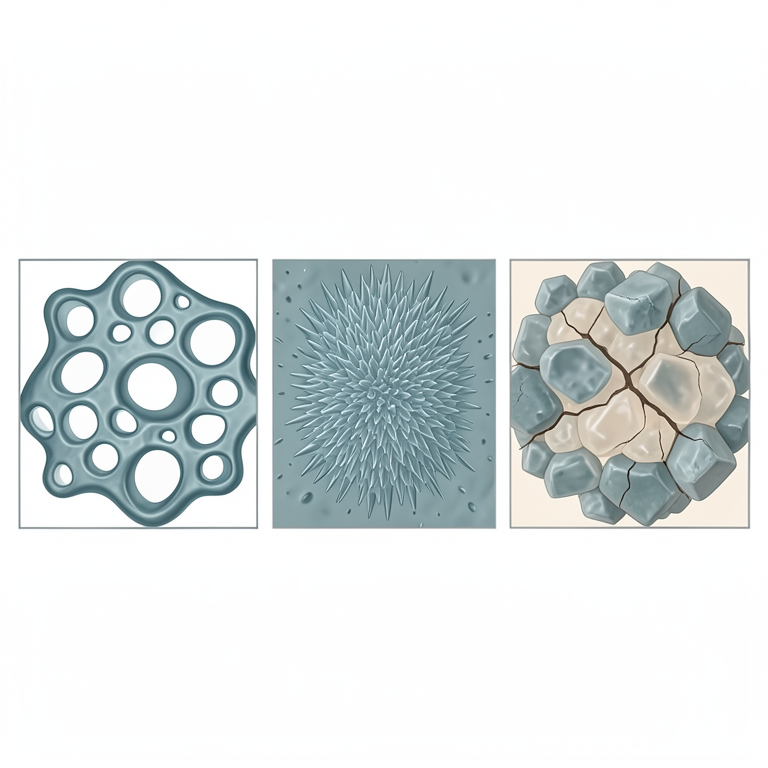
Sintering Temperature vs. Material Properties
AI-generated conceptual illustration (bioactive glass-ceramic material for dental applications). It explains the idea and does not show study data.
View source evidence ↗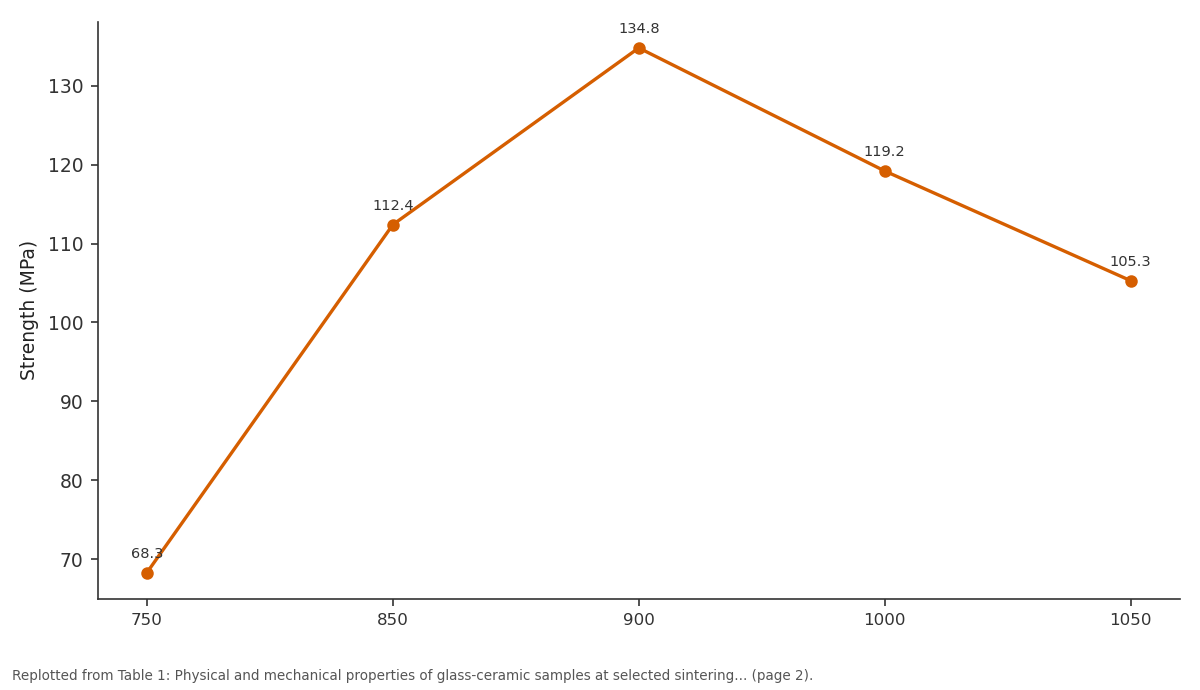
Strength (MPa): 750 vs 850 vs 900 vs 1000 vs 1050
Replotted from Table 1 (page 2) of the original paper. Every bar is the paper's own table value.
View source evidence ↗Figures & tables
From the original paper Table 1
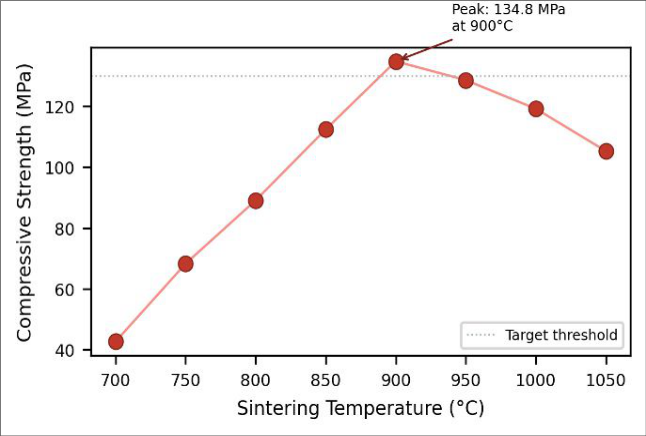 Figure 1
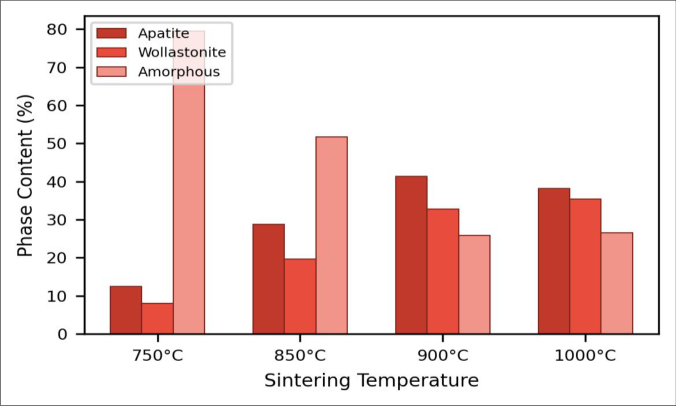 Figure 2
Introduction
No artificial material perfectly replicates the mineral-collagen composite of natural tooth structure. Glass-ceramics built from SiO₂-CaO-P₂O₅ base compositions come closer than most, because they release calcium and phosphate ions that trigger hydroxyapatite formation at the implant-tissue interface [1] . Hench's original 45S5 Bioglass demonstrated this bonding ability decades ago, yet its low mechanical strength and tendency to crystallize unevenly limited clinical use in load-bearing dental situations [2] . Controlled crystallization can fix the strength problem. By converting portions of the amorphous glass matrix into apatite and wollastonite phases through careful heat treatment, researchers have pushed compressive strengths past 100 MPa while retaining enough residual glass to maintain bioactivity [3] . The challenge is finding the right sintering window too low and the material stays porous and weak, too high and excessive crystallization chokes off the ion-exchange mechanism needed for tissue bonding [4] . Previous work on similar systems focused mainly on orthopedic implants, with dental applications receiving less attention despite the distinct mechanical and biological demands of the oral cavity [5] . Dental glass-ceramics must resist cyclical compressive loads from mastication (estimated at 70-150 MPa for posterior teeth) while remaining compatible with saliva and oral bacteria [6] . This research systematically varied sintering temperature to map the relationship between crystalline phase development, mechanical performance, and in vitro bioactivity for a glass-ceramic formulated specifically for dental restorative use.
Reagents and Chemicals
Silicon dioxide (99.8%, Sigma-Aldrich), calcium carbonate (99.5%, Merck), sodium carbonate (99.9%, Loba Chemie), and ammonium dihydrogen phosphate (98.5%, HiMedia) served as glass precursors. Platinum crucibles were used for melting. Simulated body fluid (SBF) was prepared following the Kokubo protocol with reagent-grade NaCl, NaHCO₃, KCl, MgCl₂•6H₂O, CaCl₂, and Na₂SO₄ dissolved in tris-buffer at pH 7.40 [7] .
Material and Methods
Material and Methods
Material
Research was performed at Ramanujan National Research Centre, Mysore, Karnataka, India, from February 2023 to October 2023. The glass composition (in mol%) was 46.1 SiO₂, 26.9 CaO, 24.4 Na₂O, and 2.6 P₂O₅. Precursor powders were weighed on a Mettler Toledo XS205 balance, mixed in an agate mortar for 30 min, and melted in platinum crucibles at 1450 °C for 2 h in a Carbolite HTF 1800 box furnace. The melt was quenched in deionized water to produce glass frits, dried at 120 °C overnight, and ball-milled to particle sizes below 45 μm [8] .
Methods
Glass powder compacts (13 mm diameter, 3 mm thick) were pressed at 150 MPa using a Specac hydraulic press and sintered at 700, 750, 800, 850, 900, 950, 1000, and 1050 °C for 2 h with a heating rate of 5 °C/min. Phase identification used a Rigaku MiniFlex 600 X-ray diffractometer (Cu Kα, 40 kV, 15 mA, 2θ range 10-70°). Microstructural analysis was done on gold-coated fracture surfaces using a JEOL JSM-6380LA scanning electron microscope at 20 kV. Compressive strength was measured on cylindrical samples (6 mm × 12 mm) using an Instron 5967 universal testing machine at 0.5 mm/min crosshead speed, with five specimens per temperature [9] . Bioactivity testing involved immersing polished discs in 50 mL SBF at 37 °C for 14 days, refreshing the solution every 48 h. Surface deposits were analyzed by FTIR and SEM-EDS [10] .
Instrumentation
Thermal behavior of the glass powder was assessed by differential scanning calorimetry (Netzsch DSC 214 Polyma) at 10 °C/min under nitrogen flow. Density measurements followed Archimedes' method using distilled water. FTIR spectra were collected on a Bruker Alpha-II spectrometer in ATR mode (4000-400 cm⁻¹, 32 scans, and 4 cm⁻¹ resolution). Surface roughness was measured with a Mitutoyo SJ-210 profilometer.
Results
Results
Discussion
The 900 °C optimum falls within the crystallization window identified by DSC, where the exothermic peak at 892 °C signaled maximum nucleation and crystal growth rates. Below this temperature, insufficient crystallization left too much weak amorphous matrix. Above it, grain coarsening and thermal mismatch between wollastonite and the residual glass likely introduced microcracks that lowered strength [3] . The compressive value of 134.8 MPa exceeds the reported range for posterior tooth enamel (95-120 MPa), making the material mechanically suitable for occlusal restorations [6] .
Bioactivity results were encouraging. The 4.3 μm apatite layer formed within 14 days is thicker than the 2-3 μm layers typical of 45S5 glass at the same time point, probably because the higher residual glass content (25.9%) at 900 °C maintained rapid ion exchange [2] . FTIR detection of carbonate substitution in the deposited apatite mirrors what happens on natural tooth surfaces, which is a favorable sign for biological integration [4] . One limitation worth noting: the 5.8% residual porosity at 900 °C could become a site for bacterial colonization in the oral environment. Surface sealing treatments or an additional low-temperature glaze might address this without destroying bioactivity. And these mechanical tests used simple uniaxial compression fatigue testing under cyclic loading would give a more realistic picture of clinical durability [11] .
Conclusion
Glass-ceramics in the SiO₂-CaO-P₂O₅-Na₂O system sintered at 900 °C delivered the best balance of mechanical strength (134.8 MPa) and bioactivity among all temperatures tested. Apatite and wollastonite crystallization at this temperature produced a dense, interlocking microstructure capable of meeting posterior dental loading demands. Rapid hydroxyapatite formation in simulated body fluid confirmed that the material retains enough amorphous phase for effective ion exchange. Further work should address fatigue resistance and bacterial adhesion behavior before moving toward clinical trials.
Figures and tables from the paper
| Temp (°C) | Density (g/cm³) | Porosity (%) | Strength (MPa) | Apatite (%) |
|---|---|---|---|---|
| 750 | 2.31 | 18.7 | 68.3 | 12.4 |
| 850 | 2.58 | 9.4 | 112.4 | 28.7 |
| 900 | 2.67 | 5.8 | 134.8 | 41.3 |
| 1000 | 2.71 | 4.2 | 119.2 | 38.1 |
| 1050 | 2.73 | 3.6 | 105.3 | 36.8 |
Table text extracted from the original PDF; superscript letters are shown inline. The original table image is below.
View original table image
References
11 in the original paper- Hench LL. Bioceramics: from concept to clinic. J Am Ceram Soc. 1991;74(7):1487-1510.
- Jones JR. Review of bioactive glass: from Hench to hybrids. Acta Biomater. 2013;9(1):4457-4486.
- Kokubo T, Takadama H. How useful is SBF in predicting in vivo bone bioactivity? Biomaterials. 2006;27(15):2907-2915.
- Peitl O, Zanotto ED, Hench LL. Highly bioactive P₂O₅Na₂O-CaO-SiO₂ glass-ceramics. J Non-Cryst Solids. 2001;292(1):115-126.
- Montazerian M, Dutra Zanotto E. History and trends of bioactive glass-ceramics. J Biomed Mater Res A. 2016;104(5):1231-1249.
- Kelly JR. Ceramics in restorative and prosthetic dentistry. Annu Rev Mater Sci. 1997;27(1):443-468.
- Kokubo T, Kushitani H, Sakka S. Solutions able to reproduce in vivo surface-structure changes in bioactive glass-ceramics. J Biomed Mater Res. 1990;24(6):721734.
- Bellucci D, Cannillo V, Sola A. An overview of the effects of thermal processing on bioactive glasses. Sci Sinter. 2010;42(3):307-320.
- Clupper DC, Hench LL. Crystallization kinetics of tapecast bioactive glass 45S5. J Non-Cryst Solids. 2003;318(1):43-48.
- Bohner M, Lemaitre J. Can bioactivity be tested in vitro with SBF solution? Biomaterials. 2009;30(12):21752179.
- Denry I, Holloway JA. Ceramics for dental applications: a review. Materials (Basel). 2010;3(1):351-368.