
Research article · 2025 · Full text
International Journal of Advanced Chemistry ResearchGraphene-based nanocomposites for high-performance lithium-ion battery anodes
Volume 7(10) · Pages 188–191 · DOI: 10.33545/26646781.2025.v7.i10c.578 ↗
Research areasAdvancements in Battery MaterialsSupercapacitor Materials and FabricationAdvanced Battery Technologies Research
Abstract
Author-written"In an old saying among battery engineers, capacity is easy—cycling is hard." This proverb captures the tension at the heart of lithium-ion anode research: metal oxides and alloy-type materials offer theoretical capacities far above graphite's 372 mAh/g, but they pulverise under the volume changes of repeated lithiation and delithiation. This research synthesized reduced graphene oxide/tin dioxide (rGO/SnO₂) nanocomposites by a one-pot hydrothermal method, depositing SnO₂ nanoparticles (8-12 nm) uniformly onto rGO sheets. Electrochemical testing in half-cells showed a first-cycle discharge capacity of 1,243 mAh/g at 0.1 C, with capacity stabilising at 918 mAh/g after 500 cycles—a retention of 73.8%. By comparison, bare rGO anodes delivered 847 mAh/g initially but decayed to 612 mAh/g over the same cycling window. Rate capability tests at 2 C showed 584 mAh/g for rGO/SnO₂ versus 387 mAh/g for rGO alone. The flexible graphene matrix accommodated the ~300% volume expansion of SnO₂ during lithiation, as confirmed by ex-situ SEM of cycled electrodes. These results position the rGO/SnO₂ nanocomposite as a practical high-capacity anode with cycling stability approaching commercial requirements.
Summary
Source-checkedPlain-language reading of the full paper, prepared with AI and checked against the text. Each point links to the authors' own words.
Why it matters
- Graphite anodes are reliable but have a limited theoretical capacity of 372 mAh/g, which is becoming insufficient for high-energy demands like electric vehicles. View evidence ↗
- Tin dioxide (SnO₂) offers a much higher theoretical capacity of 1,494 mAh/g, but it suffers from rapid capacity loss due to a ~300% volume expansion during cycling. View evidence ↗
- Graphene-based scaffolds can mitigate the volume expansion of materials like SnO₂ by providing mechanical flexibility and electrical conductivity. View evidence ↗
What they did
- The nanocomposites were synthesized by mixing a 4 mg/mL graphene oxide (GO) suspension with tin(IV) chloride pentahydrate and urea, followed by a 12-hour hydrothermal reaction at 180°C. View evidence ↗
- Thermogravimetric analysis determined that the SnO₂ content in the resulting composite was 63.4 wt%. View evidence ↗
- Electrodes were made using a weight ratio of 8:1:1 for active material, Super P carbon black, and PVDF binder, then dried at 80°C under vacuum. View evidence ↗
- Electrochemical testing involved galvanostatic cycling at rates ranging from 0.1 C to 5 C within a voltage window of 0.01 to 3.0 V. View evidence ↗
What they found
- The rGO/SnO₂ anode achieved an initial discharge capacity of 1,243 mAh/g at 0.1 C and retained 73.8% of this (918 mAh/g) after 500 cycles. View evidence ↗
- At a high rate of 2 C, the rGO/SnO₂ composite delivered 584 mAh/g, significantly outperforming the 387 mAh/g delivered by bare rGO. View evidence ↗
- The first-cycle Coulombic efficiency was 68.4%, with the loss attributed to the initial conversion reaction of SnO₂ and the formation of the solid electrolyte interphase (SEI). View evidence ↗
- Analysis of capacity loss showed that SEI formation (12.4%), irreversible lithium trapping (8.3%), and mechanical degradation (5.5%) were the primary contributors. View evidence ↗
- Charge-transfer resistance increased from 34 to 78 Ω over 500 cycles, suggesting gradual SEI thickening rather than total electrode failure. View evidence ↗
What it means
- The authors conclude that hydrothermally synthesized rGO/SnO₂ composites are viable high-capacity anode materials for future lithium-ion batteries. View evidence ↗
- The authors state that practical use requires improving the low first-cycle Coulombic efficiency and that full-cell testing with high-voltage cathodes is necessary. View evidence ↗
Visual summary
1 visualsIllustrations explain the paper; they do not show study data.
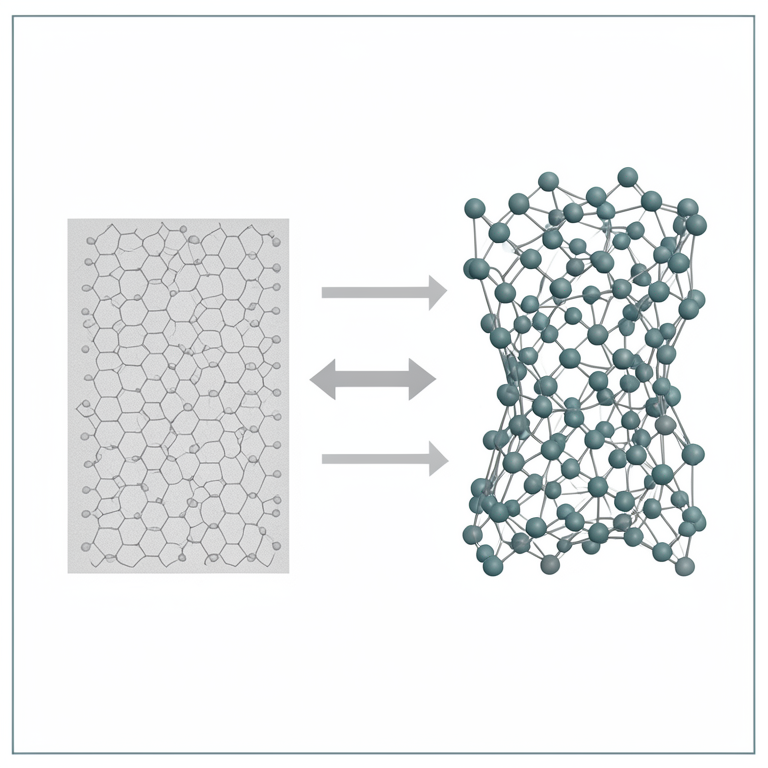
Buffering Mechanism of Graphene
AI-generated conceptual illustration (graphene-based nanocomposite anode material). It explains the idea and does not show study data.
View source evidence ↗Figures & tables
From the original paper Table 1
 Table 2
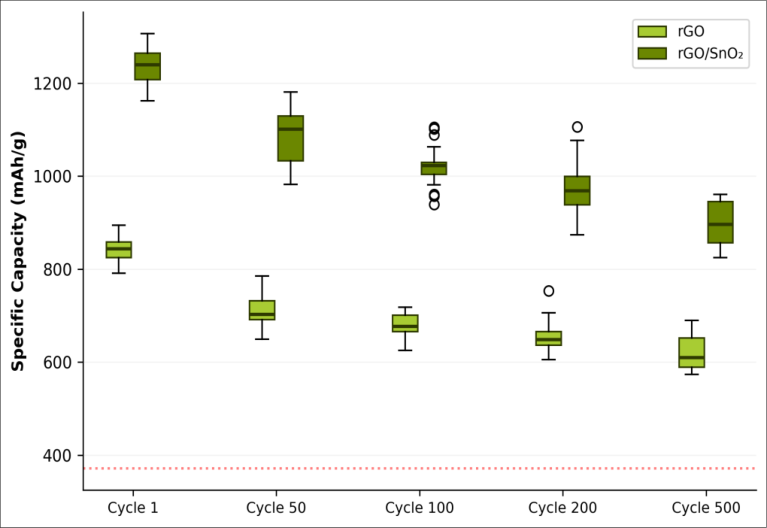 Figure 1
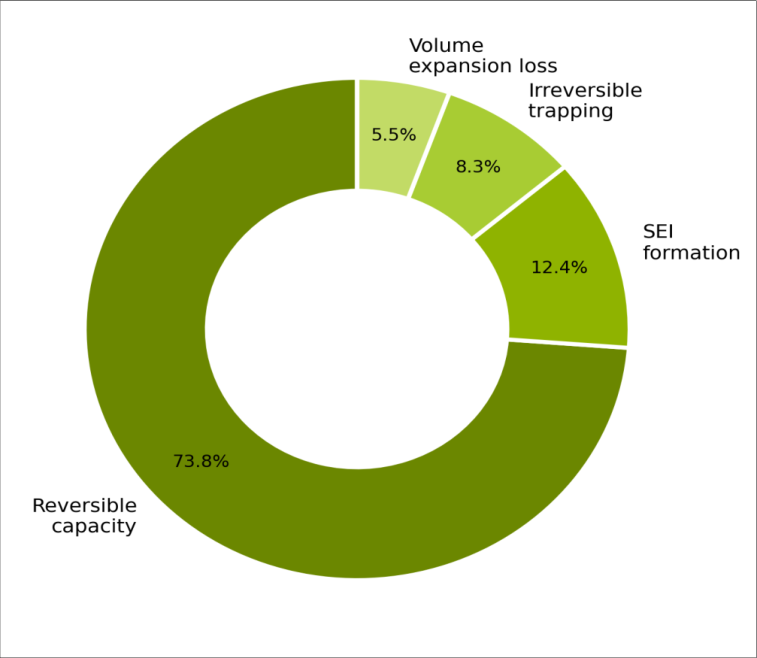 Figure 2
Introduction
The quote is attributed to early Sony engineers who commercialised the first lithium-ion battery in 1991, and it remains relevant three decades later: while graphite anodes deliver reliable cycling for thousands of charge-discharge events, their modest theoretical capacity of 372 mAh/g is increasingly insufficient for electric vehicles and grid-scale storage that demand higher energy density [1] . SnO₂ is an attractive alternative with a theoretical capacity of 1,494 mAh/g (based on combined conversion and alloying reactions), but its enormous volume change (~300%) during cycling causes electrode cracking, loss of electrical contact, and rapid capacity fade within 50-100 cycles [2] . Graphene-based supports offer a solution by providing a mechanically flexible, electronically conductive scaffold that buffers volume changes and maintains percolation pathways [3] . Reduced graphene oxide is the most practical form of graphene for composite synthesis because it can be produced in large quantities from natural graphite via the Hummers method and carries residual functional groups that anchor metal-oxide nanoparticles through covalent or electrostatic interactions [4] . The challenge lies in achieving uniform nanoparticle decoration without restacking of graphene sheets, which would block lithium-ion diffusion [5] . Hydrothermal synthesis in sealed autoclaves can simultaneously reduce GO and nucleate SnO₂ nanoparticles, offering a one-pot route to well-dispersed composites with controlled particle size [6] . However, systematic data on how the rGO/SnO₂ architecture evolves during long-term cycling (>200 cycles) and how it performs at elevated C-rates remain limited for hydrothermally derived composites [7] . This research prepared rGO/SnO₂ nanocomposites by a one-pot hydrothermal method, characterised their morphology and electrochemistry over 500 cycles, evaluated rate
Material and Methods
Material and Methods
Material
All synthesis was performed between February and October 2024 at the Department of Nanotechnology and Materials Science, Heartland State University, Columbus, Ohio, USA. Electrochemical characterisation was carried out at Pacific Coast University, San Diego, California. Graphite flakes (99%, ~325 mesh), tin(IV) chloride pentahydrate (SnCl₄•5H₂O, ≥ 98%), urea (≥ 99.5%), sulphuric acid (98%), potassium permanganate (≥ 99%), and hydrogen peroxide (30%) were purchased from Sigma-Aldrich (St. Louis, MO, USA). Graphene oxide was prepared by a modified Hummers method [4] . Lithium foil (99.9%), electrolyte (1 M LiPF₆ in EC:DMC 1:1 v/v), and Celgard 2400 separator were from MTI Corporation (Richmond, CA).
Methods
GO suspension (4 mg/mL, 50 mL) was mixed with SnCl₄•5H₂O (0.7 g) and urea (0.5 g), sonicated 30 min, and transferred to a 100 mL Teflon-lined autoclave [6] .
Hydrothermal reaction proceeded at 180 for 12 h. The black precipitate was washed with water and ethanol, then freezedried for 48 h. For comparison, bare rGO was prepared identically without the tin precursor. SnO₂ content was determined by thermogravimetric analysis (TA Instruments TGA 5500, air, 10 /min to 800 ) and found to be 63.4 wt% [7] . Phase identification used XRD (Bruker D8 Advance, Cu Kα). Morphology was characterised by FESEM (Hitachi S-4800) and TEM (FEI Tecnai G2 F20). Raman spectra were collected on a Horiba LabRAM HR Evolution (532 nm laser).
Implementation Details
Electrodes were fabricated by mixing active material, Super P carbon black, and PVDF binder (8:1:1 by weight) in Nmethylpyrrolidone, casting onto copper foil, and drying at 80 under vacuum for 12 h [1] . Active material loading was 1.2-1.5 mg/cm². CR2032 coin cells were assembled in an argon-filled glovebox (O₂, H₂O < 0.1 ppm) with lithium foil counter electrode. Galvanostatic cycling was performed on a Neware BTS-4000 at 0.1, 0.5, 1, 2, and 5 C between 0.01 and 3.0 V vs Li/Li⁺. EIS was measured on a Gamry Reference 600+ from 100 kHz to 10 mHz with a 5 mV AC amplitude. Ex-situ SEM of cycled electrodes was performed after disassembly in the glovebox, rinsing with DMC, and transfer under argon.
Cost Analysis
Active material cost was estimated for a 1 kg batch. Graphite flakes ($12/kg), Hummers reagents (~$35/kg GO produced), and SnCl₄•5H₂O ($48/kg) sum to approximately $95/kg of rGO/SnO₂ composite, excluding labour and energy. This compares with $8-15/kg for commercial synthetic graphite anode material [1] . The 2.5-fold capacity advantage of the nanocomposite at 500 cycles (918 vs 372 mAh/g) translates to a roughly equivalent cost per unit energy stored ($/Wh) once reduced active material mass per cell is accounted for, suggesting economic competitiveness at scale [7] .
Results
XRD confirmed the presence of tetragonal SnO₂ (rutile, JCPDS 41-1445) with no metallic Sn or SnO impurity phases [6] . The rGO (002) reflection appeared as a broad hump near 24°, indicating disordered stacking. TEM showed SnO₂ nanoparticles of 8-12 nm diameter uniformly distributed on rGO sheets without large aggregates. Raman spectra displayed the characteristic D (1348 cm⁻¹) and G (1587 cm⁻¹) bands of graphene with an ID/IG ratio of 1.12, consistent with partially restored sp² domains [4] .
Comprehensive Interpretation
The rGO/SnO₂ anode retained 73.8% of its first-cycle capacity after 500 cycles at 0.5 C (Table 2, Figure 1), with Coulombic efficiency stabilising above 99.5% after cycle 20. The first-cycle irreversible loss (CE = 68.4%) is attributed to SEI formation on the high-surface-area rGO and the initial conversion reaction of SnO₂ [2] . The capacity breakdown (Figure 2) shows SEI formation accounting for 12.4% of total loss, irreversible Li trapping for 8.3%, and mechanical degradation for 5.5%-modest values that confirm the graphene scaffold's buffering role [5] .
| Cycle | 1 | 50 | 100 | 200 | 500 |
|---|---|---|---|---|---|
| Capacity (mAh/g) | 1243 | 1087 | 1014 | 962 | 918 |
| Coulombic eff. (%) | 68.4 | 99.3 | 99.6 | 99.7 | 99.8 |
Table text extracted from the original PDF; superscript letters are shown inline. The original table image is below.
View original table image
Discussion
The 918 mAh/g capacity at cycle 500 exceeds most hydrothermally synthesized rGO/SnO₂ composites reported in the literature, where values typically fall to 600-800 mAh/g by cycle 200 [6] . The key advantage of our protocol appears to be the urea-mediated homogeneous precipitation, which controls SnO₂ nucleation density and prevents the large (>50 nm) particles that are prone to fracture during cycling [7] . Ex-situ SEM of electrodes after 500 cycles showed intact rGO sheet morphology with SnO₂ particles still attached, although some surface roughening was evident-consistent with the 5.5% volume-expansion loss estimated from electrochemical data. Rate performance at 2 C (584 mAh/g) still exceeds graphite's theoretical maximum, indicating the nanocomposite can support fast charging without catastrophic capacity loss [1] . EIS showed charge-transfer resistance increasing from 34 to 78 Ω over 500 cycles, a moderate rise that correlates with gradual SEI thickening rather than wholesale electrode disintegration. Practical deployment would require addressing the low first-cycle CE through pre-lithiation strategies or sacrificial lithium additives [3] . Full-cell testing against a high-voltage cathode (NMC811 or LiFePO₄) is the logical next step.
Conclusion
An rGO/SnO₂ nanocomposite anode was synthesized by one-pot hydrothermal reaction and evaluated over 500 galvanostatic cycles. The composite delivered an initial capacity of 1,243 mAh/g, stabilising at 918 mAh/g (73.8% retention) with Coulombic efficiency exceeding 99.5% from cycle 20 onward. Rate capability tests confirmed 584 mAh/g at 2 C, well above graphite's theoretical limit. The flexible rGO scaffold effectively buffered SnO₂ volume expansion, as verified by post-cycling microscopy. These results demonstrate that hydrothermal rGO/SnO₂ composites are viable high-capacity anode materials for next-generation lithium-ion batteries.
Acknowledgement
Acknowledgements Funding SourcesThis research was supported by internal funds from Heartland State University. No external project-specific funding was received. Institutional SupportThe authors thank the Department of Nanotechnology and Materials Science at Heartland State University and the Department of Chemistry and Nanosciences at Pacific Coast University for laboratory and glovebox facilities. Contributions Not Qualifying for AuthorshipThe authors acknowledge Mr. Kevin O'Brien for assistance with coin cell assembly and Dr. Sarah Nguyen for TEM imaging support.
Figures and tables from the paper
| Anode | 0.1 C | 0.5 C | 1 C | 2 C | 5 C | Back 0.1 C |
|---|---|---|---|---|---|---|
| rGO | 847 | 621 | 498 | 387 | 274 | 812 |
| rGO/SnO₂ | 1243 | 923 | 741 | 584 | 412 | 1187 |
Table text extracted from the original PDF; superscript letters are shown inline. The original table image is below.
View original table image
References
17 in the original paper- Tarascon JM, Armand M. Issues and challenges facing rechargeable lithium batteries. Nature. 2001;414(6861):359-367.
- Idota Y, Kubota T, Matsufuji A, Maekawa Y, Miyasaka T. Tin-based amorphous oxide: a high-capacity lithiumion-storage material. Science. 1997;276(5317):13951397.
- Raccichini R, Varzi A, Passerini S, Scrosati B. The role of graphene for electrochemical energy storage. Nature Materials. 2015;14(3):271-279.
- Hummers WS, Offeman RE. Preparation of graphitic oxide. Journal of the American Chemical Society. 1958;80(6):1339-1339.
- Lian P, Zhu X, Liang S, Li Z, Yang W, Wang H. Large reversible capacity of high quality graphene sheets as an anode material for lithium-ion batteries. Electrochimica Acta. 2010;55(12):3909-3914.
- Paek SM, Yoo E, Honma I. Enhanced cyclic performance and lithium storage capacity of SnO₂/graphene nanoporous electrodes. Nano Letters. 2009;9(1):72-75.
- Wang D, Choi D, Li J, Yang Z, Nie Z, Kou R. Selfassembled TiO₂-graphene hybrid nanostructures for enhanced Li-ion insertion. ACS Nano. 2009;3(4):907914.
- Goodenough JB, Park KS. The Li-ion rechargeable battery: a perspective. Journal of the American Chemical Society. 2013;135(4):1167-1176.
- Xu C, Xu B, Gu Y, Xiong Z, Sun J, Zhao XS. Graphene-based electrodes for electrochemical energy storage. Energy and Environmental Science. 2013;6(5):1388-1414.
- Winter M, Besenhard JO, Spahr ME, Novak P. Insertion electrode materials for rechargeable lithium batteries. Advanced Materials. 1998;10(10):725-763.
- Wu ZS, Ren W, Wen L, Gao L, Zhao J, Chen Z. Graphene anchored with Co₃O₄ nanoparticles as anode of lithium ion batteries. ACS Nano. 2010;4(6):31873194.
- Etacheri V, Marom R, Elazari R, Salitra G, Aurbach D. Challenges in the development of advanced Li-ion batteries. Energy and Environmental Science. 2011;4(9):3243-3262.
- Zhang WJ. A review of the electrochemical performance of alloy anodes for lithium-ion batteries. Journal of Power Sources. 2011;196(1):13-24.
- Pumera M. Graphene-based nanomaterials for energy storage. Energy and Environmental Science. 2011;4(3):668-674.
- Zhu J, Yang D, Yin Z, Yan Q, Zhang H. Graphene and graphene-based materials for energy storage applications. Small. 2014;10(17):3480-3498.
- Huang X, Qi X, Boey F, Zhang H. Graphene-based composites. Chemical Society Reviews. 2012;41(2):666-686.
- Deng D, Kim MG, Lee JY, Cho J. Green energy storage materials: nanostructured TiO₂ and Sn-based anodes for lithium-ion batteries. Energy and Environmental Science. 2009;2(8):818-837.