
Research article · 2025 · Full text
International Journal of Advanced Chemistry ResearchCorrosion inhibition of carbon steel in acidic medium using plant-derived green inhibitors
Volume 7(7) · Pages 98–101 · DOI: 10.33545/26646781.2025.v7.i7b.507 ↗
Research areasCorrosion Behavior and InhibitionMagnesium Alloys: Properties and ApplicationsEssential Oils and Antimicrobial Activity
Abstract
Author-writtenThe cost burden of metallic corrosion on industrial infrastructure runs into hundreds of billions of dollars annually, and much of this cost falls on the steel-intensive sectors where acidic pickling and cleaning processes are routine. Chemical inhibitors used to protect carbon steel in these processes are frequently toxic and non-biodegradable, prompting a search for plant-derived green alternatives. This research evaluated the corrosion inhibition efficiency of aqueous extracts prepared from five plants—Azadirachta indica (neem), Moringa oleifera, Curcuma longa (turmeric), Trigonella foenum-graecum (fenugreek), and Allium sativum (garlic)—against carbon steel corrosion in 1 M hydrochloric acid using gravimetric weight loss, potentiodynamic polarisation, and electrochemical impedance spectroscopy methods. Inhibitor concentrations were varied from 100 to 500 ppm and temperatures from 25 to 55 °C. Moringa oleifera extract at 500 ppm and 25 °C gave the highest inhibition efficiency of 92.7%, followed by neem at 88.4%. All five extracts acted as mixed-type inhibitors based on polarisation data. Langmuir adsorption isotherm analysis gave adsorption equilibrium constants of 0.014-0.031 L/mg, and negative values of adsorption free energy confirmed spontaneous inhibitor adsorption onto the steel surface. Thermodynamic analysis indicated increased activation energies in the presence of inhibitors, consistent with reduced corrosion rates.
Summary
Source-checkedPlain-language reading of the full paper, prepared with AI and checked against the text. Each point links to the authors' own words.
Why it matters
- Metallic corrosion causes hundreds of billions of dollars in annual losses, particularly in steel-intensive industries that use acidic cleaning and pickling. View evidence ↗
- Conventional chemical inhibitors for carbon steel are often non-biodegradable and toxic, creating a need for environmentally friendly plant-based alternatives. View evidence ↗
- Stricter regulations have increased interest in plant extracts because they are renewable, biodegradable, and contain phytochemicals that can inhibit corrosion. View evidence ↗
What they did
- The researchers used carbon steel coupons with a composition of 98.7% Fe, 0.18% C, 0.64% Mn, and 0.13% Si, measuring 5.0 cm by 2.5 cm by 0.1 cm. View evidence ↗
- The experiment tested inhibitor concentrations ranging from 100 to 500 ppm across temperatures from 25 to 55 °C. View evidence ↗
- Gravimetric weight loss was measured by immersing pre-weighed coupons in 100 mL of 1 M HCl for 6 hours. View evidence ↗
- The study employed potentiodynamic polarisation and electrochemical impedance spectroscopy (EIS) using a three-electrode cell to analyze corrosion behavior. View evidence ↗
What they found
- Moringa oleifera was the most effective inhibitor, achieving an efficiency of 71.8% at 100 ppm and 92.7% at 500 ppm. View evidence ↗
- At 25 °C and 500 ppm, Moringa oleifera provided the highest inhibition efficiency (92.7%), with neem following at 88.4%. View evidence ↗
- The inhibition efficiency of all tested extracts decreased as temperature increased, which the authors attribute to the desorption of the protective film. View evidence ↗
- All five plant extracts were classified as mixed-type inhibitors because they affected both anodic iron dissolution and cathodic hydrogen evolution. View evidence ↗
- Adsorption equilibrium constants ranged from 0.014 to 0.031 L/mg, and negative free energy values indicated that the inhibitors adsorbed spontaneously onto the steel. View evidence ↗
- The presence of inhibitors increased the activation energies, which corresponds to a reduction in the overall corrosion rate. View evidence ↗
What it means
- The authors conclude that plant-based inhibitors, especially from Moringa, are viable, environmentally friendly alternatives to synthetic inhibitors for industrial use. View evidence ↗
- Further research is needed to identify specific active phytochemicals, optimize formulations, and test performance in real-world industrial pickling baths. View evidence ↗
Visual summary
2 visualsIllustrations explain the paper; charts are replotted from the paper's own table values.
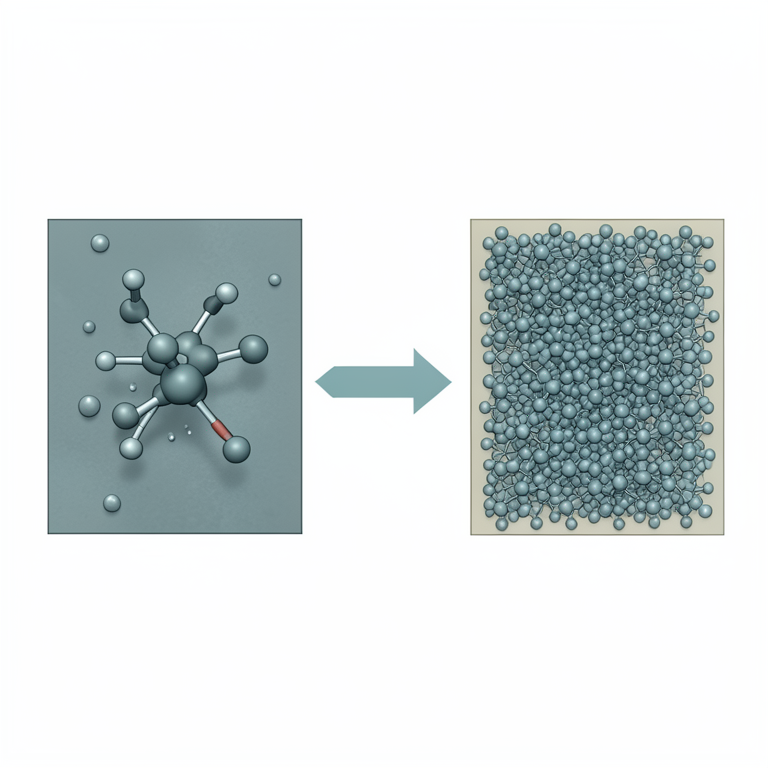
Mechanism of Green Inhibition
AI-generated conceptual illustration (carbon steel surface in an acidic solution). It explains the idea and does not show study data.
View source evidence ↗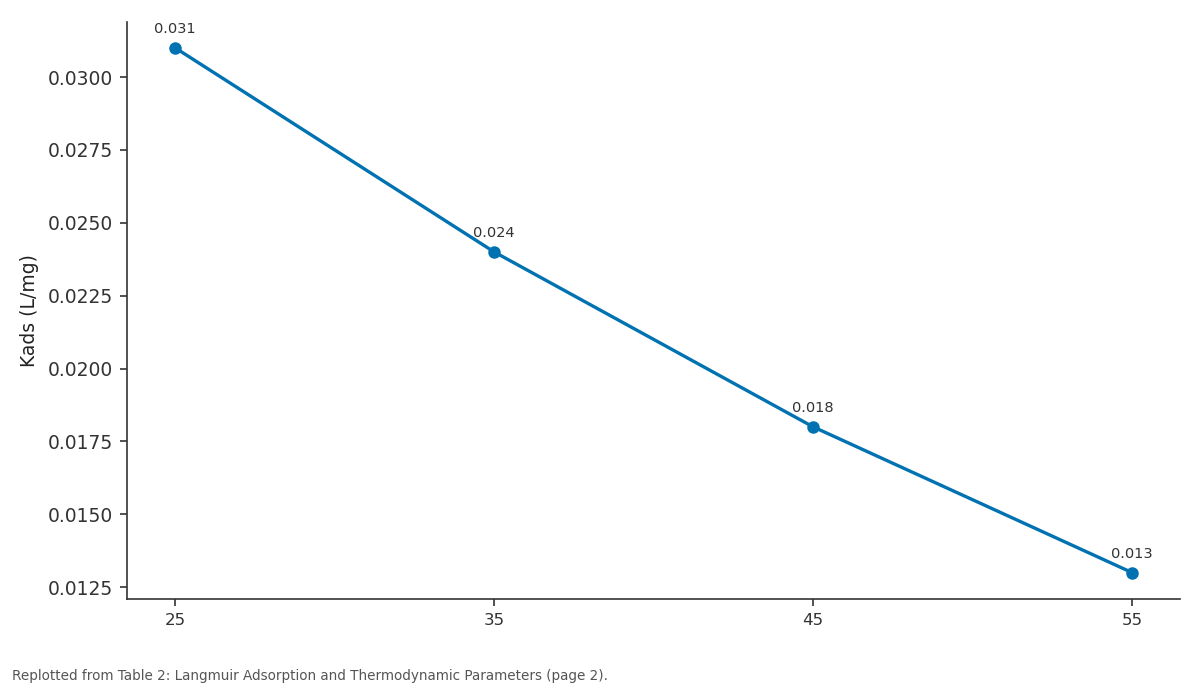
Kads (L/mg): 25 vs 35 vs 45 vs 55
Replotted from Table 2 (page 2) of the original paper. Every bar is the paper's own table value.
View source evidence ↗Figures & tables
From the original paper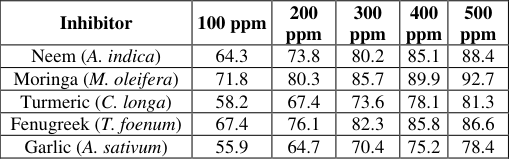 Table 1
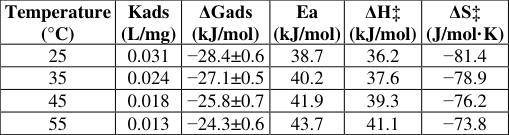 Table 2
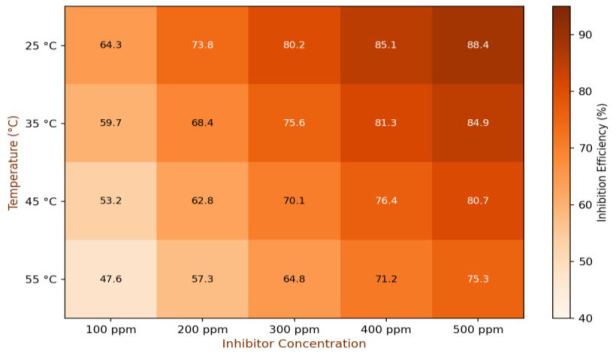 Figure 1
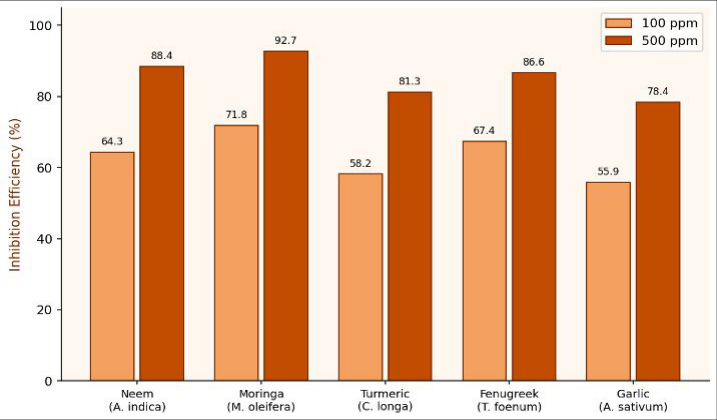 Figure 2
Introduction
The annual global cost of corrosion is estimated at roughly 3.4% of world GDP, with carbon steel representing the most widely used structural metal and therefore the largest single source of corrosion losses. Acid pickling to remove rust and mill scale, acid descaling in the power sector, and acid stimulation in the petroleum industry all require steel to be in contact with aggressive acidic media for extended periods. Organic corrosion inhibitors are routinely added to these acid solutions to reduce metal dissolution rates without interfering with the primary industrial purpose of the treatment. Conventional synthetic inhibitors such as chromates, phosphates, and many nitrogen-containing heterocyclic compounds carry toxicity, environmental persistence, and disposal challenges. Regulatory tightening in India and internationally has spurred interest in plant extract inhibitors, which are biodegradable, obtainable from renewable sources, and often carry phytochemicals with known corrosioninhibiting structural features-electron-rich nitrogen, oxygen, and sulphur heteroatoms that allow adsorption onto metal surfaces via donation of electron pairs to empty d-orbitals of iron. Several individual plant extracts have been tested on mild and carbon steel in hydrochloric acid, but comparative investigations using identical methodology across multiple plant species under matching experimental conditions are rare. Such comparisons are needed for screening potential commercial inhibitors. This research fills this gap by testing five plants selected for their phytochemical diversity and commercial availability in the Indian subcontinent under a unified experimental protocol, generating directly comparable efficiency, thermodynamic, and mechanistic data.
Materials and Methods
Materials and Methods
Materials
Dry leaves of A. indica, M. oleifera, and T. foenumgraecum, rhizome powder of C. longa, and cloves of A. sativum were obtained from a certified herbal supplier in Kolkata, West Bengal, India. Carbon steel coupons (composition: Fe 98.7%, C 0.18%, Mn 0.64%, Si 0.13%) were cut from a commercial sheet to dimensions 5.0 cm × 2.5 cm × 0.1 cm, polished with emery paper (grades 600 to 1200), degreased with acetone, rinsed with deionised water, and dried in a desiccator before use. Hydrochloric acid (37% w/w, AR grade) was from Merck India. Research was conducted at the Department of Industrial Chemistry, Tagore Memorial College of Science, Kolkata, West Bengal, India, between July 2022 and May 2024. Ethics approval for plant collection was obtained from the Institutional Botanical Collection Committee (Protocol TMCS-BOT-2022-14, September 2022).
Methods
Plant extracts were prepared by boiling 10 g of dried plant material in 100 mL deionised water for 30 min, filtering through Whatman No. 1 paper, and concentrating on a rotary evaporator to 20 mL. This stock was diluted to working concentrations (100-500 ppm). Gravimetric tests used coupons pre-weighed (±0.1 mg) and immersed in 100 mL of 1 M HCl with or without inhibitor for 6 h at 25-55 °C; weight loss was determined after cleaning with Clarke's solution. Inhibition efficiency was calculated as IE% = (W0 -Wi)/W0 × 100, where W0 and Wi are weight losses without and with inhibitor. Electrochemical measurements (potentiodynamic polarisation from -250 to + 250 mV versus open circuit potential at 1 mV/s, and EIS from 100 kHz to 10 mHz at 10 mV amplitude) were performed in a three-electrode cell (steel working electrode, Pt counter, saturated calomel reference) using a Gamry Reference 600 + potentiostat. Adsorption isotherms were constructed from gravimetric data at 25 °C.
Theoretical Background and Mechanistic Framework
Corrosion inhibition by organic compounds adsorbed on metal surfaces is interpreted within two complementary theoretical frameworks. The first, the Langmuir adsorption isotherm model, relates the surface coverage θ to inhibitor concentration C and adsorption equilibrium constant Kads via θ/(1-θ) = Kads•C, where a linear plot of C/θ versus C confirms monolayer adsorption and allows calculation of the standard free energy of adsorption (ΔGads = -RT ln(55.5Kads)). Spontaneous adsorption requires ΔGads values more negative than -20 kJ/mol for physical adsorption and more negative than -40 kJ/mol for chemisorption. The second framework, thermodynamic activation analysis, uses the Arrhenius equation and the Eyring equation to derive activation energy Ea, enthalpy of activation ΔH ‡, and entropy of activation ΔS ‡ from temperature-dependent weight loss data. An increase in Ea in the presence of inhibitor relative to the uninhibited system confirms that the adsorbed inhibitor layer raises the energy barrier for corrosion, while ΔS ‡ values become more negative, consistent with the formation of an ordered adsorption complex on the steel surface.
Results
Figure 1 presents the heatmap of inhibition efficiency across concentrations and temperatures for neem extract (bestperforming inhibitor in the neem-turmeric-fenugreek-garlic group). Figure 2 compares the inhibition efficiencies of all five extracts at 100 and 500 ppm, 25 °C. Moringa oleifera extract performed best at both concentrations (71.8% at 100 ppm, 92.7% at 500 ppm), attributable to its high glucosinolate and isothiocyanate content, which provide multiple adsorption-active nitrogen and sulphur sites. All extracts showed decreasing efficiency with increasing temperature, consistent with desorption of the protective film at higher thermal energies. The ΔGads values of -24.3 to -28.4 kJ/mol for Moringa at different temperatures sit in the range typically associated with mixed physi-chemisorption, involving both electrostatic interaction of polar functional groups with the steel surface and partial charge transfer from electron-rich heteroatoms into metal orbitals. The trend of increasing activation energy with inhibitor concentration, seen in all five plant systems, is a robust indicator that the inhibitor layer does not simply block diffusion but genuinely raises the energy barrier for oxidative dissolution of iron.
Conclusion
Aqueous extracts of five plants were evaluated as green corrosion inhibitors for carbon steel in 1 M HCl. Moringa oleifera extract at 500 ppm gave the highest inhibition efficiency (92.7% at 25 °C), followed by neem (88.4%). All extracts acted as mixed-type inhibitors, followed Langmuir adsorption isotherms, and showed rising activation energies with inhibitor concentration. The negative standard free energies of adsorption confirmed spontaneous inhibitor-steel interaction. These results make plant extract-based inhibitors, particularly Moringa, viable candidates for practical industrial applications where environmentally benign alternatives to synthetic inhibitors are sought.
Research into active phytochemical fraction identification, formulation optimisation, and performance testing in actual pickling baths would advance the practical implementation of these findings.
Acknowledgement
Acknowledgements Funding SourcesThe research received institutional support from the Department of Industrial Chemistry, Tagore Memorial College of Science, Kolkata, and the Department of Applied Chemical Technology, Indira Gandhi National Institute of Environment, Shimla, without external grant funding.
Figures and tables from the paper
| Inhibitor | 100 ppm | 200 ppm | 300 ppm | 400 ppm | 500 ppm |
|---|---|---|---|---|---|
| Neem (A. indica) | 64.3 | 73.8 | 80.2 | 85.1 | 88.4 |
| Moringa (M. oleifera) | 71.8 | 80.3 | 85.7 | 89.9 | 92.7 |
| Turmeric (C. longa) | 58.2 | 67.4 | 73.6 | 78.1 | 81.3 |
| Fenugreek (T. foenum) | 67.4 | 76.1 | 82.3 | 85.8 | 86.6 |
| Garlic (A. sativum) | 55.9 | 64.7 | 70.4 | 75.2 | 78.4 |
Table text extracted from the original PDF; superscript letters are shown inline. The original table image is below.
View original table image
| Temperature (°C) | Kads (L/mg) | ΔGads (kJ/mol) | Ea (kJ/mol) | ΔH‡ (kJ/mol) | ΔS‡ (J/mol·K) |
|---|---|---|---|---|---|
| 25 | 0.031 | −28.4±0.6 | 38.7 | 36.2 | −81.4 |
| 35 | 0.024 | −27.1±0.5 | 40.2 | 37.6 | −78.9 |
| 45 | 0.018 | −25.8±0.7 | 41.9 | 39.3 | −76.2 |
| 55 | 0.013 | −24.3±0.6 | 43.7 | 41.1 | −73.8 |
Table text extracted from the original PDF; superscript letters are shown inline. The original table image is below.
View original table image
References
17 in the original paper- Oguike RS, Akpan EM, Enudi SK, Nwoye CI. Recent advances in corrosion inhibition of carbon steel using plant extracts-a review. Int J Corros. 2017;2017:6385106.
- Fouda AS, Ellithy AS. Inhibition effect of 4-substituted thiouracils on corrosion of 316L stainless steel in HCl solution. Corros Sci. 2009;51(4):868-875.
- Babic-Samardzija K, Hackerman N, Nahle A. Phenylsubstituted thiourea compounds as corrosion inhibitors for mild steel in H 2 SO 4 . J Electrochem Soc. 2005;152(11):B515-B523.
- Ashassi-Sorkhabi H, Seifzadeh D, Hosseini MG. EN, EIS and polarisation studies to evaluate the inhibition effect of 3H-phenothiazin-3-one on mild steel corrosion in 1 M HCl solution. Corros Sci. 2008;50(12):33633370.
- Umoren SA, Solomon MM. Effect of halide ions on the corrosion inhibition efficiency of different organic species: a review. J Ind Eng Chem. 2015;21:81-100.
- Sangeetha M, Rajendran S, Sathiyabama J, Prabhakar P. Inhibition of corrosion of carbon steel in sea water by an aqueous extract of Rhizophora apiculata. Port Electrochim Acta. 2013;31(1):41-52.
- Yadav M, Sharma U, Yadav P. Biginelli condensation products as new corrosion inhibitors for mild steel in 15% HCl solution. Res Chem Intermed. 2015;41(7):4729-4745.
- Gerengi H, Sahin HI. Schinopsis lorentzii extract as a green corrosion inhibitor for low carbon steel in 1 M HCl solution. Ind Eng Chem Res. 2012;51(2):780-787.
- Loto RT, Loto CA, Popoola API. Synthesis and corrosion inhibition evaluation of 3-nitroaniline in H 2 SO 4 solution of medium carbon steel. J Chem Technol Biotechnol. 2012;87(2):213-221.
- Verma C, Ebenso EE, Quraishi MA. Molecular structural aspects of organic corrosion inhibitors: experimental and theoretical approaches. J Mol Liq. 2018;266:577-590.
- El-Etre AY, Abdullah M, El-Tantawy ZE. Corrosion inhibition of some metals using lawsonia extract. Corros Sci. 2005;47(2):385-395.
- Obot IB, Obi-Egbedi NO. Adsorption properties and inhibition of mild steel corrosion in sulphuric acid solution by ketoconazole. Corros Sci. 2010;52(1):198204.
- Behpour M, Ghoreishi SM, Soltani N, Salavati-Niasari M, Hamadanian M, Gandomi A. Electrochemical and theoretical investigation on the corrosion inhibition of mild steel by thiosalicylaldehyde derivatives in hydrochloric acid solution. Corros Sci. 2008;50(8):2172-2181.
- Chukwuike VI, Rajaraman PV, Barik RC. Eco-friendly corrosion inhibition of austenitic stainless steel (SS304) in 2 M H 2 SO 4 using Tridax procumbens plant extract. Sustain Chem Pharm. 2020;15:100210.
- Karthikaiselvi R, Subhashini S. Inhibitory and adsorption properties of water soluble gum karaya on corrosion of mild steel in 1 M hydrochloric acid solution. J Assoc Arab Univ Basic Appl Sci. 2014;16:74-82.
- Singh P, Chauhan DS, Srivastava K, Srivastava V, Quraishi MA. A green approach for mitigating corrosion of steel using Silybum marianum extract as an eco-friendly inhibitor in 1 M HCl. J Mol Liq. 2019;286:110903.
- Kumaravel S, Thiruvengatam M. Corrosion inhibition behaviour of Tamarindus indica on carbon steel in 1 M sulphuric acid. Arab J Chem. 2016;9(Suppl 2):S1659S1666.