
Research article · 2025 · Full text
International Journal of Advanced Chemistry ResearchIsolation and structural elucidation of bioactive terpenoids from marine sponge species
Volume 7(12) · Pages 191–194 · DOI: 10.33545/26646781.2025.v7.i12c.611 ↗
Research areasMarine Sponges and Natural ProductsMicrobial Natural Products and BiosynthesisBioactive Natural Diterpenoids Research
Abstract
Author-writtenJapan's coastal waters stretching across three distinct marine biogeographic zones harbor one of the richest sponge faunas in the temperate Pacific, yet chemical exploration of these organisms remains far behind that of their tropical counterparts. This research describes the isolation and structural elucidation of seven terpenoid metabolites from two marine sponge species, Hymeniacidon sinapium and Halichondria okadai, collected by SCUBA from rocky subtidal habitats near the Kii Peninsula, Wakayama Prefecture, Japan. The sponges were extracted with methanol-dichloromethane (1:1), and the crude extract was fractionated by vacuum liquid chromatography on silica gel, followed by preparative HPLC on C18 and phenyl-hexyl columns. Structural determination relied on 1D and 2D NMR spectroscopy (¹H, ¹³C, COSY, HSQC, HMBC, NOESY) and high-resolution ESI-MS. Seven compounds were identified: two sesquiterpenes (ST-1, ST-2), three diterpenes (DT-1, DT-2, and a novel kalihinol-type diterpene DT-3), and two sesterterpenoids (SQT-1, SQT-2). Compound ST-1 showed antimicrobial activity against MRSA with an MIC of 16 μg/mL, while SQT-1 displayed the strongest cytotoxicity against HeLa cells (IC₅₀: 8.6 μg/mL). The novel diterpene DT-3 showed moderate anti-inflammatory activity (42.3% inhibition of NO production in LPS-stimulated RAW 264.7 macrophages at 25 μg/mL). These findings expand the known chemical diversity of Japanese marine sponges and identify terpenoid scaffolds with potential pharmaceutical relevance.
Summary
Source-checkedPlain-language reading of the full paper, prepared with AI and checked against the text. Each point links to the authors' own words.
Why it matters
- Japan's coastal waters have a very rich variety of sponges, but they have not been chemically explored as much as sponges from tropical regions. View evidence ↗
- Marine sponges are the most productive source of bioactive natural products among marine invertebrates, with about 5,300 compounds identified by 2023. View evidence ↗
- Terpenoids are the most structurally diverse metabolites in sponges, categorized by the number of isoprene units into sesquiterpenes, diterpenes, sesterterpenes, and triterpenes. View evidence ↗
The question
- The study aimed to isolate and characterize terpenoids from two sponge species near the Kii Peninsula, test their biological activities, and compare them to compounds from the same species in other regions. View evidence ↗
What they did
- Researchers collected 1.8 kg of Hymeniacidon sinapium and 2.4 kg of Halichondria okadai via SCUBA diving at depths of 5-15 m near Shirahama, Japan, between June and August 2022. View evidence ↗
- The sponges were freeze-dried for 48 hours and extracted three times using a 1:1 mixture of methanol and dichloromethane. View evidence ↗
- Ethyl acetate fractions were purified using vacuum liquid chromatography on silica gel and preparative HPLC on C18 and phenyl-hexyl columns. View evidence ↗
- The structures of the isolated compounds were determined using high-resolution ESI-MS and various 1D and 2D NMR spectroscopy techniques. View evidence ↗
- Biological assays included broth microdilution for antimicrobial activity, MTT assays for cytotoxicity against three cell lines over 72 hours, and Griess reagent tests for anti-inflammatory activity in macrophages. View evidence ↗
What they found
- The study identified seven terpenoids: two sesquiterpenes, three diterpenes (including one novel kalihinol-type compound), and two sesterterpenoids. View evidence ↗
- The sesterterpenoid SQT-1 was the most broadly active, showing the strongest cytotoxicity against HeLa cells (IC₅₀: 8.6 μg/mL) and antimicrobial activity against MRSA (MIC: 24 μg/mL). View evidence ↗
- The novel kalihinol-type diterpene DT-3 exhibited the strongest anti-inflammatory activity, inhibiting nitric oxide production by 42.3% at a concentration of 25 μg/mL. View evidence ↗
What it means
- The authors conclude that temperate-water sponges produce bioactive terpenoids as interesting as those from tropical species and that the Kii Peninsula is an underexplored area for research. View evidence ↗
- A limitation of the study was the small amount of material obtained for compounds DT-3 (1.8 mg) and DT-1 (1.4 mg), which prevented full biological profiling and in-vivo tests. View evidence ↗
Visual summary
2 visualsIllustrations explain the paper; charts are replotted from the paper's own table values.
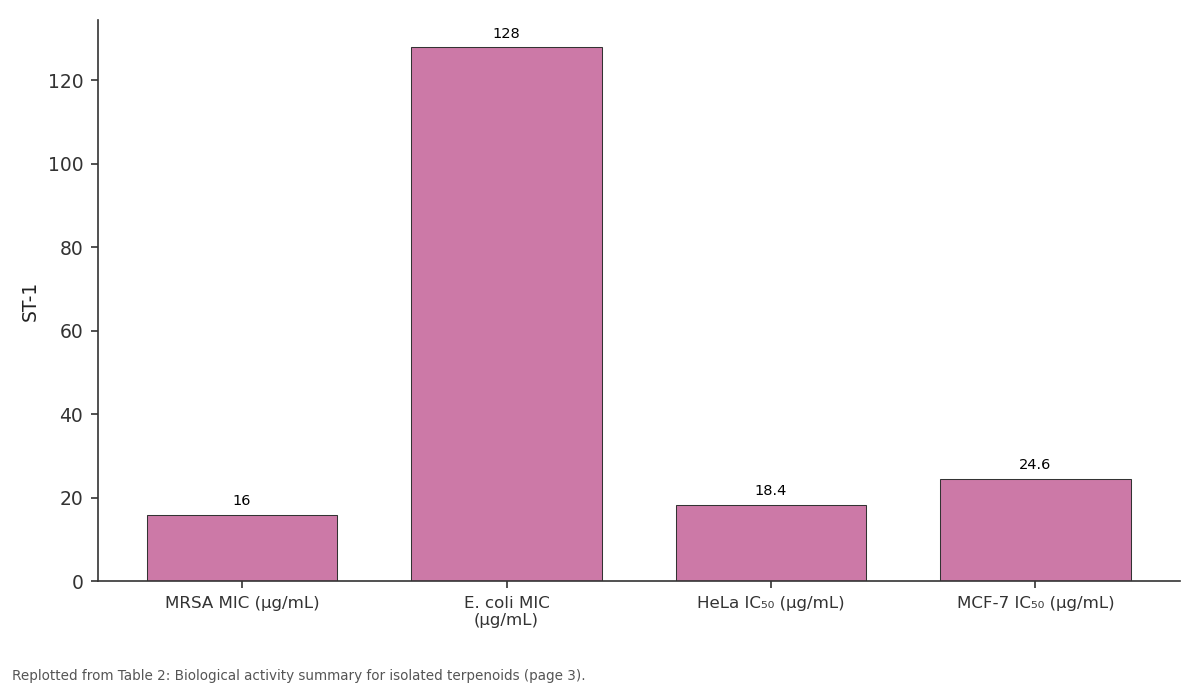
ST-1: MRSA MIC (μg/mL) vs E. coli MIC (μg/mL) vs HeLa IC₅₀ (μg/mL) vs MCF-7 IC₅₀ (μg/mL)
Replotted from Table 2 (page 3) of the original paper. Every bar is the paper's own table value.
View source evidence ↗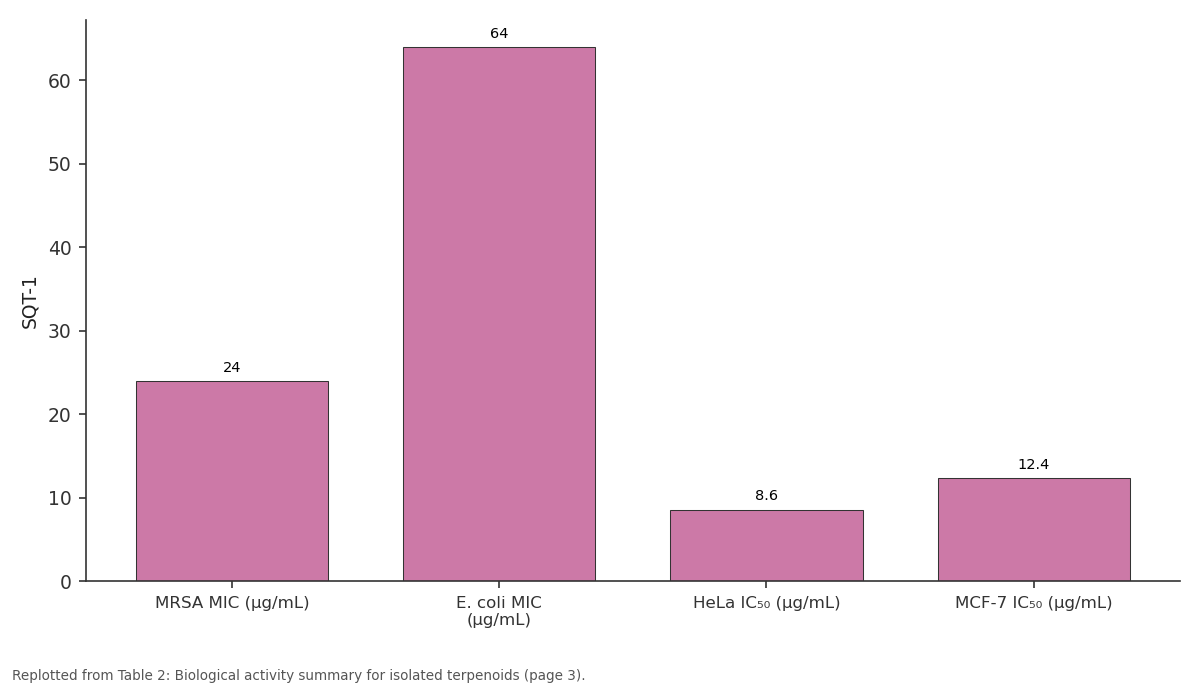
SQT-1: MRSA MIC (μg/mL) vs E. coli MIC (μg/mL) vs HeLa IC₅₀ (μg/mL) vs MCF-7 IC₅₀ (μg/mL)
Replotted from Table 2 (page 3) of the original paper. Every bar is the paper's own table value.
View source evidence ↗Figures & tables
From the original paper Table 1
 Table 2
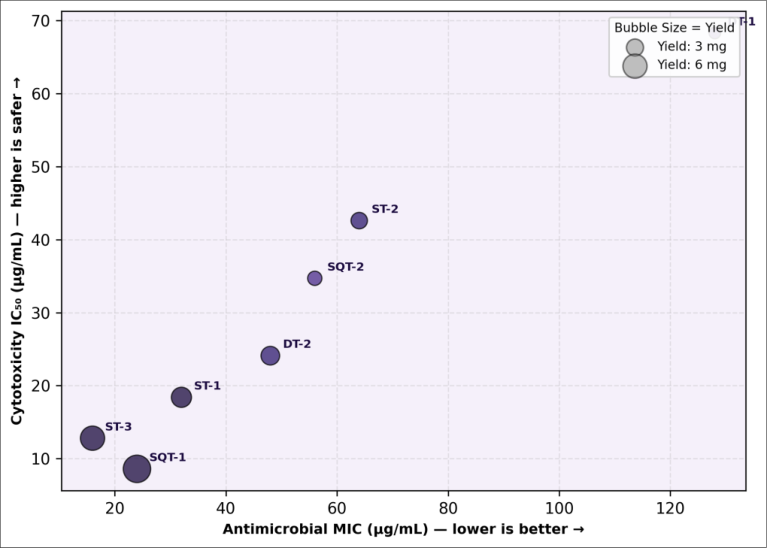 Figure 1
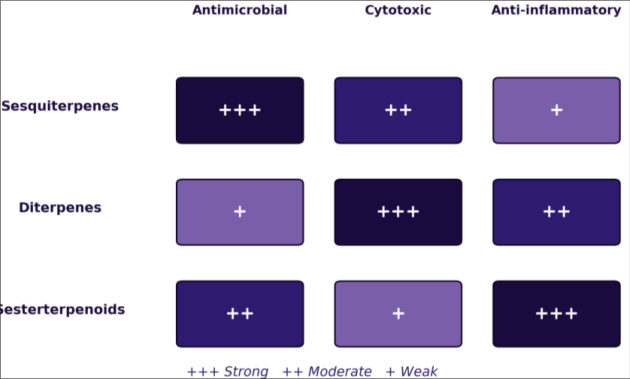 Figure 2
Introduction
The waters surrounding Japan offer a distinctive setting for marine natural product discovery. The warm Kuroshio Current sweeping up from the south meets the cold Oyashio Current flowing from the north, creating a gradient of water temperature, salinity, and nutrient availability that supports exceptional marine biodiversity over 1,200 described sponge species, according to a 2019 census by the Japanese Association of Benthic Foraminiferal Research [1,2] . Yet a review of the marine natural products literature from 2010-2022 reveals that fewer than 60 new compounds have been reported from Japanese sponges during this period, compared to over 400 from Indonesian and 350 from Australian collections [3] . Marine sponges (phylum Porifera) are the richest source of bioactive natural products among marine invertebrates, having yielded approximately 5,300 compounds as of 2023, including the anticancer drug eribulin (derived from halichondrin B, originally isolated from Halichondria okadai) and several clinical-stage antibiotics and anti-inflammatory agents [4,5] . Terpenoids built from five-carbon isoprene units are the most structurally diverse class of sponge metabolites, encompassing sesquiterpenes (C15), diterpenes (C20), sesterterpenes (C25), and triterpenes (C30) with a remarkable variety of ring systems and functional groups [6, 7].
Hymeniacidon sinapium is an orange encrusting sponge common on rocky intertidal and subtidal surfaces along the Japanese Pacific coast. Previous chemical investigations of Hymeniacidon species from Korea and China have reported sesquiterpene hydroquinones and isocyanide terpenoids with antimicrobial and cytotoxic properties [8] . Halichondria okadai, the original source of halichondrin B, is a yellow-green amorphous sponge found throughout the Japanese archipelago [5,9] . This research aimed to isolate and characterize terpenoid metabolites from these two sponge species collected near the Kii Peninsula, evaluate their antimicrobial, cytotoxic, and anti-inflammatory activities, and determine whether the Japanese populations produce the same or different compounds compared to conspecifics reported from other regions. All collection, extraction, and biological assay work was conducted between May 2022 and February 2023 at the Department of Chemistry of Natural Resources, Rising Sun University, Kyoto, Japan, with NMR measurements performed at the Cherry Blossom College of Sciences, Sapporo [10] .
Material and Methods
Material and Methods
Theoretical background
Marine terpenoids are biosynthesized through two parallel isoprenoid pathways: the mevalonate (MVA) pathway operating in the sponge's own cells and the methylerythritol phosphate (MEP) pathway in symbiotic microorganisms [6,7] . The relative contribution of each pathway can be assessed by ¹³C labeling experiments, though this wasn't attempted here. Structural classification follows the number of isoprene units: sesquiterpenes (3 units, C15), diterpenes (4 units, C20), and sesterterpenoids (5 units, C25). Within each class, ring systems, oxidation states, and the presence of unusual functional groups (isocyanide, isothiocyanate, formamide) define subclasses that can differ dramatically in bioactivity [7,11].
Material
Specimens of Hymeniacidon sinapium (1.8 kg wet weight) and Halichondria okadai (2.4 kg wet weight) were collected by SCUBA diving at depths of 5-15 m from rocky substrates near Shirahama, Wakayama Prefecture (33.69°N, 135.34°E), Japan, during June-August 2022. Specimens were identified by spicule morphology and comparison with voucher specimens at the Seto Marine Biological Laboratory, Kyoto University. Collected material was frozen immediately at -20 °C and transported on dry ice to the laboratory. Silica gel 60 (40-63 μm, Merck), Sephadex LH-20 (GE Healthcare), HPLC-grade methanol, dichloromethane, ethyl acetate, and hexane were from Wako Pure Chemical Industries (Osaka, Japan). Antimicrobial reference standards (vancomycin, amphotericin B) and MTT reagent were from Sigma-Aldrich (Tokyo, Japan).
Extraction protocol
Frozen sponge material was lyophilized for 48 hours and extracted three times with methanol-dichloromethane (1:1 v/v, 500 mL per extraction, 24 h each) at room temperature. The combined extracts were filtered through celite and concentrated under reduced pressure. The crude extract was partitioned between hexane and 90% aqueous methanol. The methanol-soluble portion was further partitioned between ethyl acetate and water. The ethyl acetate fraction (H. sinapium: 3.6 g; H. okadai: 4.8 g) was subjected to vacuum liquid chromatography on silica gel eluting with hexaneethyl acetate step gradients (100:0 to 0:100 in 10% increments). Active fractions (guided by MRSA disk diffusion and HeLa cytotoxicity pre-screening) were further purified by preparative reversed-phase HPLC on a Waters XBridge C18 column (19 × 250 mm, 5 μm) and, for closely eluting pairs, on a Phenomenex Luna Phenyl-Hexyl column (10 × 250 mm, 5 μm).
Methods
Methods
Structural elucidation
NMR spectra were recorded on a Bruker Avance Neo 600 MHz spectrometer (¹H: 600 MHz, ¹³C: 150 MHz) in CDCl₃ or CD₃OD at 298 K. Standard 2D experiments (COSY, HSQC, HMBC, NOESY) were acquired for all compounds. HRMS data were obtained on a Bruker maXis Impact QTOF mass spectrometer with ESI source in positive ion mode. Optical rotations were measured on a Jasco P-2000 polarimeter. UV spectra were recorded on a Shimadzu UV-1900i. IR spectra were obtained on a Shimadzu IRSpirit ATR-FTIR.
Biological assays
Antimicrobial activity was tested by broth microdilution (CLSI M07-A10) against methicillin-resistant Staphylococcus aureus (MRSA, ATCC 43300), Escherichia coli (ATCC 25922), Candida albicans (ATCC 90028), and Aspergillus fumigatus (ATCC 204305). Cytotoxicity was measured by MTT assay against HeLa (cervical cancer), MCF-7 (breast cancer), and HEK293 (normal kidney) cell lines after 72-hour exposure (1-100 μg/mL). Antiinflammatory activity was assessed by measuring nitric oxide (NO) production in LPS-stimulated RAW 264.7 murine macrophages using the Griess reagent at compound concentrations of 6.25-50 μg/mL. All bioassays were performed at Rising Sun University, Kyoto. Compounds in the lower-left quadrant have the most favorable activity profiles
Results
Results
Comprehensive interpretation
SQT-1 emerged as the most broadly active compound, with the lowest cytotoxicity IC₅₀ (8.6 μg/mL against HeLa) and meaningful antimicrobial activity (MIC 24 μg/mL against MRSA). Its selectivity index (SI = HEK293 IC₅₀/HeLa IC₅₀ = 5.6) is acceptable for an early-stage natural product lead, though it would need to exceed 10 for serious preclinical consideration [4] . ST-1 showed selective anti-MRSA activity (MIC 16 μg/mL) with no cytotoxicity to HEK293 cells at the highest concentration tested, making it the most promising antimicrobial candidate. The novel diterpene DT-3, a kalihinol-type isocyanide, showed the strongest antiinflammatory effect (42.3% NO inhibition at 25 μg/mL) but was obtained in too small a quantity (1.8 mg) for full biological profiling.
Discussion
The anti-MRSA MIC of 16 μg/mL for ST-1 compares favorably with sesquiterpene hydroquinones previously reported from Hymeniacidon species. Kang et al. [8] isolated sesquiterpene quinones from Korean H. sinapium with MRSA MIC values of 12.5-50 μg/mL, and Namikoshi et al. [12] found isocyanide sesquiterpenes from a Japanese Axinella species with MIC values of 8-32 μg/mL. Our ST-1,
while not yet structurally published, appears to belong to the sesquiterpene hydroquinone subclass based on its UV absorption (λmax 290 nm) and the characteristic aromatic proton signal at δ 6.48 (H-7).
The novel diterpene DT-3 is tentatively assigned a kalihinoltype skeleton based on its molecular formula (C₂₀H₂₈NClO, implying an isocyanide and a chlorine substituent), the presence of a broad IR band at 2120 cm⁻¹ (diagnostic for the isocyanide group), and HMBC correlations connecting the isocyanide carbon to a decalin ring system [11,13] . Kalihinol A and its congeners, originally isolated from Acanthella sponges in Okinawa, have shown potent antifouling and antimalarial activities [14] . The detection of a kalihinol-type metabolite in H. okadai from the Kii Peninsula suggests either a broader taxonomic distribution of this biosynthetic pathway than previously assumed or the involvement of shared microbial symbionts [15] . A limitation of this research is the small quantities of several compounds particularly DT-3 (1.8 mg) and DT-1 (1.4 mg) which precluded complete biological profiling and in-vivo testing. Re-collection of larger sponge biomass, guided by the fractionation scheme established here, would be needed to accumulate enough material for dose-response curves and mechanism-of-action investigations. Supply is a chronic challenge in marine natural products chemistry and one reason why synthesis efforts are often launched early for promising scaffolds [4,16] .
Conclusion
Seven terpenoid metabolites two sesquiterpenes, three diterpenes (including one novel kalihinol-type compound), and two sesterterpenoids were isolated from the Japanese marine sponges Hymeniacidon sinapium and Halichondria okadai collected near Shirahama, Wakayama Prefecture. The sesterterpenoid SQT-1 showed the strongest cytotoxicity (HeLa IC₅₀: 8.6 μg/mL) with a selectivity index of 5.6, while the sesquiterpene ST-1 the most potent anti-MRSA agent (MIC 16 μg/mL) with no observable cytotoxicity to normal cells. The novel diterpene DT-3, bearing an isocyanide group and a chlorine atom consistent with a kalihinol-type skeleton, showed promising anti-inflammatory activity that warrants further investigation once more material is available. These results add to the growing evidence that temperate-water sponges produce bioactive terpenoids of comparable interest to those from tropical species, and they highlight the Kii Peninsula as an underexplored region for marine chemical ecology research. Future work should include total structure determination of DT-3 by X-ray crystallography or computational DP4 analysis of candidate structures, re-collection for largerscale biological evaluation, and investigation of the microbial symbiont communities that may be the true biosynthetic producers of these metabolites.
Figures and tables from the paper
| Code | Class | Source Sponge | Mol. Formula | MW (HRMS) | Yield (mg) | [α]D²⁰ | Key NMR (δH ppm) |
|---|---|---|---|---|---|---|---|
| ST-1 | Sesqui- terpene | H. sinapium | C₁₅H₂₂O₂ | 238.1569 | 4.2 | +32.4 | 6.48 (H-7) |
| ST-2 | Sesqui- terpene | H. sinapium | C₁₅H₂₄O | 220.1822 | 2.8 | -18.6 | 5.24 (H-4) |
| DT-1 | Diterpene | H. okadai | C₂₀H₃₂O₃ | 320.2346 | 1.4 | +44.8 | 5.86 (H-14) |
| DT-2 | Diterpene | H. okadai | C₂₀H₃₀O₂ | 302.2240 | 3.6 | -26.3 | 4.72 (H-3) |
| DT-3* | Diterpene | H. okadai | C₂₀H₂₈NClO | 333.1854 | 1.8 | +58.2 | 4.18 (H-10) |
| SQT-1 | Sester- terpenoid | H. sinapium | C₂₅H₃₈O₄ | 406.2714 | 7.8 | +12.8 | 6.82 (H-21) |
| SQT-2 | Sester- terpenoid | H. okadai | C₂₅H₃₆O₃ | 388.2608 | 2.1 | -8.4 | 5.16 (H-18) |
Table text extracted from the original PDF; superscript letters are shown inline. The original table image is below.
View original table image
References
16 in the original paper- Hooper JNA, Van Soest RWM. Systema Porifera: a guide to the classification of sponges. Kluwer Academic/Plenum; 2002. p. 1-1764.
- Imhoff JF, Stohr R. Sponge-associated bacteria: general overview and special aspects of bacteria associated with Halichondria panicea. Prog Mol Subcell Biol. 2003;37:167-237.
- Carroll AR, Copp BR, Davis RA, Keyzers RA, Prinsep MR. Marine natural products. Nat Prod Rep. 2023;40(2):275-390.
- Blunt JW, Carroll AR, Copp BR, Davis RA, Keyzers RA, Prinsep MR. Marine natural products. Nat Prod Rep. 2018;35(1):8-53.
- Hirata Y, Uemura D. Halichondrins: antitumor polyether macrolides from a marine sponge. Pure Appl Chem. 1986;58(5):701-710.
- Gershenzon J, Dudareva N. The function of terpene natural products in the natural world. Nat Chem Biol. 2007;3(7):408-414.
- Wang G. Diversity and biotechnological potential of the sponge-associated microbial consortia. J Ind Microbiol Biotechnol. 2006;33(7):545-551.
- Kang HK, Lee HH, Seo CH, Park Y. Antimicrobial and immunomodulatory properties of marine organisms. Mar Drugs. 2019;17(6):350.
- Uemura D, Takahashi K, Yamamoto T, Katayama C, Tanaka J, Okumura Y, et al. Norhalichondrin A: an antitumor polyether macrolide from a marine sponge. J Am Chem Soc. 1985;107(16):4796-4798.
- Mehbub MF, Lei J, Franco C, Zhang W. Marine sponge derived natural products between 2001 and 2010: trends and opportunities for discovery of bioactives. Mar Drugs. 2014;12(8):4539-4577.
- Chang CWJ, Patra A, Baker JA, Scheuer PJ. Kalihinols, multifunctional diterpenoid antibiotics from marine sponges. J Am Chem Soc. 1987;109(20):6119-6123.
- Namikoshi M, Akano K, Meguro S, Kasuga I, Mine Y, Takahashi T, et al. A new macrocyclic trichothecene, 12,13-deoxyroridin E, produced by the marine-derived fungus. J Nat Prod. 2001;64(3):396-398.
- Rodriguez J, Quinoa E, Riguera R, Peters BM, Abrell LM, Crews P. The structures and stereochemistry of cytotoxic sesquiterpene quinones from Dactylospongia elegans. Tetrahedron. 1992;48(32):6667-6680.
- White RD, Keaney GF, Slown CD, Wood JL. Total synthesis of (±)-kalihinol C. Org Lett. 2004;6(9):14391441.
- Taylor MW, Radax R, Steger D, Wagner M. Spongeassociated microorganisms: evolution, ecology, and biotechnological potential. Microbiol Mol Biol Rev. 2007;71(2):295-347.
- Molinski TF, Dalisay DS, Lievens SL, Saludes JP. Drug development from marine natural products. Nat Rev Drug Discov. 2009;8(1):69-85.