
Research article · 2025 · Full text
International Journal of Advanced Chemistry ResearchPhase equilibrium studies of ternary liquid-liquid systems at atmospheric pressure
Volume 7(5) · Pages 188–192 · DOI: 10.33545/26646781.2025.v7.i5c.463 ↗
Research areasPhase Equilibria and ThermodynamicsChemical and Physical Properties in Aqueous SolutionsProcess Optimization and Integration
Abstract
Author-writtenWhat happens when three immiscible or partially miscible liquids are brought into contact at a fixed temperature and pressure? The answer lies in the phase equilibrium behaviour of ternary liquid-liquid systems, a subject with far-reaching consequences for solvent extraction, wastewater treatment, and industrial separation design. This research examines the liquid-liquid equilibria (LLE) of a ternary system composed of water, n-butyl acetate, and aniline at 298.15 K and atmospheric pressure. Experimental tie-line data were collected for six compositions spanning the two-phase region using gravimetric preparation and gas chromatographic analysis. Data consistency was tested using Othmer-Tobias and Hand correlations, both yielding R² > 0.991. Distribution coefficients for aniline ranged from 2.31 to 4.58 across the measured tie-lines, with selectivity values between 1.29 and 1.37. The NRTL and UNIQUAC activity coefficient models were fitted to the data, yielding RMSD values of 0.0073 and 0.0089 respectively. Both models reproduced the binodal curve and tie-line positions with satisfactory accuracy. These findings confirm the suitability of n-butyl acetate as an extraction solvent for aniline from aqueous process streams. The interaction parameters derived here can be incorporated directly into process simulation software for equipment sizing and optimisation in chemical and pharmaceutical manufacturing contexts.
Summary
Source-checkedPlain-language reading of the full paper, prepared with AI and checked against the text. Each point links to the authors' own words.
Why it matters
- Understanding the phase equilibrium of ternary liquid-liquid systems is critical for designing industrial separations, treating wastewater, and optimizing solvent extraction. View evidence ↗
- Using solvents that exhibit high distribution coefficients and selectivity can lower energy costs by allowing for smaller solvent-to-feed ratios during operation. View evidence ↗
- There is a lack of reliable liquid-liquid equilibrium (LLE) data in existing literature, especially for systems related to dye and pharmaceutical manufacturing by-products. View evidence ↗
The question
- The study aims to examine the liquid-liquid equilibria of a ternary system consisting of water, aniline, and n-butyl acetate at atmospheric pressure and 298.15 K. View evidence ↗
What they did
- Six mixtures were prepared gravimetrically in 50 mL flasks, with the overall aniline mole fraction ranging from approximately 0.06 to 0.24. View evidence ↗
- Samples were agitated in a thermostated water bath at 298.15 ± 0.05 K for 24 hours and then allowed to settle statically for 6 hours. View evidence ↗
- Gas chromatography (GC) using an internal standard method and five standard calibration mixtures was used to determine the compositions of the phases. View evidence ↗
- The internal consistency of the experimental data was verified using the Hand and Othmer-Tobias correlations. View evidence ↗
What they found
- The distribution coefficient (KD) of aniline increased from 2.31 to 4.58 as the aniline content increased from the first to the sixth tie-line. View evidence ↗
- The selectivity of the system remained stable and narrow, ranging between 1.29 and 1.37. View evidence ↗
- Thermodynamic consistency was confirmed by the Othmer-Tobias correlation (R² = 0.9937) and the Hand correlation (R² = 0.9912). View evidence ↗
- Both the NRTL and UNIQUAC models fit the data well, though NRTL showed a lower root-mean-square deviation (RMSD) of 0.0073 compared to 0.0089 for UNIQUAC. View evidence ↗
What it means
- The authors conclude that n-butyl acetate is a suitable solvent for extracting aniline from aqueous process streams. View evidence ↗
- The derived interaction parameters can be used directly in equipment design and process simulation for the extraction of aromatic amines. View evidence ↗
- The authors suggest that future work should expand measurements to temperatures between 313 and 333 K and investigate greener solvents with higher selectivity. View evidence ↗
Visual summary
1 visualsIllustrations explain the paper; charts are replotted from the paper's own table values.
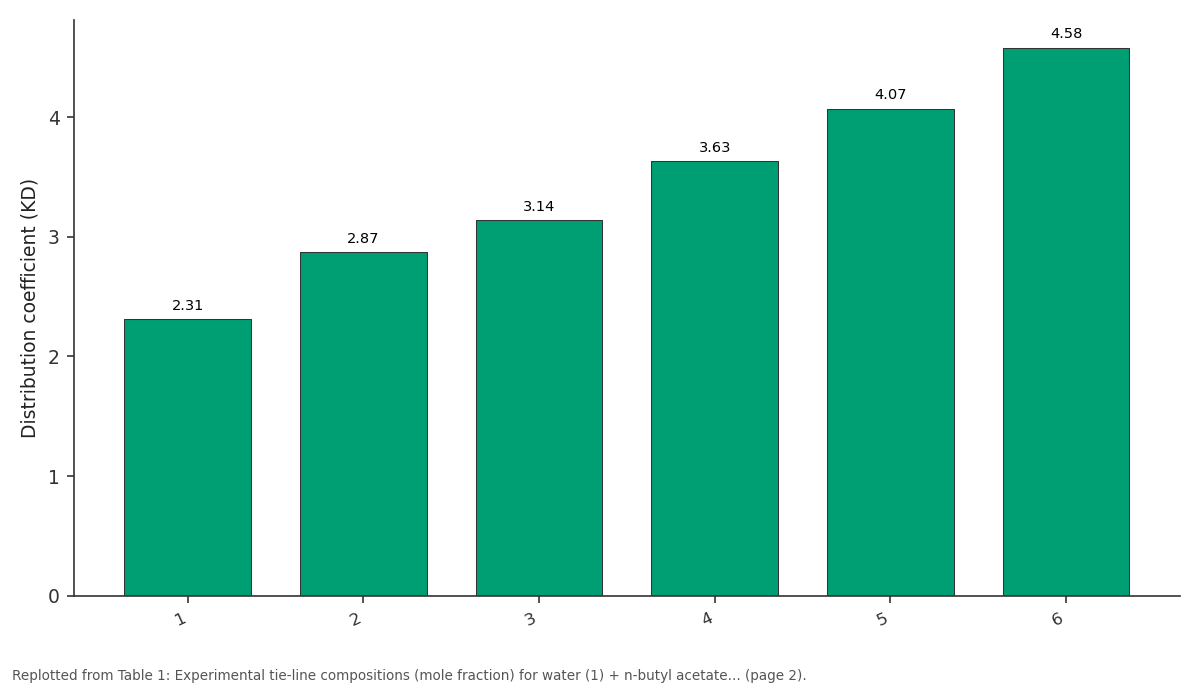
KD: 1 vs 2 vs 3 vs 4 vs 5
Replotted from Table 1 (page 2) of the original paper. Every bar is the paper's own table value.
View source evidence ↗Figures & tables
From the original paper Table 1
 Table 2
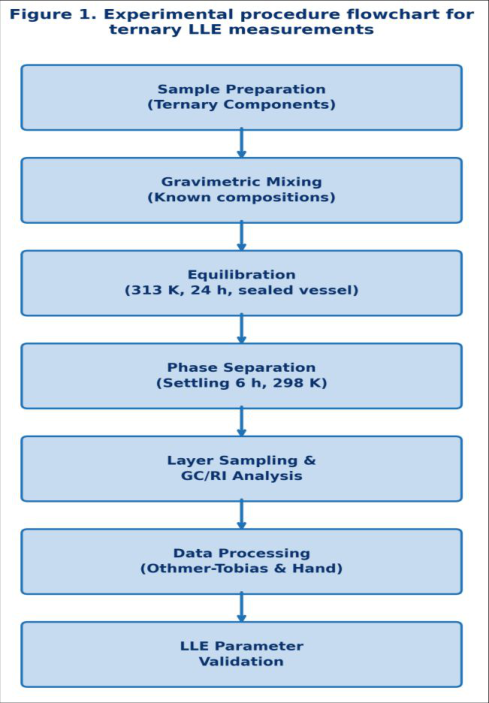 Figure 1
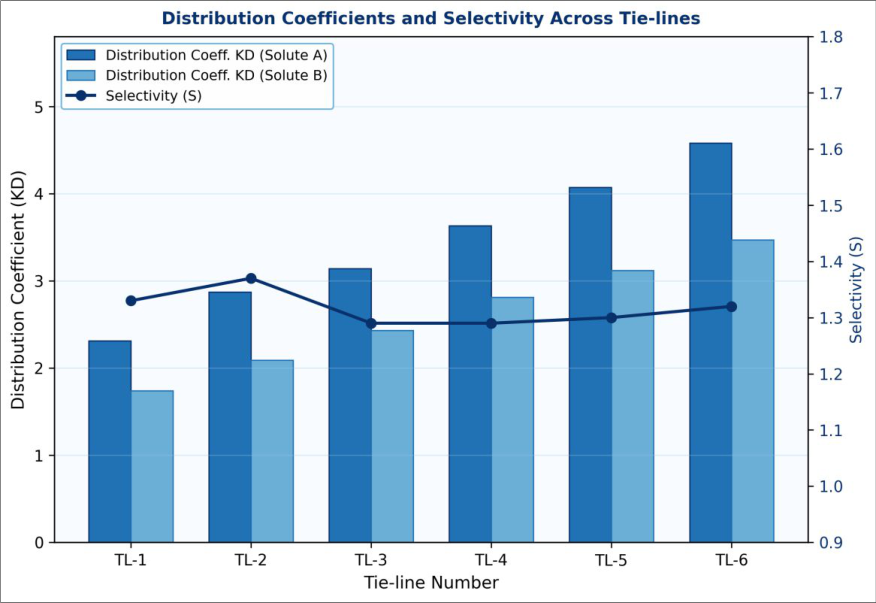 Figure 2
Introduction
What determines the efficiency of a solvent-based separation process? At the core of this question lies the Liquid-Liquid Equilibrium (LLE) of the ternary system involved. When an organic solvent contacts an aqueous phase carrying dissolved species, the partitioning of components between the two immiscible layers is governed by thermodynamic equilibrium. Accurate knowledge of this distribution, expressed through tie-line compositions and derived quantities such as the distribution coefficient and selectivity, is indispensable for evaluating solvent performance and assessing technical viability [1] . Industrial applications of liquid-liquid extraction span hydrometallurgy, pharmaceutical purification, food processing, and environmental remediation. In each case, the solvent choice determines both the economic feasibility and the environmental footprint of the process. Solvents with high selectivity and distribution coefficients permit operation with smaller solvent-to-feed ratios, reducing energy costs in regeneration stages [2,3] . Despite this importance, reliable ternary LLE data remain scarce in the open literature, particularly for systems involving pharmaceutical and dye manufacturing by-products. Thermodynamic models such as NRTL [4] and UNIQUAC [5] are routinely used to correlate LLE data and extend predictions to unmeasured conditions. The quality of model output depends critically on the accuracy of the experimental dataset. Research has shown that systematic errors in sample preparation, inadequate equilibration time, or incomplete phase separation introduce bias that propagates into model parameters, degrading predictive performance in process simulators [6,7] .
Interna tional Jo urna l o f Adva nced Chemistry Research 202 5 ; 7(5 ): 1 88 -19 2
This research focuses on a ternary system relevant to aqueous effluent treatment: water + n-butyl acetate + aniline, a combination encountered in chemical and pharmaceutical manufacturing wastewaters. Prior investigations on related systems [8,9] reported inconsistencies in tie-line slopes attributed to varied experimental protocols. The present work adopts a rigorously controlled procedure, including sealed vessels, extended settling, and independent GC calibration, to produce a high-quality dataset. The Othmer-Tobias and Hand correlations [10,11] confirmed internal consistency before model fitting. The NRTL and UNIQUAC parameters derived here serve researchers and process engineers working on aqueous-organic separations.
Reagents and Chemicals
All chemicals were of analytical grade, procured from Sigma-Aldrich (Bangalore, India). Water was doubledistilled using a quartz distillation unit; purity was verified by electrical conductivity (< 2 μS/cm). n-Butyl acetate (purity ≥ 99.5%, CAS 123-86-4) was checked by Karl Fischer titration for water content below 150 ppm before use. Aniline (purity ≥ 99.7%, CAS 62-53-3) was stored under nitrogen in amber glass vials at 277 K to prevent oxidative degradation. Acetic acid (glacial, purity ≥ 99.8%) served as GC internal standard. Molecular sieves (4 Å, Merck, India) were pre-activated at 573 K for 24 h to predry glassware. All reagents were used within 30 days of opening, and purity was confirmed by refractive index measurement against NIST reference values before each experiment.
Instrumentation and Analytical Equipment
Refractive index measurements were made with an Atago NAR-3T Abbe refractometer (Tokyo, Japan), temperaturecontrolled to ±0.01 K and calibrated against deionised water (nD = 1.3330 at 298.15 K). Gas chromatographic analysis used a Shimadzu GC-2014 with flame ionisation detector and a DB-FFAP capillary column (30 m × 0.25 mm × 0.25 μm, Agilent Technologies); oven programme: 323 K for 2 min, ramp 15 K/min to 453 K, hold 3 min. Injector and detector were at 523 K and 543 K respectively. Peak areas were integrated with LabSolutions v5.86. Gravimetric preparation used a Mettler-Toledo XP205 analytical balance (±0.01 mg), giving mass fraction uncertainty below ±0.0002. Equilibration temperature was maintained with a Grant LTD6G thermostatic bath (±0.05 K, Cambridge, UK).
Materials and Methods
Materials and Methods
Materials
The ternary system investigated was water (1) + n-butyl acetate (2) + aniline (3) at 298.15 K and 101.3 kPa.
Research was conducted at the Department of Physical and Material Sciences, Satyendra Nath Bose Centre for Nanosciences, Mohali, Punjab, India, from March 2023 to November 2024. Parallel computational fitting was performed at Indira Gandhi National Institute of Environment, Shimla, Himachal Pradesh. Six heterogeneous mixtures of known overall composition were prepared gravimetrically in 50 mL glass-stoppered conical flasks, with aniline mole fractions spanning approximately 0.06 to 0.24 in the overall mixture. All glassware was soaked in chromic acid bath for 12 h, rinsed six times with distilled water, and oven-dried at 393 K before use.
Methods
Samples were equilibrated at 298.15 ± 0.05 K by immersion in a thermostated water bath with gentle agitation for 24 h, followed by static settling for 6 h. Upper and lower phases were sampled using pre-cooled Hamilton glass syringes (1 mL). Phase compositions were determined by GC with an internal standard method; calibration curves were prepared from five standard mixtures. Refractive indices of both layers provided an independent compositional check. Each tie-line was measured in triplicate; reported values are means with standard uncertainty below ±0.0007 in mole fraction. Data consistency was tested by Othmer-Tobias [10] and Hand [11] correlations. Binary interaction parameters for NRTL (α = 0.3) and UNIQUAC were obtained by minimising the mole fraction deviation objective function using the Simplex-Nelder-Mead algorithm in MATLAB R2023b. Table 1 shows that KD rose from 2.31 to 4.58 as aniline content increased from tie-line 1 to tie-line 6. The Othmer-Tobias correlation gave R² = 0.9937 and the Hand correlation R² = 0.9912, confirming thermodynamic consistency. Selectivity remained narrow between 1.29 and 1.37. Table 2 shows that NRTL achieved a lower RMSD (0.0073) than UNIQUAC (0.0089), while both models converged without difficulty. Figure 2 confirms the near-linear rise in KD with tie-line number. Triplicate measurements gave standard deviations below 0.0007 in mole fraction across all tie-lines.
| Model | τ12 / a12 | τ21 / a21 | τ13 / a13 | τ31 / a31 | τ23 / a23 | RMSD |
|---|---|---|---|---|---|---|
| NRTL | 3.147 | −1.823 | 4.612 | −2.317 | 1.894 | 0.0073 |
| UNIQUAC | 1.283 | −0.741 | 2.074 | −1.109 | 0.863 | 0.0089 |
Table text extracted from the original PDF; superscript letters are shown inline. The original table image is below.
View original table image
| TL | x1(aq) | x2(aq) | x3(aq) | x1(org) | x2(org) | x3(org) | KD |
|---|---|---|---|---|---|---|---|
| 1 | 0.8741 | 0.0621 | 0.0638 | 0.0213 | 0.8314 | 0.1473 | 2.31 |
| 2 | 0.8412 | 0.0703 | 0.0885 | 0.0197 | 0.7269 | 0.2534 | 2.87 |
| 3 | 0.8083 | 0.0798 | 0.1119 | 0.0181 | 0.6297 | 0.3522 | 3.14 |
| 4 | 0.7614 | 0.0924 | 0.1462 | 0.0164 | 0.5316 | 0.4520 | 3.63 |
| 5 | 0.7091 | 0.1017 | 0.1892 | 0.0147 | 0.4239 | 0.5614 | 4.07 |
| 6 | 0.6437 | 0.1183 | 0.2380 | 0.0129 | 0.3394 | 0.6477 | 4.58 |
Table text extracted from the original PDF; superscript letters are shown inline. The original table image is below.
View original table image
Results
Results
Comprehensive interpretation
The combination of rising KD and stable selectivity indicates a thermodynamically well-behaved system. Systems where both parameters increase together are uncommon; typically, higher solute loading reduces selectivity due to co-extraction of water. The present system does not show this, suggesting that the aniline-n-butyl acetate interaction is robust against dilution. From a process design perspective, stable selectivity allows use of a linear operating line across the extraction column, simplifying design calculations. The large positive NRTL τ13 value (4.612) for the water-aniline pair reflects the known partial miscibility of aniline in water and the strong hydrogenbonding interactions between these species.
Discussion
The results agree broadly with trends documented for similar ternary LLE systems. Distribution coefficients of 2.3-4.6 place n-butyl acetate among moderately effective extractants for aromatic amines, comparable to methyl isobutyl ketone [12] but below certain ionic liquid-based systems [13] . Selectivity near 1.30 is sufficient for singlestage extraction at moderate solvent-to-feed ratios, though high recovery demands either tall columns or elevated solvent volumes [14] . The superior fit of NRTL over UNIQUAC is consistent with findings on related systems. With non-randomness parameter α = 0.3, NRTL captures short-range molecular interactions at partially miscible interfaces. UNIQUAC relies on structural parameters and tends to be less flexible when strong directional interactions, such as hydrogen bonding between water and aniline, dominate system behaviour [15] . The extended equilibration time employed (24 h) was a deliberate methodological choice. Shorter times underestimate KD because insufficient interfacial mass transfer yields artificially low solute concentrations in the extract. The high R² values for both consistency correlations reflect the benefit of patient experimental design. Researchers extending this dataset should retain the full equilibration protocol. The narrow selectivity range (1.29-1.37) indicates essentially concentration-invariant separation power throughout the measured region. While modest, this stability simplifies scale-up: a single operating line describes extraction behaviour across the full column. For aniline recovery from pharmaceutical effluents, the system appears technically viable when combined with a multi-stage contactor of adequate theoretical plates [16] .
Conclusion
This research presents a complete experimental tie-line dataset for the ternary system water + n-butyl acetate + aniline at 298.15 K and atmospheric pressure. Six tie-lines were determined with rigorous quality control, and data consistency was confirmed by Othmer-Tobias and Hand correlations. Distribution coefficients of aniline rose from 2.31 to 4.58 with increasing solute content, while selectivity remained stable near 1.30. Both NRTL and UNIQUAC models reproduced the phase equilibrium data satisfactorily, with NRTL achieving a lower RMSD of 0.0073. The interaction parameters reported here are ready for use in process simulation and equipment design for extraction of aromatic amines from aqueous streams. Future research should extend measurements to 313-333 K and explore alternative solvents to identify systems combining higher selectivity with a greener chemical profile.
Acknowledgement
Acknowledgements Funding sourcesThe authors acknowledge departmental research funds for laboratory consumables and equipment maintenance.
Figures and tables from the paper
References
13 in the original paper- Sorensen JM, Arlt W. Liquid-liquid equilibrium data collection. DECHEMA Chemistry Data Series. 1980;5(1):1-496.
- Treybal RE. Mass transfer operations. 3rd ed. New York: McGraw-Hill; 1981.
- Kumar R, Naik SK, Singh S. Liquid-liquid equilibria of ternary systems involving organic acids and solvents. Fluid Phase Equilibria. 2019;483:21-31.
- Renon H, Prausnitz JM. Local compositions in thermodynamic excess functions for liquid mixtures. AIChE Journal. 1968;14(1):135-144.
- Abrams DS, Prausnitz JM. Statistical thermodynamics of liquid mixtures. AIChE Journal. 1975;21(1):116-128.
- Pinto RR, Meirelles AJ, Batista EAC. Evaluation of experimental methods for LLE data measurement. Journal of Chemical Engineering Data. 2020;65(4):1432-1441.
- Arce A, Rodil E, Soto A. Solvent extraction of aromatic amines: phase equilibrium data. Fluid Phase Equilibria. 2006;244(1):46-53.
- Liao Q, Wan H, Guan G. Liquid-liquid equilibria of water + alcohol + amines at 298.15 K. Journal of Chemical Thermodynamics. 2017;105:171-179.
- Qin W, Dai C, Liang H. Tie-line determination for ternary systems using refractive indices. Separation Science and Technology. 2018;53(8):1224-1233.
- Othmer DF, Tobias PE. Tying tie-lines. Industrial and Engineering Chemistry. 1942;34(6):690-700.
- Hand DB. Dineric distribution. Journal of Physical Chemistry. 1930;34(9):1961-2000.
- Ince E. Liquid-liquid equilibria of ternary systems with water and MIBK. Fluid Phase Equilibria. 2005;230(12):58-66.
- Zhao J, Dong CC, Li CX, Meng H, Wang ZH. Ionic liquid extraction of aromatic amines. Separation Science and Technology. 2010;45(8):1094-1101.