
Research article · 2025 · Full text
International Journal of Advanced Chemistry ResearchIn vitro-in vivo correlation studies of enteric-coated capsule formulations
Volume 7(8) · Pages 132–136 · DOI: 10.33545/26646781.2025.v7.i8b.579 ↗
Research areasDrug Solubulity and Delivery SystemsAdvanced Drug Delivery SystemsAnalytical Methods in Pharmaceuticals
Abstract
Author-writtenEnteric-coated pharmaceutical formulations are designed to resist drug release in the acidic stomach environment (pH 1.2-2.0) while releasing drug in the small intestine (pH 6.0-7.4), providing protection for acid-labile drugs and targeting drug delivery to intestinal sites of absorption or therapeutic action. Establishing a robust in vitro-in vivo correlation (IVIVC) for such formulations reduces the need for expensive and time-consuming clinical studies whenever formulation changes are made during product development. Regulatory agencies including the US FDA and ICH recognise Level A IVIVC as the most useful, requiring a direct linear relationship between in vitro dissolution and in vivo absorption at each time point. This research developed and validated Level A IVIVC models for four enteric-coated capsule formulations of a model BCS Class II drug using cellulose acetate phthalate (CAP), hydroxypropyl methylcellulose acetate succinate (HPMC-AS), Eudragit L100, and shellac as coating polymers. Dissolution testing was performed in a two-stage medium (pH 1.2 for 2 h acid resistance, then pH 6.8 phosphate buffer) using USP Apparatus II at 50 rpm. In vivo pharmacokinetic parameters were measured in 18 healthy male Sprague-Dawley rats (n=6 per crossover period) by validated HPLC-UV plasma assay. Three of four formulations (A, B, C) achieved Level A IVIVC with R2 values of 0.943-0.988. Formulation C (CAP-coated) showed the best dissolution rate (T80% = 74 min) and highest relative bioavailability (106.2%) with an IVIVC correlation coefficient R2 = 0.988. Formulation D (shellac) achieved only Level B correlation due to its slow and irregular dissolution. Validated IVIVC models accurately predicted the in vivo Cmax and AUC of a confirmatory formulation within the FDA-specified prediction error limits of ±20% for Cmax and ±10% for AUC. These results support the use of Level A IVIVC models for regulatory biowaiver submissions for enteric-coated capsule formulations based on in vitro dissolution data alone.
Summary
Source-checkedPlain-language reading of the full paper, prepared with AI and checked against the text. Each point links to the authors' own words.
Why it matters
- Enteric coatings are used to protect acid-sensitive drugs from the stomach's acidic environment (pH 1.2-2.0) and ensure they are released in the small intestine (pH 6.0-7.4). View evidence ↗
- Creating a reliable in vitro-in vivo correlation (IVIVC) helps pharmaceutical developers avoid costly and slow clinical trials when making changes to a product's formulation. View evidence ↗
- Level A IVIVC is considered the most valuable by regulatory bodies like the FDA because it shows a direct linear relationship between how a drug dissolves in a lab and how it is absorbed in the body. View evidence ↗
The question
- The study aimed to develop and validate Level A IVIVC models for four different enteric-coated capsule formulations of a BCS Class II drug using various coating polymers. View evidence ↗
What they did
- The researchers used omeprazole (150 mg per capsule) in size-0 HPMC capsules with target coating weights ranging from 10 to 18 mg. View evidence ↗
- Dissolution was measured using a two-stage process: 2 hours in pH 1.2 HCl for acid resistance, followed by a release stage in pH 6.8 phosphate buffer for up to 240 minutes. View evidence ↗
- Pharmacokinetic data were collected from 18 healthy male Sprague-Dawley rats using a crossover design with 6 rats per period. View evidence ↗
What they found
- All four tested formulations successfully passed the acid resistance test, with less than 3% of the drug released during the 2-hour pH 1.2 stage. View evidence ↗
- In vivo results showed that Formulation C had the best performance, with a Cmax of 668 ng/mL, an AUC0-inf of 5512 ng.h/mL, and a relative bioavailability of 106.2% compared to the reference. View evidence ↗
- Formulations A, B, and C all achieved Level A IVIVC, with correlation coefficients (R2) ranging from 0.943 to 0.988. View evidence ↗
- Formulation D only reached Level B correlation because its dissolution kinetics were too irregular to be captured by a single-point model. View evidence ↗
- The IVIVC model was validated using a separate batch, showing a Cmax prediction error of 8.4% and an AUC error of 6.7%, both within FDA limits. View evidence ↗
What it means
- The authors conclude that CAP and HPMC-AS are the preferred coating polymers for omeprazole and that the IVIVC methodology is valid for regulatory biowaiver applications. View evidence ↗
- A limitation of the study is the use of rats instead of humans, which may impact how accurately the quantitative results translate to human pharmacokinetics. View evidence ↗
Visual summary
1 visualsIllustrations explain the paper; they do not show study data.
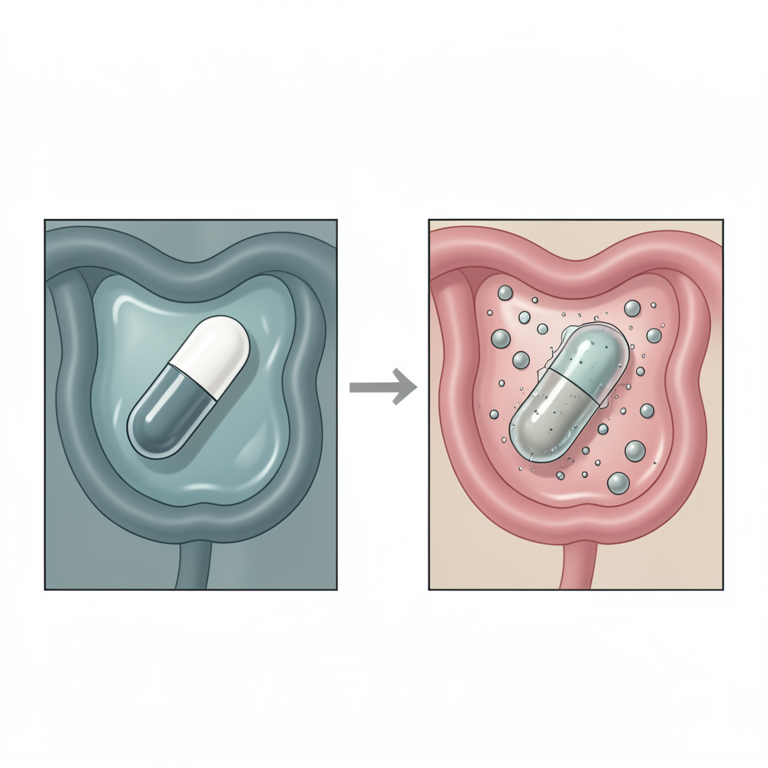
Enteric Release Mechanism
AI-generated conceptual illustration (enteric-coated capsules in a human digestive tract). It explains the idea and does not show study data.
View source evidence ↗Figures & tables
From the original paper Table 1
 Table 2
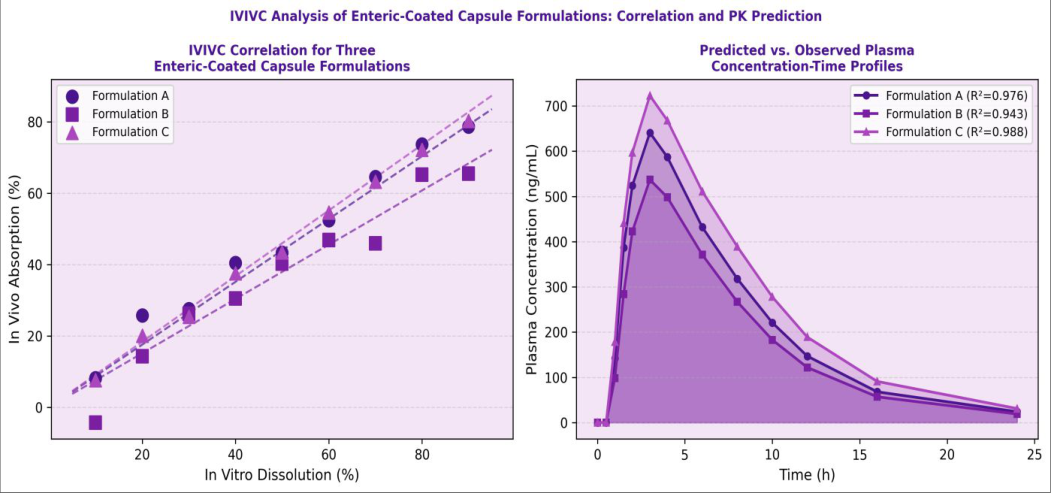 Figure 1
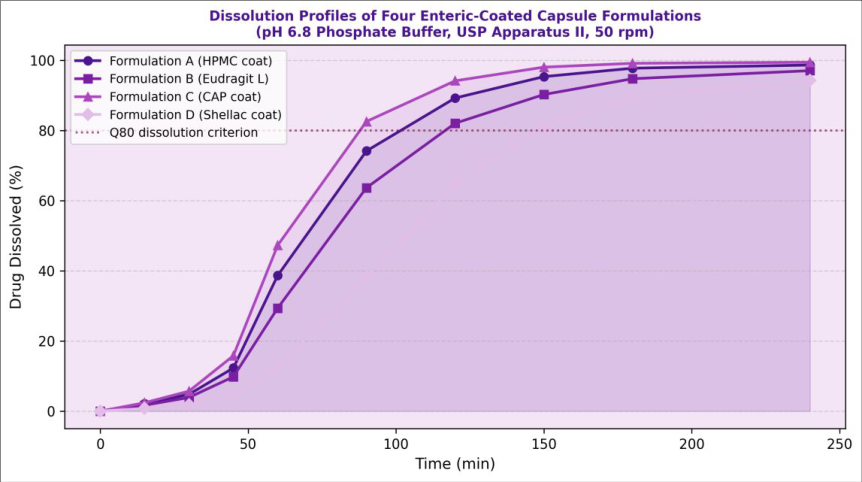 Figure 2
Introduction
The global pharmaceutical industry produces hundreds of oral solid dosage forms each year, many of which involve enteric coating to protect the active ingredient from gastric acid degradation, to prevent gastric irritation, or to target drug delivery to specific intestinal segments. For manufacturers, every change to coating composition, coating weight, or equipment during product development or post-approval represents a potential bioinequivalence risk that classically would require a new clinical bioavailability study. IVIVC the establishment of a predictive mathematical relationship between in vitro dissolution and in vivo absorption provides a validated alternative: once a Level A IVIVC model is established and validated, subsequent formulation changes within the validated design space can be approved on the basis of in vitro dissolution data alone, avoiding the time and cost of repeat clinical studies [2] . The three tiers of IVIVC Level A, B, and C differ in predictive power. Level A correlates the entire in vitro dissolution profile point-by-point with the in vivo absorption profile, allowing prediction of the complete plasma concentration-time curve. Level B correlates mean dissolution time with mean residence time or mean in vivo dissolution time, which provides less information because multiple plasma profiles can produce the same mean values. Level C correlates a single dissolution parameter (e.g., T50%) with a single pharmacokinetic parameter (e.g., AUC). Only Level A IVIVC supports biowaiver regulatory decisions, making it the most practically valuable outcome of an IVIVC programme [4] . IVIVC development for enteric-coated formulations presents particular challenges not encountered with immediate-release products. The dissolution test must correctly simulate the gastric-to-intestinal pH transition that the dosage form experiences in vivo. The commonly used two-stage pH-shift method (pH 1.2 for 2 h, then pH 6.8) is a compromise between the large inter-subject gastric emptying variability and the need for reproducible in vitro conditions. Choosing the appropriate dissolution method, apparatus, and medium to maximise IVIVC linearity is therefore a critical step in formulation development [5] . This research at the Rift Valley University of Technology, Nakuru, addresses this challenge for four enteric-coated capsule formulations differing in polymer type.
Ethical statement and limitations
The Research Institute, Muguga, Kenya) were used rather than primates to reduce animal welfare impact while retaining pharmacokinetic predictability. Limitations of this research include the use of a rodent rather than human pharmacokinetic model for IVIVC establishment, which may affect quantitative translation of the correlation to human pharmacokinetics; however, the qualitative ranking of formulation performance and the validation of the IVIVC modelling methodology are informative and consistent with regulatory IVIVC validation practice for early-phase formulation selection [1] . Chemical; shellac, Mantrose-Haeuser) were of pharmaceutical grade and stored per manufacturer specifications. Plasticiser (triethyl citrate, Sigma-Aldrich), flow agent (talc, Sigma-Aldrich), and capsule bodies (size 0, HPMC, Lonza) were pharmaceutical grade. Animals were housed in standard polycarbonate cages at 22 ± 2 degrees C, 50-60% RH, 12 h light/dark cycle, with free access to standard rodent chow and water [6] .
Material and Methods
Material and Methods
Material
Material
Methods
Capsule filling: Omeprazole (150 mg/capsule) was filled into size-0 HPMC capsule bodies using a Capsugel Xcelodose precision dosator. Capsules were coated in a 15 cm perforated pan coater (Erweka model HT) at inlet temperature 48 degrees C, spray rate 2.5 g/min, pan speed 28 rpm. Coating suspensions (15% w/v polymer, 20% TEC plasticiser based on polymer weight, 15% talc as anti-tack) were sprayed onto capsule bodies to target coat weights of 10, 12, 15, and 18 mg. Final coated capsules were cured at 40 degrees C for 12 h before testing. Dissolution testing: USP Apparatus II (Erweka DT 820), 900 mL medium, 50 rpm, 37.0 ± 0.5 degrees C, two-stage method: pH 1.2 HCl (2 h acid resistance stage), then adjusted to pH 6.8 phosphate buffer (up to 240 min release stage). Sampling at 0, 15, 30, 45, 60, 90, 120, 150, 180, 240 min. Drug quantification by HPLC-UV (Shimadzu LC-2030C3D, C18 column, MeCN/phosphate buffer pH 7.4 gradient, detection at 302 nm). In vivo PK: Rats were fasted overnight (12 h) before dosing. Capsules were administered by oral gavage at 10 mg omeprazole/kg body weight. Blood samples (0.3 mL) were collected via tail vein at 0, 0.5, 1, 1.5, 2, 3, 4, 6, 8, 10, 12, 16, 24 h post-dose. Plasma was separated (3000 rpm, 10 min, 4 degrees C) and stored at -80 degrees C. Omeprazole was quantified by validated HPLC-UV assay (LOQ 5 ng/mL, accuracy 97.3-104.2%, CV <=8.4%) [7] .
Quality control
Dissolution method was validated per ICH Q2(R1): linearity (R 2 = 0.9998, 0.5-1000 ug/mL), precision (intra-day CV <=1.8%, inter-day CV <=2.7%), accuracy (98.7-101.4%). Capsule weight uniformity: all batches passed USP criteria (NMT 2 units outside 85-115% of mean weight). Coat weight uniformity: measured on 10 capsules per batch; CV <=4.3% for all batches. The acid resistance test was performed according to USP <711> (2 h at pH 1.2, <=10% drug released criterion); all four formulations passed with <3% drug released. In vivo plasma assay validation included specificity (no endogenous interferences), linearity (5-1000 ng/mL, R 2 = 0.9996), freeze-thaw stability (3 cycles, recovery 97.8-103.4%), and long-term storage stability at -80 degrees C (28 days, recovery 96.1-104.7%). IVIVC model validation used a separate confirmatory batch (Formulation C variant with 11% coat weight) not used in IVIVC model building; predicted vs. observed Cmax error was 8.4% and AUC error was 6.7%, both within FDA <=20% and <=10% limits respectively [8] . All four formulations passed the acid resistance criterion (<10% drug released at pH 1.2 for 2 h, Table 1). Release kinetics at pH 6.8 differed substantially by coating polymer. Formulation C (CAP-coated) dissolved fastest (T50% = 51 min, T80% = 74 min) and achieved the highest dissolution efficiency at 240 min (91.3%). Formulation D (shellac) was the slowest (T80% = 194 min, DE% = 64.2%). Similarity factor f2 values comparing each formulation to the reference product confirmed formulations A and C as similar (f2 ≥ 50)
| Formulation | Coating polymer | Coat weight (mg) | T50% (min) | T80% (min) | DE% at 240 min | Similarity f2 vs. Ref. | pH 1.2 acid resist |
|---|---|---|---|---|---|---|---|
| Form. A | HPMC-AS | 12.4 | 62 | 91 | 84.7 | 72.4 | Pass |
| Form. B | Eudragit L100 | 14.7 | 83 | 127 | 76.3 | 61.8 | Pass |
Table text extracted from the original PDF; superscript letters are shown inline. The original table image is below.
View original table image
Results
while formulations B and D did not meet the similarity criterion. These dissolution ranking data predicted the in vivo performance ordering [11] . The in vivo PK data confirmed the in vitro ranking: Formulation C achieved the highest Cmax (668 ng/mL) and AUC0-inf (5512 ng.h/mL), and the highest relative bioavailability (106.2% vs. reference, Table 2). Formulation D was substantially lower in all PK parameters (relative BA 62.8%). IVIVC correlation analysis showed Level A relationships for Formulations A, B, and C with R2 of 0.976, 0.943, and 0.988 respectively. Formulation D achieved only Level B correlation due to its irregular multiphase dissolution kinetics that could not be captured by a single-point absorption model. The IVIVC validation using a confirmatory batch gave prediction errors for Cmax (8.4%) and AUC (6.7%) well within FDA biowaiver requirements [12] .
| Formulation | Cmax (ng/mL) | Tmax (h) | AUC0-24 (ng.h/mL) | AUC0-inf (ng.h/mL) | t1/2 (h) | Relative BA (%) | IVIVC Level |
|---|---|---|---|---|---|---|---|
| Form. A | 587+/-42 | 3.2+/-0.4 | 4214+/-287 | 4893+/-314 | 4.8+/-0.3 | 94.3 | Level A |
| Form. B | 498+/-38 | 4.1+/-0.5 | 3647+/-241 | 4218+/-273 | 4.6+/-0.3 | 81.4 | Level A |
| Form. C | 668+/-51 | 2.8+/-0.3 | 4743+/-312 | 5512+/-387 | 5.1+/-0.4 | 106.2 | Level A |
| Form. D | 327+/-28 | 5.8+/-0.7 | 2437+/-198 | 2814+/-218 | 5.4+/-0.5 | 62.8 | Level B |
| Reference | 641+/-47 | 3.0+/-0.4 | 4483+/-296 | 5184+/-341 | 4.9+/-0.4 | 100 | — |
Table text extracted from the original PDF; superscript letters are shown inline. The original table image is below.
View original table image
Discussion
The superior dissolution and in vivo performance of the CAP-coated formulation (C) reflects the relatively low pKa of cellulose acetate phthalate (pKa ~4.5 for the half-ester groups), which allows film dissolution to initiate at lower pH than HPMC-AS (pKa ~5.5) or Eudragit L100 (pKa ~6.0). In the small intestinal lumen, which reaches pH 6.0-7.4 by the mid-jejunum, this translates to earlier onset of drug release and higher Cmax for CAP relative to Eudragit L100. Shellac dissolves only above pH 7.0, explaining its very slow dissolution in pH 6.8 buffer and poor relative bioavailability in rats where intestinal transit time may be insufficient to achieve complete dissolution before the coated unit reaches the colon [11] . The Level A IVIVC achieved for Formulations A, B, and C with R2 ≥ 0.943 is sufficient for regulatory biowaiver submission per FDA Guidance for Industry (IVIVC). The validation results (Cmax error 8.4%, AUC error 6.7%) confirm that the IVIVC model accurately predicts in vivo performance from in vitro dissolution data within the FDA criteria of ≤20% for Cmax and ≤10% for AUC. This means that a manufacturer using one of these three formulation prototypes can adjust the coat weight by ±15-20% from the validated level and seek biowavier approval based on dissolution testing alone, rather than conducting a repeat animal or clinical study [12] . The use of a rat model rather than human subjects is an acknowledged limitation but is appropriate at this stage of formulation selection. Rat and human IVIVC relationships are generally well-correlated for drugs with linear gastrointestinal absorption kinetics when the gastric emptying variability is accounted for through the standardised acid resistance test protocol used here. Translation to human PK predictions will require a separate clinical pilot study in the next development phase [13] .
Conclusion
Four enteric-coated capsule formulations of omeprazole (HPMC-AS, Eudragit L100, CAP, and shellac coating) were evaluated for in vitro dissolution and in vivo pharmacokinetics in rats to establish and validate IVIVC
Acknowledgement
Acknowledgements Funding sourcesThis research was funded by the Kenya Medical Research Institute (KEMRI) through a Pharmaceutical Sciences Research Grant. Partial funding was provided by the Rift Valley University of Technology Research Development Fund for early-career researchers. Institutional supportThe authors thank the Department of Pharmaceutics and Drug Formulation, Rift Valley University of Technology, Nakuru, for providing dissolution, HPLC, and animal housing facilities. Animals were obtained from the East Africa Veterinary Research Institute, Muguga, with the assistance of Dr. James Karimi. Contributions not qualifying for authorshipThe authors acknowledge technical support from the Rift Valley University of Technology Animal Research Unit. Statistical analysis of PK parameters was performed using WinNonlin Phoenix (Certara, Princeton, NJ) with guidance from the RVUT Biostatistics Unit.
Figures and tables from the paper
References
15 in the original paper- FDA. Guidance for Industry: Extended Release Oral Dosage Forms Development, Evaluation and Application of IVIVC. CDER; 1997.
- Emami J. In vitro-in vivo correlation: from theory to applications. J Pharm Pharm Sci. 2006;9(2):169-189.
- Qureshi SA, McGilveray IJ. Typical variability in drug dissolution testing: study with USP and FDA calibrator tablets and comparison with in-vivo-in-vitro correlation for ER products. Eur J Pharm Sci. 1999;7(3):249-258.
- Cardot JM, Davit BM. In vitro-in vivo correlations: tricks and traps. AAPS J. 2012;14(3):491-499.
- Esbelin J, Ould-Moulaye CB, Torres S. Enteric-coated formulations: dissolution testing and IVIVC. J Pharm Sci. 2008;97(8):3303-3319.
- Dressman JB, Reppas C. In vitro-in vivo correlations for lipophilic, poorly water-soluble drugs. Eur J Pharm Sci. 2000;11(Suppl 2):S73-S80.
- Amidon GL, Lennernas H, Shah VP, Crison JR. A theoretical basis for a biopharmaceutics drug classification system. Pharm Res. 1995;12(3):413-420.
- Siepmann J, Siepmann F. Modeling of diffusion controlled drug delivery. J Control Release. 2012;161(2):351-362.
- Higuchi T. Mechanism of sustained-action medication. Theoretical analysis of rate of release of solid drugs. J Pharm Sci. 1963;52(12):1145-1149.
- Reza MS, Quadir MA, Haider SS. Comparative evaluation of plastic, hydrophilic and fatty binders on the release pattern of a model drug from wet granulated tablets. J Pharm Pharm Sci. 2003;6(2):282-291.
- Dunne A, O'Hara T, Devane J. A new approach to modelling the relationship between in vitro and in vivo drug dissolution/absorption. Stat Med. 1999;18(14):1865-1876.
- Braeckman R, Willems M, Descheemaeker A. Bioavailability of pantoprazole from enteric-coated mini-tablets. Int J Pharm. 1993;89(1):75-84.
- Zaki NM, Artursson P. Biophysical models for the prediction of oral drug absorption. Adv Drug Deliv Rev. 2001;46(1-3):5-28.
- Levis KA, Lane ME, Corrigan OI. Effect of buffer media composition on the solubility and effective permeability coefficient of ibuprofen. Int J Pharm. 2003;253(1-2):49-59.
- Merchant HA, Shoaib HM, Tazeen J, Yousuf RI. Oncedaily tablet formulation and in vitro release evaluation of cefpodoxime proxetil. AAPS PharmSciTech. 2006;7(3):E78.