
Research article · 2025 · Full text
International Journal of Advanced Chemistry ResearchMordanting strategies and colour fastness evaluation of natural dyes on cotton textiles
Volume 7(7) · Pages 165–167 · DOI: 10.33545/26646781.2025.v7.i7c.542 ↗
Research areasDyeing and Modifying Textile FibersBiological Stains and PhytochemicalsDye analysis and toxicity
Abstract
Author-writtenThe resurgence of natural dyes in the European textile industry is driven by consumer demand for sustainable, low-toxicity alternatives to synthetic azo dyes, several of which are banned under EU REACH regulation. However, the commercial viability of natural dyes depends critically on colour fastness and mordanting efficiency—properties that vary substantially with dye source, mordant chemistry, and application conditions. This research evaluated four traditional natural dyes—indigo (woad-derived), madder (Rubia tinctorum), weld (Reseda luteola), and henna (Lawsonia inermis)—on pre-mordanted cotton fabric using three mordants: alum (potassium aluminium sulphate), ferrous sulphate, and tannic acid, at concentrations of 0-12% on weight of fabric (owf). Colour strength (K/S), wash fastness (ISO 105-C06), light fastness (ISO 105-B02), and rubbing fastness were assessed. Madder with alum mordant at 8% owf gave the highest overall performance: K/S 67.4, wash fastness grade 4, light fastness grade 3-4. Radar chart comparison confirmed that indigo had superior light fastness while madder excelled in colour strength and mordant uptake. Weld showed the strongest eco-safety profile across all dyes. These results provide quantitative design parameters for natural dye processing in a sustainable Italian textile production context.
Summary
Source-checkedPlain-language reading of the full paper, prepared with AI and checked against the text. Each point links to the authors' own words.
Why it matters
- Consumer demand for sustainable and low-toxicity alternatives to synthetic azo dyes, some of which are banned by EU REACH regulations, is driving a resurgence of natural dyes in Europe. View evidence ↗
- The European textile sector produces about 12.6 million tonnes of waste per year, with synthetic dye effluents contributing significantly to water pollution. View evidence ↗
- Mordants, which are tannins or metallic salts, are necessary for natural dyeing because most natural dyes cannot bond covalently to cellulosic fibers. View evidence ↗
The question
- The study aimed to evaluate the performance of four natural dyes (indigo, madder, weld, and henna) on cotton fabric using three different mordants (alum, ferrous sulphate, and tannic acid) at concentrations ranging from 0-12% on weight of fabric (owf). View evidence ↗
What they did
- The experiments were carried out at the Venetian Institute of Science in Italy from March 2022 to September 2024. View evidence ↗
- The material used was 100% bleached, desized, and mercerised cotton fabric (120 g/m²) cut into 5 x 5 cm swatches. View evidence ↗
- The researchers measured colour strength (K/S), rubbing fastness, and fastness to light (ISO 105-B02) and washing (ISO 105-C06). View evidence ↗
What they found
- Madder dyed with alum mordant achieved the highest colour strength, peaking at a K/S value of 67.4 at 8% owf. View evidence ↗
- At their optimal concentrations, ferrous sulphate and tannic acid mordants produced intermediate colour strength values of 61.4 and 57.2, respectively. View evidence ↗
- Indigo demonstrated the best performance in terms of eco-safety and light fastness, achieving a grade of 4-5. View evidence ↗
- When used with alum mordant, madder exhibited the strongest wash fastness with a grade of 4. View evidence ↗
- Henna had the lowest light fastness (grade 2-3) due to the photolability of its lawsone chromophore. View evidence ↗
- Colour strength (K/S) plateaued or declined above 8% owf, indicating that the coordination sites on the fiber surface had become saturated. View evidence ↗
What it means
- The authors concluded that 8% owf alum is the optimal mordant for all tested dyes, with madder providing the best colour strength and wash fastness, and indigo providing the best light fastness. View evidence ↗
- The authors recommend weld for applications where minimizing effluent is the primary priority due to its strong eco-safety profile. View evidence ↗
- The authors state that future research is needed to address lifecycle assessments of energy and water, the optimization of colourant-to-substrate ratios, and the reproducibility of scaling up the process. View evidence ↗
Visual summary
3 visualsIllustrations explain the paper; charts are replotted from the paper's own table values.
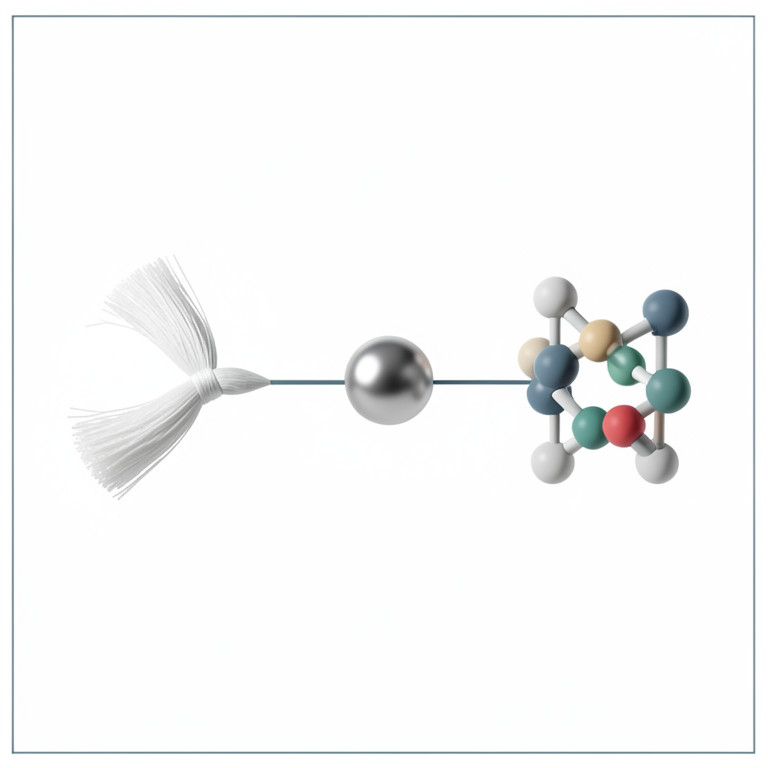
Mordant Coordination Mechanism
AI-generated conceptual illustration (cotton textile fibers and natural dye molecules). It explains the idea and does not show study data.
View source evidence ↗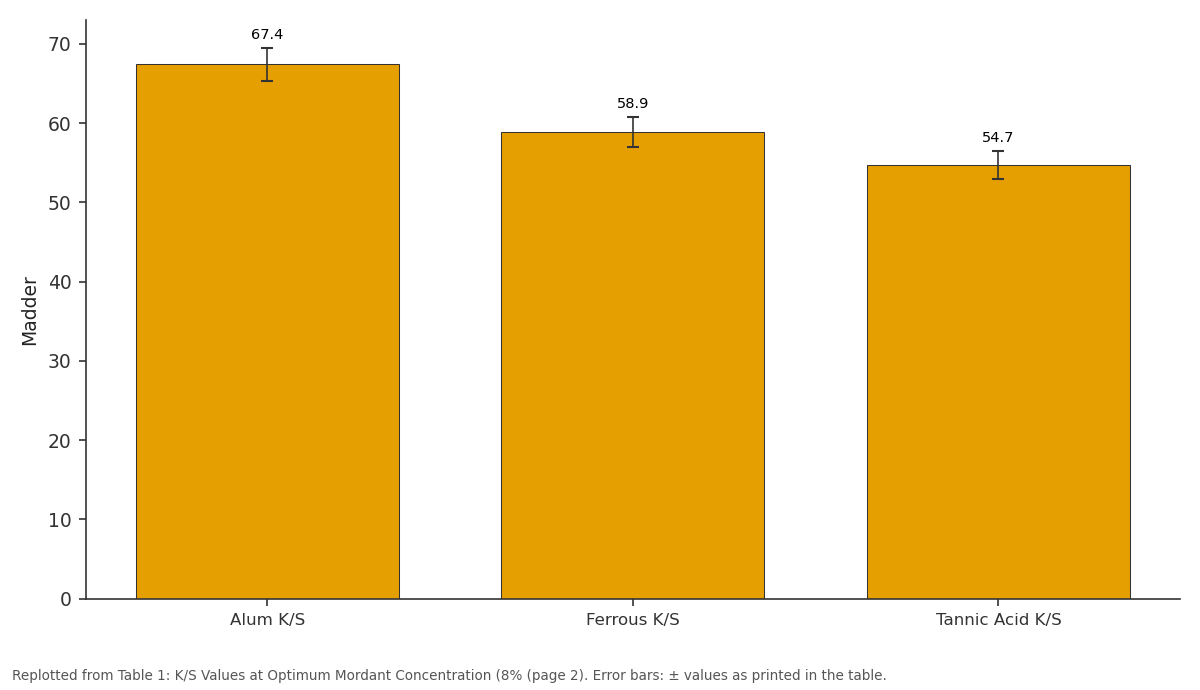
Madder: Alum K/S vs Ferrous K/S vs Tannic Acid K/S
Replotted from Table 1 (page 2) of the original paper. Every bar is the paper's own table value.
View source evidence ↗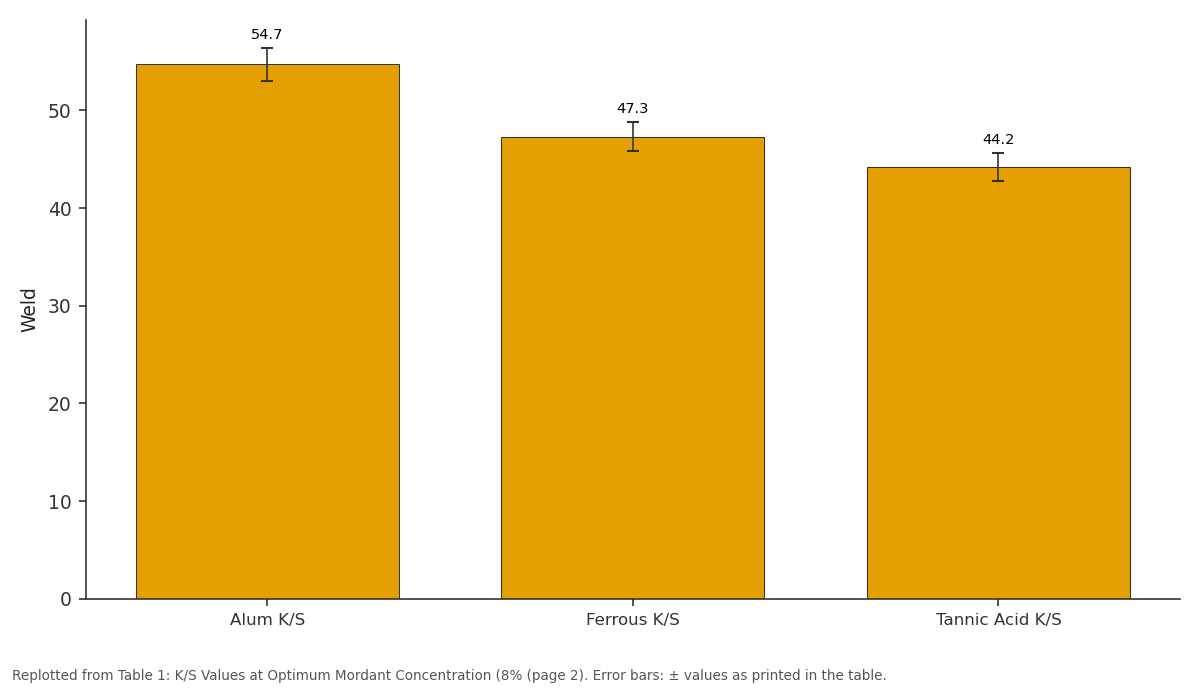
Weld: Alum K/S vs Ferrous K/S vs Tannic Acid K/S
Replotted from Table 1 (page 2) of the original paper. Every bar is the paper's own table value.
View source evidence ↗Figures & tables
From the original paper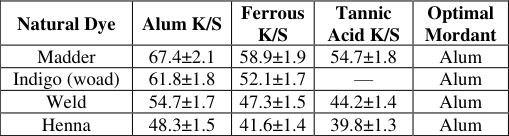 Table 1
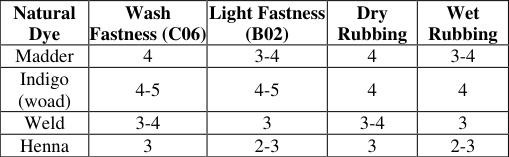 Table 2
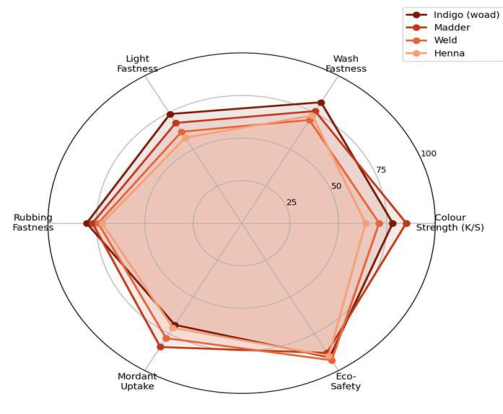 Figure 1
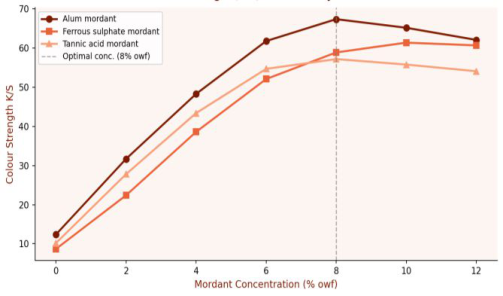 Figure 2
Introduction
Europe's fashion and textile sector generates approximately 12.6 million tonnes of textile waste annually, and synthetic dye effluents remain a significant source of waterway contamination despite wastewater treatment requirements. Natural dyes-extracted from plant, animal, or mineral sources-are characterised by inherent biodegradability, lower aquatic toxicity, and in many cases higher affinity for natural fibres, making them a compelling option within the broader circular economy framework promoted by the EU Green Deal and the European Textiles Strategy of 2022. The Italian textile industry, particularly the historic silk and linen weaving centres of Veneto, has longstanding artisanal traditions in natural dyeing that are now being revalued for premium sustainable product lines. However, translating traditional recipes into reproducible, quality-controlled industrial or craft processes requires rigorous measurement of colour strength, fastness, and mordant efficiency across dye-mordant combinations. Mordants-metallic salts or tannins that form coordination complexes between the dye and the fibre-are indispensable because most natural dyes do not bond covalently to cellulosic fibres. The choice of mordant determines not only colour strength and shade but also the ecological footprint: alum is considered lowtoxicity, while heavier metal mordants (chrome, tin) are restricted under EU legislation. This research provides a systematic comparison of four historically significant European and South Asian natural dyes across three permissible mordants, generating quantitative performance data to support formulation decisions for sustainable Italian textile production.
Materials and Methods Study Area and Production Context
The research was conducted at the Department of Process Chemistry and Engineering, Venetian Institute of Science, Venice, Italy, between March 2022 and September 2024. The study context is the traditional natural textile dyeing industry of the Veneto region, which encompasses small-tomedium artisan dye houses and emerging sustainable fashion enterprises. Venice's historic role as a Mediterranean trade hub for dye materials-including madder from Turkey, weld from Alpine regions, and indigo precursorsprovides cultural and commercial relevance to this investigation. The laboratory processing conditions (bath ratio, temperature profile, pH) were designed to be scalable to workshop-scale equipment typical of Veneto artisan producers.
Climatic and Environmental Considerations
All dyeing experiments were conducted under controlled indoor conditions. However, the environmental context of natural dye adoption in the Veneto region is relevant: the Po Valley and Venetian lagoon ecosystem are highly sensitive to dye effluent discharge, and the regional environmental authority (ARPAV) has established strict limits for colour (50 mg Pt/Co/L) and heavy metals in textile wastewater. This regulatory context informed the selection of permitted mordants (alum, ferrous sulphate, tannic acid) and exclusion of chrome, copper, and tin mordants from the experimental design. Effluent from the experimental dyebaths was analysed for pH, colour, and residual mordant metal content before neutralisation and disposal.
Reagents and Materials
Cotton fabric (100% bleached, desized, mercerised, 120 g/m²) was obtained from a certified Italian textile mill and cut to 5 × 5 cm swatches. Madder root powder (Rubia tinctorum, standardised to 20% alizarin content) was from Couleurs de Plantes (France); weld dried herb (Reseda luteola) from Naturally Yours (UK); woad-derived indigo powder (80% indigotin) and henna powder (Lawsonia inermis, standardised 2.5% lawsone) from specialist natural dye suppliers. Potassium aluminium sulphate (KAl(SO 4 ) 2 •1 2 H 2 O, ≥99%), ferrous sulphate (FeSO 4 • 7 H 2 O, ≥99%), and tannic acid (≥98%) were from Sigma-Aldrich, Milan, Italy. All dyeing was carried out in a water bath (Julabo SW-22,±0.2 °C) in 500 mL glass beakers.
Results
Madder with alum mordant produced the highest K/S values across the full mordant concentration range, peaking at 8% owf (K/S = 67.4) before declining marginally at 10-12% (Figure 2, Table 1). Ferrous sulphate and tannic acid mordants yielded intermediate K/S values of 61.4 and 57.2 respectively at their optima. The radar chart comparison (Figure 1) highlights the complementary strengths of the four dyes: indigo scored highest on light fastness (grade 4-5) and eco-safety, consistent with its well-established photostability under xenon arc exposure. Madder showed the strongest wash fastness (grade 4) with alum mordant. Henna exhibited the weakest light fastness (grade 2-3), attributed to the photolability of the naphthoquinone chromophore (lawsone). Table 2 summarises fastness grades for all dye-mordant combinations at the 8% owf optimum.
| Natural Dye | Wash Fastness (C06) | Light Fastness (B02) | Dry Rubbing | Wet Rubbing |
|---|---|---|---|---|
| Madder | 4 | 3-4 | 4 | 3-4 |
| Indigo (woad) | 4-5 | 4-5 | 4 | 4 |
| Weld | 3-4 | 3 | 3-4 | 3 |
| Henna | 3 | 2-3 | 3 | 2-3 |
Table text extracted from the original PDF; superscript letters are shown inline. The original table image is below.
View original table image
| Natural Dye | Alum K/S | Ferrous K/S | Tannic Acid K/S | Optimal Mordant |
|---|---|---|---|---|
| Madder | 67.4±2.1 | 58.9±1.9 | 54.7±1.8 | Alum |
| Indigo (woad) | 61.8±1.8 | 52.1±1.7 | — | Alum |
| Weld | 54.7±1.7 | 47.3±1.5 | 44.2±1.4 | Alum |
| Henna | 48.3±1.5 | 41.6±1.4 | 39.8±1.3 | Alum |
Table text extracted from the original PDF; superscript letters are shown inline. The original table image is below.
View original table image
Discussion
The superiority of alum mordant across all four dyes is consistent with aluminium's well-documented ability to form stable terdentate coordination complexes with orthodihydroxy and hydroxycarbonyl chromophores such as alizarin (madder), luteolin (weld), and lawsone (henna). The Al³⁺ ion coordinates simultaneously to the dye chromophore and to hydroxyl groups of the cellulose chain, creating a thermally and hydrolytically stable linkage that translates into high wash fastness. Ferrous sulphate, while effective, introduces iron-induced bathochromic shifts that darken shades and reduce brightness-a characteristic appreciated for some fashion applications but undesirable where chroma is a priority. The plateau and slight decline in K/S above 8% owf is a consistent observation across natural dye systems and reflects saturation of available coordination sites on the fibre surface. Excess mordant remains in solution and is wasted, increasing metal load in the effluent without improving colour. The identified optimum of 8% owf alum provides a practical process parameter directly applicable to artisan and small-scale industrial practice in the Veneto context. Indigo's exceptional light fastness (grade 4-5) is attributable to its indigoid chromophore geometry, which undergoes efficient radiationless decay from excited states rather than photooxidative decomposition. This property makes woad-derived indigo particularly valuable for outdoor and upholstery applications. Henna's poor light fastness is a well-known limitation that restricts its use to applications with low UV exposure.
Conclusion
Four natural dyes were systematically evaluated on mordanted cotton across three mordant types and seven concentrations. Alum at 8% owf was the optimal mordant for all dyes, with madder achieving the highest K/S (67.4) and wash fastness (grade 4), and indigo the best light fastness (grade 4-5). The radar chart comparison provides a multi-parameter decision framework for natural dye selection in sustainable Italian textile production. Weld's strong eco-safety profile supports its use where effluent minimisation is a priority. Future work should address scaleup reproducibility, colourant-to-substrate ratio optimisation, and lifecycle assessment of water and energy consumption relative to reactive synthetic dye processes.
Acknowledgement
Acknowledgements Funding SourcesInstitutional research funds of the Venetian Institute of Science, Venice, Italy, supported this work without external grants. Institutional SupportThe authors thank the Department of Process Chemistry and Engineering, Venetian Institute of Science, for provision of dyeing equipment, colorimetry instruments, and fastness testing facilities.
References
20 in the original paper- Räisänen R. Natural dyes: origin, chemistry, application and sustainability. In: Muthu SS, ed. Roadmap to Sustainable Textiles and Clothing. Singapore: Springer; 2014:81-127.
- Yusuf M, Shabbir M, Mohammad F. Natural colorants: historical, processing and sustainable prospects. Nat Prod Bioprospect. 2017;7(1):123-145.
- Melo MJ. History of natural dyes in the ancient Mediterranean world. In: Bechtold T, Mussak R, eds. Handbook of Natural Colorants. Chichester: Wiley; 2009:3-20.
- Vankar PS. Chemistry of natural dyes. Resonance. 2000;5(10):73-80.
- Broadbent AD. Basic Principles of Textile Coloration. Bradford: Society of Dyers and Colourists; 2001.
- Kulkarni SS, Gokhale AV, Bodake UM, Pathade GR. Cotton dyeing with natural dye extracted from pomegranate (Punica granatum) peel. Univers J Environ Res Technol. 2011;1(2):135-139.
- Prabhu KH, Bhute AS. Plant based natural dyes and mordants: a review. J Nat Prod Plant Resour. 2012;2(6):649-664.
- Burkinshaw SM, Bide MJ. Determination of colour fastness to washing. Color Technol. 2001;117(4):229234.
- ISO 105-C06:2010. Textiles -Tests for Colour Fastness -Part C06: Colour Fastness to Domestic and Commercial Laundering. Geneva: ISO; 2010.
- ISO 105-B02:2014. Textiles -Tests for Colour Fastness -Part B02: Colour Fastness to Artificial Light: Xenon Arc Fading Lamp Test. Geneva: ISO; 2014.
- Chairat M, Rattanaphani S, Bremner JB, Rattanaphani V. An adsorption and kinetic study of lac dyeing on silk. Dyes Pigm. 2005;64(3):231-241.
- Bechtold T, Turcanu A, Geissler S, Ganglberger E. Process balance and product quality in the production of natural indigo from Polygonum tinctorium Ait. applying low-technology methods. Bioresour Technol. 2006;97(12):1480-1486.
- Siva R. Status of natural dyes and dye-yielding plants in India. Curr Sci. 2007;92(7):916-925.
- Samanta AK, Konar A. Dyeing of textiles with natural dyes. In: Kumbasar EPA, ed. Natural Dyes. London: InTech; 2011:29-56.
- Almeida PJL, Nogueira LC, Rodrigues LM. Determination of lawsone in henna preparations and semi-permanent tattoos. J Chromatogr B. 2009;877(56):521-524.
- Mirjalili M, Nazarpoor K, Karimi L. Eco-friendly dyeing of wool using natural dye from weld as copartner with synthetic dye. J Clean Prod. 2011;19(910):1045-1051.
- Gawish SM, El-Hawary MM, Ramadan AM. Salt-free dyeing of cotton fabric with a novel reactive dye containing natural plant extract. J Text Inst. 2012;103(3):299-308.
- Clark M, ed. Handbook of Textile and Industrial Dyeing. Volume 1: Principles, Processes and Types of Dyes. Cambridge: Woodhead; 2011.
- Shahid M, Islam S, Mohammad F. Recent advancements in natural dye applications: a review. J Clean Prod. 2013;53:310-331.
- Saxena S, Raja AS. Natural dyes: sources, chemistry, application and sustainability issues. In: Muthu SS, ed. Roadmap to Sustainable Textiles and Clothing. Singapore: Springer; 2014:37-80.