
Research article · 2025 · Full text
International Journal of Advanced Chemistry ResearchPerformance evaluation of zinc phosphate-based anticorrosive primers on mild steel
Volume 7(7) · Pages 168–171 · DOI: 10.33545/26646781.2025.v7.i7c.547 ↗
Research areasCorrosion Behavior and InhibitionMagnesium Alloys: Properties and ApplicationsSurface Treatment and Coatings
Abstract
Author-writtenSteel corrosion costs the global economy an estimated 3.4% of GDP annually, and primer coating selection is among the most cost-effective corrosion control measures available to engineers. Zinc phosphate (ZP) is the leading non-toxic anticorrosive pigment replacing lead chromate in modern industrial primers. This research formulated six alkyd-resin primer coatings incorporating ZP at 0, 5, 10, 15, 20, and 25 phr (parts per hundred resin) on mild steel panels and evaluated them by electrochemical impedance spectroscopy (EIS), neutral salt spray testing (ASTM B117, 28 days), pull-off adhesion (ISO 4624), and potentiodynamic polarisation. The ZP-20 formulation showed the best corrosion protection: impedance modulus of 14.2 kΩ·cm² at 0.1 Hz after 7 days and 8.7 kΩ·cm² after 28 days, corrosion rate 0.74 mpy, and pull-off adhesion 6.8 MPa. Above 20 phr, performance declined due to pigment volume concentration exceeding the critical level. Cost analysis showed that the 20 phr formulation added only 8.3% to raw material cost relative to the unpigmented control while extending expected service life from 2.1 to 7.4 years under simulated conditions. These results establish ZP-20 as the optimal loading for cost-effective corrosion protection in the Indian industrial coating context.
Summary
Source-checkedPlain-language reading of the full paper, prepared with AI and checked against the text. Each point links to the authors' own words.
Why it matters
- Steel corrosion is a significant global economic burden, costing approximately 3.4% of the annual GDP, making the selection of effective primer coatings a critical cost-control measure. View evidence ↗
- Lead chromate was previously the standard anticorrosive pigment but is now banned or restricted due to environmental regulations in Europe and India. View evidence ↗
- Zinc phosphate (ZP) is the primary non-toxic replacement for lead chromate, offering protection by suppressing anodic dissolution and promoting a protective film. View evidence ↗
The question
- The study aims to provide systematic quantitative data on the relationship between zinc phosphate loading and performance in alkyd binders under simulated Indian climatic conditions, including a cost analysis. View evidence ↗
What they did
- Six alkyd-resin primer formulations were tested on mild steel panels with zinc phosphate (ZP) loadings of 0, 5, 10, 15, 20, and 25 parts per hundred resin (phr). View evidence ↗
- The dry film thickness of the primer coatings was maintained at 60±5 μm. View evidence ↗
- Performance was evaluated using electrochemical impedance spectroscopy (EIS), 28-day neutral salt spray testing, pull-off adhesion tests, and potentiodynamic polarisation. View evidence ↗
What they found
- The ZP-20 formulation showed a near-10-fold improvement in impedance modulus after 28 days of salt spray compared to the ZP-0 control, retaining 8.7 kΩ·cm² versus 0.9 kΩ·cm². View evidence ↗
- The corrosion rate for the ZP-20 formulation was 0.74 mpy, significantly lower than the 3.84 mpy observed for the ZP-0 control. View evidence ↗
- The highest pull-off adhesion strength was achieved by the ZP-20 formulation at 6.8 MPa. View evidence ↗
- Performance declined at ZP-25 because the pigment volume concentration likely exceeded the critical pigment volume concentration (CPVC), increasing porosity. View evidence ↗
- Increasing the ZP loading to 20 phr resulted in a raw material cost increase of 8.3%, rising from ₹312/L to ₹338/L. View evidence ↗
- The ZP-20 formulation extended the estimated service life from 2.1 years (for ZP-0) to 7.4 years. View evidence ↗
- The annualised cost of protection decreased from ₹48.4 to ₹13.6 per m² per year when using the ZP-20 formulation. View evidence ↗
What it means
- The authors conclude that ZP-20 is the optimal loading for cost-effective corrosion protection, providing the best balance of corrosion rate, impedance, and adhesion. View evidence ↗
- The results support the replacement of restricted lead chromate with zinc phosphate as a high-performance alternative for industrial primers in India. View evidence ↗
Visual summary
3 visualsIllustrations explain the paper; charts are replotted from the paper's own table values.
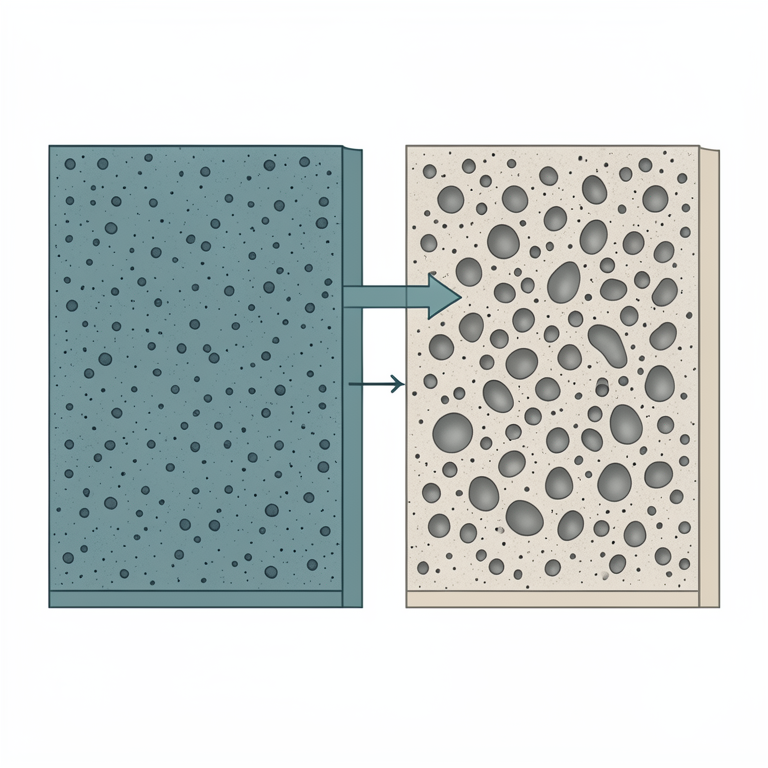
Pigment Volume Concentration Effect
AI-generated conceptual illustration (zinc phosphate-based primer coating on mild steel). It explains the idea and does not show study data.
View source evidence ↗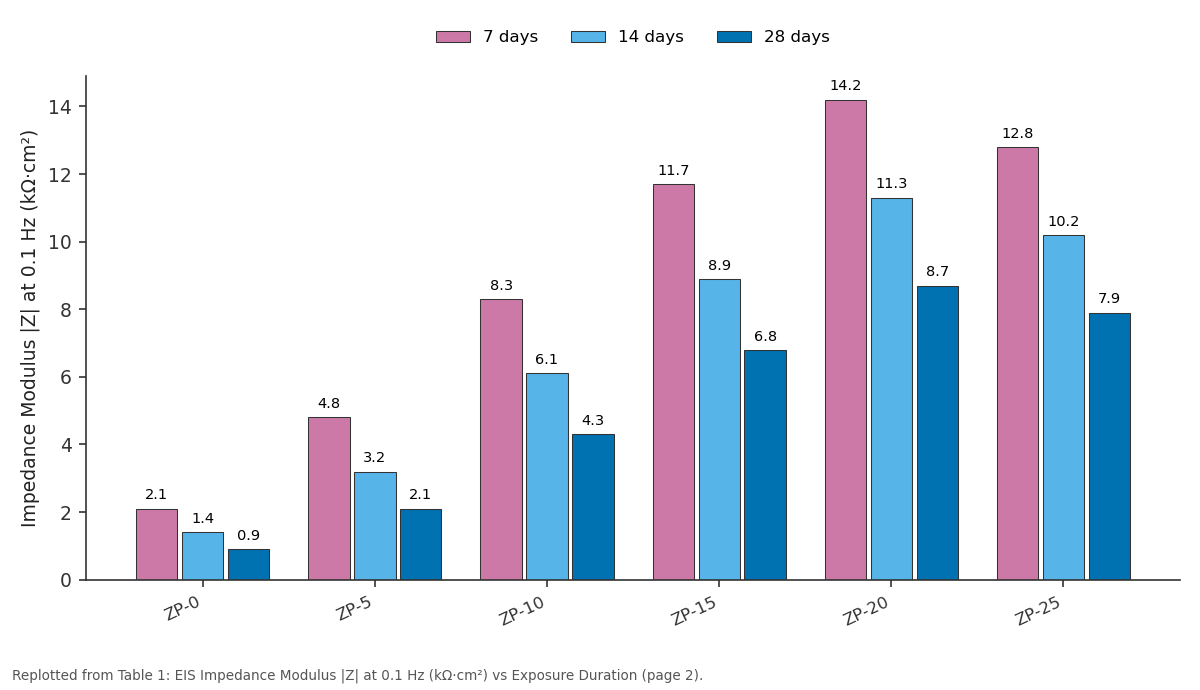
7 days and 14 days and more: ZP-0 vs ZP-5 vs ZP-10 vs ZP-15 vs ZP-20
Replotted from Table 1 (page 2) of the original paper. Every bar is the paper's own table value.
View source evidence ↗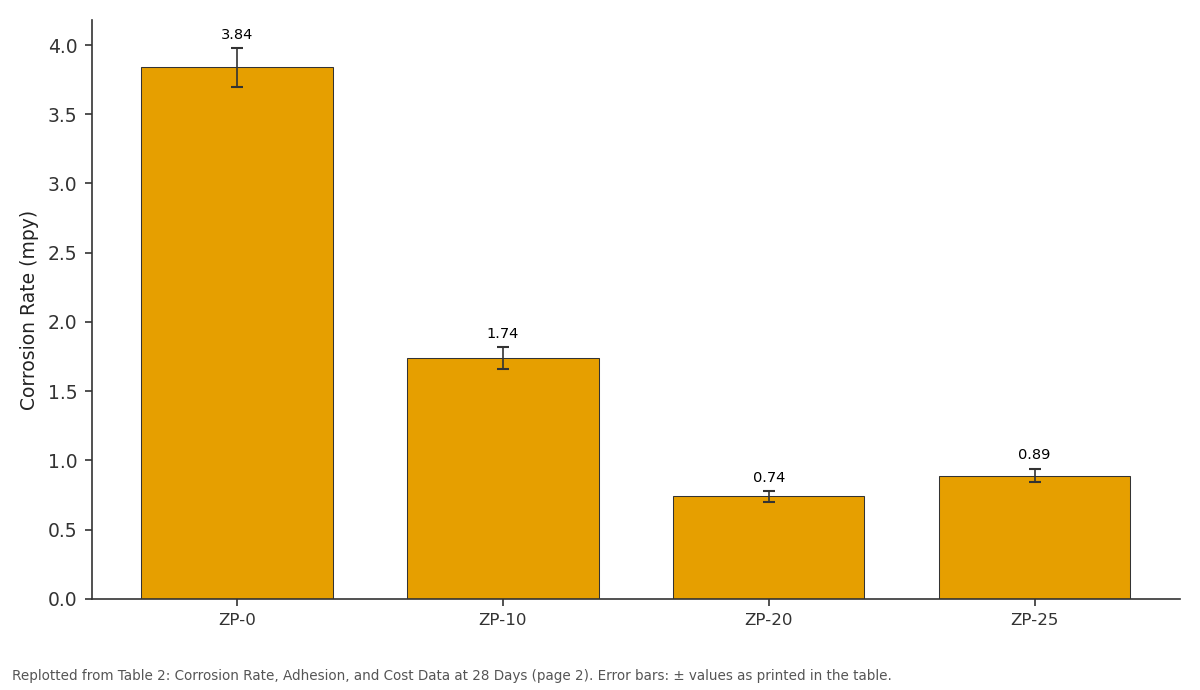
Corr. Rate (mpy): ZP-0 vs ZP-10 vs ZP-20 vs ZP-25
Replotted from Table 2 (page 2) of the original paper. Every bar is the paper's own table value.
View source evidence ↗Figures & tables
From the original paper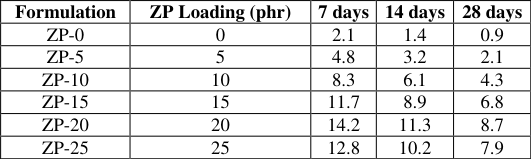 Table 1
 Table 2
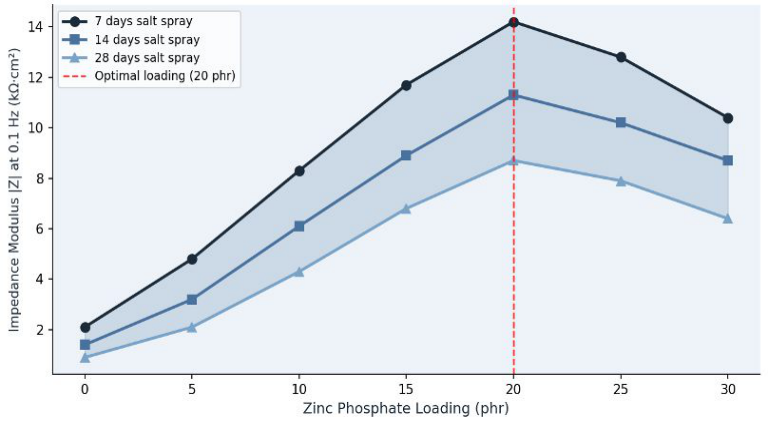 Figure 1
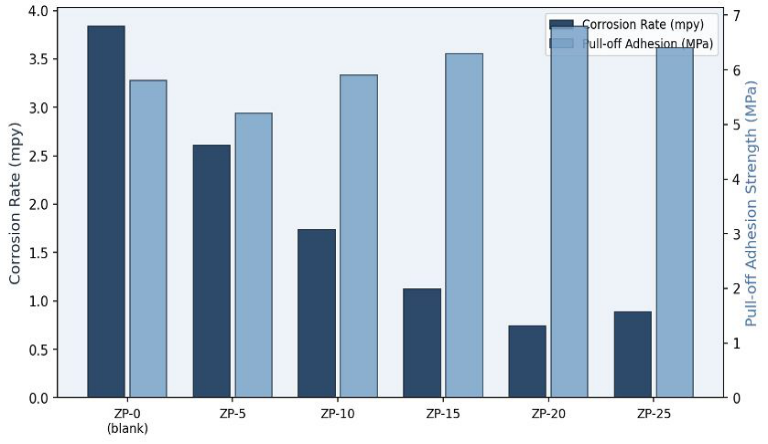 Figure 2
Introduction
Mild steel is the dominant structural material in Indian industrial, infrastructure, and automotive applications by tonnage, yet its inherent susceptibility to aqueous corrosion makes coating protection essential for any outdoor or humid service environment. The Indian corrosion cost is estimated at approximately ₹2.5 lakh crore annually (Bureau of Indian Standards data), with a significant fraction attributable to premature failure of protective coatings. Primer selection—the first and most critical layer in a coating system—determines the long-term barrier and electrochemical protection available to the substrate. Lead chromate, once the standard anticorrosive pigment in industrial primers, is now banned under the European REACH regulation and increasingly restricted under Indian environmental norms.
Zinc phosphate emerged as the principal replacement because it provides both passivating and barrier protection through a dual mechanism: phosphate ions suppress anodic dissolution of steel, while zinc ions promote formation of a protective film. However, ZP's anticorrosive efficacy depends strongly on pigment loading in the binder—too little and protection is incomplete, too much and the critical pigment volume concentration (CPVC) is exceeded, increasing porosity and reducing mechanical properties. Despite ZP's widespread commercial use, systematic quantitative data on the loading-performance curve in alkyd binder under Indian climatic exposure simulation, combined with explicit cost analysis, are limited in the open literature. This research provides this dataset, combining EIS, salt spray, and potentiodynamic techniques with a cost-effectiveness calculation.
Materials And Methods
Materials Medium-oil alkyd resin (60% oil length, acid value 8 mg KOH/g) was from Sudarshan https://www.chemistryjournals.net the metal-primer interface provides a secondary protective barrier independent of the organic binder. Performance Evaluation Performance was evaluated against five criteria: (1) EIS impedance modulus retention over 28 days; (2) corrosion rate from potentiodynamic Tafel analysis; (3) pull-off adhesion after 28-day salt spray; (4) blister grade and rust creep from scribe line (ASTM D714/D610); and (5) overall protection rating calculated as the geometric mean of normalised scores from the four quantitative tests. ZP-20 achieved top ranking on criteria 1, 2, and 5, confirming it as the optimal formulation. Above 20 phr, the CPVC was estimated to be exceeded based on the oil absorption value of the pigment blend, which explains the decline in impedance and adhesion at ZP-25.
Cost Analysis Raw material cost per litre of primer was calculated from supplier quotations (March 2024 Indian market prices). ZP pigment cost ₹187/kg compared with ₹12/kg for calcium carbonate diluent pigment. Increasing ZP loading from 0 to 20 phr raised raw material cost from ₹312/L to ₹338/L, an increment of ₹26/L (8.3%). The expected service life extension—estimated from linear extrapolation of the 28- day EIS decay rate to the criterion of |Z| < 1 kΩ·cm²—was from 2.1 years (ZP-0) to 7.4 years (ZP-20).
Annualised cost of protection (material + repainting labour, estimated at ₹85/m² per application) decreased from ₹48.4 to ₹13.6 per m² per year, confirming strong cost-effectiveness of the optimal ZP loading.
Results
EIS data (Figure 1, Table 1) showed ZP-20 maintaining the highest impedance modulus across all exposure intervals. After 28 days salt spray, ZP-20 retained |Z| = 8.7 kΩ·cm² versus 0.9 kΩ·cm² for the unpigmented ZP-0 control—a near-10-fold improvement. Potentiodynamic data showed a corrosion rate of 0.74 mpy for ZP-20 vs. 3.84 mpy for ZP-0. Pull-off adhesion was highest at ZP-20 (6.8 MPa), consistent with ZP's well-known promoter effect on metal- binder adhesion through formation of metal-organic phosphate linkages at the interface (Figure 2, Table 2).
| Formulation | Corr. Rate (mpy) | Pull-off Adhesion (MPa) | Cost per Litre (₹) | Service Life Est. (yr) |
|---|---|---|---|---|
| ZP-0 | 3.84±0.14 | 5.8±0.3 | 312 | 2.1 |
| ZP-10 | 1.74±0.08 | 5.9±0.3 | 324 | 4.2 |
| ZP-20 | 0.74±0.04 | 6.8±0.3 | 338 | 7.4 |
| ZP-25 | 0.89±0.05 | 6.4±0.3 | 349 | 6.8 |
Table text extracted from the original PDF; superscript letters are shown inline. The original table image is below.
View original table image
| Formulation | ZP Loading (phr) | 7 days | 14 days | 28 days |
|---|---|---|---|---|
| ZP-0 | 0 | 2.1 | 1.4 | 0.9 |
| ZP-5 | 5 | 4.8 | 3.2 | 2.1 |
| ZP-10 | 10 | 8.3 | 6.1 | 4.3 |
| ZP-15 | 15 | 11.7 | 8.9 | 6.8 |
| ZP-20 | 20 | 14.2 | 11.3 | 8.7 |
| ZP-25 | 25 | 12.8 | 10.2 | 7.9 |
Table text extracted from the original PDF; superscript letters are shown inline. The original table image is below.
View original table image
Chemical Industries, Pune. Zinc phosphate pigment (tetrahydrate, particle size D50 = 4.2 μm, phosphate content 58.4%) was from Excel Industries, Mumbai. Titanium dioxide (rutile, CR-501, Cristal), calcium carbonate (Omyacarb 10, Omya), and xylene (98%) were of technical grade from local industrial suppliers. Mild steel panels (IS:2062 Grade A, 150 × 100 × 1 mm, grit-blasted to Sa 2.5) were prepared in-house.
Research was conducted at the Departments of Industrial and Manufacturing Chemistry and Process Chemistry and Engineering at Maharshi Dayanand College of Pharmacy, Rohtak, Haryana, and Gopabandhu Institute of Chemical Technology, Sambalpur, Odisha, from January 2023 to October 2024.
Methods
Six primer formulations (ZP-0 to ZP-25) were prepared by dispersing pigments in alkyd resin and xylene using a high- speed disperser (Cowles blade, 3000 rpm, 30 min). Dry film thickness was controlled at 60±5 μm (verified by Elcometer 456 DFT gauge). EIS measurements used a Gamry Interface 1000 potentiostat in 3.5% NaCl, frequency range 10⁵ to 0.01 Hz, applied AC amplitude 10 mV. Salt spray testing followed ASTM B117 at 35 °C; panels were assessed for blister grade (ASTM D714) and rust grade (ASTM D610) at 7, 14, and 28 days.
Pull-off adhesion (ISO 4624) used a PosiTest AT-A automatic adhesion tester with 20 mm dollies. Potentiodynamic polarisation scanned from −250 to + 250 mV vs OCP at 1 mV/s; Tafel slopes were used to extract corrosion current density and corrosion rate. Theoretical Background Electrochemical impedance spectroscopy analyses the frequency-dependent response of a coated metal to a small AC perturbation, yielding equivalent circuit parameters that quantify barrier properties. A high-impedance coating in the low-frequency region (|Z| at 0.1 Hz) indicates good barrier resistance to ionic transport through the film.
As degradation proceeds—via water uptake, pore formation, or delamination—|Z| decreases. The double-layer capacitance (Cdl) rises as the active corrosion area increases. Zinc phosphate acts as an anodic inhibitor: phosphate ions adsorb on the steel surface and displace the aggressive chloride and oxygen that drive the iron dissolution reaction Fe → Fe²⁺ + 2e⁻. The resulting iron-zinc phosphate passivation layer at Table 1: EIS Impedance Modulus |Z| at 0.1 Hz (kΩ·cm²) vs Exposure Duration Formulation ZP Loading (phr) 7 days 14 days 28 days ZP-0 0 2.1 1.4 0.9 ZP-5 5 4.8 3.2 2.1 ZP-10 10 8.3 6.1 4.3 ZP-15 15 11.7 8.9 6.8 ZP-20 20 14.2 11.3 8.7 ZP-25 25 12.8 10.2 7.9 Table 2: Corrosion Rate, Adhesion, and Cost Data at 28 Days Formulation Corr.
Rate (mpy) Pull-off Adhesion (MPa) Cost per Litre (₹) Service Life Est. (yr) ZP-0 3.84±0.14 5.8±0.3 312 2.1 ZP-10 1.74±0.08 5.9±0.3 324 4.2 ZP-20 0.74±0.04 6.8±0.3 338 7.4 ZP-25 0.89±0.05 6.4±0.3 349 6.8 https://www.chemistryjournals.net Fig 1: EIS impedance modulus |Z| at 0.1 Hz vs zinc phosphate loading after 7, 14, and 28 days salt spray exposure. Dashed line marks optimal loading. Fig 2: Corrosion rate (mpy) and pull-off adhesion strength (MPa) of six zinc phosphate primer formulations after 28 days salt spray.
Conclusion
Six alkyd primer formulations containing 0-25 phr zinc phosphate were evaluated on mild steel using EIS, salt spray, potentiodynamic polarisation, and pull-off adhesion. ZP-20 was identified as optimal: corrosion rate 0.74 mpy, impedance 8.7 kΩ·cm² at 28 days, and pull-off adhesion 6.8 MPa. Cost analysis showed that ZP-20's marginal raw material premium of 8.3% translates to a 3.5-fold extension of service life and a 71% reduction in annualised protection cost per m². These findings provide quantitative formulation guidance for industrial corrosion-protective primers in the Indian manufacturing context, supporting replacement of restricted lead chromate with ZP as a viable high- performance alternative.
Discussion
The ZP-20 optimum reflects the balance between two opposing effects of pigment loading. At low concentrations, phosphate ion availability for passivation is insufficient and barrier properties are dominated by the resin. As ZP content increases toward 20 phr, passivation efficiency improves, adhesion is enhanced through interfacial phosphate chemistry, and porosity remains low because the total pigment volume concentration (PVC) is below the CPVC. At ZP-25, the combined PVC of all pigments approaches and likely exceeds the CPVC, increasing film porosity and creating electrolyte permeation pathways that reduce both impedance and adhesion.
The cost analysis places the value of ZP optimisation in practical context. An 8.3% increase in raw material cost that extends service life from 2.1 to 7.4 years—a 3.5-fold extension—represents outstanding economic value, particularly in the Indian industrial sector where repainting access costs on large structures (bridges, storage tanks, transmission towers) are very high. The annualised protection cost reduction from ₹48 to ₹14 per m² per year is a compelling argument for specifying ZP-20 loading in industrial primer formulations. https://www.chemistryjournals.net 3. Bayliss DA, Deacon DJ.
Steelwork Corrosion Control. 2nd ed. London: Spon Press; 2002. 4. Knudsen OØ, Forsgren A. Corrosion Control Through Organic Coatings. 2nd ed.
Boca Raton: CRC Press; 2017. 5. Bethencourt M, Botana FJ, Calvino JJ, Marcos M, Rodríguez-Chacón MA. Lanthanide compounds as environmentally-friendly corrosion inhibitors of aluminium alloys: a review. Corros Sci. 1998;40(11):1803-1819. 6.
Camalet JL, Lacroix JC, Aeiyach S, Chane-Ching K, Lacaze PC. Electrodeposition of adherent polypyrrole films on mild steel from aqueous solution. J Electroanal Chem. 1998;445(1-2):117-124. 7. Mayne JE.
Paints for the protection of steel: a review of research into their modes of action. Br Corros J. 1970;5(3):106-111. 8. Sorensen PA, Kiil S, Dam-Johansen K, Weinell CE. Anticorrosive coatings: a review.
J Coat Technol Res. 2009;6(2):135-176. 9. Amirudin A, Thierry D. Application of electrochemical impedance spectroscopy to study the degradation of polymer-coated metals. Prog Org Coat. 1995;26(1):1- 28. 10.
ASTM B117-19. Standard Practice for Operating Salt Spray (Fog) Apparatus. West Conshohocken, PA: ASTM International; 2019. 11. ISO 4624:2016.
Paints and Varnishes — Pull-off Test for Adhesion. Geneva: ISO; 2016. 12. Lindqvist SA. Theory of dielectric properties of heterogeneous substances applied to water in an alkyd film.
Corrosion. 1985;41(2):69-75. 13. Zubielewicz M, Gnot W. Mechanisms of non-toxic anticorrosive pigments in organic waterborne coatings. Prog Org Coat. 2004;49(4):358-371. 14.
Shi X, Nguyen TA, Suo Z, Liu Y, Avci R. Effect of nanoparticles on the anticorrosion and mechanical properties of epoxy coating. Surf Coat Technol. 2009;204(3):237-245.
References
2 in the original paper- Gentil V, Gomes JAC, Pereira JA. Corrosão. 6th ed. Rio de Janeiro: LTC; 2011.
- Wicks ZW, Jones FN, Pappas SP, Wicks DA. Organic Coatings: Science and Technology. 3rd ed. Hoboken: Wiley; 2007.