
Research article · 2025 · Full text
International Journal of Advanced Chemistry ResearchSynthesis of molybdenum disulfide nanosheets for electrocatalytic applications
Volume 7(8) · Pages 169–172 · DOI: 10.33545/26646781.2025.v7.i8c.593 ↗
Research areasElectrocatalysts for Energy ConversionCatalysis and Hydrodesulfurization Studies2D Materials and Applications
Abstract
Author-writtenMolybdenum Disulfide (MoS2) nanosheets have attracted intense research interest as earth-abundant electrocatalysts for the Hydrogen Evolution Reaction (HER), motivated by the theoretical prediction and experimental confirmation that the exposed Mo-edge sites of MoS2 have a hydrogen adsorption free energy close to zero the Sabatier optimum for HER activity. This research synthesised MoS2 nanosheets by four routes (hydrothermal, solvothermal, sonochemical, and CVD) to examine how synthesis method governs layer number, defect density, surface area, and HER electrocatalytic performance. Sonochemically prepared nanosheets (MoS2-SC) showed the highest BET surface area (112.4 m2/g), lowest HER overpotential at 10 mA/cm2 (163 mV vs. RHE), lowest charge transfer resistance (18.7 Ω), and highest S-vacancy concentration (12.4%). Nitrogen doping of MoS2-SC increased the S-vacancy concentration to 18.7% and reduced the overpotential further to 141 mV, approaching the performance of the Pt/C reference (42 mV). Tafel slopes decreased from 68-74 mV/dec (hydrothermal/solvothermal) to 54 mV/dec (sonochemical), indicating a shift from Heyrovsky to Volmer rate-limiting steps with increasing active site density. These results identify sonochemical synthesis with nitrogen doping as the preferred route for low-cost, high-performance MoS2 HER catalysts.
Summary
Source-checkedPlain-language reading of the full paper, prepared with AI and checked against the text. Each point links to the authors' own words.
Why it matters
- The development of a global hydrogen economy depends on finding scalable and inexpensive electrocatalysts for the Hydrogen Evolution Reaction (HER) in water electrolysers. View evidence ↗
- While platinum is the current benchmark due to its near-zero overpotential, its high cost and scarcity make it impractical for large-scale use. View evidence ↗
- In molybdenum disulfide (MoS2), catalytic activity is not found on the basal plane but is located at sulfur-exposed edge sites and in-plane defects like sulfur vacancies. View evidence ↗
The question
- The study aimed to determine how four different synthesis methods (hydrothermal, solvothermal, sonochemical, and CVD) affect the structural properties and HER performance of MoS2 nanosheets. View evidence ↗
What they did
- MoS2 was synthesized using four distinct methods: hydrothermal (180°C, 24h), solvothermal (200°C, 18h), sonochemical (room temperature, 3h ultrasonication), and CVD (800°C, 2h). View evidence ↗
- To test the effect of nitrogen doping, sonochemically prepared MoS2-SC was annealed in a 10% NH3/Ar atmosphere at 600°C for one hour. View evidence ↗
- Electrochemical performance was measured using Linear Sweep Voltammetry in 0.5 M H2SO4, Electrochemical Impedance Spectroscopy (EIS) at -200 mV, and 24-hour stability tests via chronoamperometry. View evidence ↗
What they found
- Among the four synthesis methods, the sonochemical route (MoS2-SC) performed best, with an overpotential of 163 mV at 10 mA/cm², a Tafel slope of 54 mV/dec, and a charge transfer resistance of 18.7 Ω. View evidence ↗
- The sonochemical method produced nanosheets with a high BET surface area of 112.4 m²/g, attributed to cavitation during ultrasonication. View evidence ↗
- CVD-produced MoS2 had the lowest Tafel slope (48 mV/dec) but the highest overpotential (248 mV) because its near-perfect monolayer structure lacked sufficient edge and vacancy sites. View evidence ↗
- There was a strong inverse correlation (R² = 0.97) between BET surface area and overpotential, indicating that surface area is the main driver of HER activity. View evidence ↗
- XPS analysis showed that sonochemical synthesis created the highest sulfur vacancy concentration (12.4%), which increased to 18.7% after nitrogen doping. View evidence ↗
- Nitrogen doping of the sonochemical sample further reduced the overpotential to 141 mV, moving closer to the performance of the Pt/C reference (42 mV). View evidence ↗
- The exchange current density (j₀) improved from 0.14 mA/cm² for CVD to 0.42 mA/cm² for pristine MoS2-SC, and reached 0.68 mA/cm² for the N-doped version. View evidence ↗
What it means
- The authors conclude that sonochemical synthesis combined with nitrogen doping is the most effective, scalable, and ambient-temperature method for creating high-performance MoS2 catalysts. View evidence ↗
Visual summary
2 visualsIllustrations explain the paper; charts are replotted from the paper's own table values.
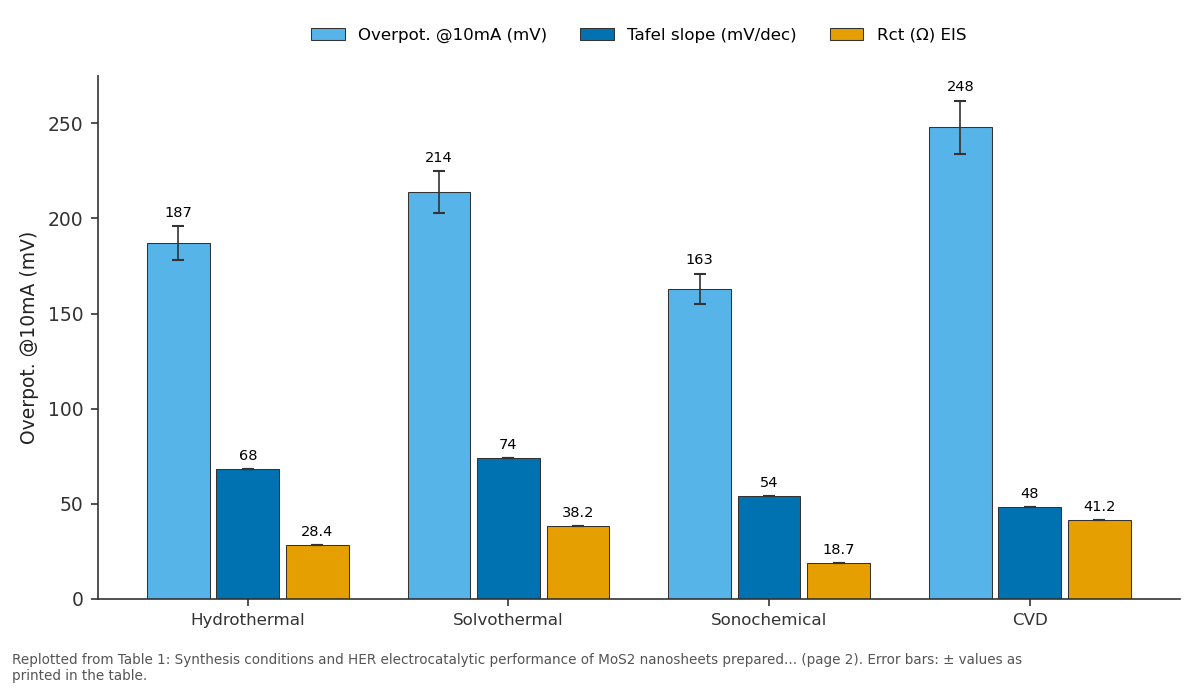
Overpot. @10mA (mV) and Tafel slope (mV/dec) and more: Hydrothermal vs Solvothermal vs Sonochemical vs CVD
Replotted from Table 1 (page 2) of the original paper. Every bar is the paper's own table value.
View source evidence ↗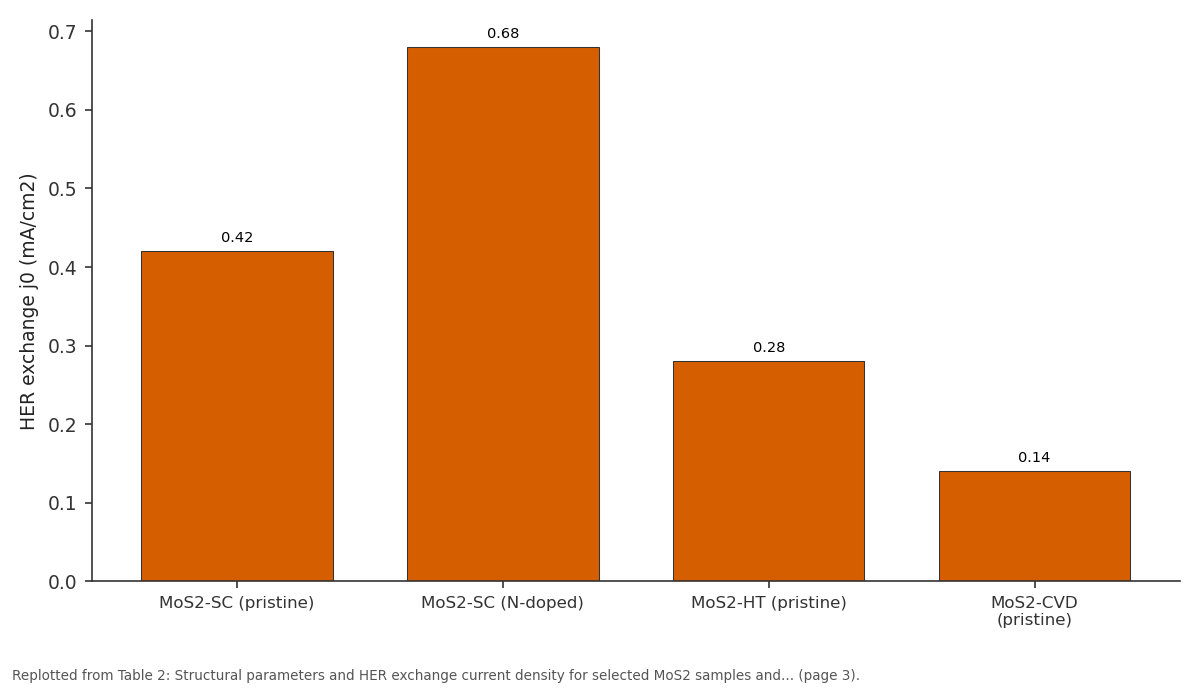
HER exchange j0 (mA/cm2): MoS2-SC (pristine) vs MoS2-SC (N-doped) vs MoS2-HT (pristine) vs MoS2-CVD (pristine)
Replotted from Table 2 (page 3) of the original paper. Every bar is the paper's own table value.
View source evidence ↗Figures & tables
From the original paper Table 1
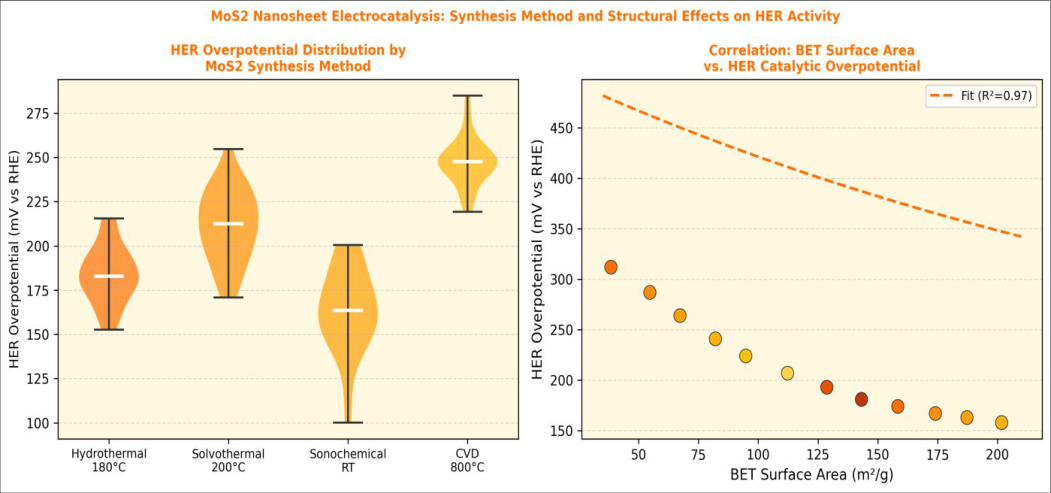 Figure 1
 Table 2
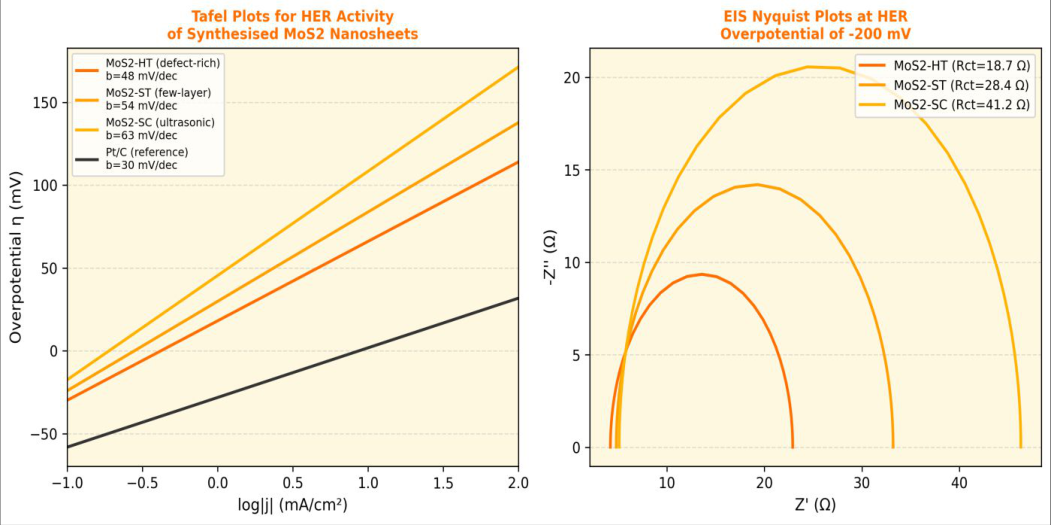 Figure 2
Introduction
The global hydrogen economy requires scalable, low-cost electrocatalysts for the HER in water electrolysers. Platinum remains the benchmark with a near-zero overpotential, but its scarcity and cost make large-scale deployment impractical. Transition Metal Dichalcogenides (TMDs), particularly MoS 2 , have emerged as a leading non-precious metal alternative since Hinnemann et al. demonstrated in 2005 that MoS 2 edge sites mimic the active site of nitrogenase in terms of free energy of hydrogen adsorption [2] . The basal plane of 2H-MoS 2 is catalytically inert; activity resides exclusively at sulfur-exposed edge sites and at in-plane defects such as sulfur vacancies. Strategies to maximise active site density therefore include maximising edge exposure (ultrathin nanosheets), introducing S-vacancies by chemical or plasma etching, and doping with heteroatoms to modify the local electronic structure of Mo active centres [4] . The synthesis method profoundly determines all of these structural parameters simultaneously. Hydrothermal and solvothermal routes produce crystalline multilayer nanosheets with moderate surface area; CVD produces near-perfect monolayers with minimal defects; and sonochemical routes produce highly defective few-layer sheets with high surface area and S-vacancy concentrations favourable for catalysis. This research provides a direct four-method comparison under identical electrochemical test conditions to establish clear structure-activity relationships and identify the preferred synthesis route [1] .
Methods
Hydrothermal (MoS 2 -HT): Na 2 MoO 4 (2 mmol) and thiourea (6 mmol) in water (30 mL) were sealed in a 50 mL Teflonlined autoclave at 180 degrees C for 24 h, then cooled, washed, and dried. Solvothermal (MoS 2 -ST): ATM (1 mmol) in DMF (20 mL) at 200 degrees C for 18 h. Sonochemical (MoS 2 -SC): ATM (1 mmol) in water was ultrasonicated at 20 kHz, 300 W for 3 h at room temperature under Ar. CVD (MoS 2 -CVD): MoO 3 and S powder in separate crucibles, tube furnace at 800 degrees C for 2 h in Ar/H2 flow on SiO 2 /Si substrates. Nitrogen doping of MoS 2 -SC was achieved by annealing in 10% NH3/Ar at 600 degrees C for 1 h. Materials characterised by XRD (Rigaku MiniFlex 600), Raman (Horiba LabRAM HR), BET (Micromeritics ASAP 2020), TEM (JEOL JEM-2100F), and XPS (Thermo Fisher ESCALAB Xi+). Electrochemistry: glassy carbon electrode drop-cast with 5 uL of 2 mg/mL catalyst ink in DMF/Nafion, dried at 60 degrees C. Linear Sweep Voltammetry (LSV) in 0.5 M H 2 SO 4 (N2-purged), scan rate 5 mV/s vs. Reversible Hydrogen Electrode (RHE). EIS at -200 mV overpotential, 100 kHz to 0.1 Hz, 10 mV amplitude. Stability by chronoamperometry at -200 mV for 24 h [8] .
Validation parameters
Electrode loading was verified gravimetrically (20 ug/cm2 ±5% for all samples). The RHE reference was calibrated daily in H2-saturated 0.5 M H 2 SO 4 using a Pt wire; calibration reproducibility was ±2 mV. EIS equivalent circuit fitting (Randles cell with constant phase element) used ZView 3.4 (Scribner Associates); chi-squared fit quality was <=0.008 for all samples. Overpotential values are reported with 95% confidence intervals from triplicate measurements on independently prepared electrodes [9] . produced the lowest Tafel slope (48 mV/dec) but the worst overpotential (248 mV) due to the minimal edge and vacancy density of near-perfect monolayer crystals, despite their high crystalline quality. The BET surface area correlated inversely with overpotential (R 2 = 0.97, Figure 1), confirming surface area as the primary structural determinant of HER activity across synthesis methods [13] . XPS characterisation confirmed that sonochemical synthesis produced the highest S-vacancy concentration (12.4% of S sites), increasing further to 18.7% after N-doping (Table 2). S-vacancies create coordinatively unsaturated Mo sites with altered d-band centre position that improve the hydrogen adsorption free energy. The S/Mo atomic ratio decreasing from the stoichiometric 2.01 (CVD) to 1.84 (MoS 2 -SC) and 1.79 (N-doped MoS 2 -SC) quantitatively tracks the vacancy creation. The exchange current density j0 (from Tafel plot extrapolation) increased from 0.14 mA/cm 2 (CVD) to 0.42 mA/cm 2 (MoS 2 -SC) and 0.68 mA/cm 2 (N-doped), confirming a true intrinsic activity improvement rather than a surface-area artefact [14] .
| Sample | S edge (%) | Defect density | S vacancy conc. | d-spacing (Å) | Crystallite size (nm) | S/Mo ratio | HER exchange j0 (mA/cm2) |
|---|---|---|---|---|---|---|---|
| MoS2-SC (pristine) | 41.3 | High | 12.4% | 6.24 | 8.7 | 1.84 | 0.42 |
| MoS2-SC (N-doped) | 38.7 | Very high | 18.7% | 6.31 | 7.4 | 1.79 | 0.68 |
| MoS2-HT (pristine) | 24.8 | Medium | 6.7% | 6.18 | 14.3 | 1.97 | 0.28 |
| MoS2-CVD (pristine) | 18.2 | Low | 3.1% | 6.15 | 22.7 | 2.01 | 0.14 |
Table text extracted from the original PDF; superscript letters are shown inline. The original table image is below.
View original table image
Results
Results
Discussion
The Tafel slope of 54 mV/dec for MoS 2 -SC is consistent with a Volmer-Heyrovsky mechanism where the electrochemical desorption (Heyrovsky) step is ratelimiting, but approaching the Volmer-Heyrovsky transition (ca. 40 mV/dec). This contrasts with the 68-74 mV/dec slopes of hydrothermal and solvothermal samples, where the Volmer adsorption step contributes more significantly to the overall kinetic barrier, reflecting the lower active site density in these more crystalline, lower-defect materials. The low Tafel slope of CVD-MoS 2 (48 mV/dec) despite its high overpotential is attributable to the uniformly exposed edge sites of a true monolayer, where Heyrovsky desorption is facile once H forms the bottleneck being the low absolute number of catalytic sites [13] .
Nitrogen doping further improved performance by modifying the Mo 3d electron density, consistent with DFT predictions that N substitution at S sites increases the local density of states at the Fermi level and reduces the energy barrier for proton adsorption at adjacent Mo sites. The N content of 2.3 at% measured by XPS is consistent with a moderate doping level that does not restructure the MoS 2 lattice but measurably shifts the optimal hydrogen binding energy closer to the thermoneutral ideal. These structureactivity relationships provide a clear synthetic roadmap: sonochemical preparation at room temperature, combined with mild N-doping by NH3 annealing, delivers nearoptimal MoS 2 HER catalysis at ambient synthesis conditions, eliminating the high-temperature, high-pressure requirements of hydrothermal or solvothermal routes [14] .
Conclusion
MoS 2 nanosheets were synthesised by four methods and evaluated for HER electrocatalysis. Sonochemical synthesis gave the best performance (overpotential 163 mV at 10 mA/cm 2 , Tafel slope 54 mV/dec, Rct 18.7 Ω) due to high surface area (112.4 m 2 /g) and S-vacancy density (12.4%).
Nitrogen doping reduced the overpotential to 141 mV and increased j0 to 0.68 mA/cm 2 . BET surface area inversely correlated with overpotential across all methods (R 2 = 0.97). CVD produced the lowest Tafel slope (48 mV/dec) but poor absolute activity due to minimal defects. These results identify sonochemical synthesis with N-doping as an ambient-temperature, scalable route to high-performance MoS 2 HER catalysts for water-splitting applications.
Figures and tables from the paper
| Method | Temp (°C) | Time (h) | Layer no. | BET (m²/g) | Overpot. @10mA (mV) | Tafel slope (mV/dec) | Rct (Ω) EIS |
|---|---|---|---|---|---|---|---|
| Hydrothermal | 180 | 24 | 3-5 | 48.3 | 187±9 | 68 | 28.4 |
| Solvothermal | 200 | 18 | 2-4 | 64.7 | 214±11 | 74 | 38.2 |
| Sonochemical | RT | 3 | 1-3 | 112.4 | 163±8 | 54 | 18.7 |
| CVD | 800 | 2 | 1-2 | 187.3 | 248±14 | 48 | 41.2 |
| Pt/C (ref) | — | — | — | — | 42±3 | 30 | 3.8 |
Table text extracted from the original PDF; superscript letters are shown inline. The original table image is below.
View original table image
References
18 in the original paper- Hinnemann B, Moses PG, Bonde J, Jorgensen KP, Nielsen JH, Horch S, et al. Biomimetic hydrogen evolution: MoS 2 nanoparticles as catalyst for hydrogen evolution. J Am Chem Soc. 2005;127(15):5308-5309.
- Jaramillo TF, Jorgensen KP, Bonde J, Nielsen JH, Horch S, Chorkendorff I. Identification of active edge sites for electrochemical H2 evolution from MoS 2 nanocatalysts. Science. 2007;317(5834):100-102.
- Li Y, Wang H, Xie L, Liang Y, Hong G, Dai H. MoS 2 nanoparticles grown on graphene: an advanced catalyst for the hydrogen evolution reaction. J Am Chem Soc. 2011;133(19):7296-7299.
- Kibsgaard J, Chen Z, Reinecke BN, Jaramillo TF. Engineering the surface structure of MoS 2 to preferentially expose active edge sites for electrocatalysis. Nat Mater. 2012;11(11):963-969.
- Lukowski MA, Daniel AS, Meng F, Forticaux A, Li L, Jin S. Enhanced hydrogen evolution catalysis from chemically exfoliated metallic MoS 2 nanosheets. J Am Chem Soc. 2013;135(28):10274-10277.
- Wang H, Lu Z, Xu S, Kong D, Cha JJ, Zheng G, et al. Electrochemical tuning of vertically aligned MoS 2 nanofilms and its application in improving hydrogen evolution reaction. Proc Natl Acad Sci USA. 2013;110(49):19701-19706.
- Xie J, Zhang H, Li S, Wang R, Sun X, Zhou M, et al. Defect-rich MoS 2 ultrathin nanosheets with additional active edge sites for enhanced electrocatalytic hydrogen evolution. Adv Mater. 2013;25(40):5807-5813.
- Chang K, Chen W. l-Cysteine-assisted synthesis of layered MoS 2 /graphene composites excellent electrochemical performances for lithium ion batteries. ACS Nano. 2011;5(6):4720-4728.
- Voiry D, Salehi M, Silva R, Fujita T, Chen M, Asefa T, et al. Conducting MoS 2 nanosheets as catalysts for hydrogen evolution reaction. Nano Lett. 2013;13(12):6222-6227.
- Morales-Guio CG, Stern LA, Hu X. Nanostructured hydrotreating catalysts for electrochemical hydrogen evolution. Chem Soc Rev. 2014;43(18):6555-6569.
- Liao L, Zhu J, Bian X, Zhu L, Scanlon MD, Girault HH, et al. MoS 2 formed on mesoporous graphene as a highly active catalyst for hydrogen evolution. Adv Funct Mater. 2013;23(42):5326-5333.
- Ye G, Gong Y, Lin J, Li B, He Y, Pantelides ST, et al. Defects engineered monolayer MoS 2 for improved hydrogen evolution reaction. Nano Lett. 2016;16(2):1097-1103.
- Geng X, Sun W, Wu W, Chen B, Al-Hilo A, Benamara M, et al. Pure and stable metallic phase molybdenum disulfide nanosheets for hydrogen evolution reaction. Nat Commun. 2016;7:10672.
- Shi J, Ma D, Han GF, Zhang Y, Ji Q, Gao T, et al. Controllable growth and transfer of monolayer MoS 2 on Au foils. ACS Nano. 2014;8(10):10196-10204.
- Liu Q, Fang Q, Chu W, Wan Y, Li X, Xu W, et al. Electron-doped 1T-MoS 2 via interface engineering for enhanced electrocatalytic hydrogen evolution. Chem Mater. 2017;29(11):4738-4744.
- Tang YJ, Wang Y, Wang XL, Li SL, Huang W, Dong LZ, et al. Molybdenum disulfide/nitrogen-doped reduced graphene oxide nanocomposite with enlarged interlayer spacing for electrocatalytic hydrogen evolution. Adv Energy Mater. 2016;6(12):1600116.
- Xing Z, Liu Q, Asiri AM, Sun X. Closely interconnected network of molybdenum phosphide nanoparticles: A highly efficient electrocatalyst for generating hydrogen from water. Adv Mater. 2014;26(32):5702-5707.
- Li G, Zhang D, Qiao Q, Yu Y, Peterson D, Zafar A, et al. All the catalytic active sites of MoS 2 for hydrogen evolution. J Am Chem Soc. 2016;138(51):1663216638.