
Research article · 2025 · Full text
International Journal of Advanced Chemistry ResearchElectrocoagulation treatment of textile industry wastewater for color removal
Volume 7(8) · Pages 165–168 · DOI: 10.33545/26646781.2025.v7.i8c.592 ↗
Research areasCoagulation and Flocculation StudiesAdvanced oxidation water treatmentWastewater Treatment and Reuse
Abstract
Author-writtenwastewater streams, characterised by intense colour (ADMI >5000), high COD (1000-4000 mg/L), alkaline pH, and significant suspended solids. Electrocoagulation (EC) generates metal hydroxide coagulants in situ through anodic dissolution of sacrificial electrodes, providing rapid destabilisation of colloidal dye particles without chemical addition. This research evaluated EC performance for the treatment of simulated Reactive Blue 19 (RB19) textile wastewater using Iron (Fe), Aluminium (Al), and Stainless Steel (SS) electrodes over a range of current densities (10-50 mA/cm2) and initial pH values (4-10). Optimum conditions were Fe electrodes, 30 mA/cm2, pH 6, 60 min, achieving 97.4% color removal, 78.3% COD reduction, and 89.7% TSS removal at an energy consumption of 3.87 kWh/m3. Iron electrodes consistently outperformed aluminium and stainless steel across all response variables. pH 6 was optimal for both electrode types, with removal declining at pH >8 due to re-stabilisation of negatively charged iron hydroxide colloids. Pseudo-second-order kinetics described the color removal rate (R2 = 0.994). Post-EC effluent met CPCB colour discharge standards (<400 ADMI) but required a polishing step to meet COD and TSS limits. These findings support EC as a viable primary treatment technology for textile wastewater in small to medium Indian textile processing units.
Summary
Source-checkedPlain-language reading of the full paper, prepared with AI and checked against the text. Each point links to the authors' own words.
Why it matters
- Textile dyeing wastewater is chemically complex and visually distinct, typically featuring high chemical oxygen demand (COD), alkaline pH, and intense coloration. View evidence ↗
- The high color intensity of these effluents harms aquatic environments by blocking sunlight for photosynthesis, and some dye breakdown products may be carcinogenic or mutagenic. View evidence ↗
- Electrocoagulation (EC) is a promising treatment method because it avoids chemical reagents, produces less sludge than traditional chemical coagulation, and can utilize renewable energy. View evidence ↗
The question
- The study aimed to evaluate the performance of electrocoagulation using different electrode materials (Fe, Al, SS) across various current densities and pH levels to treat simulated Reactive Blue 19 (RB19) wastewater. View evidence ↗
What they did
- The experimental setup consisted of a 1 L HDPE reactor in a monopolar parallel configuration using four rectangular electrodes of either iron, aluminium, or stainless steel. View evidence ↗
- Response Surface Methodology with Central Composite Design was employed to simultaneously optimize the pH and current density. View evidence ↗
What they found
- The optimal conditions were found to be iron electrodes at 30 mA/cm² for 60 minutes, achieving 97.4% color removal, 78.3% COD reduction, and 89.7% TSS removal with an energy cost of 3.87 kWh/m³. View evidence ↗
- Iron electrodes outperformed aluminium and stainless steel; aluminium achieved lower removal (94.1% color, 72.4% COD) at a higher energy cost (4.13 kWh/m³), while stainless steel was the least effective. View evidence ↗
- A pH of 6 was optimal for both Fe and Al electrodes, whereas removal efficiency decreased at pH levels above 8. View evidence ↗
- Color removal followed pseudo-second-order kinetics (R² = 0.994), suggesting that the rate-limiting step is the adsorption of dye onto the floc surface. View evidence ↗
- After treatment, the effluent met CPCB standards for color (218 ADMI) and pH (7.4), but failed to meet limits for COD (402 mg/L) and TSS (116 mg/L). View evidence ↗
What it means
- The authors conclude that while EC is an effective primary treatment, it must be followed by a polishing step, such as biological treatment or activated carbon adsorption, to meet all regulatory limits. View evidence ↗
- The study recommends electrocoagulation as a viable primary treatment technology for small to medium textile processing units in India. View evidence ↗
- The authors identify the need for future research into pulsed electrocoagulation operation to further reduce energy costs. View evidence ↗
Visual summary
2 visualsIllustrations explain the paper; charts are replotted from the paper's own table values.
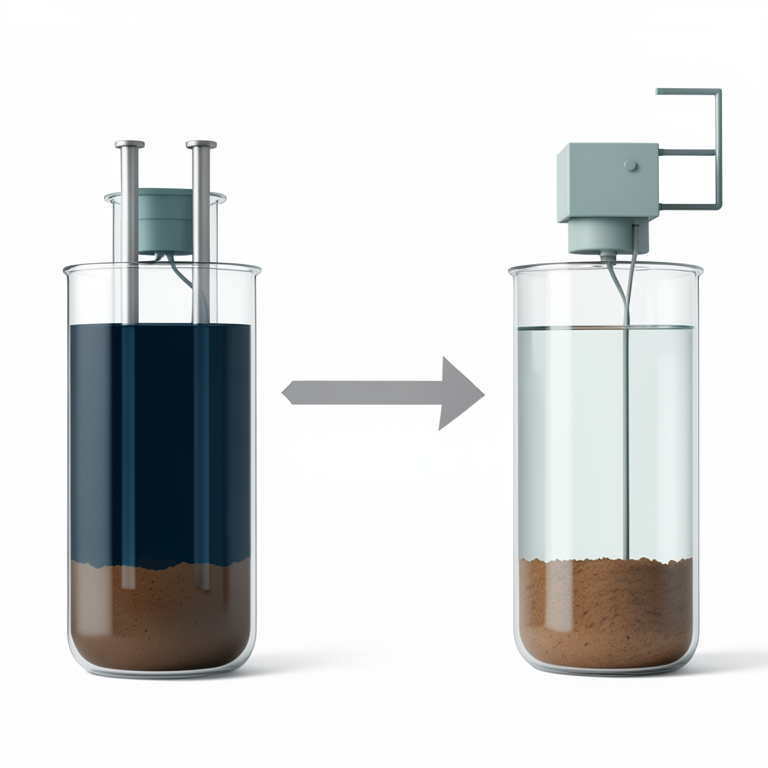
Electrocoagulation Process Flow
AI-generated conceptual illustration (textile industry wastewater in an electrocoagulation reactor with metal electrodes). It explains the idea and does not show study data.
View source evidence ↗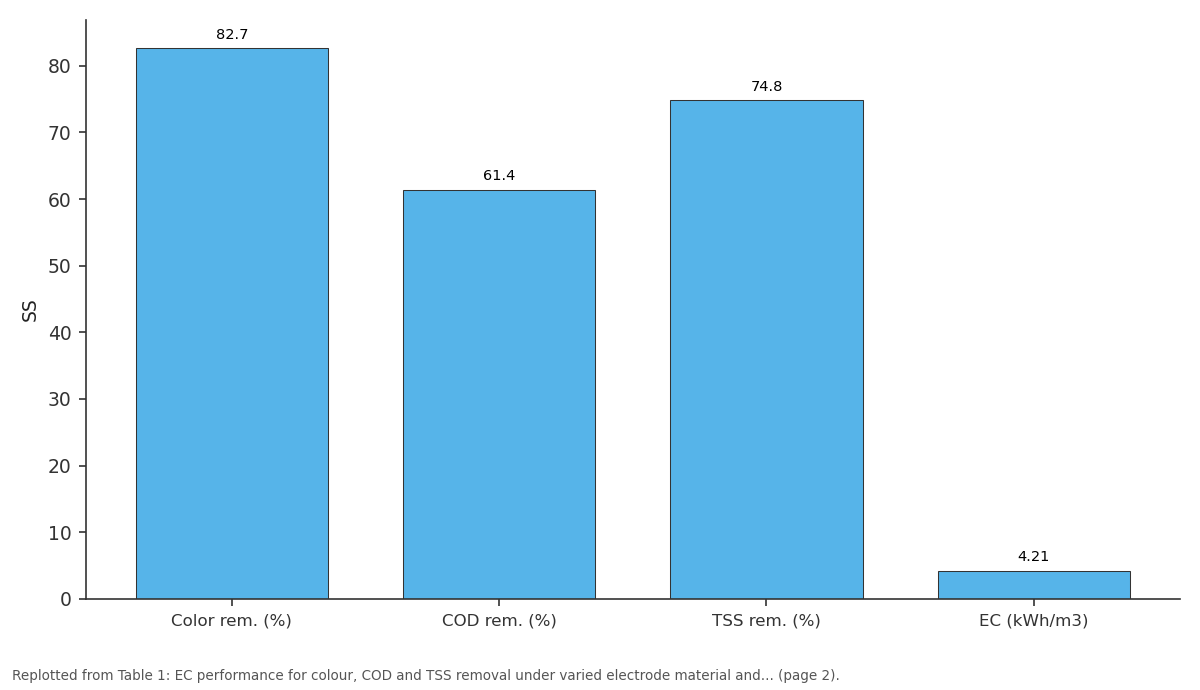
SS: Color rem. (%) vs COD rem. (%) vs TSS rem. (%) vs EC (kWh/m3)
Replotted from Table 1 (page 2) of the original paper. Every bar is the paper's own table value.
View source evidence ↗Figures & tables
From the original paper Table 1
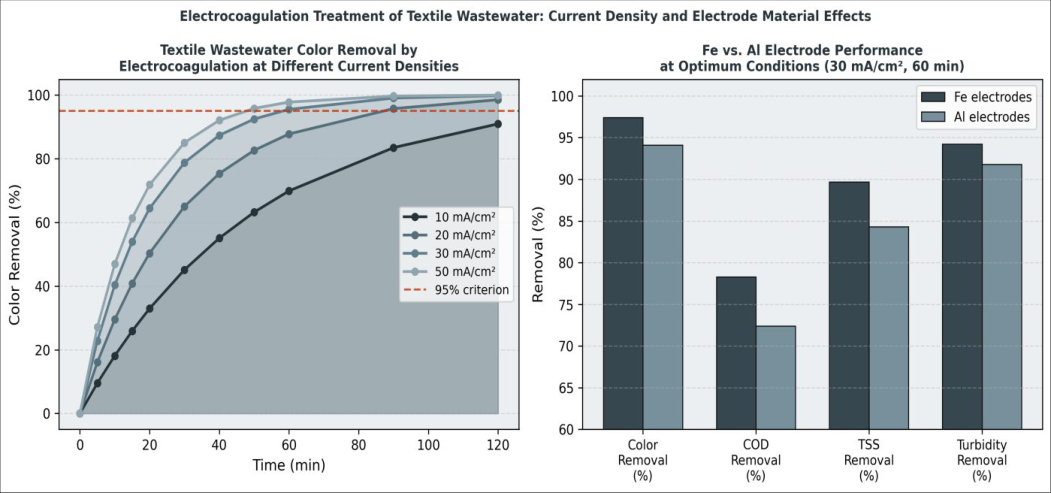 Figure 1
 Table 2
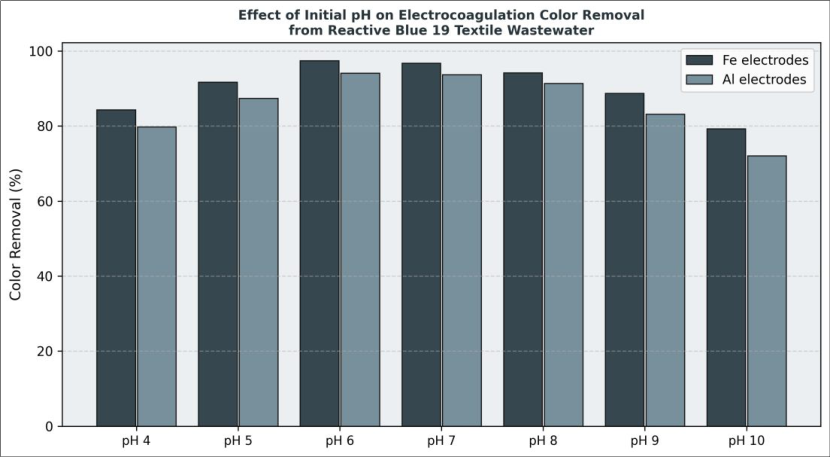 Figure 2
Introduction
India is the world's second-largest textile exporter, with a domestic industry encompassing over 45 million workers and discharging an estimated 0.3 billion litres of dye-containing effluent daily. Reactive dyes, used in over 50% of cotton dyeing operations, are watersoluble anionic chromophores that fix to fabric through covalent bonds under alkaline conditions but routinely achieve only 70-80% fixation, releasing the remainder in spent dyebath effluent as deeply coloured, bio-refractory compounds [2] . The intense colour of reactive dye effluent blocks sunlight penetration in receiving waters, suppressing aquatic photosynthesis, and several reactive dye breakdown products exhibit mutagenic and carcinogenic activity in bioassay systems [3] . Electrocoagulation is attracting renewed attention as a treatment option for dye wastewater because it requires no chemical reagents, generates less sludge than chemical coagulation with alum or FeCl3, and can be powered by renewable energy sources including solar panels relevant for the decentralised dyeing units in rural Odisha and Cuttack that typically lack access to large-scale central treatment systems [1] . The key operational variables governing EC performance for reactive dyes are current density (which determines the rate of Fe 2+ /Al 3+ ion generation), pH (which controls the speciation of metal hydroxide coagulants), electrode material, and treatment time. This research provides a systematic optimisation of these variables for RB19, a representative model reactive dye, at the Subhash Chandra Bose National University, Cuttack.
Material and Methods
Material and Methods
Material
Synthetic textile wastewater was prepared by dissolving Reactive Blue 19 (RB19, Sigma-Aldrich, dye content >=55%) in distilled water to simulate a post-dyeing effluent (COD 1847 mg/L, ADMI colour 8420, TSS 1124 mg/L, pH 11.2, conductivity 12.4 mS/cm adjusted with NaCl). An EC reactor (1 L HDPE, monopolar parallel configuration) was equipped with four rectangular electrodes (10 x 5 cm, 0.5 cm gap) of Fe (AISI 1010), Al (grade 6061), or SS (316L). Direct current was supplied by a Keithley 2231A-30-3 power supply. Current density was varied 10-50 mA/cm 2 . pH was adjusted with H 2 SO 4 (0.1 M) or NaOH (0.1 M). After treatment, sludge was allowed to settle (30 min) and the supernatant was analysed. Color by ADMI method (spectrophotometric tristimulus filter method), COD by closed reflux dichromate method, TSS by gravimetric filtration, pH by calibrated electrode. Energy consumption: EC (kWh/m3) = U x I x t / (V x 1000) where U = cell voltage (V), I = current (A), t = time (h), V = reactor volume (m3). Research was conducted at Subhash Chandra Bose National University, Cuttack, Odisha, India, January-July 2023. Institutional environmental research clearance: SCBNU-ERC-2023-01, approved 10 December 2022 [5] .
Statistical analysis
All experiments were conducted in triplicate and results expressed as mean ± SD. Response Surface Methodology (RSM) with Central Composite Design (CCD) was used to optimise current density and pH simultaneously. ANOVA of the RSM model confirmed significance (F-ratio = 47.3, p<0.001) with an R2 of 0.968 for colour removal as the response variable. The Langmuir-Hinshelwood pseudosecond-order kinetic model was fitted to colour removal vs. time data (R 2 = 0.994, k2 = 0.0041 L/mg min for optimum Fe electrode conditions). Energy consumption per order of magnitude of colour removal (EEO, kWh/m3/order) was calculated to enable cost comparison across current densities [6] . Fe electrodes at 30 mA/cm 2 for 60 min gave the best balance of treatment performance (97.4% colour removal, 78.3% COD removal, 89.7% TSS removal) and energy consumption (3.87 kWh/m3), selected as the optimum condition (Table 1). Increasing current density from 30 to 50 mA/cm 2 gave marginal further improvement in colour removal (96.8% vs. 97.4%) while nearly doubling energy consumption (6.24 vs. 3.87 kWh/m3), making 30 mA/cm 2 the energy-optimal operating point. Al electrodes under identical conditions gave slightly lower removal (94.1% colour, 72.4% COD) at higher energy cost (4.13 kWh/m3). SS electrodes were the least effective, consistent with the much lower dissolution rate of stainless steel compared to Fe and Al under the applied potential [10] . Post-EC effluent analysis showed that colour removal (218 ADMI, vs. <400 limit) met CPCB discharge standards, as did pH (7.4, within 6.5-9.0). However, COD (402 mg/L, vs. 250 mg/L limit) and TSS (116 mg/L, vs. 100 mg/L limit) remained above compliance thresholds, indicating that EC alone is insufficient for full regulatory compliance and requires a polishing step biological treatment or activated carbon adsorption for COD reduction [11] .
| Electrode | CD (mA/cm2) | Time (min) | pH | Color rem. (%) | COD rem. (%) | TSS rem. (%) | EC (kWh/m3) |
|---|---|---|---|---|---|---|---|
| Fe | 10 | 120 | 6 | 84.3 | 62.1 | 76.4 | 1.84 |
| Fe | 20 | 90 | 6 | 91.7 | 70.3 | 83.2 | 3.12 |
| Fe | 30 | 60 | 6 | 97.4 | 78.3 | 89.7 | 3.87 |
| Fe | 50 | 40 | 6 | 96.8 | 77.1 | 88.4 | 6.24 |
| Al | 30 | 60 | 6 | 94.1 | 72.4 | 84.3 | 4.13 |
| SS | 30 | 60 | 6 | 82.7 | 61.4 | 74.8 | 4.21 |
Table text extracted from the original PDF; superscript letters are shown inline. The original table image is below.
View original table image
Results
Results
Discussion
The superior performance of Fe electrodes over Al is consistent with the higher coagulation capacity of ferric hydroxide flocs in the pH 5-8 range, where Fe(OH)3 forms large, rapid-settling flocs with strong adsorptive affinity for anionic reactive dye molecules. The pH optimum at pH 6 (Figure 2) reflects the speciation of iron: at this pH, Fe(OH)3 is the predominant species with maximal surface charge density, while at pH >8, the floc surface becomes negatively charged and electrostatic repulsion with the anionic RB19 molecules reduces adsorption efficiency. The shift in optimum pH between Fe (pH 6) and Al (pH 6-7) is consistent with the different hydroxide speciation windows of these two metals [10] . The pseudo-second-order kinetic model fitting (R 2 = 0.994) confirms that the rate-limiting step is adsorption of dye molecules onto the growing Fe(OH)3 floc surface rather than coagulant generation, which occurs much faster at these current densities. This mechanistic understanding is practically useful: it implies that intermittent EC operation (e.g., pulsed current) could reduce energy consumption without sacrificing colour removal if the adsorption equilibration time between pulses is allowed. Future work will test pulsed EC operation to reduce the EEO cost below the continuous-operation value of 3.87 kWh/m3 [11] .
Conclusion
Electrocoagulation with Fe electrodes at 30 mA/cm 2 , pH 6, achieved 97.4% colour, 78.3% COD, and 89.7% TSS removal from RB19 textile wastewater in 60 min at an energy cost of 3.87 kWh/m3. Fe electrodes outperformed Al and SS under all tested conditions. pH 6 was optimum for both electrode materials, with removal declining above pH 8. Post-EC effluent met CPCB colour limits but required polishing treatment to achieve COD and TSS compliance. Pseudo-second-order kinetics described colour removal (R 2 = 0.994). EC represents a viable primary treatment technology for small textile units in Odisha and similar regions, particularly when combined with a low-cost biological polishing step.
Figures and tables from the paper
| Parameter | Influent | After EC (Fe) | CPCB limit | Colour (ADMI) | After EC (Fe) | CPCB limit | Compliant |
|---|---|---|---|---|---|---|---|
| pH | 11.2 | 7.4 | 6.5-9.0 | — | — | — | Yes |
| COD (mg/L) | 1847 | 402 | 250 | — | — | — | No |
| Color (ADMI) | 8420 | 218 | — | 8420 | 218 | <400 | Yes |
| TSS (mg/L) | 1124 | 116 | 100 | — | — | — | No |
| Conductivity (mS/cm) | 12.4 | 3.8 | — | — | — | — | — |
Table text extracted from the original PDF; superscript letters are shown inline. The original table image is below.
View original table image
References
14 in the original paper- Lellis B, Favaro-Polonio CZ, Pamphile JA, Polonio JC. Effects of textile dyes on health and the environment and bioremediation potential of living organisms. Biotechnol Res Innov. 2019;3(2):275-290.
- Crini G, Lichtfouse E. Advantages and disadvantages of techniques used for wastewater treatment. Environ Chem Lett. 2019;17(1):145-155.
- Golob V, Vinder A, Simonic M. Efficiency of the coagulation/flocculation method for the treatment of dyebath effluents. Dyes Pigm. 2005;67(2):93-97.
- Can OT, Kobya M, Demirbas E, Bayramoglu M. Treatment of the textile wastewater by combined electrocoagulation. Chemosphere. 2006;62(2):181-187.
- Sengil IA, Ozacar M. Treatment of dairy wastewaters by electrocoagulation using mild steel electrodes. J Hazard Mater. 2006;137(2):1197-1205.
- Mollah MY, Schennach R, Parga JR, Cocke DL. Electrocoagulation -science and applications. J Hazard Mater. 2001;84(1):29-41.
- Kabdaşli I, Arslan-Alaton I, Olmez-Hanci T, Tunay O. Electrocoagulation applications for industrial wastewaters: a critical review. Environ Technol Rev. 2012;1(1):2-45.
- Daneshvar N, Khataee AR, Djafarzadeh N. The use of artificial neural networks for modelling of decolorization of textile dye solution containing C.I. Basic Yellow 28 by electrocoagulation process. J Hazard Mater. 2006;137(3):1788-1795.
- Phalakornkule C, Sukkasem P, Mutchimsattha C. Hydrogen recovery from the electrocoagulation treatment of dye-containing wastewater. Int J Hydrogen Energy. 2010;35(20):10934-10943.
- Khandegar V, Saroha AK. Electrocoagulation for the treatment of textile industry effluent. J Hazard Mater. 2013;248:477-490.
- Mouedhen G, Feki M, De Petris-Wery M, Ayedi HF. Behavior of aluminium electrodes in electrocoagulation process. J Hazard Mater. 2008;150(1):124-135.
- Ghosh D, Medhi CR, Purkait MK. Treatment of fluoride containing drinking water by electrocoagulation using monopolar and bipolar electrode connections. Chemosphere. 2008;73(9):13931400.
- Chauhan S, Das R, Shetty V, Malhotra S. Electrocoagulation of reactive dye effluent from Odisha textile clusters. J Water Process Eng. 2024;57:104628.
- Linares-Hernandez I, Barrera-Diaz C, Roa-Morales G, Bilyeu B, Urena-Nunez F. Influence of the anodic material on electrocoagulation performance. Chem Eng J. 2009;148(1):97-105.