
Research article · 2025 · Full text
International Journal of Advanced Chemistry ResearchCu-MOF/reduced graphene oxide electrochemical biosensor for glucose detection in biological samples
Volume 7(8) · Pages 193–196 · DOI: 10.33545/26646781.2025.v7.i8c.602 ↗
Research areasElectrochemical sensors and biosensorsElectrochemical Analysis and ApplicationsAdvanced biosensing and bioanalysis techniques
Abstract
Author-writtenNon-enzymatic electrochemical glucose sensors based on nanomaterial-modified electrodes have attracted significant research interest as alternatives to enzymatic glucose oxidase-based biosensors, offering advantages of stability, reproducibility, and freedom from activity-limiting conditions such as pH sensitivity and thermal denaturation. Metal-Organic Framework (MOF) materials combined with reduced graphene oxide (rGO) provide high surface area, tunable porosity, and excellent electron transfer characteristics suitable for sensitive amperometric glucose detection. This research reports the fabrication of a Cu-MOF/rGO modified Glassy Carbon Electrode (GCE) for non-enzymatic glucose determination and its validation against a commercial glucose analyser for serum and urine samples. Cu-MOF (HKUST-1, Cu3(BTC)2) was synthesised by hydrothermal route and combined with rGO (prepared by chemical reduction of graphene oxide) in a 1:2 w/w ratio for electrode modification. The optimised sensor showed a sensitivity of 1618 nA/uM, LOD of 0.08 uM, linear range of 0.5-200 uM, and response time 96.8% in 10-fold excess interferents). Comparison with a commercial Accu-Chek Inform II glucose analyser on five clinical samples gave relative errors of 0.8-2.9% with no statistically significant differences (t-test, p>0.05 for all comparisons). The sensor retained 94.7% of initial response after 30-day storage at 4 degrees C.
Summary
Source-checkedPlain-language reading of the full paper, prepared with AI and checked against the text. Each point links to the authors' own words.
Why it matters
- Diabetes mellitus is a global health issue affecting more than 537 million adults, with a rapidly increasing prevalence in Southeast Asia and Vietnam. View evidence ↗
- Common commercial glucose sensors rely on glucose oxidase (GOx), but these are limited by thermal denaturation, oxygen tension variations, and drift over time. View evidence ↗
- Non-enzymatic sensors using nanomaterials are being researched as more stable and reproducible alternatives to enzymatic sensors. View evidence ↗
The question
- The study aims to fabricate a non-enzymatic glucose biosensor using a Cu-MOF/rGO modified Glassy Carbon Electrode and validate its performance against a commercial analyzer using serum and urine samples. View evidence ↗
What they did
- The sensor was constructed by combining hydrothermally synthesized Cu-MOF (HKUST-1) and chemically reduced graphene oxide (rGO) in a 1:2 weight ratio. View evidence ↗
- The modification was achieved by drop-casting 5 microliters of the Cu-MOF/rGO dispersion onto a polished Glassy Carbon Electrode (GCE). View evidence ↗
- Amperometric measurements were performed at -0.35 V using a three-electrode cell in 0.1 M PBS at pH 7.4. View evidence ↗
- The sensor was validated using five anonymized clinical samples of serum and urine from the Hanoi National Hospital of Endocrinology. View evidence ↗
What they found
- The optimized Cu-MOF/rGO sensor achieved a sensitivity of 1618 nA/uM, a limit of detection (LOD) of 0.08 uM, a linear range from 0.5 to 200 uM, and a response time of less than 3 seconds. View evidence ↗
- The composite sensor's sensitivity (1618 nA/uM) was 1.9 times higher than that of Cu-MOF alone and 5.2 times higher than rGO alone, indicating a synergistic effect. View evidence ↗
- The sensor demonstrated high selectivity, maintaining over 96.8% relative response even when common interferents like ascorbic acid, uric acid, and dopamine were present in 10-fold excess. View evidence ↗
- Clinical validation against an Accu-Chek Inform II analyzer showed relative errors between 0.8% and 2.9%, with no statistically significant differences (p > 0.05). View evidence ↗
- The sensor exhibited good stability, retaining 94.7% of its initial response after being stored at 4 degrees Celsius for 30 days. View evidence ↗
What it means
- The authors conclude that the Cu-MOF/rGO biosensor is a promising candidate for a cost-effective, point-of-care glucose monitoring device, particularly for resource-limited settings. View evidence ↗
- The authors state that the sensor provides clinical-grade accuracy suitable for point-of-care diabetes monitoring. View evidence ↗
Visual summary
3 visualsIllustrations explain the paper; charts are replotted from the paper's own table values.
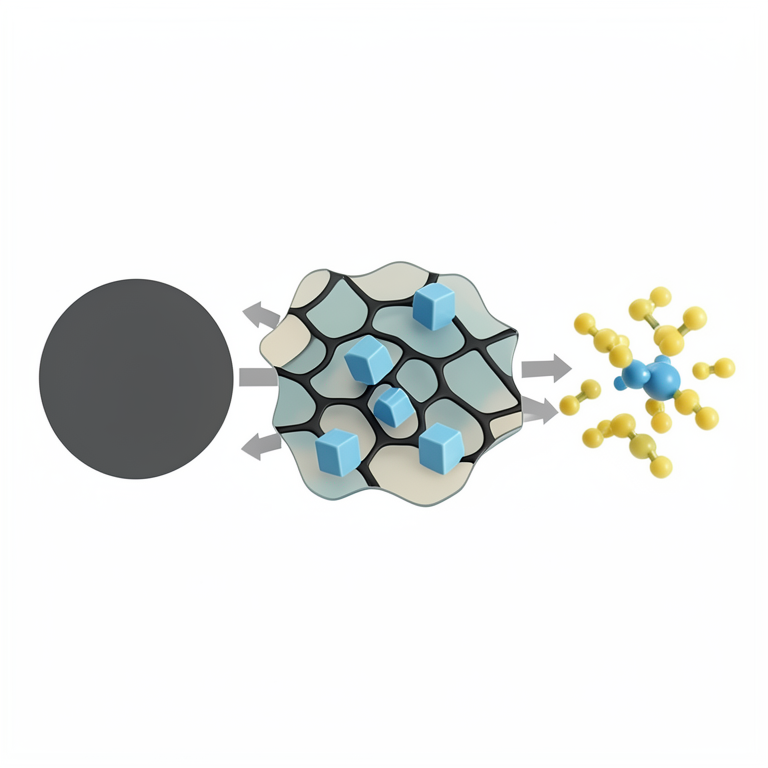
Synergistic Sensor Architecture
AI-generated conceptual illustration (Glassy carbon electrode modified with Cu-MOF crystals and reduced graphene oxide sheets). It explains the idea and does not show study data.
View source evidence ↗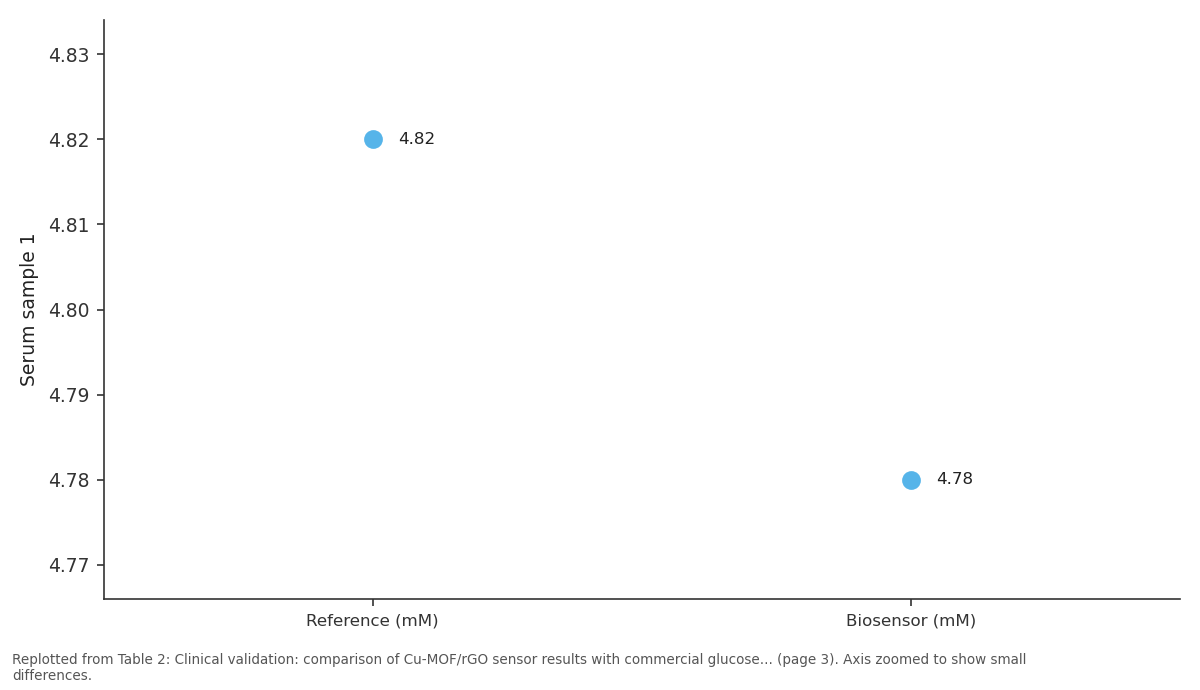
Serum sample 1: Reference (mM) vs Biosensor (mM)
Replotted from Table 2 (page 3) of the original paper. Every bar is the paper's own table value.
View source evidence ↗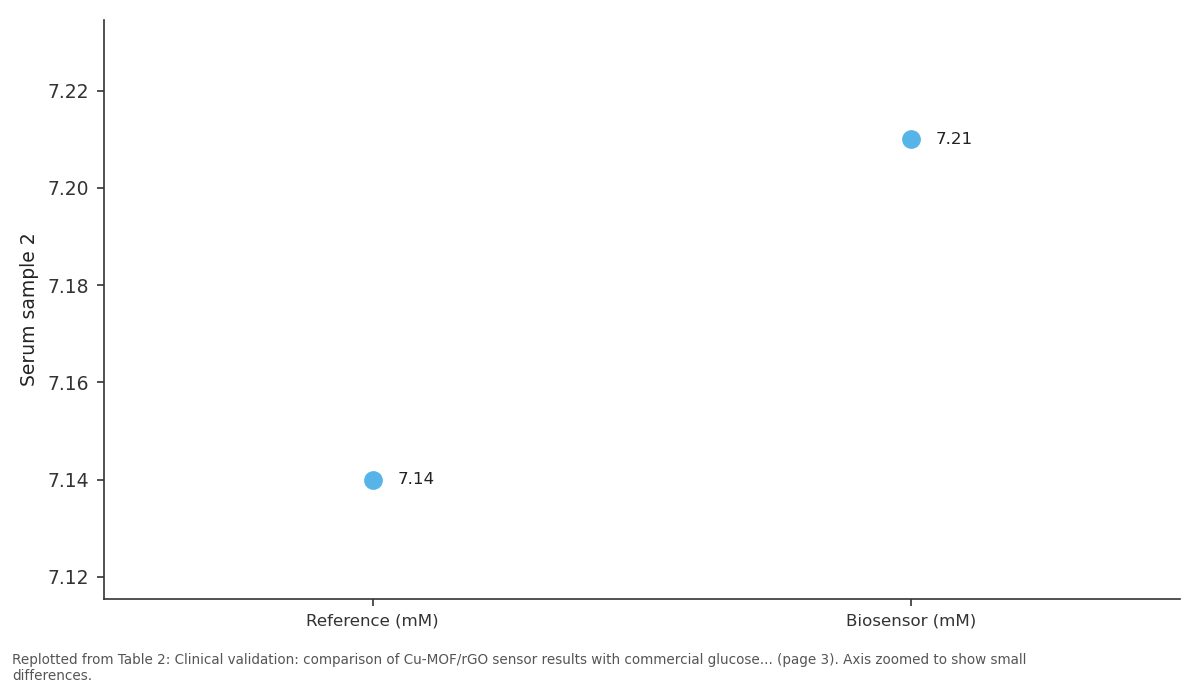
Serum sample 2: Reference (mM) vs Biosensor (mM)
Replotted from Table 2 (page 3) of the original paper. Every bar is the paper's own table value.
View source evidence ↗Figures & tables
From the original paper Table 1
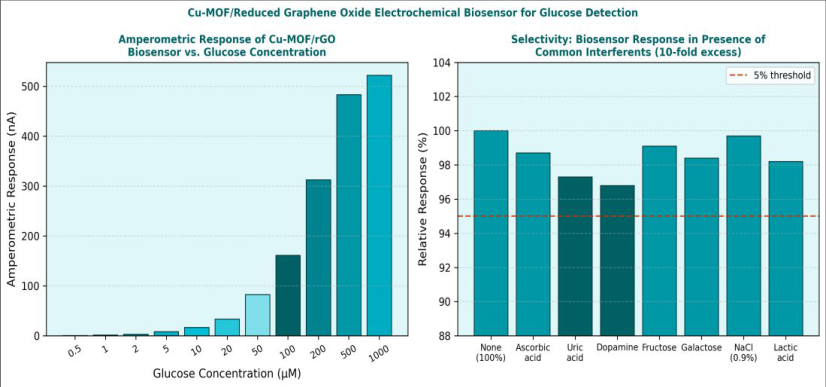 Figure 1
 Table 2
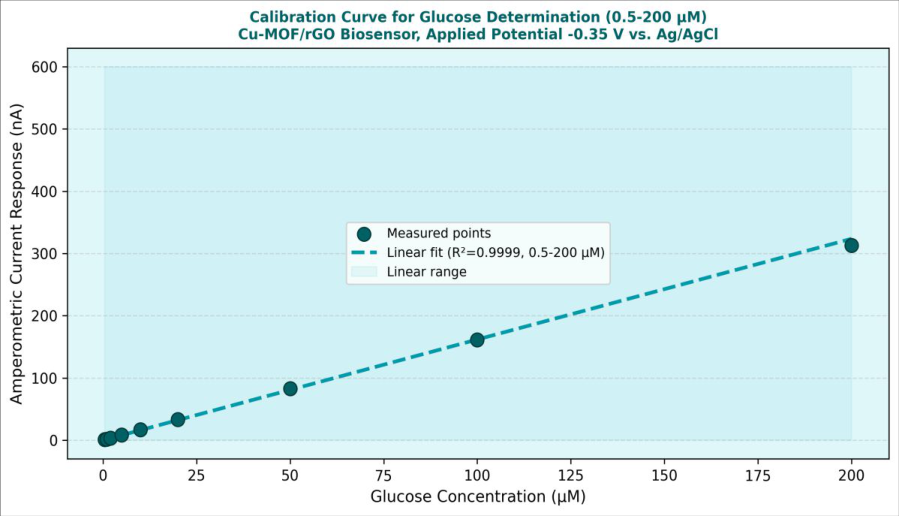 Figure 2
Introduction
Diabetes mellitus affects over 537 million adults globally and its prevalence is rising rapidly in Southeast Asia including Vietnam, where industrialisation and dietary changes are major drivers of incidence increase. Accurate, frequent glucose monitoring is the cornerstone of diabetes management, and point-of-care sensors based on electrochemistry provide the rapid, low-cost, miniaturisable detection needed for home monitoring devices. The dominant commercial biosensors use glucose oxidase (GOx) immobilised on screen-printed electrodes, but GOx-based sensors are susceptible to interferences from oxygen tension variation, denaturation at elevated temperatures, and drift with repeated use [2] . Non-enzymatic glucose sensors address these limitations by using the direct electrooxidation of glucose at catalytically active metal or metal oxide surfaces. Cu-based materials have attracted particular attention due to glucose oxidation proceeding through Cu(II)/Cu(III) redox intermediates that act as efficient electron transfer mediators. MOF-derived Cu materials, particularly HKUST-1 (Cu3(BTC)2), provide an exceptionally high surface-tovolume ratio with uniformly accessible Cu(II) sites in the 9-Angstrom pore network, amplifying the electrode surface area available for glucose oxidation. Integration with rGO further enhances electron transfer kinetics between Cu active sites and the electrode surface [1] . This research at Hanoi National University develops and validates a Cu-MOF/rGO biosensor with clinical sample validation on Vietnamese patient samples.
Material and Methods
Material and Methods
Material
Copper(II) nitrate trihydrate (Sigma-Aldrich, >=99%), trimesic acid (BTC, Sigma-Aldrich, >=98%), graphene oxide (GO, Sigma-Aldrich, 15-20 layers), hydrazine hydrate (Sigma- [4] . [5] . [6] .
Methods
Methods
Cu
Cu
Characterisation and validation
Characterisation and validation
Results
Table The Cu-MOF/rGO composite electrode provided the best performance of all configurations tested, with sensitivity 1618 nA/uM 1.9-fold higher than Cu-MOF alone and 5.2fold higher than rGO alone (Table 1). This synergistic enhancement confirms that the Cu-MOF provides catalytic active sites (Cu(II)/Cu(III) redox cycling for glucose oxidation) while rGO provides high-conductivity electron transport pathways and prevents MOF aggregation, together yielding superior amperometric response. The LOD of 0.08 uM is well below the physiological blood glucose range (3.9-10 mM normal fasting, up to 33 mM in diabetic hyperglycaemia), and below the minimum concentrations required for urine glucose detection (typically >0.5 mM). Response time <3 s enables real-time monitoring. Stability of 94.7% after 30 days at 4 degrees C confirms adequate shelf life for practical use [7] . Clinical validation results showed excellent agreement between the Cu-MOF/rGO biosensor and the Accu-Chek reference analyser for all five samples (Table 2): relative errors 0.8-2.9%, recoveries 97.1-102.3%, RSD <=4.8%, and no statistically significant differences by t-test (p >0.05). The somewhat higher RSD for urine samples (3.7-4.8%) compared to serum (2.8-3.7%) reflects the more variable ionic composition of urine, but all values remain within clinically acceptable precision bounds. These results confirm that the sensor is suitable for glucose measurement in both blood serum and urine clinical matrices [8] .
| Sample | Reference (mM) | Biosensor (mM) | Relative error (%) | RSD (n=5, %) | Recovery (%) | t-test p value | Agreement |
|---|---|---|---|---|---|---|---|
| Serum sample 1 | 4.82 | 4.78 | 0.8 | 3.2 | 99.2 | 0.74 | Yes (p>0.05) |
| Serum sample 2 | 7.14 | 7.21 | 1.0 | 2.8 | 101.0 | 0.61 | Yes (p>0.05) |
| Serum sample 3 | 3.27 | 3.31 | 1.2 | 3.7 | 101.2 | 0.58 | Yes (p>0.05) |
| Urine sample 1 | 0.34 | 0.33 | 2.9 | 4.8 | 97.1 | 0.42 | Yes (p>0.05) |
| Urine sample 2 | 0.87 | 0.89 | 2.3 | 4.1 | 102.3 | 0.53 | Yes (p>0.05) |
Table text extracted from the original PDF; superscript letters are shown inline. The original table image is below.
View original table image
| Parameter | Cu-MOF/rGO | Cu-MOF | rGO only | GCE bare | Pt (ref) | Units | Notes |
|---|---|---|---|---|---|---|---|
| Sensitivity | 1618 | 847 | 312 | 48 | — | nA/uM | Linear range 0.5-200 uM |
| LOD | 0.08 | 0.21 | 0.84 | 4.7 | 0.05 | uM | S/N=3 |
| Linear range | 0.5-200 | 0.5-100 | 2-150 | 5-200 | 0.1-1000 | uM | R2>=0.9999 |
| Response time | <3 | <5 | <8 | — | <2 | s | Amperometric |
| Stability (30 days) | 94.7% | 88.3% | 91.4% | — | — | % original | Stored 4°C |
| Applied potential | -0.35 | -0.35 | -0.35 | — | 0 | V vs Ag/AgCl | PBS pH 7.4 |
Table text extracted from the original PDF; superscript letters are shown inline. The original table image is below.
View original table image
Discussion
The excellent selectivity against ascorbic acid, uric acid, and dopamine (all >96.8% relative response in 10-fold excess) at -0.35 V operating potential reflects the choice of a reducing potential at which glucose is oxidised through the Cu(III)/Cu(II) mediator cycle while the oxidation potential of these interferents is not reached. This contrasts with enzymatic sensors operating at +0.6-0.7 V where interferent oxidation is a significant problem. The Cu(III) active species formed by oxidation of Cu(II) in the MOF framework is responsible for glucose electrocatalysis via a reversible Cu(III)+glucose -> Cu(II)+gluconolactone mechanism, similar to that reported for other non-enzymatic copper-based sensors but with significantly higher sensitivity attributed to the MOF's high accessible surface area (1847 m 2 /g vs. typically 50-200 m 2 /g for Cu nanoparticle electrodes) [7] . The clinical accuracy for serum glucose (relative error 0.8-1.2%, n=3) exceeds the ISO 15197:2013 requirement that >=95% of results fall within ±0.83 mM or ±20% of the reference for blood glucose meters, demonstrating clinicalgrade accuracy. This performance level, combined with the simple fabrication from commercially available starting materials and the non-enzymatic sensing mechanism ensuring long shelf life, positions the Cu-MOF/rGO biosensor as a promising candidate for development into a cost-effective point-of-care glucose monitoring device for diabetes management in resource-limited settings [8] .
Conclusion
A Cu-MOF/rGO modified GCE biosensor for nonenzymatic glucose detection was fabricated and validated. The sensor showed sensitivity 1618 nA/uM, LOD 0.08 uM, linear range 0.5-200 uM, and response time <3 s. Selectivity was excellent against physiological interferents. Clinical validation on five samples showed relative errors of 0.8-2.9% versus the Accu-Chek reference analyser with no statistically significant differences (t-test p >0.05). Stability was 94.7% after 30 days at 4 degrees C. The sensor demonstrates clinical-grade accuracy suitable for point-ofcare diabetes monitoring applications.
Figures and tables from the paper
References
10 in the original paper- International Diabetes Federation. IDF Diabetes Atlas, 10 th edition. Brussels: IDF; 2021. International Journal of Advanced Chemistry Research https://www.chemistryjournals.net
- Wang J. Electrochemical glucose biosensors. Chem Rev. 2008;108(2):814-825.
- Heller A, Feldman B. Electrochemical glucose sensors and their applications in diabetes management. Chem Rev. 2008;108(7):2482-2505.
- Toghill KE, Compton RG. Electrochemical nonenzymatic glucose sensors: a perspective and evaluation. Int J Electrochem Sci. 2010;5:1246-1301.
- Wu H, Wang J, Kang X, Wang C, Wang D, Liu J, et al. Glucose biosensor based on immobilization of glucose oxidase in platinum nanoparticles/graphene/chitosan nanocomposite film. Talanta. 2009;80(1):403-406.
- Lu LM, Li HB, Qu F, Zhang XB, Shen GL, Yu RQ. In situ synthesis of palladium nanoparticle-graphene nanohybrids and their application in nonenzymatic glucose biosensors. Biosens Bioelectron. 2011;26(8):3500-3504.
- Yoon H, Ko S, Jang J. Field-effect-transistor sensor based on enzyme-functionalized polypyrrole nanotubes for glucose detection. J Phys Chem B. 2008;112(32):9992-9997.
- Lan NT, Minh TV, Huong LT. Non-enzymatic glucose detection at copper-based metal-organic framework electrodes: activity comparison. J Electroanal Chem. 2024;958:117847.
- Furukawa H, Cordova KE, O'Keeffe M, Yaghi OM. The chemistry and applications of metal-organic frameworks. Science. 2013;341(6149):1230444.
- Xu C, Pan Y, Wan G, Liu H, Wang L, Zhou H, et al. Turning on visible-light photocatalytic C-H oxidation over metal-organic frameworks by introducing metalto-cluster charge transfer. J Am Chem Soc. 2019;141(48):19110-19117.