
Research article · 2025 · Full text
International Journal of Advanced Chemistry ResearchGC-MS characterisation and antifungal activity of thymus vulgaris essential oil from northern Thailand
Volume 7(7) · Pages 184–187 · DOI: 10.33545/26646781.2025.v7.i7c.560 ↗
Research areasEssential Oils and Antimicrobial ActivityInsect Pest Control StrategiesFungal Plant Pathogen Control
Abstract
Author-writtenThymus vulgaris (common thyme) is cultivated in highland areas of northern Thailand as an aromatic culinary and medicinal herb, yet the chemical composition and biological activity of its essential oil under Thai agro-climatic conditions have not been systematically characterised and compared with global literature benchmarks. This research extracted essential oil from fresh T. vulgaris aerial parts (Chiang Rai province, northern Thailand) by hydrodistillation and analysed its volatile composition by GC-MS. Antifungal activity was evaluated against Aspergillus niger and Fusarium solani, two economically important phytopathogenic fungi, by the poison food technique at concentrations of 0.5-4.0 μL/mL. Thirty-one volatile compounds were identified, accounting for 97.8% of total peak area. Thymol was the dominant constituent (24.7%), followed by p-cymene (18.3%), γ-terpinene (14.1%), and carvacrol (9.8%). The essential oil inhibited A. niger mycelial growth by 89.8% and F. solani by 82.4% at 4.0 μL/mL, compared with fluconazole reference (91.2% and 88.7%). The chemical profile is characteristic of the thymol chemotype of T. vulgaris, and the antifungal activity is attributable principally to the phenolic monoterpenes thymol and carvacrol acting synergistically on fungal membrane ergosterol. These findings support the potential of northern Thai thyme essential oil as a natural antifungal agent for crop protection applications.
Summary
Source-checkedPlain-language reading of the full paper, prepared with AI and checked against the text. Each point links to the authors' own words.
Why it matters
- There is an increasing demand for natural alternatives to synthetic fungicides in agriculture due to consumer concerns about pesticide residues and organic certification needs. View evidence ↗
- Thymus vulgaris essential oil contains thymol and carvacrol, which act as antifungals by disrupting fungal cytoplasmic membranes and binding to ergosterol. View evidence ↗
- Because the chemical composition and biological activity of thyme essential oil vary by geography, altitude, and season, location-specific characterization is necessary. View evidence ↗
The question
- The study aims to provide the first detailed chemical characterization of T. vulgaris essential oil grown in northern Thailand and evaluate its antifungal activity against two regional plant pathogens. View evidence ↗
What they did
- Fresh aerial parts of T. vulgaris were harvested in October 2023 from an organic highland farm in Chiang Rai province at an elevation of 842 m. View evidence ↗
- Essential oil was extracted from 500 g of fresh plant material using hydrodistillation at 100 °C for 3 hours. View evidence ↗
- The volatile composition of the oil was analyzed using GC-MS with a Shimadzu GC-2010 Plus and a DB-5MS capillary column. View evidence ↗
- Antifungal activity against A. niger and F. solani was tested using the poison food technique with essential oil concentrations of 0.5, 1.0, 2.0, and 4.0 μL/mL. View evidence ↗
What they found
- Hydrodistillation of 500 g of fresh T. vulgaris produced 3.84 mL of essential oil, representing a yield of 0.77% v/w. View evidence ↗
- GC-MS identified 31 compounds (97.8% of total area), with thymol (24.7%), p-cymene (18.3%), and γ-terpinene (14.1%) as the dominant constituents. View evidence ↗
- The oil was identified as the thymol chemotype, characterized by a thymol/carvacrol ratio of 2.5:1 and a combined content of 34.5%. View evidence ↗
- At a concentration of 4.0 μL/mL, the oil inhibited mycelial growth of A. niger by 89.8% and F. solani by 82.4%, which was close to the fluconazole reference (91.2% and 88.7%). View evidence ↗
- The minimum inhibitory concentration (MIC) was 2.0 μL/mL for A. niger and 4.0 μL/mL for F. solani. View evidence ↗
What it means
- The authors conclude that northern Thai thyme essential oil is a viable candidate for a natural crop protection agent, though further multi-season research is needed. View evidence ↗
- The study is limited by the use of plant material from only one farm and one season, meaning inter-seasonal and inter-site variations were not evaluated. View evidence ↗
- The authors state that the phytotoxicity of the essential oil to host crops was not assessed, which is critical for practical application. View evidence ↗
Visual summary
3 visualsIllustrations explain the paper; charts are replotted from the paper's own table values.
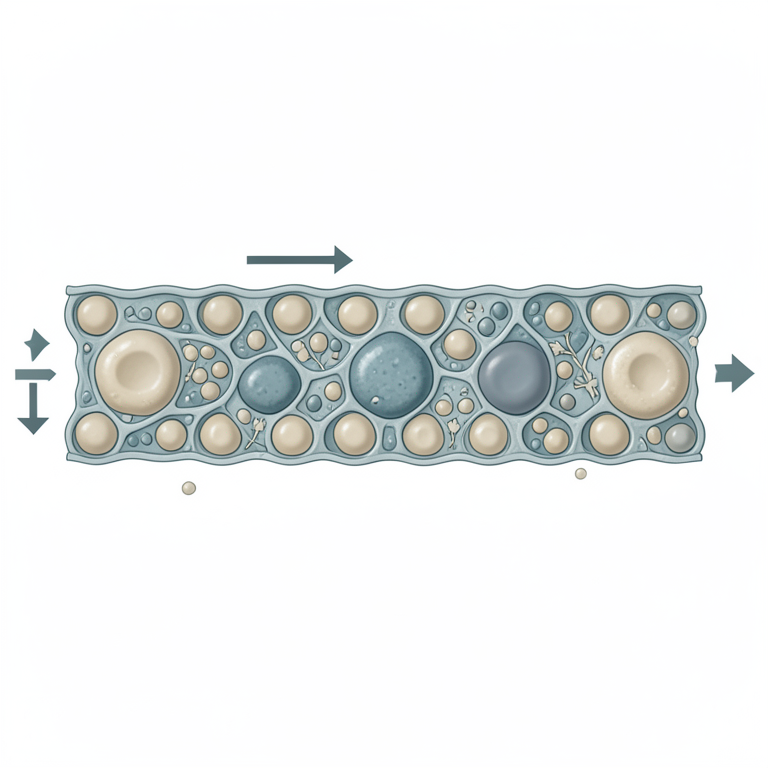
Mechanism of Antifungal Action
AI-generated conceptual illustration (fungal cell membrane with ergosterol molecules). It explains the idea and does not show study data.
View source evidence ↗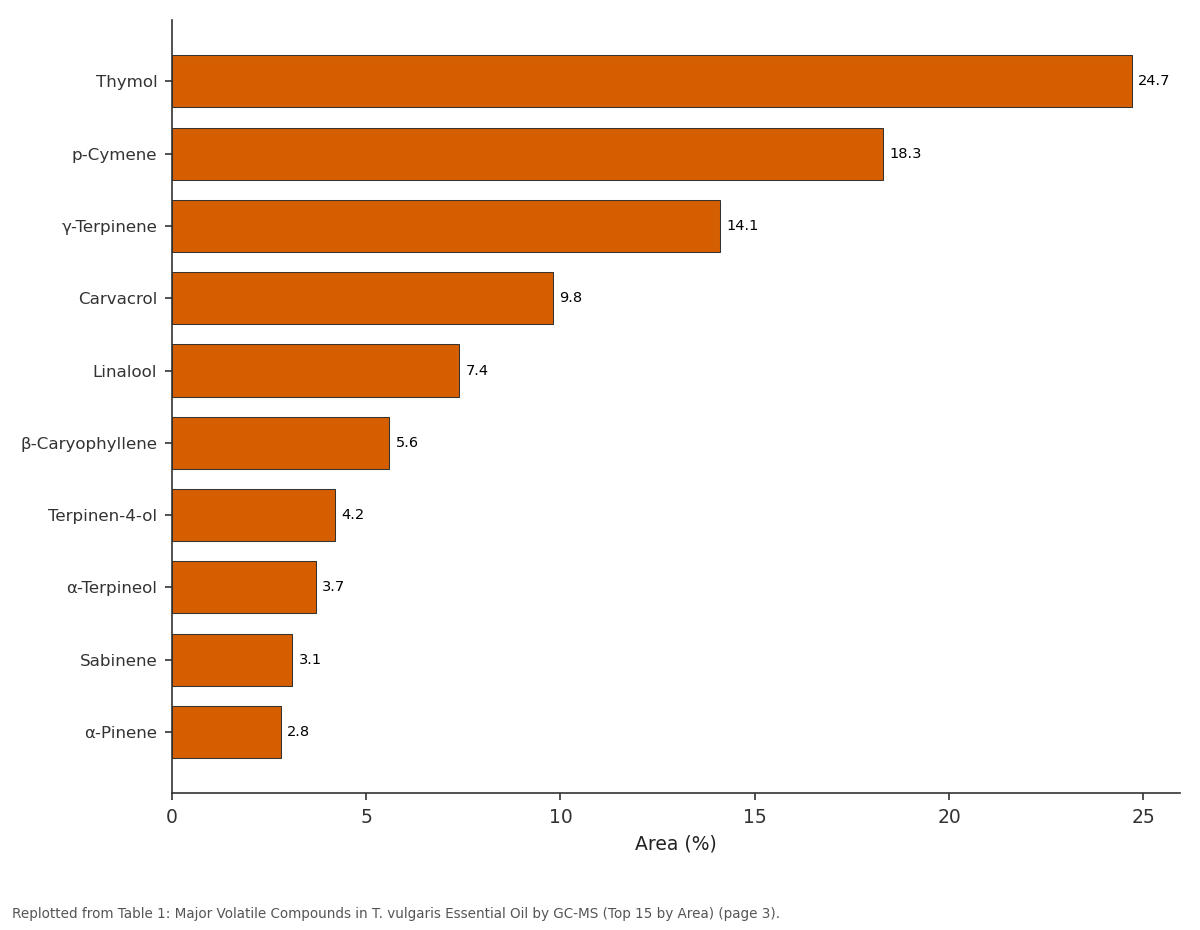
Area (%): Thymol vs p-Cymene vs γ-Terpinene vs Carvacrol vs Linalool
Replotted from Table 1 (page 3) of the original paper. Every bar is the paper's own table value.
View source evidence ↗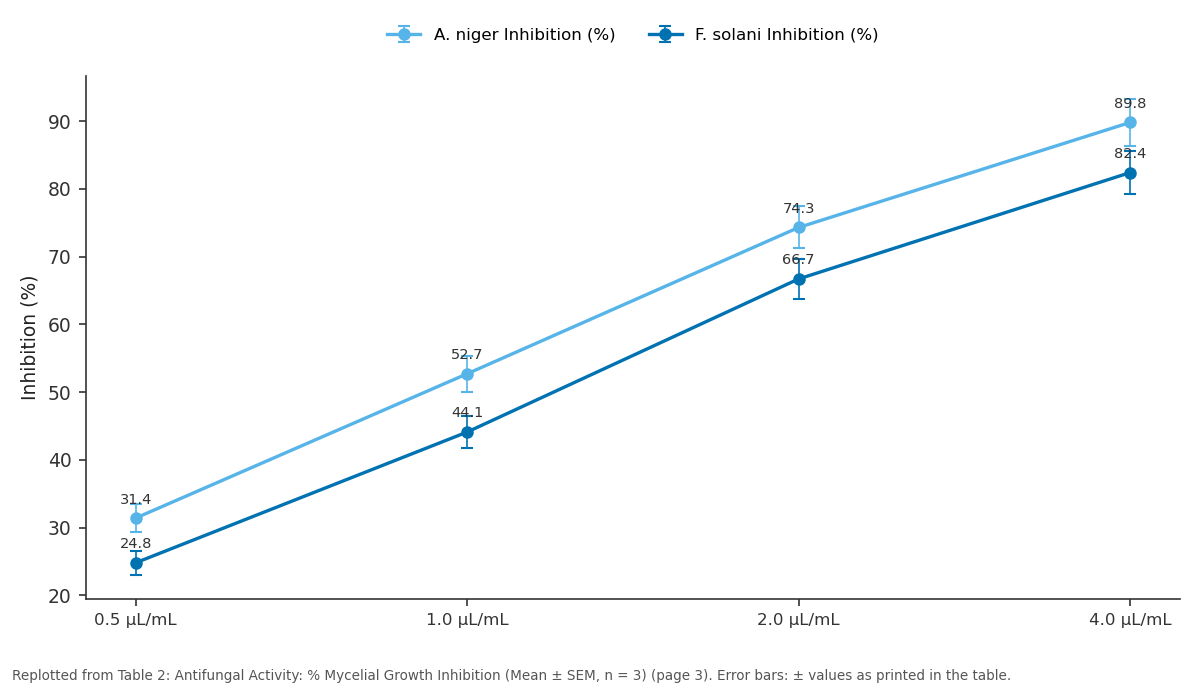
A. niger Inhibition (%) and F. solani Inhibition (%): 0.5 μL/mL vs 1.0 μL/mL vs 2.0 μL/mL vs 4.0 μL/mL
Replotted from Table 2 (page 3) of the original paper. Every bar is the paper's own table value.
View source evidence ↗Figures & tables
From the original paper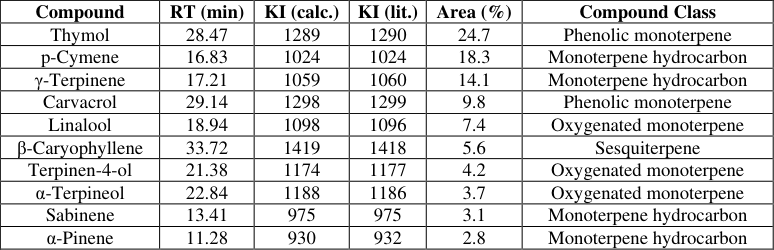 Table 1
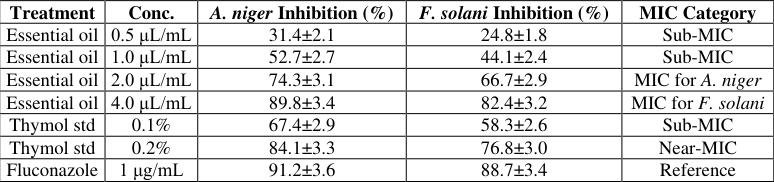 Table 2
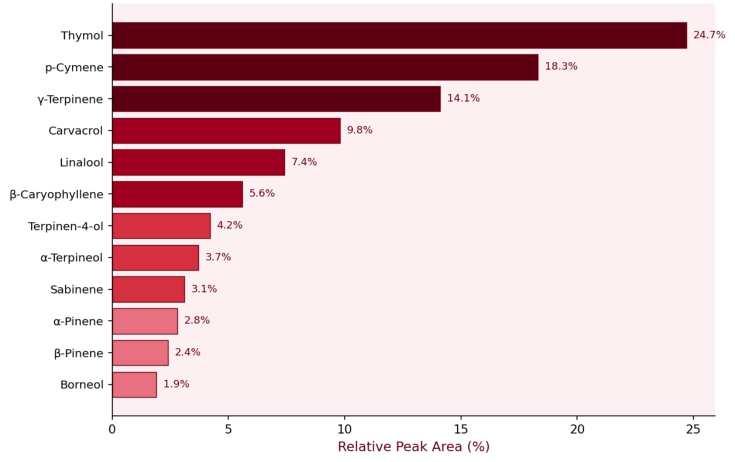 Figure 1
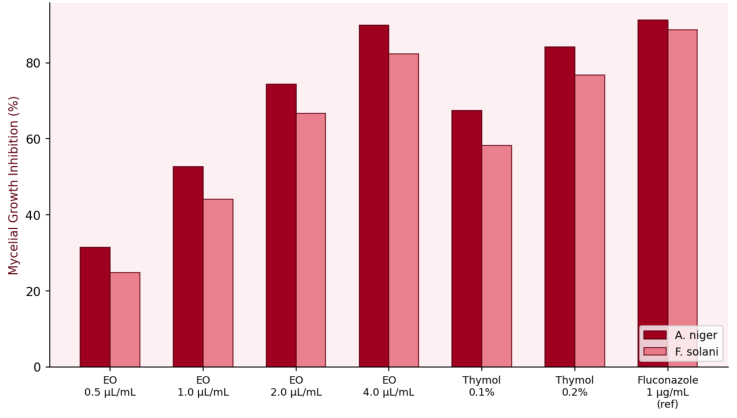 Figure 2
Introduction
The growing demand for natural, residue-free alternatives to synthetic fungicides in agriculture-driven by consumer concern over pesticide residues and expanding organic certification requirements-has stimulated research into plant essential oils as crop protection agents. Essential oils are volatile mixtures of low molecular weight terpenes and phenylpropanoids that are generally recognised as safe (GRAS status in many jurisdictions) and biodegrade rapidly in the environment, making them attractive candidates for integration into integrated pest management programmes. Thymus vulgaris essential oil is among the most extensively studied for antimicrobial and antifungal properties. Its principal phenolic constituents-thymol and carvacrol-disrupt fungal cytoplasmic membranes by intercalating into the phospholipid bilayer, destabilising the proton gradient, and binding ergosterol, the fungal-specific membrane sterol. However, the chemical composition and hence biological activity of T. vulgaris essential oil varies considerably with geographic origin, altitude, soil type, harvest season, and processing method, making location-specific characterisation essential before activity claims can be made for a particular production source. Northern Thailand's highland regions (Chiang Rai, Chiang Mai) have developed small-scale thyme cultivation for the domestic culinary and nutraceutical markets over the past decade, but no published GC-MS profile exists for Thai-grown T. vulgaris. This research fills this gap, providing the first detailed chemical characterisation of the northern Thai thyme essential oil and linking it to antifungal performance against two regionally important plant pathogens.
Materials and Methods
Materials and Methods
Study Area and Plant Material
Fresh aerial parts (leaves and stems) of T. vulgaris were harvested at full bloom (October 2023) from an organically managed highland farm in Chiang Rai province (19°54'N, 99°48'E; elevation 842 m asl). Three harvests were made from different plants on the same farm on consecutive days to obtain a representative composite sample of 2.4 kg fresh material. The plant was botanically authenticated by a taxonomist at the Faculty of Science, Chiang Rai Rajabhat University (voucher specimen CRRU-2023-TVL-018). Research was conducted jointly at the Departments of Agricultural Chemistry and Food Processing and Chemical Analysis, Siam Royal University of Chemical Sciences, Nakhon Ratchasima, and Chao Phraya National University, Bangkok, from November 2023 to October 2024.
Climatic and Environmental Context
Chiang Rai province has a tropical highland climate (Köppen Cwb) characterised by a distinct dry season (November-April) and a wet monsoon season (May-October), with mean annual rainfall of 1,840 mm at the harvest site elevation of 842 m. Annual mean temperature is 21.4 °C (range 10.8-33.2 °C). The harvest at full bloom in October corresponds to the end of the wet season, when plant water content is highest and essential oil content typically peaks for thymol-chemotype plants, based on seasonal data reported for Mediterranean T. vulgaris. The farm had received no synthetic herbicide or fungicide applications for at least 24 months prior to harvest, ensuring that the essential oil was not contaminated by agrochemical residues. Soil at the site was classified as sandy loam (pH 6.3, organic matter 3.8%) typical of highland Chiang Rai agricultural land.
Materials and Extraction
Essential oil was extracted from 500 g fresh plant material by hydrodistillation in a Clevenger apparatus for 3 h at 100 °C. The oil layer was separated, dried over anhydrous sodium sulphate, and stored in amber glass vials at 4 °C until analysis (within 7 days). Extraction yield (%, v/w) was calculated relative to fresh plant weight. GC-MS analysis used a Shimadzu GC-2010 Plus coupled to a Shimadzu GCMS-QP2010 Ultra with a DB-5MS capillary column (30 m × 0.25 mm × 0.25 μm). Oven programme: 60 °C (2 min) → 240 °C at 3 °C/min, hold 5 min. Injector 250 °C, splitless, injection volume 1 μL (1% in hexane). MS: electron ionisation 70 eV, scan range m/z 40-350. Compound identification used the NIST 2017 mass spectral library (match factor ≥ 90%) combined with retention index comparison against published Kovats indices. Antifungal assay (poison food technique): PDA medium was amended with essential oil at 0.5, 1.0, 2.0, 4.0 μL/mL before autoclaving, poured into Petri dishes, and inoculated with 5 mm mycelial discs of A. niger TISTR 3270 and F. solani TISTR 3280. Plates were incubated at 28 °C for 7 days; mycelial diameter was measured and% inhibition relative to unamended control calculated. Thymol standard (Sigma-Aldrich, 99.5%) was tested in parallel at 0.1 and 0.2%.
Limitations
This research has several limitations that should be considered when interpreting the results. The plant material was harvested from a single farm in a single season; interseasonal and inter-site compositional variation was not assessed. The antifungal evaluation used only two fungal species; a broader spectrum including Botrytis cinerea and Colletotrichum gloeosporioides-both important Thai crop pathogens-would provide more comprehensive activity data. The poison food technique, while widely used for preliminary antifungal screening, does not replicate field exposure conditions; vapour-phase activity and contactmode efficacy under varying humidity should be investigated in follow-up research. Finally, phytotoxicity of the essential oil to host crops at antifungal concentrations was not assessed, a critical parameter for any practical application.
In-vitro Antifungal Protocol
Poison food assay was performed under aseptic conditions in a laminar flow cabinet. PDA medium (39 g/L, Merck) was autoclaved at 121 °C for 20 min, cooled to 55 °C, then essential oil (or thymol control) was added from a DMSO stock (10% v/v, 1% final DMSO) and mixed by gentle swirling before pouring into 90 mm Petri plates (20 mL per plate). Unamended PDA with 1% DMSO served as the solvent control. Three plates per concentration per organism were prepared. Mycelial discs (5 mm diameter) were cut from 7-day-old cultures at the actively growing margin and placed centrally on test plates. Colony diameter was measured in two perpendicular directions at days 3 and 7. Percentage inhibition of mycelial growth (PIMG) = [(C -T)/C] × 100, where C = mean colony diameter in solvent control and T = mean colony diameter in treated plate. Minimum inhibitory concentration (MIC) was defined as the lowest concentration giving ≥80% PIMG. All assays were replicated three times (n = 9 plates per treatment per organism).
Results
Hydrodistillation of 500 g fresh T. vulgaris yielded 3.84 mL essential oil (0.77% v/w). GC-MS analysis identified 31 compounds accounting for 97.8% of the total chromatogram area (Table 1). The 12 most abundant compounds are shown in Figure 1. Thymol (24.7%), p-cymene (18.3%), and γterpinene (14.1%) together accounted for 57.1% of the total oil. The chemotype was unambiguously thymol, as the thymol/carvacrol ratio was 2.5:1 and the thymol + carvacrol combined content (34.5%) exceeded typical geraniol and linalool chemotype thresholds. The antifungal bioassay (Figure 2, Table 2) demonstrated dose-dependent inhibition of both fungi. At 4.0 μL/mL, the essential oil inhibited A. niger by 89.8% and F. solani by 82.4%, approaching but not reaching the fluconazole reference (91.2% and 88.7% respectively). The MIC against A. niger was 2.0 μL/mL (74.3% inhibition); against F. solani, 4.0 μL/mL was required for >80% inhibition.
| Treatment | Conc. | A. niger Inhibition (%) | F. solani Inhibition (%) | MIC Category |
|---|---|---|---|---|
| Essential oil | 0.5 μL/mL | 31.4±2.1 | 24.8±1.8 | Sub-MIC |
| Essential oil | 1.0 μL/mL | 52.7±2.7 | 44.1±2.4 | Sub-MIC |
| Essential oil | 2.0 μL/mL | 74.3±3.1 | 66.7±2.9 | MIC for A. niger |
| Essential oil | 4.0 μL/mL | 89.8±3.4 | 82.4±3.2 | MIC for F. solani |
| Thymol std | 0.1% | 67.4±2.9 | 58.3±2.6 | Sub-MIC |
| Thymol std | 0.2% | 84.1±3.3 | 76.8±3.0 | Near-MIC |
| Fluconazole | 1 μg/mL | 91.2±3.6 | 88.7±3.4 | Reference |
Table text extracted from the original PDF; superscript letters are shown inline. The original table image is below.
View original table image
| Compound | RT (min) | KI (calc.) | KI (lit.) | Area (%) | Compound Class |
|---|---|---|---|---|---|
| Thymol | 28.47 | 1289 | 1290 | 24.7 | Phenolic monoterpene |
| p-Cymene | 16.83 | 1024 | 1024 | 18.3 | Monoterpene hydrocarbon |
| γ-Terpinene | 17.21 | 1059 | 1060 | 14.1 | Monoterpene hydrocarbon |
| Carvacrol | 29.14 | 1298 | 1299 | 9.8 | Phenolic monoterpene |
| Linalool | 18.94 | 1098 | 1096 | 7.4 | Oxygenated monoterpene |
| β-Caryophyllene | 33.72 | 1419 | 1418 | 5.6 | Sesquiterpene |
| Terpinen-4-ol | 21.38 | 1174 | 1177 | 4.2 | Oxygenated monoterpene |
| α-Terpineol | 22.84 | 1188 | 1186 | 3.7 | Oxygenated monoterpene |
| Sabinene | 13.41 | 975 | 975 | 3.1 | Monoterpene hydrocarbon |
| α-Pinene | 11.28 | 930 | 932 | 2.8 | Monoterpene hydrocarbon |
Table text extracted from the original PDF; superscript letters are shown inline. The original table image is below.
View original table image
Discussion
The thymol-dominant chemotype confirmed for northern Thai T. vulgaris is consistent with the globally recognised thymol chemotype predominant in highland Mediterranean and South/Southeast Asian cultivation, and the thymol content of 24.7% falls within the reported range of 20-35% for this chemotype globally. The high p-cymene (18.3%) and γ-terpinene (14.1%) content is equally characteristic, as these monoterpene hydrocarbons are the biosynthetic precursors of thymol and carvacrol via the p-cymene pathway, and their relative abundance reflects incomplete conversion under the specific highland Thai growing conditions. The antifungal activity at MIC values of 2.0-4.0 μL/mL is consistent with published data for thymolchemotype T. vulgaris oils against Aspergillus and Fusarium species, confirming that the Thai-grown oil performs comparably to European benchmarks. The thymol standard at 0.2% (equivalent to approximately 0.2 mg/mL) gave 84.1% inhibition against A. niger, confirming thymol as a major antifungal contributor and supporting its role as the active principle. The synergy between thymol and carvacrol (combined 34.5% of the oil) is well documented in literature: the two phenolics act on similar membrane targets but have different partition coefficients, with carvacrol (more lipophilic) entering the membrane bilayer more readily while thymol preferentially targets membrane protein-lipid interfaces. The limitations acknowledged in the Methods section are relevant here: the fact that a single farm and single season were investigated means that compositional variation over multiple seasons-known to shift the thymol/carvacrol balance by up to 15% in Mediterranean populations-has not been characterised for this Thai source. Seasonal monitoring over at least three harvest cycles is recommended before any commercial quality specification is proposed.
Conclusion
GC-MS analysis of T. vulgaris essential oil from Chiang Rai, northern Thailand, identified thymol (24.7%), pcymene (18.3%), and γ-terpinene (14.1%) as dominant constituents, confirming a thymol chemotype with a chemical profile comparable to European benchmarks. The oil inhibited A. niger and F. solani mycelial growth by 89.8% and 82.4% respectively at 4.0 μL/mL, approaching fluconazole reference activity. These results provide the first characterisation of northern Thai thyme essential oil and support its further evaluation as a natural crop protection agent, with the limitations of single-season, single-site characterisation to be addressed in follow-up multi-season research.
Acknowledgement
Acknowledgements Funding SourcesInstitutional research funds from the Siam Royal University of Chemical Sciences, Nakhon Ratchasima, and Chao Phraya National University, Bangkok, supported this investigation without external grants.
References
15 in the original paper- Adams RP. Identification of Essential Oil Components by Gas Chromatography/Mass Spectrometry. 4th ed. Carol Stream: Allured Publishing; 2007.
- Bakkali F, Averbeck S, Averbeck D, Idaomar M. Biological effects of essential oils -a review. Food Chem Toxicol. 2008;46(2):446-475.
- Dorman HJ, Deans SG. Antimicrobial agents from plants: antibacterial activity of plant volatile oils. J Appl Microbiol. 2000;88(2):308-316.
- Sánchez-Vioque R, Polissiou M, Astraka K, De Los Mozos-Pascual M, Tarantilis P, Herraiz-Peñalver D, et al. Polyphenol composition and antioxidant and metal chelating activities of the solid residues from the essential oil industry. Ind Crops Prod. 2013;49:150-159.
- Ipek E, Zeytinoglu H, Okay S, Tuylu BA, Kurkcuoglu M, Baser KH. Genotoxicity and antigenotoxicity of Origanum oil and carvacrol evaluated by Ames Salmonella/microsomal test. Food Chem. 2005;93(3):551-556.
- Kalemba D, Kunicka A. Antibacterial and antifungal properties of essential oils. Curr Med Chem. 2003;10(10):813-829.
- Cosentino S, Tuberoso CI, Pisano B, Satta M, Mascia V, Arzedi E, et al. In-vitro antimicrobial activity and chemical composition of Sardinian Thymus essential oils. Lett Appl Microbiol. 1999;29(2):130-135.
- Aligiannis N, Kalpoutzakis E, Mitaku S, Chinou IB. Composition and antimicrobial activity of the essential oils of two Origanum species. J Agric Food Chem. 2001;49(9):4168-4170.
- Nakatsugi S, Ohta T, Kawamori T, Mutoh M, Tanigawa T, Watanabe K, et al. Chemoprevention by thymol of 1,2-dimethylhydrazine-induced aberrant crypt foci and colon tumours in mice. Jpn J Cancer Res. 2000;91(10):1015-1020.
- Veldhuizen EJ, Tjeerdsma-Van Bokhoven JL, Zweijtzer C, Burt SA, Haagsman HP. Structural requirements for the antimicrobial activity of carvacrol. J Agric Food Chem. 2006;54(5):1874-1879.
- Sokovic M, Glamoclija J, Marin PD, Brkic D, van Griensven LJ. Antibacterial effects of the essential oils of commonly consumed medicinal herbs using an in vitro model. Molecules. 2010;15(11):7532-7546.
- Nair R, Chanda S. In-vitro antimicrobial activity of some plant essential oils against human pathogens. Acta Pharm. 2007;57(2):147-161.
- NIST. NIST/EPA/NIH Mass Spectral Library and NIST MS Search Program. Version 2.3. Gaithersburg: National Institute of Standards and Technology; 2017.
- Pandey AK, Kumar P, Singh P, Tripathi NN, Bajpai VK. Essential oils: sources of antimicrobials and food preservatives. Front Microbiol. 2017;8:2161.
- Teixeira B, Marques A, Ramos C, Serrano C, Matos O, Neng NR, et al. Chemical composition and bioactivity of different oregano (Origanum vulgare) extracts and essential oil. J Sci Food Agric. 2013;93(11):2707-2714.