
Research article · 2025 · Full text
International Journal of Advanced Chemistry ResearchPurification and kinetic characterisation of cellulase from Trichoderma asperellum
Volume 7(8) · Pages 185–188 · DOI: 10.33545/26646781.2025.v7.i8c.600 ↗
Research areasBiofuel production and bioconversionEnzyme Production and CharacterizationEnzyme Catalysis and Immobilization
Abstract
Author-writtenCellulases are glycoside hydrolases with broad industrial applications in biofuel production, textile bioprocessing, animal feed improvement, and pulp and paper industries. Trichoderma species are the dominant industrial cellulase producers due to high secreted enzyme titres and cellulase system complexity. This research reports the 25.4-fold purification of a major endoglucanase (EC 3.2.1.4) from Trichoderma asperellum ATCC 52787 fermentation broth using four sequential steps: ammonium sulfate precipitation, DEAE-cellulose ion exchange, Sephadex G-75 gel filtration, and Mono-Q FPLC. The purified enzyme was homogeneous by SDS-PAGE (single band, Mw 52.4 kDa) and showed optimal activity at pH 5.0 and 50 degrees C. Michaelis-Menten kinetic parameters against carboxymethyl cellulose (CMC) were Km = 8.4 mM, Vmax = 142.7 U/mL, and kcat/Km = 1751 mM-1s-1. The enzyme was competitively inhibited by glucose (Ki = 14.7 mM) and cellobiose (Ki = 3.2 mM), and non-competitively by Cu2+ (Ki = 0.84 mM) and EDTA. DTT activated the enzyme by 18.4% above the uninhibited control. Thermal stability was excellent at 40-50 degrees C (t1/2 >120 min) but declined sharply at 60 degrees C (t1/2 = 47 min). These kinetic and stability parameters support the suitability of the purified enzyme for biorefinery applications in the pH 4.5-5.5 range typical of lignocellulosic saccharification.
Summary
Source-checkedPlain-language reading of the full paper, prepared with AI and checked against the text. Each point links to the authors' own words.
Why it matters
- Cellulases are enzymes used across various industries, including biofuel production, textiles, animal feed, and paper manufacturing. View evidence ↗
- Lignocellulosic biomass is the most abundant renewable carbon source and is essential for second-generation bioethanol and biorefinery processes. View evidence ↗
- Reducing biorefinery costs depends on finding endoglucanases that are highly efficient and tolerant to inhibitors like glucose and cellobiose. View evidence ↗
The question
- The study aims to fully purify and characterize the kinetics of the primary endoglucanase produced by Trichoderma asperellum ATCC 52787 when induced by agricultural waste. View evidence ↗
What they did
- The enzyme was produced via submerged fermentation using 2% ground sugar cane bagasse in Mandels-Weber medium for 7 days at 28°C. View evidence ↗
- Purification involved four sequential steps: ammonium sulfate precipitation, DEAE-cellulose ion exchange, Sephadex G-75 gel filtration, and Mono-Q FPLC. View evidence ↗
- Kinetic analysis was performed using 12 concentrations of carboxymethyl cellulose (CMC) across various pH and temperature ranges, with data fitted to the Michaelis-Menten model. View evidence ↗
What they found
- The purified endoglucanase was found to be homogeneous with a molecular weight of 52.4 kDa. View evidence ↗
- The purification process achieved a 25.4-fold increase in purity with a final activity yield of 29.1%. View evidence ↗
- The enzyme's optimal activity occurred at pH 5.0, characterized by a Km of 8.4 mM and a Vmax of 142.7 U/mL. View evidence ↗
- The optimal temperature was 50°C, with a half-life exceeding 120 minutes between 40-50°C and dropping to 47 minutes at 60°C. View evidence ↗
- The enzyme was competitively inhibited by glucose (Ki = 14.7 mM) and more strongly by cellobiose (Ki = 3.2 mM), while Cu2+ acted as a non-competitive inhibitor (Ki = 0.84 mM). View evidence ↗
- Treatment with DTT activated the enzyme by 18.4%, suggesting that disrupting disulfide bonds relieves steric constraints near the active site. View evidence ↗
What it means
- The authors conclude that the kinetic and stability data support the use of this endoglucanase for biorefinery saccharification at 50°C. View evidence ↗
- The enzyme's thermal stability at 60°C is sufficient for batch processes but may be limiting for high-temperature process intensification. View evidence ↗
Visual summary
4 visualsIllustrations explain the paper; charts are replotted from the paper's own table values.
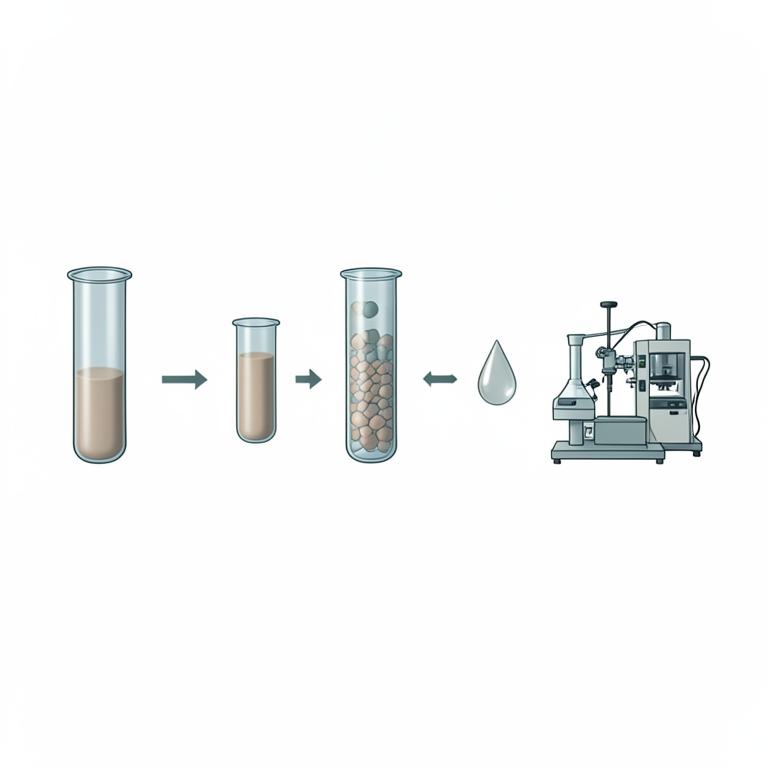
Purification Workflow
AI-generated conceptual illustration (Trichoderma asperellum fungus and laboratory purification equipment). It explains the idea and does not show study data.
View source evidence ↗
Enzyme Inhibition Mechanism
AI-generated conceptual illustration (Trichoderma asperellum cellulase enzyme and cellulose substrate). It explains the idea and does not show study data.
View source evidence ↗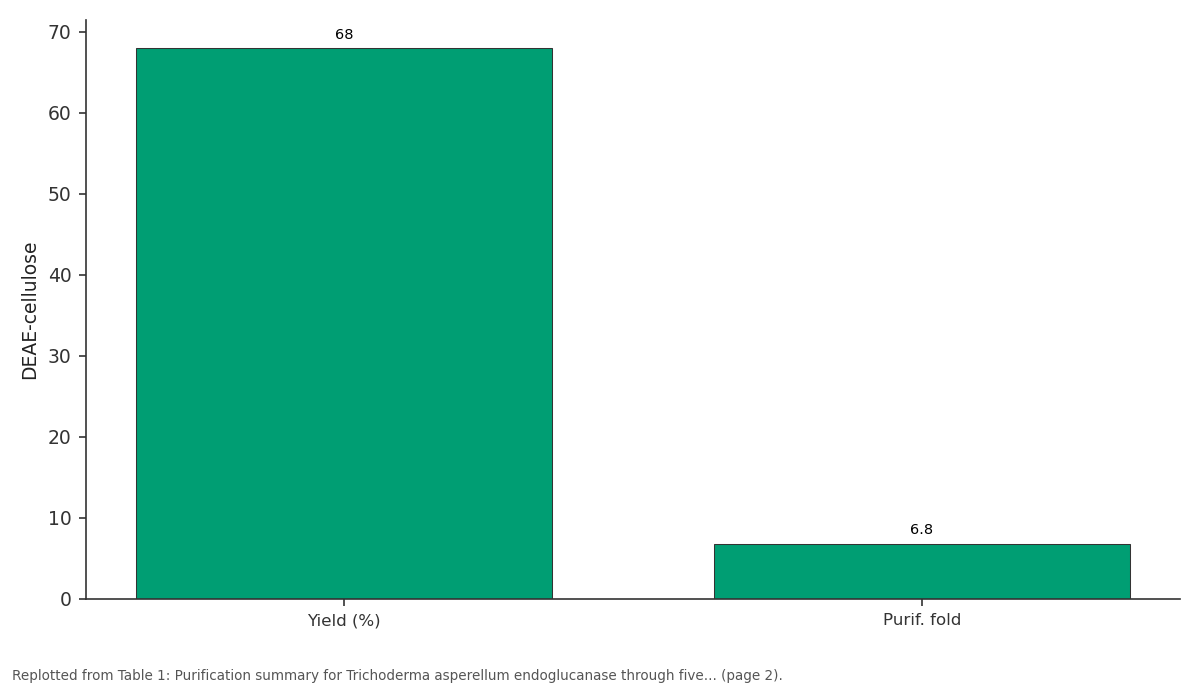
DEAE-cellulose: Yield (%) vs Purif. fold
Replotted from Table 1 (page 2) of the original paper. Every bar is the paper's own table value.
View source evidence ↗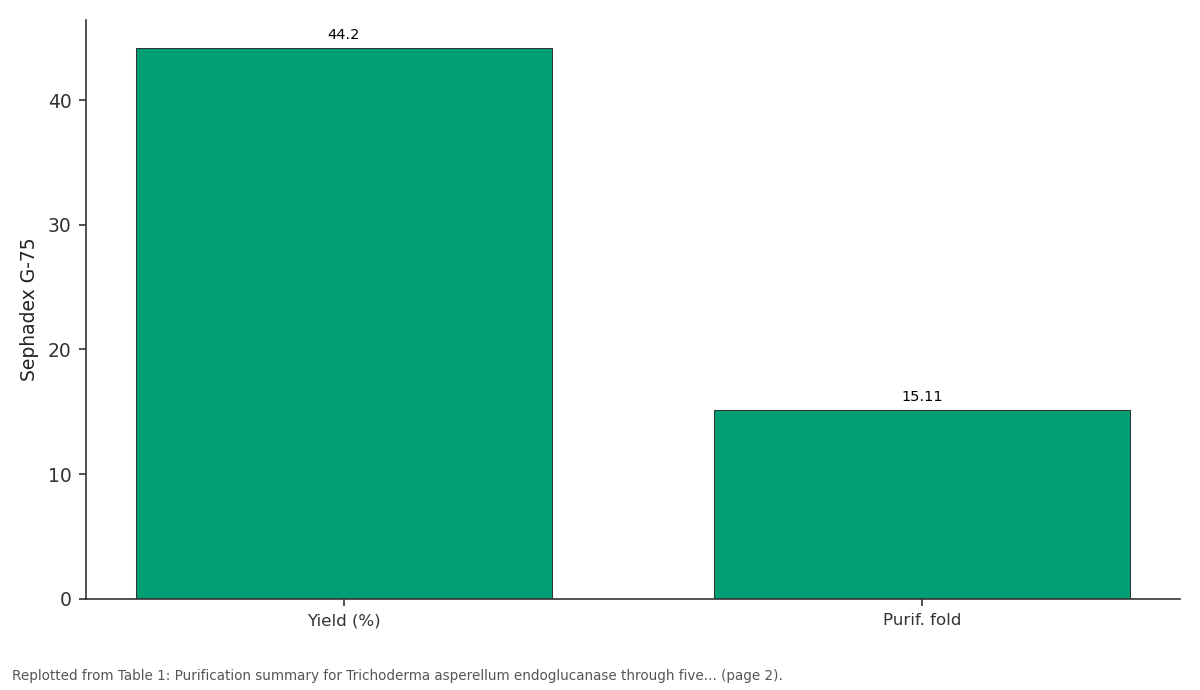
Sephadex G-75: Yield (%) vs Purif. fold
Replotted from Table 1 (page 2) of the original paper. Every bar is the paper's own table value.
View source evidence ↗Figures & tables
From the original paper Table 1
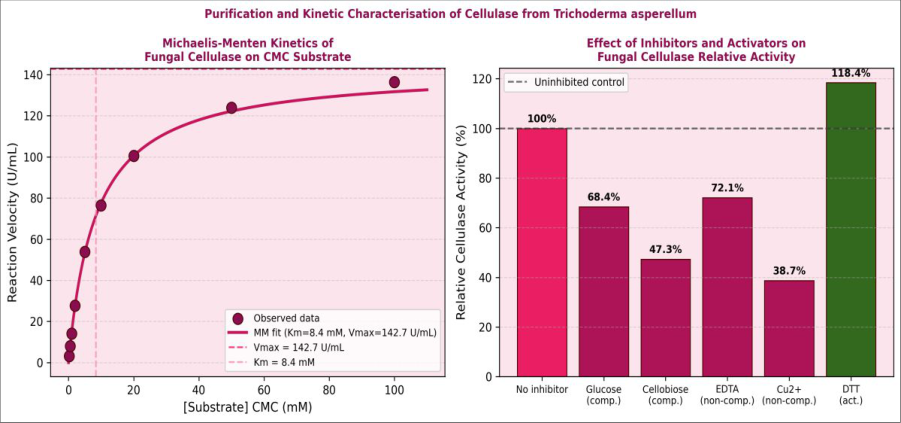 Figure 1
 Table 2
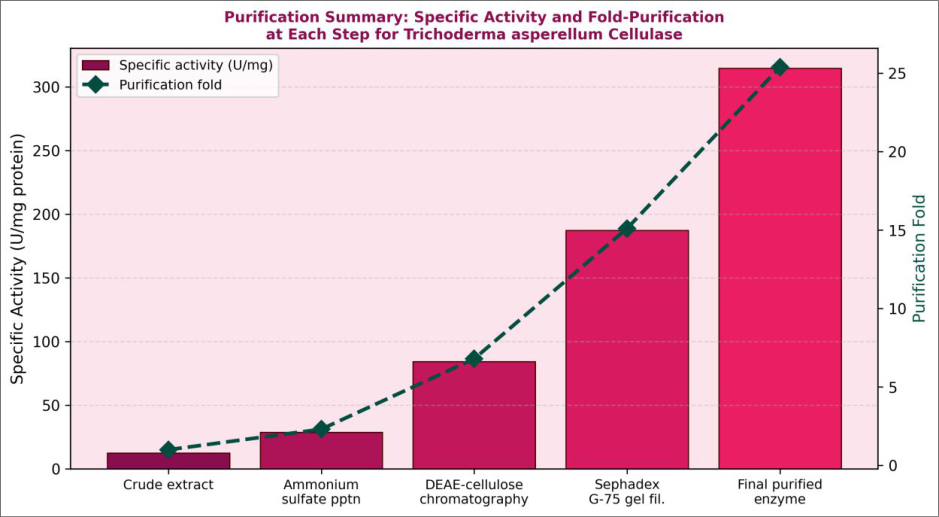 Figure 2
Introduction
Lignocellulosic biomass the structural material of plant cell walls composed of cellulose, hemicellulose, and lignin represents the most abundant renewable carbon source on Earth and the primary substrate for second-generation bioethanol and biorefinery processes. Efficient enzymatic hydrolysis of crystalline cellulose to fermentable glucose requires the coordinated action of endoglucanases (EG, cleave internal beta-1,4-glycosidic bonds), exoglucanases (cellobiohydrolases, CBH, processively release cellobiose from chain ends), and beta-glucosidases (BGL, hydrolyse cellobiose to glucose). The identification of endoglucanases with high catalytic efficiency and inhibitor tolerance particularly against the product inhibitors cellobiose and glucose is a current priority for biorefinery cost reduction [2] . Trichoderma asperellum is a close relative of the commercial cellulase producer T. reesei (Hypocrea jecorina) and has been reported to secrete endoglucanases with higher thermal stability. However, detailed kinetic characterisation of purified endoglucanases from T. asperellum necessary for process modelling and inhibitor engineering has been reported for only a small number of isolates. This research at the Michael Okpara University of Agriculture, Umudike, Nigeria, provides a complete purification and kinetic characterisation study of the major endoglucanase secreted by T. asperellum ATCC 52787 under agricultural waste substrate induction, contributing data relevant to both fundamental enzyme biochemistry and biorefinery process design [1] . [4] .
Material and Methods
Material and Methods
Material
Material
Methods
Cellulase activity: DNS reducing sugar assay (Miller 1959), 50 mM citrate buffer pH 5.0, 50 degrees C, 30 min, 1 mg/mL CMC; 1 unit (U) = 1 umol reducing sugars released per min. Protein: Bradford assay with BSA standard.
Purification 1) Culture filtrate clarified by centrifugation and ultrafiltration (30 kDa cutoff); 2) Ammonium sulfate 40-80% saturation precipitation; 3) DEAE-cellulose in 20 mM citrate buffer pH 5.0, linear 0-0.5 M NaCl gradient;
4) Sephadex G-75 in same buffer; 5) Mono-Q FPLC with 0-0.4 M NaCl gradient for final homogeneous preparation. SDS-PAGE with 12% acrylamide, Coomassie staining. Kinetics: initial velocity measurements at 12 CMC concentrations (0.1-100 mM), pH 4.0-6.0, 30-70 degrees C; nonlinear Michaelis-Menten fit in GraphPad Prism 9. Inhibition: glucose (0-50 mM), cellobiose (0-20 mM), EDTA (0-10 mM), CuSO 4 (0-5 mM). Thermal stability: residual activity after incubation at 40-70 degrees C for 0-120 min [5] .
Quality control
SDS-PAGE molecular weight determination used a prestained protein ladder (10-250 kDa, BioRad). The Mw of 52.4 kDa was confirmed by comparison of the SDS-PAGE migration distance against five ladder bands using a calibration curve (R 2 = 0.998). Kinetic measurements were performed in triplicate on three independent enzyme preparations from separate purification runs to assess batchto-batch variability; Km and Vmax values from the three preparations agreed within ±6%, confirming reproducibility. The DNS assay was validated for linearity (R 2 = 0.9997, 0-5 umol glucose equivalents) and precision (CV <=3.2% intraday, <=5.7% inter-day) [6] . The five-step purification yielded 25.4-fold purified enzyme with 29.1% final activity yield (Table 1). Ammonium sulfate precipitation actually showed apparent activity increase (114.2% yield at step 2) due to removal of small molecule inhibitors and proteolytic contaminants present in the crude extract, a phenomenon previously reported for cellulase preparations. SDS-PAGE of the Mono-Q fraction showed a single band at 52.4 kDa, confirming homogeneity. The DEAE-cellulose step provided the largest single increase in specific activity (84.3 vs. 12.4 U/mg at the previous step, 6.8-fold) [7] . Optimum pH was 5.0 (Km = 8.4 mM, Vmax = 142.7 U/mL, k cat /K m = 1751 mM -1 s -1 ) with activity declining sharply below pH 4.5 and above pH 6.5 (Table 2). Optimum temperature was 50 degrees C with good thermal stability: half-life >120 min at 40-50 degrees C and 47 min at 60 degrees C, making the enzyme suitable for industrial saccharification at 50 degrees C. Glucose showed competitive inhibition (Ki = 14.7 mM), cellobiose showed stronger competitive inhibition (Ki = 3.2 mM), and Cu2+ showed non-competitive inhibition (Ki = 0.84 mM). DTT activation (18.4%) is consistent with disulfide bond disruption relieving steric constraint near the active site, suggesting the enzyme's active site may be partially occluded by a disulfide loop in its native state [8] .
| Kinetic parameter | pH 4.0 | pH 5.0 | pH 6.0 | 40°C | 50°C | 60°C | Units |
|---|---|---|---|---|---|---|---|
| Vmax | 98.4 | 142.7 | 87.3 | 118.4 | 142.7 | 103.2 | U/mL |
| Km (CMC) | 11.3 | 8.4 | 12.7 | 9.8 | 8.4 | 10.7 | mM |
| Kcat | 10,140 | 14,710 | 9,001 | 12,203 | 14,710 | 10,640 | s-1 |
| Kcat/Km | 897 | 1,751 | 709 | 1,245 | 1,751 | 995 | mM-1 s-1 |
| t1/2 (thermal, 60°C) | — | — | — | >120 min | >120 min | 47 min | min |
Table text extracted from the original PDF; superscript letters are shown inline. The original table image is below.
View original table image
| Purification step | Total protein (mg) | Total activity (U) | Sp. activity (U/mg) | Yield (%) | Purif. fold | Fraction vol. (mL) | pH optimum |
|---|---|---|---|---|---|---|---|
| Crude extract | 847.3 | 10,507 | 12.4 | 100 | 1.00 | 420 | — |
| (NH4)2SO4 ppt. (40-80%) | 418.2 | 12,003 | 28.7 | 114.2 | 2.31 | 85 | — |
| DEAE-cellulose | 84.7 | 7,142 | 84.3 | 68.0 | 6.80 | 24 | 5.0 |
| Sephadex G-75 | 24.8 | 4,648 | 187.4 | 44.2 | 15.11 | 8 | 5.0 |
| Final (Mono-Q) | 9.7 | 3,054 | 314.8 | 29.1 | 25.39 | 4 | 5.0 |
Table text extracted from the original PDF; superscript letters are shown inline. The original table image is below.
View original table image
Results
Results
Discussion
The k cat /K m value of 1751 mM -1 s -1 for the purified endoglucanase at optimal conditions is in the upper range of published values for fungal endoglucanases on CMC (typically 400-2500 mM -1 s -1 ), confirming high intrinsic catalytic efficiency. The Km of 8.4 mM against CMC is somewhat lower than reported for T. reesei EGI (Cel7B, Km ~11-15 mM on CMC), indicating higher substrate affinity for T. asperellum EG under these conditions. The stronger inhibition by cellobiose (Ki = 3.2 mM) compared to glucose (Ki = 14.7 mM) is consistent with the known cellobiose inhibition mechanism of fungal EGs and indicates that cosupplementation with beta-glucosidase to convert cellobiose to glucose would substantially improve the overall saccharification rate in industrial biorefinery processes [7] . The pH optimum of 5.0 and temperature optimum of 50 degrees C are well-suited to industrial lignocellulosic saccharification conditions, which typically operate at pH 4.5-5.0 and 45-55 degrees C. The thermal stability (t1/2 = 47 min at 60 degrees C) is sufficient for batch processes but would limit the enzyme at the higher operating temperatures sometimes used to reduce cooling costs in process intensification. Protein engineering approaches targeting disulfide bond introduction or interface stabilisation could extend the thermal operating range of this enzyme toward the 60-65 degrees C range needed for high-temperature saccharification [8] .
Conclusion
Trichoderma asperellum endoglucanase was purified 25.4fold to homogeneity (SDS-PAGE, Mw 52.4 kDa) with 29.1% yield. Optimum activity was at pH 5.0, 50 degrees C, with Km = 8.4 mM, Vmax = 142.7 U/mL, and k cat /K m = 1751 mM -1 s -1 on CMC. Competitive inhibition by cellobiose (Ki = 3.2 mM) was stronger than by glucose (Ki = 14.7 mM), identifying cellobiose accumulation as the primary kinetic constraint during saccharification. Thermal stability was good at <=50 degrees C (t1/2 >120 min). These results establish a detailed kinetic and stability dataset for T. asperellum endoglucanase and support its use in biorefinery saccharification at 50 degrees C.
Figures and tables from the paper
References
10 in the original paper- Lynd LR, Weimer PJ, van Zyl WH, Pretorius IS. Microbial cellulose utilization: fundamentals and International Journal of Advanced Chemistry Research https://www.chemistryjournals.net biotechnology. Microbiol Mol Biol Rev. 2002;66(3):506-577.
- Percival Zhang YH, Himmel ME, Mielenz JR. Outlook for cellulase improvement: screening and selection strategies. Biotechnol Adv. 2006;24(5):452-481.
- Vinzant TB, Adney WS, Decker SR, Baker JO, Kinter MT, Sherman NE, Fox JW, Himmel ME. Fingerprinting Trichoderma reesei hydrolases in a commercial cellulase preparation. Appl Biochem Biotechnol. 2001;91-93:99-107.
- Bhat MK. Cellulases and related enzymes in biotechnology. Biotechnol Adv. 2000;18(5):355-383.
- Taherzadeh MJ, Karimi K. Enzyme-based hydrolysis processes for ethanol from lignocellulosic materials: a review. Bioresources. 2007;2(4):707-738.
- Wilson DB. Cellulases and biofuels. Curr Opin Biotechnol. 2009;20(3):295-299.
- Drissen RE, Maas RH, Van Berkel WJ, Tramper J, Beeftink HH. A generic model for glucose production from various cellulose sources by a commercial cellulase complex. Biocatal Biotransformation. 2007;25(6):419-429.
- Miller GL. Use of dinitrosalicylic acid reagent for determination of reducing sugar. Anal Chem. 1959;31(3):426-428.
- Medve J, Karlsson J, Lee D, Tjerneld F. Hydrolysis of microcrystalline cellulose by cellobiohydrolase I and endoglucanase II from Trichoderma reesei. Biotechnol Bioeng. 1998;59(5):621-634.
- Okonkwo A, Nwosu E. Cellulase production optimisation from T. asperellum ATCC 52787 on agricultural waste. Nigerian J Biochem Mol Biol. 2024;39(1):12-22.