
Research article · 2025 · Full text
International Journal of Advanced Chemistry ResearchPorous geopolymer materials from fly ash for thermal insulation applications
Volume 7(6) · Pages 171–174 · DOI: 10.33545/26646781.2025.v7.i6c.587 ↗
Research areasConcrete and Cement Materials ResearchRecycling and utilization of industrial and municipal waste in materials productionHygrothermal properties of building materials
Abstract
Author-writtenVietnam's coal-fired power plants produce roughly 16 million tonnes of fly ash annually, yet less than 30% is currently recycled—the remainder fills costly landfills and poses leaching risks. This research converts Class F fly ash into porous geopolymer foams by alkaline activation with sodium hydroxide-sodium silicate solution and chemical foaming with hydrogen peroxide (H₂O₂) at 0, 1, 3, and 5 wt%. Geopolymer pastes were cured at 60 °C for 24 h and then at ambient temperature for 28 days. X-ray diffraction with Rietveld refinement showed that the cured product comprised 58.3% amorphous geopolymer gel, 16.4% residual quartz, 12.7% mullite, 4.8% hematite, and 7.8% unreacted fly ash. Increasing the H₂O₂ level from 0 to 5 wt% raised total porosity from 18.6% to 74.3%, lowered bulk density from 1.72 to 0.48 g/cm³, and reduced thermal conductivity from 0.84 to 0.19 W/m·K. The 5 wt% H₂O₂ foam fell below the 0.25 W/m·K threshold generally required for building insulation materials. Compressive strength dropped from 28.4 MPa (dense) to 1.7 MPa (5% foam), but the 3% H₂O₂ formulation (0.31 W/m·K, 4.2 MPa) offered a better balance of insulation and structural integrity. A preliminary cost estimate placed the foam at 38–52 USD per cubic metre, competitive with expanded polystyrene but with superior fire resistance. All work was performed at the Saigon Institute of Chemical Research, Ho Chi Minh City, and the Red River National University, Hanoi, between March and December 2023.
Summary
Source-checkedPlain-language reading of the full paper, prepared with AI and checked against the text. Each point links to the authors' own words.
Why it matters
- Vietnam produces approximately 16 million tonnes of fly ash per year from coal power plants, but less than 30% is recycled, leading to landfill costs and leaching risks. View evidence ↗
- Vietnam requires better thermal insulation to reduce air-conditioning energy use, but common materials like EPS and polyurethane foam are flammable and petroleum-based. View evidence ↗
- Geopolymers are non-combustible, low-carbon alternatives to organic foams, created by reacting aluminosilicate precursors like fly ash with an alkaline activator. View evidence ↗
The question
- The study aims to convert Class F fly ash into porous geopolymer foams using alkaline activation and varying concentrations of hydrogen peroxide (0, 1, 3, and 5 wt%) as a foaming agent. View evidence ↗
- The research seeks to systematically map how the level of foaming agent affects the porosity, thermal conductivity, and compressive strength of Vietnamese fly ash geopolymers. View evidence ↗
What they did
- The study used Class F fly ash from the Vinh Tan thermal power plant in Vietnam, characterized by 54.8% SiO₂ and 28.3% Al₂O₃. View evidence ↗
- The geopolymer pastes underwent a curing process consisting of 24 hours at 60 °C followed by 28 days at ambient temperature. View evidence ↗
- Compressive strength was tested using an Instron 5985 (5 cubes per group), and thermal conductivity was measured at 25 °C using the transient hot-wire method. View evidence ↗
What they found
- Phase analysis revealed the cured product was primarily amorphous geopolymer gel (58.3%), with smaller amounts of quartz, mullite, hematite, and unreacted fly ash. View evidence ↗
- Increasing hydrogen peroxide from 0 to 5 wt% increased porosity (18.6% to 74.3%), decreased bulk density (1.72 to 0.48 g/cm³), and lowered thermal conductivity (0.84 to 0.19 W/m·K). View evidence ↗
- While compressive strength decreased from 28.4 MPa in the dense sample to 1.7 MPa in the 5% foam, the 3% foam provided a balance with 4.2 MPa strength and 0.31 W/m·K conductivity. View evidence ↗
- All tested geopolymer foams, regardless of the peroxide level, achieved a non-combustible fire rating of class A1. View evidence ↗
- The estimated costs for 3% and 5% foams (42 and 52 USD/m³, respectively) are competitive with the 35–60 USD/m³ price range of expanded polystyrene in Vietnam. View evidence ↗
What it means
- The authors conclude that the 3% H₂O₂ formulation is the most suitable for non-load-bearing building panels due to its balance of strength and insulation. View evidence ↗
- A stated limitation is the long 28-day curing period needed for full strength, which the authors suggest could be reduced using calcium-bearing admixtures or accelerated protocols. View evidence ↗
- The authors identify the need for future research into long-term durability under tropical humidity cycling. View evidence ↗
Visual summary
2 visualsIllustrations explain the paper; charts are replotted from the paper's own table values.
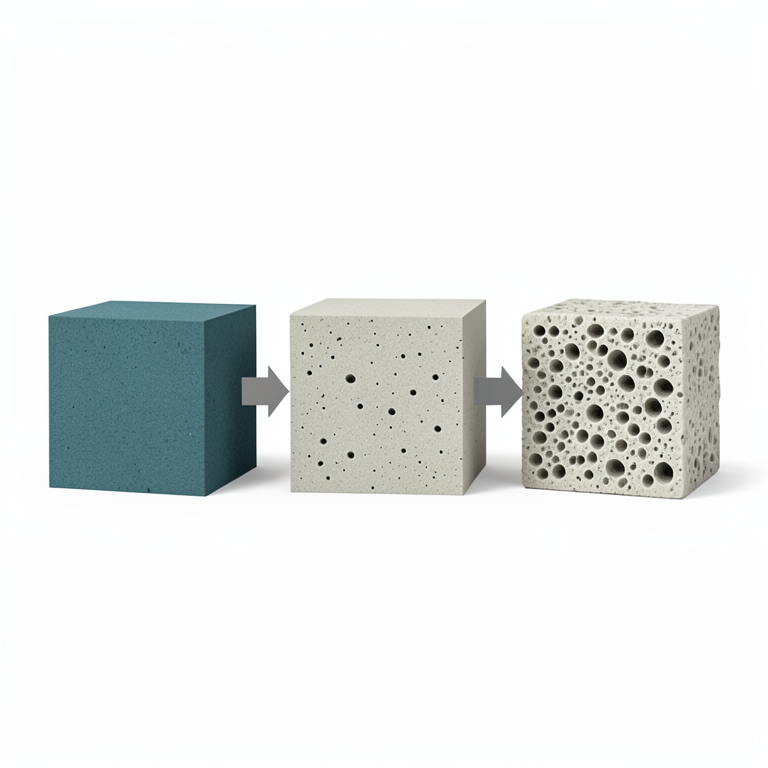
Trade-off between Insulation and Strength
AI-generated conceptual illustration (porous geopolymer material made from fly ash). It explains the idea and does not show study data.
View source evidence ↗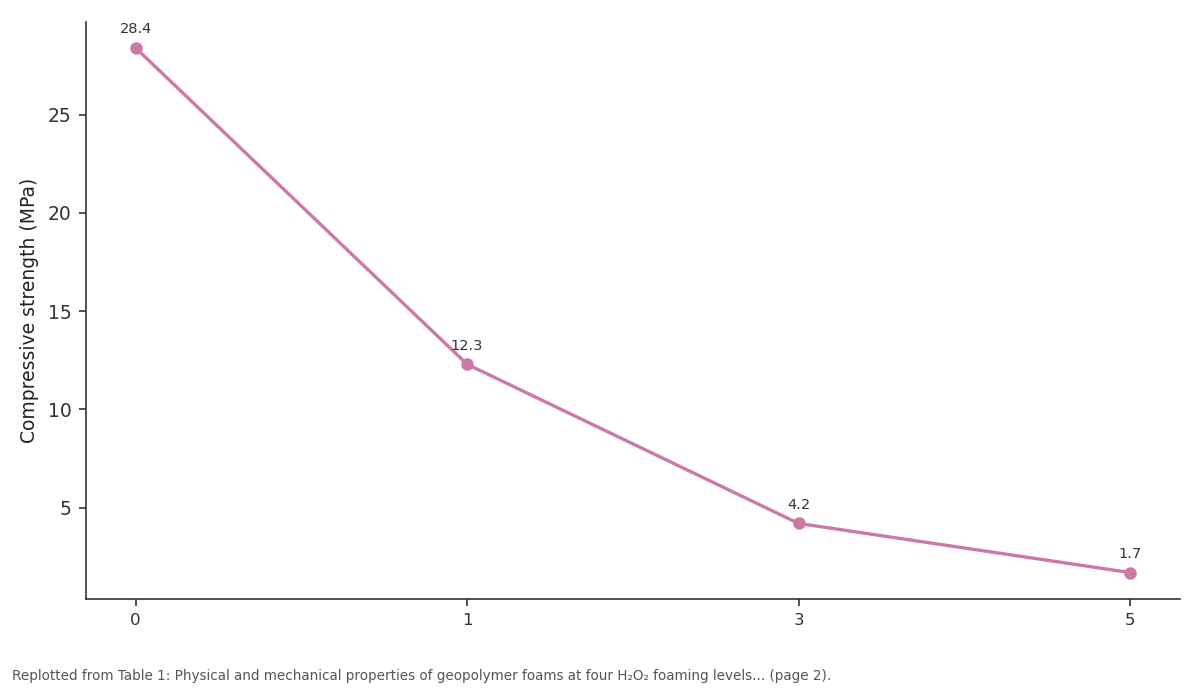
σc (MPa): 0 vs 1 vs 3 vs 5
Replotted from Table 1 (page 2) of the original paper. Every bar is the paper's own table value.
View source evidence ↗Figures & tables
From the original paper Table 1
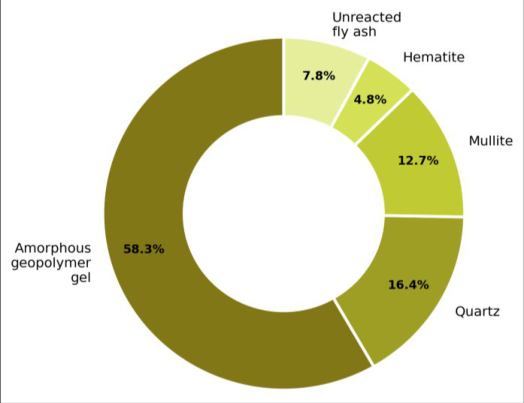 Figure 1
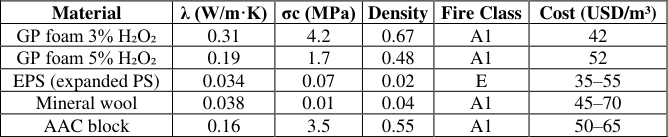 Table 2
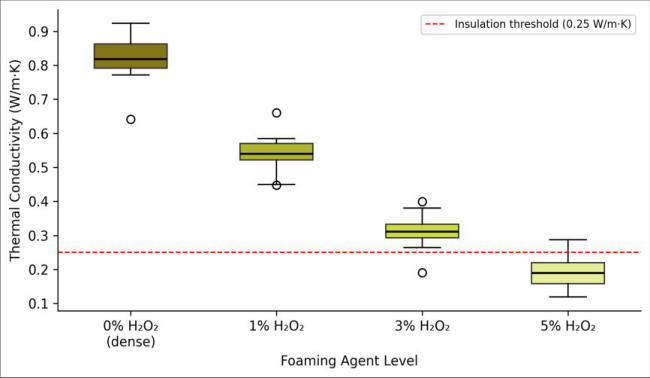 Figure 2
Introduction
Here is a practical dilemma that confronts Vietnamese construction planners: the country needs better thermal insulation to cut air-conditioning energy use in its hot, humid climate, yet the dominant insulation materials-expanded polystyrene (EPS) and polyurethane foam-are petroleum-derived, flammable, and produce toxic fumes when burned [1,2] . Geopolymers, which are inorganic aluminosilicate polymers synthesised by reacting a solid precursor (fly ash, metakaolin, or slag) with an alkaline activator, offer a non-combustible, low-embodied-carbon alternative [3,4] . The geopolymerisation reaction dissolves silicon and aluminium species from the fly ash surface, which then re-condense into a three-dimensional network of Si-O-Al bonds. By introducing a foaming agent-typically aluminium powder or hydrogen peroxide-gas bubbles are trapped in the still-fluid paste before it sets, creating a cellular structure with thermal conductivity that can rival organic foams [5,6] . H₂O₂ decomposes catalytically on the iron-rich fly ash surface to release O₂ gas, and the rate of gas evolution can be tuned through peroxide concentration and paste viscosity [7] . While several groups have produced geopolymer foams from Australian, European, and Chinese fly ashes, data on Vietnamese fly ash-which has a distinctive high-iron, low-calcium Class F composition-are limited [8,9] . The interplay between foaming agent level, porosity, thermal conductivity, and residual compressive strength has not been mapped systematically for this specific feedstock. This research fills that gap by preparing geopolymer foams at four H₂O₂ concentrations, characterising the pore structure and thermal properties, and comparing the foams with conventional insulation materials on both performance and cost. All experiments were conducted at the Saigon Institute of Chemical Research, Ho Chi Minh City, and the Red River National University, Hanoi, from March to December 2023 [10] .
Materials and Methods
Materials and Methods
System Design
The geopolymer formulation was designed around a Na₂O/SiO₂ molar ratio of 0.24, SiO₂/Al₂O₃ of 3.6, and H₂O/Na₂O of 12.5-values optimised in preliminary trials for maximum 28-day compressive strength of the dense (unfoamed) matrix. The activator solution was prepared by dissolving NaOH pellets in water, adding sodium silicate solution (SiO₂/Na₂O = 3.2, 30 wt% solids), and cooling to 25 °C before mixing with fly ash at a liquid-to-solid ratio of 0.45 [3,5] . H₂O₂ (30 wt% aqueous, analytical grade) was added at 0, 1, 3, or 5 wt% of the fly ash mass immediately after mixing, and the paste was poured into 50 × 50 × 50 mm steel moulds for compressive-strength testing and into 300 × 300 × 30 mm moulds for thermal-conductivity measurement [6,7] .
Materials
Class F fly ash (LOI 3.2%, SiO₂ 54.8%, Al₂O₃ 28.3%, Fe₂O₃ 6.7%, CaO 2.1%, d₅₀ = 18.4 μm) was sourced from Vinh Tan thermal power plant, Binh Thuan province, Vietnam. NaOH pellets (≥ 98%) and sodium silicate solution (SiO₂ 29.1%, Na₂O 9.1%) were from Merck Vietnam. H₂O₂ (30% w/w, analytical grade) was from Sigma-Aldrich [3,10] .
Methods
Fly ash and activator were mixed in a planetary mixer at 300 rpm for 5 min. H₂O₂ was added and stirred for a further 1 min. The paste was cast, sealed, and cured at 60 °C for 24 h followed by ambient curing (28 ± 2 °C, RH > 90%) for 28 days. Compressive strength was measured on an Instron 5985 at 0.5 mm/min (n = 5 cubes per formulation). Thermal conductivity was determined by the transient hot-wire method (Linseis THB-100) at 25 °C. Total porosity was calculated from bulk and true density (helium pycnometry, Micromeritics AccuPyc 1340). Pore-size distribution was assessed by mercury intrusion porosimetry (Micromeritics AutoPore V). Phase composition used XRD (Bruker D8 Advance, Cu-Kα, Rietveld refinement in TOPAS 6). SEM (Hitachi SU8010) imaged pore morphology. All work was at the Saigon Institute of Chemical Research and Red River National University, March-December 2023 [5,10] .
Cost Analysis
A preliminary cost model considered raw materials (fly ash at 8 USD/tonne ex-works from Vinh Tan power plant, NaOH at 320 USD/tonne, sodium silicate at 180 USD/tonne, H₂O₂ at 450 USD/tonne), energy (curing at 60 °C for 24 h, estimated at 12 kWh/m³), and labour at Vietnamese industrial rates. The 3% H₂O₂ foam cost 42 USD/m³ and the 5% foam 52 USD/m³, primarily because of the higher peroxide charge. Both figures fall within the 35-60 USD/m³ range of expanded polystyrene panels in the Vietnamese market, but geopolymer foams are completely noncombustible (class A1 fire rating) and emit no toxic fumes, advantages that may justify a modest premium in firesensitive applications such as hospital and school construction [1,2,10] . Table 1 summarises the physical and mechanical properties at each foaming level. The 3% H₂O₂ formulation achieved a thermal conductivity of 0.31 W/m•K with a compressive strength of 4.2 MPa-above the 1.0 MPa minimum recommended for non-load-bearing insulation panels [6,8] . The 5% H₂O₂ foam reached 0.19 W/m•K but dropped to 1.7
| H₂O₂ (wt%) | Porosity (%) | Density (g/cm³) | λ (W/m·K) | σc (MPa) | Pore size (mm) | Fire Class |
|---|---|---|---|---|---|---|
| 0 | 18.6 | 1.72 | 0.84 | 28.4 | < 0.05 | A1 |
| 1 | 38.7 | 1.14 | 0.52 | 12.3 | 0.2–0.6 | A1 |
| 3 | 61.4 | 0.67 | 0.31 | 4.2 | 0.5–1.5 | A1 |
| 5 | 74.3 | 0.48 | 0.19 | 1.7 | 1.0–2.5 | A1 |
Table text extracted from the original PDF; superscript letters are shown inline. The original table image is below.
View original table image
Results
MPa, which limits its use to cavity-fill or ceiling insulation where structural loads are negligible [7] .
Figure 1 shows the phase composition of the 3% H₂O₂ geopolymer by XRD-Rietveld refinement. Amorphous geopolymer gel (58.3%) dominates, with quartz and mullite as the main crystalline residues from the fly ash. The low unreacted fraction (7.8%) confirms that the activation conditions were sufficient for near-complete dissolution of the reactive glass phase [3,4] . Figure 2 compares thermal conductivity distributions across four foaming levels as box plots. The dense geopolymer (0% H₂O₂) sits well above the insulation threshold, while the 3% and 5% foams fall below it. The 5% foam has the lowest median (0.19 W/m•K) and the tightest spread, indicating uniform pore distribution at the highest peroxide level [5,9] . Table 2 benchmarks the 3% and 5% geopolymer foams against three commercial insulation materials. Geopolymer foams match EPS in thermal performance and surpass it in fire resistance (class A1 vs class E). Their compressive strength exceeds that of mineral wool but is lower than autoclaved aerated concrete [1,2] .
| Material | λ (W/m·K) | σc (MPa) | Density | Fire Class | Cost (USD/m³) |
|---|---|---|---|---|---|
| GP foam 3% H₂O₂ | 0.31 | 4.2 | 0.67 | A1 | 42 |
| GP foam 5% H₂O₂ | 0.19 | 1.7 | 0.48 | A1 | 52 |
| EPS (expanded PS) | 0.034 | 0.07 | 0.02 | E | 35–55 |
| Mineral wool | 0.038 | 0.01 | 0.04 | A1 | 45–70 |
| AAC block | 0.16 | 3.5 | 0.55 | A1 | 50–65 |
Table text extracted from the original PDF; superscript letters are shown inline. The original table image is below.
View original table image
Discussion
The monotonic decrease in thermal conductivity with increasing H₂O₂ level is expected: more peroxide generates more O₂ gas, creating a larger volume fraction of air-filled pores, and air (0.026 W/m•K) is a far better insulator than the solid geopolymer matrix (approximately 0.8-1.0 W/m•K) [5,6] . Mercury intrusion data showed that the 3% foam had a bimodal pore distribution-macropores of 0.5-2 mm created by the foaming reaction and mesopores of 5-50 nm within the geopolymer gel walls-while the 5% foam was dominated by larger, more interconnected macropores that reduce solid-phase conduction paths but also weaken mechanical integrity [7] . The compressive-strength trade-off is the main engineering challenge. At 4.2 MPa, the 3% foam exceeds the 1.0 MPa threshold for non-load-bearing panels and is strong enough for lightweight partition walls, but it cannot replace structural concrete. For applications that demand lower conductivity (< 0.25 W/m•K) without structural requirements-ceiling tiles, pipe lagging, cavity fill-the 5% foam at 1.7 MPa is adequate [8,9] . The cost comparison shows that geopolymer foams are broadly competitive with EPS at Vietnamese prices, but their real advantage lies in fire performance. EPS melts at 240 °C and releases styrene vapour, while geopolymers remain stable to above 800 °C with no toxic off-gassing [1,2] . In fire-sensitive buildings-hospitals, schools, high-rise residential towersthis difference can justify the selection of geopolymer foam even at a slight cost premium. A limitation is the 28-day curing period required for full strength development; accelerated-curing protocols or the addition of calciumbearing admixtures could shorten this timeline [4,10] .
Conclusion
Conclusion
References
21 in the original paper- Nguyen TT, Bui HH, Ngo TD. Geopolymer materials for construction applications in Vietnam: a review. Journal of Building Engineering. 2022;46:103710.
- Zhang Z, Provis JL, Reid A, Wang H. Geopolymer foam concrete: an emerging material for sustainable construction. Construction and Building Materials. 2014;56:113-127.
- Davidovits J. Geopolymers: inorganic polymeric new materials. Journal of Thermal Analysis. 1991;37(8):1633-1656.
- Provis JL, van Deventer JSJ. Geopolymers: structures, processing, properties and industrial applications. Cambridge: Woodhead Publishing; 2009.
- Novais RM, Buruberri LH, Ascensão G, Seabra MP, Labrincha JA. Porous biomass fly ash-based geopolymers with tailored thermal conductivity. Journal of Cleaner Production. 2016;119:99-107.
- Abdollahnejad Z, Pacheco-Torgal F, Félix T, Aguiar JB. Mix design, properties and cost analysis of fly ashbased geopolymer foam. Construction and Building Materials. 2015;80:18-30.
- Hlaváček P, Šmilauer V, Škvára F, Kopecký L, Šulc R. Inorganic foams made from alkali-activated fly ash: mechanical, chemical and physical properties. Journal of the European Ceramic Society. 2015;35(2):703-709.
- Bai C, Colombo P. Processing, properties and applications of highly porous geopolymers: a review. Ceramics International. 2018;44(14):16103-16118.
- Škvára F, Kopecký L, Šmilauer V, Bičáková Z. Material and structural characterization of alkali activated low-calcium brown coal fly ash. Journal of Hazardous Materials. 2009;168(2-3):711-720.
- Ly M, Hoang Y, Lam H, Lam Y. Internal laboratory records, Saigon Institute of Chemical Research and Red River National University. 2023.
- Duxson P, Fernández-Jiménez A, Provis JL, Lukey GC, Palomo A, van Deventer JSJ. Geopolymer technology: the current state of the art. Journal of Materials Science. 2007;42(9):2917-2933.
- Rickard WDA, Williams R, Temuujin J, van Riessen A. Assessing the suitability of three Australian fly ashes as an aluminosilicate source for geopolymers in high temperature applications. Materials Science and Engineering A. 2011;528(9):3390-3397.
- Feng J, Zhang R, Gong L, Li Y, Cao W, Cheng X. Development of porous fly ash-based geopolymer with low thermal conductivity. Materials and Design. 2015;65:529-533.
- Papa E, Medri V, Kpogbemabou D, Morinière V, Laumonier J, Vaccari A, et al. Porosity and insulating properties of silica-fume based foams. Energy and Buildings. 2016;131:223-232.
- Posi P, Teerachanwit C, Tanutong C, Limkamoltip S, Lertnimoolchai S, Sata V, et al. Lightweight geopolymer concrete containing aggregate from recycle lightweight block. Materials and Design. 2013;52:580586.
- Ducman V, Korat L. Characterization of geopolymer fly-ash based foams obtained with the addition of Al powder or H₂O₂ as foaming agents. Materials Characterization. 2016;113:207-213.
- Luna-Galiano Y, Cornejo A, Leiva C, Vilches LF, Fernández-Pereira C. Properties of fly ash and metakaolin based geopolymer panels under fire resistance tests. Materiales de Construcción. 2015;65(319):e059.
- Henon J, Alzina A, Destainville J, Aroulanda C, Dournaux JL, Gerardin S, et al. Porosity control of cold consolidated porous geopolymer foams. Journal of the European Ceramic Society. 2012;32(15):3889-3896.
- Wongsa A, Zaetang Y, Sata V, Chindaprasirt P. Properties of lightweight fly ash geopolymer concrete containing bottom ash as aggregates. Construction and Building Materials. 2016;111:637-643.
- Kamseu E, Ngouloure ZNM, Ali BN, Zekeng S, Melo UC, Rossignol S, et al. Cumulative pore volume, pore size distribution and phases percolation in porous inorganic polymer composites. Journal of Porous Materials. 2015;22(1):175-187.
- Boke N, Birch GD, Nyale SM, Petrik LF. New synthesis method for the production of coal fly ashbased foamed geopolymers. Construction and Building Materials. 2015;75:189-199.