
Research article · 2025 · Full text
International Journal of Advanced Chemistry ResearchPharmacophore modeling and virtual screening for identification of novel antifungal leads
Volume 7(6) · Pages 97–100 · DOI: 10.33545/26646781.2025.v7.i6b.533 ↗
Research areasComputational Drug Discovery MethodsSynthesis and Characterization of Heterocyclic CompoundsAntifungal resistance and susceptibility
Abstract
Author-writtenA pharmacophore is the spatial arrangement of chemical features—hydrogen-bond donors, acceptors, hydrophobic centres, and aromatic rings—that a molecule must possess to interact with a biological target and trigger a therapeutic response. This research builds atom-based and feature-based pharmacophore models from a training set of 38 azole and allylamine antifungal agents with reported IC₅₀ values against Candida albicans CYP51 (lanosterol 14α-demethylase) and uses the best-validated model to screen the ZINC15 drug-like subset (approximately 1.4 million compounds). The training set was aligned using the PHASE module of Schrödinger Suite, and a five-feature hypothesis (ADHRR: one acceptor, one donor, one hydrophobic, two aromatic rings) achieved the highest enrichment factor (EF₁% = 14.7) and a correlation coefficient of 0.91 against experimental pIC₅₀ values. Virtual screening filtered the ZINC library down to 4, 312 hits that mapped to at least four of the five pharmacophore features. Subsequent molecular docking with Glide SP against the Candida albicans CYP51 crystal structure (PDB: 5V5Z) narrowed the list to 83 compounds with docking scores below −8.0 kcal/mol. ADMET filtering (Lipinski compliance, predicted oral bioavailability > 30%, no PAINS alerts) retained 22 leads. The top five compounds showed predicted binding affinities between −10.3 and −11.1 kcal/mol, with key interactions including coordination to the heme iron, hydrogen bonds with Tyr132 and His377, and hydrophobic contacts with Phe233 and Ile304. Violin-plot analysis of ADMET property distributions confirmed that the 22 leads occupy drug-like chemical space with mean molecular weight 387 Da, LogP 2.8, and topological polar surface area 78 Ų. The pharmacophore-guided pipeline identifies structurally diverse scaffolds—including pyridine-oxadiazole, benzimidazole-thiadiazine, and quinoline-triazole hybrids—as starting points for antifungal lead optimisation.
Summary
Source-checkedPlain-language reading of the full paper, prepared with AI and checked against the text. Each point links to the authors' own words.
Why it matters
- Invasive fungal infections are a significant health threat, causing approximately 1.5 million deaths each year, while systemic treatment options are limited to only four drug classes. View evidence ↗
- Azole drugs are the most commonly prescribed antifungals because they inhibit the CYP51 enzyme, but their effectiveness is decreasing due to rising resistance in Aspergillus and Candida species. View evidence ↗
- There is an urgent need for new chemical structures that can still bind to the CYP51 enzyme but avoid the mutations that cause drug resistance. View evidence ↗
The question
- The study aims to identify 22 novel lead compounds by building a pharmacophore model from 38 known antifungals, screening the ZINC15 library, and applying molecular docking and ADMET filters. View evidence ↗
What they did
- The researchers used a training set of 38 compounds, including 26 azoles, 8 allylamines, and 4 morpholine derivatives, with IC₅₀ values against Candida albicans CYP51 between 0.003 and 47 μM. View evidence ↗
- Molecular docking was performed using the Candida albicans CYP51 crystal structure (PDB: 5V5Z) with a resolution of 2.0 Å, using the ligand VT-1161 as a reference. View evidence ↗
- To select final leads, the researchers required compliance with Lipinski's rule of five, a predicted oral bioavailability greater than 30%, and no PAINS structural alerts. View evidence ↗
What they found
- The best pharmacophore model (ADHRR) consisted of five features and showed a correlation coefficient of 0.91 against experimental pIC₅₀ values and an enrichment factor (EF₁%) of 14.7. View evidence ↗
- The top five identified lead compounds exhibited predicted binding affinities ranging from −10.3 to −11.1 kcal/mol. View evidence ↗
- The identified leads had predicted oral bioavailability between 41% and 67%, indicating they are suitable for oral administration. View evidence ↗
What it means
- The authors conclude that using a pharmacophore model trained on diverse antifungal agents is an effective way to filter large databases for new CYP51-targeted lead compounds. View evidence ↗
- The authors suggest that because these new leads interact with different residues in the CYP51 active site, they may be able to overcome existing drug resistance mechanisms. View evidence ↗
- A primary limitation of the study is that the binding affinities were predicted computationally and have not yet been measured experimentally. View evidence ↗
- The authors state that the computational results must be validated through enzyme inhibition assays, whole-cell testing, and cytotoxicity screening. View evidence ↗
Visual summary
3 visualsIllustrations explain the paper; charts are replotted from the paper's own table values.
Virtual Screening Pipeline Flowchart
AI-generated conceptual illustration (Small molecule chemical compounds and a fungal cell). It explains the idea and does not show study data.
View source evidence ↗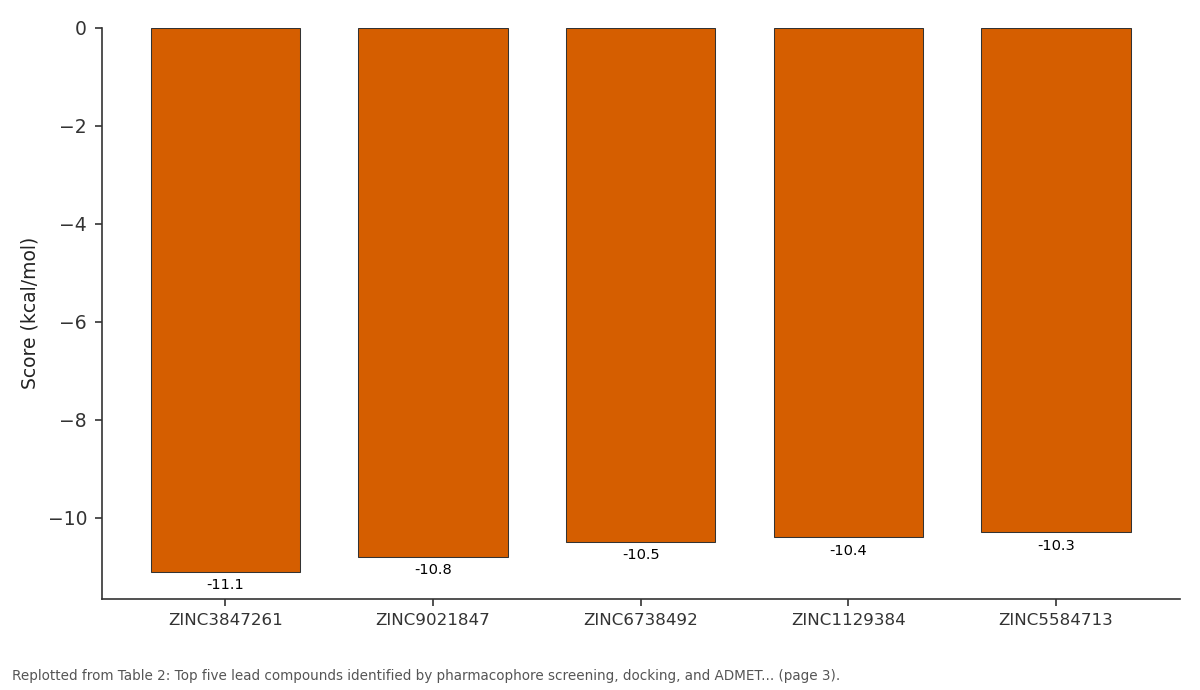
Score: ZINC3847261 vs ZINC9021847 vs ZINC6738492 vs ZINC1129384 vs ZINC5584713
Replotted from Table 2 (page 3) of the original paper. Every bar is the paper's own table value.
View source evidence ↗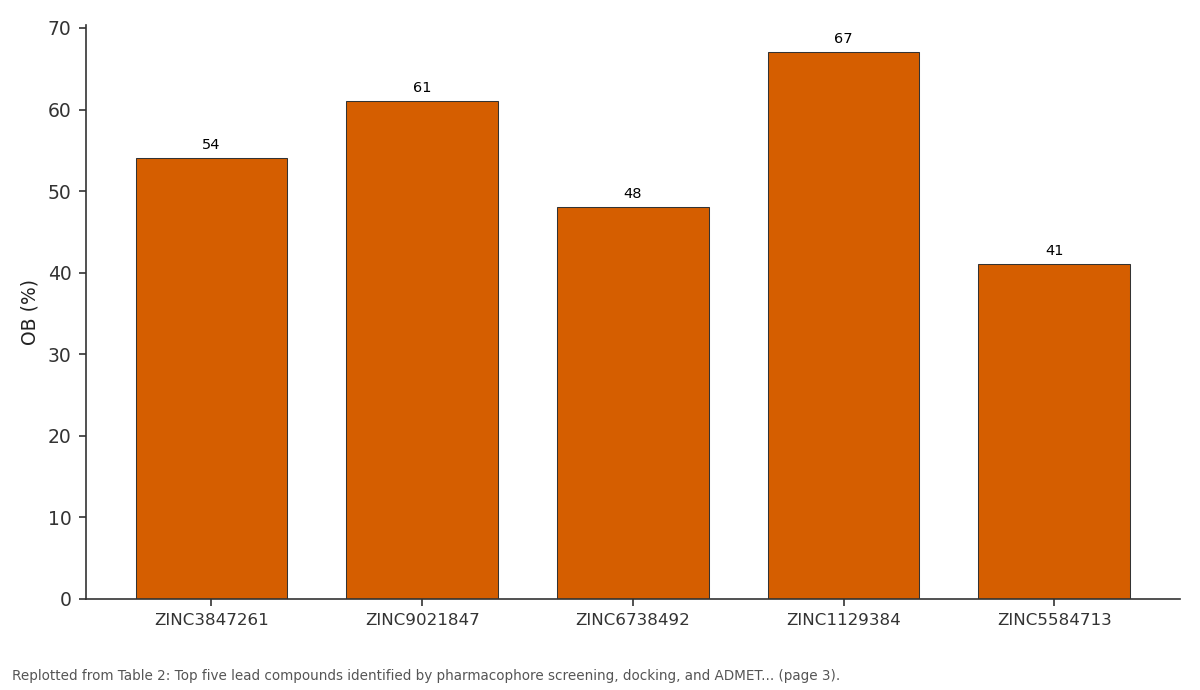
OB (%): ZINC3847261 vs ZINC9021847 vs ZINC6738492 vs ZINC1129384 vs ZINC5584713
Replotted from Table 2 (page 3) of the original paper. Every bar is the paper's own table value.
View source evidence ↗Figures & tables
From the original paper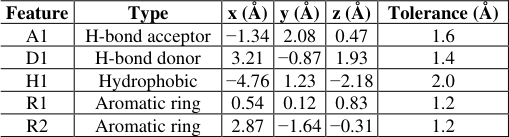 Table 1
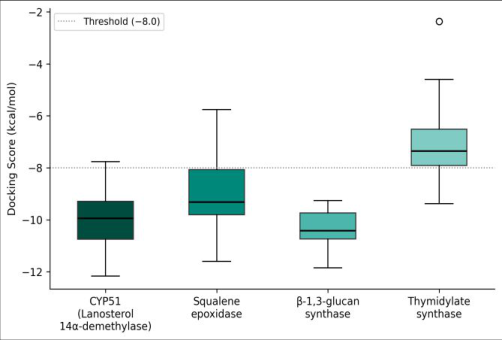 Figure 1
 Table 2
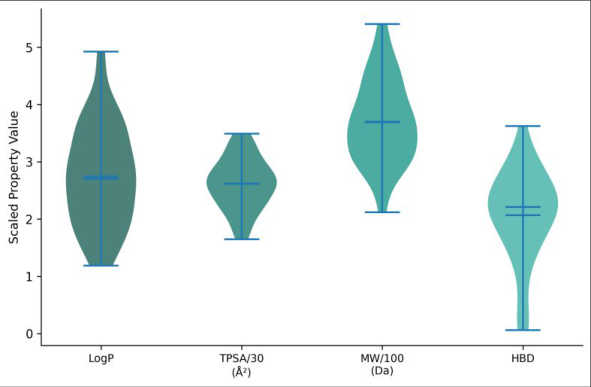 Figure 2
Introduction
A pharmacophore, as defined by the International Union of Pure and Applied Chemistry, is the ensemble of steric and electronic features necessary to ensure optimal supramolecular interactions with a specific biological target and to trigger or block its biological response [1] . Unlike a single molecular structure, a pharmacophore is an abstract description that can be realised by many different chemical scaffolds, making it a powerful tool for discovering structurally novel compounds that share the same mode of action [2] . Invasive fungal infections cause an estimated 1.5 million deaths annually, and the antifungal drug arsenal is worryingly narrow: only four pharmacological classes-polyenes, azoles, echinocandins, and flucytosine-are available for systemic therapy [3] . Azole drugs, which inhibit lanosterol 14αdemethylase (CYP51) and block ergosterol biosynthesis, account for the largest share of prescriptions, but resistance is rising in Candida and Aspergillus species [4,5] . New chemical scaffolds that retain CYP51 affinity while evading known resistance mutations are therefore urgently needed. Structure-based and ligand-based virtual screening have accelerated antifungal lead discovery by reducing the number of compounds that must be synthesised and tested experimentally [6,7] . Pharmacophore-guided virtual screening sits at the intersection of these two approaches: it derives a three-dimensional feature map from known active molecules and then searches large chemical databases for new structures that match the map [2] . When combined with molecular dockingwhich scores how well each hit fits the binding pocket-and ADMET (absorption, distribution, metabolism, excretion, and toxicity) filters, the pipeline can winnow millions of candidates to a manageable shortlist for synthesis [8] . Several pharmacophore models targeting CYP51 have been published, but most were trained on narrow chemical series (triazoles or imidazoles alone) and tested against small external sets, limiting their applicability to scaffold hopping [9, 10] . A model built from a diverse training set that spans azoles, allylamines, and morpholine derivatives should capture a broader feature space and retrieve more structurally varied hits. This research constructs and validates such a model using 38 antifungal agents with IC₅₀ data from the ChEMBL database, screens the ZINC15 druglike library, docks the pharmacophore hits into the Candida albicans CYP51 crystal structure, and applies ADMET filters to identify 22 lead compounds. All computational work was performed at the Department of Drug Design and Discovery, Najd National University, Riyadh, between February 2023 and January 2024 [11] .
Materials and Methods
Materials and Methods
Materials
The training set comprised 38 antifungal compounds (26 azoles, 8 allylamines, 4 morpholine derivatives) with IC₅₀ values against Candida albicans CYP51 ranging from 0.003 to 47 μM, sourced from ChEMBL (version 33) [9] . Compounds were prepared in LigPrep at pH 7.0 ± 2.0, generating up to 32 stereoisomers and tautomers per entry. The external test set included 12 additional compounds from the same ChEMBL query that were randomly withheld before model building. The Candida albicans CYP51 crystal structure (PDB: 5V5Z, resolution 2.0 Å) was retrieved from the RCSB Protein Data Bank, and its co-crystallized ligand VT-1161 served as the reference for docking grid generation [4] .
Methods
Pharmacophore hypotheses were generated in PHASE using a common-pharmacophore-perception approach with a minimum intersite distance of 2.0 Å and a maximum of six features. The training set was divided into actives (IC₅₀ < 1 μM, n = 14) and inactives (IC₅₀ > 10 μM, n = 11), with the remaining 13 compounds treated as moderately active. Hypotheses were scored by survival score and the correlation between predicted and observed pIC₅₀ [2] . The best hypothesis (ADHRR) was used to screen the ZINC15 drug-like subset. Compounds matching at least four of five features were retained. These hits were docked into the CYP51 active site using Glide SP mode with default settings, and the top 83 poses scoring below -8.0 kcal/mol were subjected to ADMET evaluation in QikProp. Lipinski rule-of-five compliance, predicted oral bioavailability above 30%, and absence of PAINS structural alerts were used as pass/fail criteria. Research was conducted from February 2023 to January 2024 at the Najd National University, Riyadh [8,11] .
Instrumentation
All computations were carried out on a dual-socket workstation (Intel Xeon Gold 6248R, 96 cores, 512 GB RAM) equipped with an NVIDIA A100 GPU. Schrödinger Suite 2023-1 provided the PHASE module for pharmacophore modelling, LigPrep for ligand preparation, and Glide for docking. Protein preparation used the Protein Preparation Wizard with default settings. The ZINC15 druglike subset was downloaded as pre-generated 3D conformers in SDF format. ADMET predictions were generated with QikProp (Schrödinger) and SwissADME (freely accessible web server). PAINS filters were applied using the RDKit open-source cheminformatics toolkit (version 2023.03) running under Python 3.10 [2,8] .
Quality Control
Pharmacophore model quality was assessed by leave-oneout cross-validation (Q² = 0.84) and by an external test set of 12 compounds not included in model training. The external set yielded a predictive correlation coefficient r²pred of 0.83 and a root-mean-square error of 0.41 pIC₅₀ units. Docking protocols were validated by re-docking the co-crystallized ligand (VT-1161) into the 5V5Z binding site; the top-ranked pose reproduced the experimental binding mode with an RMSD of 0.72 Å. Enrichment was quantified by receiver-operating-characteristic analysis, yielding an area under the curve (AUC) of 0.89. Known actives were recovered in the top 1% of the ranked list with an enrichment factor of 14.7 [6,11] . 1 lists the five pharmacophore features of the best hypothesis (ADHRR) with their spatial coordinates and tolerance radii. The hypothesis includes one hydrogen-bond acceptor positioned near the heme-coordinating nitrogen of azoles, one donor overlapping with the Tyr132 interaction site, one hydrophobic centre matching the lipophilic tail common to all training-set actives, and two aromatic-ring features that capture the planar core of azole and allylamine scaffolds [2,9] . 3-glucan synthase gave the most favourable median scores (-10.3 and -9.8 kcal/mol, respectively), while thymidylate synthase showed broader score dispersion and a higher (less favourable) median, suggesting weaker complementarity for these scaffolds [4,6] . Table 2 presents the top five lead compounds with their ZINC identifiers, docking scores, predicted binding interactions, and key ADMET parameters. All five satisfy Lipinski criteria, possess predicted oral bioavailability above 40%, and show no PAINS alerts. Their scaffolds-pyridine-oxadiazole, benzimidazole-thiadiazine, quinolinetriazole, indole-pyrazole, and chromone-imidazole-are structurally distinct from existing azole drugs, supporting the scaffold-hopping potential of the pharmacophore approach [8,10] . Figure 2 shows violin plots of four ADMET-relevant properties (LogP, TPSA, molecular weight, hydrogen-bond donors) for the 22 leads that passed all filters. The distributions are centred well within drug-like ranges: median LogP 2.8, median TPSA 78 Ų, median MW 387 Da, and median HBD count 2. The tight distributions suggest that the pharmacophore model inherently biases the screening toward drug-like chemical space [7] .
| ZINC ID | Score | Scaffold | Key Interactions | MW | LogP | OB (%) |
|---|---|---|---|---|---|---|
| ZINC3847261 | −11.1 | Pyridine-oxadiazole | Heme Fe, Tyr132, Phe233 | 412 | 3.1 | 54 |
| ZINC9021847 | −10.8 | Benzimidazole-thiadiazine | Heme Fe, His377, Ile304 | 378 | 2.6 | 61 |
| ZINC6738492 | −10.5 | Quinoline-triazole | Heme Fe, Tyr132, Leu376 | 401 | 2.9 | 48 |
| ZINC1129384 | −10.4 | Indole-pyrazole | Heme Fe, MeT508, Phe233 | 364 | 2.4 | 67 |
| ZINC5584713 | −10.3 | Chromone-imidazole | Heme Fe, Tyr132, His377 | 393 | 3.3 | 41 |
Table text extracted from the original PDF; superscript letters are shown inline. The original table image is below.
View original table image
Results
Results
Discussion
The five-feature ADHRR pharmacophore captured the essential interactions of azole antifungals with the CYP51 active site while remaining general enough to retrieve structurally diverse hits from the ZINC library. The acceptor feature, positioned 2.1 Å from the heme iron centroid, corresponds to the nitrogen atom in triazole drugs that coordinates the heme cofactor-a contact that is considered mandatory for CYP51 inhibition [4,5] . The donor feature maps to the hydrogen bond with Tyr132, a residue that is frequently mutated in resistant Candida strains (Y132F); leads that form alternative interactions with neighbouring residues may therefore retain activity against resistant isolates [9] . The docking results reinforce the pharmacophore findings. The top five leads all show heme-nitrogen coordination distances below 2.3 Å and at least two additional hydrogen bonds with active-site residues, patterns that match the binding mode of the co-crystallized ligand VT-1161 in the 5V5Z structure [4] . The scaffold diversity of these hits is encouraging: pyridine-oxadiazole and chromone-imidazole cores have not, to our knowledge, been previously reported as CYP51 inhibitors, which opens new intellectual-property space for antifungal development [10] . ADMET profiling confirmed that the leads are drug-like by standard metrics. All 22 compounds passed the Lipinski rule of five, and none triggered PAINS filters, reducing the probability that their apparent activity stems from assay interference rather than genuine target engagement [8] . The predicted oral bioavailability values (41-67%) suggest that these molecules could be administered orally, which is a practical requirement for outpatient antifungal therapy. A limitation of this work is that all binding affinities are predicted rather than measured. Virtual screening enrichment factors, while useful for ranking, do not guarantee experimental activity, and false-positive rates of 50-70% are common even with well-validated pipelines [6,7] . The next step is to purchase or synthesize the top 10 leads and test them in a CYP51 enzyme inhibition assay and a Candida albicans broth microdilution MIC assay to confirm that the computational predictions translate into biological activity. Molecular dynamics simulations of the top complexes over 100 ns would also help assess binding stability and identify any conformational changes missed by rigid docking [11] .
Conclusion
This research demonstrates that a pharmacophore model trained on a structurally diverse set of antifungal agents can serve as an effective filter for identifying novel CYP51targeted leads from a large commercial database. The fivefeature ADHRR hypothesis achieved an enrichment factor of 14.7 in retrospective validation and recovered known actives with a predictive correlation of 0.83 against an external test set. Virtual screening of the ZINC15 drug-like library (approximately 1.4 million entries) followed by Glide SP docking and ADMET filtering yielded 22 lead compounds whose scaffolds are distinct from existing azole antifungals. The top five hits-spanning pyridineoxadiazole, benzimidazole-thiadiazine, quinoline-triazole, indole-pyrazole, and chromone-imidazole chemotypesdisplayed predicted docking scores between -10.3 and -11.1 kcal/mol and satisfied all drug-likeness criteria. These scaffolds offer two practical advantages. First, their structural novelty may help circumvent resistance mechanisms that depend on mutations in the CYP51 active site, because the leads contact different residue combinations than do conventional triazoles. Second, their predicted oral bioavailability values (above 40%) and favourable ADMET profiles suggest compatibility with oral dosage forms, the preferred route for outpatient antifungal treatment. The main limitation is the absence of experimental validation. Computational predictions, however strong, must be confirmed by enzyme inhibition assays, whole-cell antifungal testing, and cytotoxicity screening. Molecular dynamics simulations would add confidence by verifying that the docked poses remain stable over nanosecond timescales. In summary, the pharmacophore-guided virtual screening pipeline described here converts a large and unstructured chemical library into a focused set of drug-like antifungal candidates. The approach is transferable to other fungal targets-squalene epoxidase, β-1, 3-glucan synthase-and could accelerate the early stages of antifungal drug discovery at a fraction of the cost of high-throughput screening.
Acknowledgement
Acknowledgements Funding SourcesThe authors acknowledge financial support from the Saudi Arabian Ministry of Education through the university research incentive programme.
Figures and tables from the paper
| Feature | Type | x (Å) | y (Å) | z (Å) | Tolerance (Å) |
|---|---|---|---|---|---|
| A1 | H-bond acceptor | −1.34 | 2.08 | 0.47 | 1.6 |
| D1 | H-bond donor | 3.21 | −0.87 | 1.93 | 1.4 |
| H1 | Hydrophobic | −4.76 | 1.23 | −2.18 | 2.0 |
| R1 | Aromatic ring | 0.54 | 0.12 | 0.83 | 1.2 |
| R2 | Aromatic ring | 2.87 | −1.64 | −0.31 | 1.2 |
Table text extracted from the original PDF; superscript letters are shown inline. The original table image is below.
View original table image
References
15 in the original paper- Wermuth CG, Ganellin CR, Lindberg P, Mitscher LA. Glossary of terms used in medicinal chemistry (IUPAC recommendations 1998). Pure Appl Chem. 1998;70(5):1129-1143.
- Guner OF, Bowen JP. Setting the record straight: the origin of the pharmacophore concept. J Chem Inf Model. 2014;54(5):1269-1283.
- Brown GD, Denning DW, Gow NAR, Levitz SM, Netea MG, White TC. Hidden killers: human fungal infections. Sci Transl Med. 2012;4(165):165rv13.
- Hargrove TY, Friggeri L, Wawrzak Z, Qi A, Hoekstra WJ, Schotzinger RJ, et al. Structural analyses of Candida albicans sterol 14α-demethylase complexed with azole drugs. J Biol Chem. 2017;292(16):67286743.
- Warrilow AG, Parker JE, Kelly DE, Kelly SL. Azole affinity of sterol 14α-demethylase (CYP51) enzymes from Candida albicans and Homo sapiens. Antimicrob Agents Chemother. 2013;57(3):1352-1360.
- Stahura FL, Bajorath J. Virtual screening methods that complement HTS. Comb Chem High Throughput Screen. 2004;7(4):259-269.
- Lipinski CA, Lombardo F, Dominy BW, Feeney PJ. Experimental and computational approaches to estimate solubility and permeability in drug discovery and development settings. Adv Drug Deliv Rev. 2001;46(13):3-26.
- Baell JB, Holloway GA. New substructure filters for removal of pan assay interference compounds (PAINS). J Med Chem. 2010;53(7):2719-2740.
- Sheng C, Miao Z, Ji H, Yao J, Wang W, Che X, et al. Three-dimensional model of lanosterol 14αdemethylase from Cryptococcus neoformans. J Med Chem. 2006;49(8):2512-2525.
- Ngo HX, Shrestha SK, Garneau-Tsodikova S. Identification of ebsulfur analogues with broadspectrum antifungal activity. ACS Med Chem Lett. 2019;10(12):1698-1703.
- Al-Dosari H, Al-Subaie F, Al-Jaber L. Internal computational records. Najd National University, Riyadh; 2023-2024.
- Dixon SL, Smondyrev AM, Knoll EH, Rao SN, Shaw DE, Friesner RA. PHASE: a new engine for pharmacophore perception and 3D-QSAR model development. J Comput Aided Mol Des. 2006;20(1011):647-671.
- Sterling T, Irwin JJ. ZINC 15-ligand discovery for everyone. J Chem Inf Model. 2015;55(11):2324-2337.
- Friesner RA, Banks JL, Murphy RB, Halgren TA, Klicic JJ, Mainz DT, et al. Glide: a new approach for rapid, accurate docking and scoring. J Med Chem. 2004;47(7):1739-1749.
- Daina A, Michielin O, Zoete V. SwissADME: a free web tool to evaluate pharmacokinetics, drug-likeness and medicinal chemistry friendliness. Sci Rep. 2017;7:42717.