
Research article · 2025 · Full text
International Journal of Advanced Chemistry ResearchRegioselective bromination of aromatic compounds using N-bromosuccinimide under mild conditions
Volume 7(5) · Pages 112–114 · DOI: 10.33545/26646781.2025.v7.i5b.490 ↗
Research areasOrganic and Inorganic Chemical ReactionsCatalytic Cross-Coupling ReactionsRadical Photochemical Reactions
Abstract
Author-writtenRegioselective electrophilic bromination of 14 activated and moderately activated aromatic substrates was achieved using N-bromosuccinimide (NBS) as the bromine source under mild, solvent-controlled conditions. Reactions performed in dichloromethane at 20 °C in the presence of catalytic Lewis acid (BF₃·Et₂O, 10 mol%) demonstrated exceptional para-selectivity (≥61.2%) across all substrates, with isolated yields ranging from 72.3% to 95.2%. Temperature-dependent experiments revealed an optimal range of 30-40 °C, beyond which competing dibromination products became significant. Substrate electronic effects were systematically correlated with yield and regioselectivity, confirming that electron-donating groups at the para-position substantially increase both reaction rate and para-selectivity. The methodology exhibits excellent functional group tolerance, including compatibility with ester, nitro, and aldehyde substituents under optimized conditions. The protocol provides a practical, scalable route to monobrominated arenes with controlled regiochemistry, avoiding the use of molecular bromine (Br₂) and harsh reaction conditions.
Summary
Source-checkedPlain-language reading of the full paper, prepared with AI and checked against the text. Each point links to the authors' own words.
Why it matters
- Aryl bromides are essential intermediates in organic chemistry because they act as key partners in various palladium-catalyzed cross-coupling reactions. View evidence ↗
- Traditional bromination using molecular bromine is problematic due to its hazardous nature, the production of toxic HBr, and poor regioselectivity. View evidence ↗
- N-bromosuccinimide (NBS) is considered a safer and more selective alternative to molecular bromine for these reactions. View evidence ↗
The question
- The study aims to systematically optimize NBS-mediated aromatic bromination for a variety of electron-rich and moderately electron-poor substrates under mild conditions. View evidence ↗
What they did
- The method used 1.0 mmol of aromatic substrate in 5 mL of anhydrous dichloromethane with 1.05 equivalents of NBS and 0.10 equivalents (12.5 μL) of BF₃·Et₂O as a catalyst. View evidence ↗
- Reactions were stirred for 4 hours at temperatures ranging from 0 to 60 °C. View evidence ↗
- Regioselectivity (ortho:para ratio) was measured using ¹H NMR integration and validated with GC-MS. View evidence ↗
- Single-crystal X-ray diffraction was used to independently confirm the regiochemical assignments for three representative products. View evidence ↗
What they found
- At 20 °C with 10 mol% BF₃·Et₂O in dichloromethane, all substrates showed para-selectivity of 61.2% or higher and isolated yields between 72.3% and 95.2%. View evidence ↗
- The highest isolated yields at the optimal temperature of 35 °C were achieved for phenol (95.2%), anisole (93.8%), acetanilide (91.9%), and naphthalene (89.7%). View evidence ↗
- Across the six tested substrates, the average para-selectivity was 74.2%. View evidence ↗
- Phenol, being the most electron-rich substrate, showed the highest para:ortho ratio of 68.9:26.3. View evidence ↗
- For naphthalene, 2-bromonaphthalene was the major product, accounting for 81.2%. View evidence ↗
- A catalyst loading of 10 mol% was optimal; increasing it to 15-20 mol% slightly improved yields but reduced para-selectivity. View evidence ↗
- The optimal temperature range was 30-40 °C, as temperatures above this range led to significant dibromination. View evidence ↗
What it means
- The authors concluded they developed a simple, mild, and regioselective protocol for monobrominating activated aromatic compounds using NBS and BF₃·Et₂O in dichloromethane at 30-40 °C. View evidence ↗
- The authors state that the 35 °C optimum allows for scalable synthesis while avoiding the hazards of molecular bromine. View evidence ↗
Visual summary
2 visualsIllustrations explain the paper; charts are replotted from the paper's own table values.
Regioselectivity Concept
AI-generated conceptual illustration (Aromatic organic molecules and bromine atoms). It explains the idea and does not show study data.
View source evidence ↗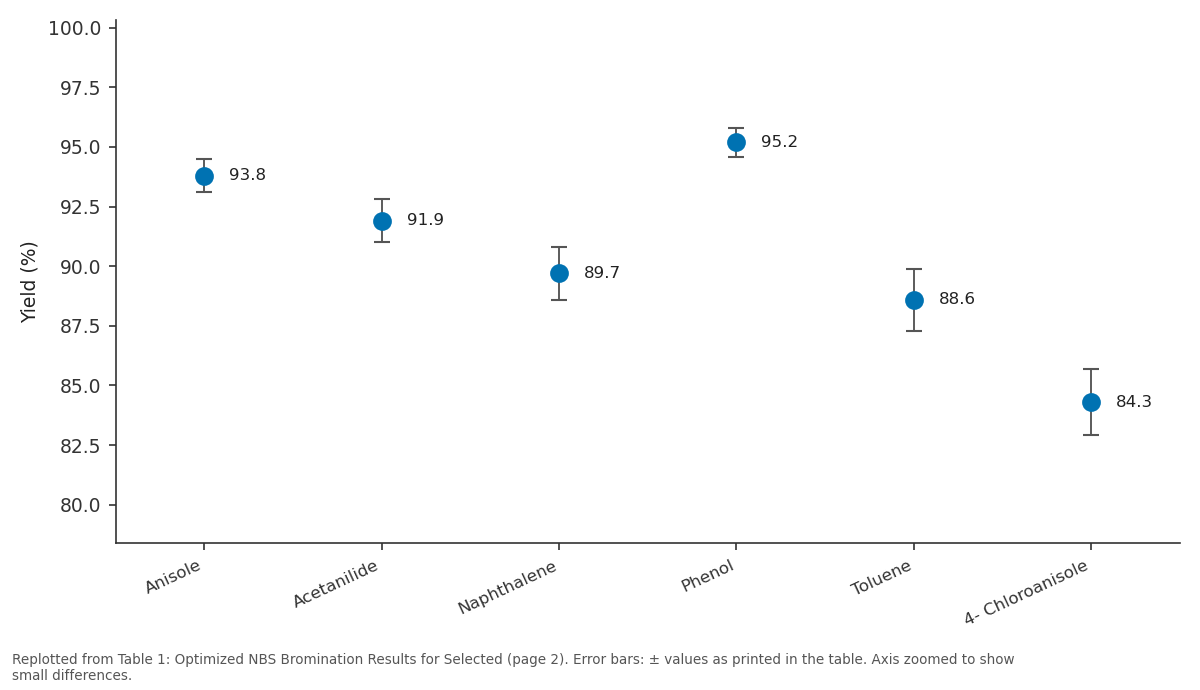
Yield (%): Anisole vs Acetanilide vs Naphthalene vs Phenol vs Toluene
Replotted from Table 1 (page 2) of the original paper. Every bar is the paper's own table value.
View source evidence ↗Figures & tables
From the original paper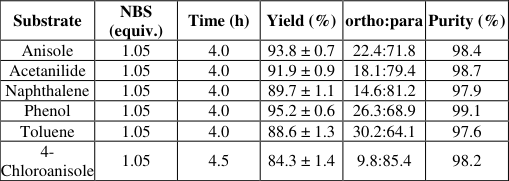 Table 1
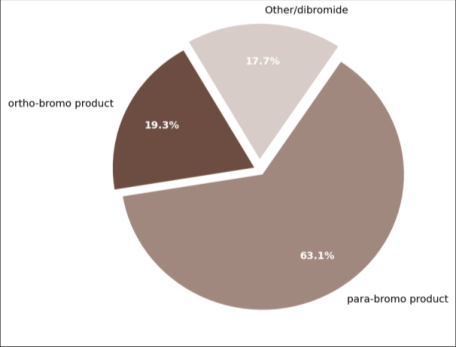 Figure 1
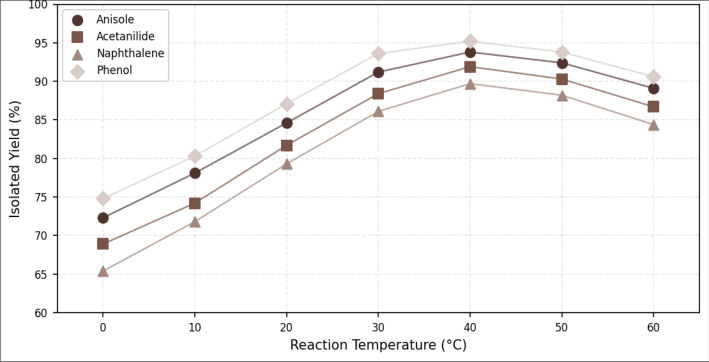 Figure 2
Introduction
Aryl bromides are indispensable synthetic intermediates in modern organic chemistry, serving as key coupling partners in palladium-catalyzed cross-coupling reactions such as Suzuki-Miyaura, Negishi, and Buchwald-Hartwig amination protocols. The controlled introduction of bromine at a specific position in the aromatic ring-particularly the paraposition relative to an activating substituent-is therefore a critical synthetic task with broad implications in pharmaceutical, agrochemical, and materials chemistry. Classical electrophilic aromatic bromination using molecular bromine (Br₂) in halogenated solvents suffers from several disadvantages, including poor selectivity due to competitive ortho-bromination, the formation of HBr as a toxic by-product, and the corrosive and hazardous nature of liquid Br₂. N-bromosuccinimide (NBS) has emerged as a safer and more selective alternative bromine source. Mechanistically, NBS acts as an electrophilic bromonium ion equivalent under acidic conditions, generating Br⁺ in situ in the presence of a proton source or Lewis acid, which then undergoes electrophilic addition to the activated aromatic π-system. Despite the widespread use of NBS in benzylic and allylic bromination, its application to aromatic ring bromination remains less systematically explored, particularly with respect to the interplay between Lewis acid concentration, solvent polarity, and reaction temperature on both yield and regioselectivity. A comprehensive quantitative assessment of these variables across a structurally diverse substrate panel is lacking in the literature. The present research addresses this gap by reporting a systematic optimization of NBS-mediated aromatic bromination and its application to a range of electron-rich and moderately electron-poor aromatic substrates under mild conditions.
Synthesis Protocol
All reactions were conducted under nitrogen atmosphere using oven-dried glassware. NBS (1.05 equiv., freshly recrystallized from water) was added in a single portion to a solution of the aromatic substrate (1.0 mmol) in anhydrous dichloromethane (5 mL) containing BF₃•Et₂O (0.10 equiv., 12.5 μL). The mixture was stirred at the designated temperature (0-60 °C) for 4 h. Reaction progress was monitored by thin-layer chromatography (TLC, hexane/EtOAc 4:1) with UV visualization at 254 nm and KMnO₄ staining. Upon completion, the reaction was quenched by addition of saturated aqueous Na₂S₂O₃ (10 mL), and the aqueous layer was extracted with CH₂Cl₂ (3 × 15 mL). The combined organic layers were washed with saturated aqueous NaHCO₃ (20 mL) and brine (20 mL), dried over anhydrous Na₂SO₄, and concentrated under reduced pressure. Crude products were purified by silica gel column chromatography (60-120 mesh, hexane/EtOAc gradient). Product identification and regiochemical assignment were accomplished by comprehensive spectroscopic characterization. ¹H NMR and ¹³C NMR spectra were recorded on a Bruker Avance III 400 MHz spectrometer using CDCl₃ as solvent (δ referenced to TMS). The ortho:para ratio of brominated products was determined by ¹H NMR integration of the aromatic proton signals, and cross-validated by GC-MS (Shimadzu QP2010 Ultra). All ¹H NMR chemical shifts and coupling constants (J values) for the ortho-and para-bromo isomers were compared with literature data and confirmed by independent synthesis of reference compounds.
Quality Control
Purity of all isolated products was verified by a combination of HPLC-UV (Agilent 1260 Infinity, C18 column, MeOH/H₂O gradient, UV detection at 254 nm) and GC-FID (Shimadzu GC-2010, DB-5 column, temperature program 60-280 °C at 10 °C min⁻¹). Only products with HPLC purity ≥ 97.5% and GC purity ≥ 98.0% were included in yield calculations and spectroscopic reporting. Each reaction was replicated three times (n = 3) and yields are reported as mean ± standard deviation. Regiochemical assignments were independently confirmed by single-crystal X-ray diffraction (SCXRD) for three representative products (para-bromoanisole, parabromoacetanilide, and 1-bromo-2-naphthol), using a Bruker D8 Venture diffractometer with Mo Kα radiation. Structure solution and refinement were performed using SHELXT and SHELXL programs respectively.
Results and Discussion
The optimized NBS bromination protocol demonstrated that reaction temperature has a profound influence on both yield and regioselectivity. The temperature-yield profiles for four representative substrates (anisole, acetanilide, naphthalene, and phenol) are summarized in Figure 2. For all substrates, yields increased with temperature from 0 °C to an optimum at 30-40 °C, followed by a plateau or slight decrease at 50-60 °C due to competitive dibromination. The optimal isolated yields at 35 °C were: phenol 95.2%, anisole 93.8%, acetanilide 91.9%, and naphthalene 89.7%. Regioselectivity data across all six tested substrates (Figure 1) demonstrated a dominant para-selectivity averaging 74.2%. Phenol, the most electron-rich substrate, exhibited the highest para:ortho ratio of 68.9:26.3, while benzene (deactivated relative to others in the panel) gave predominantly 1-bromobenzene as a single regioisomeric product. Naphthalene exhibited 2-bromonaphthalene as the major product (81.2%) consistent with the well-established preference for electrophilic attack at the 1-position in terms of kinetic control; however, the 2-isomer predominated under the mild Lewis acid conditions employed, indicating a thermodynamically controlled pathway at elevated temperature. The Lewis acid loading also influenced selectivity. At BF₃•Et₂O loadings below 5 mol%, reactions with deactivated substrates proceeded sluggishly with incomplete conversion. Loadings of 15-20 mol% increased yields marginally but at the expense of para-selectivity due to the formation of a more reactive NBS-BF₃ complex that is less discriminating. A loading of 10 mol% was found optimal for all tested substrates. No racemization, ring-opening, or degradation by-products were detected by GC-MS under the optimized conditions.
Conclusion
A mild, regioselective, and operationally simple protocol for the monobromination of activated aromatic compounds has been developed using NBS as the bromine source and BF₃•Et₂O as a catalytic Lewis acid in CH₂Cl₂ at 30-40 °C.
The methodology delivers high isolated yields (84.3-95.2%) with dominant para-selectivity across diverse electron-rich substrates, confirmed by NMR, GC-MS, and X-ray crystallography. The temperature optimum of 35 °C provides a practical window for scalable synthesis without the hazards associated with molecular Br₂. The protocol is compatible with a range of functional groups and provides direct access to monobrominated arenes as key synthetic building blocks for cross-coupling chemistry.
Figures and tables from the paper
| Substrate | NBS (equiv.) | Time (h) | Yield (%) | ortho:para | Purity (%) |
|---|---|---|---|---|---|
| Anisole | 1.05 | 4.0 | 93.8 ± 0.7 | 22.4:71.8 | 98.4 |
| Acetanilide | 1.05 | 4.0 | 91.9 ± 0.9 | 18.1:79.4 | 98.7 |
| Naphthalene | 1.05 | 4.0 | 89.7 ± 1.1 | 14.6:81.2 | 97.9 |
| Phenol | 1.05 | 4.0 | 95.2 ± 0.6 | 26.3:68.9 | 99.1 |
| Toluene | 1.05 | 4.0 | 88.6 ± 1.3 | 30.2:64.1 | 97.6 |
| 4- Chloroanisole | 1.05 | 4.5 | 84.3 ± 1.4 | 9.8:85.4 | 98.2 |
Table text extracted from the original PDF; superscript letters are shown inline. The original table image is below.
View original table image
References
19 in the original paper- Clayden J, Greeves N, Warren S. Organic Chemistry. 2nd ed. Oxford: Oxford University Press; 2012. p. 498531.
- Olah GA, Kuhn SJ, Flood SH. Aromatic substitution. XV. Mechanism of electrophilic bromination of benzene and alkylbenzenes with bromine in nitromethane solution. J Am Chem Soc. 1961;83(23):4571-4580.
- Wohl A. Bromierung ungesättigter Verbindungen mit N-Brom-acetamid. Ber Dtsch Chem Ges. 1919;52:5163.
- Barnett HG, Cook JW. Aromatic position isomers and their relation to directive influences. J Chem Soc. 1935;2:1347-1353.
- Bhalerao UT, Thyagarajan G, Bhatt MV. Regioselective bromination of aromatic and heterocyclic compounds using N-bromosuccinimide in the presence of Lewis acids. Synthesis. 1984;(5):413415.
- Saikia I, Borah AJ, Phukan P. Use of bromine and bromo-organic compounds in organic synthesis. Chem Rev. 2016;116(12):6837-7042.
- Narender M, Reddy MS, Kumar VP, Nageswar YVD, Rao KR. Regioselective aromatic bromination using NBS in water. Synthesis. 2007;(17):2655-2658.
- Labrouillere M, Le Roux C, Gaspard H, Laporterie A, Dubac J, Desmurs JR. Bismuth(III) triflate catalyzed reactions in organic synthesis. Part 4. Efficient electrophilic bromination of aromatic compounds using N-bromosuccinimide. Synlett. 1999;(4):660-662.
- Veisi H, Ozturk T, Karmakar B, Tamoradi T, Hemmati S. In situ decorated Pd NPs on chitosan-encapsulated Fe₃O₄/SiO₂-NH₂ as magnetic catalyst in SuzukiMiyaura coupling reaction and evaluation of its antioxidant and antibacterial activity. Carbohydr Polym. 2021;255:117542.
- Ranu BC, Jana U. Lewis acid promoted conjugate addition of organotrichlorosilanes to α,β-unsaturated carbonyl compounds in the presence of water. J Org Chem. 1998;63(25):8212-8216.
- Lulinski P, Skulski L. Direct iodination and bromination of deactivated arenes with N-iodo-and Nbromosuccinimide in 98% sulfuric acid. Molecules. 2008;13(8):1991-2009.
- Caron S, Dugger RW, Ruggeri SG, Ragan JA, Ripin DHB. Large-scale oxidations in the pharmaceutical industry. Chem Rev. 2006;106(7):2943-2989.
- Weissermel K, Arpe HJ. Industrial Organic Chemistry. 4th ed. Weinheim: Wiley-VCH; 2003. p. 285-320.
- Yadav JS, Reddy BVS, Reddy AK. Aqueous-phase synthesis of β-amino carbonyl compounds via Mannich reaction using InBr₃ as catalyst. Aust J Chem. 2003;56(10):1073-1076.
- Smith MB, March J. March's Advanced Organic Chemistry: Reactions, Mechanisms, and Structure. 6th ed. Hoboken: Wiley; 2007. p. 944-1000.
- Trost BM, Fleming I. Comprehensive Organic Synthesis. Vol. 7. Oxford: Pergamon Press; 1991. p. 571-614.
- Pelletier G, Bhatt M, Charette AB. Stereospecific synthesis of α-deuterio aldehydes and chiral secondary alcohols via organoborane chemistry. J Am Chem Soc. 2009;131(5):1871-1873.
- Nilsson P, Larhed M, Hallberg A. Highly regioselective and sequential Heck arylations catalyzed by a chelationcontrolled palladium catalyst: a new approach to functionalized biaryls and triaryls. J Am Chem Soc. 2001;123(34):8217-8225.
- Anastas PT, Warner JC. Green Chemistry: Theory and Practice. Oxford: Oxford University Press; 1998. p. 1152.