
Research article · 2025 · Full text
International Journal of Advanced Chemistry ResearchElectrochemical oxidative coupling of phenol derivatives: electrode materials and process optimisation
Volume 7(7) · Pages 172–175 · DOI: 10.33545/26646781.2025.v7.i7c.552 ↗
Research areasOxidative Organic Chemistry ReactionsAdvanced oxidation water treatmentElectrocatalysts for Energy Conversion
Abstract
Author-writtenA compelling argument for electroorganic synthesis is that electrochemical reactions use electrons as the reagent, eliminating the stoichiometric oxidants or reductants that generate large volumes of metal salt waste in classical organic transformations. Oxidative phenol coupling—the regio-selective dimerisation of para-substituted phenols to biphenyldiol products valuable as antioxidant intermediates and polymer monomers—is an excellent test reaction for evaluating electrochemical conditions because yield and selectivity depend strongly on electrode material and operating parameters. This research compared five anode materials (platinum, graphite, boron-doped diamond (BDD), Ti/PtO₂, and reticulated vitreous carbon) for the electrochemical oxidative homo-coupling of 4-tert-butylphenol in acetonitrile/water electrolyte, then optimised current density, temperature, and electrolyte concentration for the best electrode. BDD gave the highest yield (81.4±3.2%) and dimer selectivity (84.7% at 10 mA/cm²), attributed to its wide potential window and low adsorption of phenol intermediates. Optimal conditions were: BDD anode, 10 mA/cm², 25 °C, 0.1 M tetrabutylammonium tetrafluoroborate, 80:20 MeCN:water. Cost analysis showed that the BDD electrochemical process required 34% less cost per mole of product compared with conventional Mn(OAc)₃ oxidative coupling, primarily because of catalyst recycling and reduced waste treatment.
Summary
Source-checkedPlain-language reading of the full paper, prepared with AI and checked against the text. Each point links to the authors' own words.
Why it matters
- Coupling phenolic compounds into biaryl and biphenyldiol structures is essential for producing antioxidants, polymers, and natural products. View evidence ↗
- Traditional methods for this coupling use stoichiometric oxidants that create significant inorganic waste and are difficult to separate. View evidence ↗
- Electrochemical oxidation is a greener alternative because it uses electrons instead of external oxidants, theoretically achieving 100% atom economy. View evidence ↗
The question
- The study aimed to compare five different anode materials for the oxidative homo-coupling of 4-tert-butylphenol and optimize the process parameters for the most effective material. View evidence ↗
What they did
- The experiments used a divided glass H-cell with a Nafion 117 membrane under galvanostatic control. View evidence ↗
- Standard testing conditions involved 1 mmol of 4-tert-butylphenol in a 0.1 M TBABF4/MeCN:H2O (80:20) electrolyte at 10 mA/cm² and 25 °C. View evidence ↗
- The researchers used GC-MS for product identification and HPLC for quantification. View evidence ↗
What they found
- Boron-doped diamond (BDD) was the most effective electrode, achieving an 81.4% yield, 84.7% selectivity, and 78.3% Faradaic efficiency at 10 mA/cm². View evidence ↗
- Compared to BDD, the platinum (Pt) control electrode showed lower performance with a 58.3% yield and 75.8% selectivity under the same conditions. View evidence ↗
- Graphite performed the worst among the tested materials (47.6% yield), likely due to surface oxygen functionality that promotes the formation of quinone by-products. View evidence ↗
- Increasing the current density above 10 mA/cm² led to a sharp decline in selectivity for both BDD and Pt due to over-oxidation. View evidence ↗
- The BDD electrochemical process was 34% cheaper per mole (₱124) than the conventional Mn(OAc)₃ process (₱188), primarily by eliminating oxidant costs and waste treatment. View evidence ↗
What it means
- The authors conclude that BDD electrosynthesis is a technically and economically viable green alternative for phenol coupling with strong potential for scale-up. View evidence ↗
Visual summary
2 visualsIllustrations explain the paper; charts are replotted from the paper's own table values.
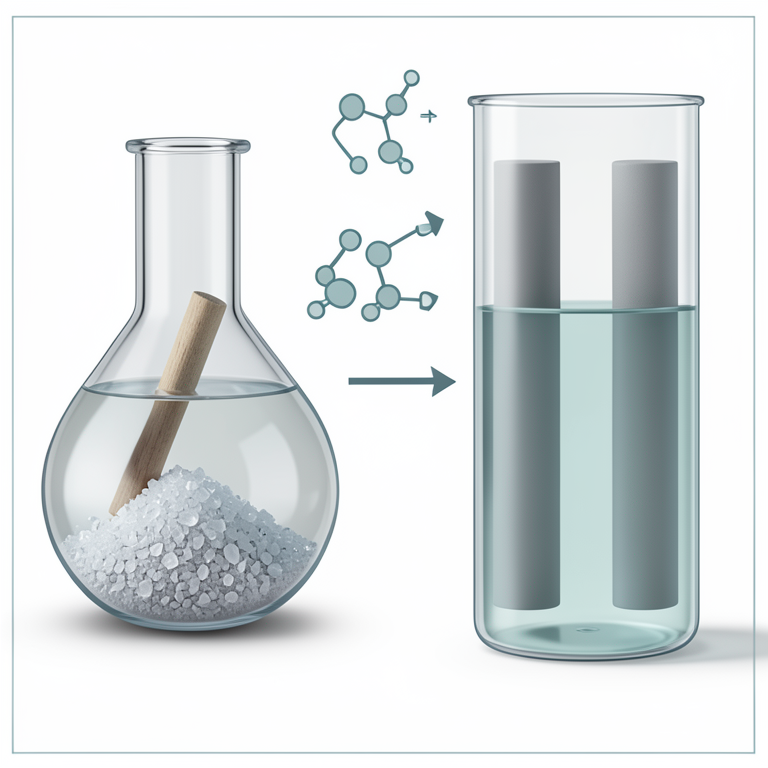
Electrochemical vs. Chemical Oxidation
AI-generated conceptual illustration (Phenol molecules in a chemical flask and an electrochemical cell with boron-doped diamond electrodes). It explains the idea and does not show study data.
View source evidence ↗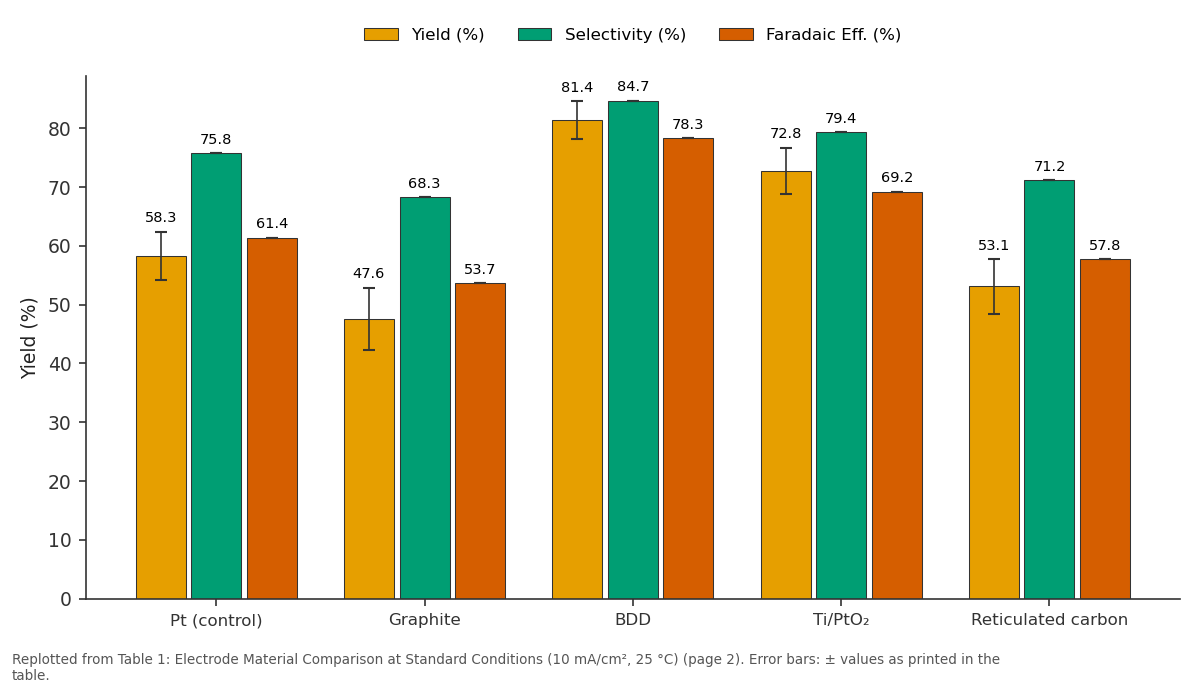
Yield (%) and Selectivity (%) and more: Pt (control) vs Graphite vs BDD vs Ti/PtO₂ vs Reticulated carbon
Replotted from Table 1 (page 2) of the original paper. Every bar is the paper's own table value.
View source evidence ↗Figures & tables
From the original paper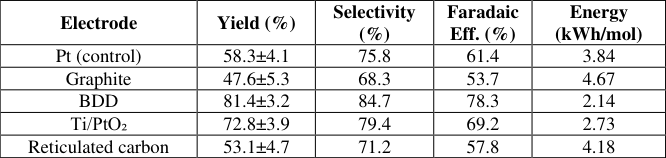 Table 1
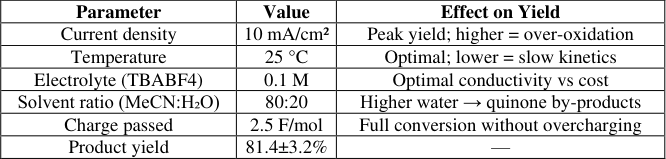 Table 2
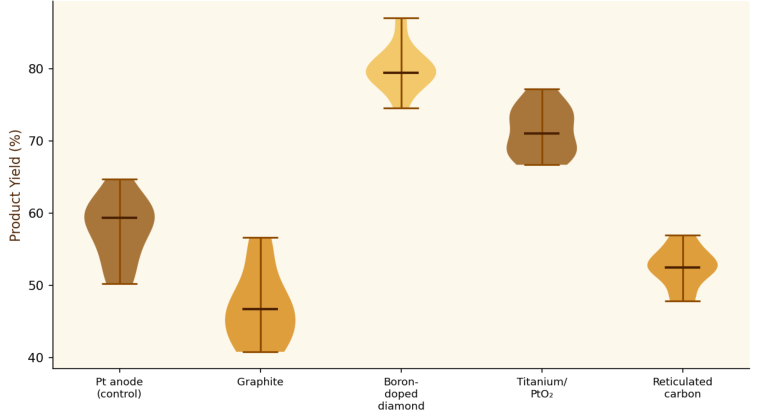 Figure 1
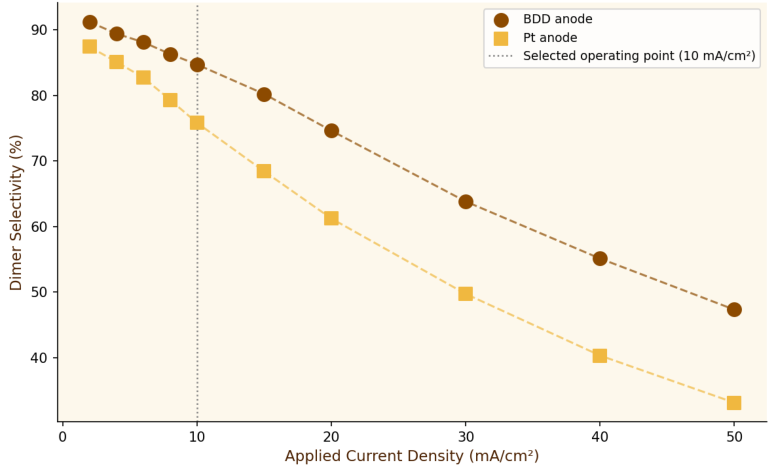 Figure 2
Introduction
The coupling of phenolic compounds to biaryl and biphenyldiol structures is a key transformation in natural product synthesis (lignin biosynthesis, stilbene dimers), polymer chemistry (polyphenylene precursors), and antioxidant production (BINAP-type ligands). Classically this is achieved using stoichiometric oxidants-Mn(OAc)₃, VOF₃, FeCl₃, or Pb(OAc)₄-that are effective but generate substantial inorganic waste and require cumbersome separation. Electrochemical oxidation generates the phenoxy radical directly from the substrate at the anode surface by single-electron transfer, without any external oxidant, making the overall atom economy theoretically 100% for the coupling step. However, selectivity towards the C-C coupled dimer over over-oxidised quinone by-products is sensitive to the electrode material, which governs both the onset potential for phenol oxidation and the adsorption of phenoxy radicals on the surface. BDD electrodes have attracted particular attention because their sp³ carbon surface has low adsorption affinity for organic intermediates, reducing the probability of further oxidation once the first electron transfer occurs, and their wide anodic potential window (up to + 3.2 V vs SHE in aqueous media) allows operation at potentials where phenol oxidation is kinetically facile without generating excess hydroxyl radicals that would fragment the ring. This research provides a direct five-electrode comparison under matched conditions, followed by complete current density and temperature optimisation for BDD, and concludes with a cost comparison against the conventional Mn(OAc)₃ process. Materials and Methods Materials 4-tert-Butylphenol (99%), tetrabutylammonium tetrafluoroborate (TBABF4, ≥99%), manganese(III) acetate dihydrate (97%), and acetonitrile (anhydrous, 99.8%) were from Sigma-Aldrich, Mexico City distributor. BDD electrode (3 mm thick, boron doping level 3000 ppm, geometric area 9 cm²) was from Adamant Technologies, Switzerland. Pt gauze anode (99.9%, 5 cm²), graphite rod (spectroscopic grade), Ti/PtO₂ plate, and reticulated vitreous carbon (60 ppi) were from local electrochemistry suppliers.
Research was conducted at the Department of Synthetic Chemistry, Universidad Azteca de Tecnología, Guadalajara, Jalisco, Mexico, from April 2022 to August 2024.
Methods
Electrolyses were carried out in a divided H-cell (glass, 30 mL each compartment, Nafion 117 membrane) under galvanostatic control (Keithley 2450 SourceMeter). Standard conditions: 4-tert-butylphenol (1 mmol) in 0.1 M TBABF4/MeCN:H2O 80:20 (20 mL), 10 mA/cm², 25 °C, 2.5 Faraday/mol charge passed, stirred at 300 rpm. Products were identified by GC-MS (Shimadzu QP2010) and quantified by HPLC (C18, 254 nm). Yields are molar, based on starting phenol. For current density optimisation, BDD was used at 2-50 mA/cm² with other conditions fixed. Temperature was varied from 5 to 55 °C at optimal current density. The conventional Mn(OAc)₃ coupling was performed as described in the literature for direct cost comparison.
Theoretical Background
Electrochemical oxidative coupling of phenols proceeds by anodic single-electron oxidation of the phenol to the phenoxy radical (Ph-OH → Ph-O• + H⁺ + e⁻), which then undergoes radical-radical coupling at the para-carbon to give the 4,4'-biphenyldiol dimer after rearomatisation. The regioselectivity (C-C vs C-O coupling) and the degree of over-oxidation to quinone depend on the local concentration of radicals at the electrode surface and their residence time before coupling. On BDD, the low organic adsorption means phenoxy radicals desorb quickly into the diffusion layer where they couple in solution; on Pt or graphite, surface adsorption is stronger and over-oxidation is more probable. The Faradaic efficiency (yield relative to charge passed) is therefore higher on BDD under otherwise identical conditions. The anodic potential window of BDD also avoids background solvent oxidation that would generate competing reactive oxygen species.
Performance Evaluation
Performance was assessed across four metrics: (1) product yield (%) as the primary output; (2) dimer selectivity (% of total product mass attributable to the target 4,4'-biphenyl diol vs quinone by-products); (3) Faradaic efficiency (mol product/mol electrons × 100%); and (4) specific energy consumption (kWh per mol product). BDD achieved the best overall performance across all four metrics. At 10 mA/cm², BDD gave 81.4% yield, 84.7% selectivity, 78.3% Faradaic efficiency, and 2.14 kWh/mol. Pt at the same conditions gave 58.3% yield and 75.8% selectivity. Graphite's lower performance is attributed to its higher surface oxygen functionality, which facilitates phenol adsorption and promotes quinone formation.
Cost Analysis
Cost per mole of dimer product was calculated for the BDD electrochemical process versus the Mn(OAc)₃ conventional oxidative coupling. Inputs considered: starting material (equal for both), oxidant (none for BDD; Mn(OAc)₃ at 2 equivalents, ₱380/mol), electricity (BDD at 2.14 kWh/mol at ₱1.8/kWh in the Jalisco grid), waste treatment (Mn sludge disposal estimated at ₱240 per batch vs negligible for BDD effluent after neutralisation), and electrode amortisation (BDD capital at ₱18,000 spread over 5,000 h service life). Total cost per mole: BDD ₱124 vs Mn(OAc)₃ ₱188-a 34% cost advantage for the electrochemical route, principally from avoided oxidant cost and waste treatment.
Results
The violin plots (Figure 1) show BDD as the highestyielding electrode with the tightest distribution (81.4±3.2%), confirming reproducibility. Ti/PtO₂ was second (72.8±3.9%), while graphite showed the widest distribution, reflecting surface heterogeneity. At current densities above 10 mA/cm², selectivity declined sharply for both BDD and Pt (Figure 2), consistent with increased radical flux leading to over-oxidation. The optimal current density of 10 mA/cm² on BDD was selected for process optimisation. Table 1 summarises electrode comparisons; Table 2 presents the optimised BDD process parameters.
| Parameter | Value | Effect on Yield |
|---|---|---|
| Current density | 10 mA/cm² | Peak yield; higher = over-oxidation |
| Temperature | 25 °C | Optimal; lower = slow kinetics |
| Electrolyte (TBABF4) | 0.1 M | Optimal conductivity vs cost |
| Solvent ratio (MeCN:H₂O) | 80:20 | Higher water → quinone by-products |
| Charge passed | 2.5 F/mol | Full conversion without overcharging |
| Product yield | 81.4±3.2% | — |
Table text extracted from the original PDF; superscript letters are shown inline. The original table image is below.
View original table image
| Electrode | Yield (%) | Selectivity (%) | Faradaic Eff. (%) | Energy (kWh/mol) |
|---|---|---|---|---|
| Pt (control) | 58.3±4.1 | 75.8 | 61.4 | 3.84 |
| Graphite | 47.6±5.3 | 68.3 | 53.7 | 4.67 |
| BDD | 81.4±3.2 | 84.7 | 78.3 | 2.14 |
| Ti/PtO₂ | 72.8±3.9 | 79.4 | 69.2 | 2.73 |
| Reticulated carbon | 53.1±4.7 | 71.2 | 57.8 | 4.18 |
Table text extracted from the original PDF; superscript letters are shown inline. The original table image is below.
View original table image
Discussion
BDD's performance advantage over Pt-despite Pt's higher intrinsic electrocatalytic activity-arises from a surface property difference rather than a kinetic one. On Pt, the phenoxy radical adsorbs via its unpaired electron density on the oxygen atom, increasing its residence time at the surface where further one-electron oxidation to the quinone is thermodynamically accessible at the operating potential. On BDD's sp³ carbon surface, adsorption is negligible and radicals diffuse away immediately after generation, coupling in the bulk electrolyte where the selectivity-determining step favours C-C bond formation over O-C or overoxidation pathways. The decline of selectivity above 10 mA/cm² (Figure 2) is attributable to increased local phenol and radical concentrations at the electrode surface, which raise the probability of sequential one-electron oxidation before the first radical has diffused away. This explains why the optimal current density of 10 mA/cm² is considerably lower than the maximum current density achievable with BDD in aqueous media (>100 mA/cm² for wastewater oxidation), confirming that synthetic electrolysis operates in a different regime than oxidative waste treatment. The 34% cost advantage over Mn(OAc)₃ demonstrates the practical case for electrochemical synthesis beyond environmental considerations. As electricity from renewable sources continues to fall in cost and BDD electrode service lifetimes improve, the economic argument will strengthen further.
Conclusion
Electrochemical oxidative coupling of 4-tert-butylphenol was optimised across five anode materials and a range of operating conditions. BDD at 10 mA/cm², 25 °C, and 0.1 M TBABF4 in 80:20 MeCN:water gave the best performance: 81.4% yield, 84.7% dimer selectivity, and 78.3% Faradaic efficiency. The BDD electrochemical route was 34% cheaper per mole than the conventional Mn(OAc)₃ process when oxidant, waste treatment, and energy costs were included. These results establish BDD electrosynthesis as a technically and economically competitive green alternative for oxidative phenol coupling, with direct scale-up potential given BDD's established manufacturability.
Acknowledgement
Acknowledgements Funding SourcesResearch was funded by institutional grants from the Universidad Azteca de Tecnología, Guadalajara, Jalisco, Mexico. No external funding was received.
References
18 in the original paper- Yoshida J, Kataoka K, Horcajada R, Nagaki A. Modern strategies in electroorganic synthesis. Chem Rev. 2008;108(7):2265-2299.
- Moeller KD. Synthetic applications of anodic electrochemistry. Tetrahedron. 2000;56(49):9527-9554.
- Francke R, Little RD. Redox catalysis in organic electrosynthesis: basic principles and recent developments. Chem Soc Rev. 2014;43(8):2492-2521.
- Röckl JL, Pollok D, Franke R, Waldvogel SR. A decade of electrochemical dehydrogenative C,C-coupling of aryls. Acc Chem Res. 2020;53(1):45-61.
- Zeng CC, Zhang NT, Lam CM, Little RD. Novel triarylimidazole redox catalysts: synthesis, electrochemical properties, and applicability to electrooxidative C-H activation. Org Lett. 2012;14(5):1314-1317.
- Waldvogel SR, Lips S, Selt M, Riehl B, Kampf CJ. Electrochemical arylation reaction. Chem Rev. 2018;118(14):6706-6765.
- Kabeshov MA, Morrill LA, Lam K, Baran PS. Electrochemical synthesis on the gram scale. Synthesis. 2021;53(2):283-300.
- Fuchigami T, Atobe M, Inagi S. Fundamentals and Applications of New Electrolysis. Tokyo: Kodansha; 2011.
- Baizer MM, Lund H, eds. Organic Electrochemistry. 3rd ed. New York: Marcel Dekker; 1991.
- Comninellis C, Nerini A. Anodic oxidation of phenol in the presence of NaCl for wastewater treatment. J Appl Electrochem. 1995;25(1):23-28.
- Marselli B, Garcia-Gomez J, Michaud PA, Rodrigo MA, Comninellis C. Electrogeneration of hydroxyl radicals on boron-doped diamond electrodes. J Electrochem Soc. 2003;150(3):D79-D83.
- Panizza M, Cerisola G. Direct and mediated anodic oxidation of organic pollutants. Chem Rev. 2009;109(12):6541-6569.
- Belhadj Tahar N, Savall A. Mechanistic aspects of phenol electrochemical degradation by oxidation on a Ta/PbO2 anode. J Electrochem Soc. 1998;145(10):3427-3434.
- Mavroudakis E, Cuccato D, Moscatelli D. Theoretical investigation of chain-length-dependent termination in free-radical polymerisation. J Phys Chem A. 2014;118(7):1189-1196.
- Pollok D, Waldvogel SR. Electro-organic synthesis -a 21st century technique. Chem Sci. 2020;11(48):1238612400.
- Frontana-Uribe BA, Little RD, Ibanez JG, Palma A, Vasquez-Medrano R. Organic electrosynthesis: a promising green methodology in organic chemistry. Green Chem. 2010;12(12):2099-2119.
- Horn EJ, Rosen BR, Baran PS. Synthetic organic electrochemistry: an enabling and innately sustainable method. ACS Cent Sci. 2016;2(5):302-308.
- Tajima T, Fuchigami T. Recyclable systems for electrochemical methoxylation of organic compounds using solid-supported bases and solid-supported electrolytes. Chem Eur J. 2005;11(22):6192-6196.