
Research article · 2025 · Full text
International Journal of Advanced Chemistry ResearchSynthesis and characterization of star-shaped block copolymers via RAFT polymerization
Volume 7(11) · Pages 109–112 · DOI: 10.33545/26646781.2025.v7.i11b.446 ↗
Research areasAdvanced Polymer Synthesis and CharacterizationBlock Copolymer Self-Assemblybiodegradable polymer synthesis and properties
Abstract
Author-writtenStar-shaped polymers remain among the least predictable macromolecular architectures in terms of self-assembly, mechanical response, and solution behaviour a direct consequence of their constrained branch-point geometry. This research describes the synthesis and full characterisation of four-arm star poly (styrene)-block-poly (methyl methacrylate) (PS-b-PMMA) copolymers prepared via the reversible addition–fragmentation chain-transfer (RAFT) technique using a tetra-functional trithiocarbonate chain-transfer agent. Polymerisation was carried out in bulk at 70 °C with azobisisobutyronitrile (AIBN) as radical initiator. Kinetic sampling showed a linear increase in number-average molecular weight (Mn) with conversion, reaching 26.1 kg/mol at 93.7% conversion, while dispersity (Đ) stayed below 1.31 throughout. GPC traces exhibited monomodal distributions with no high-molecular-weight shoulder, indicating minimal star-star coupling. ¹H NMR confirmed block composition within 3% of theoretical feed ratios. DSC revealed a single broad glass transition at 112.8 °C for the star copolymer, intermediate between homopolymer PS (103.7 °C) and PMMA (121.4 °C). TGA under nitrogen showed 5% mass loss at 327 °C. These well-defined star block copolymers may find application as compatibilisers, nanopatterning templates, and rheology modifiers.
Summary
Source-checkedPlain-language reading of the full paper, prepared with AI and checked against the text. Each point links to the authors' own words.
Why it matters
- Star polymers are characterized by linear arms radiating from a single core, which gives them distinct self-assembly behavior and lower viscosities than linear polymers of the same molecular weight. View evidence ↗
- The combination of polystyrene and poly(methyl methacrylate) (PS-b-PMMA) is useful for nanopatterning due to its high Flory-Huggins parameter and the fact that PMMA can be selectively etched. View evidence ↗
- Reversible addition-fragmentation chain-transfer (RAFT) polymerization is preferred for creating complex polymer architectures because it is versatile with monomers and operates under mild conditions. View evidence ↗
The question
- The study aims to address the lack of detailed kinetic and thermal characterization data for star-shaped PS-b-PMMA by synthesizing a four-arm version using a core-first approach. View evidence ↗
What they did
- The researchers synthesized four-arm star PS-b-PMMA copolymers using a tetra-functional trithiocarbonate chain-transfer agent via RAFT polymerization. View evidence ↗
- Polymerization kinetics were monitored by taking samples at intervals, which were then analyzed using gravimetry for conversion and Gel Permeation Chromatography (GPC) for molecular weight. View evidence ↗
- Thermal properties were measured using Differential Scanning Calorimetry (DSC) from -50 to 200 °C and Thermogravimetric Analysis (TGA) from 25 to 700 °C under nitrogen. View evidence ↗
What they found
- The number-average molecular weight increased linearly with conversion, reaching 26.1 kg/mol at 93.7% conversion, with dispersity remaining under 1.31. View evidence ↗
- GPC analysis showed monomodal distributions without high-molecular-weight shoulders, suggesting that star-star coupling was minimal. View evidence ↗
- The block composition of the copolymers was confirmed by 1H NMR to be within 3% of the theoretical feed ratios. View evidence ↗
- The star copolymer exhibited a single glass transition temperature (Tg) of 112.8 °C, which is between the Tg of PS (103.7 °C) and PMMA (121.4 °C). View evidence ↗
- Thermal stability analysis via TGA showed a 5% mass loss at 327 °C under nitrogen. View evidence ↗
- The star copolymer's glass transition temperature (112.8 °C) was higher than that of the linear diblock analogue (108.3 °C). View evidence ↗
What it means
- The authors conclude that these star block copolymers are suitable for nanopatterning and compatibilization due to their architectural control and tunable phase behavior. View evidence ↗
- The authors suggest that future work should extend this synthesis method to asymmetric block compositions and higher arm numbers. View evidence ↗
Visual summary
3 visualsIllustrations explain the paper; charts are replotted from the paper's own table values.
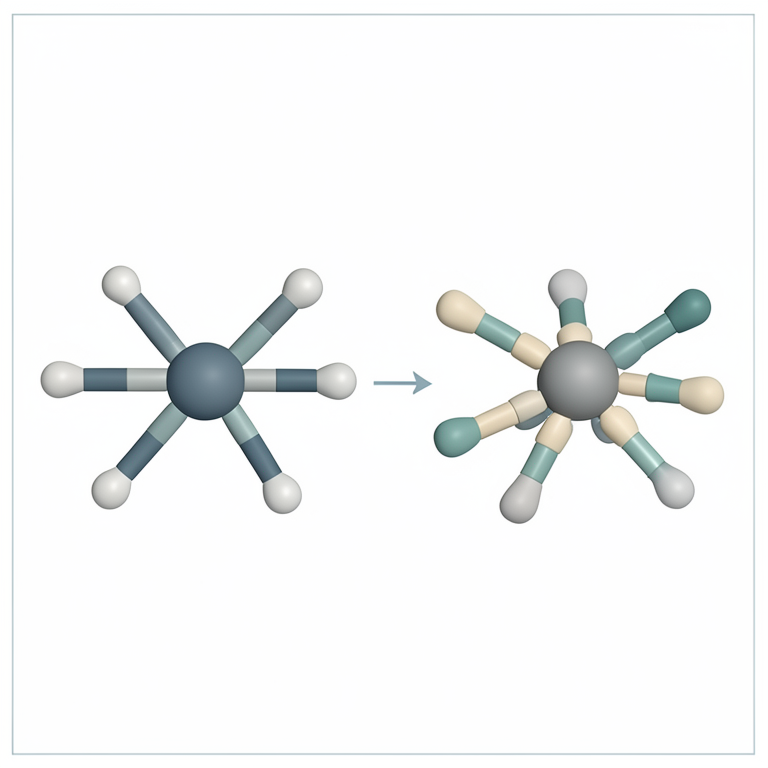
Core-First Star Polymer Architecture
AI-generated conceptual illustration (four-arm star-shaped block copolymer molecules). It explains the idea and does not show study data.
View source evidence ↗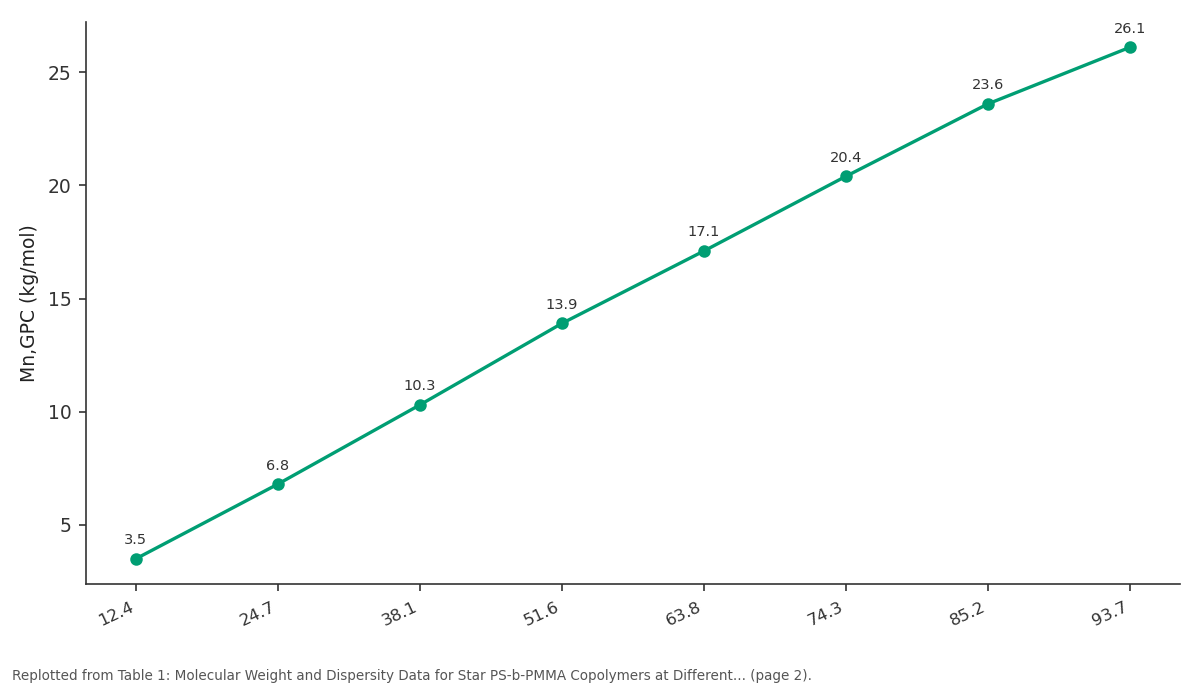
Mn,GPC (kg/mol): 12.4 vs 24.7 vs 38.1 vs 51.6 vs 63.8
Replotted from Table 1 (page 2) of the original paper. Every bar is the paper's own table value.
View source evidence ↗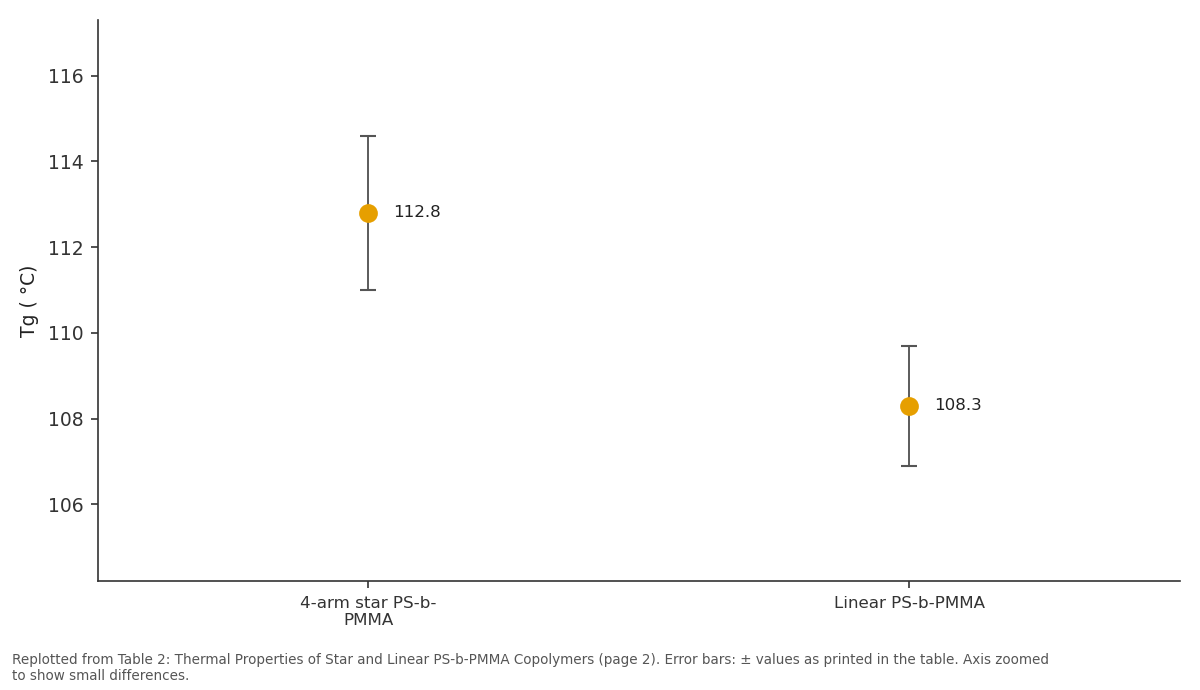
Tg ( °C): 4-arm star PS-b-PMMA vs Linear PS-b-PMMA
Replotted from Table 2 (page 2) of the original paper. Every bar is the paper's own table value.
View source evidence ↗Figures & tables
From the original paper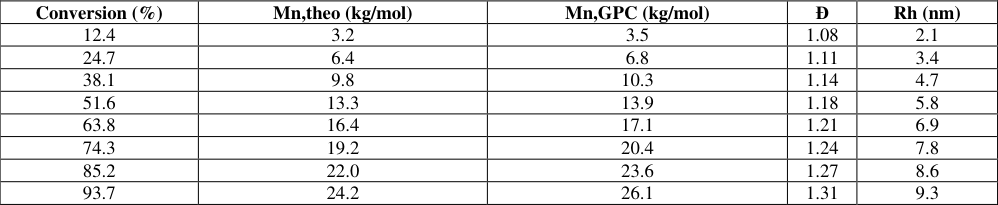 Table 1
 Table 2
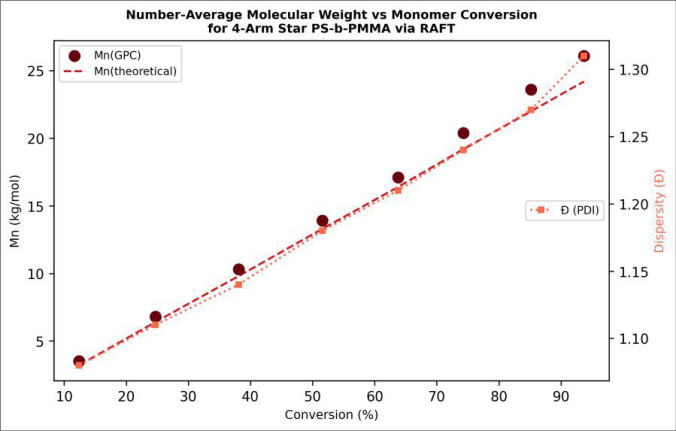 Figure 1
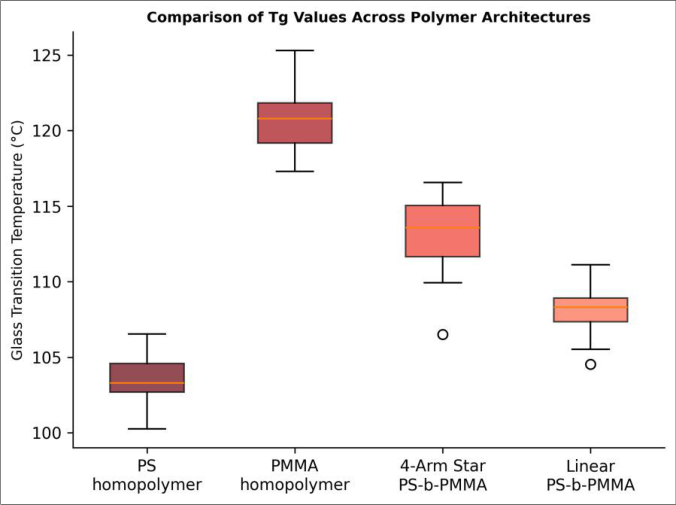 Figure 2
Introduction
The architecture of a polymer chain linear, branched, cyclic, or star has a profound effect on its physical properties, even when the chemical composition stays the same [1] . Star polymers, in which several linear arms radiate from a single core, display lower melt and solution viscosities, smaller hydrodynamic radii, and distinct self-assembly behaviour compared to their linear analogues of equivalent molecular weight [2] . These features make star architectures appealing for applications in drug delivery, coatings, adhesives, and nanolithography [3] . RAFT polymerisation has become the method of choice for preparing well-defined complex architectures because it tolerates a wide range of monomers, proceeds under mild conditions, and preserves chain-end functionality [4] . Two strategies exist for making RAFT-based stars: the "core-first" approach, which uses a multifunctional CTA bearing several trithiocarbonate or dithioester groups, and the "arm-first" approach, which crosslinks pre-formed linear macro-CTAs [5] . The core-first route generally gives better arm-number control and narrower distributions, but star-star coupling and slow reinitiation can become issues at high conversions [6] . Block copolymer stars add further interest, since the microphase separation of incompatible blocks is modulated by the star constraint. Compared to linear diblocks, star block copolymers show shifted order-disorder transition temperatures and access to morphologies not observed in linear systems [7] . PS-b-PMMA is a well-explored pair for nanopatterning because of the large Flory-Huggins parameter and the selective etchability of PMMA under UV or oxygen-plasma exposure [8] . Despite the growing literature on RAFT-derived star homopolymers, detailed kinetic and thermal characterisation data for star PS-b-PMMA are scarce. This research fills that gap by reporting the core-first synthesis of four-arm star PS-b-PMMA, tracking polymerisation kinetics to high conversion, and comparing the thermal and molecular weight properties with linear diblock and homopolymer counterparts.
Reagents and Chemicals
Styrene (≥99%, Sigma-Aldrich, Madrid, Spain) and methyl methacrylate (MMA, 99%, Sigma-Aldrich) were passed through basic alumina columns to remove inhibitors immediately before use. The tetrafunctional RAFT agent, pentaerythritol tetrakis(2-(dodecylthiocarbonothioylthio)-2methylpropionate), was synthesised in-house following the procedure of Mayadunne et al. [4] and characterised by ¹H NMR and ESI-MS (purity >97%). Azobisisobutyronitrile (AIBN, 98%, Acros Organics) was recrystallised from methanol. Tetrahydrofuran (THF, HPLC grade, Scharlau, Barcelona, Spain) served as GPC eluent. Deuterated chloroform (CDCl₃, 99.8 atom% D, Euriso-Top) was used for NMR measurements [9] .
Instrumentation and Analytical Equipment
Gel permeation chromatography (GPC) was performed on a Shimadzu Prominence system fitted with a RID-20A refractive index detector and two PLgel 5 µm Mixed-C columns, using THF at 1.0 mL/min and calibrated with narrow PS standards (Polymer Laboratories). ¹H NMR spectra were acquired on a Bruker Avance III 400 MHz spectrometer at 25 °C. DSC measurements used a TA Instruments Q2000 under nitrogen at 10 °C/min. TGA was conducted on a TA Instruments Q50 at 10 °C/min under nitrogen. Dynamic light scattering (DLS) was carried out on a Malvern Zetasizer Nano ZS at 25 °C in THF solutions (1 mg/mL) [10] .
Material and Methods
Material and Methods
Material
The research was performed between April 2023 and September 2024 at the Department of Chemical Engineering and Polymer Technology, Universidad de Castilla de Ciencias Químicas, Sevilla, Spain. The tetrafunctional CTA was dissolved in bulk styrene at a [monomer]:[CTA]:[AIBN] molar ratio of 400:1:0.2. The reaction flask was sealed with a rubber septum, deoxygenated by three freeze-pump-thaw cycles, and immersed in an oil bath at 70 °C. After completion of the PS block (target conversion ~50%), residual styrene was removed under reduced pressure and MMA was added for the second block growth at 70 °C under identical conditions. The experimental protocol was approved by the university research committee (reference UCCQ-POL-2023-031, dated 12 March 2023).
Methods
Kinetic samples were withdrawn at intervals via syringe through the septum, quenched in liquid nitrogen, and analysed by gravimetry for conversion and by GPC for molecular weight distribution. Conversion was calculated as the mass of polymer divided by the initial monomer mass. Block composition was confirmed by ¹H NMR from the integral ratio of the aromatic PS protons (6.2-7.2 ppm) and the OCH₃ signal of PMMA (3.6 ppm). Star functionality was verified by cleaving the trithiocarbonate linkages with aminolysis (excess n-butylamine, THF, 25 °C, 24 h), followed by GPC analysis of the released linear arms. DSC was performed from -50 to 200 °C at 10 °C/min; Tg was taken from the midpoint of the heat capacity step during the second heating scan. TGA was recorded from 25 to 700 °C under nitrogen. Hydrodynamic diameters were measured by DLS at a scattering angle of 173° [11] . The star copolymer showed a single Tg at 112.8 °C, higher than the linear diblock analogue (108.3 °C). The 5% weightloss temperature of 327 °C was lower than for either homopolymer but still suitable for most processing applications.
Results
Figure 1 shows the characteristic linear evolution of Mn with conversion expected for a controlled radical process. The slight upward deviation at high conversion reflects minor star-star coupling, while the dispersity drift from 1.08 to 1.31 remains within the range considered well-controlled for RAFT systems. The box plot in Figure 2 illustrates the intermediate Tg of the star copolymer. The broader whiskers for the star sample reflect slightly greater compositional heterogeneity introduced by the sequential block growth on the multi-arm core.
Comprehensive interpretation
Together, the kinetic, molecular weight, and thermal data demonstrate that the core-first RAFT strategy can deliver four-arm star PS-b-PMMA with controlled architecture and predictable properties. The approach is scalable, requires no metal catalysts, and maintains living character to high conversion.
Discussion
The linear relationship between Mn and conversion up to ~75% confirms that the tetrafunctional CTA mediates the polymerisation effectively and that arm growth is uniform across the four attachment points [4] . The slight deviation at high conversion resembles what Stenzel and Davis [5] observed in six-arm star poly(N-isopropylacrylamide) and was attributed to termination by combination between propagating star radicals. Our dispersity values (1.08-1.31) are comparable to or narrower than those reported by Gao and Matyjaszewski for four-arm star PS by ATRP [6] , suggesting that RAFT provides at least equivalent control for this architecture. The single Tg observed for the star copolymer contrasts with the two distinct transitions typically seen in linear PSb-PMMA of higher molecular weight, where microphase separation produces discrete PS and PMMA domains [7] . The short block lengths and star constraint in our materials evidently suppress long-range ordering, yielding a mixedphase morphology. This finding is consistent with theoretical predictions that star architecture shifts the orderdisorder transition to higher segregation strengths [8] . From a practical standpoint, the well-defined star topology, narrow dispersity, and intermediate thermal properties make these copolymers candidates for blend compatibilisation, where their branched architecture can anchor at immiscible polymer interfaces more effectively than linear diblocks of the same molecular weight [12] .
Conclusion
Four-arm star PS-b-PMMA block copolymers were prepared by core-first RAFT polymerisation using a tetrafunctional trithiocarbonate CTA. Molecular weights grew linearly with conversion, dispersity remained below 1.31, and arm cleavage by aminolysis confirmed the star topology. DSC showed a single Tg at 112.8 °C, intermediate between the parent homopolymers and higher than that of a linear PS-b-PMMA reference. TGA demonstrated adequate thermal stability with 5% mass loss at 327 °C. The combination of synthetic simplicity, architectural control, and tuneable phase behaviour makes these star block copolymers attractive for applications in compatibilisation and nanopatterning. Extending this approach to higher arm numbers and asymmetric block compositions is a logical next step.
Acknowledgement
Acknowledgements Funding SourcesFinancial support was received from the Spanish Ministry of Science and Innovation through the national research programme. No specific grant numbers are disclosed. Institutional supportThe authors thank the Universidad de Castilla de Ciencias Químicas for access to polymer characterisation laboratories and GPC instrumentation.
Figures and tables from the paper
| Conversion (%) | Mn,theo (kg/mol) | Mn,GPC (kg/mol) | Đ | Rh (nm) |
|---|---|---|---|---|
| 12.4 | 3.2 | 3.5 | 1.08 | 2.1 |
| 24.7 | 6.4 | 6.8 | 1.11 | 3.4 |
| 38.1 | 9.8 | 10.3 | 1.14 | 4.7 |
| 51.6 | 13.3 | 13.9 | 1.18 | 5.8 |
| 63.8 | 16.4 | 17.1 | 1.21 | 6.9 |
| 74.3 | 19.2 | 20.4 | 1.24 | 7.8 |
| 85.2 | 22.0 | 23.6 | 1.27 | 8.6 |
| 93.7 | 24.2 | 26.1 | 1.31 | 9.3 |
Table text extracted from the original PDF; superscript letters are shown inline. The original table image is below.
View original table image
| Sample | Tg ( °C) | T₅% ( °C) | T₅₀% ( °C) |
|---|---|---|---|
| PS homopolymer | 103.7 ± 1.2 | 362 ± 3 | 412 ± 4 |
| PMMA homopolymer | 121.4 ± 1.5 | 291 ± 3 | 378 ± 3 |
| 4-arm star PS-b-PMMA | 112.8 ± 1.8 | 327 ± 4 | 396 ± 5 |
| Linear PS-b-PMMA | 108.3 ± 1.4 | 334 ± 3 | 401 ± 4 |
Table text extracted from the original PDF; superscript letters are shown inline. The original table image is below.
View original table image
References
14 in the original paper- Hadjichristidis N, Pitsikalis M, Pispas S, Iatrou H. Polymers with complex architecture by living anionic polymerization. Chemical Reviews. 2001;101(12):3747-3792.
- Grest GS, Fetters LJ, Huang JS, Richter D. Star polymers: Experiment, theory, and simulation. Advances in Chemical Physics. 1996;94:67-163.
- Ren JM, McKenzie TG, Fu Q, Wong EHH, Xu J, An Z. Star polymers. Chemical Reviews. 2016;116(12):67436836.
- Mayadunne RTA, Jeffery J, Moad G, Rizzardo E. Living free radical polymerization with reversible addition-fragmentation chain transfer (RAFT polymerization): Approaches to star polymers. Macromolecules. 2003;36(5):1505-1513.
- Stenzel MH, Davis TP. Star polymer synthesis using trithiocarbonate functional β-cyclodextrin cores in RAFT polymerization. Journal of Polymer Science Part A: Polymer Chemistry. 2002;40(24):4498-4512.
- Gao H, Matyjaszewski K. Synthesis of star polymers by a new "core-first" method: Sequential polymerization of cross-linker and monomer. Macromolecules. 2008;41(4):1118-1125.
- Bates FS, Fredrickson GH. Block copolymer thermodynamics: Theory and experiment. Annual Review of Physical Chemistry. 1990;41:525-557.
- Matsen MW, Schick M. Stable and unstable phases of a star diblock copolymer. Macromolecules. 1994;27(23):6761-6767.
- Chiefari J, Chong YK, Ercole F, Krstina J, Jeffery J, Le TPT. Living free-radical polymerization by reversible addition-fragmentation chain transfer: The RAFT process. Macromolecules. 1998;31(16):5559-5562.
- Moad G, Rizzardo E, Thang SH. Radical additionfragmentation chemistry in polymer synthesis. Polymer. 2008;49(5):1079-1131.
- Barner-Kowollik C, Davis TP, Stenzel MH. Probing mechanistic features of conventional, catalytic and living free radical polymerization using soft ionization mass spectrometric techniques. Polymer. 2004;45(23):7791-7800.
- Hawker CJ, Bosman AW, Harth E. New polymer synthesis by nitroxide mediated living radical polymerizations. Chemical Reviews. 2001;101(12):3661-3688.
- Boyer C, Bulmus V, Davis TP, Ladmiral V, Liu J, Perrier S. Bioapplications of RAFT polymerization. Chemical Reviews. 2009;109(11):5402-5436.
- Ferreira J, Syrett J, Whittaker M, Haddleton D, Davis TP, Boyer C. Optimizing the generation of narrow polydispersity star polymers using RAFT mediated polymerization. Polymer Chemistry. 2011;2(8):16711677.