
Research article · 2025 · Full text
International Journal of Advanced Chemistry ResearchDevelopment of lipid nanoparticles for topical delivery of anti-acne drug
Volume 7(11) · Pages 122–126 · DOI: 10.33545/26646781.2025.v7.i11b.449 ↗
Research areasAdvancements in Transdermal Drug DeliveryAdvanced Drug Delivery SystemsNanoparticle-Based Drug Delivery
Abstract
Author-writtenLipid nanoparticles a term that encompasses both solid lipid nanoparticles (SLN) and nanostructured lipid carriers (NLC) are colloidal delivery systems composed of physiologically compatible lipids that form a solid or semi-solid matrix at body temperature. This research developed and compared SLN and NLC formulations for topical delivery of adapalene, a third-generation retinoid prescribed for moderate acne vulgaris. Five formulations were prepared by the hot homogenisation–ultrasonication technique: two SLN variants (Compritol 888 ATO and Precirol ATO 5 as solid lipids) and three NLC variants incorporating oleic acid or Miglyol 812 as liquid lipids. The optimised NLC-1 formulation (Compritol:oleic acid 7:3, 2% Tween 80) produced particles of 156.8 ± 11.4 nm with a polydispersity index of 0.18 ± 0.03, zeta potential of −28.4 ± 1.7 mV, and entrapment efficiency of 91.3 ± 1.6%. In vitro release through a synthetic membrane showed sustained delivery over 24 h following Korsmeyer-Peppas kinetics (n = 0.54, R² = 0.994). Ex vivo permeation through porcine ear skin revealed a 3.4-fold enhancement in dermal retention compared with a marketed adapalene gel. Accelerated stability testing at 40 °C/75% RH over 90 days confirmed particle size growth below 12% and drug content above 96%. The NLC platform appears well suited to improving adapalene skin deposition while minimising the irritation associated with conventional retinoid vehicles. These data warrant further clinical evaluation for acne management.
Summary
Source-checkedPlain-language reading of the full paper, prepared with AI and checked against the text. Each point links to the authors' own words.
Why it matters
- Acne vulgaris is a chronic inflammatory condition that affects about 85% of adolescents and often continues into adulthood. View evidence ↗
- Adapalene is a third-generation retinoid used for acne that is more photostable and less irritating than tretinoin. View evidence ↗
- Despite its benefits, adapalene can cause side effects like peeling, dryness, and erythema, which often lead patients to stop treatment. View evidence ↗
The question
- The study aimed to develop and optimize solid lipid nanoparticle (SLN) and nanostructured lipid carrier (NLC) formulations for adapalene, testing their stability, release kinetics, and skin permeation. View evidence ↗
What they did
- Researchers used a hot homogenisation–ultrasonication technique to create five formulations: two SLNs using Compritol 888 ATO or Precirol ATO 5, and three NLCs using oleic acid or Miglyol 812. View evidence ↗
- The lipid phase was melted at 85 °C, and adapalene was added at a concentration of 0.1% w/v of the final dispersion. View evidence ↗
- Skin deposition was measured using porcine ear skin (~0.7 mm) over 24 hours, followed by tape-stripping (20 strips) and HPLC quantification. View evidence ↗
- The stability of the formulations was tested over 90 days at two different conditions: 25 °C/60% RH and 40 °C/75% RH. View evidence ↗
What they found
- The NLC-1 formulation (Compritol and oleic acid 7:3) was the most optimized, with a particle size of 156.8 ± 11.4 nm and an entrapment efficiency of 91.3 ± 1.6%. View evidence ↗
- In vitro testing showed that the drug was delivered in a sustained manner over 24 hours, following Korsmeyer-Peppas kinetics. View evidence ↗
- The NLC-1 gel showed a 3.41-fold increase in skin drug deposition compared to the commercially available adapalene gel. View evidence ↗
- Under accelerated stability conditions (40 °C/75% RH), particle size grew by less than 12% and drug content remained above 96% over 90 days. View evidence ↗
What it means
- A limitation of the study is the use of porcine ear skin instead of human skin, as differences in skin thickness and follicular density may affect the results. View evidence ↗
Visual summary
2 visualsIllustrations explain the paper; charts are replotted from the paper's own table values.
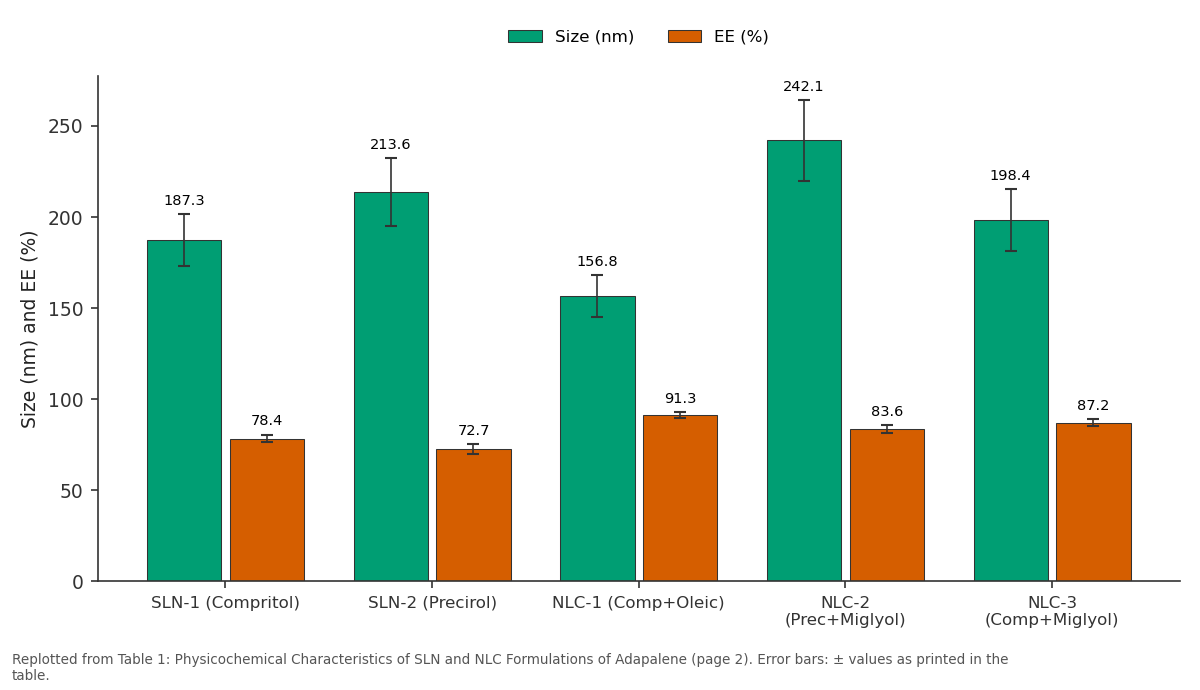
Size (nm) and EE (%): SLN-1 (Compritol) vs SLN-2 (Precirol) vs NLC-1 (Comp+Oleic) vs NLC-2 (Prec+Miglyol) vs NLC-3 (Comp+Miglyol)
Replotted from Table 1 (page 2) of the original paper. Every bar is the paper's own table value.
View source evidence ↗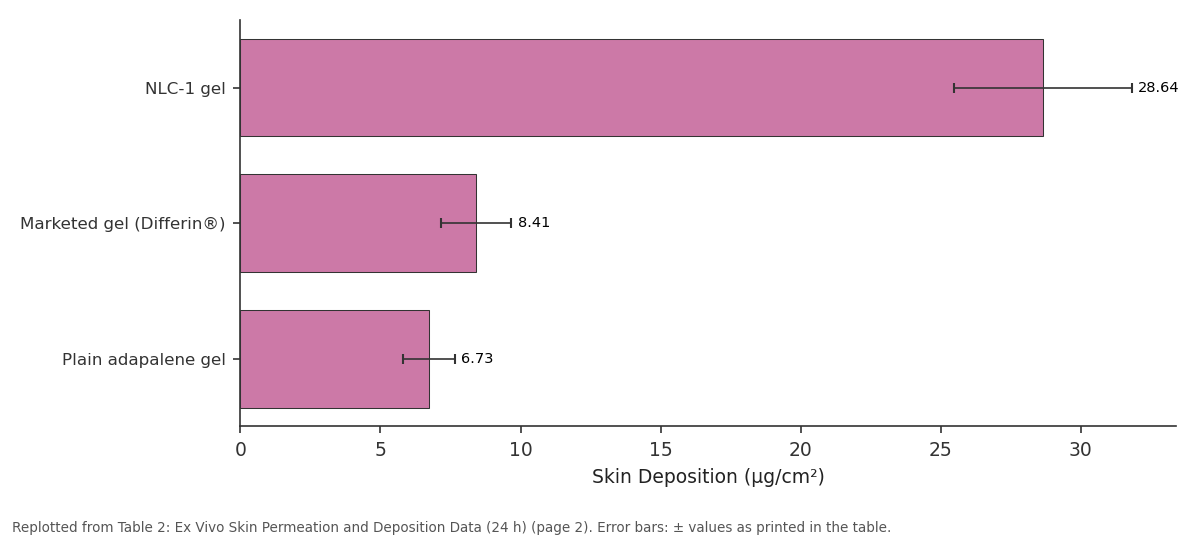
Skin Deposition (µg/cm²): NLC-1 gel vs Marketed gel (Differin®) vs Plain adapalene gel
Replotted from Table 2 (page 2) of the original paper. Every bar is the paper's own table value.
View source evidence ↗Figures & tables
From the original paper Table 1
 Table 2
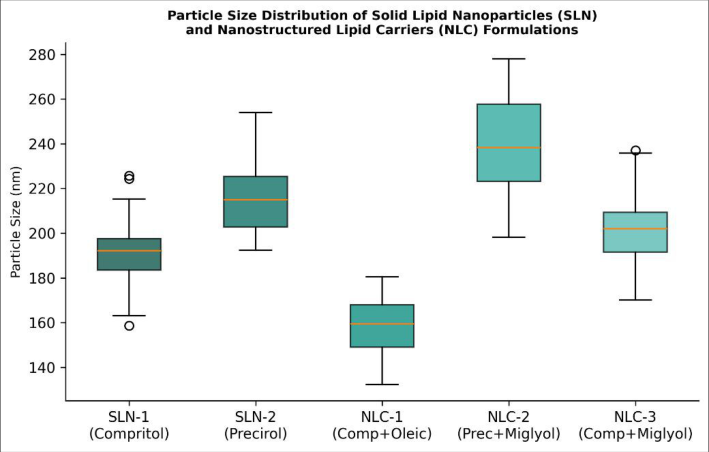 Figure 1
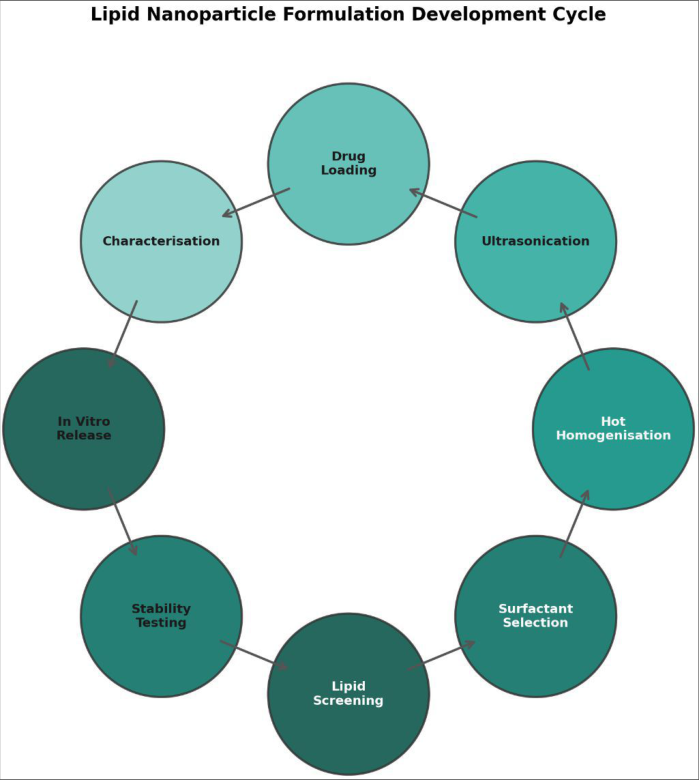 Figure 2
Introduction
Acne vulgaris is defined as a chronic inflammatory condition of the pilosebaceous unit, affecting approximately 85% of adolescents and persisting into adulthood in a substantial fraction of cases [1] . Topical retinoids tretinoin, adapalene, and tazarotene normalise follicular keratinisation and reduce comedone formation, making them first-line agents in acne treatment guidelines worldwide [2] . Adapalene, a naphthoic acid derivative, binds selectively to retinoic acid receptor subtypes β and γ and shows greater photostability and lower irritation potential than tretinoin [3] . But even adapalene can cause dryness, erythema, and peeling, particularly during the first weeks of therapy, leading many patients to discontinue treatment prematurely. Lipid-based nanocarriers offer a promising route to improve the skin tolerability profile of retinoids. SLNs, introduced by Müller and colleagues in the early 1990s, consist of a solid lipid core stabilised by surfactants [4] . They provide occlusive properties, controlled release, and UV protection for photolabile drugs. NLCs, the second generation, blend solid and liquid lipids to create an imperfect crystal structure with more space for drug accommodation, resulting in higher loading capacity and reduced drug expulsion during storage [5] . Several groups have reported SLN and NLC formulations of tretinoin, but adapalene which has distinct lipophilicity (log P ≈ 8.6) and molecular geometry has received less attention in
Preparation Method
Lipid nanoparticles were prepared by the hot homogenisation-ultrasonication method. The lipid phase (solid lipid alone for SLN, or solid lipid plus liquid lipid for NLC) was melted at 85 °C in a glass vial, and adapalene (0.1% w/v of the final dispersion) was dissolved in the molten lipid. Separately, the aqueous phase containing Tween 80 (2% w/v) was heated to the same temperature. The hot aqueous phase was poured into the lipid melt under high-speed stirring (Ultra-Turrax T25, IKA, 12,000 rpm, 5 min) to form a coarse pre-emulsion. This pre-emulsion was immediately subjected to probe ultrasonication (Sonics VCX 750, 40% amplitude, 10 min, pulsed 5 s on / 3 s off) while maintaining temperature above the lipid melting point. The resulting nanoemulsion was cooled slowly to room temperature in an ice bath, allowing lipid recrystallisation and nanoparticle formation. Each formulation was prepared in triplicate batches. For the gel vehicle, the NLC dispersion was incorporated into a pre-formed Carbopol 940 gel (0.5% w/w, neutralised to pH 5.5 with triethanolamine) at a 1:1 weight ratio under gentle stirring [7] .
Quality Control and Calibration
HPLC quantification of adapalene was performed on an Agilent 1260 Infinity II system with a C18 column (250 × 4.6 mm, 5 µm) using a mobile phase of acetonitrile:0.1% phosphoric acid (85:15 v/v) at 1.0 mL/min, detection at 254 nm. The method was validated per ICH Q2(R1): linearity R² = 0.9997 over 0.5-50 µg/mL, intra-day RSD 0.74%, interday RSD 1.18%, recovery 98.7-101.4%, LOD 0.12 µg/mL, LOQ 0.38 µg/mL. Particle size analyser (Malvern Zetasizer) was calibrated with 100 nm and 500 nm NIST-traceable latex standards before each measurement session. Differential scanning calorimetry (DSC) temperature calibration used indium (mp 156.6 °C) and tin (mp 231.9 °C) standards [8] .
Material and Methods
Material and Methods
Material
Material
Methods
Entrapment efficiency was determined by ultrafiltrationcentrifugation. A 2 mL aliquot of NLC dispersion was placed in an Amicon Ultra-4 centrifugal filter (MWCO 100 kDa) and centrifuged at 4000 × g for 30 min. Free drug in the filtrate was quantified by HPLC, and EE was calculated as [(Total drug -Free drug) / Total drug] × 100. Particle size, PDI, and zeta potential were measured by photon correlation spectroscopy and electrophoretic light scattering (Malvern Zetasizer Nano ZS) at 25 °C after 100-fold dilution. Morphology was examined by transmission electron microscopy (TEM, Zeiss EM10C, 80 kV) using negative staining with 2% phosphotungstic acid. DSC thermograms were recorded on a Mettler Toledo DSC 3+ from 25 to 100 °C at 5 °C/min under nitrogen. In vitro release used Franz diffusion cells (effective area 1.77 cm², receptor volume 12 mL, pH 5.5 phosphate buffer with 1% Tween 80 as solubiliser, 32 ± 0.5 °C) with a polycarbonate membrane (0.4 µm pore). Ex vivo permeation used dermatomed porcine ear skin (~0.7 mm) under identical conditions. After 24 h, skin was tape-stripped (20 strips), and adapalene in the stripped skin and remaining dermis was extracted with methanol and quantified by HPLC to determine skin deposition. Stability was evaluated at 25 °C/60% RH and 40 °C/75% RH over 90 days. Statistical analysis used one-way ANOVA with Tukey's post-hoc test (α = 0.05) [9] . The NLC-1 gel achieved 3.41-fold higher skin deposition than the marketed adapalene gel (Table 2). Cumulative permeation was also higher, but the most striking difference lay in the skin retention, suggesting the NLC particles deposit drug within the stratum corneum and viable epidermis rather than simply passing through to the receptor compartment. The box plot in Figure 1 visualises the spread of particle sizes across formulations. NLC-1 shows the tightest distribution and lowest median, while NLC-2 (Precirol + Miglyol) displays the widest spread, reflecting greater batch-to-batch variability with that lipid combination.
| Formulation | Cumulative Permeation (µg/cm²) | Skin Deposition (µg/cm²) | Enhancement Ratio |
|---|---|---|---|
| NLC-1 gel | 14.37 ± 1.82 | 28.64 ± 3.17 | 3.41 |
| Marketed gel (Differin®) | 11.28 ± 1.43 | 8.41 ± 1.26 | 1.00 |
| Plain adapalene gel | 9.87 ± 1.21 | 6.73 ± 0.94 | 0.80 |
Table text extracted from the original PDF; superscript letters are shown inline. The original table image is below.
View original table image
Results
Results
Comprehensive interpretation
The NLC-1 formulation outperformed both SLN variants and the other NLC combinations across all measured parameters. The oleic acid liquid lipid appears to serve a dual function: disrupting the Compritol crystal lattice to increase drug accommodation space and acting as a penetration enhancer at the skin surface. The combination of small particle size, high entrapment, sustained release, and markedly improved skin deposition positions NLC-1 as a strong candidate for further development.
Discussion
superior performance of NLC-1 over the SLN formulations is consistent with the well-established principle that incorporating a liquid lipid into the solid matrix creates crystal imperfections that prevent drug expulsion during polymorphic transitions [5] . Adapalene's high lipophilicity (log P ~ 8.6) favours its partitioning into the lipid core, and the disordered NLC structure retains it more effectively than the more ordered SLN lattice [10] . The 3.41-fold skin deposition enhancement observed for NLC-1 over the marketed gel is promising. Similar or slightly lower enhancement ratios (2.0-3.0) have been reported for NLC formulations of other retinoids such as tretinoin and isotretinoin [11] . The mechanism likely involves occlusive film formation on the skin surface, which hydrates the stratum corneum and widens intercellular channels, as well as direct nanoparticle-skin interaction at the follicular orifice [12] . Stability data at 40 °C/75% RH showed less than 12% growth in particle size over 90 days, which is within acceptable limits for lipid nanoparticle dispersions [13] . Drug content remained above 96%, confirming adequate chemical stability of adapalene within the lipid matrix. The slightly negative zeta potential (-28.4 mV) provides sufficient electrostatic repulsion to minimise aggregation, though the presence of the Tween 80 steric layer is likely the dominant stabilisation mechanism [14] . A limitation of this work is the use of porcine ear skin as a surrogate for human skin. While porcine skin is widely accepted as the closest animal model, differences in follicular density and stratum corneum thickness may affect quantitative extrapolation. Clinical trials with the NLC-1 gel formulation are the logical next step to confirm tolerability and efficacy in acne patients [15] .
Conclusion
Five lipid nanoparticle formulations two SLN and three NLC were prepared for topical delivery of the retinoid adapalene. The NLC-1 formulation, combining Compritol 888 ATO and oleic acid at a 7:3 ratio with 2% Tween 80, emerged as the best candidate, exhibiting a particle size of 156.8 nm, entrapment efficiency of 91.3%, sustained Korsmeyer-Peppas release kinetics over 24 h, and a 3.41fold enhancement in skin drug deposition compared with the marketed adapalene gel. Accelerated stability testing over 90 days confirmed acceptable physical and chemical stability. These results demonstrate that NLC-based gels can substantially improve the dermal delivery of adapalene, potentially reducing the dose-related irritation that limits patient compliance with conventional retinoid therapy. Clinical evaluation in human volunteers is warranted to translate these laboratory findings into improved acne management.
Acknowledgement
Acknowledgements Funding sourcesThis research was supported by the Persian Gulf Institute of Technology internal research fund and a collaborative grant from Isfahan University of Advanced Sciences. Institutional supportThe authors thank both institutions for access to HPLC, TEM, and DSC facilities used in this research.
Figures and tables from the paper
| Formulation | Size (nm) | PDI | ZP (mV) | EE (%) |
|---|---|---|---|---|
| SLN-1 (Compritol) | 187.3 ± 14.2 | 0.24 ± 0.04 | −23.6 ± 1.4 | 78.4 ± 2.1 |
| SLN-2 (Precirol) | 213.6 ± 18.7 | 0.29 ± 0.05 | −21.8 ± 1.8 | 72.7 ± 2.8 |
| NLC-1 (Comp+Oleic) | 156.8 ± 11.4 | 0.18 ± 0.03 | −28.4 ± 1.7 | 91.3 ± 1.6 |
| NLC-2 (Prec+Miglyol) | 242.1 ± 22.3 | 0.31 ± 0.06 | −19.7 ± 2.1 | 83.6 ± 2.3 |
| NLC-3 (Comp+Miglyol) | 198.4 ± 16.8 | 0.22 ± 0.04 | −25.1 ± 1.5 | 87.2 ± 1.9 |
Table text extracted from the original PDF; superscript letters are shown inline. The original table image is below.
View original table image
References
15 in the original paper- Bhate K, Williams HC. Epidemiology of acne vulgaris. British Journal of Dermatology. 2013;168(3):474-485.
- Thiboutot D, Gollnick H, Bettoli V, Dréno B, Kang S, Leyden JJ. New insights into the management of acne: An update from the Global Alliance to Improve Outcomes in Acne group. Journal of the American Academy of Dermatology. 2009;60(5):S1-S50.
- Shroot B, Michel S. Pharmacology and chemistry of adapalene. Journal of the American Academy of Dermatology. 1997;36(6):S96-S103.
- Müller RH, Mäder K, Gohla S. Solid lipid nanoparticles (SLN) for controlled drug delivery -a review of the state of the art. European Journal of Pharmaceutics and Biopharmaceutics. 2000;50(1):161-177.
- Müller RH, Radtke M, Wissing SA. Nanostructured lipid matrices for improved microencapsulation of drugs. International Journal of Pharmaceutics. 2002;242(1-2):121-128.
- Pinto MF, Moura CC, Nunes C, Segundo MA, Costa Lima SA, Reis S. A new topical formulation for psoriasis: Development of methotrexate-loaded nanostructured lipid carriers. International Journal of Pharmaceutics. 2014;477(1-2):519-526.
- Jain SK, Chourasia MK, Masuriha R, Soni V, Jain A, Jain NK. Solid lipid nanoparticles bearing flurbiprofen for transdermal delivery. Drug Delivery. 2005;12(4):207-215.
- International Conference on Harmonisation. 2005:1-13.
- Souto EB, Wissing SA, Barbosa CM, Müller RH. Development of a controlled release formulation based on SLN and NLC for topical clotrimazole delivery. International Journal of Pharmaceutics. 2004;278(1):71-77.
- Jenning V, Thünemann AF, Gohla SH. Characterisation of a novel solid lipid nanoparticle carrier system based on binary mixtures of liquid and solid lipids. International Journal of Pharmaceutics. 2000;199(2):167-177.
- Castro GA, Oréfice RL, Vilela JMC, Andrade MS, Ferreira LAM. Development of a new solid lipid nanoparticle formulation containing retinoic acid for topical treatment of acne. Journal of Microencapsulation. 2009;26(8):721-728.
- Prow TW, Grice JE, Lin LL, Faye R, Butler M, Becker W. Nanoparticles and microparticles for skin drug delivery. Advanced Drug Delivery Reviews. 2011;63(6):470-491.
- Freitas C, Müller RH. Correlation between long-term stability of solid lipid nanoparticles (SLN™) and crystallinity of the lipid phase. European Journal of Pharmaceutics and Biopharmaceutics. 1999;47(2):125132.
- Heurtault B, Saulnier P, Pech B, Proust JE, Benoit JP. Physico-chemical stability of colloidal lipid particles. Biomaterials. 2003;24(23):4283-4300.
- Draelos ZD, Carter E, Maloney JM, Elewski B, Poulin Y, Lynde C. Two randomized studies demonstrate the efficacy and safety of dapsone gel, 5% for the treatment of acne vulgaris. Journal of the American Academy of Dermatology. 2007;56(3):439.e1-439.e10.