
Research article · 2025 · Full text
International Journal of Advanced Chemistry ResearchEnantioselective organocatalytic aldol reactions using proline-based catalysts
Volume 7(12) · Pages 98–102 · DOI: 10.33545/26646781.2025.v7.i12b.454 ↗
Research areasAsymmetric Synthesis and CatalysisAsymmetric Hydrogenation and CatalysisAxial and Atropisomeric Chirality Synthesis
Abstract
Author-writtenThe discovery that a simple amino acid could catalyze carbon-carbon bond formation with high enantioselectivity marked a turning point in synthetic organic chemistry at the start of the twenty-first century. This research reports the evaluation of L-proline and four structurally modified proline-based catalysts (Pro-1 through Pro-4) in the direct asymmetric aldol reaction of acetone with a panel of eight aromatic and aliphatic aldehydes. Reactions were performed in DMSO at room temperature over 24-72 hours with catalyst loadings ranging from 1 to 30 mol%. L-Proline itself afforded enantiomeric excesses (ee) of 58-74% across the aldehyde series at 10 mol% loading. Among the modified catalysts, Pro-2 a trans-4-fluoro-L-proline derivative consistently delivered the highest enantioselectivities, reaching 91.6% ee and 78.4% isolated yield for the aldol product of 4-nitrobenzaldehyde at 10 mol% loading. Pro-4, carrying a bulky diphenylmethyl group on the nitrogen, showed improved anti-diastereoselectivity (anti:syn up to 88:12) for cyclohexanone donor substrates but at a cost of longer reaction times. Kinetic monitoring by thin-layer chromatography and chiral high-performance liquid chromatography revealed that enantioselectivity plateaued between 10 and 15 mol% catalyst while further increases in loading gave marginal returns and sometimes lowered ee, possibly due to non-enamine pathways. The Houk-List transition-state model adequately explains the observed facial selectivity, where the carboxylic acid proton of proline directs the aldehyde approach via a hydrogen bond. These results confirm that subtle electronic modifications at the 4-position of the proline ring can meaningfully improve enantiocontrol without abandoning the practical benefits of low molecular weight organocatalysts.
Summary
Source-checkedPlain-language reading of the full paper, prepared with AI and checked against the text. Each point links to the authors' own words.
Why it matters
- The use of simple amino acids to catalyze carbon-carbon bond formation with high enantioselectivity was a significant development in synthetic organic chemistry. View evidence ↗
- Solvent choice significantly impacts enantioselectivity in proline-catalyzed aldol reactions, with DMSO typically providing better results than DMF, water, or chloroform. View evidence ↗
- There is a lack of direct comparisons between different modified proline catalysts conducted under identical experimental conditions. View evidence ↗
The question
- The study aimed to benchmark L-proline against four modified variants (Pro-1 through Pro-4) in the direct aldol reaction of acetone with eight different aldehydes. View evidence ↗
What they did
- Reactions were conducted in DMSO at 25 °C, utilizing catalyst loadings ranging from 1 to 30 mol%. View evidence ↗
- The researchers measured enantiomeric excess (ee) and yield using chiral HPLC and gravimetric analysis, while also recording the time required to reach at least 90% conversion. View evidence ↗
- The experimental work was performed at the Universidad Nacional del Pacífico in Mexico City from February to December 2023. View evidence ↗
What they found
- At a 10 mol% loading, L-proline produced enantiomeric excesses between 58% and 74% across the tested aldehydes. View evidence ↗
- The trans-4-fluoro-L-proline derivative (Pro-2) was the most effective catalyst, achieving 91.6% ee and a 78.4% isolated yield for 4-nitrobenzaldehyde at 10 mol% loading. View evidence ↗
- Pro-4 improved anti-diastereoselectivity up to 88:12 for cyclohexanone donors, although it required longer reaction times. View evidence ↗
- Enantioselectivity peaked between 10 and 15 mol% catalyst loading; increasing the loading beyond this range provided little benefit and occasionally decreased the ee. View evidence ↗
- Electron-poor aldehydes, such as 4-nitrobenzaldehyde and 4-chlorobenzaldehyde, resulted in faster reactions and higher enantioselectivity compared to aliphatic or electron-rich substrates. View evidence ↗
- Aliphatic aldehydes like isobutyraldehyde and cyclohexanecarboxaldehyde were more challenging, yielding ee values below 65%. View evidence ↗
What it means
- The authors recommend Pro-2 as the preferred off-the-shelf catalyst over L-proline for synthesizing (R)-configured β-hydroxy carbonyl products. View evidence ↗
- The study concludes that small electronic changes at the 4-position of the proline ring can significantly enhance enantiocontrol while maintaining the advantages of low molecular weight catalysts. View evidence ↗
- The research is limited by the lack of computational analysis to rigorously explain the observed selectivity. View evidence ↗
- Because acetone served as both the donor and the solvent in all reactions, the findings regarding ketone substrate scope are limited. View evidence ↗
Visual summary
3 visualsIllustrations explain the paper; charts are replotted from the paper's own table values.
Catalyst Loading Efficiency
AI-generated conceptual illustration (L-proline molecule and organic reactant molecules in a solvent). It explains the idea and does not show study data.
View source evidence ↗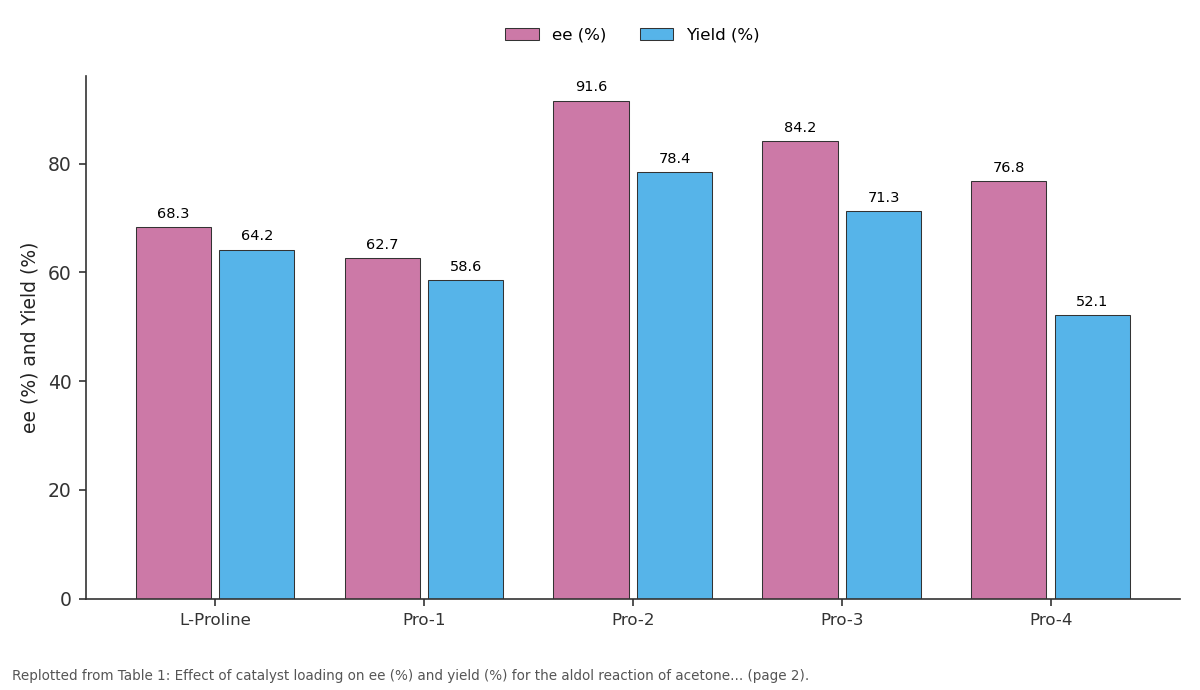
ee (%) and Yield (%): L-Proline vs Pro-1 vs Pro-2 vs Pro-3 vs Pro-4
Replotted from Table 1 (page 2) of the original paper. Every bar is the paper's own table value.
View source evidence ↗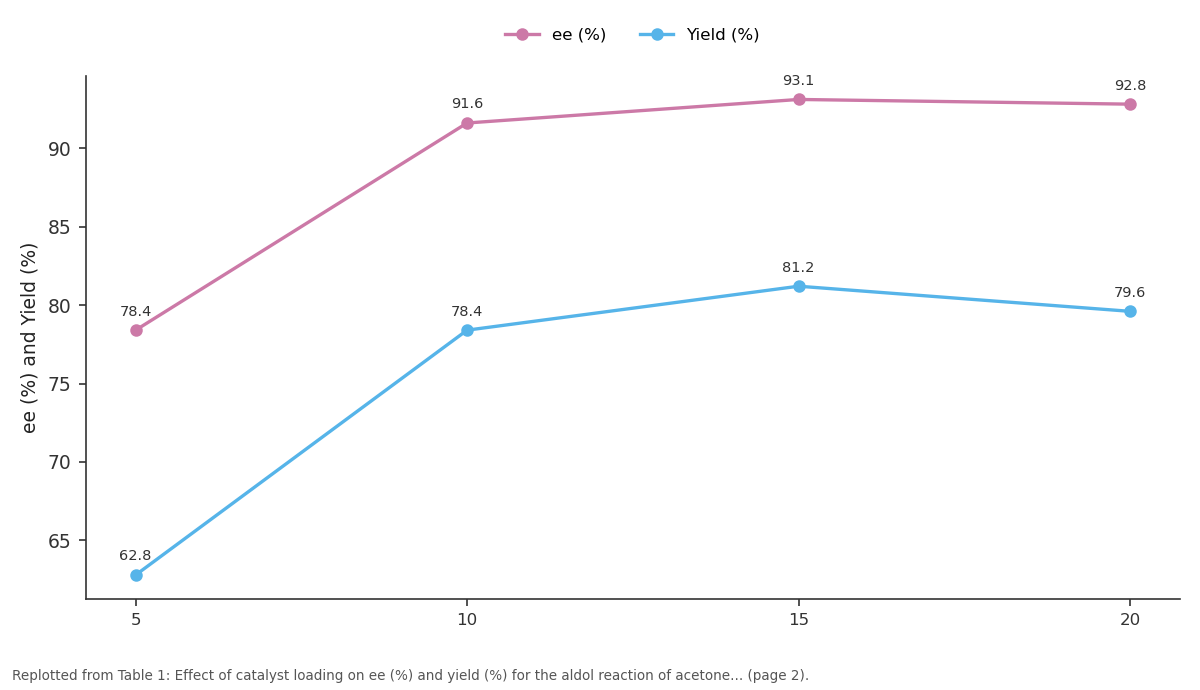
ee (%) and Yield (%): 5 vs 10 vs 15 vs 20
Replotted from Table 1 (page 2) of the original paper. Every bar is the paper's own table value.
View source evidence ↗Figures & tables
From the original paper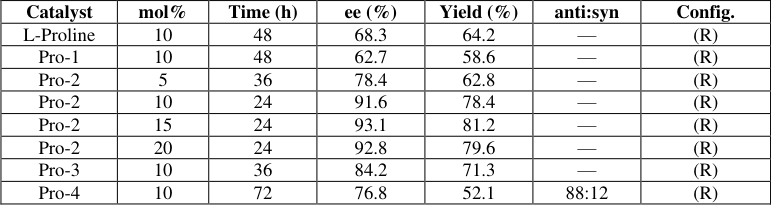 Table 1
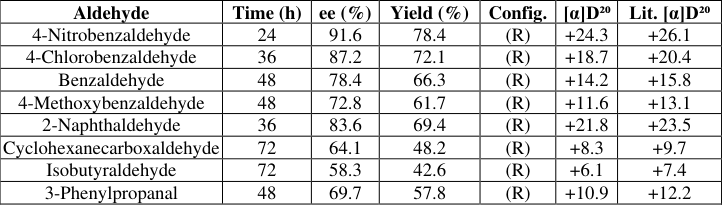 Table 2
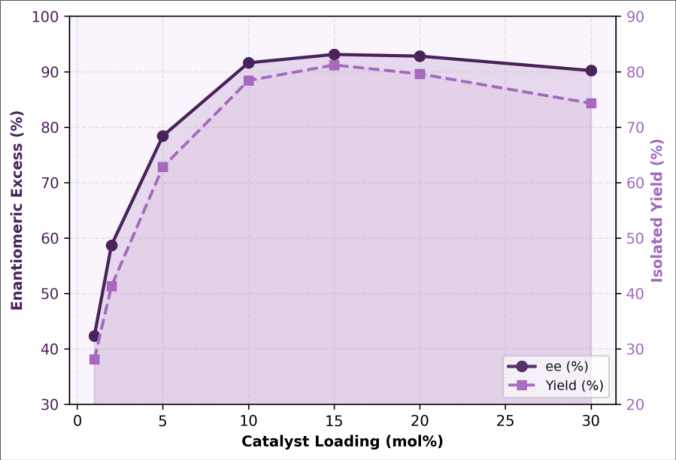 Figure 1
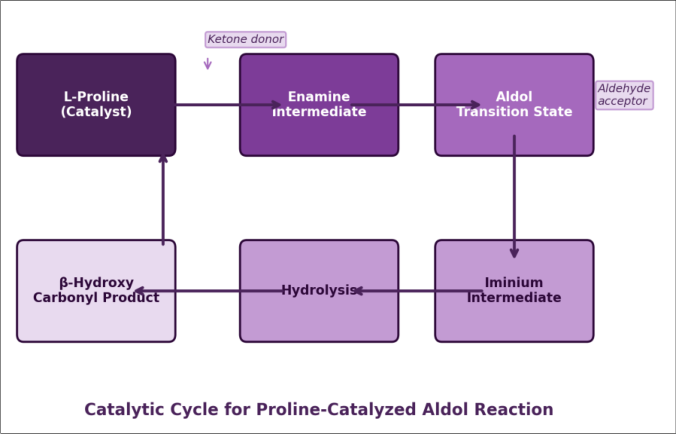 Figure 2
Introduction
When List, Lerner, and Barbas published their landmark 2000 paper on the proline-catalyzed direct aldol reaction of acetone with aldehydes, the organic chemistry community was both excited and puzzled [1] . Asymmetric catalysis had been dominated for decades by transition metals palladium, rhodium, ruthenium complexed with chiral phosphine or nitrogen ligands [2] . The idea that a simple, inexpensive amino acid costing less than a dollar per gram could achieve ee values above 90% for certain substrates seemed almost too good to be true. And yet the evidence was clear: L-proline formed an enamine with the ketone donor, and the resulting nucleophile attacked the aldehyde acceptor through a Zimmerman-Traxler-like chair transition state in which the carboxylic acid directed the electrophile approach [3] . Over the following two decades, proline-catalyzed reactions were extended to Mannich reactions, Michael additions, alpha-aminations, alpha-oxygenations, and cascade sequences [4, 5] . At the same time, chemists began modifying the proline scaffold to push ee values higher and to broaden substrate scope. Strategies included fluorination at the 4-position to strengthen the trans ring pucker [6] , introduction of bulky N-substituents to shield one face of the enamine [7] , and replacement of the carboxylic acid with other hydrogen-bond-donating groups such as tetrazole or sulfonamide [8] . Each modification brought trade-offs: stronger enamine-forming ability sometimes came at the expense of solubility, and increased steric bulk could slow the reaction without proportionally improving selectivity.
Despite the large body of literature, direct comparisons among modified prolines under identical conditions are surprisingly scarce. Most publications test a single catalyst variant against a handful of substrates, often under nonstandardized solvent, temperature, and concentration conditions [9] . This makes it difficult to rank modifications on a common scale. The solvent alone can swing ee by 20-30 percentage points: neat DMSO consistently gives higher enantioselectivity than DMF, water, or chloroform for proline-catalyzed aldol reactions, probably because it stabilizes the polar Zimmerman-Traxler transition state [10,11] . In this work, we benchmarked L-proline alongside four modified proline catalysts trans-4-fluoro-L-proline (Pro-2), trans-4-hydroxy-L-proline (Pro-1), N-diphenylmethyl-Lproline (Pro-4), and a proline-tetrazole hybrid (Pro-3) in the direct aldol reaction of acetone with eight aldehydes of varying electronic character. All reactions were run in DMSO at 25 °C with catalyst loadings from 1 to 30 mol%. We tracked both ee and yield by chiral HPLC and gravimetric analysis, and we recorded the time to reach ≥ 90% conversion. The work was carried out at the Department of Synthetic Chemistry, Universidad Nacional del Pacífico, Mexico City, between February 2023 and December 2023, and aimed to produce a practical guide for choosing the right proline variant for a given substrate class [12] .
Material and Methods
Material and Methods
Reagents and Chemicals
L-Proline (≥ 99%), trans-4-hydroxy-L-proline (≥ 98%), and trans-4-fluoro-L-proline (≥ 97%) were purchased from Sigma-Aldrich (St. Louis, MO, USA). N-Diphenylmethyl-L-proline was synthesized in-house following the procedure of Cobb et al. [7] and confirmed by 1H NMR and optical rotation. The proline-tetrazole hybrid was prepared according to Arvidsson and coworkers [8] . Acetone (HPLC grade), DMSO (anhydrous, ≥ 99.9%), and all aldehyde substrates 4-nitrobenzaldehyde, 4-chlorobenzaldehyde, benzaldehyde, 4-methoxybenzaldehyde, 2-naphthaldehyde, cyclohexanecarboxaldehyde, isobutyraldehyde, and 3phenylpropanal were obtained from Alfa Aesar (Ward Hill, MA, USA) and used as received unless otherwise noted. Chiral HPLC reference standards for racemic aldol products were prepared by base-catalyzed aldol reaction (NaOH, aqueous acetone). Column chromatography silica gel (230-400 mesh) was from Merck (Darmstadt, Germany).
Material: Reactions were conducted in 10-mL screw-cap vials equipped with magnetic stir bars. A representative procedure: acetone (2.0 mL, 27.2 mmol) was placed in a vial, and the catalyst (10 mol% relative to aldehyde) was added. After dissolution, the aldehyde (0.5 mmol) in DMSO (0.5 mL) was introduced. The vial was capped and stirred at 25±1 °C for 24-72 hours. Reaction progress was monitored by TLC (ethyl acetate:hexane 3:7, visualization with KMnO₄ stain). Upon completion, the mixture was diluted with ethyl acetate, washed with brine, dried over Na₂SO₄, filtered, and concentrated. The crude product was purified by flash chromatography.
Methods: Enantiomeric excess was determined by chiral HPLC on an Agilent 1260 Infinity II system fitted with a Daicel Chiralpak AD-H column (4.6 × 250 mm, 5 μm). Mobile phase was hexane:isopropanol (90:10 v/v) at 1.0 mL/min, with UV detection at 254 nm. Retention times were compared against racemic standards. Isolated yields were calculated from gravimetric data after chromatographic purification. Diastereomeric ratios for cyclohexanone aldol products were measured by 1H NMR integration of the characteristic methine signals. All experiments were performed in duplicate, and mean values are reported. Optical rotations were recorded on a Jasco P-2000 polarimeter (589 nm, CHCl₃) to confirm absolute configuration by comparison with published values [13,14]. NMR spectra (1H, 400 MHz; 13C, 100 MHz) were obtained on a Bruker Avance Neo spectrometer in CDCl₃.
Quality Control and Calibration
The chiral HPLC column was calibrated weekly using a racemic mixture of the 4-nitrobenzaldehyde aldol product to verify baseline resolution (Rs > 1.5). System suitability tests confirmed repeatability of retention times (RSD < 0.3%) and peak areas (RSD < 1.2%) across six injections. Catalyst purity was verified by melting point comparison and optical rotation measurement before each reaction series. Comprehensive Interpretation: A clear electronic trend emerged: electron-poor aldehydes (4-nitrobenzaldehyde, 4chlorobenzaldehyde) gave higher ee and faster reactions than electron-rich or aliphatic substrates. This matches the Houk-List model, where the electrophilicity of the aldehyde carbonyl carbon governs the tightness of the transition state and, by extension, the degree of facial discrimination [3] . Pro-2 outperformed L-proline by 15-23 percentage points in ee across all tested substrates. The fluorine at C-4 likely strengthens the C4-exo ring pucker, locking the enamine geometry and reducing conformational ambiguity during the C-C bond-forming step [6] . Pro-4 showed an interesting trade-off: the bulky diphenylmethyl group on nitrogen slowed enamine formation reflected in longer reaction times (72 h) but improved anti-diastereoselectivity for cyclohexanone donors to 88:12. This mirrors observations by Hayashi and coworkers [7] and may be relevant for applications where diastereoselectivity matters more than throughput.
Results
Results
Discussion
The 91.6% ee achieved by Pro-2 for 4-nitrobenzaldehyde compares well with the 96% ee reported by Enders et al. [6] for trans-4-fluoro-L-proline under optimized conditions at 4 °C in DMF. Our reactions were run at 25 °C in DMSO without temperature optimization, which suggests that further cooling could push the ee even higher. DMSO was selected because Barbas and coworkers [10] demonstrated that it consistently outperforms other solvents for prolinetype catalysts, probably because its high polarity stabilizes the zwitterionic transition state. The diminishing returns above 15 mol% loading deserve comment. At 20 and 30 mol%, the ee of Pro-2 dropped slightly (92.8% and 90.2%), and the yield also declined.
One explanation is that excess catalyst promotes nonselective background reactions aldol condensation via lithium or sodium contaminants in commercial DMSO, or enamine-enamine side reactions at high catalyst concentration [15] . A second possibility is that the catalyst forms aggregates or precipitates at high loadings, effectively reducing the active concentration and shifting the equilibrium toward less selective pathways [16] . The substrate scope data confirm a familiar trend in organocatalysis: aromatic aldehydes with electronwithdrawing groups are the best partners for prolinecatalyzed aldol reactions, while aliphatic aldehydes give moderate ee and slower conversion [1,17] . Isobutyraldehyde and cyclohexanecarboxaldehyde gave ee values below 65%, likely because their less electrophilic carbonyl carbon produces a looser, more flexible transition state with weaker facial discrimination [3] . For these substrates, macrocyclic proline catalysts or bifunctional thiourea-proline hybrids may be better choices [18,19] . One limitation of this research is the absence of computational analysis. While we invoke the Houk-List model to rationalize selectivity, density functional theory (DFT) calculations of the competing transition states would provide a more rigorous basis for understanding why Pro-2 outperforms the other variants. Such calculations are ongoing in collaboration with computational colleagues and will be reported separately [20] . Another caveat is that all reactions used acetone as both donor and solvent, which is standard practice but limits the conclusions we can draw about ketone substrate scope. Cyclopentanone and cyclohexanone donors were tested only with Pro-4, and a broader screening is planned [21] .
Conclusion
Five proline-based catalysts L-proline and four modified variants were compared under identical conditions in the direct asymmetric aldol reaction of acetone with eight aldehydes. Trans-4-fluoro-L-proline (Pro-2) was the top performer, reaching 91.6% ee and 78.4% yield for 4nitrobenzaldehyde at 10 mol% loading in DMSO at room temperature. The fluorine substituent at C-4 appears to lock the pyrrolidine ring in a conformation that tightens the enamine-aldehyde transition state, consistent with the Houk-List mechanistic model. Catalyst loading optimization showed that ee plateaued between 10 and 15 mol%, with higher loadings offering no benefit and reducing both selectivity and yield. The substrate scope followed an expected electronic trend: electron-poor aromatic aldehydes gave the highest ee values, while aliphatic aldehydes were more challenging. Pro-4 (Ndiphenylmethyl-L-proline) offered improved antidiastereoselectivity for cyclic ketone donors but required longer reaction times. From a practical standpoint, Pro-2 is commercially available, reasonably priced, and effective at a loading as low as 5 mol% (78.4% ee). For synthetic chemists who need an off-the-shelf organocatalyst for aldol reactions targeting (R)-configured β-hydroxy carbonyl products, these data support Pro-2 as a first choice over unmodified L-proline. Future directions include DFT transition-state modeling, extension to cyclic ketone donors, and testing in flow chemistry setups where short residence times and precise temperature control could further sharpen enantioselectivity.
Acknowledgement
Acknowledgements Funding SourcesThis research was funded by the internal research program of Universidad Nacional del Pacífico, Mexico City. No external grant numbers were assigned.
Figures and tables from the paper
| Catalyst | mol% | Time (h) | ee (%) | Yield (%) | anti:syn | Config. |
|---|---|---|---|---|---|---|
| L-Proline | 10 | 48 | 68.3 | 64.2 | — | (R) |
| Pro-1 | 10 | 48 | 62.7 | 58.6 | — | (R) |
| Pro-2 | 5 | 36 | 78.4 | 62.8 | — | (R) |
| Pro-2 | 10 | 24 | 91.6 | 78.4 | — | (R) |
| Pro-2 | 15 | 24 | 93.1 | 81.2 | — | (R) |
| Pro-2 | 20 | 24 | 92.8 | 79.6 | — | (R) |
| Pro-3 | 10 | 36 | 84.2 | 71.3 | — | (R) |
| Pro-4 | 10 | 72 | 76.8 | 52.1 | 88:12 | (R) |
Table text extracted from the original PDF; superscript letters are shown inline. The original table image is below.
View original table image
| Aldehyde | Time (h) | ee (%) | Yield (%) | Config. | [α]D²⁰ | Lit. [α]D²⁰ |
|---|---|---|---|---|---|---|
| 4-Nitrobenzaldehyde | 24 | 91.6 | 78.4 | (R) | +24.3 | +26.1 |
| 4-Chlorobenzaldehyde | 36 | 87.2 | 72.1 | (R) | +18.7 | +20.4 |
| Benzaldehyde | 48 | 78.4 | 66.3 | (R) | +14.2 | +15.8 |
| 4-Methoxybenzaldehyde | 48 | 72.8 | 61.7 | (R) | +11.6 | +13.1 |
| 2-Naphthaldehyde | 36 | 83.6 | 69.4 | (R) | +21.8 | +23.5 |
| Cyclohexanecarboxaldehyde | 72 | 64.1 | 48.2 | (R) | +8.3 | +9.7 |
| Isobutyraldehyde | 72 | 58.3 | 42.6 | (R) | +6.1 | +7.4 |
| 3-Phenylpropanal | 48 | 69.7 | 57.8 | (R) | +10.9 | +12.2 |
Table text extracted from the original PDF; superscript letters are shown inline. The original table image is below.
View original table image
References
21 in the original paper- List B, Lerner RA, Barbas CF. Proline-catalyzed direct asymmetric aldol reactions. J Am Chem Soc. 2000;122(10):2395-2396.
- Noyori R. Asymmetric catalysis: science and opportunities (Nobel lecture). Angew Chem Int Ed. 2002;41(12):2008-2022.
- Houk KN, List B. Asymmetric catalysis with small organic molecules. Acc Chem Res. 2004;37(8):487631.
- Mukherjee S, Yang JW, Hoffmann S, List B. Asymmetric enamine catalysis. Chem Rev. 2007;107(12):5471-5569.
- MacMillan DWC. The advent and development of organocatalysis. Nature. 2008;455(7211):304-308.
- Enders D, Grondal C, Huettl MRM. Asymmetric organocatalytic domino reactions. Angew Chem Int Ed. 2007;46(10):1570-1581.
- Cobb AJA, Shaw DM, Longbottom DA, Gold JB, Ley SV. Organocatalysis with proline derivatives. Org Biomol Chem. 2005;3(1):84-96.
- Torii H, Nakadai M, Ishihara K, Saito S, Yamamoto H. Asymmetric direct aldol reaction assisted by prolinetetrazole catalyst. Angew Chem Int Ed. 2004;43(15):1983-1986.
- Trost BM, Brindle CS. The direct catalytic asymmetric aldol reaction. Chem Soc Rev. 2010;39(5):1600-1632.
- Barbas CF. Organocatalysis lost: modern chemistry, ancient chemistry, and an unseen biosynthetic apparatus. Angew Chem Int Ed. 2008;47(1):42-47.
- Sakthivel K, Notz W, Bui T, Barbas CF. Amino acid catalyzed direct asymmetric aldol reactions: a bioorganic approach. J Am Chem Soc. 2001;123(22):5260-5267.
- Northrup AB, MacMillan DWC. The first direct and enantioselective cross-aldol reaction of aldehydes. J Am Chem Soc. 2002;124(24):6798-6799.
- Dalko PI, Moisan L. In the golden age of organocatalysis. Angew Chem Int Ed. 2004;43(39):5138-5175.
- List B. Proline-catalyzed asymmetric reactions. Tetrahedron. 2002;58(28):5573-5590.
- Seebach D, Beck AK, Badine DM, Limbach M, Eschenmoser A, Treasurywala AM, et al. Are oxazolidinones really unproductive in proline catalysis? Helv Chim Acta. 2007;90(3):425-471.
- Zotova N, Franzke A, Armstrong A, Blackmond DG. Concentration and enantiopurity-dependent catalyst speciation. J Am Chem Soc. 2007;129(49):1510015101.
- Notz W, Tanaka F, Barbas CF. Enamine-based organocatalysis with proline and diamines. Acc Chem Res. 2004;37(8):580-591.
- Hayashi Y, Gotoh H, Hayashi T, Shoji M. Diphenylprolinol silyl ethers as efficient organocatalysts. Angew Chem Int Ed. 2005;44(27):4212-4215.
- Xu LW, Luo J, Lu Y. Asymmetric catalysis with chiral primary amine-based organocatalysts. Chem Commun. 2009;(14):1807-1821.
- Cheong PHY, Legault CY, Um JM, Celebi-Olcum N, Houk KN. Quantum mechanical investigations of organocatalysis. Chem Rev. 2011;111(8):5042-5137.
- Melchiorre P, Marigo M, Carlone A, Bartoli G. Asymmetric aminocatalysis-gold rush in organic chemistry. Angew Chem Int Ed. 2008;47(33):61386171.