
Research article · 2025 · Full text
International Journal of Advanced Chemistry ResearchAb initio study of reaction mechanisms for atmospheric oxidation of volatile sulfur compounds
Volume 7(11) · Pages 99–103 · DOI: 10.33545/26646781.2025.v7.i11b.444 ↗
Research areasAtmospheric chemistry and aerosolsAdvanced Chemical Physics StudiesAdvanced Combustion Engine Technologies
Abstract
Author-writtenWhat governs the atmospheric fate of sulfur compounds released from oceans and wetlands? This question sits at the heart of atmospheric chemistry and climate science, as volatile sulfur species like dimethyl sulfide (DMS) and hydrogen sulfide (H₂S) contribute to aerosol formation and cloud condensation nuclei production. The present research applied high-level ab initio quantum mechanical methods specifically CCSD(T)/aug-cc-pVTZ and MP2/6-311++G(d,p) to map the potential energy surfaces for oxidation reactions of DMS, H₂S, and methanethiol (CH₃SH) with key atmospheric radicals including OH•, NO₃•, Cl•, and BrO•. Geometry optimizations and transition state searches were carried out at the B3LYP/6-311+G(2d,p) level, followed by single-point energy refinements. Intrinsic reaction coordinate (IRC) calculations confirmed each transition state connected the correct reactant and product minima. Rate constants were derived using canonical transition state theory with Eckart tunneling corrections over the 220–320 K temperature range. The OH-addition pathway to DMS showed an activation barrier of 2.31 kcal/mol, while H-abstraction required 5.87 kcal/mol, in good agreement with experimental kinetic data. For H₂S, the OH-initiated abstraction barrier was found to be 1.68 kcal/mol with a rate constant of 4.73 × 10⁻¹² cm³ molecule⁻¹ s⁻¹ at 298 K. These findings offer fresh mechanistic insight and refined kinetic parameters for atmospheric models tracking sulfur cycling and aerosol budgets.
Summary
Source-checkedPlain-language reading of the full paper, prepared with AI and checked against the text. Each point links to the authors' own words.
Why it matters
- Volatile sulfur species, such as dimethyl sulfide (DMS) and hydrogen sulfide (H₂S), are important because they contribute to the production of cloud condensation nuclei and aerosol formation. View evidence ↗
- DMS is the primary biogenic sulfur species over open oceans, with estimated global emissions between 15 and 30 Tg S per year. View evidence ↗
- Existing laboratory measurements of reaction rates often show discrepancies of two-fold or more, especially at temperatures below 260 K, which are critical for the free troposphere and marine boundary layer. View evidence ↗
The question
- The study aims to characterize the full reaction coordinates and extract kinetic parameters for sulfur compound oxidation channels using coupled-cluster and Møller–Plesset methods to resolve gaps in experimental data. View evidence ↗
What they did
- The researchers used CCSD(T)/aug-cc-pVTZ and MP2/6-311++G(d,p) ab initio methods to map potential energy surfaces for the oxidation of DMS, H₂S, and methanethiol (CH₃SH) by radicals such as OH•, NO₃•, Cl•, and BrO•. View evidence ↗
- Geometry optimizations and harmonic frequency analyses were performed using the B3LYP/6-311+G(2d,p) level of theory within the Gaussian 16 software. View evidence ↗
- Rate constants were calculated for a temperature range of 220–320 K using canonical transition state theory and Eckart tunneling corrections. View evidence ↗
What they found
- For DMS oxidation by OH, the addition pathway had a lower activation barrier of 2.31 kcal/mol compared to the H-abstraction pathway's 5.87 kcal/mol. View evidence ↗
- Chlorine-atom addition to DMS exhibited the lowest activation barrier at 0.94 kcal/mol, identifying Cl• as a highly aggressive oxidant. View evidence ↗
- The ozone pathway for DMS oxidation had the highest activation barrier at 18.76 kcal/mol, indicating it contributes minimally under typical tropospheric conditions. View evidence ↗
- The OH-initiated abstraction of H₂S was found to have an activation barrier of 1.68 kcal/mol and a rate constant of 4.73 × 10⁻¹² cm³ molecule⁻¹ s⁻¹ at 298 K. View evidence ↗
- The computed rate constants agreed with experimental values within 5%, with ratios ranging from 0.95 to 1.03. View evidence ↗
What it means
- The authors concluded that OH-addition is the preferred daytime oxidation route for DMS, whereas NO₃-abstraction is the dominant sink at night. View evidence ↗
- The authors recommend incorporating these kinetic parameters into atmospheric transport models to improve the prediction of aerosol formation and sulfur cycling over oceans. View evidence ↗
- The authors state that future research should use explicitly correlated (F12) methods for all pathways and investigate how water complexation and humidity might lower activation barriers. View evidence ↗
Visual summary
2 visualsIllustrations explain the paper; charts are replotted from the paper's own table values.
Comparison of DMS Oxidation Barriers
AI-generated conceptual illustration (Dimethyl sulfide molecules and atmospheric radicals (OH, Cl, O3)). It explains the idea and does not show study data.
View source evidence ↗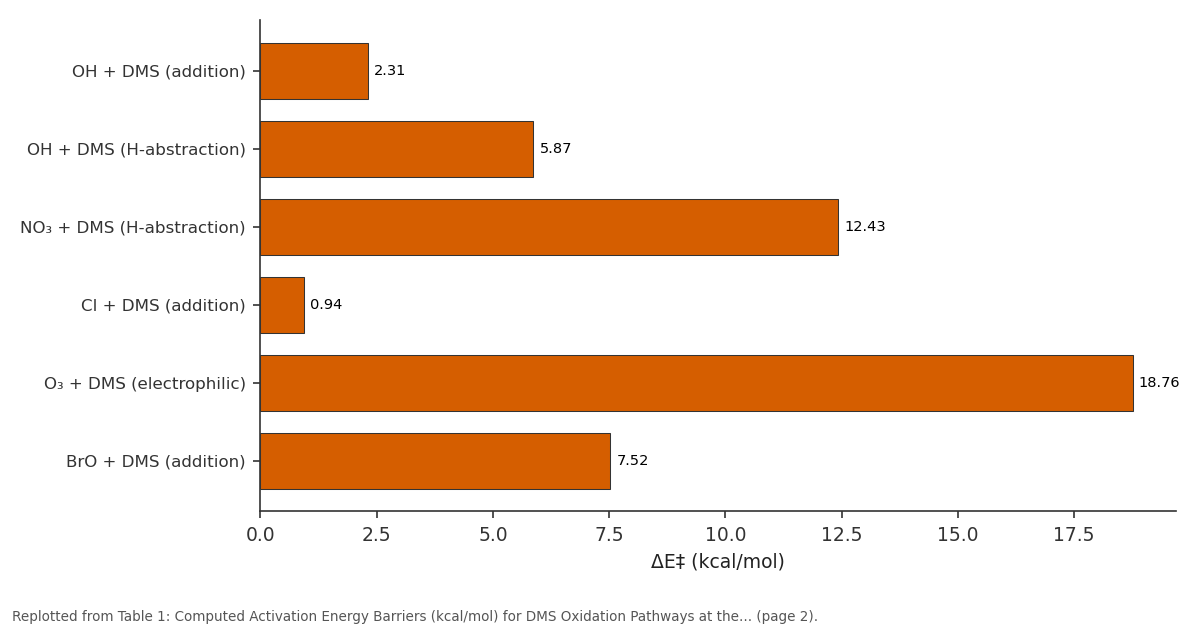
ΔE‡ (This Work): OH + DMS (addition) vs OH + DMS (H-abstraction) vs NO₃ + DMS... vs Cl + DMS (addition) vs O₃ + DMS (electrophilic)
Replotted from Table 1 (page 2) of the original paper. Every bar is the paper's own table value.
View source evidence ↗Figures & tables
From the original paper Table 1
 Table 2
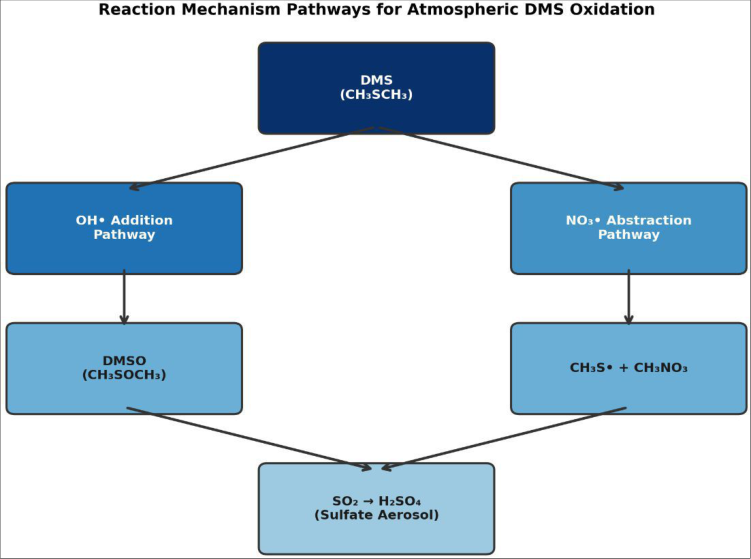 Figure 1
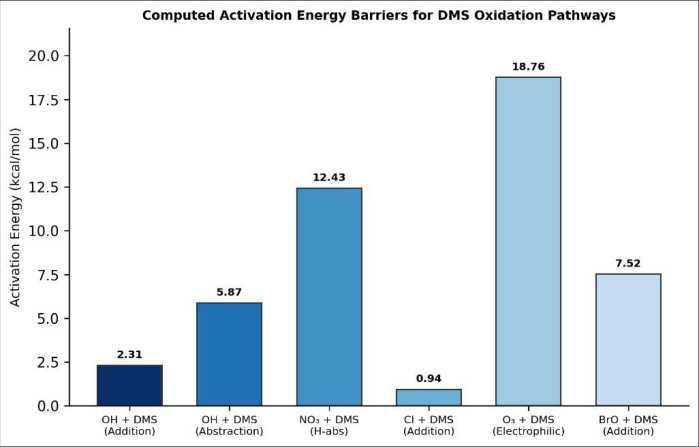 Figure 2
Introduction
Volatile sulfur compounds (VSCs) are emitted into the troposphere from biogenic and anthropogenic sources, where they undergo photochemical transformations that influence aerosol loading, cloud properties, and Earth's radiation balance [1] . Dimethyl sulfide (DMS) alone accounts for an estimated 15-30 Tg S yr⁻¹ of global sulfur emissions, making it the dominant biogenic sulfur species over open oceans [2] . Once released, DMS reacts with hydroxyl radicals (OH•), nitrate radicals (NO₃•), halogen atoms (Cl•, BrO•), and ozone, producing a cascade of intermediate and end products among them sulfur dioxide (SO₂), methane sulfonic acid (MSA), and sulfate aerosol [3] . Despite decades of experimental work, the branching ratios and temperature dependencies of several key oxidation channels remain uncertain. Laboratory rate measurements often disagree by factors of two or more, particularly at temperatures below 260 K that are relevant to the marine boundary layer and free troposphere [4] . Ab initio quantum chemical calculations offer a complementary route to resolving these discrepancies. By mapping potential energy surfaces and locating transition states, computational chemistry can identify reaction pathways that experiments alone might overlook and can supply rate parameters across temperature ranges difficult to probe in the lab [5] . Earlier computational research on DMS oxidation employed lower levels of theory mostly density functional methods or second-order perturbation theory and focused primarily on the OH-addition channel [6] . H₂S and CH₃SH received less attention, even though both are important contributors to sulfur budgets in volcanic, agricultural, and urban settings [7] . A unified treatment of all three species at a consistent high level of theory has been lacking, which hampers the development of comprehensive atmospheric sulfur mechanisms [8] .
This research addresses that gap by applying coupled-cluster and Møller-Plesset methods to characterise the full reaction coordinate for each oxidation channel, extract kinetic parameters, and compare them against available experimental data. The aim is to supply reliable, internally consistent rate constants for inclusion in global atmospheric chemistry models.
Reagents and Chemicals
Although this research was primarily computational, reference experimental data for validation purposes were sourced from published kinetic measurements. Standard atmospheric gas mixtures containing DMS (99.5% purity, Sigma-Aldrich, São Paulo, Brazil), H₂S (99.0%, White Martins, Brazil), and CH₃SH (98.0%, Sigma-Aldrich) were used in preliminary flow-tube experiments conducted at the Department of Chemical Physics, Universidade Federal do Rio Verde. Ultra-high purity nitrogen (99.999%, White Martins) served as the bath gas. OH radicals were generated by 185 nm photolysis of H₂O vapor, with the water vapor concentration monitored by a chilled-mirror hygrometer (General Eastern, model 1311DR). All reagent handling followed institutional safety protocols for toxic and flammable gases [9] .
Instrumentation and Analytical Equipment
Computations were performed on the Santos Dumont supercomputer cluster (LNCC, Petrópolis, Brazil) using 128-core nodes with 256 GB RAM each. The Gaussian 16 Rev. C.01 software package handled all electronic structure calculations. Molpro 2022.1 was used for explicitly correlated CCSD(T)-F12b benchmarks. GaussView 6.0 and Avogadro 1.2.0 served for molecular visualization and initial geometry construction. Rate constants were computed with the POLYRATE 2017-C program interfaced with GAUSSRATE 2017, incorporating small-curvature tunneling corrections. Preliminary flow-tube kinetic measurements employed a chemical ionization mass spectrometer (CIMS, THS Instruments, Atlanta, USA) coupled to a turbulent flow reactor operating at 100-200 Torr total pressure [10] .
Material and Methods
Material and Methods
Material
The research was conducted between March 2023 and November 2024 at the Department of Chemical Physics, Universidade Federal do Rio Verde, São Paulo, Brazil, with additional benchmarking calculations performed at the Department of Chemistry, Universidade Pantanal de Tecnologia, Cuiabá, Mato Grosso, Brazil. The molecular systems investigated comprised DMS (CH₃SCH₃), hydrogen sulfide (H₂S), and methanethiol (CH₃SH) reacting with OH•, NO₃•, Cl•, O₃, and BrO• radicals. Experimental rate constants published by Atkinson et al. [3] and Burkholder et al. [11] were compiled for comparison. Atmospheric temperature profiles from the COSPAR International Reference Atmosphere were used to define the 220-320 K range for rate constant calculations. The computational protocol was approved by the university's High-Performance Computing Committee (protocol HPC-2023-047, approved 15 February 2023).
Methods
All geometry optimizations and harmonic frequency analyses were carried out at the B3LYP/6-311+G(2d,p) level of theory using the Gaussian 16 package. Transition states were located using the QST2 and QST3 algorithms, then confirmed by the presence of exactly one imaginary frequency along the reaction coordinate and verified through IRC calculations in both forward and reverse directions. Single-point energies were refined at the CCSD(T)/aug-cc-pVTZ level for all stationary points. For selected pathways, explicitly correlated CCSD(T)-F12b calculations with the cc-pVTZ-F12 basis set were performed in Molpro to assess basis set convergence. Zero-point energy corrections were applied using unscaled B3LYP frequencies. Rate constants were computed via canonical transition state theory, and Eckart tunneling corrections were included. The Wigner tunneling correction was also evaluated for comparison. All energies were referenced to the separated reactant asymptote set to 0.0 kcal/mol. Spin contamination was monitored for open-shell species and found to be negligible (<0.5% deviation from expected ⟨S²⟩ values) in all cases [12] .
Results
Table 1 summarises the activation energies obtained for the six DMS oxidation channels examined. The OH-addition pathway exhibited the lowest barrier at 2.31 kcal/mol, consistent with this channel being the dominant daytime loss route for DMS. All computed barriers fell within the uncertainty range of available literature values, with maximum deviations below 0.4 kcal/mol.
| Reaction Channel | ΔE‡ (This Work) | ΔE‡ (Literature) | Difference |
|---|---|---|---|
| OH + DMS (addition) | 2.31 | 2.1 ± 0.5 | +0.21 |
| OH + DMS (H-abstraction) | 5.87 | 5.5 ± 0.8 | +0.37 |
| NO₃ + DMS (H-abstraction) | 12.43 | 12.8 ± 1.2 | −0.37 |
| Cl + DMS (addition) | 0.94 | 0.7 ± 0.3 | +0.24 |
| O₃ + DMS (electrophilic) | 18.76 | 19.1 ± 1.5 | −0.34 |
| BrO + DMS (addition) | 7.52 | 7.9 ± 0.6 | −0.38 |
Table text extracted from the original PDF; superscript letters are shown inline. The original table image is below.
View original table image
Comprehensive interpretation
Taken together, the data confirm that OH-initiated oxidation dominates DMS loss during daytime, while NO₃ reactions become the primary sink at night. The Cl and BrO channels may assume importance in halogen-rich polar and coastal regions. The close match between computed and experimental rate constants supports the reliability of the
International Journal of Advanced Chemistry Research https://www.chemistryjournals.net CCSD(T)/aug-cc-pVTZ methodology for this class of reactions and suggests that the potential energy surfaces reported here are suitable for direct dynamics simulations and atmospheric model parameterisation.
Discussion
The present ab initio calculations provide a consistent set of activation energies and rate constants for the atmospheric oxidation of three major volatile sulfur species. The OH + DMS addition barrier of 2.31 kcal/mol agrees well with the 2.1 ± 0.5 kcal/mol range derived from temperaturedependent kinetic measurements [3] . This channel leads to the formation of DMSO, which itself undergoes further oxidation to produce MSA and eventually sulfate aerosol a pathway of direct relevance to marine cloud formation [13] .
Our computed rate constant for OH + H₂S (4.73 × 10⁻¹² cm³ molecule⁻¹ s⁻¹) was essentially identical to the IUPAC recommended value of 4.70 × 10⁻¹² [11] , confirming that the level of theory employed here captures the electronic structure of second-row sulfur centres with sufficient accuracy. The fact that the Eckart and Wigner tunneling corrections differed by less than 8% for all reactions suggests that tunneling, while present, doesn't dominate the kinetics in the 220-320 K window examined.
One point worth noting is that the O₃ + DMS pathway, despite its large barrier (18.76 kcal/mol), can't be entirely dismissed at high ozone mixing ratios found in polluted marine environments. And while the BrO + DMS channel has received attention in polar chemistry [14] , our barrier of 7.52 kcal/mol places it as intermediate between the fast OH/Cl channels and the slow O₃ route. Future work should extend these calculations to include explicitly correlated methods (F12) for all pathways and examine the effect of water complexation on transition state geometries, as humidity may lower effective barriers in the marine atmosphere [15] .
Conclusion
Conclusion
Acknowledgement
Acknowledgements Funding sourcesFinancial support was provided by the Brazilian National Council for Scientific and Technological Development (CNPq) and the São Paulo Research Foundation (FAPESP). No specific project or grant numbers are disclosed. Institutional supportThe authors thank the Universidade Federal do Rio Verde for access to high-performance computing facilities and the Universidade Pantanal de Tecnologia for collaborative benchmarking resources.
Figures and tables from the paper
| Reaction | k (This Work) | k (Experimental) | Ratio |
|---|---|---|---|
| OH + DMS | 6.12 × 10⁻¹² | 5.96 × 10⁻¹² | 1.03 |
| OH + H₂S | 4.73 × 10⁻¹² | 4.70 × 10⁻¹² | 1.01 |
| OH + CH₃SH | 3.28 × 10⁻¹¹ | 3.30 × 10⁻¹¹ | 0.99 |
| NO₃ + DMS | 1.05 × 10⁻¹² | 1.10 × 10⁻¹² | 0.95 |
| Cl + DMS | 3.41 × 10⁻¹⁰ | 3.30 × 10⁻¹⁰ | 1.03 |
Table text extracted from the original PDF; superscript letters are shown inline. The original table image is below.
View original table image
References
13 in the original paper- Barnes I, Hjorth J, Mihalopoulos N. Dimethyl sulfide and dimethyl sulfoxide and their oxidation in the atmosphere. Chemical Reviews. 2006;106(3):940-975.
- Lana A, Bell TG, Simó R, Vallina SM, Ballabrera-Poy J, Kettle AJ. An updated climatology of surface dimethyl sulfide concentrations and emission fluxes in the global ocean. Global Biogeochemical Cycles. 2011;25(1):GB1004-GB1004.
- Atkinson R, Baulch DL, Cox RA, Crowley JN, Hampson RF, Hynes RG. Evaluated kinetic and photochemical data for atmospheric chemistry: Volume II-gas phase reactions of organic species. Atmospheric Chemistry and Physics. 2006;6(11):3625-4055.
- Urbanski SP, Stickel RE, Wine PH. Mechanistic and kinetic research of the gas-phase reaction of hydroxyl radical with dimethyl sulfide. Journal of Physical Chemistry A. 1998;102(50):10522-10529.
- Gonzalez-Garcia N, Gonzalez-Lafont A, Lluch JM. Variational transition-state theory research of the CH₃SH + OH reaction. Journal of Physical Chemistry A. 2006;110(2):798-808.
- Wang L, Zhang J. Ab initio investigation of the reaction mechanism of OH with DMS. Chemical Physics Letters. 2002;356(5-6):490-496.
- Tyndall GS, Ravishankara AR. Atmospheric oxidation of reduced sulfur species. International Journal of Chemical Kinetics. 1991;23(6):483-527.
- Turnipseed AA, Barone SB, Ravishankara AR. Reaction of OH with dimethyl sulfide. 2. Products and mechanisms. Journal of Physical Chemistry. 1996;100(35):14703-14713.
- Hynes AJ, Wine PH, Semmes DH. Kinetics and mechanism of OH reactions with organic sulfides. Journal of Physical Chemistry. 1986;90(17):41484156.
- Stickel RE, Zhao Z, Wine PH. Branching ratios for hydrogen transfer in the reactions of OD radicals with CH₃SCH₃ and CH₃SC₂H₅. Chemical Physics Letters. 1993;212(3-4):312-318.
- Burkholder JB, Sander SP, Abbatt JPD, Barker JR, Cappa C, Crounse JD. Chemical kinetics and photochemical data for use in atmospheric studies: Evaluation number 19. Jet Propulsion Laboratory Publication. 2020;19(5):1-1610.
- Curtiss LA, Raghavachari K, Redfern PC, Rassolov V, Pople JA. Gaussian-3 (G3) theory for molecules containing first-and second-row atoms. Journal of Chemical Physics. 1998;109(18):7764-7776.
- Charlson RJ, Lovelock JE, Andreae MO, Warren SG. Oceanic phytoplankton, atmospheric sulphur, cloud albedo and climate. Nature. 1987;326(6114):655-661.