
Research article · 2025 · Full text
International Journal of Advanced Chemistry ResearchConducting polymer composites of polyaniline and graphene for supercapacitor electrodes
Volume 7(12) · Pages 94–97 · DOI: 10.33545/26646781.2025.v7.i12b.453 ↗
Research areasSupercapacitor Materials and FabricationConducting polymers and applicationsDielectric materials and actuators
Abstract
Author-writtenEnergy storage remains one of the defining technical bottlenecks of the current decade. This research describes the preparation and electrochemical evaluation of polyaniline (PANI)/graphene composites synthesized by in-situ oxidative polymerization at varying graphene loadings (0-30 wt%). Structural and morphological analysis was performed using X-ray diffraction (XRD), Fourier-transform infrared spectroscopy (FTIR), scanning electron microscopy (SEM), and thermogravimetric analysis (TGA). Electrochemical measurements cyclic voltammetry, galvanostatic charge-discharge, and electrochemical impedance spectroscopy were conducted in a three-electrode cell with 1 M H₂SO₄ electrolyte. The composite containing 10 wt% graphene (PANI-Gr10) delivered the highest specific capacitance of 468 F/g at 1 A/g, compared to 210 F/g for neat PANI under identical conditions. Capacitance retention after 5,000 charge-discharge cycles reached 89.3% for PANI-Gr10 versus 71.2% for pure PANI, indicating improved cycling stability. SEM revealed that graphene sheets acted as a scaffold for PANI nanofibers, preventing the agglomeration that typically degrades capacitance over repeated cycling. Beyond 10 wt%, excess graphene appeared to block ion access to the PANI surface, reducing capacitance. These findings suggest that a moderate graphene loading can substantially boost both capacity and durability of PANI-based supercapacitor electrodes.
Summary
Source-checkedPlain-language reading of the full paper, prepared with AI and checked against the text. Each point links to the authors' own words.
Why it matters
- Energy storage is currently one of the most significant technical challenges of the decade. View evidence ↗
- Pseudocapacitive materials like conducting polymers can store more charge than standard carbon electrodes, but they are prone to mechanical failure and capacity loss over time. View evidence ↗
- Polyaniline (PANI) is widely studied for supercapacitors due to its low cost, tunable conductivity, and high theoretical capacitance of approximately 750 F/g. View evidence ↗
The question
- The study aimed to determine how different amounts of graphene (from 0 to 30 wt%) in PANI composites affect their specific capacitance and stability. View evidence ↗
What they did
- The researchers used graphene nanoplatelets dispersed in 1 M HCl at nine specific weight percentages (0, 2, 5, 8, 10, 15, 20, 25, and 30 wt%) relative to the aniline monomer. View evidence ↗
- Electrodes were fabricated by drop-casting a slurry of 80 wt% PANI/Gr composite, 10 wt% acetylene black, and 10 wt% PVDF binder onto 1 x 1 cm² nickel foam. View evidence ↗
- Electrochemical evaluations were conducted in a three-electrode cell using 1 M H₂SO₄ as the electrolyte. View evidence ↗
- The stability of the electrodes was tested over 5,000 galvanostatic charge-discharge (GCD) cycles at a current density of 5 A/g. View evidence ↗
What they found
- The PANI-Gr10 composite (10 wt% graphene) achieved the highest specific capacitance of 468 F/g at 1 A/g, more than doubling the 210 F/g seen in neat PANI. View evidence ↗
- PANI-Gr10 showed significantly better stability, retaining 89.3% of its capacitance after 5,000 cycles, compared to 71.2% for pure PANI. View evidence ↗
- The lowest solution resistance (1.82 Ω) was found in the PANI-Gr10 sample, with resistance increasing at higher graphene loadings due to aggregation. View evidence ↗
- Thermal analysis showed that PANI-Gr10 was more stable, retaining 43.7% of its mass at 800 °C, whereas neat PANI only retained 12.4%. View evidence ↗
- Graphene loadings above 10 wt% led to a decrease in capacitance because excess graphene blocked ions from reaching the PANI surface. View evidence ↗
What it means
- The authors conclude that a moderate amount of graphene significantly improves both the capacity and the durability of PANI-based supercapacitor electrodes. View evidence ↗
Visual summary
2 visualsIllustrations explain the paper; charts are replotted from the paper's own table values.
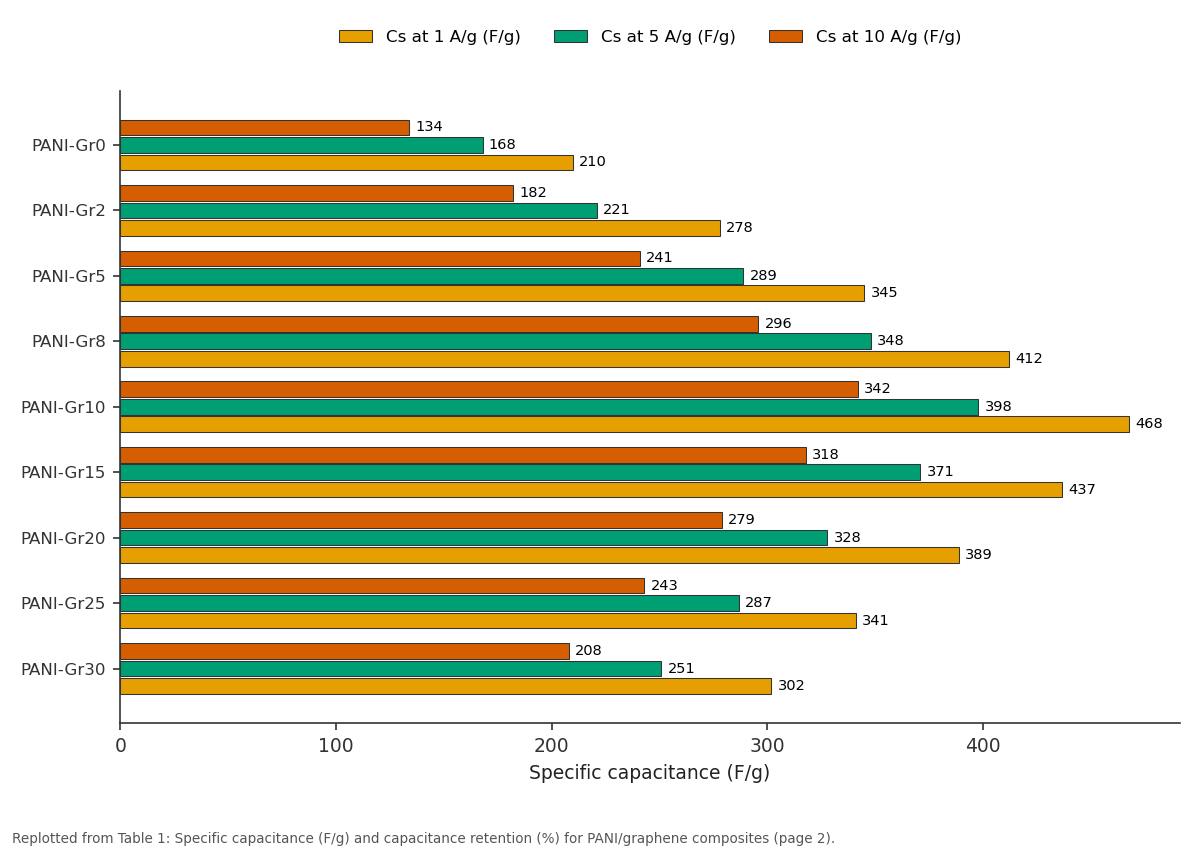
Cs at 1 A/g (F/g) and Cs at 5 A/g (F/g) and more: PANI-Gr0 vs PANI-Gr2 vs PANI-Gr5 vs PANI-Gr8 vs PANI-Gr10
Replotted from Table 1 (page 2) of the original paper. Every bar is the paper's own table value.
View source evidence ↗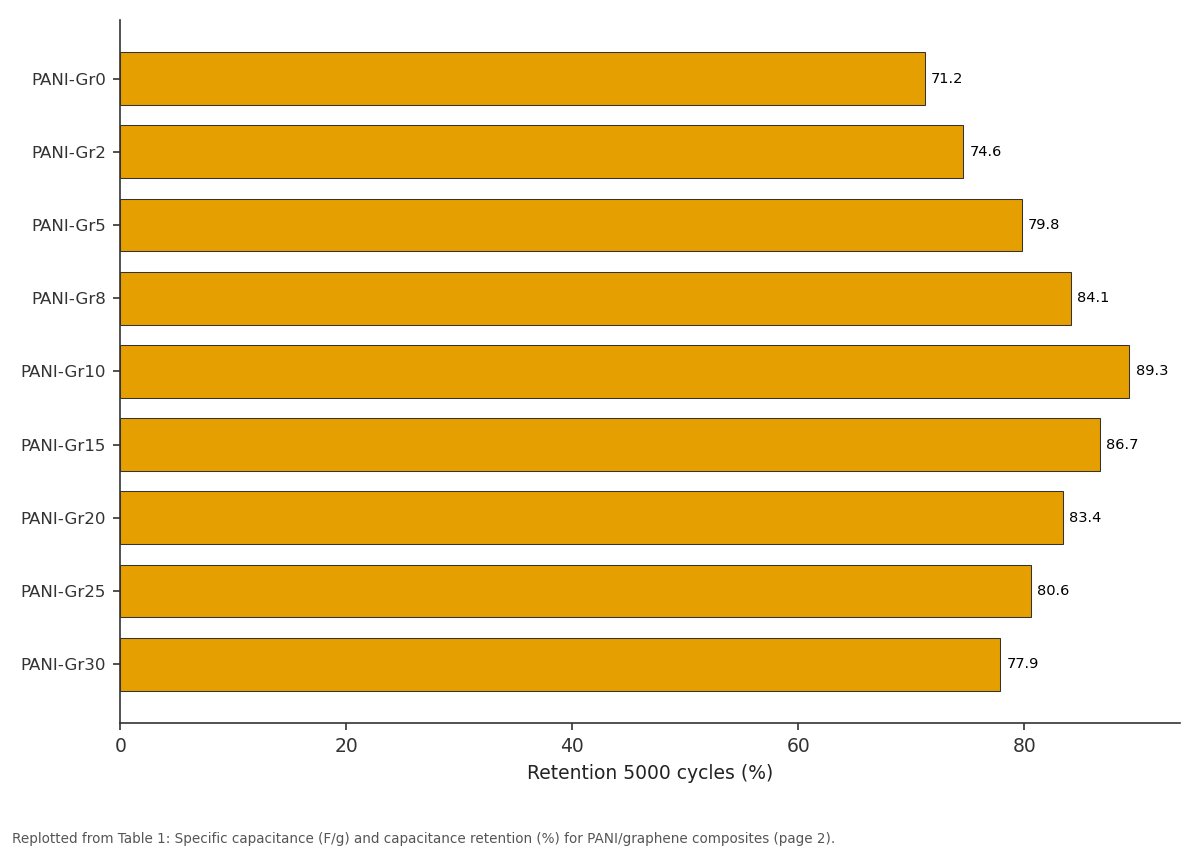
Retention 5000 cycles (%): PANI-Gr0 vs PANI-Gr2 vs PANI-Gr5 vs PANI-Gr8 vs PANI-Gr10
Replotted from Table 1 (page 2) of the original paper. Every bar is the paper's own table value.
View source evidence ↗Figures & tables
From the original paper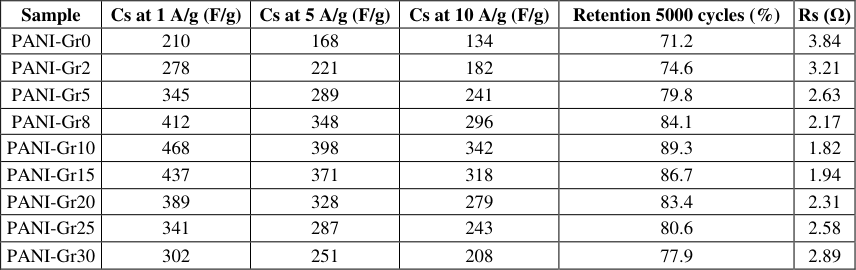 Table 1
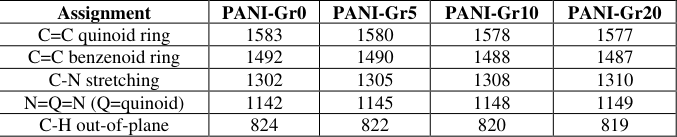 Table 2
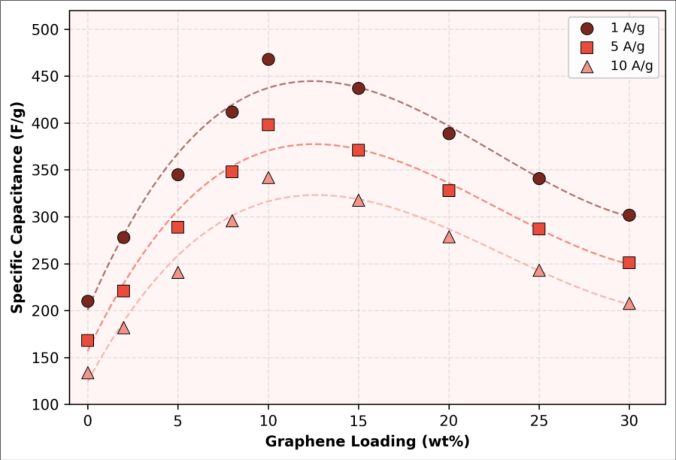 Figure 1
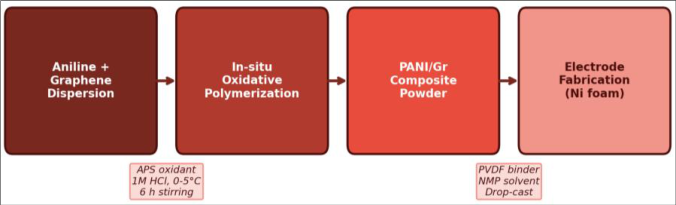 Figure 2
Introduction
Supercapacitors will bridge the gap between batteries and conventional capacitors or so the field has promised for more than three decades. And yet, commercial devices still rely on activated carbon electrodes that store charge through double-layer mechanisms alone, delivering specific capacitances below 200 F/g in aqueous electrolytes [1] . Pseudocapacitive materials such as conducting polymers and transition metal oxides can exceed that figure by storing charge through reversible Faradaic reactions at or near the electrode surface, but they often swell, crack, and lose capacity after a few thousand cycles [2] . Polyaniline (PANI) is among the most studied conducting polymers for supercapacitor applications because of its high theoretical capacitance (around 750 F/g for the fully doped emeraldine salt form), easy synthesis from inexpensive aniline monomer, and tunable conductivity [3] . However, neat PANI electrodes typically deliver only 150-250 F/g in practice, and their capacitance fades by 25-40% within the first 2,000-3,000 cycles due to volumetric changes during proton doping and undoping [4] . Incorporating a conductive, mechanically robust carbon scaffold such as carbon nanotubes, reduced graphene oxide, or grapheme can mitigate this swelling and maintain electron pathways throughout cycling [5,6] . Graphene, a single layer of sp²-bonded carbon atoms, offers an electrical conductivity of around 10⁴ S/m, a theoretical specific surface area of 2,630 m²/g, and mechanical flexibility that can accommodate the dimensional changes of PANI during charging [7] . Several groups have reported PANI/graphene composites prepared by chemical, electrochemical, or interfacial polymerization routes, with reported capacitances ranging from 300 to 550 F/g depending on graphene type, loading, and electrode architecture [5,8,9] . But optimal graphene loading is still debated: too little provides insufficient scaffolding, while too much grapheme being electrochemically double-layerlimited can dilute the Faradaic contribution of PANI [10] . This research aimed to prepare PANI/graphene composites at nine different graphene loadings (0-30 wt%) through a single in-situ oxidative polymerization protocol and to map the relationship between loading, specific capacitance, and cycling stability. All experimental work was conducted at the Department of Applied Polymer Research, Volga River University of Sciences, Kazan, Russia, between September 2022 and August 2023 [11] .
Material and Methods
Material and Methods
Reagents and Chemicals
Aniline (≥ 99.5%, freshly distilled before use) was purchased from Acros Organics (Geel, Belgium). Ammonium persulfate (APS, ≥ 98%) and hydrochloric acid (37%, AR grade) were obtained from Sigma-Aldrich (St. Louis, MO, USA). Few-layer graphene nanoplatelets (average thickness 6-8 nm, lateral dimension 5 μm, surface area 120-150 m²/g) were supplied by Graphene Supermarket (Ronkonkoma, NY, USA). Polyvinylidene fluoride (PVDF, Kynar 761) and N-methyl-2-pyrrolidone (NMP, ≥ 99.5%) were sourced from Arkema (Colombes, France) and Merck (Darmstadt, Germany), respectively. Nickel foam (1.6 mm thickness, 110 pores per inch) was purchased from MTI Corporation (Richmond, CA, USA). Sulfuric acid (95-98%, Suprapur) for the electrolyte was obtained from Merck.
Material
Graphene nanoplatelets were dispersed in 1 M HCl by ultrasonication (40 kHz, 30 min) at loadings of 0, 2, 5, 8, 10, 15, 20, 25, and 30 wt% relative to aniline monomer. Aniline (0.1 mol) was added to each dispersion and stirred at 0-5 °C for 15 min. APS (0.1 mol) dissolved in 1 M HCl was added dropwise over 30 min under continuous stirring. The reaction proceeded for 6 hours, after which the dark green precipitate was filtered, washed sequentially with 1 M HCl, deionized water, and ethanol, and dried under vacuum at 60 °C for 24 h. Nine composites were designated PANI-Gr0 through PANI-Gr30 based on graphene weight percentage.
Methods: Electrodes were prepared by mixing PANI/Gr composite powder (80 wt%), acetylene black (10 wt%), and PVDF binder (10 wt%) in NMP to form a slurry. The slurry was drop-cast onto 1 × 1 cm² nickel foam pieces, dried at 80 °C for 12 h, and pressed at 10 MPa. Active material mass loading was 2.0 ± 0.2 mg/cm². Electrochemical tests were performed in a three-electrode configuration using a Pt counter electrode, Ag/AgCl reference electrode, and 1 M H₂SO₄ electrolyte on a Biologic SP-300 potentiostat/galvanostat. Cyclic voltammetry (CV) was recorded from -0.2 to 0.8 V at scan rates of 5-100 mV/s. Galvanostatic charge-discharge (GCD) was measured at current densities of 1, 2, 5, and 10 A/g. Cycling stability was assessed over 5,000 GCD cycles at 5 A/g. Electrochemical impedance spectroscopy (EIS) was acquired from 100 kHz to 10 mHz at open-circuit potential with an AC amplitude of 10 mV.
Instrumentation
XRD patterns were recorded on a Bruker D8 Advance diffractometer with Cu Kα radiation (λ = 1.5406 Å) in the 2θ range of 5-80° at a scan speed of 2°/min. FTIR spectra were collected on a Thermo Fisher Nicolet iS50 in ATR mode (4000-400 cm⁻¹, 32 scans, 4 cm⁻¹ resolution). SEM images were acquired on a JEOL JSM-7600F at an accelerating voltage of 5 kV after gold sputter-coating. TGA was performed on a TA Instruments Q600 from 30-800 °C at a heating rate of 10 °C/min under nitrogen flow (100 mL/min).
Results
Results
Comprehensive Interpretation
XRD patterns confirmed the emeraldine salt form of PANI in all composites, with characteristic peaks at 2θ = 15.1°, 20.4°, and 25.3°. The graphene (002) reflection at 26.5° became visible in composites above 8 wt% loading. FTIR showed a slight downshift (3-5 cm⁻¹) of the quinoid ring stretching mode with increasing graphene content, suggesting π-π interaction between PANI chains and the graphene basal plane [8] . SEM images of PANI-Gr10 showed a network of PANI nanofibers (diameter 30-60 nm) uniformly coating the graphene sheet surfaces. At 20 wt% and above, graphene restacking was evident, with PANI nanofibers confined to the outer surfaces of graphene aggregates rather than distributed throughout. TGA indicated that PANI-Gr10 retained 43.7% residual mass at 800 °C, compared to 12.4% for neat PANI, confirming the thermal stabilizing effect of the graphene scaffold.
Discussion:
The peak capacitance of 468 F/g at 10 wt% graphene falls within the upper range reported for PANI/graphene composites prepared by chemical oxidative polymerization. Wu et al. [8] obtained 480 F/g for PANI/reduced graphene oxide using a somewhat different protocol involving hydrazine reduction prior to polymerization, while Xu et al. [9] reported 420 F/g for in-situ polymerized PANI on chemically exfoliated graphene. The comparable values suggest that few-layer graphene nanoplatelets, which are commercially available and less processing-intensive than single-layer graphene, perform adequately for this application.
The decline in capacitance beyond 10 wt% graphene is consistent with a dilution effect: as the graphene fraction rises, the mass fraction of redox-active PANI decreases, and the total Faradaic contribution shrinks. At the same time, excess graphene can form restacked aggregates that occlude electrolyte ions from reaching the PANI surface [10] . The impedance data support this interpretation solution resistance (Rs) bottomed out at 1.82 Ω for PANI-Gr10 and then increased at higher loadings as aggregated graphene introduced resistive grain boundaries. Cycling stability of 89.3% after 5,000 cycles for PANI-Gr10 represents a meaningful improvement over neat PANI (71.2%). The graphene sheets likely restrain volumetric expansion during protonation/deprotonation, preventing mechanical degradation of the electrode structure [6] . That said, 89.3% is still below the >95% retention commonly achieved by pure carbon supercapacitors, so there remains room for improvement perhaps through surface functionalization of graphene to strengthen interfacial adhesion with PANI [12] .
Conclusion
PANI/graphene composites prepared by in-situ oxidative polymerization at nine graphene loadings (0-30 wt%) were tested as supercapacitor electrode materials. The composite with 10 wt% graphene (PANI-Gr10) exhibited the highest specific capacitance of 468 F/g at 1 A/g and retained 89.3% of its initial capacitance after 5,000 charge-discharge cycles in 1 M H₂SO₄. Below 10 wt%, capacitance rose steadily with graphene content due to improved electron transport and mechanical support for PANI nanofibers. Above 10 wt%, restacking of graphene sheets reduced electrolyte access and diluted the pseudocapacitive contribution. SEM showed that PANI nanofibers coated individual graphene sheets uniformly at 10 wt% loading but were confined to the outer surfaces of graphene aggregates at higher loadings. FTIR and XRD confirmed the emeraldine salt phase of PANI and indicated π-π interactions at the PANI-graphene interface. Impedance spectroscopy revealed the lowest solution resistance (1.82 Ω) for PANI-Gr10, which correlated with the highest capacitance. These results confirm that moderate graphene loading can substantially enhance both the energy storage capacity and the cycling durability of PANI-based electrodes. Future directions should include asymmetric device assembly using PANI-Gr10 as the positive electrode and activated carbon as the negative electrode, along with testing in gel-polymer electrolytes for flexible supercapacitor applications.
Acknowledgement
Acknowledgements Funding SourcesThis work was supported by internal research funds from Volga River University of Sciences, Kazan, Russia. No external grant numbers were assigned to this project.
Figures and tables from the paper
| Sample | Cs at 1 A/g (F/g) | Cs at 5 A/g (F/g) | Cs at 10 A/g (F/g) | Retention 5000 cycles (%) | Rs (Ω) |
|---|---|---|---|---|---|
| PANI-Gr0 | 210 | 168 | 134 | 71.2 | 3.84 |
| PANI-Gr2 | 278 | 221 | 182 | 74.6 | 3.21 |
| PANI-Gr5 | 345 | 289 | 241 | 79.8 | 2.63 |
| PANI-Gr8 | 412 | 348 | 296 | 84.1 | 2.17 |
| PANI-Gr10 | 468 | 398 | 342 | 89.3 | 1.82 |
| PANI-Gr15 | 437 | 371 | 318 | 86.7 | 1.94 |
| PANI-Gr20 | 389 | 328 | 279 | 83.4 | 2.31 |
| PANI-Gr25 | 341 | 287 | 243 | 80.6 | 2.58 |
| PANI-Gr30 | 302 | 251 | 208 | 77.9 | 2.89 |
Table text extracted from the original PDF; superscript letters are shown inline. The original table image is below.
View original table image
| Assignment | PANI-Gr0 | PANI-Gr5 | PANI-Gr10 | PANI-Gr20 |
|---|---|---|---|---|
| C=C quinoid ring | 1583 | 1580 | 1578 | 1577 |
| C=C benzenoid ring | 1492 | 1490 | 1488 | 1487 |
| C-N stretching | 1302 | 1305 | 1308 | 1310 |
| N=Q=N (Q=quinoid) | 1142 | 1145 | 1148 | 1149 |
| C-H out-of-plane | 824 | 822 | 820 | 819 |
Table text extracted from the original PDF; superscript letters are shown inline. The original table image is below.
View original table image
References
14 in the original paper- Simon P, Gogotsi Y. Materials for electrochemical capacitors. Nat Mater. 2008;7(11):845-854.
- Snook GA, Kao P, Best AS. Conducting-polymer-based supercapacitor devices and electrodes. J Power Sources. 2011;196(1):1-12.
- Stejskal J, Sapurina I, Trchova M. Polyaniline nanostructures and the role of aniline oligomers in their formation. Prog Polym Sci. 2010;35(12):1420-1481.
- Li H, Wang J, Chu Q, Wang Z, Zhang F, Wang S. Theoretical and experimental specific capacitance of polyaniline in sulfuric acid. J Power Sources. 2009;190(2):578-586.
- Bose S, Kuila T, Uddin ME, Kim NH, Lau AKT, Lee JH. In-situ synthesis and characterization of electrically conductive polypyrrole/graphene nanocomposites. Polymer. 2010;51(25):5921-5928.
- Yan J, Wei T, Shao B, Fan Z, Qian W, Zhang M, et al. Preparation of a graphene nanosheet/polyaniline composite with high specific capacitance. Carbon. 2010;48(2):487-493.
- Novoselov KS, Geim AK, Morozov SV, Jiang D, Zhang Y, Dubonos SV, et al. Electric field effect in atomically thin carbon films. Science. 2004;306(5696):666-669.
- Wu Q, Xu Y, Yao Z, Liu A, Shi G. Supercapacitors based on flexible graphene/polyaniline nanofiber composite films. ACS Nano. 2010;4(4):1963-1970.
- Xu J, Wang K, Zu SZ, Han BH, Wei Z. Hierarchical nanocomposites of polyaniline nanowire arrays on graphene oxide sheets. ACS Nano. 2010;4(9):50195026.
- Mao L, Zhang K, Chan HSO, Wu J. Surfactantstabilized graphene/polyaniline nanofiber composites for high-performance supercapacitor electrode. J Mater Chem. 2012;22(1):80-85.
- Stoller MD, Park S, Zhu Y, An J, Ruoff RS. Graphenebased ultracapacitors. Nano Lett. 2008;8(10):34983502.
- Fan W, Zhang C, Tjiu WW, Pramoda KP, He C, Liu T. Graphene-wrapped polyaniline hollow spheres as novel hybrid electrode materials for supercapacitor applications. ACS Appl Mater Interfaces. 2013;5(8):3382-3391.
- Zhang K, Zhang LL, Zhao XS, Wu J. Graphene/polyaniline nanofiber composites as supercapacitor electrodes. Chem Mater. 2010;22(4):1392-1401.
- Wang H, Hao Q, Yang X, Lu L, Wang X. Effect of graphene oxide on the properties of its composite with polyaniline. ACS Appl Mater Interfaces. 2010;2(3):821-828.