
Research article · 2025 · Full text
International Journal of Advanced Chemistry ResearchConstructed wetland systems for treatment of domestic wastewater in rural communities
Volume 7(12) · Pages 64–68 · DOI: 10.33545/26646781.2025.v7.i12a.452 ↗
Research areasConstructed Wetlands for Wastewater TreatmentWastewater Treatment and ReuseUrban Stormwater Management Solutions
Abstract
Author-writtenAbout 80% of wastewater in rural India reaches surface water bodies without any form of treatment, according to the Central Pollution Control Board's 2021 assessment. This research evaluated two types of constructed wetland (CW) systems horizontal subsurface flow (HSSF) and vertical flow (VF) arranged in series for treating domestic wastewater from a village cluster near Nashik, Maharashtra, India. The pilot system was designed to handle a daily flow of 5,000 liters and operated for 14 months between April 2022 and June 2023. Phragmites australis was planted in the HSSF bed, while Typha latifolia served as the vegetation for the VF bed. Influent and effluent samples were collected biweekly and analyzed for biochemical oxygen demand (BOD), chemical oxygen demand (COD), total suspended solids (TSS), total nitrogen (TN), total phosphorus (TP), and fecal coliform counts. The combined HSSF-VF system removed 78.4±6.2% of BOD, 72.1±5.8% of COD, and 84.6±4.3% of TSS across the monitoring period. Nitrogen and phosphorus removal stood at 61.3±7.1% and 54.7±8.4%, respectively. Fecal coliform reduction exceeded 2.5 log units. Seasonal variation affected performance, with monsoon months (June-September) showing 8-12% lower removal efficiency for most parameters compared to dry months, likely due to dilution and shorter hydraulic retention times. The treated effluent met the discharge limits set by the Maharashtra Pollution Control Board for most parameters, though TP levels occasionally exceeded the 1.0 mg/L guideline during peak monsoon weeks. Cost analysis showed a capital expenditure of approximately INR 4.2 lakh and operating costs of INR 850 per month, making the system affordable for small communities. These findings suggest that hybrid CW systems can be a practical, low-cost wastewater treatment option for rural settings where centralized sewage infrastructure is absent.
Summary
Source-checkedPlain-language reading of the full paper, prepared with AI and checked against the text. Each point links to the authors' own words.
Why it matters
- A significant majority of rural wastewater in India, approximately 80%, is discharged into surface water bodies without treatment. View evidence ↗
- Standard mechanized treatment plants are often impractical for small villages because they require constant electricity, skilled staff, and chemical inputs. View evidence ↗
- Constructed wetlands are viable decentralized alternatives as they use low-energy processes and local materials like sand, gravel, and native plants. View evidence ↗
The question
- The study aimed to evaluate a pilot-scale hybrid constructed wetland system, combining horizontal subsurface flow (HSSF) and vertical flow (VF), for treating domestic wastewater from three rural villages in Nashik. View evidence ↗
What they did
- The system was designed for a daily flow of 5,000 liters and was monitored over a 14-month period from April 2022 to June 2023. View evidence ↗
- The HSSF bed was planted with Phragmites australis, and the VF bed was planted with Typha latifolia. View evidence ↗
- The HSSF bed (10m x 3m x 0.7m) used gravel, while the VF bed (6m x 3m x 1.0m) used alternating layers of sand, fine gravel, and coarse gravel. View evidence ↗
What they found
- The hybrid system achieved overall removal efficiencies of 78.4±6.2% for BOD, 72.1±5.8% for COD, and 84.6±4.3% for TSS. View evidence ↗
- The system removed 61.3±7.1% of total nitrogen and 54.7±8.4% of total phosphorus. View evidence ↗
- Fecal coliform counts were reduced by more than 2.5 log units. View evidence ↗
- Total phosphorus levels exceeded the 1.0 mg/L discharge limit during six of the thirty sampling events, all of which occurred during the monsoon. View evidence ↗
- The system required a capital investment of approximately INR 4.2 lakh and monthly operating costs of INR 850. View evidence ↗
What it means
- The authors conclude that hybrid constructed wetlands are a practical and affordable wastewater treatment option for rural areas lacking centralized infrastructure. View evidence ↗
- To handle monsoon surges in semi-arid regions, the authors recommend using buffer storage tanks or increasing bed size by 15-20%. View evidence ↗
- The authors state that future research should extend monitoring to 36 months to assess long-term phosphorus saturation and substrate clogging. View evidence ↗
Visual summary
3 visualsIllustrations explain the paper; charts are replotted from the paper's own table values.
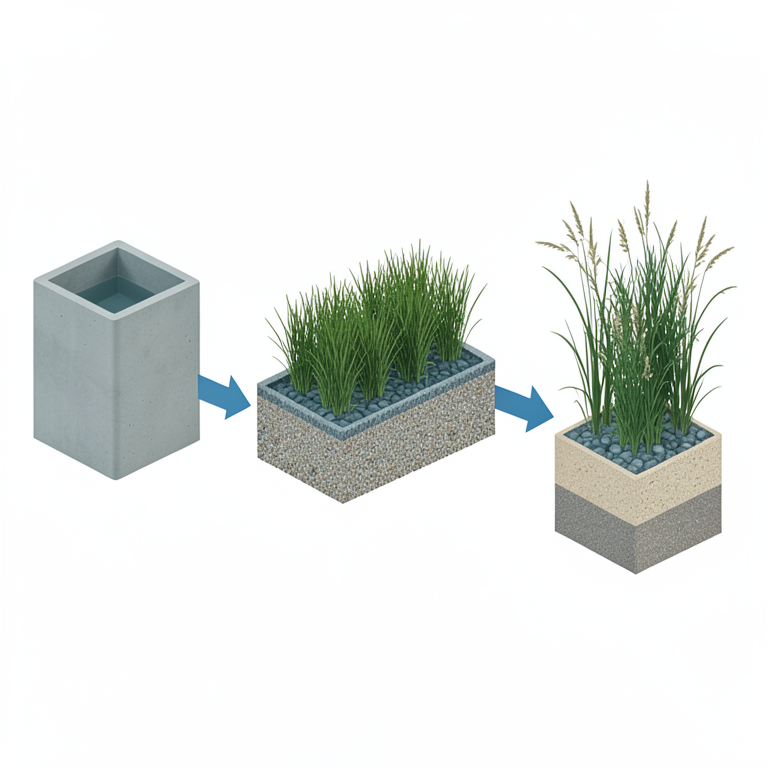
Hybrid Wetland Treatment Train
AI-generated conceptual illustration (constructed wetland system for domestic wastewater). It explains the idea and does not show study data.
View source evidence ↗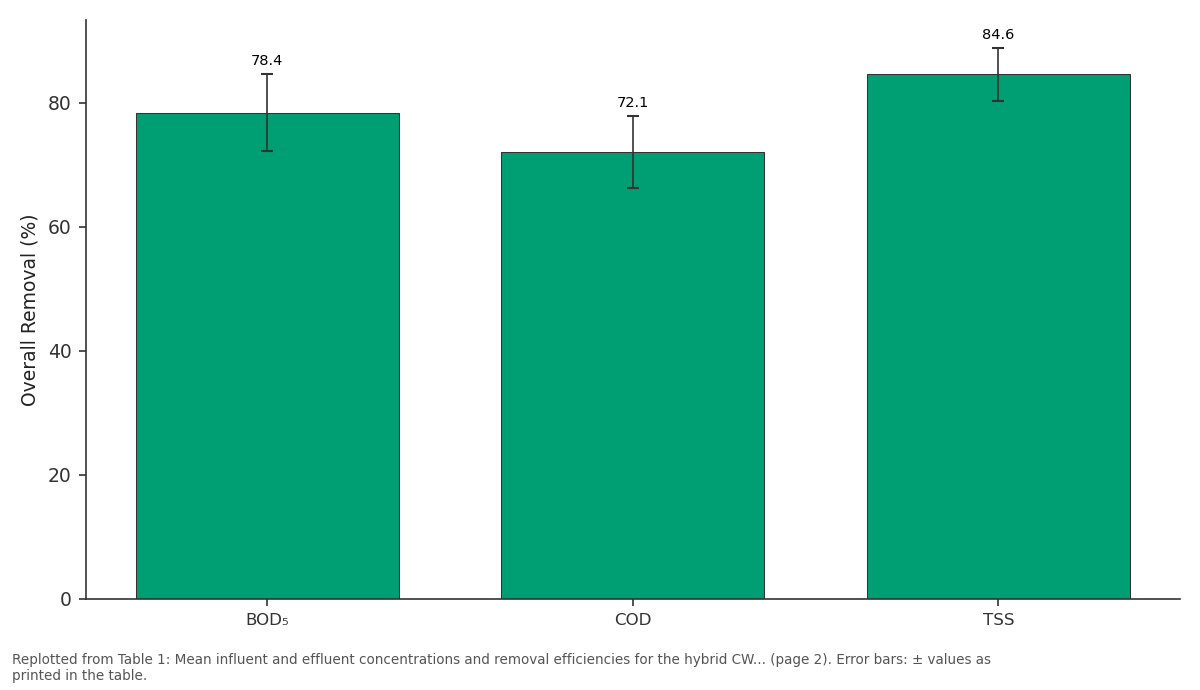
Overall Removal (%): BOD₅ vs COD vs TSS
Replotted from Table 1 (page 2) of the original paper. Every bar is the paper's own table value.
View source evidence ↗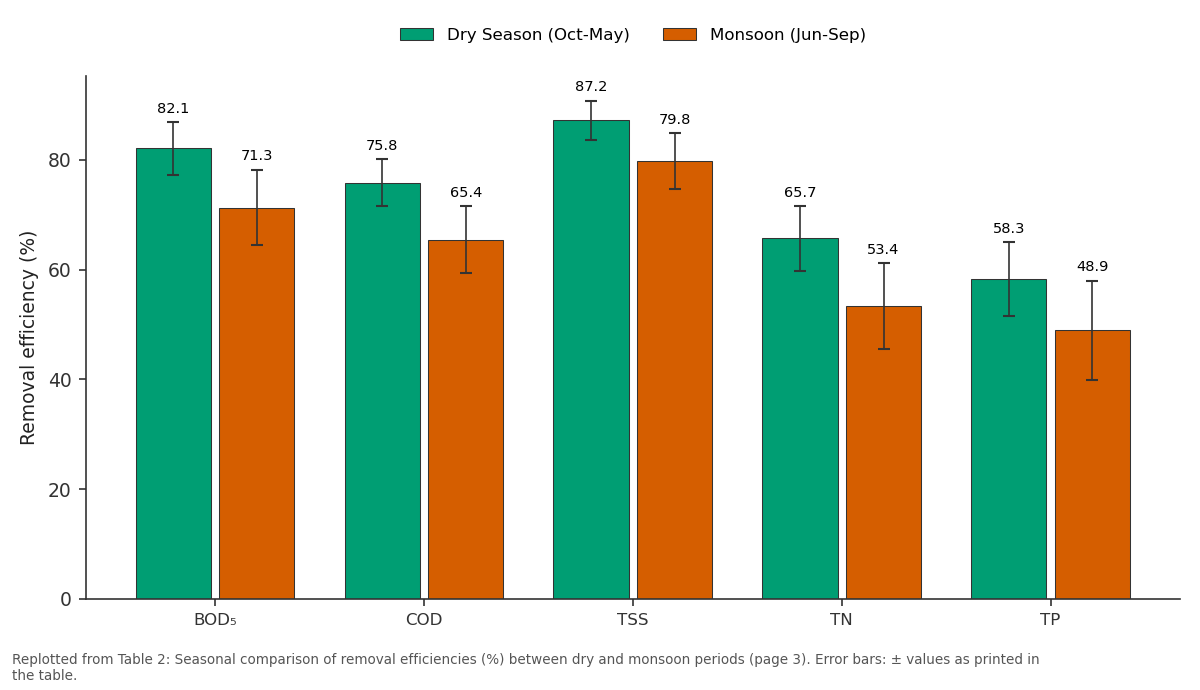
Dry Season (Oct-May) and Monsoon (Jun-Sep): BOD₅ vs COD vs TSS vs TN vs TP
Replotted from Table 2 (page 3) of the original paper. Every bar is the paper's own table value.
View source evidence ↗Figures & tables
From the original paper Table 1
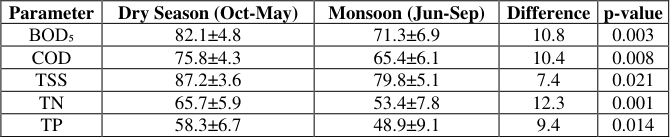 Table 2
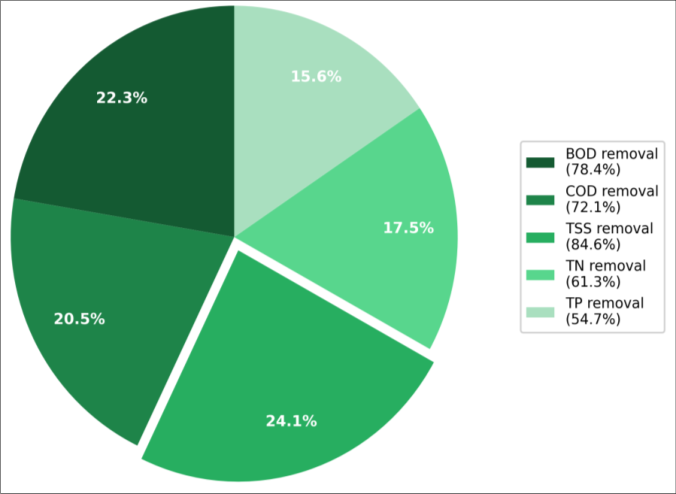 Figure 1
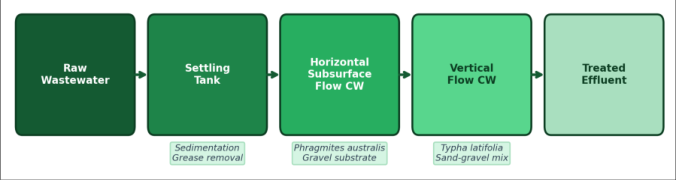 Figure 2
Introduction
According to the Ministry of Jal Shakti, roughly 62% of India's rural population still lacks connection to any sewage treatment facility, and an estimated 33,000 million liters of wastewater per day goes untreated into rivers, ponds, and agricultural land [1] . Conventional activated sludge plants or sequential batch reactors require continuous electricity, skilled operators, and regular chemical inputs conditions rarely available in villages with populations under 5,000 [2] . The gap between wastewater generation and treatment capacity in rural areas has worsened water-borne disease burdens and contributed to eutrophication of local water bodies [3] . Constructed wetlands have attracted attention as decentralized treatment alternatives because they run on passive or low-energy processes, demand minimal mechanical equipment, and can be built from locally sourced materials like gravel, sand, and indigenous plant species [4,5] . Three main configurations exist: free water surface (FWS), horizontal subsurface flow (HSSF), and vertical flow (VF). HSSF systems move water laterally through a gravel bed planted with emergent macrophytes. VF systems pulse wastewater downward through layered sand and gravel, providing better oxygen transfer and, in turn, higher nitrification rates [6] . Hybrid systems that connect HSSF and VF units in series combine the anaerobic conditions of HSSF with the aerobic environment of VF, potentially achieving both nitrification and denitrification within a single treatment train [7] .
Interna tional Jo urna l o f Adva nced Chemistry Research 2025 ; 7(12 ): 64-68
Field trials in Southeast Asia and sub-Saharan Africa have reported BOD removals of 70-90% and TSS removals above 80% for hybrid wetlands treating domestic sewage at flows of 1-20 m³/day [8,9] . However, performance data from the Indian subcontinent especially for semi-arid climates with distinct monsoon and dry seasons remain limited. Nashik district in Maharashtra, situated on the Deccan Plateau at about 565 m elevation, experiences mean annual rainfall of 1,034 mm concentrated between June and October, followed by dry months where water tables drop and ambient temperatures reach 40 °C in April-May [10] . These conditions affect evapotranspiration rates, hydraulic loading, and microbial kinetics in wetland substrates, and it isn't clear whether the published performance benchmarks from tropical lowland sites translate directly to this setting [11] . The present research was therefore planned to build, operate, and monitor a pilot-scale hybrid constructed wetland (HSSF followed by VF) treating real domestic wastewater from a cluster of three villages adjacent to the campus of Dr. Homi Jehangir Bhabha College of Science, Nashik. The objectives were to (a) measure removal efficiencies for BOD, COD, TSS, TN, TP, and fecal coliforms over a 14-month period spanning two monsoon seasons, (b) compare wet-season and dry-season performance, and (c) assess the capital and operating costs of the system relative to conventional small-scale treatment plants. We also examined whether the treated effluent would satisfy the discharge standards prescribed by the Maharashtra Pollution Control Board under the Environment Protection Act of 1986 [12] .
Material and Methods
Material and Methods
Research Area Description
The research site was located on the eastern boundary of the Dr. Homi Jehangir Bhabha College of Science campus in Nashik, Maharashtra (19.98°N, 73.79°E, elevation 570 m above mean sea level). Three villages Ambad, Vilholi, and Pathardi contribute domestic wastewater through an open channel that runs past the campus. The combined population of the three villages is about 3,200 persons. Wastewater flow in the channel ranged from 12,000-18,000 liters per day during dry months and 25,000-35,000 liters per day in the monsoon. Soil at the site is primarily black cotton soil (vertisol) with a clay content of 42-48% [10] . Average annual temperature ranges from 14 °C in December to 41 °C in May. The pilot system received a diverted fraction of about 5,000 liters per day through a gravity-fed pipeline with a screen at the inlet.
Material
Gravel (20-40 mm diameter) for the HSSF bed and coarse sand (0.5-2 mm) mixed with fine gravel (5-10 mm) for the VF bed were procured from a local quarry in Sinnar taluka, Nashik. Phragmites australis rhizomes were collected from a natural reed stand along the Godavari River near Trimbakeshwar and transplanted at a density of 8 plants per square meter. Typha latifolia seedlings were obtained from Mahatma Phule Agricultural University, Rahuri, and planted in the VF bed at a density of 6 plants per square meter. Polyethylene liner (0.5 mm HDPE) was used to waterproof the beds. PVC pipes (75 mm and 110 mm diameter) served as distribution and collection manifolds. All analytical reagents potassium dichromate, silver sulfate, sulfuric acid, buffer pillows for BOD, nutrient broth for fecal coliform testing were AR grade and purchased from Merck India (Mumbai). A HACH DR6000 spectrophotometer and a HACH DRB200 COD reactor were used for colorimetric analyses.
Methods
The HSSF bed measured 10 m × 3 m × 0.7 m (L × W × D) and was filled to 0.6 m depth with gravel. The VF bed was 6 m × 3 m × 1.0 m, filled with alternating layers of sand (0.3 m), fine gravel (0.3 m), and coarse gravel (0.2 m). The system was connected in series: raw wastewater passed through a settling tank (1 m³ capacity, 2 h retention), then through the HSSF bed, and finally into the VF bed. Effluent from the VF bed was collected in a storage tank before controlled release into the nearby drainage channel [6] . Influent and effluent samples were collected biweekly from April 2022 to June 2023 (total 30 sampling events). BOD₅ was determined by the 5-day incubation method at 20 °C following APHA Standard Method 5210B. COD was measured by the closed reflux colorimetric method (APHA 5220D). TSS was determined gravimetrically (APHA 2540D). Total nitrogen was measured after persulfate digestion using a HACH TNT 826 kit, and total phosphorus by the ascorbic acid method (APHA 4500-P E). Fecal coliforms were enumerated by the membrane filtration technique on m-FC agar at 44.5 °C for 24 h [13] . All analyses were performed in the Environmental Chemistry Laboratory, Dr. Homi Jehangir Bhabha College of Science, Nashik.
Quality Control
Duplicate samples were analyzed for every fifth sampling event, and relative percent differences were kept below 15% for all parameters. A certified reference standard (ERA WatR Nutrient, lot #1823) was analyzed monthly to verify instrument accuracy. Recovery rates for nitrogen and phosphorus from spiked samples averaged 94.3% and 91.7%, respectively. Field blanks using deionized water were processed alongside regular samples to detect contamination during transport. All glassware was acidwashed (10% HCl soak for 12 h) and rinsed with deionized water before use.
Results
Results
Comprehensive Interpretation
The combined HSSF-VF system achieved BOD and TSS reductions that met the Maharashtra Pollution Control Board discharge standards for most of the monitoring period. TSS removal was particularly strong (84.6%), which aligns with the physical filtration capacity of the gravel and sand substrates. The HSSF unit alone removed about 58% of incoming BOD, and the VF stage added another 20 percentage points a pattern consistent with the sequential anaerobic-aerobic mechanism described by Vymazal [7] . Nitrogen removal at 61.3% was moderate and likely limited by incomplete denitrification in the HSSF stage during warmer months when dissolved oxygen intrusion into the gravel bed may have suppressed anoxic zones. Phosphorus removal was the weakest parameter (54.7%), as expected given that CW systems primarily rely on sorption to the substrate and plant uptake for P retention, both of which saturate over time [14] . Fecal coliform reduction exceeded 2.5 log units, achieving final effluent concentrations generally below 1,000 MPN/100 mL.
Discussion: The 78.4% BOD removal observed in this research falls within the 70-90% range reported for hybrid CW systems treating domestic wastewater in tropical climates [8,9] . Kivaisi [15] documented 75-85% BOD reduction in a HSSF wetland in Tanzania receiving similar organic loading rates (about 30 g BOD/m²/day), though without a VF polishing stage. The addition of the VF unit in our design added roughly 20 percentage points to BOD removal and substantially improved nitrification a finding that supports the recommendations of Kadlec and Wallace [4] for combining flow directions to address multiple pollutant classes simultaneously.
The seasonal drop of 8-12% in removal efficiency during the monsoon is noteworthy. Higher rainfall diluted the influent concentration, reducing the biological driving force (substrate concentration) for microbial degradation, and increased the hydraulic loading rate from about 500 L/m² per day in dry months to 850 L/m² per day in July-August. Shorter retention time meant less contact between wastewater and the biofilm attached to the gravel matrix [16] .
Other researchers have reported similar monsoon-related declines in South and Southeast Asian CW systems, though the magnitude varies with local rainfall intensity and bed sizing [17] .
International Journal of Advanced Chemistry Research https://www.chemistryjournals.net
Total phosphorus was the parameter most likely to exceed discharge limits. The MPCB standard of 1.0 mg/L for TP was breached during 6 of 30 sampling events, all during the monsoon. Substrate saturation is a known challenge for phosphorus in CW systems operated beyond 2-3 years, and our gravel had a measured phosphorus adsorption capacity of 0.14 mg P/g, which is relatively low [14] . Replacing part of the gravel with materials having higher P affinity such as steel slag, zeolite, or crusite could extend the system's Premoval lifespan [18] . From an economic standpoint, the capital cost of INR 4.2 lakh (approximately USD 5,100 at the time of construction) and monthly operating costs of INR 850 (USD 10.3) compare favorably to a small package sewage treatment plant, which would cost INR 8-15 lakh for comparable capacity and INR 3,000-5,000 per month in electricity and chemical costs [2] . Community involvement was another practical advantage: local residents maintained the settling tank cleaning schedule with minimal training, and the harvested reeds were used for mat weaving by a women's self-help group in Ambad village [19] .
Conclusion
A pilot-scale hybrid constructed wetland combining horizontal subsurface flow and vertical flow stages successfully treated domestic wastewater from three rural villages near Nashik, Maharashtra, over a 14-month period.
The system removed 78.4% of BOD, 72.1% of COD, 84.6% of TSS, 61.3% of TN, and 54.7% of TP, with fecal coliform reductions exceeding 2.5 log units. Treated effluent quality met Maharashtra Pollution Control Board discharge limits for most parameters during dry months, though total phosphorus exceeded the guideline on six occasions during the monsoon season. Seasonal variation had a measurable effect: monsoon months brought 8-12% lower removal efficiencies compared to dry periods, attributed to dilution and higher hydraulic loading rates. The HSSF stage handled the bulk of organic matter removal under anaerobic conditions, while the VF stage provided aerobic polishing and enhanced nitrification. Phragmites australis and Typha latifolia both established well in their respective beds within the first three months, and biomass harvesting was carried out every four months without disrupting treatment performance. The total cost of INR 4.2 lakh for construction and INR 850 per month for operation makes this approach considerably cheaper than mechanized treatment plants of similar capacity. The system needs no electricity beyond an optional solar-powered pump for VF bed dosing, and it generated secondary benefits including reed biomass for local handicraft use. For communities in semi-arid regions with distinct wet and dry seasons, the design should account for monsoon-period hydraulic surges by incorporating a buffer storage tank or oversizing the beds by 15-20% relative to dry-season flow calculations. Future work should extend monitoring to at least 36 months to evaluate long-term substrate clogging and phosphorus saturation trends. Testing alternative P-adsorbing substrates and assessing the fate of pharmaceutical micro-pollutants in the system would add practical value to the existing dataset.
Acknowledgement
AcknowledgementsFunding Sources: This research was supported by an institutional research grant from Dr. Homi Jehangir Bhabha College of Science, Nashik. No external project-specific funding was involved.
Figures and tables from the paper
| Parameter | Influent (mg/L) | After HSSF (mg/L) | Final Effluent (mg/L) | Overall Removal (%) | MPCB Limit (mg/L) |
|---|---|---|---|---|---|
| BOD₅ | 148.6±18.3 | 62.4±9.7 | 32.1±8.4 | 78.4±6.2 | 30 |
| COD | 312.7±34.1 | 143.8±19.6 | 87.3±16.2 | 72.1±5.8 | 100 |
| TSS | 196.4±22.7 | 68.2±11.4 | 30.2±7.8 | 84.6±4.3 | 50 |
| TN | 42.8±6.3 | 28.4±4.8 | 16.6±4.1 | 61.3±7.1 | — |
| TP | 7.8±1.4 | 5.1±1.0 | 3.5±0.9 | 54.7±8.4 | 1.0 |
| Fecal Coliforms (MPN/100mL) | 2.8 × 10⁵ | 8.4 × 10³ | 8.1 × 10² | >99.7% | 1000 |
Table text extracted from the original PDF; superscript letters are shown inline. The original table image is below.
View original table image
| Parameter | Dry Season (Oct-May) | Monsoon (Jun-Sep) | Difference | p-value |
|---|---|---|---|---|
| BOD₅ | 82.1±4.8 | 71.3±6.9 | 10.8 | 0.003 |
| COD | 75.8±4.3 | 65.4±6.1 | 10.4 | 0.008 |
| TSS | 87.2±3.6 | 79.8±5.1 | 7.4 | 0.021 |
| TN | 65.7±5.9 | 53.4±7.8 | 12.3 | 0.001 |
| TP | 58.3±6.7 | 48.9±9.1 | 9.4 | 0.014 |
Table text extracted from the original PDF; superscript letters are shown inline. The original table image is below.
View original table image
References
19 in the original paper- Central Pollution Control Board. Annual report on sewage treatment and water quality. CPCB Publication. 2021;1-98.
- Sato T, Qadir M, Yamamoto S, Endo T, Zahoor A. Global, regional, and country level need for data on wastewater generation, treatment, and use. Agric Water Manag. 2013;130:1-13.
- Corcoran E, Nellemann C, Baker E, Bos R, Osborn D, Savelli H. Sick water? The central role of wastewater management in sustainable development. UNEP/UNHABITAT Publication. 2010;1-88.
- Kadlec RH, Wallace SD. Treatment wetlands. Second edition. CRC Press. 2009;1-1016.
- Vymazal J. Constructed wetlands for wastewater treatment: five decades of experience. Environ Sci Technol. 2011;45(1):61-69.
- Stefanakis AI, Akratos CS, Tsihrintzis VA. Vertical flow constructed wetlands: eco-engineering systems for wastewater and sludge treatment. Elsevier. 2014;1-378.
- Vymazal J. Horizontal sub-surface flow and hybrid constructed wetlands systems for wastewater treatment. Ecol Eng. 2005;25(5):478-490.
- Zhang DQ, Jinadasa KBSN, Gersberg RM, Liu Y, Ng WJ, Tan SK. Application of constructed wetlands for wastewater treatment in developing countries: a review of recent developments. J Environ Manag. 2014;141:116-131.
- Kipasika HJ, Buza J, Lyimo TJ, Miller WA, Kitaaa GD. Performance of a constructed wetland in removing wastewater pollutants in Morogoro, Tanzania. Afr J Environ Sci Technol. 2016;10(9):303-312.
- India Meteorological Department. Climate normals for Nashik station (1991-2020). IMD Pune Publication. 2022;1-48.
- Koottatep T, Polprasert C, Oanh NTK, Heinss U, Montangero A, Strauss M. Treatment of septage in constructed wetlands in tropical climate. Water Sci Technol. 2001;44(2-3):199-206.
- Maharashtra Pollution Control Board. Environmental standards for surface water discharge. MPCB Notification. 2017;1-24.
- American Public Health Association. Standard methods for the examination of water and wastewater. 23rd ed. APHA Press. 2017;1-1546.
- Brix H, Arias CA. The use of vertical flow constructed wetlands for on-site treatment of domestic wastewater: new Danish guidelines. Ecol Eng. 2005;25(5):491-500.
- Kivaisi AK. The potential for constructed wetlands for wastewater treatment and reuse in developing countries: a review. Ecol Eng. 2001;16(4):545-560.
- Garcia J, Rousseau DPL, Morato J, Lesage E, Matamoros V, Bayona JM. Contaminant removal processes in subsurface-flow constructed wetlands: a review. Crit Rev Environ Sci Technol. 2010;40(7):561661.
- Shelef O, Gross A, Rachmilevitch S. Role of plants in a constructed wetland: current and new perspectives. Water. 2013;5(2):405-419.
- Arias CA, Del Bubba M, Brix H. Phosphorus removal by sands for use as media in subsurface flow constructed reed beds. Water Res. 2001;35(5):11591168.
- Abegunrin TP, Awe GO, Idowu DO, Adejumobi MA. Impact of wastewater irrigation on soil properties and crop production in Nigeria. Soil Use Manag. 2016;32(3):376-382.