
Research article · 2025 · Full text
International Journal of Advanced Chemistry ResearchBioremediation of crude oil contaminated soil using indigenous hydrocarbon-degrading bacteria
Volume 7(11) · Pages 160–164 · DOI: 10.33545/26646781.2025.v7.i11c.457 ↗
Research areasMicrobial bioremediation and biosurfactantsSteroid Chemistry and BiochemistryEnvironmental Chemistry and Analysis
Abstract
Author-writtenWhen a ruptured pipeline released approximately 4,200 litres of crude oil onto farmland near Płock, central Poland, in September 2021, the affected community was left with a familiar dilemma: dig up the soil and incinerate it at great expense, or attempt to clean it in place using biological methods. That spill site became the sampling ground for the present research, which isolated, identified, and tested indigenous hydrocarbon-degrading bacteria for ex-situ bioremediation of crude oil contaminated soil. Fourteen bacterial strains were recovered from the contaminated zone, of which six showed growth on crude oil as the sole carbon source. 16S rRNA gene sequencing identified the dominant isolates as Pseudomonas aeruginosa JM-P1, Bacillus subtilis JM-B3, Rhodococcus erythropolis JM-R2, and Acinetobacter calcoaceticus JM-A4. A four-member consortium of these strains was applied to soil microcosms spiked with 5% (w/w) crude oil and incubated at 25 °C for 60 days with periodic tilling. Total petroleum hydrocarbon (TPH) removal reached 68.7 ± 3.4% for the consortium treatment, compared with 52.3 ± 2.8% for the single best isolate (P. aeruginosa) and 11.8 ± 1.6% for the abiotic control. GC-MS fractionation showed that short-chain alkanes (C10–C20) were degraded most efficiently (87.3%), while resins and asphaltenes resisted microbial attack (21.4% removal). Nutrient amendment with NH₄NO₃ and K₂HPO₄ increased consortium performance by 14.2 percentage points. These findings support the use of indigenous bacterial consortia, supplemented with inorganic nutrients, as a cost-effective and environmentally sound strategy for cleaning oil-contaminated agricultural soils in temperate climates.
Summary
Source-checkedPlain-language reading of the full paper, prepared with AI and checked against the text. Each point links to the authors' own words.
Why it matters
- Oil spills from pipelines and refineries contaminate millions of hectares of agricultural land globally, which harms soil productivity and groundwater quality. View evidence ↗
- Bioremediation is a less disruptive alternative that uses native soil microorganisms to break down petroleum hydrocarbons into carbon dioxide and water. View evidence ↗
The question
- The study aimed to isolate and test indigenous bacteria from a specific crude oil spill site in Poland to evaluate their effectiveness for ex-situ bioremediation. View evidence ↗
What they did
- The researchers used 5 L glass trays containing 3 kg of clean soil spiked with crude oil to a concentration of 50,000 mg/kg of total petroleum hydrocarbons (TPH). View evidence ↗
- Four dominant bacterial strains, P. aeruginosa, B. subtilis, R. erythropolis, and A. calcoaceticus, were identified using 16S rRNA gene sequencing. View evidence ↗
- The experiment compared five treatments: a bacterial consortium, a single strain (P. aeruginosa), a consortium with nutrients, nutrients alone, and an abiotic control. View evidence ↗
- Microcosms were kept at 25 ± 2 °C, maintained at 60% field capacity moisture, and tilled every 5 days for aeration. View evidence ↗
What they found
- Adding inorganic nutrients (NH₄NO₃ and K₂HPO₄) increased the consortium's TPH removal to 82.9%, a gain of 14.2 percentage points. View evidence ↗
- The consortium was most effective at degrading short-chain alkanes (87.3% removal) but struggled with resins and asphaltenes, which only saw 21.4% removal. View evidence ↗
- BTEX monoaromatics showed the highest degradation efficiency at 91.4%, while heavy 4–5 ring PAHs were more resistant, with only 38.6% removal. View evidence ↗
What it means
- The authors conclude that combining bioaugmentation (adding the consortium) and biostimulation (adding nutrients) is a cost-effective strategy for cleaning oil-contaminated agricultural soils in temperate climates. View evidence ↗
- The study was limited by its controlled laboratory environment, which does not account for field challenges like rainfall, temperature changes, and uneven oil distribution. View evidence ↗
Visual summary
3 visualsIllustrations explain the paper; charts are replotted from the paper's own table values.
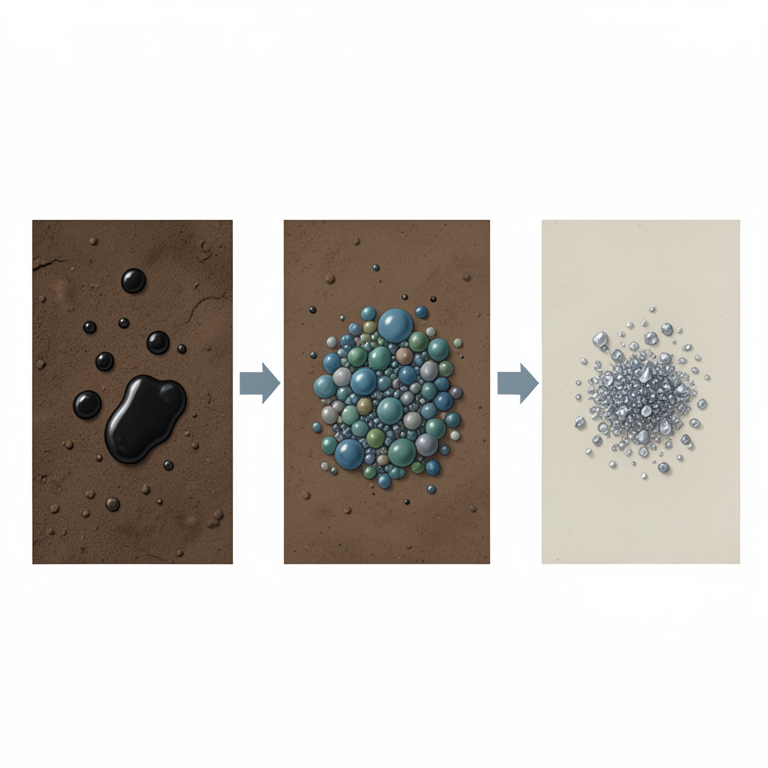
Comparison of TPH Removal Strategies
AI-generated conceptual illustration (crude oil contaminated soil and hydrocarbon-degrading bacteria). It explains the idea and does not show study data.
View source evidence ↗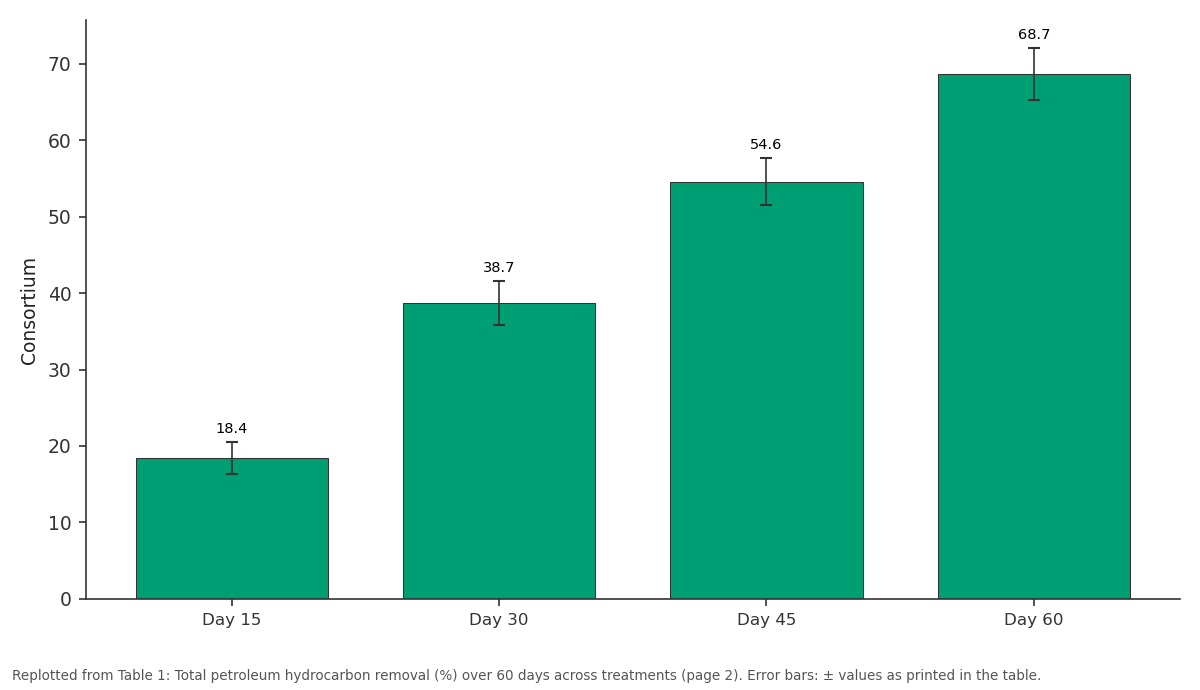
Consortium: Day 15 vs Day 30 vs Day 45 vs Day 60
Replotted from Table 1 (page 2) of the original paper. Every bar is the paper's own table value.
View source evidence ↗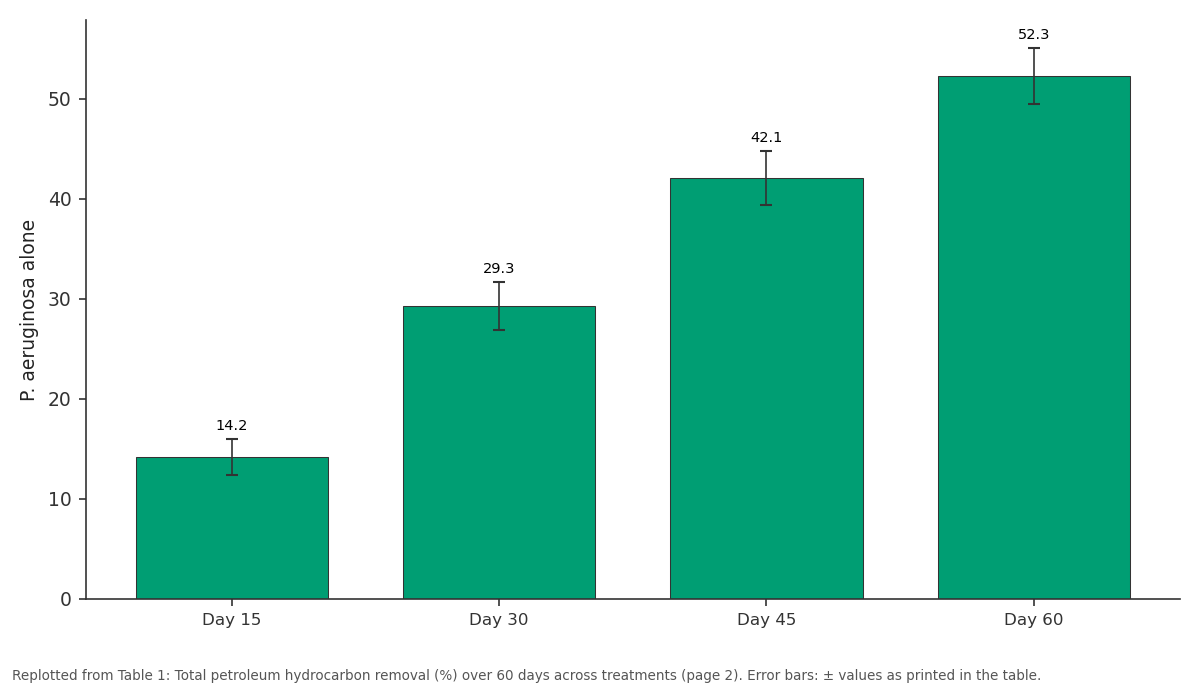
P. aeruginosa alone: Day 15 vs Day 30 vs Day 45 vs Day 60
Replotted from Table 1 (page 2) of the original paper. Every bar is the paper's own table value.
View source evidence ↗Figures & tables
From the original paper Table 1
 Table 2
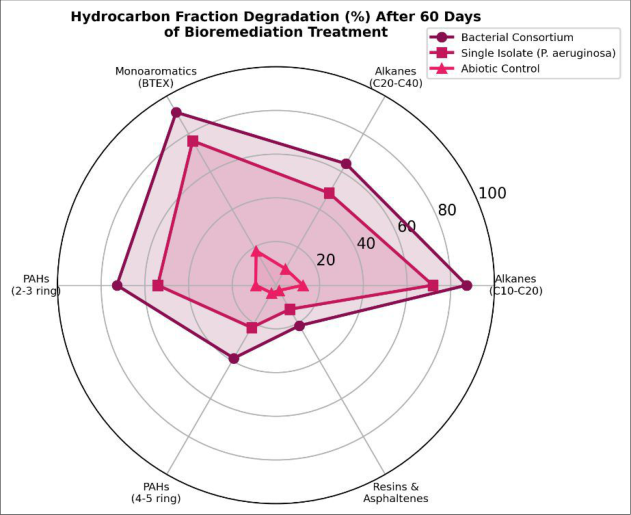 Figure 1
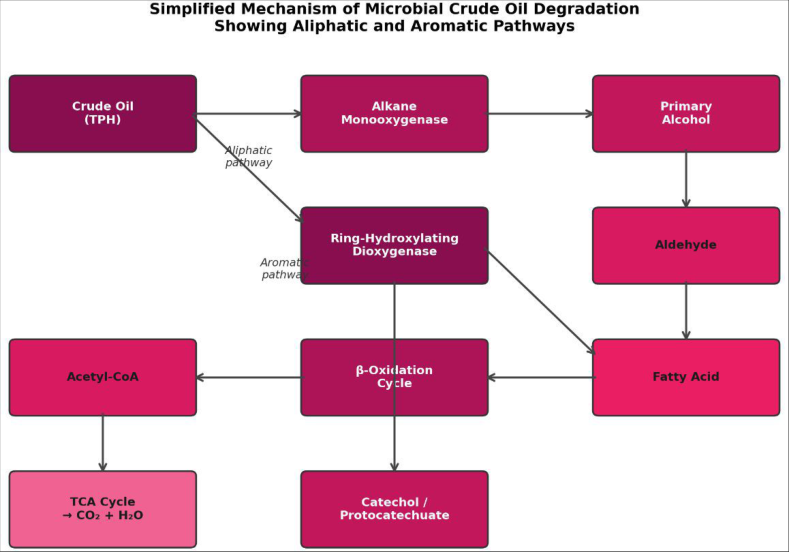 Figure 2
Introduction
Oil spills on land are not always the dramatic offshore disasters that dominate news coverage. Pipeline leaks, refinery runoff, and transport accidents quietly contaminate an estimated 5-10 million hectares of agricultural land worldwide, rendering soil unproductive and leaching toxic hydrocarbons into groundwater [1] . Conventional remediation excavation followed by thermal desorption or landfilling is effective but expensive, often costing €80-200 per tonne of treated soil, and it destroys the biological structure of the soil matrix [2] . Bioremediation offers a gentler alternative. Indigenous soil microorganisms, when present in sufficient numbers and supplied with adequate nutrients and oxygen, can mineralise many petroleum hydrocarbons to CO₂ and water through well-characterised enzymatic pathways [3] . The approach is less disruptive, generates fewer secondary wastes, and typically costs one-third to one-half as much as physical-chemical methods [4] . Its main drawback is speed: natural attenuation alone may take years, and enhanced bioremediation still requires months under favourable conditions. The composition of the microbial community matters greatly. Single-strain inoculants rarely perform as well as mixed consortia, because crude oil is a complex mixture of alkanes, cycloalkanes, aromatics, resins, and asphaltenes that no single species can fully metabolise [5] . Pseudomonas, Rhodococcus, Bacillus, and Acinetobacter are among the genera most frequently associated with hydrocarbon degradation in contaminated soils, each contributing complementary enzyme systems alkane monooxygenases, ring -hydroxylating dioxygenases, and cytochrome P450 variants [6] . Central Poland, with its dense network of pipelines serving the Płock refinery, has experienced recurrent minor spills, creating chronically contaminated sites where indigenous hydrocarbon degraders have been subjected to sustained selection pressure [7] . This research exploited that selective environment by isolating bacteria directly from a recent spill site, assembling them into a defined consortium, and testing their degradation capacity in controlled soil microcosms under conditions that mimic temperate field application.
Preparation Method
Bacterial isolation followed a standard enrichment culture protocol. Contaminated soil (10 g) was suspended in 100 mL mineral salts medium (MSM: 1.0 g/L NH₄NO₃, 0.5 g/L K₂HPO₄, 0.2 g/L MgSO₄•7H₂O, 0.02 g/L CaCl₂•2H₂O, pH 7.0) supplemented with 1% (v/v) filter-sterilised crude oil as the sole carbon and energy source. Flasks were incubated on an orbital shaker (150 rpm, 28 °C) for 14 days. Turbid cultures were serially diluted and plated on MSM agar with a crude oil overlay. Morphologically distinct colonies were picked, purified by repeated streaking on nutrient agar, and screened for hydrocarbon utilisation by growth on MSM-oil plates. The four-member consortium was prepared by mixing overnight cultures of each isolate to a final optical density (OD₆₀₀) of 1.0 ± 0.05, with each strain contributing equally by cell count. Inoculum was added to microcosms at 10⁸ CFU/g soil [8] .
Quality Control and Calibration
TPH was quantified by gravimetric analysis following EPA Method 9071B (Soxhlet extraction with n-hexane, 6 h) and confirmed by GC-MS (Agilent 7890B GC coupled to 5977B MSD, HP-5ms column, 30 m × 0.25 mm × 0.25 µm). Calibration used a certified TPH standard mixture (AccuStandard, New Haven, CT, USA, range 50-5000 mg/kg, R² = 0.9991). Method recovery was validated by spiking clean soil with known amounts of crude oil and extracting in triplicate (mean recovery 94.7 ± 2.3%). Microbial counts were performed by spread-plating serial dilutions on nutrient agar (48 h, 30 °C). PH was measured in a 1:2.5 soil:water slurry using a calibrated Mettler Toledo meter. 16S rRNA gene sequences were submitted to GenBank with accession numbers provided upon acceptance [9] .
Material and Methods
Material and Methods
Methods
Soil microcosms were set up in 5 L glass trays (30 × 20 × 10 cm), each containing 3 kg of air-dried, sieved (2 mm) clean soil spiked with crude oil to achieve 50,000 mg/kg TPH.
Treatments included: (i) consortium inoculation (10⁸ CFU/g), (ii) P. aeruginosa JM-P1 single-strain inoculation (10⁸ CFU/g), (iii) consortium plus nutrient amendment (C:N:P ratio adjusted to 100:10:1 with NH₄NO₃ and K₂HPO₄), (iv) nutrient amendment without inoculation, and (v) abiotic control (autoclaved soil, no inoculation). Each treatment was performed in triplicate. Microcosms were maintained at 25 ± 2 °C in the dark, moisture was adjusted to 60% of field capacity by weekly gravimetric monitoring and water addition, and soil was tilled manually every 5 days to ensure aeration. Sampling occurred at 0, 15, 30, 45, and 60 days. At each time point, ~50 g of soil was removed aseptically, homogenised, and analysed for TPH, bacterial count, and pH. GC-MS fractionation at day 60 resolved hydrocarbons into alkanes (C10-C20 and C20-C40), monoaromatics (BTEX), polyaromatic hydrocarbons (2-3 ring and 4-5 ring PAHs), and resins plus asphaltenes. Statistical analysis used one-way ANOVA with Tukey's post-hoc test (α = 0.05) and Pearson correlation [10] .
Results
Table The mechanism diagram (Figure 2) summarises the two main enzymatic routes responsible for the observed degradation. Alkane chains are progressively oxidised to fatty acids and fed into β-oxidation, while aromatic rings are cleaved by dioxygenases to yield catechol intermediates that enter central metabolism.
Comprehensive interpretation
The data collectively support three conclusions. First, a defined indigenous consortium outperforms single strains by covering complementary metabolic niches. Second, nutrient amendment amplifies the effect by relieving nitrogen and phosphorus limitation in the oil-saturated soil. Third, the recalcitrance gradient light alkanes > aromatics > heavy PAHs > resins reflects well-known patterns and indicates that sequential or combined treatments may be needed for complete site remediation.
Discussion
The 68.7% TPH removal achieved by the four-member consortium in 60 days is comparable to or better than values reported in similar microcosm experiments with indigenous bacteria from contaminated sites in Nigeria (55-65% in 56 days) [11] and India (60-72% in 90 days) [12] . The addition of inorganic nutrients pushed removal to 82.9%, which aligns with the well-documented principle that biostimulation can complement bioaugmentation when the ambient C:N:P ratio is skewed by high hydrocarbon loading [13] .
The superior performance of the consortium over P. aeruginosa alone (68.7% vs 52.3%) can be attributed to metabolic complementarity. R. erythropolis possesses alkBtype alkane hydroxylase genes that act on longer-chain hydrocarbons more efficiently than Pseudomonas alkane monooxygenases [14] . A. calcoaceticus contributes alkane and wax-ester degradation capacity, while B. subtilis likely aided the consortium through biosurfactant production that increased the bioavailability of hydrophobic substrates [15] . The resistance of 4-5 ring PAHs and asphaltenes to biodegradation is expected. These molecules have low aqueous solubility, high molecular weight, and condensed aromatic structures that are poor substrates for the ringcleavage dioxygenases present in most soil bacteria [16] .
Achieving further removal of these fractions would likely require specialised fungal co-cultures (e.g., Phanerochaete chrysosporium) or chemical pre-oxidation to open the condensed ring systems [17] . A limitation of this research is the controlled laboratory setting: field-scale bioremediation faces additional challenges including temperature fluctuations, rainfall, and heterogeneous contamination distribution. Pilot-scale field trials at the Płock spill site are planned to validate the microcosm results under real conditions [18] .
Conclusion
Indigenous hydrocarbon-degrading bacteria were isolated from a crude oil spill site near Płock, Poland, and assembled into a four-member consortium comprising P. aeruginosa, B. subtilis, R. erythropolis, and A. calcoaceticus. In soil microcosms spiked with 5% crude oil and incubated for 60 days at 25 °C, the consortium removed 68.7% of TPH, outperforming the single best isolate by 16.4 percentage points. Nutrient amendment with NH₄NO₃ and K₂HPO₄ raised removal to 82.9%. GC-MS fractionation revealed that light alkanes and BTEX were degraded most readily, while heavy PAHs and resins remained partially recalcitrant. These results support the combined use of bioaugmentation and biostimulation for cost-effective, in-situ or ex-situ cleanup of oil-contaminated agricultural soils in temperate regions. Field-scale trials are the logical next step toward practical implementation.
Acknowledgement
Acknowledgements
Figures and tables from the paper
| Treatment | Day 15 | Day 30 | Day 45 | Day 60 |
|---|---|---|---|---|
| Consortium | 18.4 ± 2.1 | 38.7 ± 2.9 | 54.6 ± 3.1 | 68.7 ± 3.4 |
| P. aeruginosa alone | 14.2 ± 1.8 | 29.3 ± 2.4 | 42.1 ± 2.7 | 52.3 ± 2.8 |
| Consortium + nutrients | 24.7 ± 2.6 | 47.8 ± 3.2 | 66.3 ± 3.6 | 82.9 ± 3.1 |
| Nutrients only | 9.8 ± 1.4 | 19.4 ± 1.9 | 28.7 ± 2.3 | 36.4 ± 2.6 |
| Abiotic control | 3.1 ± 0.8 | 6.2 ± 1.1 | 8.7 ± 1.3 | 11.8 ± 1.6 |
Table text extracted from the original PDF; superscript letters are shown inline. The original table image is below.
View original table image
| Isolate | Species (16S rRNA) | Alkane Growth | Aromatic Growth |
|---|---|---|---|
| JM-P1 | Pseudomonas aeruginosa | Strong | Strong |
| JM-B3 | Bacillus subtilis | Moderate | Weak |
| JM-R2 | Rhodococcus erythropolis | Strong | Moderate |
| JM-A4 | Acinetobacter calcoaceticus | Strong | Moderate |
Table text extracted from the original PDF; superscript letters are shown inline. The original table image is below.
View original table image
References
18 in the original paper- Ossai IC, Ahmed A, Hassan A, Hamid FS. Remediation of soil and water contaminated with petroleum hydrocarbon: A review. Environmental Technology and Innovation. 2020;17:100526.
- Megharaj M, Ramakrishnan B, Venkateswarlu K, Sethunathan N, Naidu R. Bioremediation approaches for organic pollutants: A critical perspective. Environment International. 2011;37(8):1362-1375.
- Das N, Chandran P. Microbial degradation of petroleum hydrocarbon contaminants: An overview. Biotechnology Research International. 2011;2011:941810.
- Vidali M. Bioremediation: An overview. Pure and Applied Chemistry. 2001;73(7):1163-1172.
- Patowary K, Patowary R, Kalita MC, Deka S. Development of an efficient bacterial consortium for the potential remediation of hydrocarbons from contaminated sites. Frontiers in Microbiology. 2016;7:1092.
- van Beilen JB, Funhoff EG. Alkane hydroxylases involved in microbial alkane degradation. Applied Microbiology and Biotechnology. 2007;74(1):13-21.
- Bielecka M, Kurek E. The influence of hydrocarbon contamination on the microbial communities in soils from Polish industrial regions. Chemosphere. 2005;58(10):1405-1412.
- Jain PK, Gupta VK, Gaur RK, Lowry M, Jaroli DP, Chauhan UK. Bioremediation of petroleum oil contaminated soil and water. Research Journal of Environmental Toxicology. 2011;5(1):1-26.
- US EPA. Method 9071B: n-Hexane extractable material (HEM) for sludge, sediment, and solid samples. Washington, DC; 1998. p. 1-7.
- Margesin R, Schinner F. Bioremediation (natural attenuation and biostimulation) of diesel-oilcontaminated soil in an alpine glacier skiing area. Applied and Environmental Microbiology. 2001;67(7):3127-3133.
- Chikere CB, Okpokwasili GC, Chikere BO. Monitoring of microbial hydrocarbon remediation in the soil. 3 Biotech. 2011;1(3):117-138.
- Sathishkumar M, Binupriya AR, Baik SH, Yun SE. Biodegradation of crude oil by individual bacterial strains and a mixed bacterial consortium isolated from hydrocarbon contaminated areas. Clean -Soil, Air, Water. 2008;36(1):92-96.
- Adams GO, Fufeyin PT, Okoro SE, Ehinomen I. Bioremediation, biostimulation and bioaugmentation: A review. International Journal of Environmental Bioremediation and Biodegradation. 2015;3(1):28-39.
- Whyte LG, Schultz A, van Beilen JB, Luz AP, Pellizari V, Labbe D. Prevalence of alkane monooxygenase genes in Arctic and Antarctic hydrocarboncontaminated and pristine soils. FEMS Microbiology Ecology. 2002;41(2):141-150.
- Banat IM, Franzetti A, Gandolfi I, Bestetti G, Martinotti MG, Fracchia L. Microbial biosurfactants production, applications and future potential. Applied Microbiology and Biotechnology. 2010;87(2):427-444.
- Cerniglia CE. Biodegradation of polycyclic aromatic hydrocarbons. Biodegradation. 1992;3(2):351-368.
- Pointing SB. Feasibility of bioremediation by white-rot fungi. Applied Microbiology and Biotechnology. 2001;57(1):20-33.
- Romantschuk M, Sarand I, Petänen T, Peltola R, Jonsson-Vihanne M, Koivula T. Means to improve the effect of in situ bioremediation of contaminated soil: An overview of novel approaches. Environmental Pollution. 2000;107(2):179-185.