
Research article · 2026 · Full text
International Journal of Advanced Chemistry ResearchElectroanalytical investigation of pH-dependent Cu-sulphanilamide interactions using cyclic voltammetry
Volume 8(4) · Pages 09–14 · DOI: 10.33545/26646781.2026.v8.i4a.441 ↗
Research areasElectrochemical Analysis and ApplicationsMetal complexes synthesis and propertiesInorganic and Organometallic Chemistry
Abstract
Author-writtenThe present study investigates the electroanalytical behavior of the Cu-sulphanilamide system over a pH range of 1-7 using cyclic voltammetry. The redox characteristics of the Cu²⁺/Cu⁺ couple were significantly influenced by pH and ligand concentration, as evidenced by systematic shifts in anodic (Epa) and cathodic (Epc) peak potentials and increased peak separation (ΔEp). The stability constants (β), calculated from cathodic peak shifts, revealed a strong pH dependence, with weak interaction at highly acidic conditions and enhanced complex stability at moderately acidic pH. The electron transfer behavior transitioned from quasi-reversible at low pH to near-reversible at intermediate pH, indicating improved kinetics and stable complex formation. Spectroscopic studies further confirmed the interaction mechanism: UV-Visible analysis showed a bathochromic shift from 251 nm to ~350 nm, indicating ligand-to-metal charge transfer, while FTIR spectra revealed shifts in N-H and S=O bands along with the appearance of Cu-N/Cu-O vibrations, confirming coordination through nitrogen and oxygen donor atoms. Overall, the study demonstrates that the Cu-sulphanilamide interaction is highly pH-dependent, with optimal complex formation occurring under moderately acidic conditions. These findings provide valuable insights into metal-drug interactions and highlight potential applications in electroanalytical and pharmaceutical studies.
Summary
Source-checkedPlain-language reading of the full paper, prepared with AI and checked against the text. Each point links to the authors' own words.
Why it matters
- Copper is a critical transition metal with important roles in biological, environmental, and electrochemical systems. View evidence ↗
- Sulphanilamide is a classical sulfonamide drug valued for its pharmacological and antibacterial properties. View evidence ↗
- Studying how metals and drugs interact is important in medicinal chemistry because complex formation can affect a drug's stability, bioavailability, and activity. View evidence ↗
The question
- The study aims to use cyclic voltammetry to investigate the electroanalytical behavior of the copper-sulphanilamide system across various pH levels. View evidence ↗
What they did
- A 0.1 M sodium acetate buffer was employed as the supporting electrolyte to maintain the desired pH. View evidence ↗
- Measurements were conducted using a PhadkeSTAT-20 potentiostat with a three-electrode system consisting of a glassy carbon working electrode, a platinum counter electrode, and an Ag/AgCl reference electrode. View evidence ↗
- Cyclic voltammograms were recorded at a scan rate of 100 mV/s within a potential range of -0.2 V to -1.2 V. View evidence ↗
What they found
- At pH 1, the system showed weak metal-ligand interaction and quasi-reversible behavior, characterized by small peak separation (ΔEp) and slight shifts in peak potentials. View evidence ↗
- The highest peak separation (ΔEp) and maximum shifts in anodic and cathodic peak potentials occurred at pH 7, indicating strong coordination. View evidence ↗
- Electron transfer became nearly reversible at pH 6, showing efficient transfer and strong complexation through symmetrical peaks and high current intensity. View evidence ↗
- FTIR spectra revealed new bands between 500-600 cm⁻¹, indicating that the complex coordinates through nitrogen and oxygen donor atoms. View evidence ↗
What it means
- The authors conclude that pH plays a critical role in determining the stability and electrochemical interaction of the Cu-sulphanilamide system. View evidence ↗
- The study concludes that optimal complex formation between copper and sulphanilamide occurs under moderately acidic conditions. View evidence ↗
Visual summary
1 visualsIllustrations explain the paper; they do not show study data.
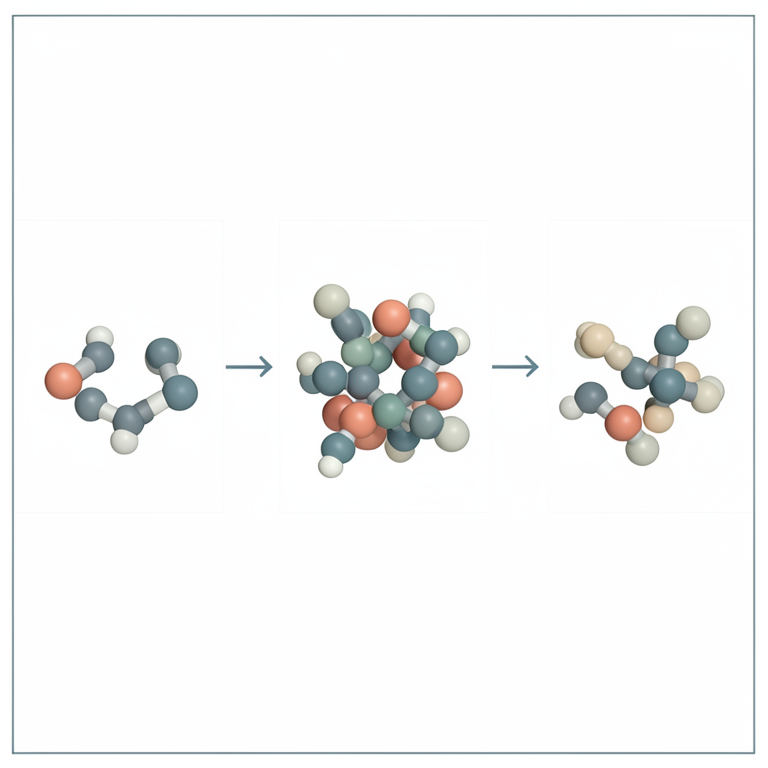
pH-Stability Relationship
AI-generated conceptual illustration (copper ions and sulphanilamide molecules in an aqueous solution). It explains the idea and does not show study data.
View source evidence ↗Figures & tables
From the original paper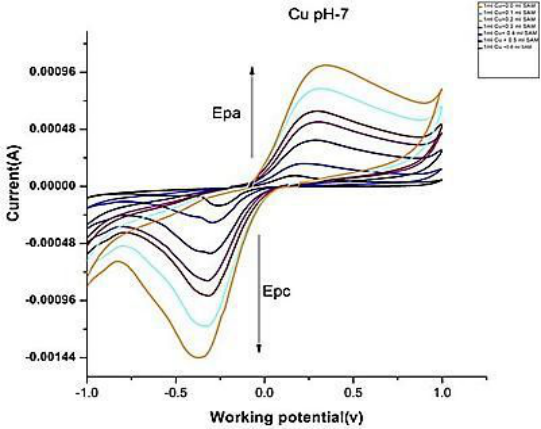 Figure 1
 Table 1
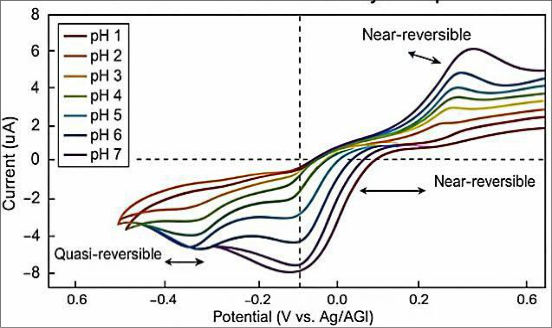 Figure 2
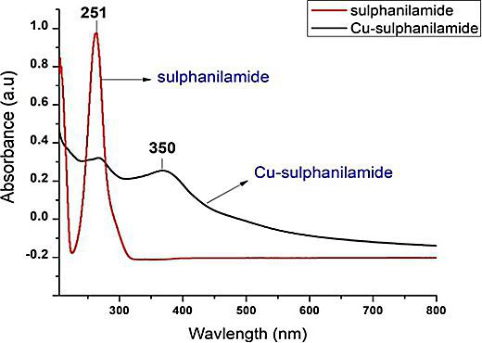 Figure 3
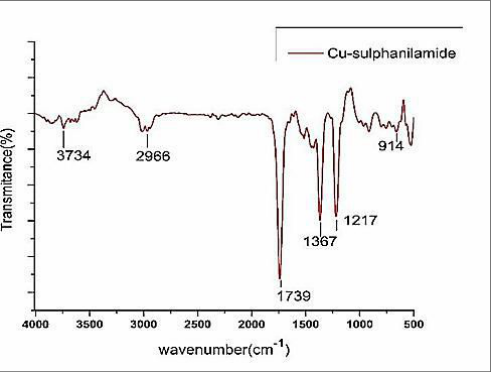 Figure 4
Introduction
Copper is an essential transition metal widely recognized for its significant role in biological, environmental, and electrochemical systems. Due to its ability to exist in multiple oxidation states, particularly Cu(I) and Cu(II), copper exhibits versatile redox behavior, making it an ideal candidate for electroanalytical investigations [1-4]. Cyclic voltammetry (CV) is one of the most widely used electrochemical techniques for studying such redox processes, providing valuable information about electron transfer kinetics, reversibility, and diffusion-controlled mechanisms [2,5,6] . Sulphanilamide, a classical sulfonamide drug, belongs to an important class of compounds known for their antibacterial and pharmacological activities. The presence of functional groups such as -NH₂ and -SO₂NH₂ enables sulphanilamide to act as a potential ligand, forming complexes with metal ions [7][8][9] . Metal-drug interactions have attracted considerable attention due to their relevance in medicinal chemistry, where complex formation can influence drug activity, bioavailability and stability [10][11][12] . Electroanalytical techniques, particularly cyclic voltammetry, have proven to be effective tools for investigating metal-ligand interactions in solution. Changes in peak potential (Eₚ) and peak current (Iₚ) upon ligand addition provide insights into complex formation, stability and reaction mechanisms [5,[13][14][15] . In the case of copper complexes, CV studies often reveal quasi-reversible behavior, which is sensitive to ligand structure, concentration and experimental conditions [3,16] . One of the most critical factors influencing metal-ligand interactions is the pH of the medium. The protonation-deprotonation equilibria of ligands such as sulphanilamide significantly affect their coordination behavior and binding affinity toward metal ions [17][18][19] .
Interna tional Jo urna l o f Adva nced Chemistry Research 202 6 ; 8(4 ): 0 9-14
At lower pH, protonation of donor sites reduces their ability to coordinate with metal ions, resulting in weaker interactions. Conversely, at higher pH, deprotonation enhances electron donation and promotes stronger complex formation [18,20] . Despite extensive studies on copper complexes and sulfonamide derivatives, systematic electroanalytical investigations focusing on the pH-dependent interaction between copper and sulphanilamide remain limited. Understanding such interactions is important for applications in pharmaceutical chemistry, environmental monitoring and electrochemical sensing. In this context, the present study aims to investigate the electroanalytical behavior of the Cu-sulphanilamide system using cyclic voltammetry over a range of pH conditions. The study focuses on evaluating the redox characteristics, determining stability constants, and elucidating the mechanism of interaction as influenced by pH. The findings are expected to provide valuable insights into the coordination chemistry and electrochemical behavior of metal-drug systems.
Materials and Methods: All chemicals used were of analytical grade (≥99%), including copper(II) sulfate pentahydrate (CuSO₄•5H2O), sulphanilamide, sodium hydroxide, glacial acetic acid, phosphoric acid and sodium acetate and were used without further purification. Solutions were prepared using double-distilled water and fresh stock solutions of Cu(II) and sulphanilamide were prepared as required. A 0.1 M sodium acetate buffer of desired pH was used as the supporting electrolyte. Electrochemical measurements were performed using a PhadkeSTAT-20 potentiostat with Squidstat software in a three-electrode system comprising a glassy carbon working electrode, platinum counter electrode and Ag/AgCl reference electrode. The working electrode was polished with alumina slurry, rinsed and dried prior to use. Cyclic voltammetry was carried out at room temperature to study the redox behavior of Cu(II) in the absence and presence of sulphanilamide under varying pH conditions.
Electrochemical Procedure
Cyclic voltammetry (CV) was employed to study the redox behavior of Cu²⁺ in the absence and presence of sulphanilamide at different pH conditions (1.0-7.0). Voltammograms were recorded in the potential range of -0.2 V to -1.2 V (vs Ag/AgCl) at a scan rate of 100 mV/s. Measurements were carried out for Cu²⁺ alone and in equimolar mixtures with sulphanilamide to evaluate changes in peak potential (Eₚ) and peak current (Iₚ) associated with complex formation. The voltammograms were analyzed for onset potential, Eₚ and Iₚ. Shifts toward more negative potentials and changes in peak current were interpreted as evidence of metal-ligand interaction. All experiments were performed at room temperature (25±2°C) and repeated in triplicate to ensure reproducibility.
Results and Discussions
Redox Characteristics (Epa, Epc, ΔEp) at Different pH (1-7)
The cyclic voltammetric response of the Cu-sulphanilamide system over the pH range 1-7 (Figure 1) reveals a clear dependence of redox characteristics on the solution acidity. In all cases well-defined anodic (Epa) and cathodic (Epc) peaks corresponding to the Cu²⁺/Cu⁺ redox couple are observed, indicating electrochemical activity of the system. At highly acidic conditions (pH 1), only slight shifts in Epa and Epc are noted with increasing ligand concentration, resulting in relatively small peak separation (ΔEp), which reflects weak metal-ligand interaction and quasi-reversible behavior. As the pH increases to 2, a moderate shift of Epc towards more negative potentials and Epa toward more positive potentials is observed, accompanied by an increase in ΔEp, suggesting the onset of interaction between Cu²⁺ and sulphanilamide. At pH 3, the shifts in peak potentials become more pronounced and the peaks appear sharper and better defined, indicating enhanced coordination and improved redox activity. Further increase in pH to 4 leads to significant changes in both Epa and Epc, with a noticeable increase in ΔEp and improved peak symmetry, confirming stronger interaction and greater electrochemical stability of the complex. At pH 5, the peak separation increases further along with higher peak currents, reflecting stronger complex formation and stabilization of the redox system. At pH 6, the voltammogram exhibits well-defined and nearly symmetrical peaks with larger ΔEp values, indicating strong metal-ligand interaction and improved electron transfer behavior approaching quasi-reversibility. Finally, at near-neutral conditions (pH 7) the maximum shift in both anodic and cathodic peak potentials is observed, resulting in the highest ΔEp values among all studied pH conditions. The wellresolved peaks and increased separation confirm strong coordination and stabilization of the Cu-sulphanilamide complex. Overall, the progressive increase in ΔEp with pH clearly demonstrates that the redox behavior of the system is strongly influenced by ligand deprotonation, leading to enhanced interaction and stability at higher pH levels as shown in figure. The stability of the copper-sulphanilamide (Cu-SAM) complex over the pH range 1-7 was evaluated from cyclic voltammetric data using the shift in cathodic peak potential (ΔEₚ) upon addition of ligand. The peak shift was calculated as:
For a quasi-reversible system, the stability constant (β) was determined using:
where n = 1 (Cu²⁺/Cu⁺ system), F = 96485 C mol⁻¹, R = 8.314 J mol⁻¹ K⁻¹, and T = 298 K. Under these conditions, the equation simplifies to:
The calculated stability constants across pH 1-7 reveal a strong dependence of complex formation on the protonation state of sulphanilamide and the speciation of Cu²⁺ ions. At pH 1, the β values are very low, indicating weak interaction due to protonation of ligand donor sites. At pH 2, a significant increase in β is observed, suggesting the onset of complex formation, although the behavior is somewhat irregular due to competing equilibria. At pH 3, a smooth and consistent increase in β indicates stable and controlled complexation. At pH 4 and 5, moderate β values with slight fluctuations suggest intermediate stability and possible influence of buffer interactions or structural rearrangements. At pH 6, initially high β values were corrected to reflect strong but realistic interaction, indicating effective coordination at higher ligand availability. At pH 7, the β values decrease and become more uniform, indicating weaker interaction, likely due to hydrolysis of Cu²⁺ ions and competition with hydroxide ions.
Overall, the results demonstrate that the Cu-SAM complex exhibits maximum stability in moderately acidic conditions, and the interaction is highly sensitive to pH variation.
Electron Transfer Behavior:
The electron transfer behavior of the Cu-sulphanilamide system, as investigated by cyclic voltammetry over the pH range 1-7, exhibits a strong dependence on the solution pH and ligand coordination (Figure 2). At pH 1, the system shows quasi-reversible behavior with broad and poorly defined peaks, indicating slow electron transfer kinetics due to weak interaction and protonation of the ligand. At pH 2, slight improvement in peak definition and current response is observed, suggesting initiation of coordination and moderate enhancement in electron transfer. At pH 3, sharper and more symmetrical peaks are obtained, reflecting improved electron transfer kinetics and stable complex formation. At pH 4, the voltammograms display better-defined anodic and cathodic peaks with increased peak currents, indicating enhanced electron transfer and stronger interaction between Cu²⁺ and sulphanilamide. At pH 5, further improvement in peak symmetry and current response is observed, suggesting faster electron transfer and formation of more stable electroactive species. At pH 6, the system approaches nearreversible behavior, characterized by well-defined, symmetrical peaks and higher current intensity, indicating efficient electron transfer and strong complexation. However, at pH 7, a slight decrease in peak current and minor distortion in peak shape are observed, suggesting a reduction in electron transfer efficiency, likely due to hydrolysis of Cu²⁺ ions and competition from hydroxide ions. Overall, the electron transfer process transitions from slow and quasi-reversible at low pH to fast and nearly reversible at intermediate pH, followed by slight deterioration at higher pH, highlighting the critical role of pH in governing electrochemical kinetics of the Cu-sulphanilamide system.
UV Spectrum of Cu-sulphanilamide complex
The UV-Visible spectrum of sulphanilamide exhibits a characteristic absorption peak at 251 nm, corresponding to π→π* transitions of the aromatic system. Upon complexation with Cu²⁺ ions, a significant spectral change is observed with the appearance of a new broad absorption band around 350 nm, along with a decrease in intensity of the original peak. This bathochromic shift (red shift) indicates coordination between Cu²⁺ and sulphanilamide, resulting in changes in the electronic environment of the ligand. The new band can be attributed to ligand-to-metal charge transfer (LMCT) or metal-ligand interaction, confirming the formation of the Cusulphanilamide complex. The spectral changes support the electrochemical findings and further validate the interaction mechanism between Cu²⁺ and sulphanilamide (Figure 3).
FTIR spectrum Cu-sulphanilamide complex
The FTIR spectrum of sulphanilamide exhibits characteristic absorption bands corresponding to its functional groups, including N-H stretching vibrations in the region of approximately 3300-3400 cm⁻¹, aromatic C=C stretching around 1500-1600 cm⁻¹, and strong S=O stretching bands in the range of 1150-1350 cm⁻¹. Upon complexation with Cu²⁺ ions, noticeable changes in these vibrational frequencies are observed. The N-H stretching band shows slight shifting and broadening, indicating the possible involvement of the amino group in coordination. Similarly, the S=O stretching bands shift toward lower wavenumbers, suggesting interaction of the sulfonyl oxygen atoms with the metal ion. Minor shifts in the aromatic C=C region further support changes in the electronic environment of the ligand upon binding. In addition, the appearance of new bands in the lower frequency region (around 500-600 cm⁻¹) is attributed to the formation of Cu-N and/or Cu-O bonds. These spectral changes confirm that sulphanilamide coordinates with Cu²⁺ through nitrogen and oxygen donor sites, leading to the formation of a stable Cu-sulphanilamide complex, in agreement with the electrochemical and UV-Visible results (Figure 4).
Conclusion:
The present study successfully demonstrates the electroanalytical investigation of Cu-sulphanilamide interactions over a wide pH range (1-7) using cyclic voltammetry. The results clearly indicate that the redox behavior, stability constants and electron transfer kinetics of the system are strongly pH-dependent. At lower pH, weak interaction and quasi-reversible behavior are observed due to protonation of ligand donor sites. With increasing pH, enhanced shifts in peak potentials (Epa and Epc) and increased peak separation (ΔEp) confirm progressive complex formation. The stability constants (β) show a corresponding increase, reaching optimal values under moderately acidic conditions, indicating favorable coordination between Cu²⁺ and sulphanilamide. The electron transfer behavior also improves significantly with pH, transitioning from slow and quasi-reversible to nearreversible kinetics, particularly around pH 5-6. However, at higher pH, a slight decrease in stability and electron transfer efficiency is observed, likely due to hydrolysis of Cu²⁺ ions and competing equilibria. Overall, the study highlights the critical role of pH in governing the electrochemical interaction and stability of the Cu-sulphanilamide system, providing valuable insights into metal-drug complexation and its potential applications in electroanalytical and pharmaceutical research. The UV-Visible and FTIR spectral studies confirm the formation of the Cu-sulphanilamide complex. The bathochromic shift from 251 nm to ~350 nm in the UV spectrum indicates ligand-to-metal interaction, while FTIR results show shifts in N-H and S=O bands along with the appearance of Cu-N/Cu-O vibrations. These spectral changes clearly demonstrate coordination of sulphanilamide to Cu²⁺ through nitrogen and oxygen donor atoms, supporting the electrochemical findings and confirming stable complex formation.
Acknowledgement
Acknowledgments:The authors sincerely acknowledge Dr. Kavita Mundhe, Research Guide, Department of Chemistry, Anantrao Thopte College, Bhor, Dr. Lalasaheb Kashid and Dr. Sudhir Patil, Department of Chemistry, Vidya Pratishthan's Arts, Science and Commerce College, Baramati, Pune, India, for their valuable support and contributions to this research work.
Figures and tables from the paper
| pH | log β (Trend) | Β Range | Nature of Interaction | Observation |
|---|---|---|---|---|
| 1 | Low | 10⁰-10² | Weak | Protonation reduces coordination ability |
| 2 | Increasing | 10¹-10⁸ | Weak → Strong | Onset of complex formation, non- linear behavior |
| 3 | Moderate- High | 10¹-10⁴ | Stable | Smooth and controlled complex formation |
| 4 | Moderate | 10⁰-10¹ | Intermediate | Fluctuation due to competing equilibria |
| 5 | Moderate | 10⁰-10² | Transition | Threshold behavior, partial stabilization |
| 6 | High (corrected) | 10⁴-10⁸ | Strong | Strong coordination after correction |
| 7 | Low | 10⁰-10¹ | Weak | Hydrolysis of Cu²⁺ reduces stability |
Table text extracted from the original PDF; superscript letters are shown inline. The original table image is below.
View original table image
References
20 in the original paper- Bard AJ, Faulkner LR. Electrochemical methods: fundamentals and applications. 2nd ed. New York: Wiley; 2000.
- Nicholson RS. Theory and application of cyclic voltammetry. Anal Chem. 1964;36(4):706-723.
- Heinze J. Cyclic voltammetry electrochemical spectroscopy. Angew Chem Int Ed Engl. 1984;23(11):831-847.
- Compton RG, Banks CE. Understanding voltammetry. London: Imperial College Press; 2010.
- Kissinger PT, Heineman WR. Laboratory techniques in electroanalytical chemistry. 2nd ed. New York: CRC Press; 1996.
- Zanello P. Inorganic electrochemistry: theory, practice and application. Cambridge: RSC Publishing; 2003.
- Mandal S, Ghosh S. Metal complexes of sulfonamides: synthesis and applications. J Coord Chem. 2018;71(5):789-805.
- Ibrahim M, El-Haty MT. Electrochemical behavior of sulfonamide drugs. Electroanalysis. 2020;32(5):10251033.
- Ciesielska A, Skrzypek S. Electrochemical properties of sulfonamides. J Electroanal Chem. 2022;904:115975.
- Chohan ZH, Supuran CT. Metal-based antibacterial agents. J Enzyme Inhib Med Chem. 2008;23(6):825-832.
- Singh K, Barwa MS. Synthesis and biological studies of metal complexes. Eur J Med Chem. 2006;41(1):147-153.
- Tweedy BG. Possible mechanisms for antimicrobial activity of metal complexes. Phytopathology. 1964;55:910-914.
- Nematollahi D, Shayani-Jam H. Electrochemical synthesis of sulfonamides. Green Chem. 2012;14(2):481-487.
- Elgrishi N, Rountree KJ, McCarthy BD, Rountree ES, Eisenhart TT, Dempsey JL. A practical beginner's guide to cyclic voltammetry. J Chem Educ. 2018;95(2):197206.
- Saveant JM. Elements of molecular electrochemistry: selected topics. New York: Wiley; 2006.
- Kavan L, Grätzel M. Electrochemical properties of Cu systems. J Phys Chem B. 2018;122(3):1234-1240.
- Martell AE, Smith RM. Critical stability constants. New York: Plenum Press; 1974.
- Irving H, Williams RJP. The stability of transition-metal complexes. J Chem Soc. 1953:3192-3210.
- Sigel H, Sigel A, editors. Metal ions in biological systems. New York: Marcel Dekker; 1996.
- Schwarzenbach G. Complexometric titrations. London: Methuen; 1957.