
Research article · 2026 · Full text
International Journal of Advanced Chemistry ResearchElectro-analytical discrimination of Pb²⁺, Cu²⁺, and Cd²⁺ based on their interaction with L-Cysteine in acetate buffer
Volume 8(4) · Pages 01–06 · DOI: 10.33545/26646781.2026.v8.i4a.439 ↗
Research areasElectrochemical Analysis and ApplicationsElectrochemical sensors and biosensorsMolecular Sensors and Ion Detection
Abstract
Author-writtenThe research involves the study of the electrochemical reactions between Pb²⁺, Cu²⁺, and Cd²⁺ and L-cysteine in sodium acetate buffer of varying pH (1-6) by cyclic voltammetry (CV). The research work is to find out the relative affinity and the order of binding of the metal ions that are harmful to the environment to the thiol functional group of cysteine and to correlate voltammetric features with complex formation. The CV responses manifested that the peak potential and current intensity distinctly shifted after the addition of each metal ion, which indicated the differences in the stability of the complex and its electrochemical behavior. Pb²⁺ has demonstrated the most powerful effect, lead to suppression of the cysteine redox signals and new irreversible features, followed by Cu²⁺ with slight changes, and Cd²⁺ with the least changes. The priority sequence that has been determined from the peak potential shifts and the current changes is Pb²⁺ > Cu²⁺ > Cd²⁺ which agrees with soft-soft interactions between metal ions and thiolate ligands. These results extend the metal-thiol chemistry knowledge under acid to almost neutral conditions and are a great help in the selective electrochemical sensor designing for heavy metal detection.
Summary
Source-checkedPlain-language reading of the full paper, prepared with AI and checked against the text. Each point links to the authors' own words.
Why it matters
- Lead, copper, and cadmium are among the most dangerous environmental heavy metals due to their ability to bioaccumulate and cause severe toxic effects. View evidence ↗
- Cyclic voltammetry (CV) is a preferred electrochemical method for detecting these metals because it is low-cost, sensitive, and provides fast responses suitable for field use. View evidence ↗
- L-cysteine can coordinate strongly with metal ions through its thiol, amine, and carboxyl functional groups. View evidence ↗
The question
- The study aims to use cyclic voltammetry to determine the electrochemical binding priority of Pb²⁺, Cu²⁺, and Cd²⁺ to L-cysteine in sodium acetate buffer across a pH range of 1 to 6. View evidence ↗
What they did
- The researchers used analytical grade reagents (≥99% purity) including lead nitrate, copper (II) sulfate dihydrate, cadmium nitrate tetrahydrate, and L-cysteine. View evidence ↗
- The electrochemical setup consisted of a glassy carbon working electrode, a platinum wire counter electrode, and an Ag/AgCl reference electrode. View evidence ↗
- Voltammograms were recorded at scan rates of 100 mV/s within a potential range typically between -0.2 V and -1.2 V vs Ag/AgCl. View evidence ↗
- The interaction between metals and cysteine was tested across pH levels from 1.0 to 6.0 to evaluate the effects of protonation and deprotonation. View evidence ↗
What they found
- At pH 3, the binding priority shifts to Cu²⁺ > Pb²⁺ > Cd²⁺. View evidence ↗
- Copper (II) demonstrated the strongest binding among the three metals, evidenced by the complete disappearance of its redox peaks. View evidence ↗
What it means
- The authors conclude that the general stability order of the metal-cysteine complexes is Cu(II) > Pb(II) > Cd(II). View evidence ↗
- The findings contribute to the understanding of metal-thiol chemistry in acidic to neutral conditions and can assist in designing selective electrochemical sensors for heavy metals. View evidence ↗
Visual summary
1 visualsIllustrations explain the paper; they do not show study data.
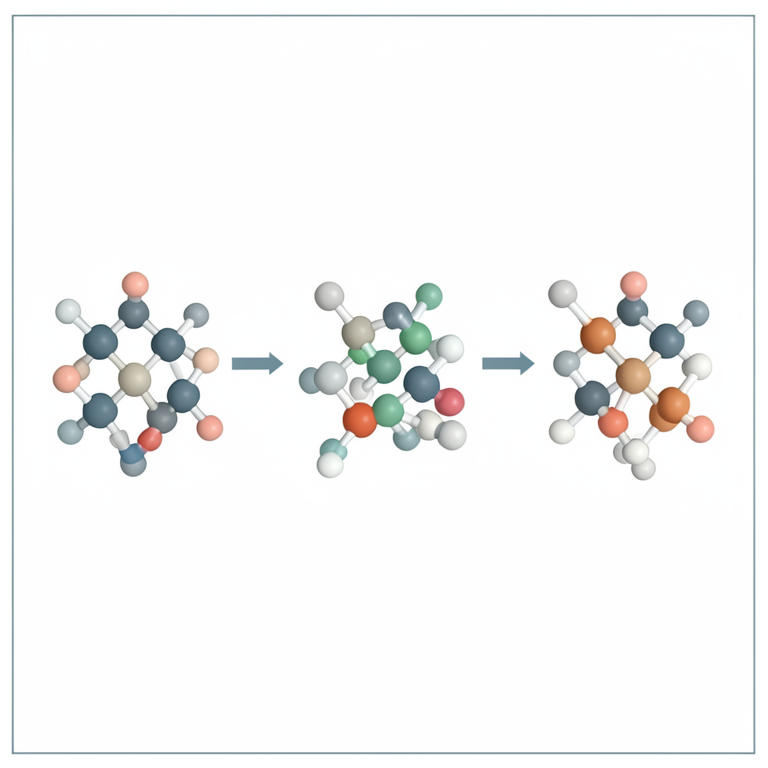
pH-Dependent Binding Priority Shift
AI-generated conceptual illustration (L-cysteine molecules and metal ions (lead, copper, and cadmium) in an acetate buffer solution). It explains the idea and does not show study data.
View source evidence ↗Figures & tables
From the original paper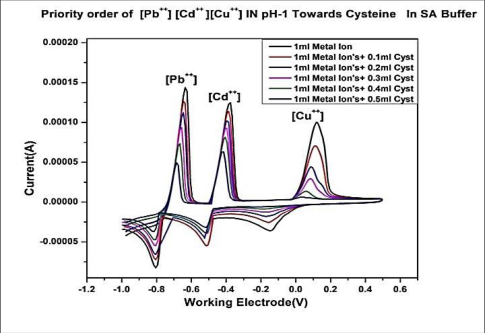 Figure 1
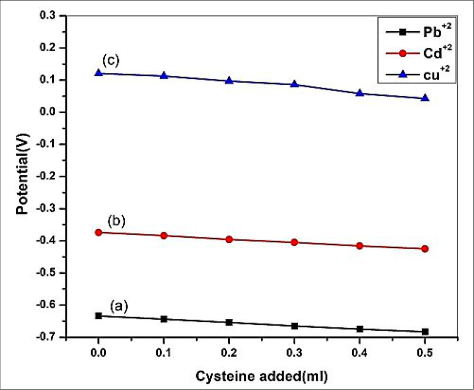 Figure 1
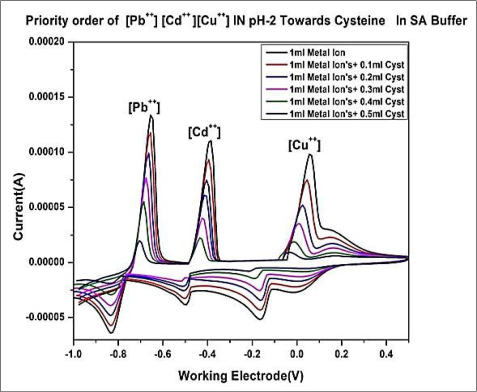 Figure 2
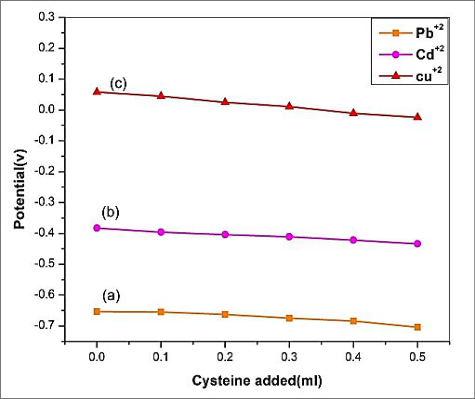 Figure 2
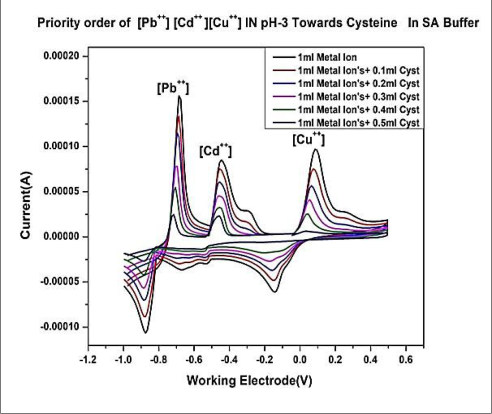 Figure 3
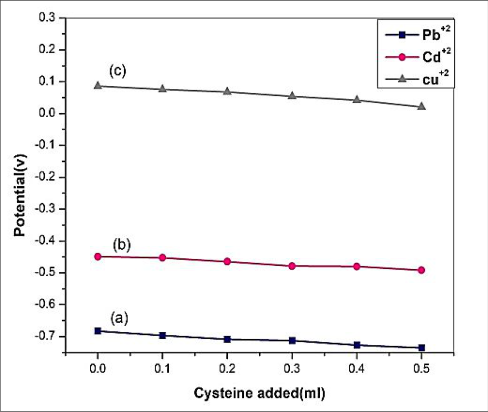 Figure 3
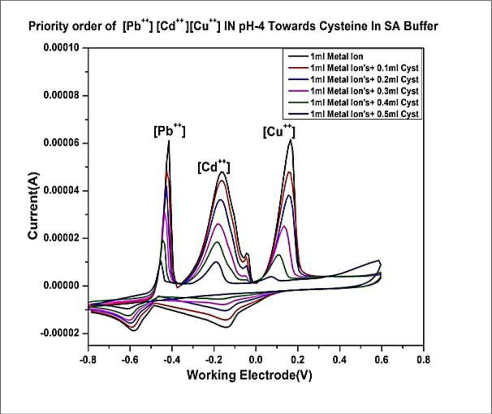 Figure 4
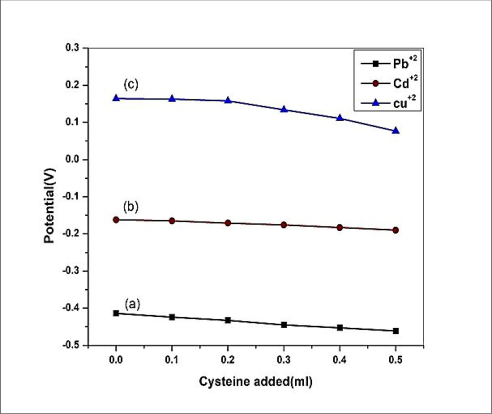 Figure 4
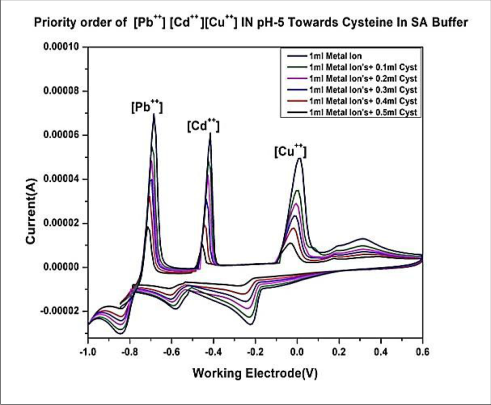 Figure 5
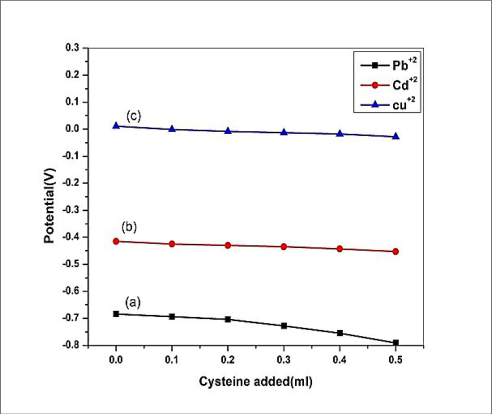 Figure 5
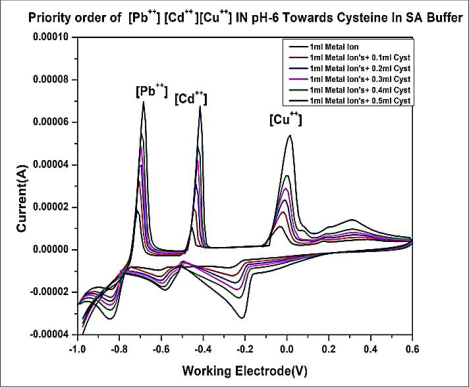 Figure 6
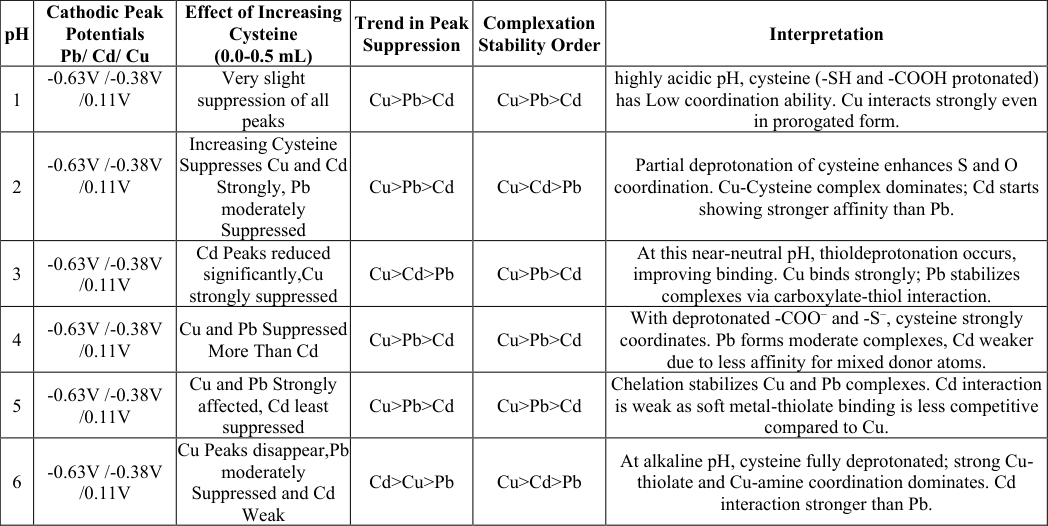 Table 1
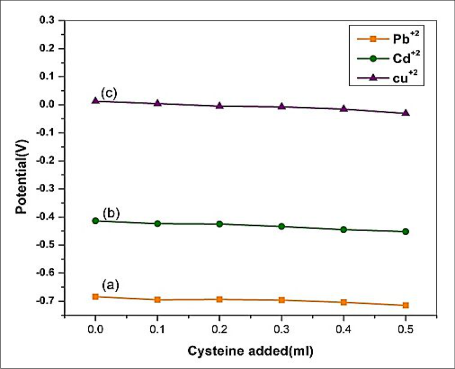 Figure 6
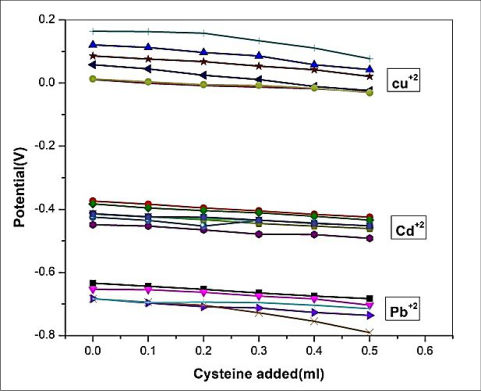 Figure 7
Introduction
Heavy metal contamination has been put on a critical list of environmental and public health problems due to rapid industrialization, mining activities, agricultural runoff, and improper waste disposal. Among toxic heavy metals, lead (Pb²⁺), copper (Cu²⁺), and cadmium (Cd²⁺) are the most dangerous for the environment because of their persistence, bioaccumulation, and the severe toxicological effects they cause. Lead exposure causes neurological and developmental disorders; cadmium is a carcinogen that affects the kidneys and bones, while excess copper leads to oxidative stress and cell death. So, the correct detection and identification of these metal ions at trace levels are vital for environmental monitoring and human health protection [1][2][3] . Typical analytical methods like atomic absorption spectroscopy (AAS), inductively coupled plasma mass spectrometry (ICP-MS), and X-ray fluorescence are very sensitive but need expensive equipment, skilled operators, and complicated sample preparation. On the other hand, electrochemical methods, especially cyclic voltammetry (CV), have the advantages of fast response, high sensitivity, and low cost, and they are also suitable for field analysis. CV allows differentiation of several metal ions based on their characteristic redox potentials and electron transfer rates, thus making it a powerful tool for the simultaneous detection of Pb²⁺, Cu²⁺, and Cd²⁺ in aqueous systems [4][5][6] .
L-cysteine is an amino acid containing sulfur and having thiol (-SH), amine (-NH₂), and carboxyl (-COOH) functional groups that enable strong coordination with metal ions. The thiol group is the main one when binding metals as it has the highest affinity toward soft and borderline metal ions. According to the Hard-Soft Acid-Base (HSAB) principle, metals like Pb²⁺ and Cu²⁺ bind usually with sulfur donors thus the metal-thiolate complexes formed are stable ones. These interactions have a great influence on metals' electrochemical behavior by means of shifting their redox potentials and changing their current responses in cyclic voltammetry [7][8][9] . In electrochemical experiments, L-cysteine is not only a complexing ligand but also a surface-active molecule that facilitates metal ion adsorption on electrode surfaces. The creation of metalcysteine complexes is usually accompanied by peak potential shifts, current intensity changes, or new redox peaks in CV, which helps in determining the interaction strength between the metal and the ligand. Because of these features, cysteine has been extensively used in electrochemical sensor applications as well as in mechanistic studies focusing on metal-thiol chemistry [10][11][12] . The choice of the supporting electrolyte and pH plays a crucial role in electrochemical experiments. Typically, sodium acetate buffer is a medium of preference in heavy metal analysis that provides a stable acidic environment of a controllable pH (mostly pH 1-6) and sufficient ionic strength for reproducible voltammetric measurements.Acetate buffer lessens the problem of the interfering reactions and keeps the electrochemical conditions the same which makes it especially good for cyclic voltammetry studies of metal ions [13][14][15] . In acidic acetate buffer, the protonation of cysteine is regulated, thus coordination is directly affected. Even if the amino and carboxyl groups might be protonated at low pH, the thiol group can still form strong complexes with heavy metal ions. Thus the metal-cysteine complex can be stable over a wide pH range, allowing pH-dependent electrochemical behavior and complex stability to be systematically studied [16][17] . While many research works individually talk about the interaction of Pb²⁺, Cu²⁺, and Cd²⁺ with sulfur-containing ligands, very few comparative studies have been done to identify the relative binding priority of Lcysteine in acetate buffer. Priority such as this can be evaluated with cyclic voltammetry by looking at the metalcysteine complexation-related peak potential changes, current changes, reversibility, and adsorption effects [18][19] . The main goal of this work is to determine the priority order of Pb²⁺, Cu²⁺, and Cd²⁺ electrochemically toward L-cysteine in sodium acetate buffer over the pH range 1-6 by means of cyclic voltammetry. Knowledge of the priority order is key to selective heavy metal discrimination, sensor design, and obtaining a deeper insight into metal-thiol interaction mechanisms in aqueous environments [20] .
Methods and Material
Chemicals and Reagents: Analytical grade reagents with a purity of ≥99%, including Lead Nitrate (PbNO 3 ), copper (II) sulfatedihydrate (CuCl 2 •2H₂O), cadmium nitrate tetrahydrate (Cd(NO₃)₂•4H₂O), L-cysteine, sodium hydroxide (NaOH), acetic acid (CH₃COOH) (glacial), sodium acetate (CH₃COONa), were used in this study. All solutions were prepared using double-distilled water. Stock solutions of metal salts and L-cysteine were freshly prepared and diluted as required. The reagents were used without further purification. A 0.04 M sodium acetate buffer with pH adjusted between 5.0 and 7.0 was employed for all electrochemical experiments.
Instrumentation and Electrochemical Measurements
Voltammetric experiments were carried out with a Phadke STAT-20 Potentiostat and Squidstat software. Three electrodes were involved: a glassy carbon was the working electrode, a platinum wire the counter one, and the reference electrode was Ag/AgCl. The working electrode, after polishing with alumina, was washed and air-dried.The redox changes of Cu²⁺, Cd²⁺, and Ag⁺ were examined by cyclic voltammetry in the presence of cysteine at room temperature. Appropriate potential ranges were chosen to capture the reduction and oxidation of the metal-cysteine complex.
Electrochemical Procedure
Cyclic voltammetry (CV) was the technique used to explore redox behaviour for the case of Cu 2+, Cd 2+, and Ag + ions. The study included the ions tested both individually and combined in the presence of L-cysteine at different pH levels. The voltammogram were recorded within a potential range suitable for the various redox transitions of the metals (typically between -0.2 V and -1.2 V vs Ag/AgCl). Unless otherwise specified, the scan rates were 100 mV/s.First of all, each metal ion was investigated individually, and later, the equimolar mixtures of the metal ions with cysteine were studied for the detection of the shifts in peak potential (Eₚ) and the changes in peak current (Iₚ) which indicate the formation of complexes and a change in electrochemical reactivity. Different pH levels (1.0 to 6.0) were also employed to determine the effect of protonation and deprotonation on the metal-cysteine interaction.Every voltammogram was analyzed for the onset potential, peak potential (Eₚ), and peak current (Iₚ) of the reduction waves.
The first reduction step was determined by the observation of the shifts of the cathodic peak along with the changes in the current resulting from the presence of cysteine. More considerable movement toward the negative potential as well as a lowered peak current was seen as evidence of stronger complexation and lower electrochemical reducibility. The work was conducted at standard temperature (25 ± 2°C) and the results were confirmed by three repetitions. Comparative analysis was done using average values. At pH 1-2, L-cysteine is in a fully protonated form and its chelating ability is therefore very limited. Metal ion interaction in this case is mainly determined by metal-sulfur intrinsic affinity and electrochemical kinetics rather than by ligand de-protonation. Cu²⁺ has the most powerful interaction because of its strong affinity for sulfur donors and fast electron transfer kinetics, thus, it is featured with a pronounced peak suppression and the highest electrochemical priority. Cd²⁺ has a moderate interaction while Pb²⁺ is the least affected and this is because of the preference of the molecule for oxygen donors and strong hydration effects. So, the priority sequence at low pH is Cu²⁺ > Cd²⁺ > Pb²⁺.
Results and Discussion At pH-1 and pH-2
At pH-3 At pH 4-5, most of L-cysteine is present in its thiolate form, therefore it can coordinate with sulfur very strongly. Cu2+, as a result of its strong preference for sulfur donors and also by stable chelation geometry, produces very stable Cucysteine complexes which are the main reasons for the maximum electrochemical suppression. Pb2+ has a moderate interaction due to less compact Pb-S bonding and Cd2+ is in a weaker coordination state and has limited surface adsorption. Hence, the electrochemical priority order at this pH is defined as Cu2+ > Pb2+ > Cd2+.
At pH-6
At pH 6 majority of the L-cysteine is a thiolate i.e. the fragment which provides the most energetic sulfur donor sites is this one. Hence the Pb²⁺ is being stabilized in the most ideal way by soft-soft interactions, decreased hydration energy and increased surface adsorption. The electrochemical priority sequence therefore changes to Pb²⁺ > Cu²⁺ > Cd²⁺.
Conclusion
The data presented in this work demonstrate that the complexing properties of Pb(II), Cd(II), and Cu(II) toward cysteine depend heavily on pH. When cysteine is protonated under acidic conditions, coordination with metals is weak, and electrochemical changes are barely detectable. Raising pH results in unmasking of reactive groups, especially the thiol (SH) group, which strongly boosts metalligand interactions and therefore leads to the dramatic decrease in cathodic peak currents. At the middle pH range, cysteine is able to bind metals mainly via sulfur and oxygen atoms and thus produce fairly stable chelate complexes. Going further into alkaline range, cysteine loses all protons and is able to behave as a multidentate ligand which ultimately results in highest stability of the complexes. The Cu(II) complex shows complete peak disappearance, indicating very strong binding.
In general, the order of stability of the three metalcysteine complexes is Cu(II) > Pb(II) > Cd(II), which can be mainly explained by the fact that thiolate is a very strong coordinating agent and that copper has the greatest preference for ligands containing sulfur among the three metals here. These results will help comprehend interactions between metals and amino acids and also their electrochemical and nanomaterial synthesis-related application.
Acknowledgement
The authors gratefully acknowledge the DST-FIST Central Facility of Vidya Pratishthan's Arts, Science and Commerce College, Baramati, Pune-413133, Maharashtra, India, for providing the necessary infrastructure and support. We sincerely thank Principal Dr. Bharat Shinde for his encouragement and for providing the required facilities to carry out the research work.
Figures and tables from the paper
| pH | Cathodic Peak Potentials Pb/ Cd/ Cu | Effect of Increasing Cysteine (0.0-0.5 mL) | Trend in Peak Suppression | Complexation Stability Order | Interpretation |
|---|---|---|---|---|---|
| 1 | -0.63V /-0.38V /0.11V | Very slight suppression of all peaks | Cu>Pb>Cd | Cu>Pb>Cd | highly acidic pH, cysteine (-SH and -COOH protonated) has Low coordination ability. Cu interacts strongly even in prorogated form. |
| 2 | -0.63V /-0.38V /0.11V | Increasing Cysteine Suppresses Cu and Cd Strongly, Pb moderately Suppressed | Cu>Pb>Cd | Cu>Cd>Pb | Partial deprotonation of cysteine enhances S and O coordination. Cu-Cysteine complex dominates; Cd starts showing stronger affinity than Pb. |
| 3 | -0.63V /-0.38V /0.11V | Cd Peaks reduced significantly,Cu strongly suppressed | Cu>Cd>Pb | Cu>Pb>Cd | At this near-neutral pH, thioldeprotonation occurs, improving binding. Cu binds strongly; Pb stabilizes complexes via carboxylate-thiol interaction. |
| 4 | -0.63V /-0.38V /0.11V | Cu and Pb Suppressed More Than Cd | Cu>Pb>Cd | Cu>Pb>Cd | With deprotonated -COO⁻ and -S⁻, cysteine strongly coordinates. Pb forms moderate complexes, Cd weaker due to less affinity for mixed donor atoms. |
| 5 | -0.63V /-0.38V /0.11V | Cu and Pb Strongly affected, Cd least suppressed | Cu>Pb>Cd | Cu>Pb>Cd | Chelation stabilizes Cu and Pb complexes. Cd interaction is weak as soft metal-thiolate binding is less competitive compared to Cu. |
| 6 | -0.63V /-0.38V /0.11V | Cu Peaks disappear,Pb moderately Suppressed and Cd Weak | Cd>Cu>Pb | Cu>Cd>Pb | At alkaline pH, cysteine fully deprotonated; strong Cu- thiolate and Cu-amine coordination dominates. Cd interaction stronger than Pb. |
Table text extracted from the original PDF; superscript letters are shown inline. The original table image is below.
View original table image
References
18 in the original paper- Jaishankar M, Tseten T, Anbalagan N, Mathew BB, Krishnamurthy KN. Toxicity, mechanism and health effects of heavy metals. Interdiscip Toxicol. 2014;7(2):60-72. DOI:10.2478/intox-2014-0009.
- Tchounwou PB, Yedjou CG, Patlolla AK, Sutton DJ. Heavy metal toxicity and the environment. EXS. 2012;101:133-164. DOI:10.1007/978-3-7643-8340-4_6.
- World Health Organization. Guidelines for drinkingwater quality. 4th ed. Geneva: WHO; 2017.
- Wang J. Electrochemical detection of heavy metals. Chem Rev. 2008;108(2):814-825. DOI:10.1021/cr068123a.
- Kudr J, Zitka O, Klimanek M, Zehnalek J, Adam V, Kizek R. Electrochemical sensors for heavy metals. Sensors. 2015;15(1):592-610. DOI:10.3390/s150100592.
- Zinoubi K, Majdoub H, Barhoumi H, Jaffrezic-Renault N. Simultaneous electrochemical determination of Pb(II) and Cd(II) by a new carbon paste electrode modified with a lignocellulosic biomass. Talanta. 2017;168:241247. DOI:10.1016/j.talanta.2017.03.027.
- Belcastro M, Marino T, Russo N, Toscano M. Interaction of cysteine with Cu2+ and Cd2+ ions: a theoretical study. J Mass Spectrom. 2005;40(3):300-306. DOI:10.1002/jms.755.
- Giles NM, Giles GI, Jacob C. Multiple roles of cysteine in biocatalysis, structure and bio-regulation. Free Radic Biol Med. 2003;35(2):132-145. DOI:10.1016/S0891-5849(03)00242-3.
- Gooding JJ. Electrochemical metal ion sensors. Sensors. 2001;1(3):75-90. DOI:10.3390/s01030075.
- March G, Nguyen T-D, Piro B. Modified electrodes used for electrochemical detection of metal ions in environmental samples: a review. Sensors. 2015;15(9):22995-23024. DOI:10.3390/s150922995.
- Roy M, Haldar TK, Mukherjee S, Banerjee S. Biomimetic synthesis of cysteine-based silver nanoparticles. RSC Adv. 2012;2(16):6496-6503. DOI:10.1039/C2RA00785A.
- Skoog DA, Holler FJ, Crouch SR. Principles of instrumental analysis. 7th ed. Boston: Cengage Learning; 2017.
- Bard AJ, Faulkner LR. Electrochemical methods: fundamentals and applications. 2nd ed. New York: Wiley; 2001.
- Ramani S, Subramaniam P. Electrochemical study of the formation of cadmium-cysteine complex. Am J Anal Chem. 2013;4(10):577-583. DOI:10.4236/ajac.2013.410068.
- Yoshinari N, Konno T. Coordination chemistry of thiolcontaining amino acids and related molecules with gold(I). Coord Chem Rev. 2023;477:214857. DOI:10.1016/j.ccr.2022.214857.
- Shalaby EA, El-Maali NA, Ghandour MA. Voltammetric sensing of Pb(II) and Cd(II) at a carbon paste electrode modified with a new Schiff base. RSC Adv. 2023;13(11):7118-7128. DOI:10.1039/D3RA00168G.
- Dinu A, Apetrei C. Electrochemical detection of Pb(II), Cu(II), and Cd(II) in environmental water samples using a screen-printed carbon electrode modified with nanomaterials. Nanomaterials. 2024;14(8):702. DOI:10.3390/nano14080702.
- Su P-G, Sun Y-C. Electrochemical discrimination of heavy metal ions based on their interaction with Lcysteine. Electroanalysis. 2014;26(1):208-215. DOI:10.1002/elan.201300477.