
Research article · 2026 · Full text
International Journal of Advanced Chemistry ResearchRecent advances in developing latent fingerprints using olive leaf powder: A comprehensive review
Volume 8(4) · Pages 07–08 · DOI: 10.33545/26646781.2026.v8.i4a.440 ↗
Research areasForensic Fingerprint Detection MethodsBiometric Identification and SecurityDermatoglyphics and Human Traits
Abstract
Author-writtenLatent fingerprints (LFPs) are very important biometric evidence for the analysis of forensic fingerprints, which is a very important part of the investigation of crimes. Although the conventional methods used for the analysis of fingerprints, such as powder dusting, are very effective, they are harmful to the environment as well as health, as they consist of chemicals such as carbon black and lead. Fingerprint evidence is one of the most powerful tools available for forensic science. Fingerprint evidence helps solve crimes because it is always present, unique, and easy to see. Fingerprint analysis is more accurate now because of the use of new techniques. This review is about how fingerprints are unique types of fingerprints and how they can be detected.
Summary
Source-checkedPlain-language reading of the full paper, prepared with AI and checked against the text. Each point links to the authors' own words.
Why it matters
- Latent fingerprints are critical biometric evidence used in forensic analysis to investigate crimes. View evidence ↗
- Traditional fingerprinting methods like powder dusting are effective but can be hazardous to human health and the environment due to chemicals like lead and carbon black. View evidence ↗
- Fingerprints are powerful forensic tools because they are unique, consistently present, and relatively easy to visualize. View evidence ↗
The question
- The review aims to examine the uniqueness of fingerprints and the various methods used for their detection. View evidence ↗
What they did
- The paper describes the biological basis of fingerprints, noting they form in the womb and persist unchanged throughout a person's life. View evidence ↗
- Fingerprint patterns are categorized into loops (65% of the population), whorls (30%), and arches (5%). View evidence ↗
What they found
- Nanoparticle powders, including TiO2 and carbon black, improve the ability to lift latent prints from faint impressions. View evidence ↗
- The use of AI-based automated identification has increased the accuracy of fingerprint analysis while reducing bias. View evidence ↗
- Advances in digital image processing and scanning have led to higher quality ridge visualization. View evidence ↗
- Spectroscopic methods, specifically Raman and infrared spectroscopy, are utilized in modern fingerprint analysis. View evidence ↗
- Cyanoacrylate fuming provides stable visualization on nonporous surfaces, though it carries a risk of overdevelopment. View evidence ↗
- Raman spectroscopy allows for non-destructive profiling across all surface types but requires expensive equipment. View evidence ↗
What it means
- The authors conclude that while fingerprint evidence remains vital, the field is being transformed by new technology that requires further validation and research. View evidence ↗
- Challenges in fingerprint analysis include surface degradation, changes in parameters, and the loss of pressure on adhesive surfaces. View evidence ↗
Visual summary
1 visualsIllustrations explain the paper; they do not show study data.
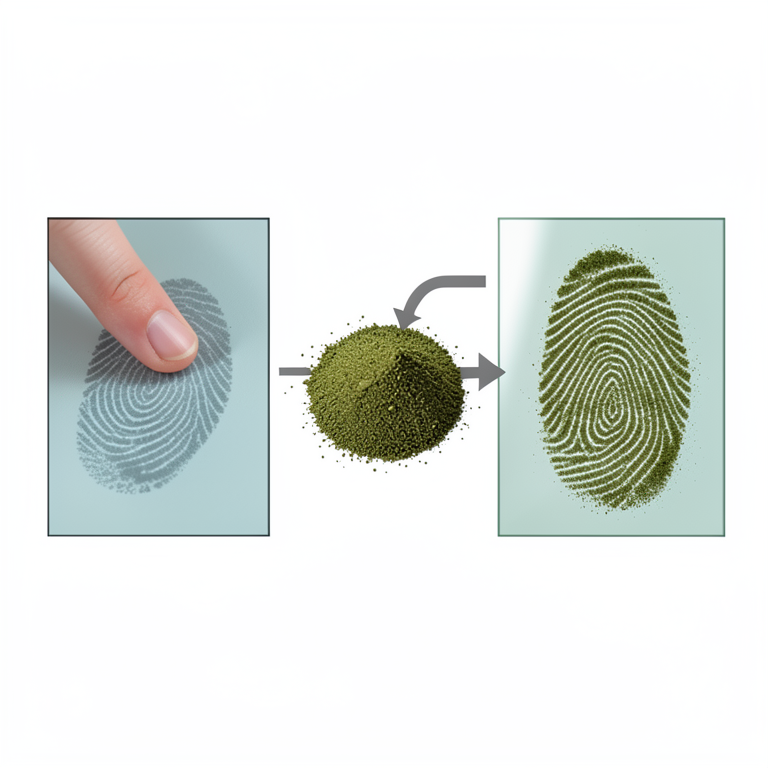
Study overview
AI-generated conceptual illustration (human fingertips and olive leaf powder). It explains the idea and does not show study data.
View source evidence ↗Introduction
A significant part of the criminal investigation process is the analysis of fingerprints for forensic purposes. The analysis offers a unique means for identifying individuals. Critical biometric data is carried in the latent fingerprints (LFPs) of individuals, and specific techniques are required for visualization and enhancement of these characteristics (Shakeel and Syed, 2023) [13]. While traditional methods, such as powder dusting, have been in use for several decades, concerns over the impact on the environment and human health have led to the development of cleaner and more effective alternatives (Hazarika and Russell, 2012) [6].
For more than a century, fingerprints have been used to identify people. They are special because they do not change and have patterns (Kaushal and Kaushal, 2011) [10]. With DNA profiling, fingerprints are still important in linking people to crime scenes (Roewer, 2013) [12]. Modern forensic science focuses on making detection more sensitive and accurate (Borysenko et al., 2021) [2]. 2.
Biological Basis and Individuality of Fingerprints Fingerprints develop in the womb and remain unchanged throughout our lives (Glover et al., 2023) [5]. They are unique because of changes during development. There are three types of fingerprints. Loops, whorls and arches.
They make up 65%, 30% and 5% of the population (Walton, 2022) [15]. 3. Types of Fingerprints at Crime Scenes Crime scene fingerprints can be: • Latent Prints: made of sweat and oils and need to be developed (Houck, 2016) [7] • Patent Prints: visible because of things like blood or paint (Daluz, 2018) [4] • Plastic Prints: 3D impressions on soft surfaces like wax or soap (Dalrymple, 2006) [3] 4. Traditional Fingerprint Development Techniques 4.1 Powder Dusting The fingerprint powder sticks to the residues and helps to visualize fingerprints. However, success is dependent on surface type and skill level (Utzhanova, 2016) [14]. https://www.chemistryjournals.net 5.3 Digital Image Processing Improvements in the enhancement of images and scanning techniques have improved the quality of the ridges (Zhang and Peng, 2023) [16]. 5.4 Machine Learning and Automated Identification Fingerprint analysis using artificial intelligence-based automated identification techniques has shown enhanced accuracy without any bias (Karsharma et al., 2025) [9]. 6.
Challenges and Limitations: Fingerprint analysis is challenged by the following: surface degradation, parameter changes, and adhesive surface pressure loss.
Conclusion
Fingerprint Evidence is still very important in the science. New technology is changing the field. This needs further research and validation. 8. Comparative Table of Major Fingerprint Detection
Methods
4.2 Chemical Methods Common chemicals used are: (Lee and Gaensslen, 2001) [11] • Ninhydrin for porous surfaces • DFO for fluorescence • Cyanoacrylate fuming for nonporous surfaces • Physical Developer for water-exposed prints These methods are essential but require careful selection. 5. Emerging Techniques 5.1 Nanomaterials and Advanced Powders Recent powders, such as TiO2 and carbon black nanoparticles, have shown enhanced performance in lifting latent prints from faint impressions (Ametefe et al., 2025) [1]. 5.2 Spectroscopic Solutions Fingerprint analysis involves the use of spectroscopy, which includes Raman spectroscopy and infrared spectroscopy (Jain et al., 2022) [8]. Method Surface Type Advantages Limitations Key References Traditional powders Nonporous Fast, inexpensive Low sensitivity on aged prints Fahmy et al., 2023 Magnetic powders Nonporous Reduce smear risk Limited use on ferromagnetic surfaces Goodwin & Smith, 2022 Ninhydrin Porous High sensitivity to amino acids Requires curing time Marquez et al., 2021 10. Kaushal N, Kaushal P.
Human identification and fingerprints: a review. J Biomet Biostat. 2011;2(4):1-5. 11. Lee HC, Gaensslen RE. Methods of latent fingerprint development.
In: Lee HC, Gaensslen RE, editors. Advances in fingerprint technology. 2nd ed. Boca Raton: CRC Press; 2001. p. 105-175. 12. Roewer L.
DNA fingerprinting in forensics: past, present, future. Investig Genet. 2013;4(1):22. 13. Shakeel M, Syed SK. A review on fingerprint as an identification tool in the discipline of forensics.
Forensic Insights Health Sci Bull. 2023;1(1):38-43. 14. Utzhanova A. Fingerprint technology and sustainable development. Eur J Sustain Dev. 2016;5(4):325-334. 15.
Walton A. Determining SNPs and demographic variables that impact level one fingerprint pattern [dissertation]. Sydney: University of Technology Sydney; 2022. 16. Zhang Z, Peng D.
Recent advances in enhancement techniques for blood fingerprints. Crit Rev Anal Chem. 2023;53(3):442-461. DFO Porous Strong fluorescence Specialized light required Hazarika & Russell, 2022 [6] Cyanoacrylate fuming Nonporous Durable and stable visualization Risk of overdevelopment Ribaux & Barrett, 2020 Physical Developer Porous (wet) Effective on water-exposed prints Complex preparation Champod, 2021 Nanoparticle powders Nonporous High sensitivity Cost and safety concerns Sharma et al., 2021 Raman spectroscopy All Non-destructive profiling Requires costly equipment Gupta et al., 2023 AI-AFIS Digital High accuracy Dependent on dataset quality Lee & Kim, 2024 [11]
References
9 in the original paper- Ametefe DS, Sarnin SS, Ali DM, Ametefe GD, John D, Hussin N. Advancements and challenges in fingerprint presentation attack detection: a systematic literature review. Neural Comput Appl. 2025;37(4):1797-1819.
- Borysenko IV, Bululukov OY, Pcholkin VD, Baranchuk VV, Prykhodko VO. The modern development of new promising fields in forensic examinations. J Forensic Sci Med. 2021;7(4):137-144.
- Dalrymple BE. Fingerprints. In: Mozayani A, Noziglia C, editors. The forensic laboratory handbook: procedures and practice. Totowa: Springer; 2006. p. 257-274.
- DaLuz HM. Fundamentals of fingerprint analysis. 2nd ed. Boca Raton: CRC Press; 2018.
- Glover JD, Sudderick ZR, Shih BB, Batho-Samblas C, Charlton L, Krause AL, et al. The developmental basis of fingerprint pattern formation and variation. Cell. 2023;186(5):940-956.e20.
- Hazarika P, Russell DA. Advances in fingerprint analysis. Angew Chem Int Ed Engl. 2012;51(15):3524- 3531.
- Houck MM, editor. Forensic fingerprints. London: Academic Press; 2016.
- Jain LC, Halici U, Hayashi I, Lee S, Tsutsui S, editors. Intelligent biometric techniques in fingerprint and face recognition. Boca Raton: Routledge; 2022.
- Karsharma M, Vasava M, Khandelwal R, RB A, Maity P. From past to present: a review on advancements in luminescent and fluorescent materials for latent fingerprint developments. Aust J Forensic Sci. 2025;57(4):433-469.