
Research article · 2026 · Full text
International Journal of Horticulture and Food ScienceEffect of different EC ranges on spinach (Spinacia oleracea) growth in NFT hydroponic system
Volume 8(4) · Pages 07–09 · DOI: 10.33545/26631067.2026.v8.i4a.504 ↗
Research areasInnovations in Aquaponics and Hydroponics SystemsPlant Growth and Agriculture TechniquesGrowth and nutrition in plants
Abstract
Author-writtenA soilless method known as hydroponic farming offers fresh veggies in harsh environmental conditions on a limited amount of arable land. This study evaluates the impact of varying electrical conductivity (EC) levels (1.7-1.8, 2.0-2.1, 2.2-2.3 mS/cm) on spinach (Spinacia oleracea) growth in a Nutrient Film Technique (NFT) hydroponic system. Optimal growth, including height, leaf number, biomass, and yield, occurred at 2.0-2.1 mS/cm, outperforming low EC (nutrient deficiency) and high EC (osmotic stress). Study shows importance of maintaining optimum EC ranges and nutrient balance for hydroponics vegetable production.
Summary
Source-checkedPlain-language reading of the full paper, prepared with AI and checked against the text. Each point links to the authors' own words.
Why it matters
- Spinach is a commercially significant annual cool-season vegetable characterized by shallow roots and leaves. View evidence ↗
- Spinach is highly nutritious, providing essential dietary fibers, a wide range of vitamins, minerals, and antioxidant compounds like flavonoids. View evidence ↗
- Hydroponic farming is becoming more popular globally because it uses natural resources efficiently, especially in areas with limited soil and water. View evidence ↗
The question
- The study aimed to evaluate how different electrical conductivity (EC) levels (1.7-1.8, 2.0-2.1, and 2.2-2.3 mS/cm) affect the growth of spinach in an NFT hydroponic system. View evidence ↗
What they did
- The researchers used three independent NFT systems, each equipped with a submersible pump, NFT channels, and a 20-liter nutrient reservoir. View evidence ↗
- Uniform spinach seedlings were transplanted into the systems, receiving the same nutrient formulation but different maintained EC levels. View evidence ↗
- The experiment consisted of three trials: Low EC (1.7-1.8 mS/cm), Medium EC (2.0-2.1 mS/cm), and High EC (2.2-2.3 mS/cm). View evidence ↗
- Growth parameters were recorded periodically to determine how the spinach plants responded to the different EC levels. View evidence ↗
What they found
- The medium EC range (2.0-2.1 mS/cm) produced the best results, characterized by vigorous growth, healthy root systems, and dark green leaves. View evidence ↗
- Plants in the low EC range (1.7-1.8 mS/cm) grew more slowly and had lower biomass accumulation and limited vegetative growth compared to the optimal range. View evidence ↗
- High EC levels (2.2-2.3 mS/cm) caused nutrient stress, resulting in pale leaves, wilting, and leaf-edge burn, likely due to reduced magnesium uptake. View evidence ↗
- Excessive salt concentrations in the root zone create osmotic stress, which hinders the plant's ability to absorb water and nutrients. View evidence ↗
What it means
- The authors conclude that 2.0-2.1 mS/cm is the optimal EC range for spinach in NFT hydroponics to ensure high-quality yield and balanced nutrient uptake. View evidence ↗
- The study concludes that the hydroponic method is more effective than conventional soil-based planting for growing spinach. View evidence ↗
- The authors suggest that future experiments should be conducted on a larger scale to determine how to meet market demands. View evidence ↗
Visual summary
2 visualsIllustrations explain the paper; charts are replotted from the paper's own table values.
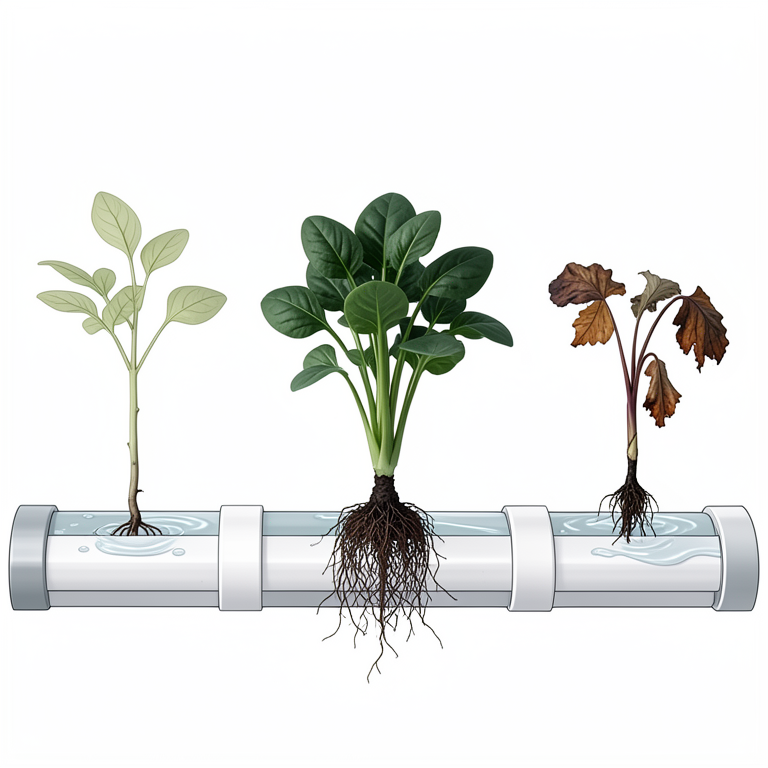
Effect of EC Levels on Spinach Growth
AI-generated conceptual illustration (spinach plants (Spinacia oleracea) in an NFT hydroponic system). It explains the idea and does not show study data.
View source evidence ↗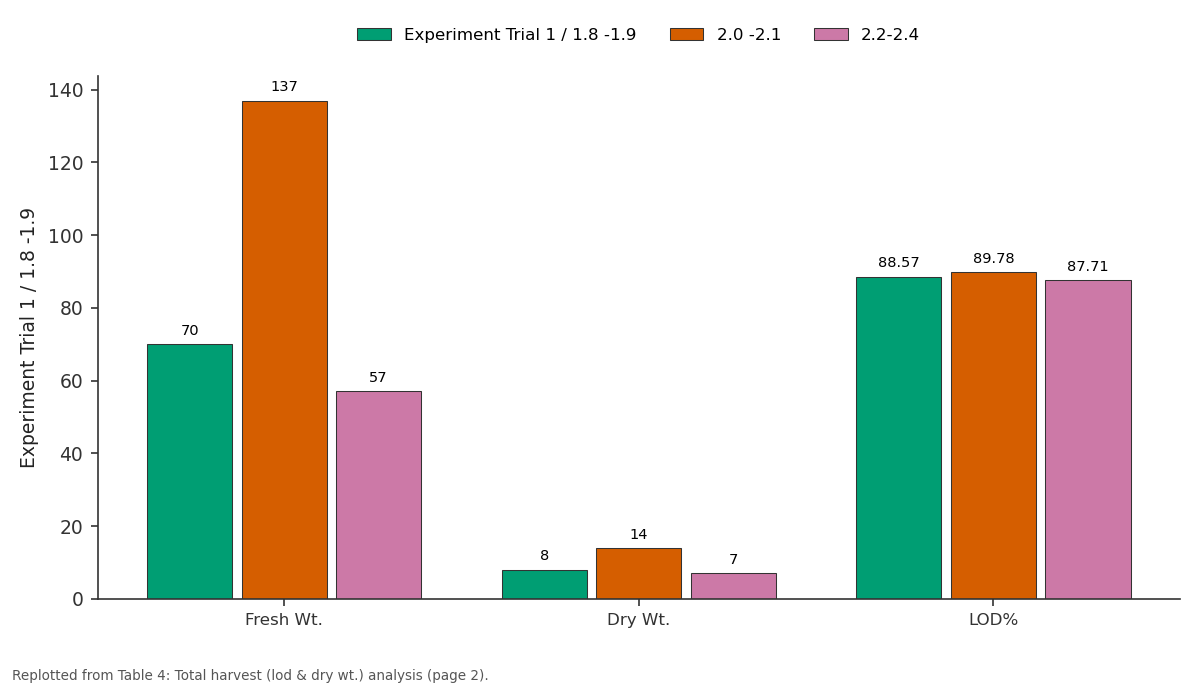
Experiment Trial 1 / 1.8 -1.9 and 2.0 -2.1 and more: Fresh Wt. vs Dry Wt. vs LOD%
Replotted from Table 4 (page 2) of the original paper. Every bar is the paper's own table value.
View source evidence ↗Figures & tables
From the original paper Table 1
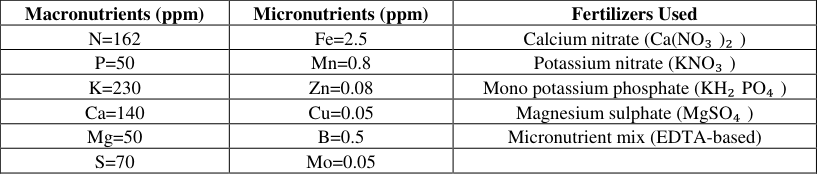 Table 2
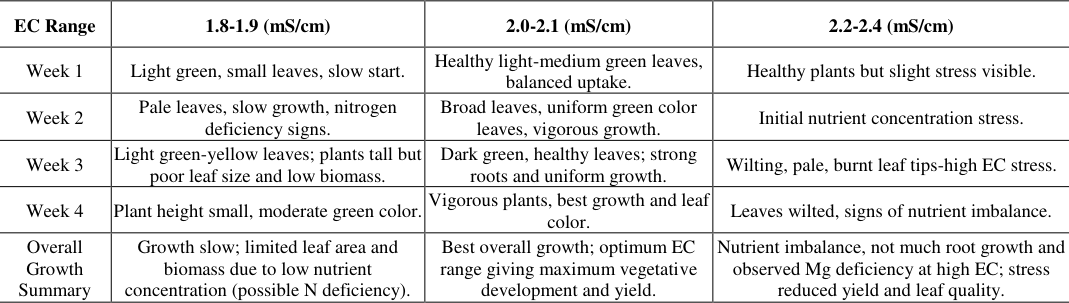 Table 3
 Table 4
Introduction
Spinach (Spinacia oleracea L.) is an annual cool-season crop commercially produced using seeds in dry soil either in hills or disseminated. It is most important vegetable crops with shallow roots and leaves. Fresh, steamed, quickly cooked, frozen, and canned spinach leaves are exceptionally high in nutrients. Furthermore, it is regarded as a good source of dietary fibers, minerals (potassium, calcium, magnesium, iron, manganese, and selenium), and numerous vitamins (A, B2, B6, B9, C, E, K, and folate), it is abundant in flavonoids, p- coumaric acid derivatives, and uridine.
These compounds have been shown to have anti- oxidative qualities crucial for maintaining human health (Bergman et al., 2001; Bergman et al., 2003; Cho et al., 2008; Zikalala, 2014) [1, 2, 10]. Due to its effective use of natural resources, particularly in regions where soil and water constrain plant development, hydroponic agriculture is gaining popularity globally (Khan, 2018; Seerat Jan et al., 2020; Prakash et al., 2020) [6, 8, 9]. It also contributes to the fight against climate change and yields high-quality food (Barrett et al., 2016; Martin & Molin, 2019) [3, 7].
Material And Methods
The experiment was conducted to study the effect of different electrical conductivity (EC) levels on spinach growth using a Nutrient Film Technique (NFT)-based hydroponic system. Three independent NFT systems were established, each consisting of a 20-liter nutrient solution reservoir, submersible pump, and NFT channels. Spinach seedlings of uniform size and age were transplanted into each system. All treatments received the same nutrient formulation; however, different EC levels were maintained in each system.
The experiment was conducted under controlled environmental conditions. Plant growth parameters were periodically recorded to assess the response of spinach plants to varying EC levels. Table 1: Experiment Trial Experiment Trial EC Range (mS/cm) Description 1 1.7-1.8 Low EC 2 2.0-2.1 Medium 3 2.2-2.3 High EC NAAS Rating (2026): 4.74 IJHFS 2026; 8(4): 07-09 Sayali K Choudhari Research Scholar, Vigyan Ashram, Pabal, Tal. Shirur, Dist.
| Experiment Trial | EC Range (mS/cm) | Description |
|---|---|---|
| 1 | 1.7-1.8 | Low EC |
| 2 | 2.0-2.1 | Medium |
| 3 | 2.2-2.3 | High EC |
Table text extracted from the original PDF; superscript letters are shown inline. The original table image is below.
View original table image
Pune, Maharashtra, India Arun D Dixit Research Head, Vigyan Ashram, Pabal, Tal. Shirur, Dist. Pune, Maharashtra, India Ranjeet J Shanbhag Deputy Director, Vigyan Ashram, Pabal, Tal. Shirur, Dist.
Pune, Maharashtra, India Sayali K Choudhari Research Scholar, Vigyan Ashram, Pabal, Tal. Shirur, Dist. Pune, Maharashtra, India https://www.hortijournal.com Table 2: Nutrient Management 3) High ec (2.2-2.3 m S/cm) Plants showed wilting, pale leaves, and leaf-edge burn, suggesting nutrient stress and reduced magnesium (Mg) uptake caused by competition from excess Ca²⁺ and K⁺ ions. When EC rises above the optimal range for spinach, water and nutrient uptake slow down.
| Macronutrients (ppm) | Micronutrients (ppm) | Fertilizers Used |
|---|---|---|
| N=162 | Fe=2.5 | Calcium nitrate (Ca(NO₃ )₂ ) |
| P=50 | Mn=0.8 | Potassium nitrate (KNO₃ ) |
| K=230 | Zn=0.08 | Mono potassium phosphate (KH₂ PO₄ ) |
| Ca=140 | Cu=0.05 | Magnesium sulphate (MgSO₄ ) |
| Mg=50 | B=0.5 | Micronutrient mix (EDTA-based) |
| S=70 | Mo=0.05 |
Table text extracted from the original PDF; superscript letters are shown inline. The original table image is below.
View original table image
Osmotic stress is the stress on plants that happens when the concentration of salts (EC) in the root zone is too high, making it difficult for roots to absorb water and nutrients through osmosis. Similar findings have been reported by Cees Sonneveld and Wim Voogt (2009) [12] and Youssef Rouphael and Giovanni Colla (2005) [11], who explained that elevated EC levels in hydroponic systems can cause osmotic stress, leading to reduced water and nutrient uptake and ultimately affecting plant growth and yield. Excessive salt concentration may also result in nutrient imbalance, which can manifest as physiological disorders such as leaf burn and chlorosis. Macronutrients (ppm) Micronutrients (ppm) Fertilizers Used N=162 Fe=2.5 Calcium nitrate (Ca(NO₃ )₂ ) P=50 Mn=0.8 Potassium nitrate (KNO₃ ) K=230 Zn=0.08 Mono potassium phosphate (KH₂ PO₄ ) Ca=140 Cu=0.05 Magnesium sulphate (MgSO₄ ) Mg=50 B=0.5 Micronutrient mix (EDTA-based) S=70 Mo=0.05
Result
& Discussion 1) Optimal ec range (EC 2.0-2.1 m S/cm) The best growth and leaf development were observed at EC 2.0-2.1 m S/cm. Plants in this range showed vigorous growth, dark green leaves, balanced nutrient uptake, and healthy root systems . 2) Low EC (1.7-1.8 m S/cm) At EC 1.7-1.8 m S/cm, plants survive and grow, but vegetative growth is limited and biomass accumulation is low. Plants did grow, but growth rate was slower compared to the optimal EC (2.0-2.1 m S/cm). You would typically observe increase in height (elongation) but less vegetative development meaning smaller, fewer, and thinner leaves.
At low EC, the nutrient concentration in the solution is too low, so plants can’t take up essential elements. As a result, spinach tries to stretch upward to search for more light and nutrients (slight height increase), but leaf size, color, and biomass remain low. Table 3: Spinach ec trial-visual observation table EC Range 1.8-1.9 (mS/cm) 2.0-2.1 (mS/cm) 2.2-2.4 (mS/cm) Week 1 Light green, small leaves, slow start. Healthy light-medium green leaves, balanced uptake.
Healthy plants but slight stress visible. Broad leaves, uniform green color Week 2 Pale leaves, slow growth, nitrogen deficiency signs. leaves, vigorous growth. Initial nutrient concentration stress. Dark green, healthy leaves; strong Week 3 Light green-yellow leaves; plants tall but poor leaf size and low biomass. roots and uniform growth.
Wilting, pale, burnt leaf tips-high EC stress. Week 4 Plant height small, moderate green color. Vigorous plants, best growth and leaf color. Leaves wilted, signs of nutrient imbalance.
Growth slow; limited leaf area and Nutrient imbalance, not much root growth and Best overall growth; optimum EC range giving maximum vegetative observed Mg deficiency at high EC; stress Overall Growth
Summary
biomass due to low nutrient concentration (possible N deficiency). development and yield. reduced yield and leaf quality. Table 4: Total harvest (lod & dry wt.) analysis Experiment Trial 1 Experiment Trial 2 EC Range 1.8 -1.9 2.0 -2.1 2.2-2.4 1.8-1.9 2.0-2.1 2.2-2.4 Fresh Wt. 70 137 57 72 167 63 Dry Wt. 8 14 7 6 14 7 LOD% 88.57% 89.78% 87.71% 91.6% 91.62% 88.89% Total Harvest (LOD & Dry wt.) Analysis The highest LOD% & Dry Biomass was recorded at EC 2.0- 2.1 mS/cm, indicating greater water retention and vigorous plant growth. At lower EC (1.7-1.9 mS/cm), plants grew normally but slightly slower, showing moderate moisture content & Dry Biomass .At higher EC (2.2-2.3 mS/cm), plants exhibited (interveinal chlorosis on older leaves), due to nutrient competition and osmotic stress, with reduced LOD & Dry Biomass .Similar findings have been reported in previous studies (Rouphael & Colla, 2005; Sonneveld & Voogt, 2009) [11, 12]
| — | Experiment Trial 1 | — | — | Experiment Trial 2 | — | — |
|---|---|---|---|---|---|---|
| EC Range | 1.8 -1.9 | 2.0 -2.1 | 2.2-2.4 | 1.8-1.9 | 2.0-2.1 | 2.2-2.4 |
| Fresh Wt. | 70 | 137 | 57 | 72 | 167 | 63 |
| Dry Wt. | 8 | 14 | 7 | 6 | 14 | 7 |
| LOD% | 88.57% | 89.78% | 87.71% | 91.6% | 91.62% | 88.89% |
Table text extracted from the original PDF; superscript letters are shown inline. The original table image is below.
View original table image
Conclusion
Hydroponics has gained popularity as a promising crop- growing method in recent years. Given the year-round feasibility of growing short-duration crops like vegetables in small places with minimal labour, hydroponics can benefit impoverished and landless areas and areas with limited soil and water resources. This study aimed to investigate soil and hydroponic growth rates the hydroponic system by growing spinach compared to the conventional soil system. After evaluating the data and findings, we may infer that the hydroponic system is superior to the traditional https://www.hortijournal.com soil system.
The end outcome unequivocally demonstrates that the hydroponic planting method outperforms the conventional method in effectiveness. Plants grown in hydroponic systems grow more quickly. The plant’s height, stem diameter, leaf size, and leaf number all exhibit this impact, indicating a higher yield. By conducting this experiment on a larger scale in the future, it will be possible to meet the demands of the current futures market.
Hence, the optimum EC range for spinach in NFT hydroponics is 2.0-2.1 mS/cm, which ensures balanced nutrient uptake, healthy foliage, and ideal moisture levels for high-quality yield. This study demonstrates how EC control directly influences plant physiology, nutrient availability, and overall productivity in hydroponic systems.
References
12 in the original paper- Bergman M, Varshavsky L, Gottlieb H, Grossman S. The antioxidant activity of aqueous spinach extract. J Sci Food Agric. 2001;88:1099-1106.
- Bergman M, Perelman A, Dubinsky Z, Grossman S. Scavenging of reactive oxygen species by a novel glucurinated flavonoid antioxidant isolated and purified from spinach. Phytochemistry. 2003;62:753-762.
- Barrett GE, Alexander PD, Robinson JS, Bragg NC. Achieving environmentally sustainable growing media for soilless plant cultivation systems: a review. Sci Hortic. 2016;212:220-234.
- Blok C, Jackson BE, Guo X, De Visser PH, Marcelis LF. Maximum plant uptakes for water, nutrients, and oxygen are not always met by irrigation rate and distribution in water-based cultivation systems. Front Plant Sci. 2017;8:562.
- Cho MJ, Howard LR, Prior RL, Morelock T. Flavonoid content and antioxidant capacity of spinach genotypes determined by high-performance liquid chromatography/mass spectrometry. J Sci Food Agric. 2008;88:1099-1106.
- Khan FA. A review on hydroponic greenhouse cultivation for sustainable agriculture. Int J Agric Environ Food Sci. 2018;2(2):59-66.
- Martin M, Molin E. Environmental assessment of an urban vertical hydroponic farming system in Sweden. Sustainability. 2019;11(15):4124.
- Prakash S, Singh R, Kumari AR, Srivastava AK. Role of hydroponics towards quality vegetable production: an overview. Int J Curr Microbiol Appl Sci. 2020;10:252-259.
- Jan S, Gul R, Nazir I. Hydroponics: a review. Int J Curr Microbiol Appl Sci. 2020;9(8):1779-1787.
- Zikalala BO. The chemical composition of baby spinach (Spinacia oleracea L.) as affected by nitrogen, phosphorus and potassium nutrition [MSc thesis]. South Africa; 2014.
- Rouphael Y, Colla G. Growth, yield, and nutrient uptake of hydroponically grown crops as affected by electrical conductivity.
- Sonneveld C, Voogt W. Plant nutrition of greenhouse crops. Dordrecht: Springer; 2009.