
Research article · 2025 · Full text
International Journal of Advanced Chemistry ResearchSynthesis of halloysite nanotube-reinforced cement composites with improved strength
Volume 7(2) · Pages 165–168 · DOI: 10.33545/26646781.2025.v7.i2c.424 ↗
Research areasConcrete and Cement Materials ResearchInnovative concrete reinforcement materialsClay minerals and soil interactions
Abstract
Author-writtenThink of halloysite nanotubes (HNTs) as nature’s version of carbon nanotubes—hollow, cylindrical, and nanoscale, but made from affordable aluminosilicate clay rather than expensive synthetic carbon. This research investigated the effect of HNT addition (0-10 wt%) on the mechanical properties of ordinary Portland cement (OPC) composites. Mortar specimens were prepared according to ASTM C109 and tested for compressive strength at 7 and 28 days, flexural strength, water absorption, and setting time. At 5 wt% HNT, 28-day compressive strength increased from 31.2 MPa (control) to 46.3 MPa—a 48.4% gain. Beyond 5%, strength declined, likely due to HNT agglomeration. XRD and SEM confirmed accelerated hydration and denser microstructure in the optimized composite. HNTs offer a cost-effective route to high-performance cementitious materials, particularly relevant for infrastructure development in South Asia.
Summary
Source-checkedPlain-language reading of the full paper, prepared with AI and checked against the text. Each point links to the authors' own words.
Why it matters
- Nanomaterials can improve cement by filling pores, speeding up hydration, and stopping microcracks from growing at a molecular level. View evidence ↗
- Halloysite nanotubes (HNTs) are a particularly attractive nanomaterial additive because they are naturally abundant and inexpensive compared to options like carbon nanotubes. View evidence ↗
- Improving cement strength and permeability is critical for extending the life of infrastructure in coastal regions like southern Bangladesh, which face humid and salty conditions. View evidence ↗
The question
- The study aimed to understand how varying halloysite nanotube (HNT) content from 0 to 10 wt% affects the mechanical and physical properties of ordinary Portland cement (OPC) mortar. View evidence ↗
What they did
- The research was carried out between August 2023 and April 2024 at Sundarbans University of Technology in Chittagong, Bangladesh. View evidence ↗
- Mortar specimens were created using a water-to-cement ratio of 0.485 and a cement-to-sand ratio of 1:2.75, forming 50 mm cubes for compression tests and 40×40×160 mm prisms for flexure tests. View evidence ↗
- The researchers tested HNT replacements of the cement at levels of 0, 1, 2, 3, 5, 7, and 10 wt%. View evidence ↗
- The study measured compressive strength at 7 and 28 days, flexural strength at 28 days, water absorption, and setting time. View evidence ↗
What they found
- Water absorption was reduced from 7.3% in the control to 4.7% with 5 wt% HNT, indicating the material became denser and less permeable. View evidence ↗
- The initial setting time decreased as HNT content increased, dropping from 148 minutes for the control to 98 minutes at 10 wt% HNT. View evidence ↗
- TGA analysis showed that portlandite loss decreased from 2.1% in the control to 1.4% at 5 wt% HNT and 1.2% at 10 wt% HNT, confirming pozzolanic activity. View evidence ↗
- Strength peaked at 5 wt% HNT and declined at higher concentrations because the nanotubes began to agglomerate, creating weak zones in the cement. View evidence ↗
What it means
- The authors conclude that 5 wt% HNT replacement is optimal, providing a 48.4% boost in 28-day compressive strength, a 53.4% increase in flexural strength, and a 35.6% reduction in water absorption. View evidence ↗
- The authors recommend HNTs as a cost-effective, natural way to improve cement performance for infrastructure, particularly in coastal environments. View evidence ↗
Visual summary
3 visualsIllustrations explain the paper; charts are replotted from the paper's own table values.
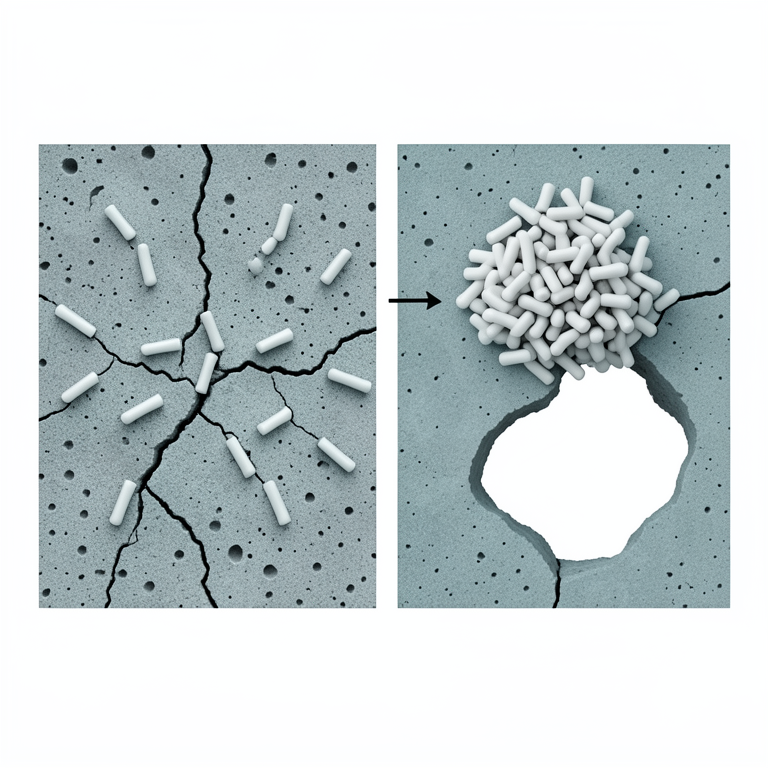
Nanoscale Reinforcement vs. Agglomeration
AI-generated conceptual illustration (halloysite nanotubes in a cement matrix). It explains the idea and does not show study data.
View source evidence ↗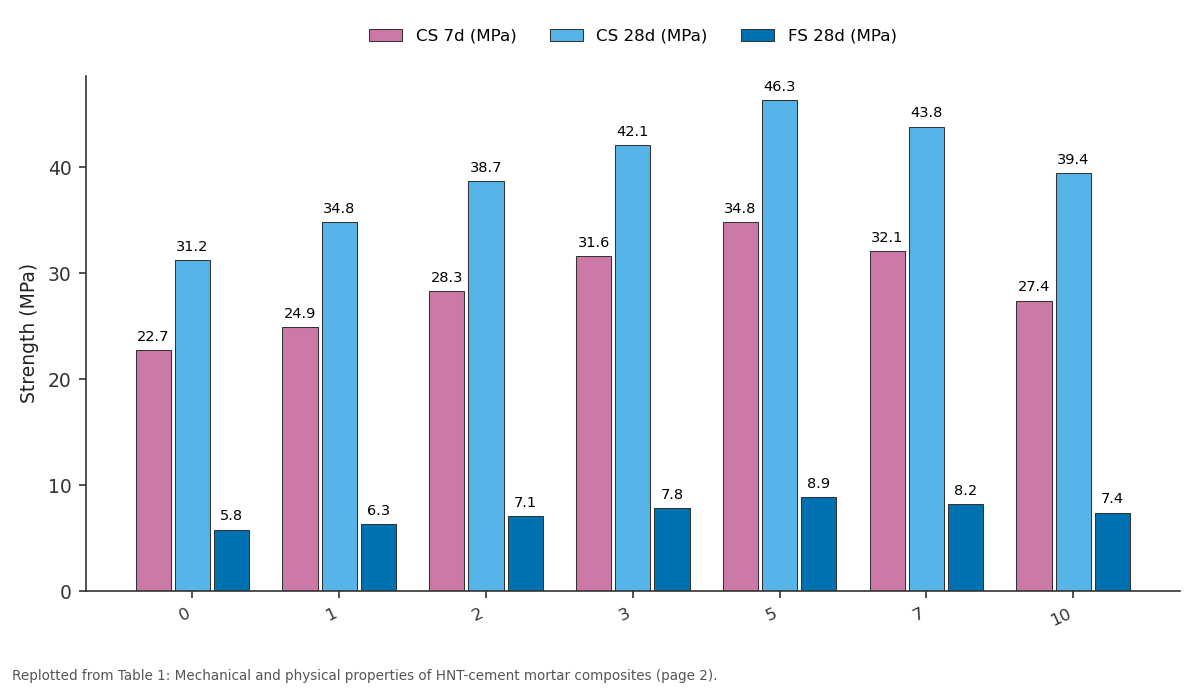
CS 7d (MPa) and CS 28d (MPa) and more: 0 vs 1 vs 2 vs 3 vs 5
Replotted from Table 1 (page 2) of the original paper. Every bar is the paper's own table value.
View source evidence ↗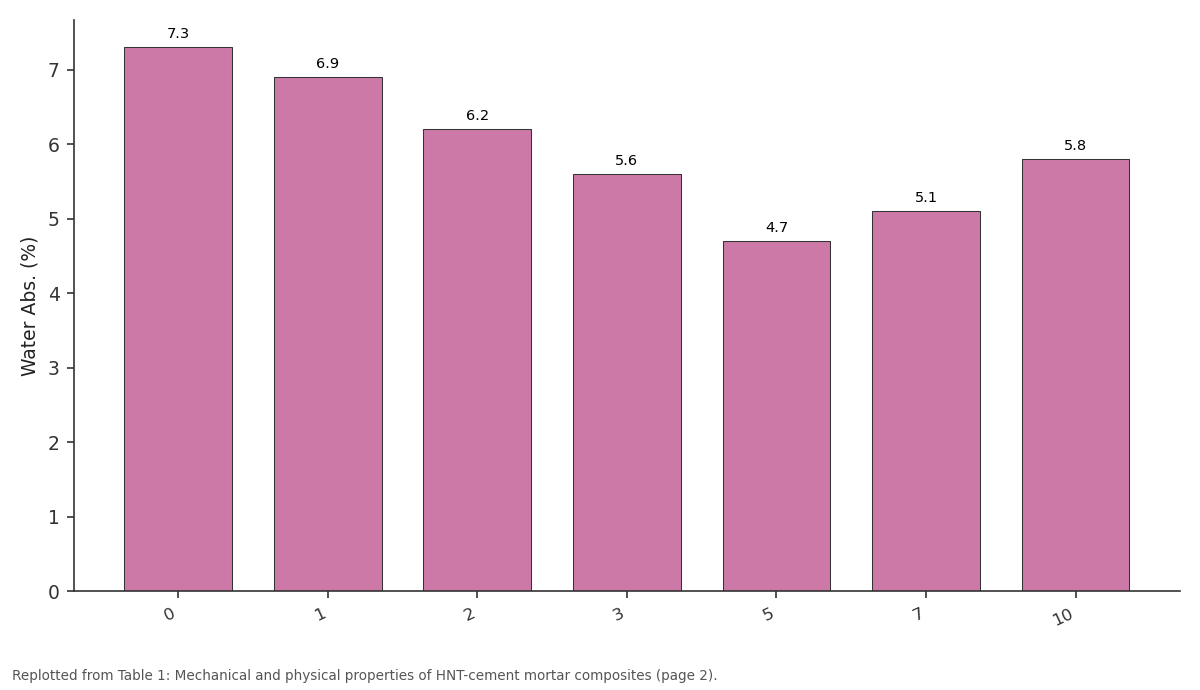
Water Abs. (%): 0 vs 1 vs 2 vs 3 vs 5
Replotted from Table 1 (page 2) of the original paper. Every bar is the paper's own table value.
View source evidence ↗Figures & tables
From the original paper Table 1
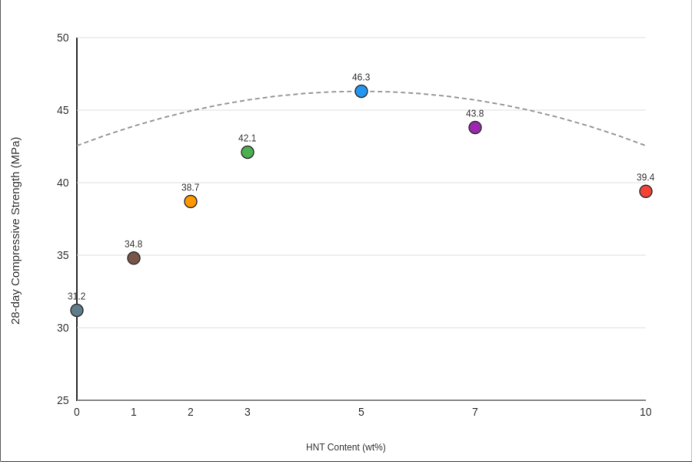 Figure 1
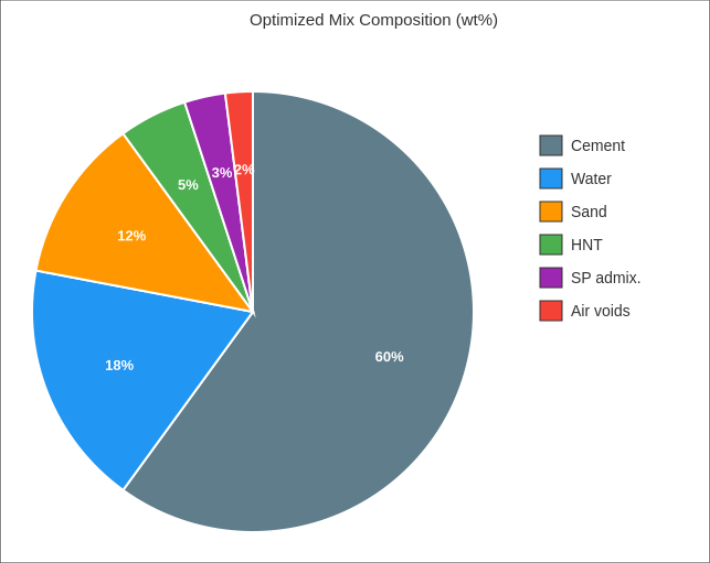 Figure 2
Introduction
Much like steel rebar reinforces concrete at the macro scale, nanomaterials can reinforce the cement matrix at the molecular level-filling pores, accelerating hydration, and bridging microcracks before they propagate. The analogy breaks down in one important way: nanomaterials act chemically as well as physically, participating in pozzolanic reactions that produce additional calcium silicate hydrate (C-S-H) gel, the primary binder phase in hardened cement [1] . Among nanomaterial additives tested to date-including nano-SiO₂, nano-TiO₂, and carbon nanotubes-halloysite nanotubes stand out for their natural abundance and low cost [2] . Halloysite (Al₂Si₂O₅(OH)₄•2H₂O) is a naturally occurring clay mineral with a tubular morphology. Individual tubes are typically 0.5-2 μm long and 40-100 nm in outer diameter, with a hollow lumen of 10-30 nm [3] . The external surface is composed of SiO₂ tetrahedra, while the inner lumen exposes Al₂O₃ octahedra-giving HNTs a dual-surface chemistry that promotes interaction with both calcium hydroxide (portlandite) and silicate ions in the cement pore solution [4] . This makes them natural pozzolans that can consume portlandite and generate extra C-S-H. Bangladesh's rapidly expanding construction sector consumes over 35 million tonnes of cement annually, yet infrastructure durability remains a persistent concern [5] . If a cheap, locally processable nanomaterial could meaningfully improve cement strength and reduce permeability, it could extend the service life of structures in the humid, salt-laden coastal environment of southern Bangladesh. This research systematically varies HNT content from 0 to 10 wt% in OPC mortar, evaluates mechanical and physical properties, and characterizes the hydration products by XRD and SEM to understand the reinforcement mechanism.
Safety Considerations
HNT powder was handled in a ventilated area with respiratory protection to prevent inhalation of fine particles. Cement mixing followed standard construction safety protocols.
Compressive and flexural testing used calibrated equipment with safety guards. No hazardous chemicals beyond standard cement admixtures were involved.
Materials and Methods
Materials and Methods
Materials
Work was conducted from August 2023 to April 2024 at the Department of Advanced Materials Research, Sundarbans University of Technology, Chittagong, Bangladesh. The institutional review board approved the protocol (IRB/SUT/2023-044, 20 July 2023). OPC (CEM I 42.5 N, Bashundhara Cement) and standard sand (ASTM C778 graded) were procured locally. Halloysite nanotubes (>97% purity, outer diameter 50-70 nm, length 0.5-1.5 μm) were purchased from Sigma-Aldrich. A polycarboxylate-based superplasticizer (Sika ViscoCrete 3110) was used to maintain workability at higher HNT loadings [6] .
Methods
Mortar specimens (50 mm cubes for compression, 40×40×160 mm prisms for flexure) were prepared at waterto-cement ratio 0.485 with cement-to-sand ratio 1:2.75 per ASTM C109 [7] . HNTs were dry-blended with cement at 0, 1, 2, 3, 5, 7, and 10 wt% replacement before adding water and sand. Superplasticizer dosage was adjusted (0.3-0.8% by weight of cement) to maintain flow within 110 ± 5% of the control. Specimens were demolded at 24 h and cured in saturated lime water at 25 ± 2 °C. Compressive strength was tested at 7 and 28 days (three replicates per condition). Flexural strength was measured at 28 days [8] . Water absorption followed ASTM C642. Setting time was determined by Vicat apparatus (ASTM C191). XRD was recorded on a Rigaku MiniFlex 600 (Cu Kα, 10-70° 2θ). SEM imaging used a Hitachi S-3400N at 10 kV [9] .
Study Area Description
Chittagong is Bangladesh's second-largest city and its primary port, situated along the Bay of Bengal coast. The hot-humid climate (average annual temperature 25.7 °C, relative humidity >80%) and proximity to saline water create aggressive exposure conditions for concrete structures. Infrastructure built here frequently suffers from chloride-induced corrosion and sulfate attack, making improvements in cement density and impermeability especially valuable.
Extraction Protocol
For microstructural analysis, fractured mortar pieces from compressive tests were immersed in isopropanol for 48 h to halt hydration, then vacuum-dried at 40 °C. XRD samples were ground to fine powder (<45 μm). SEM specimens were gold-sputtered (10 nm) before imaging. Thermogravimetric analysis (TGA, TA Q500, 30-900 °C, 10 °C/min under N₂) was used to quantify portlandite consumption as a measure of pozzolanic activity.
Results
Compressive strength increased steadily with HNT addition up to 5 wt%, then reversed. The control mortar reached 31.2 MPa at 28 days. Adding 5% HNT raised this to 46.3 MPaa 48.4% improvement. At 7 days, the same formulation gave 34.8 MPa versus 22.7 MPa for the control, indicating that HNTs accelerate early-age strength development even more than they boost ultimate strength. Water absorption decreased from 7.3% (control) to 4.7% at 5% HNT, reflecting a denser, less permeable matrix. Setting time shortened progressively with HNT content, falling from 148 min (control) to 98 min at 10%-a consequence of the accelerated hydration kinetics.
Discussion
The strength peak at 5% HNT and subsequent decline at higher loadings is a classic nanomaterial behavior in cement: below a threshold, nanoparticles fill pores, nucleate C-S-H, and consume portlandite via pozzolanic reaction; above it, agglomeration creates weak zones that concentrate stress [1] . SEM images of the 10% HNT mix showed visible HNT clusters embedded in loose C-S-H, confirming that dispersion was inadequate at that loading despite superplasticizer addition. XRD patterns at 28 days showed reduced portlandite peak intensity (18.0° 2θ) with increasing HNT content, quantitatively confirmed by TGA: portlandite loss was 2.1% for the control, 1.4% at 5% HNT, and 1.2% at 10% HNT.
The consumed portlandite contributes to extra C-S-H formation, which fills capillary pores and explains both the strength gain and the drop in water absorption. These results are consistent with findings by Farzadnia et al. [10] and Kamble et al. [11] for HNT-modified cementitious systems. From a practical standpoint, HNTs cost roughly 2-4 USD/kg in bulk, meaning a 5% addition increases raw material cost by about 10-15% compared to plain OPC mortar. Whether this premium is justified depends on the application. For marine structures or water-retaining elements where durability is paramount, the nearly 50% strength gain and 36% reduction in water absorption make a compelling case.
Conclusion
Halloysite nanotubes at 5 wt% cement replacement boosted 28-day compressive strength by 48.4%, improved flexural strength by 53.4%, and reduced water absorption by 35.6% compared to plain OPC mortar. XRD and TGA confirmed that HNTs act as pozzolanic agents, consuming portlandite and generating additional C-S-H. Beyond 5%, agglomeration offset the benefits. HNTs represent a natural, affordable nanomaterial option for upgrading cement performance in infrastructure applications, especially in coastal environments like southern Bangladesh.
Figures and tables from the paper
| HNT% | CS 7d (MPa) | CS 28d (MPa) | FS 28d (MPa) | Water Abs. (%) | Init. Set (min) |
|---|---|---|---|---|---|
| 0 | 22.7 | 31.2 | 5.8 | 7.3 | 148 |
| 1 | 24.9 | 34.8 | 6.3 | 6.9 | 142 |
| 2 | 28.3 | 38.7 | 7.1 | 6.2 | 134 |
| 3 | 31.6 | 42.1 | 7.8 | 5.6 | 126 |
| 5 | 34.8 | 46.3 | 8.9 | 4.7 | 112 |
| 7 | 32.1 | 43.8 | 8.2 | 5.1 | 108 |
| 10 | 27.4 | 39.4 | 7.4 | 5.8 | 98 |
Table text extracted from the original PDF; superscript letters are shown inline. The original table image is below.
View original table image
References
14 in the original paper- Sanchez F, Sobolev K. Nanotechnology in concrete: a review. Constr Build Mater. 2010;24(11):2060-2071.
- Yuan P, Tan D, Annabi-Bergaya F. Properties and applications of halloysite nanotubes. Appl Clay Sci. 2015;112:75-93.
- Joussein E, Petit S, Churchman J, et al. Halloysite clay minerals: a review. Clay Miner. 2005;40(4):383-426.
- Pratt DL, Fondriest SM. Halloysite nanotubes as cement pozzolan. In: Nanotechnology in Construction 3. Springer; 2009:239-244.
- Bangladesh Bureau of Statistics. Statistical Yearbook 2023. Dhaka: BBS; 2023.
- Farzadnia N, Abang Ali AA, Demirboga R, Anwar MP. Effect of halloysite nanotubes on mechanical properties and microstructure of cement mortars. Cem Concr Res. 2013;48:97-104.
- ASTM C109. Standard test method for compressive strength of hydraulic cement mortars. West Conshohocken: ASTM International; 2020.
- ASTM C348. Standard test method for flexural strength of hydraulic cement mortars. West Conshohocken: ASTM International; 2021.
- ASTM C642. Standard test method for density, absorption, and voids in hardened concrete. West Conshohocken: ASTM International; 2021.
- Farzadnia N, Abang Ali AA, Demirboga R. Incorporation of mineral admixtures in sustainable high-performance concrete. Mater Des. 2015;82:89-99.
- Kamble R, Ghag M, Gaikawad S, Panda BK. Halloysite nanotubes and applications: a review. J Adv Sci Res. 2012;3(2):25-29.
- He P, Poon CS, Tsang DC. Effect of nanomaterial incorporation on the hydration kinetics of cement composites. Cem Concr Compos. 2017;83:37-46.
- Scrivener KL, Juilland P, Monteiro PJM. Advances in understanding hydration of Portland cement. Cem Concr Res. 2015;78:38-56.
- Lothenbach B, Scrivener K, Hooton RD. Supplementary cementitious materials. Cem Concr Res. 2011;41(12):1244-1256.