
Research article · 2025 · Full text
International Journal of Advanced Chemistry ResearchEffect of green synthesized zinc oxide nanoparticles on seed germination and growth of Vigna radiata
Volume 7(3) · Pages 144–147 · DOI: 10.33545/26646781.2025.v7.i3c.412 ↗
Research areasNanoparticles: synthesis and applicationsPolymer-Based Agricultural EnhancementsPlant Growth Enhancement Techniques
Abstract
Author-writtenWalk through any agricultural district in Telangana during the kharif season and you’ll see Vigna radiata (mung bean) in nearly every field a short-duration pulse that fixes nitrogen, feeds millions, and asks little from the soil. This research examined the effect of zinc oxide nanoparticles (ZnO NPs), synthesized using Azadirachta indica (neem) leaf extract as a green reducing agent, on seed germination and seedling growth of V. radiata. Nanoparticles were characterized by XRD, TEM, and UV-vis spectroscopy, confirming a wurtzite structure with mean diameter of 28.4 nm. Seeds treated with ZnO NP suspensions at 0, 25, 50, and 100 mg/L were grown in Petri dishes for 14 days. The 50 mg/L treatment gave the best results: germination reached 96.7% (vs. 83.3% control), root length increased by 67%, and shoot length by 43%. Chlorophyll a and b rose at 25 and 50 mg/L but declined at 100 mg/L, indicating a hormetic dose response. The data point to green-synthesized ZnO NPs as a potential nano-fertilizer for mung bean at moderate concentrations.
Summary
Source-checkedPlain-language reading of the full paper, prepared with AI and checked against the text. Each point links to the authors' own words.
Why it matters
- Zinc is a critical micronutrient for plants because it acts as a cofactor for over 300 enzymes that manage protein synthesis, auxin metabolism, and photosynthesis. View evidence ↗
- Approximately half of global agricultural soils suffer from zinc deficiency, particularly in South and Southeast Asia where alkaline and calcareous conditions make zinc insoluble. View evidence ↗
- Zinc oxide nanoparticles (ZnO NPs) may be more efficient than conventional fertilizers because their high surface-to-volume ratio allows for more effective delivery to roots at lower doses. View evidence ↗
The question
- The study aimed to synthesize ZnO NPs using neem leaf extract and evaluate how three different concentrations of these particles affect the germination, chlorophyll content, and growth of Vigna radiata over a 14-day period. View evidence ↗
What they did
- ZnO NPs were synthesized by mixing a filtrate of boiled neem leaves (20 g/100 mL) with 0.1 M zinc acetate dihydrate solution at 60°C for 2 hours. View evidence ↗
- Characterization using TEM, XRD, and UV-vis spectroscopy confirmed the nanoparticles had a wurtzite structure and a mean diameter of 28.4 nm. View evidence ↗
- Vigna radiata seeds were sterilized and soaked for 4 hours in ZnO NP suspensions of 0, 25, 50, or 100 mg/L, with ten seeds per dish across three replicates. View evidence ↗
- The researchers measured daily germination, root and shoot lengths at days 7 and 14, and quantified chlorophyll a, b, and carotenoids on day 14 using 80% acetone. View evidence ↗
What they found
- The 50 mg/L ZnO NP treatment was the most effective, resulting in a germination rate of 96.7% and a root length of 10.2 cm, which was 67% longer than the control. View evidence ↗
- Chlorophyll a levels peaked at 1.93 mg/g with the 50 mg/L treatment but decreased to 1.18 mg/g at the 100 mg/L concentration. View evidence ↗
- High concentrations (100 mg/L) inhibited growth, reducing germination to 76.7% (lower than the control) and resulting in shorter roots and shoots. View evidence ↗
- Root zinc content increased in a dose-dependent manner, rising from 34 µg/g in the control to 87 µg/g at 50 mg/L and 156 µg/g at 100 mg/L. View evidence ↗
- Growth curves showed the 50 mg/L treatment grew fastest, whereas the 100 mg/L treatment plateaued around day 10 and declined, likely due to visual root-tip necrosis. View evidence ↗
What it means
- The authors conclude that the dose-response follows a hormetic model, where moderate nanoparticle zinc supplementation stimulates early seedling development. View evidence ↗
- The study suggests that green-synthesized ZnO NPs could serve as a potential nano-fertilizer for mung beans when used at moderate concentrations. View evidence ↗
- The authors state that field and pot trials using soil application are necessary before making any formal agricultural recommendations. View evidence ↗
- A limitation of the study is the use of Petri-dish assays, which exclude soil interactions such as microbial communities and pH buffering that could alter nanoparticle behavior. View evidence ↗
Visual summary
3 visualsIllustrations explain the paper; charts are replotted from the paper's own table values.
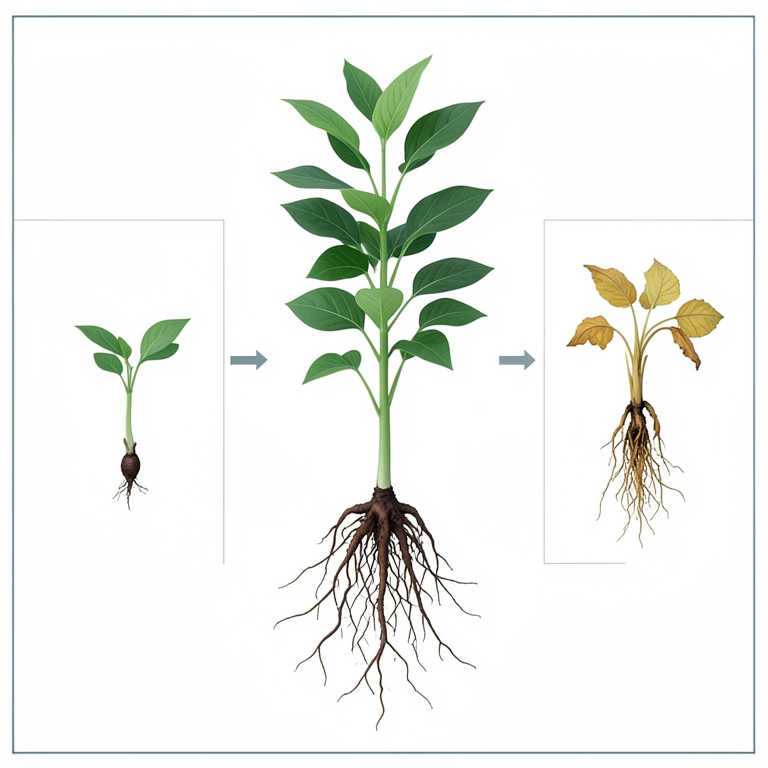
Hormetic Dose-Response Concept
AI-generated conceptual illustration (Mung bean (Vigna radiata) seedlings). It explains the idea and does not show study data.
View source evidence ↗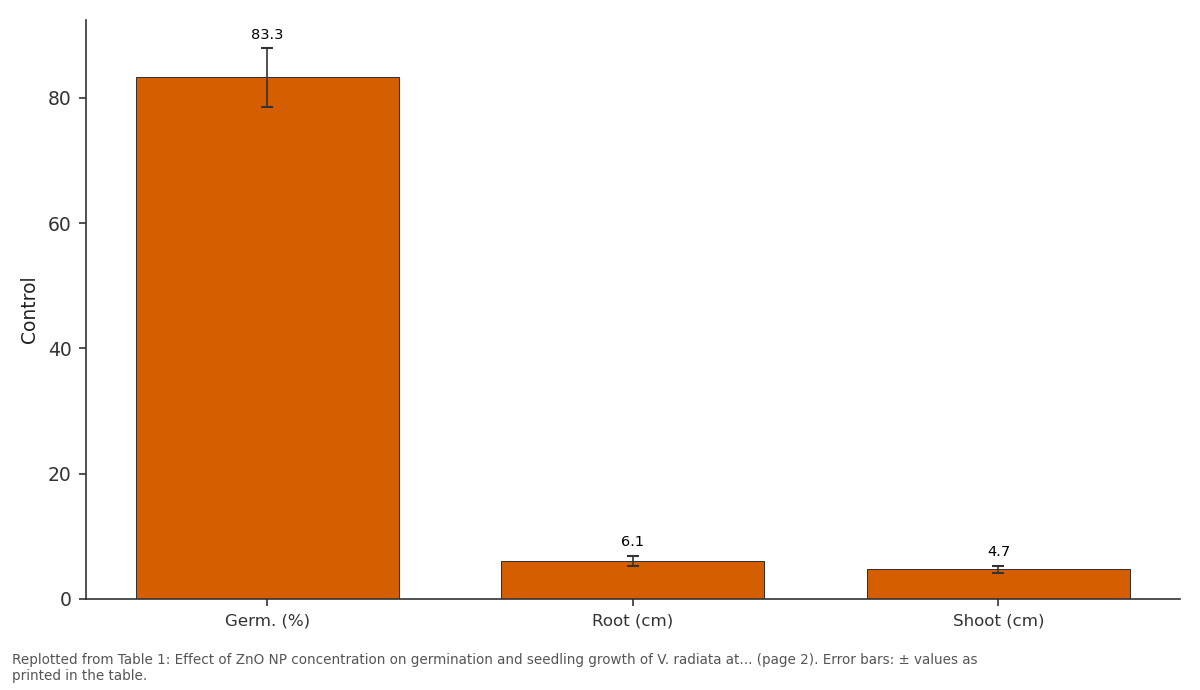
Control: Germ. (%) vs Root (cm) vs Shoot (cm)
Replotted from Table 1 (page 2) of the original paper. Every bar is the paper's own table value.
View source evidence ↗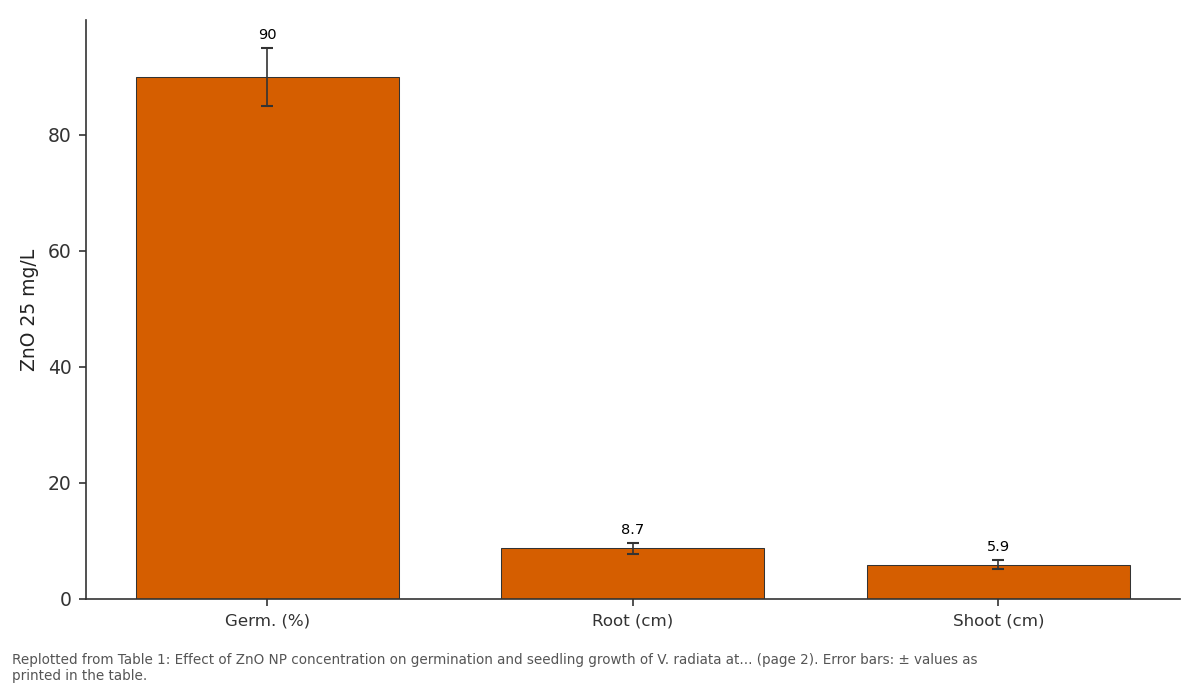
ZnO 25 mg/L: Germ. (%) vs Root (cm) vs Shoot (cm)
Replotted from Table 1 (page 2) of the original paper. Every bar is the paper's own table value.
View source evidence ↗Figures & tables
From the original paper Table 1
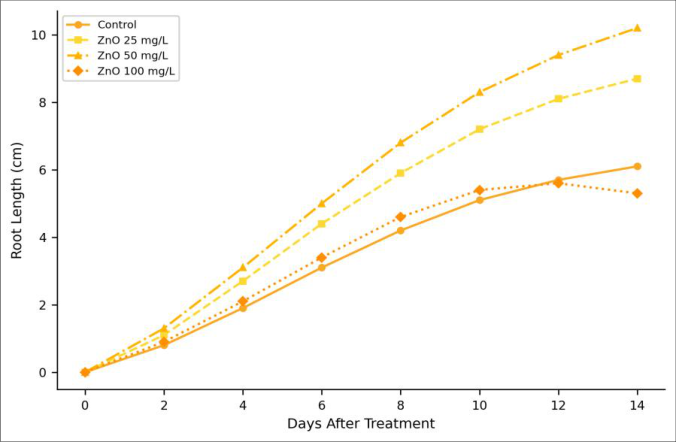 Figure 1
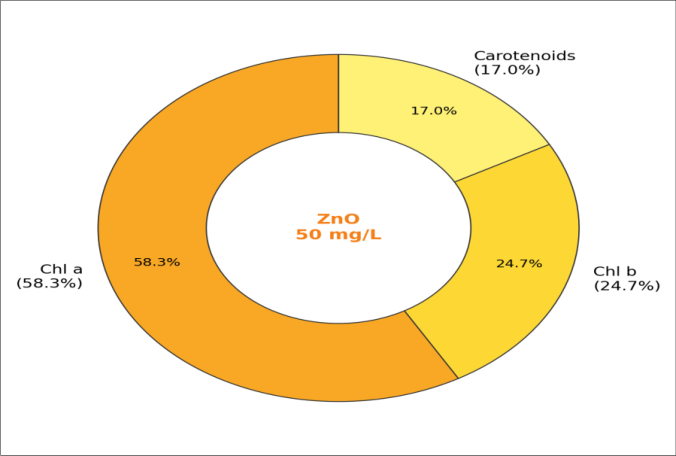 Figure 2
Introduction
Zinc is an essential micronutrient for plants, required as a cofactor in more than 300 enzymes involved in photosynthesis, auxin metabolism, and protein synthesis [1] . Yet zinc deficiency affects nearly half of the world's agricultural soils, especially in South and Southeast Asia, where calcareous and alkaline conditions lock zinc into insoluble forms [2] . Conventional zinc sulphate fertilizers have low use efficiency much of the applied zinc precipitates within days of soil application. Nanoparticulate ZnO, with its higher surface-to-volume ratio, may deliver zinc to plant roots more effectively and at lower total doses [3] . Green synthesis of metal oxide nanoparticles using plant extracts avoids toxic reducing agents and high-temperature calcination [4] . Neem (Azadirachta indica) leaf extract, rich in terpenoids and flavonoids, reduces zinc acetate to ZnO while capping the particles against aggregation [5] . The resulting nanoparticles carry a bio-organic coating that may improve compatibility with living systems. Vigna radiata is India's third most important pulse crop, with annual production around 2.5 million tonnes [6] . Its short growth cycle (60-75 days) and sensitivity to micronutrient status make it a good model for nanoparticle phytotoxicity and bio-stimulation studies. Previous work has tested chemically synthesized ZnO NPs on mung bean, but comparative data using green-synthesized particles which may behave differently because of their surface chemistry remain limited [7] . This research synthesized ZnO NPs from neem leaf extract, characterized them, and assessed their effects on V. radiata germination, root and shoot growth, and chlorophyll content at three concentrations over 14 days.
Safety Considerations
Nanoparticle suspensions were prepared and handled under a laminar airflow cabinet to prevent inhalation of dry powder. Zinc acetate solution was handled with nitrile gloves and eye protection. All nanoparticle waste was collected in sealed containers and sent for incineration through the university's environmental health office. No human or animal subjects were involved; no institutional ethics clearance was required [8] .
Material and Methods
Material and Methods
Material
All work was carried out at the Department of Botany and Plant Biotechnology, Siddhartha National Academy of Sciences, Hyderabad, from July 2022 to January 2023. Fresh neem leaves were collected from the campus garden, washed, and boiled in distilled water (20 g/100 mL) for 20 min. The filtrate was mixed with 0.1 M zinc acetate dihydrate solution (1:4 v/v) at 60°C for 2 h under constant stirring. The white precipitate was centrifuged (10,000 rpm, 15 min), washed twice with distilled water, and calcined at 400°C for 2 h [5] . V. radiata seeds (variety Samrat) were obtained from the Indian Institute of Pulses Research, Kanpur.
Methods
Nanoparticles were characterized by XRD (Rigaku MiniFlex 600, Cu Kα), TEM (JEOL JEM-2100, 200 kV), and UV-vis spectroscopy (Shimadzu UV-1800). Seeds were surface-sterilized with 0.1% HgCl₂ for 2 min, rinsed, and soaked in ZnO NP suspensions (0, 25, 50, or 100 mg/L) for 4 h. Ten seeds per Petri dish (three replicates per treatment) were placed on moist filter paper and kept in a growth chamber at 25±2°C, 12 h photoperiod, 70% RH. Germination was scored daily; root and shoot lengths were measured on days 7 and 14. Chlorophyll a, b, and carotenoids were extracted from leaves on day 14 with 80% acetone and quantified using Arnon's equations [9] . Zinc uptake in roots was measured by AAS (Varian AA240) after acid digestion [10] .
Statistical Analysis
Data were subjected to one-way ANOVA with Tukey's HSD post-hoc comparison at p<0.05. Growth curves were fitted by non-linear regression (Gompertz model) in R version 4.2. All values are reported as mean ±standard deviation of three biological replicates, each containing ten seeds [11] .
Results
Table The 50 mg/L treatment produced the best outcomes on every measure (Table 1). Germination reached 96.7%, and root length at day 14 was 10.2 cm 67% longer than control roots. But 100 mg/L reversed these gains: germination fell to 76.7%, below the control, and both root and shoot lengths were shorter. Chlorophyll a showed a similar pattern, peaking at 1.93 mg/g (50 mg/L) and dropping to 1.18 mg/g (100 mg/L). Growth curves (Figure 1) diverged sharply after day 4. The 50 mg/L treatment pulled ahead fastest, while the 100 mg/L line plateaued around day 10 and then appeared to decline slightly likely reflecting root-tip necrosis observed visually in that group. AAS showed that root zinc content rose from 34 µg/g (control) to 87 µg/g (50 mg/L) and 156 µg/g (100 mg/L), confirming dose-dependent uptake [12] . At 50 mg/L, chlorophyll a made up 58.3% of total pigments, chlorophyll b 24.7%, and carotenoids 17.0% (Figure 2). The Chl a/b ratio of 2.36 was slightly higher than the control (2.45 for control vs. 2.36 for 50 mg/L), suggesting zinc promoted chlorophyll b synthesis proportionally more consistent with enhanced light-harvesting complex assembly [9] .
| Treatment | Germ. (%) | Root (cm) | Shoot (cm) | Chl a (mg/g) | Chl b (mg/g) |
|---|---|---|---|---|---|
| Control | 83.3±4.7 | 6.1±0.8 | 4.7±0.6 | 1.42±0.11 | 0.58±0.06 |
| ZnO 25 mg/L | 90.0±5.0 | 8.7±0.9 | 5.9±0.7 | 1.71±0.13 | 0.69±0.07 |
| ZnO 50 mg/L | 96.7±2.9 | 10.2±1.1 | 6.7±0.8 | 1.93±0.14 | 0.82±0.08 |
| ZnO 100 mg/L | 76.7±5.8 | 5.3±0.7 | 4.1±0.5 | 1.18±0.10 | 0.47±0.05 |
Table text extracted from the original PDF; superscript letters are shown inline. The original table image is below.
View original table image
Discussion
The bell-shaped dose-response stimulation at low to moderate concentrations, inhibition at high ones is a textbook example of hormesis, well documented for metal oxide nanoparticles in plants [3] . At 25-50 mg/L, ZnO NPs supply zinc that activates carbonic anhydrase and tryptophan synthase, boosting photosynthesis and auxin production, which in turn drives root elongation [1] . Above 100 mg/L, excess intracellular Zn²⁺ disrupts mitochondrial electron transport, generates reactive oxygen species, and damages root meristems explaining the growth inhibition and slight root shortening observed [13] .
The green synthesis route may confer an advantage over chemically synthesized ZnO. The neem-derived capping layer slows dissolution, releasing Zn²⁺ more gradually and reducing the initial ionic shock [5] . Prasad and colleagues found that green-synthesized ZnO at 50 mg/L gave 20% better root growth in mung bean than commercial nanograde ZnO [7] . Our root-length increase at 50 mg/L sits in the upper range of published values, possibly due to the high crystallinity and narrow size distribution (28.4±4.1 nm by TEM) of our particles. Chlorophyll enhancement at moderate doses is consistent with zinc's role in protochlorophyllide reductase on the chlorophyll biosynthesis pathway [9] . The decline at 100 mg/L probably reflects oxidative damage to thylakoid membranes. We did not measure ROS or antioxidant enzyme activities; doing so would clarify the stress threshold. And Petri-dish assays exclude soil interactions nanoparticle behaviour in real soil, with its pH buffering and microbial community, may differ considerably [14] .
Conclusion:
Green-synthesized ZnO NPs at 50 mg/L improved germination, root and shoot growth, and chlorophyll content of V. radiata, while 100 mg/L was inhibitory. The dose-response fits a hormetic model, confirming that moderate zinc supplementation via nanoparticles stimulates early seedling development. The neem-capped particles are cheap and avoid hazardous reagents. Pot and field trials with soil application are needed before any agricultural recommendation can be made.
Acknowledgement
Acknowledgements Funding SourcesThis research received no specific external funding. Institutional SupportThe authors thank Siddhartha National Academy of Sciences, Hyderabad, for TEM and XRD instrumentation.
References
14 in the original paper- Broadley MR, White PJ, Hammond JP, Zelko I, Lux A. Zinc in plants. New Phytol. 2007;173(4):677-702.
- Cakmak I. Enrichment of cereal grains with zinc: agronomic or genetic biofortification? Plant Soil. 2008;302(1-2):1-17.
- Agathokleous E, Feng Z, Iavicoli I, Calabrese EJ. The two faces of nanomaterials: a quantification of hormesis in algae and plants. Environ Int. 2019;131:105044.
- Iravani S. Green synthesis of metal nanoparticles using plants. Green Chem. 2011;13(10):2638-2650.
- Bhuyan T, Mishra K, Khanuja M, Prasad R, Varma A. Biosynthesis of zinc oxide nanoparticles from Azadirachta indica for antibacterial and photocatalytic applications. Mater Sci Semicond Process. 2015;32:5561.
- Nair RM, Yang RY, Easdown WJ, Thavarajah D, Thavarajah P, Hughes JDA, et al. Biofortification of mungbean (Vigna radiata) as a whole food to enhance human health. J Sci Food Agric. 2013;93(8):1805-1813.
- Prasad TNVKV, Sudhakar P, Sreenivasulu Y, Latha P, Munaswamy V, Reddy KR, et al. Effect of nanoscale zinc oxide particles on the germination, growth and yield of peanut. J Plant Nutr. 2012;35(6):905-927.
- Oberdörster G, Oberdörster E, Oberdörster J. Nanotoxicology: an emerging discipline evolving from studies of ultrafine particles. Environ Health Perspect. 2005;113(7):823-839.
- Arnon DI. Copper enzymes in isolated chloroplasts: polyphenoloxidase in Beta vulgaris. Plant Physiol. 1949;24(1):1-15.
- APHA. Standard methods for the examination of water and wastewater. 23rd ed. American Public Health Association; 2017. p. 3111-3113.
- R Core Team. R: a language and environment for statistical computing. Vienna: R Foundation for Statistical Computing; 2022.
- Lin D, Xing B. Phytotoxicity of nanoparticles: inhibition of seed germination and root growth. Environ Pollut. 2007;150(2):243-250.
- Ma H, Williams PL, Diamond SA. Ecotoxicity of manufactured ZnO nanoparticles: a review. Environ Pollut. 2013;172:76-85.
- Dimkpa CO, McLean JE, Latta DE, Manangón E, Britt DW, Johnson WP, et al. CuO and ZnO nanoparticles: phytotoxicity, metal speciation, and induction of oxidative stress in sand-grown wheat. J Nanopart Res. 2012;14(9):1125.